Tag Archives: Library of Congress

Opening Day at Fenway

For everyone in New England (excluding pockets of Connecticut and Vermont where New York fans abound) and those regions of Red Sox nation beyond, tomorrow is an exciting day:  the opener at Fenway against the Yankees.  I always feel better knowing that baseball is on, even if I’m not watching.  And this is also an opportunity for me to showcase some really great photographs:  of the park but mostly of the players.

Fenway Park was built almost a century ago, in 1912, to replace the older Huntingdon Avenue Grounds.  A few years ago I wasn’t sure it would be standing for its centennial (it was placed on Preservation Massachusetts’s most endangered list in 1999) but its present owners seem committed to its preservation.  A century ago, it was the most modern of parks featuring all sorts of innovations for crowd accessibility and control:  reserved seating (with gold leaf lettering!), separate entrances for the bleacher, grandstand and pavilion seating (which some contemporaries feared was destroying the egalitarian sociability of baseball games).   I think of Fenway as the most intimate of stadiums, but at least one historian has noted that it and the other “modern” parks built just before World War I “standardized and depersonalized the sport while allowing more fans to see the game”, separated these same fans from the players, and “generally removed much of the previous informality”. (Robert  Bluthardt, “Fenway Park and the Golden Age of the Baseball Park, 1909-1915”, Journal of Popular Culture 21 (1987), a reference I owe to my SSU colleague Brad Austin) Still, Fenway is a far cry from the super stadiums of the later twentieth century, and for that I am grateful.

Some images of Fenway in its first few years (1912-14) from the Bain News Service archive at the Library of Congress; the last one features backup catcher Hick Cady who is so prominent in pictures from this era you would think he was Babe Ruth!

And now for some photographs of the old towne team in the same era.  From the collection of the Boston Public Library, photographs of the 1911 and 1912 Red Sox teams, the first on a down day in Los Angeles, the second in a (rather strange) diamond formation, and the third at the World Series of 1912.  The last photograph is a conventional roster shot of the 1913 team on a cigarette card from the New York Public Library.

The ability of the modern sports stadiums of the twentieth century, both early and late, to separate the players on the field from the fans in the stands must explain why I find the photographs of individual players (and managers) of the early century so particularly poignant.  The photographs below are from another archive in the Library of Congress:  a collection of photographs taken by Chicago Daily News photographers from 1902-33.  Among this collection are several of Boston Red Sox players at Comiskey Field.  Babe Ruth was there and is here, but the rest of the photographs I have chosen are of players (and one manager, Patsy Donovan) who are not quite as well-known:  after Patsy (1911), there is Harry Bartholomew Hooper (1912), Clarence “Tilly” Walker (1916) and Babe Ruth (1918).

I chose these particular photographs just because they seem so immediate and intimate.  Baseball players, politicians, average everyday people, it doesn’t matter:  people just seem to have a closer, more honest relationship with the camera in the earlier days of photography.  They are really there; look at Harry Hooper.

Baseball cards deserve another exclusive post, as they’re important forms of ephemera as well as cultural artifacts.  I’m going to include Harry Hooper’s card from 1912 here, however, just because of my particular fascination with him. 

Hooper is also an inspirational figure for the beginning of the season,  as he is the only player (SO FAR) to be a part of FOUR Red Sox World championship teams:  those of 1912, 1915, 1916, and 1918.


Something about Cherries

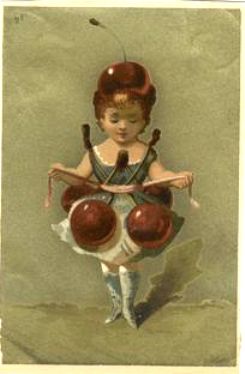
When you put Japan and America and Spring together you automatically get cherries, right?  I have these cards in my ephemera file (under “fruit people”, a surprisingly large category) and was never sure what to do with them or how to tie it them to anything I’ve been writing about, but then I realized (from the Library of Congress’s Today in History site) that this weekend marks the anniversary of the first planting of the Japanese cherry trees in Washington in 1912, so there you go.  I love the sentiment on the first card (Cheer Up!  Cherries are Ripe) and it is clear from the last two that cherries make everything better, even cough syrup.


At about the same time that drug and beverage companies were adding cherry flavor to their recipes (the first “organic” additive) thousands of Japanese cherry trees were planted in Washington. I’ve seen the spring cherry blossoms in Washington several times, and they are beautiful.  You would think that a gift of friendship from Japan to the United States would be a simple and somewhat spontaneous gesture but apparently it took some time to germinate.  The woman behind Washington’s cherry trees was Eliza Ruhamah Scidmore, one of many Americans who travelled to Japan during the Meiji Restoration, fell in love with its landscape and culture, and wanted to take something back home (I wrote about another here).  It took Miss Scidmore, a writer, photographer, and the first female board member of the National Geographic Society, several decades to bring about the planting of Japanese cherry trees in her native Washington.  The key moment came when she was able to convince First Lady Helen Herron Taft of this necessity, and on March 27, 1912 Mrs. Taft and the wife of the Japanese Ambassador planted two Yoshino cherry trees on the Potomoc River’s Tidal Basin bank, the first of over 3000 donated to the United States by Japan in that year.  In 1965, another 3800 trees were sent over by Japan, further identifying the American capital with cherry blossoms.

The Tidal Basin in the late 1920s, Theodor Horydczak photograph, Library of Congress

Crowning the Queen of the Cherry Blossoms (the daughter of the Japanese Ambassador) in 1937, Library of Congress


Miss Scidmore was not the only westerner entranced by Japanese cherry trees.  More locally, Charles Sprague Sargent, the first director of the Arnold Arboretum in Boston, employed intrepid “plant hunter” Ernest Henry Wilson to find just the right Asian cherry tree varieties for the park.  The two men are pictured below in 1915, before a flourishing specimen.  Salem’s famed horticulturist Robert Manning was also an admirer and cultivator of cherry trees, though more of the “English” variety (brought to England from the Continent by Henry VIII in the early sixteenth century) than the Asian ones.

Cherries from Robert Manning's Book of Fruits, 1838

Of course, the other reason why Miss Scidmore wanted cherry trees installed in Washington was their connection to its namesake, the first President.  All forms of popular culture from the period make it clear that Washington the man was inextricably intertwined with the cherry tree he cut down as a boy (thus revealing his truthful nature):  what better way to compensate for this mistake than by planting thousands of replacements in Washington the city?

Washington trade cards and Journal magazine cover from New York Public Library Digital Gallery; Washington cherry jell-o advertisement, Duke University Library Ad* Access Collection.


The Life of Lincoln

As this weekend marks Abraham Lincoln’s actual birthday, February 12 (as opposed to the consolidated “Presidents’ Day” which seems to be a holiday of convenience rather than commemoration) I sought out some images of his life in the vast collections of the Library of Congress.  In assembling these images, I  focused on his life as opposed to his death, as my initial impression is that many Lincolniana collections are rather macabrely-focused on the latter, constituting a “cult of remembrance” for the martyred President.  I’m more interested in the man than his death, but I did include a photograph of a late nineteenth-century Smithsonian exhibit featuring only Lincoln’s suit and hat.  The photograph of the President, Allan Pinkerton and General McClellan on the battlefield at Antietam in October of 1862 has been reproduced many times and is widely available, but I could not resist including it as it is such a striking image:  the iconic figure of Lincoln with other people.  He is so often alone.

My collection of images is organized chronologically, beginning with the first photograph of Lincoln as a newly elected congressman in 1846-47, through his presidency.  The two crowd photographs are from his first and second inaugurals in 1861 and 1865, and the last two images (oddly clothing-related) are from the later nineteenth century.

Photography credits:  all images but the last two from the Library of Congress Digital Collections; the remainder from the New York Public Library Digital Gallery.