Tag Archives: Library of Congress

No Poe?

The Library of Congress is currently running an exhibition (both digital and material) entitled Books That Shaped America as part of their multiyear “Celebration of the Book”.  There are 88 books in all, and the list is intended to provoke reading, thought, discussion, and additions:  According to the Librarian of Congress, James H. Billington, it is a “starting point… intended to spark a national conversation on books written by Americans that have influenced our lives, whether they appear on this initial list or not.” To contribute to this conversation, you can take a survey on the site. I have found myself thinking about the list quite a bit over the last week or so, and every time I make a mental case on why a certain book should be (or should not be) on the list I go to the exhibit website and read the Library’s rationale.

The books include classic examples of both nonfiction and fiction:  the former category includes several works of grammar, cookbooks, scientific books, and quite a few works which call for social reform, pretty understandable given the list’s focus on impact, influence, identity. There are several early primers, but twentieth-century textbooks do not make the grade.  Amelia Simmons’ American Cookery (1796) is on the list, along with Irma Rombauer’s Joy of Cooking (1931), but not Fannie Farmer’s Boston Cooking-School Cookbook (the first to use standardized measurements) or Julia Child’s The French Chef Cookbook (which really revolutionized the American palate, in my understanding).

A history of how-to:  The New England Primer (1802), The American Woman’s Home by Catharine Beecher and Harriet Beecher Stowe (1869) and Dale Carnegie’s incredibly influential How to Win Friends and Influence People (1936).

The fiction works seem more predictable:  lots of New England authors, I must say, including Salem’s own Nathaniel Hawthorne, Thoreau, Melville, Alcott, Dickinson.  Washington Irving is on the list, as is, of course, Mark Twain.  All the expected southern authors (with the exception of Flannery O’Connor) are included, and many major twentieth-century texts, from The Jungle to In Cold Blood.  The list also includes classic children’s books, including  The Wonderful Wizard of Oz (1900), Good Night Moon (1947), and Where the Wild Things Are (1973).

Forceful Fiction:  Washington Irving’s Legend of Sleepy Hollow (1820), L. Frank Baum’s Wonderful Wizard of Oz (1900), and J.D. Salinger’s Catcher in the Rye (1951).

Actually, I think that children’s literature is a bit over-represented as compared to other genres.  And I know I’m biased, but history seems under-represented, as well as economics (Sandburg’s Lincoln? Milton Friedman?).  As for fiction, I think I’ve figured out why works by James Fenimore Cooper and Edith Wharton were not included but why no Poe?  Certainly The Raven must be put on the list, at the very least.

Antonio Frasconi illustration for/of The Raven, 1959, in the current exhibition at the Brandywine River Museum: Picturing Poe: Illustrations for Edgar Allen Poe’s Stories and Poems.


Mourning in England and America

When I found the painting below, alternatively titled The Saltonstall Family, or Members of the Saltonstall Family, and painted by David Des Granges about 1636-37, I was immediately drawn to it for several reasons.  I teach several courses on this period, so I thought it would be very useful in illustrating the importance of family in Stuart England. And then there was the Salem connection:  the Saltonstalls were one of the founding families of Massachusetts and of Salem:  Nathaniel Salstonstall (1639-1707) was one of the judges in the witch trials and Leverett Saltonstall (1783-1845) was the city’s first mayor and later a U.S. representative. We have a Saltonstall School and a Saltonstall parkway.  However, a little genealogical research (I never like to engage in too much genealogy–it’s a tangled web) has convinced me that I don’t really have a Salem story:  the man in the painting is indeed Sir Richard Saltonstall, but he is not THE Sir Richard Salstonstall (1586-1661), who sailed up the Charles River in 1630 and became the founder of the Massachusetts Saltonstalls of later fame and fortune. This Sir Richard Saltonstall (1595-1650) never left England, and in the same year that the man who shared his name was exploring the New World he was losing his first wife, who is also pictured below, along with his second, and the children he had with both women.

David Des Granges, The Saltonstall Family, 1636-37.  Tate Museum, London.

This, then, is a mourning portrait, depicting the living and the dead, together:  a truly blended family!  Sir Richard is pictured alongside his dead first wife, Elizabeth Basse, who is pointing to their two surviving children, Richard (wearing a long skirt as was customary for English boys of a certain class until age 6 or 7) and Ann, who link hands with each other and with their father, demonstrating the bonds of family.  Sir Richard’s second wife, Mary Parker, is seated with their newborn child on the right, completing the framed family.

Though some might think it a little creepy to have a dead person in the picture (though certainly far less creepy than those Victorian photographs of the dearly departed), I think that this painting is a rather tender portrayal of remembrance. Sir Richard’s outstretched hand seems to be including everyone in his family, and reminding his children not to forget their mother.  Here mourning is about remembering the dead, rather than just dwelling on loss by putting something on–a dress, a ring, a brooch, an armband.  In terms of aesthetics, I have always admired the elegant American mourning paintings from the Federal period–usually painted on silk and with the requisite weeping willow taking center stage–but this earlier English example strikes me as far more personal, and poignant.

New England mourning paintings on silk from 1810, 1811 & 1815, Metropolitan Museum of Art, New York, and a D.W. Kellogg chromolithographic print of an 1825 painting, Library of Congress.


Salem and the War of 1812

On this day 200 years ago President James Madison declared war on Great Britain, commencing the War of 1812, a conflict that must have meant very different things to different people.  I imagine that Canadians viewed the War as an attempted land grab by upstart Americans and I know that the British viewed it as an annoyance by pesky Americans occurring when the far greater threat, Napoleon, deserved all of their attention.  As an English historian, I never really gave the War of 1812 much consideration, but living here in Salem one can’t help but see its lasting impact.  The people of Salem in particular, and coastal New England in general, were bitterly opposed to the War, nearly to the point of secession.  They believed that it would spell the end of their commercial ascendancy, and they were right.

Salem and other ports up and down the Eastern seaboard had already suffered from the policies of the preceding Jefferson administration, most notably the Embargo Act of 1807, and Madison’s war was seen as a continuation of these anti-commercial (and anti-American?) policies.  One of the most often-cited causes of the War, the impressment of thousands of American seamen by the British Navy, apparently did not rally Salem to the cause, if this 1813 Salem Gazette article is any indication.

I’ve cropped a much larger document from the Library of Congress; it’s difficult to read from the scan, but this article consists of two comparative columns regarding the fates of “Impressed Seamen from Salem” (their parentheses, not mine):  the official story and then “the facts”, which seem to conclude that the seamen in question were simply deserters or otherwise unaccounted for.  This article is implicitly (explicitly?) accusing the US government of perpetuating a hoax on its citizenry in order to rationalize war with Britain, an accusation that doesn’t seem very extreme if you examine the words and deeds of Salem’s opposition Federalist party over the previous decade.  Salem’s leading Federalist was the eminent Timothy Pickering (1745-1829), former Secretary of State, Secretary of War, Senator and current Congressman, pictured below in a contemporary caricature of the Hartford Convention, comprising the New England opposition to the War. Kneeling before King George III in the center, Pickering is given the words:  I, strongly and most fervently pray for the success of this great leap which will change my vulgar name into that of my Lord of Essex. God Save the King.  No wonder that he and his associates were accused of being “Blue-Light Federalists”,  traitors who signalled to British ships with blue lights from the New England shores.  The Federalist Party would never recover from that accusation, in Salem or elsewhere.

Besides political opposition, the other major role played by Salemites during the War of 1812 was that of more proactive privateering.  Captain George Coggeshall’s History of the American Privateers and Letters-of-Marque during our War with England in the Years 1812, ’13, and ’14 (1844) is full of the exploits of Salem privateering vessels, including the Polly, the Snowbird, the Buckskin, the Montgomery, the John, the Revenge, the Dolphin, and the justly-famous Fame.  I particularly liked this passage about the Dolphin which Coggeshall culled from the Salem Gazette:  the privateer Dolphin, after a successful cruise of 20 days, returned to Salem on the 23rd of July.  The Dolphin has taken six prizes without receiving the smallest injury.  She was reportedly chased by the English at one time for 24 hours, but finally escaped. She has treated her prisoners with the greatest kindness. In rowing away from men-of-war, she found great aid from their voluntary assistance.  The prisoners said they had much rather go to America than return aboard a British man-of-war.”  The Fame had similar success before her shipwreck in 1814, and a reproduction Fame has been embarking on cruises around Salem Harbor for nearly a decade.  Her Captain, Michael Rutstein, has recently published an illustrated history of Salem privateers entitled The Privateering Stroke:  Salem’s Privateers in the War of 1812.

George Ropes, The Launching of the Ship Fame, 1802. Courtesy Peabody Essex Museum, Salem.

Ultimately what become known as the War of 1812 ended in a draw in 1814, with lessons learned on both sides.  For the Americans, I think the most important lesson was:  it’s not enough to just grow or sell things, we’ve got to MAKE things (like Great Britain).  So Salem’s commercial heyday was over, but its industrial era was just about to begin.

John Archibald Woodside, We Owe Allegiance to No Crown, 1814:  part of the current exhibition at the National Portrait Gallery:  1812A Nation Emerges.


Zouaves

This poster for the Watch City Festival this weekend in Waltham, a very happening city to the west of us, caught my eye not only because of its fetching image but also because of its reference to the Salem Zouaves, a reference I’ve seen quite a few times in these past few months.  Who or what are the Salem Zouaves, you may ask, a question I’ve been asking myself.  I think I’m going to use this post to try to figure them out.

It’s not too difficult to figure out who the Salem Zouaves are here in the present:  a reenactment group who “recreate the exotic, flashy drill and uniforms of the original Salem Zouaves, including our signature bayonet and sabre fencing.”  But who were the original exotic Salem Zouaves?  Apparently they were a Civil War incarnation of the Salem Light Infantry, and among the first responders to President Lincoln’s call for volunteer militias to defend the capital after hostilities broke out in April of 1861.  They were attached to the 8th Massachusetts Regiment, and spent several months guarding Old Ironsides in Baltimore Harbor before returning home.  I doubt that their sabres or bayonets left their sides. This is hardly heroic service deserving of reenactment 150 years later:  what’s the rest of the story?

I suspect the secret of the Zouaves’ appeal, then and now, lies more in their exuberance than their service.  They looked and acted in a dramatic, romantic, even theatrical fashion, and thus captured the imagination of those who wanted to believe that war was glorious.  The mid-19th century Zouave craze was inspired by the dashing exploits of French soldiers in north Africa who adapted the native attire for their own uniforms before and after the Crimean War (1853-56), which was the first war to be documented extensively by “foreign correspondents” for the major western newspapers, along with photographers like Roger Fenton, who had himself photographed as a Zouave on the front.  The majority of his striking Crimean photographs, including his famous “Valley of the Shadow of Death” can be accessed through the Library of Congress.

Roger Fenton in the Crimea, 1855 (Library of Congress) and a mid-nineteenth-century print of French Zouaves (New York Public Library Digital Gallery).

Roger Fenton did not want to offend early Victorian sensibilities by showing pictures of the dead and wounded, so the contemporary image of the Crimean War that emerged was one of dashing exploits in an exotic locale, symbolized succinctly by the Zouaves.  In America, several voluntary militia companies–still very much in existence after their colonial foundation–transformed themselves into Zouave regiments.  The key figure in the transformation of Salem’s Light Infantry into the Salem Zouaves was clearly Arthur Forrester Devereux, the son of a prosperous Salem family who became commander of the Infantry in 1859.  In his early career, Devereux lived in Chicago, where he became a close associate of the founder of the American Zouave movement, Elmer Ellsworth, a close associate of Abraham Lincoln who would also be the first casualty/martyr of the Civil War (in the process of taking down a confederate flag in Alexandria, Virginia spied from the White House).  Devereux seems to have been more fascinated by the precision drill tactics of the Zouaves than their uniforms, but his company was well-outfitted just the same.  Pictorial envelopes of the era, one of my very favorite visual sources for the Civil War, emphasize both Zouave distinctions:  they stand out among other regional regiments on the first postcard (the Salem Zouaves are #6, at right), and are able to deftly jump confederate cannonballs in one minute and form a human hanging post in the next!

I’m having a hard time reconciling these printed exploits with the reality of the war; the very existence of the dashing Zouaves seems to point to a clash between war expectations and experience. Harem pants just don’t seem to fit into my perception of the Civil War!  And we have seen that the Salem Zouaves did not last long nor did they see any real action:  though Arthur Devereux certainly did, commanding the 19th Massachusetts Regiment at Gettysburg. Perhaps the Salem company is not representative:  there were regiments like the 114th Pennsylvania and the famous 5th New York Volunteer Infantry of Abram Duryée that were thoroughly, and heroically engaged.

The 114th Pennsylvania at Brandy Station, Pennsylvania, in April, 1864 (Library of Congress); the 5th New York Voluntary Infantry in Virginia in the winter of 1862-63 as drawn by wartime illustrator Edwin Forbes (New York Public Library Digital Gallery).

Despite the service of the brave men in these companies, it’s still difficult for me to see the American Zouave movement as much more than fashionable , a perception that is reinforced by contemporary images such as those below:  a page from Godey’s Lady Book (of all places!!!) illustrating the new Zouave jacket in 1860, and Thomas Nast’s 1862 painting The Young Zouave.  But I could be wrong.


Leaping Ladies

I don’t know about the supposedly “medieval” custom of ladies proposing to their fellows on Leap Days; it sounds like another example of what cultural historians call the invention of tradition to me.  As stated again and again (especially on the internet), the “Ladies’ Privilege” dates from either the future St. Patrick’s dialogue with the future St. Bridget in the fifth century, or a Scottish Act of Parliament in the thirteenth century.  In the Tudor-Stuart period that I study, I have found a few references to this odd day out, a day that doesn’t quite fit on the calendar, and one on which unusual things may occur, notably in the 1600 play The Maydes Metamorphosis, which contains the couplet Master be contented, this is leape year, Women wear breetches, petticoats are deare.

Actually there’s a long tradition of turning-the-tables in western culture:  lords of misrule, charivari, the “world turned upside down”, festivals.  Probably in other cultures too.  So I think the irregularity of leap day became equated with a day when women wore the pants, obviously an equally unnatural occurrence.  Not only do we have the Mayd’s Metamorphosis rhyme, but two images from several centuries later, both of which clearly express not-so-subtle political (King George IV wearing a dress) and social (bloomers!) sentiments.

George Cruikshank, A Leap Year Drawing Room, or the Pleasures of Petticoat Government, 1820. British Cartoon Prints Collection, Library of Congress.

Bloomers for Leap Year, Harper's New Monthly Magazine, 1852. New York Public Library Digital Gallery.

The cartoons above are critical caricatures, but women acting like men could also be entertainment, as very literally illustrated by this 1896 poster for the Forepaugh & Sells Brothers Combined Circus (from the Library of Congress), featuring “”the leap year ladies of laughter” and  “the only clown women who wear the comic crown”.

As far as I can tell, it is not until after the turn of the century, when we enter into a “golden age” for postcards, that we see the almost-exclusive association of Leap Year and the Ladies’ Privilege.  Rather than “new women” pushing the boundaries, we see desperate women chasing men pictured on penny postcards.  So many of these ephemeral items survived that they must have been manufactured by the ton, particularly in the leap years 1908 and 1912. After World War I, it was a different story.  There are some lovely, wistful women, but also a lot of unattractive and old maids, doing anything to catch a man on that special leap day.  Here is just a small selection of some random but (I think) representative samples, starting with some relatively mild examples from 1904 and then proceeding t0 the heady year of 1908 (popping ladies, man in a mousetrap).

And one postcard from 1912, another leap year that produced a mountain of cards portraying women in pursuit of men, and this one, which brings us back to who wears the pants.


Little Bits of Lincolniana

I hate Presidents’ Day; it obscures the achievements of those individual presidents which it claims to recognize.  We should celebrate, or at least remember, the birthdays of Abraham Lincoln and George Washington even if we do not have the day off from work. Today is Lincoln’s birthday, and for the occasion I’ve assembled some scraps of paper which bear witness to his personal life more than his presidential one (but ultimately they become inseparable).  There is a vast sea of Lincolniana, and this was just my way of navigating through it.

The clever little “business card” of young lawyer Lincoln, and the Cotillion Party for which he is listed as a “manager” (I suppose this is the equivalent of today’s “sponsor”), along with a certain Mr. Todd.  As that is his future wife’s maiden name, I like to think that he met Mary Todd at this party, though I could be wrong.  These items, as well as the four images below, come from the William E. Barton Lincoln Collection at the University of Chicago. Because they are quite charming, I’ve included some digitized exhibition labels from the Lincoln Centennial as well as the records.

The Marriage License of Abraham Lincoln and Mary Todd, the last bit of a letter from Abraham to Mary written while he was serving in Congress in Washington:  the majority of it is about money, indicating that Mary’s reputation as a spendthrift is well-deserved, and he closes with “kiss and love the dear rascals” referring to their boys.  A check for $5 to Tad, one of the rascals.

The items above are all from the Alfred Whital Stern Collection of Lincolniana at the Library of Congress:  a dance card from Lincoln’s first inaugural ball, a Union envelope from the Civil War, a Massachusetts Republican ticket for the election of 1864, and a mourning ribbon for Lincoln from later 1865.  All manner of ribbons survive, as everyone must have worn one; this is a particularly fancy one, I think.


Up, Up and Away

Today is Jules Verne’s birthday, and as I’ve been engaged in putting together a steampunk-themed exhibition and event at the Salem Athenaeum and have hot air balloons on the brain, I thought I’d share some of my favorite images of the balloon craze of the later nineteenth century.  Even though hot air balloons were invented in the later eighteenth century, they really picked up steam a century later due in large part to the enormous popularity of Verne’s “Voyages Extraordinaires”,  beginning with the publication of Cinq Semaines en Ballon (Five Weeks in a Balloon) in 1863.  The Balloon became the most accessible and emblematic of Verne’s fantastic wayfaring machines, and started to show up in all sorts of places.


Frontpieces to early Hetzel editions of Jules Verne’s collected Voyages Extraordinaires.

In addition to Verne’s texts, one of the very best places to look for early balloon images of all types is in the Tissandier collection at the Library of Congress.  Gaston and Albert Tissandier were balloon enthusiasts, collectors, and contemporaries of Jules Verne’s, and the Library of Congress purchased their 400+ item collection in the 1930s.  Here are the two balloonist brothers in the 1880s: as you can see, shortly after balloons captured the public’s imagination, airships of all kinds began to appear.  Anything was possible in the air.

A rather arbitrary sampling of the Tissandier collection is below:  Gaston and some journalist companions passed out due to lack of oxygen after their balloon Zénith reached a record height of 28,000 feet over Paris in April of 1875, an advertisement for balloon rides over Paris from the 1880s, and a photograph of several balloons within the newly-built Eiffel Tower at the Paris Exhibition of 1889.

In France, ballooning clearly became an art form, both the activity itself and its graphic depictions, as well as an expression of patriotism.  I love the print by Camille Grávis below, with a clockface balloon flying over the Eiffel Tower; it dates from the 1890s and exemplifies the time and place so well. Then we have a tricolor balloon and a fleet of balloons, all bearing the tricolor.

The next step was to remove the basket altogether and attach the balloon, or balloons, directly to a person, or to a horse, or to a person on a horse, or perhaps to a bicycle on its way to the moon.  Nothing was impossible; no place was unreachable–in the worlds of Jules Verne.

Throughout the western world, the motif of the hot air balloon infiltrates nearly every manifestation of popular culture  in the later nineteenth century:  advertising, entertainment, political satire, housewares, clothing, and ultimately moving pictures as well as still ones. I could post about balloon shows, women balloonists, politicians depicted as balloons (not a stretch for late nineteenth-century cartoonists), balloon wallpaper and fabric, balloon-view maps, and all the different types of balloon ephemera. Certainly the actual balloonists–the Montgolfiers in the eighteenth century, the Tissandiers in the nineteenth, and all of their followers–are responsible for this infiltration, but so too was Verne. It’s no accident that the pioneering 1902 Georges Méliès film Voyage dans la lune (of Hugo fame) was inspired by Verne’s earlier story From the Earth to the Moon.  At that point in time, Verne was nearing the end of his long and prolific life, and already recognized as a “prophet” of the new century.


Calendar Girls

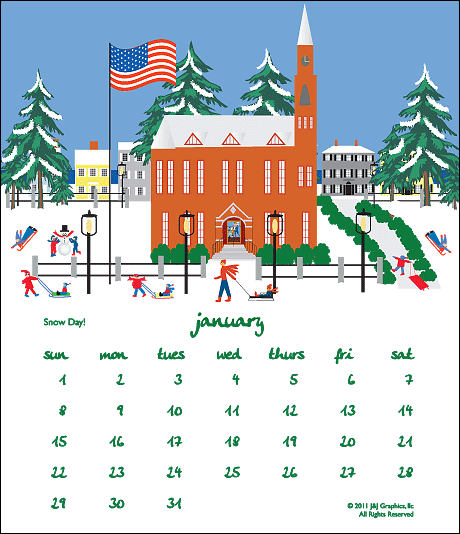
I’m a bit late for a calendar post, but then again I always buy my calendars after January 1st–sometimes well after January 1st.  While I’m not likely to engage in consistent sale-shopping or coupon-clipping, for some reason I get great pleasure from buying my annual calendars after they have gone on sale.  We usually purchase a “North Shore Folk Art” calendar from J & J Graphics at the Peabody Essex Museum shop for our refrigerator, and sometimes I even wait until they have their big January sale (this year it’s on the weekend of the 20th-22nd, definitely worth a visit if you’re in our area).  I’ll post January right here so I know what the date is until I get my own.

Upstairs in my office I generally pick something a bit more girly, whimsical, botanical, historical..whatever catches my eye.  Right now I’m liking this ethereal calendar from Irena Sophia, already on sale on Etsy!  I like the September and October girls–and Miss foxy February.

Calendars are an important form of ephemera that I haven’t featured on the blog yet, so why not now?  At the same time, they are among the timeliest and most artistic of genres.  And like all the pieces of paper we’ve examined over the last year–postcards, trade cards, book plates–they emerged as a mass-produced product in the later nineteenth century, coincidentally with the development of chromolithography.  I love the calendars from the “Penfield era”, from about 1890 to 1920, when the distinctive designs of illustrator Edward Penfield (1866-1925) graced the covers of magazines and the pages of the new poster calendars much more than those that came later with their Vargas-inspired pin-ups.  My “calendar girls” kept their clothes on!

Penfield calendars for 1897 and 1906 from the Library of Congress, above, and the work of some of his predecessors below (so you can see what an impression he made on turn-of-the-century graphic design):  an 1876 advertisement calendar for cigars and champagne, and two calendars by Boston-era publishers, also from the Library of Congress.

Calendars from Penfield’s fellow art nouveau illustrators  Louis Rhead (for Prang) and A.B. Wenzell for 1897 and 1899 are below, along with another rather less-artistic 1907 Boston calendar, for the beloved Necco wafers, all from the New York Public Library.


Armistice Day

As the enormity of loss in the Civil War created Memorial Day, the traumatic experience of World War One, the “Great War”, led to Armistice Day, celebrated in Great Britain and the Commonwealth countries as “Remembrance Day” and in the US as Veterans Day after 1954.  Remembrance Day is marked by a two-minute collective silence, at the eleventh hour of the eleventh day of the eleventh month, and the placement of poppies, representing both blood (death) and life in Flanders’ fields.

I can understand why Armistice Day was changed to Veterans’ Day in the United States, as the term “Armistice” specifically refers to World War I and a more general name was needed for the national holiday after World War II and the Korean War.  But the wars of the first half of the twentieth century were “total wars” demanding contributions and sacrifice on the part of the entire population, so I think I prefer the even more-inclusive “Remembrance Day”.  The posters below, from 1917-1918 and the Library of Congress, illustrate how the home front supported the war front during the Great War.

Eat less, waste nothing, fill in for the boys, buy war bonds and stamps; even children had their part to play:

The Food Will Win the War message/mission must have been a drumbeat, enforced by ration cards like the examples below.  The second card is from the impressive archive of local collector and historian Nelson Dionne.

Mr. Dionne also sent along this amazing photographic collage by commercial photographer Leland Tilford of the new draftees of Salem leaving for the war, so determined. Many of these young men would be dead within a few years, either from the conflict itself or from some disease contracted on the field, in the trenches, or in a military hospital.  When browsing through the Report of the Commission on Massachusetts’ Part in the World War, Part II:  The Gold Star Record of Massachusetts (1929), it was immediately apparent just how many soldiers from Salem (over half the casualties I surveyed) died from an unidentified “disease”, most likely the deadly post-war flu pandemic.

When the soldiers of the Great War returned, if they returned, it was to a grateful nation, parades, and the first national programs for veterans.  Unfortunately, the Great War was only the first World War, and as the twentieth century produced more wars and more veterans, Armistice Day evolved into Veterans Day, a day of reflection and remembrance.

Scenes from a post-war world:  Department of Labor poster and “Back to the Farm” (with a prostheses) exhibit, 1918-1919 (Library of Congress) and an Armistice Day parade on Tremont Street in Boston, 1929 (Boston Public Library).


End-of-Summer Gardens

I love muted tones in gardens anyway, so late summer gardens are just my thing.  Here are some photographs of two very different gardens:  my own humble garden and those of Glen Magna Farms in Danvers, the summer home of Salem’s Derby Family.  I was in this part of Danvers (originally called Salem Village) yesterday, getting some images for upcoming posts on the Witch Trials (beware:  next week is a very important week in the history of the Trials), and so I took a detour to Glen Magna.  Though the property came into the Derby family in 1812, the estate as it exists today is largely the vision of Ellen Peabody Endicott, a Derby descendant who significantly expanded and redesigned the house and its gardens after 1892.  Her grandson moved Samuel McIntire’s magnificent summer house (1793) from Salem to Danvers in 1901.

My garden:  including a close-up of a squirrel (I think it’s the same one) who climbs up and down a dogwood tree all day long knocking off and burying its red berries.

And now for the magnificent Glen Magna:  the house, Mrs. Endicott by John Singer Sargent (1901), McIntire’s summer house, and surrounding gardens.

Ellen Peabody Endicott by John Singer Sargent, 1901

Second Floor Interior of Derby Summer House, HABS, Library of Congress, 1960