Tag Archives: House of the Seven Gables

Two Nights in Salem

As you might imagine, my teenage stepson is not at all sympathetic to my I don’t want to see tacky & exploitative witchcraft “attractions” attitude in October so we have ventured downtown for the last couple of nights.The weather has been warm but rainy so there weren’t that many people milling about but we did avoid the more commercial sites. I think I first took him to the Salem Witch “Museum” when he was six or seven and he thought it was ridiculous then; so he has no desire to return now, thankfully. On Thursday night we went to a few shops on the way to one of the Peabody Essex Museum’s monthly themed PEM/PM evenings, which are always great.This month’s theme was “Moon Landing”, in reference to their brand new exhibition “Lunar Attraction”, which is just the kind of multi-media, multi-genre, multi-era, and multi-perspective presentation that I always enjoy. We spent a lot of time watching the colorized version of Georges Méliès’ A Trip to the Moon (1902) that was playing continuously, but I found many of the exhibit items almost as captivating.

two-nights-pem

two-nights-to-the-moon

two-nights-melies

two-nights-vaca

two-nights-2-the-moon

two-nights-rabbit

two-nights-holyoke-eclipse

The Peabody Essex Museum on Thursday evening past: atrium and “Lunar Attraction” exhibits, including screen shots from A Trip to the Moon; Beth Hoeckel’s “Campground” collage from her ongoing series “Point of View”; Scott Listfield’s “To the Moon”, 2004, a Japanese moon rabit, and Edward Holyoke’s ink illustration of a solar eclipse, 1713.

On our way over to the Museum we stopped in at the Salem Arts Association, where there were works both timeless and ephemeral and seasonal-macabre, some more witty than others. I liked these little coffins in the window and a “Vampire Test”mirror; my stepson liked a map of the United States divided into regions which have Waffle Houses and regions which do not.That came home with us.

two-night-arts-2

two-nights-arts

On Friday night, before the deluge we had later and the PBS documentary on the making of Hamilton, we went to the House of the Seven Gables for one of their seasonal experiences, “Legend of the Hanging Judge”, in which actors play out different roles relating to the witch trials in the rooms of Nathaniel Hawthorne’s birthplace: the author himself was in residence, consumed with guilt, as his ancestor is the title character. The one good thing about Salem’s crass commercial Halloween tourism is that it gets tourists through the doors of real museums like the Gables, although I fear out-of-town sausage sellers make more money.

two-nights-gables-at-night

The Gables at Night. I can never get a good night shot–was trying for the contrast of garden and house and this is the best I could do!


Genealogical Houses

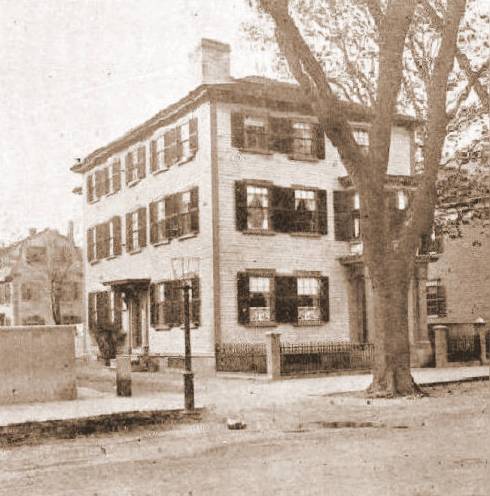
The practice and study of genealogy is supposed to be about people of course, but some of the genealogical tomes that I have consulted over the years seem to be almost as interested in houses, both family homesteads and the impressive residences of offspring. I’m not over-familiar with genealogical literature (I like a bit more context in my history), so I’m not sure whether this is a unique feature of Salem genealogies or not but many of the nineteenth-century histories of Salem’s venerable families feature plates of houses as well as portraits of the family members who lived in them. The best example, by far, is the weighty genealogy of the Pickering family and its many branches: The Pickering genealogy : being an account of the first three generations of the Pickering family of Salem, Mass., and of the descendants of John and Sarah (Burrill) Pickering, of the third generation by Harrison Ellery and Charles Pickering Bowditch, published in three volumes in 1897. The first volume is a veritable treasure trove of Pickering houses, most of which are still with us, others long gone. The second and third volumes follow the family through the nineteenth century and include lots of photographic portraits but few houses, as if to say we’ve built our houses for generations in true Yankee fashion–or perhaps we don’t like Victorian architecture. It seems to me as if the houses are presented as part of the foundation of the family, its very rootedness, as well as its thrift.

Pickering Houses no longer standing:

Diman House Pickering Genealogy

Haraden House Charter Street

Goodhue House

The James Diman House on Hardy Street, the Jonathan Haraden House on Charter Street, and the Benjamin Goodhue House at 403 Essex Street (I’m not sure of the dates of demolition of any of these houses, but I assume the Goodhue house was consumed by the Great Salem Fire of 1914).

Pickering Houses still standing, with the exception of the Phippen House, all in the vicinity of upper Essex and Chestnut Streets:

Clarke House Pickering Genealogy

Clarke House

Silsbee House Pickering Genealogy

Silsbee House

Cabot House Pickering Genealogy

Cabot House

Barnard House

Pickering Houses

Phippen House 1782

Phippen House

The Clarke, Silsbee, and Barnard Houses on Essex Street, the Pickering double house on Chestnut, and the Phippen House on Hardy and the grounds of the House of the Seven Gables Settlement Association.


The Gables Garden

I was fortunate to be at the House of the Seven Gables on this past Thursday, which really felt the first day of Spring in Salem: sunny, breezy, glorious. The Gables garden is always lovely, but on this day it looked stunning, and Mrs. Emmerton’s favorite lilacs and the wisteria arbor hadn’t even popped yet! The setting helps–the stark buildings of the Gables campus and Salem Harbor make perfect backdrops–but I think the structure makes this garden: I’m a sucker for raised beds and diagonal paths. This was the essential design that architect Joseph Everett Chandler laid out during the Gables’ restoration/recreation at the beginning of the twentieth century, although this structure seems overwhelmed by vibrant plantings in the many “garden view” postcards of the House published in the first half of the twentieth century. In any case, the garden is much more the creation of noted landscape architect and Salem native (and lifelong resident) Daniel J. Foley, a 1935 graduate of the University of Massachusetts who went on to become the editor of Horticulture magazine, the author of scores of books and articles on various aspect of gardening, a broadcaster, and long-time steward of the Gables garden, which is a living memorial to his life and work. From the 1960s, Foley enhanced the structure of the garden with mature boxwoods, and reinforced its colonial ambiance with period plants. In several of his writings, Foley reveals the inspiration that “old Salem gardens” had on his craft and his career: when I first began to explore the plant realm, I remember a visit I made one warm afternoon in June was to an old Salem garden where sweet William and foxgloves, delphiniums and Canterbury bells, ferns and sweet rocket and a host of other plants flourished in a series of meandering borders (1933). This is exactly the sense of time and place that pervades the Gables garden today.

Gardens at Gables 1900

Gables Garden 1950s PC

Gables Garden Dan Foley

The Gables Garden c. 1900, before Chandler’s raised beds, and in the 1950s, before Mr. Foley’s stewardship; Mr. Foley in a 1955 photograph and the first of  his bestselling garden books–this one seems to have been constantly in print for over 20 years!

And the garden on this past Thursday:  tulips just going out, lilacs just coming in, wisteria arbor, amazing Solomon’s Seal which the camera can’t quite capture……

Gables Garden 7

Gables Garden 10

Gables Garden 6

Gables Garden 1

Gables Garden 8

The house and the view of the garden from the house, resident cat, on the way out…

Gables Garden 4

Gables Garden 2

Gables Garden Cat

Gables Garden 5

Gables Garden 3


Considering Caroline

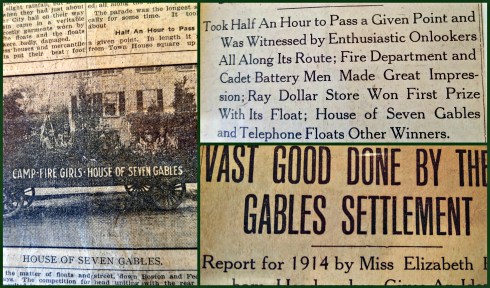
The House of the Seven Gables is featuring a new exhibit on its founder, Caroline O. Emmerton (1866-1942) in commemoration of the sesquicentennial of her birth and as the rather mysterious Caroline has long intrigued me I took advantage of a preview invitation to check it out even before the official opening. Despite her fortunate birth into one of Salem’s wealthiest and most philanthropic families, her connections, and her achievements, Caroline is a bit enigmatic, and I was hoping that Caroline Emmerton. An Unbounded Vision would shed new light on her for me. It did, but my suspicion that Caroline can only really be known in context rather than strictly on her own was confirmed. The exhibit actually presents Caroline in several contexts and it is through these perspectives that we come to know her: the wealth, privileges, and sense of civic duty that came to her through her family, her interest in the emerging Settlement Movement, with its aims of aiding and assimilating (or “Americanizing”) the country’s expanding immigrant communities, and the corresponding Preservation Movement, which aimed to preserve the pre-industrial past in an era of dynamic change. You can definitely perceive how Salem shaped her. The exhibit appropriately emphasizes Caroline’s settlement activities over her preservation goals but you certainly get the sense that they are going to merge with the formation of the House of the Seven Gables Settlement Association in 1910.

Gables Exhibition

Gables 2

Gables 4.jpg

Gables Panels 2

Gables Panels

Gables 10

Caroline Emmerton: an Unbounded Vision, at the House of the Seven Gables through August 31: A young Caroline and a very famous photograph of her with children at the Settlement House c. 1920; Exhibition panels, which were also produced in Spanish (a 21st-century update on Caroline’s settlement goals).

Gables 13

Gables 3Gables Scrap Collage

Context, context: the Gables in the Community. Great photograph of a Derby Street factory and worker, instructing neighborhood girls in the Settlement House kitchen; newspaper clippings from a Gables scrapbook.

So the context was definitely there but what about the personal Caroline? There was a sense of her in the exhibit, actually: a photograph of her home on Essex Street (with a wallpaper sample and a few household possessions), a range of photographs of her at different stages in her life, an original notepaper version of her (very ye Olde) tour for the Gables, and my favorite, the hand-written manuscript of her book Chronicle of Three Old Houses, which she published in 1935 for the 25th anniversary of the Gables. It was lovely to see these things, and also to talk with Irene Axelrod, the former Research Librarian of the Phillips Library of the Peabody Essex Museum, who knows more about Caroline than anyone else. I asked Irene where Caroline went to school, because in my experience institutions often offer up lots of evidence, and she said that Caroline was tutored at home and then probably went on the Grand Tour. So there goes that source. Irene told me that her research forayed into oral history, and she was able to interview some (quite old) people that actually knew Caroline. So that’s about as close as I’m going to get, I think: four degrees of separation?

Gables 12

Gables Emmerton Handwriting

LOVE this handwritten manuscript of Caroline’s Chronicles of Three Old Houses complete with little intextual illustrations! The companion book to the exhibition by David Moffat features a full-page view, along with lots of other illustrations from the Gables archives, sources, and more context.


Hawthorne’s Homes and Haunts

In the later nineteenth century there emerged a particular genre of topical nonfiction writing which focused on literary “shrines”, and Nathaniel Hawthorne received lots of attention from its practitioners. There were several periodical articles and books published with variant titles in the “Homes and Haunts of Hawthorne” realm, exploring the role of environment on his works with varying degrees of depth. As he was a native son, obviously Salem plays a central role in these analyses, generally as an urban and conversely puritanical place from which he wanted to escape to Concord and pastoral points west. No doubt all these authors were inspired by Hawthorne himself, not just his works but also his (quite self-conscious) words, written in 1840 about a garret room in his uncle’s house on Herbert Street where he spent quite a bit of time: Here I sit in my old accustomed chamber, where I used to sit in days gone by….Here I have written many tales–many that have been burned to ashes, many, doubtless, that deserved the same fate….If ever I should have a biographer, he ought to make mention of this chamber in my memoirs, because so much of my lonely youth was wasted here, and here my mind and character were formed.  All of the Hawthorne biographers did indeed make their way to the stark Herbert Street house (which Hawthorne later described as “Castle Dismal”) and it is interesting to see its comparative depictions. Winfield S. Nevins calls it a “severely plain”, common, though tidy, tenement house in his 1894 article in The New England Magazine, while Helen Archibald Clarke goes much more negative in her 1926 book, Hawthorne’s Country: It is now a tenement house, into which one does not care to intrude farther than the yard, so untidy that no amount of enthusiasm for shrines can blind one to it. When asking the way to the house, one is apt to be met by the reply: ‘I cannot speak English’. It is a comfort to remember that in Hawthorne’s day the district was not so closely built up [YES IT WAS],and was at least quiet and clean, and that however unlovely the lines of the house, the beach and boundless ocean were not far off.  Well, you can tell that she is going to prefer Concord to Salem!

Hawthorne Collage

Sepia drawings of Hawthorne’s birthplace, then on Union Street, now on the campus of the House of the Seven Gables, and the adjacent rear window of 10 Herbert Street from  W.B. Closson’s Homes and Haunts of the Poets, a series of etchings issued by Prang in 1886, and a photograph of the same buildings from Winfield S. Nevins’ “Homes and Haunts of Hawthorne” from New England Magazine (15) 1894.

Both authors include lots of illustrations in their works, including drawings, prints and photographs, but Nevins wants to portray a past Salem for the most part, devoid of people, while Clarke lets us see some 1926 inhabitants in the Witch City: children are prominently placed on Gallows Hill, even though it is not exactly clear what this site has to do with Hawthorne. The time span between the two texts affords us to see the restoration (or creation) of the House of the Seven Gables, never the home of Hawthorne but perpetually his most conspicuous Salem “haunt”.

Homes and Haunts Dearborn

Hawthorne Homes and Haunts Chestnut

Hawthorne Houses Mall Street

Hawthorne Homes and Haunts Custom House Clarke

Hawthorne Homes and Haunts Main

hawthornescountr00claruoft_0133p

Gables collage

Hawthorne Homes and Haunts Gables2

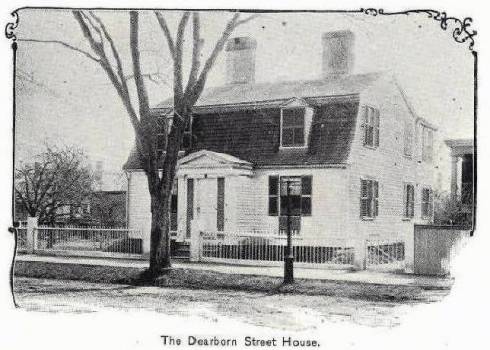
Photographs of Hawthorne’s Dearborn and Chestnut Street residences, along with the Turner-Ingersoll House before its transformation into the House of the Seven Gables (on the left above) from Winfield S. Nevins’ 1894 article, “The Homes and Haunts of Hawthorne”; photographs of the Mall Street house, the Customs House, a view towards Washington Square, the “Sockets” of Gallows Hill, and the House of the Seven Gables from Helen Archibald Clarke’s Hawthorne’s Country (1926).


The Wayfaring Chapel

To stick with cinema for just a bit, I’ve always believed that those in Salem who favor the maritime over the witchcraft in terms of tourism focus are handicapped a bit because Salem was not a whaling port like New Bedford. Merchants are simply not as dashing and courageous as whalers; there is no Hawthornian equivalent of Moby Dick. When I think of the latter, I must admit that images from the 1956 film come to mind much more quickly and vividly than detailed passages from the 1851 book, and the very first image that comes to mind is the passionate preaching of Father Mapple (Orson Welles) from that amazing pulpit shaped like the bow of a ship in a seamen’s chapel, or Bethel, packed with mariners. Both the preacher and the place were based on reality; in the case of the former, the “Mariner’s Preacher” of the Boston Bethel, Edward Thompson Taylor, and the Bethel was based on that of New Bedford, which is still standing (its original pulpit was not the elaborate one depicted in the film, but a similar one constructed to satisfy the tourists who made their way to New Bedford in increasing numbers due to the popularity of the film–a version of Salem’s Samantha statue).

Bethel

Bethel Collage

Orson Welles in John Huston’s Moby Dick (1956); The New Bedford Bethel or “Whaleman’s Chapel”, exterior and interior.

Like nearly every seaport of a certain size, Salem had a Seamen’s Bethel too, but it was a wandering one. It clearly existed in the early part of the nineteenth century (there is an extant sign, and several references to a chapel at the head of Phillips Wharf), but was reincarnated later on. The French Catholic parish, St. Joseph’s, purchased an old Bethel on Herbert Street in 1873, and then it turns up in two locations on Turner Street: first right on the water in the House of the Seven Gables’ front yard, and then alongside it on the street. A large bequest by Captain Henry Barr funded the construction of this later building in 1890-91, but a decade later newspapers across the country were commenting on Salem’s fading maritime glory, testified to by the fact there were simply not enough sailors in Salem to attend services in this new Bethel; consequently the YMCA took over the building in 1911. By the 1920s it was moved to another location on Turner Street to accommodate the expanding House of Seven Gables Settlement Association, and by the 1930s it was gone. The last picture of the Bethel below, taken by the Boston-based architectural photographer Leon Abdalian in 1929, was probably more notable for the blimp than the Bethel at the time!

Seamen's Bethel Salem on Water

Bethel on Turner

The Salem Seamen’s Bethel, 1914 and 1929, Boston Public Library.


Ephemera-esque

At the end of last semester, one of my students gave me a beautiful card with what looked like a vintage (1920s-1940s) lithograph of the House of the Seven Gables. I just loved it–not just the sentiment inside, but also the image outside, which looked vaguely familiar, but I couldn’t quite place it. So I went right to the producer, Lantern Press, and found a treasure trove of images in all forms (cards, posters, souvenirs of all sorts), some actual reproductions of vintage lithographs, some “vintage-esque”: travel posters, crate labels, old postcards, lots of maps, both regional and global in content and perspective. Very accessible ephemera with no need to get your hands dirty hunting through flea market boxes: you can even get one of the oldest Salem Witch postcards in the form of a refrigerator magnet (if you must).

Some old, some new: a few examples from Lantern Press’s inventory of images:

Lantern Press Gables Card Cover

Lantern Press Golf

Lantern Press Umbrella Card

Lantern Press Blue Ridge Parkway

Lantern Press Capes


A Storied Salem House

Over the several years that I’ve been writing this blog, I’ve been trying to ascertain both the history and the imagery of as many seventeenth-century Salem houses as possible in a rather sporadic manner. All the famous houses (the House of the Seven Gables, the Jonathan Corwin “Witch” House, the Pickering House) are easy: well-documented in terms of both literary and photographic evidence. Other houses–both those that still stand and those that are long-lost–are more elusive, so when I run into obstacles I leave them alone for a while. I’m interested in these houses for several reasons beyond basic appreciation: as an early modern English historian walking around this New English city the seventeenth-century structures are an accessible window into the past that I study, I’ve been rereading (and reading for the first time in many cases) Hawthorne over the past few years, and I like to imagine the Salem of his time, when there were far more standing first-period buildings, and lastly, I like photographs that show architectural and urban transition, and those that show leaning wooden multi-gabled buildings adjacent to stalwart stone multi-storied structures are particularly striking.

One very elusive house that I’ve been chasing for some time is (or was) the Deliverance Parkman House, which was built near what is now the corner of North and Essex Streets (right across from the Witch House) around 1673 and taken down by 1835, according to Cousins’ and Riley’s Colonial Architecture of Salem: long enough for Hawthorne to see it, but not quite long enough for it to be photographed, so no striking contrast picture. Nevertheless, or perhaps because of this lack of realistic imagery, the house–or any remaining perception of it–is cast in a rather romantic light: Hawthorne refers to it twice (in his “Notes” and the short story “Peter Goldthwaite’s Treasure”) in relation to the practice of alchemy and buried treasure within: what could be more alluring than that? The only image that I can find of the Parkman House was made by Salem illustrator J.L. Bridgman about 1900–and clearly based on Hawthorne’s characterization. As in the case of the House of the Seven Gables, the Deliverance Parkman house seems to have inspired Nathaniel Hawthorne to “create” a storied house.

Deliverance Parkman House Bridgman

Deliverance Parkman House stereoview

Essex Street Salem c 1915

L.J. Bridgman sketch of the Deliverance Parkman House, individually and in stereo (NYPL Digital Collections); one block of Essex Street in 1915, long after the Parkman House was razed, to be replaced by the brick Greek Revival Shepard block, rear right.


Mary Harrod Northend

I’m not bound to such designations, but as we’re almost running out of Women’s History Month and our mayor has declared March 29 Salem Women’s History Day I’ve decided to feature a notable Salem woman on this last weekend in March. After much deliberation–as there are many notable women in Salem’s history–I’ve settled on the author and entrepreneur Mary Harrod Northend (1850-1926). She has interested me for some time, and she’s popped up in several posts in the past, but she deserves her own. Northend was from old, old Massachusetts families on both sides, and this heritage is key to her life and work. Both parents were actually from northern Essex County, but moved south after their marriage: her father, William Dummer Northend, became a prominent attorney and a state senator for Salem. Mary was born at 17 Beckford Street, a side-to-street late Federal house, but the family moved over to Lynde Street, in the shadow of the Federal Street courthouses, in the later 1850s. Their grand Italianate double house, photographed for Mary’s books later, is now sadly chopped into 12 apartments by my count. The few biographical details I could gather refer to a childhood sickness; in fact by all accounts (or by no accounts) Mary led a quiet life in her childhood and adulthood, until she burst out in her 50s and started writing all about colonial Salem and colonial New England, necessitating regional travel, which she clearly embraced. Eleven books were published between 1904 and 1926, when she died in Salem from complications sustained from a car accident, and many, many articles for magazines such as Good Housekeeping, The Century and The House Beautiful: I haven’t had time to compile a proper bibliography. But she was an incredibly prolific woman: an acknowledged expert on New England architecture and antiquities, with a touch of Martha Stewart-esque domestic stature as well, forged by her publications on decorating and party-planning. Let us, she writes in a very Martha tone in The Art of Home Decoration: link the old and the new, working out entrancing combinations that are ideal, making our home joyous and bright through the right utilizing of great grandmother’s hoard.

Northend Birthplace Beckford Street Salem

Northend 1862 Portrait

Mary Harrod Northend’s birthplace at 17 Beckford Street, Salem; her father William Dummer Northend, newly-elected State Senator from Salem, 1862, State Library of Massachusetts.

Her books and articles reveal Mary to be a fierce advocate for “Old-time” New England; she is at the forefront of that (second?) generation of strident Colonial Revivalists, fearful that the (changing) world around them hasn’t developed proper appreciation for colonial architecture and material culture. She is evangelical in her love of clapboards, mantles, arches, doorways, garden ornaments, pewter and seamless glass. The phrase “detail-oriented” doesn’t even come close to capturing Mary’s appreciation of the things that were built and made in the colonial past: these things are her life and her world. And like any good educator–which she was–Mary wanted her (growing) audience to see her world and so she spared no expense when it came to photography, first taking her own photographs and then “directing” commercial photographers in the manner of a cinematographer, according to Mary N. Woods’ Beyond the Architect’s Eye: Photographs and the American Built Environment (2011). The end result was a vast collection of still images (there are 6000 glass plate negatives in the collection of Historic New England alone, though the entry in the biographical dictionary Who’s Who in New England for 1915 indicates that Mary has “20,000 negatives and prints of American homes”) which she used to illustrate her own books, sold to other architectural writers, and colorized in the style of  Wallace Nutting to sell directly to the public.

Northend Historic Homes 1914

Northend Doorways 1926

Northend Cook Oliver

Northend Framed Photo Cook Oliver

Two of Northend’s most popular titles, Historic Homes of New England (1914) and Historic Doorways of Old Salem (1926); the Cook-Oliver House on Federal Street in Salem, featured in Historic Homes and sold as an individual colorized print, “The Half Open Door”.

It’s relatively easy to research the work of Mary Harrod Northend: her books are still readily available in both print and digital form and prints from her photographic collection are at Historic New England and the Winterthur Library. But I wish I knew more about her business, the business of publishing books and photographs, writing, lecturing, collecting. I’m also curious about money: there’s definitely a bit of voyeurism in Northend’s books and I can’t discern why she remained in the family home on busy Lynde Street rather than move to the McIntire District just a few blocks away. In one of her most personal, yet still fictionalized, books, Memories of Old Salem: Drawn from the Letters of a Great-Grandmother (1917), the great-grandmother in the title lives on Chestnut Street, but Mary never did. This might have been a family matter: her widowed mother and sister lived right next door in the Italianate double house, which was also an appropriate “stage” for some of her photographs. I also think it was quite likely that Miss Northend was seldom at her own home, as she was so busy documenting those of others!

A very random sampling of Mary Harrod Northend photographs, mostly from Historic Homes and Colonial Homes and their Furnishing (1912), all from the Winterthur Digital Collections:

northend-gables-door1

Northend 10 Chestnut Door

Northend Robinson House Summer Street

Three very different Salem houses:  doorway at the House of the Seven Gables, entrance of 10 Chestnut, side view of the Robinson House on Summer Street.

Northend Pewter Mantle

Northend Waters House Mantle

Northend Mantles

Salem mantles: a pewter display, McIntire mantle at the Waters House (LOVE this louvred fire screen), Whipple and Pickman mantles.

Northend 29 Washington Square Hallway

Northend Ropes Windowseat

Northend Saltonstall House Haverhill Hall

Northend Kittredge House Yarmouth Remodeled Farmhouses Cape

Northend Bright House Beds

Details & decor I love:  hallway of 29 Washington Square, Salem, Ropes Mansion windowseat, entry hall at Saltonstall House, Haverhill, Attic and twin canopy beds on the Cape (from Remodeled Farmhouses, 1915–but all of Miss Northend’s books feature canopied beds! I would place them headboard to headboard.)

Northend Kate Sanborn House Spinning Wheel

Northend House Winterthur

Flagrant displays of Colonial Revivalism: Spinning wheel and fire buckets at the Kate Sanborn House, and Miss Northend’s own house on Lynde Street, all dressed up for Spring.


Mid-Century Colonial

I have recently discovered the work of prolific Boston-area photographer Arthur Griffin (1903-2001), who was the exclusive photographer for the Boston Globe Rotogravure Magazine and photojournalist for Life and Time magazines for a good part of the twentieth century. There’s an entire museum in Winchester, Massachusetts dedicated to his work, and thousands of images have been digitized at the Digital Commonwealth. Griffin was a pioneer in the use of color film, but I love his black-and-white but still very bright pictures of Salem in the 1940s and 1950s because they depict a place that was decidedly not Witch City. There’s not a witch to be found in his photographs of the perfect Pickering House, the various house museums of the then-Essex Institute (now Peabody Essex Museum) and the House of the Seven Gables: instead we see well-dressed tourists and guides garbed, for the most part, in “colonial” dress. I always like to see occasions of colonial dress-up, and these photographs depict a decidedly mid-century display.

Griffen 1

Griffen 2

Griffen 2a

Griffen 3

Griffen 5

Griffen 4

Griffin7

Griffen 6

Visiting the Pickering House; Pioneer Village with the extant Arbella; the Retire Becket House at the House of the Seven Gables; inspecting the hearth and bed hangings at the John Ward House; a nice shot of the Solomon Chaplin House on Monroe Street.