
My contribution to Thanksgiving next week at my brother’s house will be Indian Pudding, which I have made many times in years past, always with variant recipes. As we are getting into the holidays, my general plan is to avoid some of the more serious topics here on the blog in favor of food, decorations, and traditions, but as I started looking into the history of this pudding, a dish that was always around and which I always took for granted, I started getting into some material that was not light, fluffy, and cheery. Indian Pudding is more complex than I thought! The general story is one of colonial New Englanders missing their old English puddings, and substituting “Indian” corn meal out of necessity, but this is too simple a tale: you can also connect this native pudding to the French and Indian Wars, the inventive expat Count Rumford, slavery and abolition, vegetarianism, and “Yankee” thrift. It’s more American than Apple pie.

 An advertisement for Durgin Park in Boston, which always featured Indian Pudding and closed just this year, from Historic New England, and a typical “old New England” recipe card featuring IP (not one of my recipes—I’m egg-phobic so I always bake the eggless varieties).
The Oxford English Dictionary lists a 1722 cookbook as the first source of the phrase “Indian Pudding”, but the first reference I could find was not in a cookbook, but rather in “Indian Pete” Williamson’s “memoir” French and Indian Cruelty, exemplified in the Life and various Vicissitudes of Fortune of Peter Williamson, who was carried off from Aberdeen in his Infancy and sold as a slave in Pennsylvania (York, 1757). This is a sensational and suspect source, in which Williamson ascribes all sorts of barbaric behavior to the “savages” of North America, including cannibalism and the concoction of “Indian Puddings” out of their British victims. Published in the midst of the French and Indian War (which was the North American theater of the Seven Years War) this was lurid propaganda, but the reference pops up in several other North American “descriptions” later in the century before disappearing (thankfully). Much more influential was Benjamin Thompson, Count Rumford’s recipe for “wholesome” and cheap Indian pudding, prescribed as a beneficial food for the European poor in his Essays, political, economical, and philosophical (1796). Thompson, Massachusetts Loyalist, accused spy, and accomplished inventor (who served an apprenticeship in Salem) achieved fame, fortune, and title in Britain and Bavaria, but always seems a bit sentimental about his native land. He devotes quite a few pages to Indian Pudding, describing its benefits, providing a recipe (with American variations) and even giving directions on how to eat it.


Back in America, Indian Pudding was a staple in all the cookbooks issued from the later eighteenth century well into the twentieth–as far as I could tell: I checked in with a sample about every twenty years. There are notable variations: boiled or baked, plain or fancy, eggs or no eggs, savory or sweet, all sorts of additions in terms of spices, berries, and nuts. The pudding becomes progressively sweet in the early nineteenth century, presumably as it is moving from breakfast porridge to dessert, but then there is a reduction of sweetness in the later nineteenth century, as it was featured as an economical and “healthy” food, and a favorite dessert of vegetarians. In between, there is an amazing abolitionist argument put forward by Nathan Bangs in his Emancipation, its necessity and means of accomplishment : Calmly submitted to the Citizens of the United States (1849) in which he associates rice pudding with the perpetuation of slavery and Indian Pudding, “the good old food of New England” with freedom! (This argument does seem to discount the sugar and molasses in “Yankee” Indian Pudding).
Indian Pudding was already “old” in 1849 and became older still—definitely out of fashion in the later nineteenth century except for working families and housewives more concerned with thrift than show. The Colonial Revival movement put it back on the table, especially the Thanksgiving table, for “old-fashioned” holiday meals at the beginning of the twentieth century. And after that, I’m not sure what happens to Indian Pudding: I guess it depends on the family, and the region. It is included in all of the cookbooks which were labeled American in the twentieth century, but that might be more for custom than utility: I have a feeling that pies prevail.
t


I don’t think this unhappy family (in the American Agriculturist, 1894) is pondering pudding, but the juxtaposition is amusing; Anna Wells Morrison’s “Colonial Thanksgiving” menu in the 1902 Delineator features “Indian Meal Pudding”; Jeri Quinzio’s Pudding is part of the Edible Series at the University of Chicago Press.


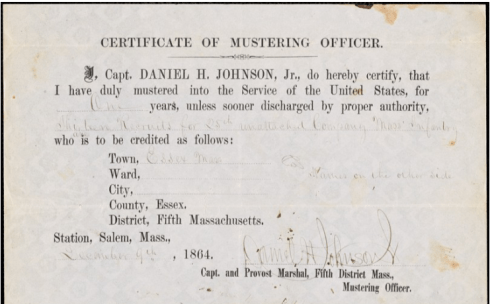 Recruiting posters from 1861-1863, New York Historical Society via New York Heritage; Town of Essex Civil War records, 1864 via Digital Commonwealth.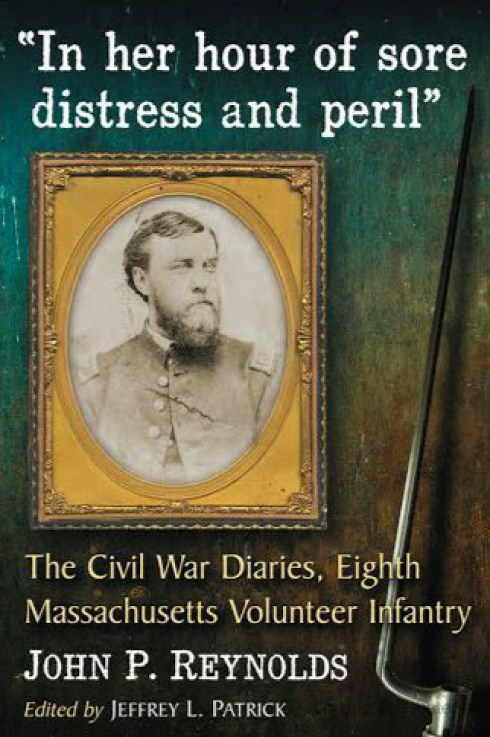

 Valentine’s Virginia vignettes, 1863-64, National Archives.

 Library Company of Philadelphia and Richard Frajola.
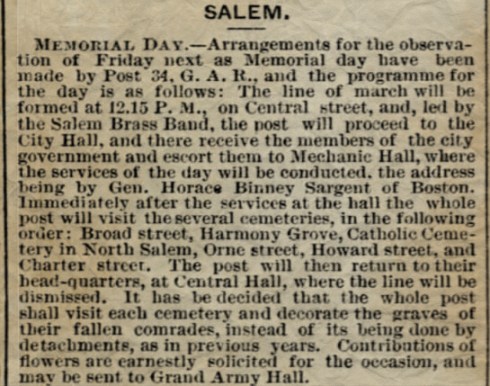

 The evolution of Memorial Day: C.H. Webber outfits participants for the occasion, Salem Register, May 19, 1870; Boston Globe May 1873, 1923, and 1944: the last GAR members in Massachusetts, including Thomas A. Corson of Salem, who died later that year at age 103.

 Essex Register
 The taproom of the Buckman Tavern, where Elijah Sanderson fell asleep by the fire; early 19th century view of the Battle of Lexington, New York Public Library Digital Collections.


 So interesting that this 1844 Polk Print (Library of Congress) mirrors the “Landsdowne” Portrait of George Washington from 1796: National Portrait Gallery, Smithsonian Institution.
 Two abolitionist “Moral Maps” which illustrate fears of the spread of slavery in the United States and North America, 1847-1854, Cornell and Yale University Libraries.
 Salem Register, July 5, 1847


 French silk New Years’ postcards for 1918 and 1919 featuring the Allied flags, Europeana; Xavier Sager and Santa planting the American flag on the North Pole postcards, 1919, Delcampe.net; Santa’s gift of peace poster by the U.S. Food Administration, Library of Congress; Rudolph Ruzicka holiday card for 1918-1919, Harvard.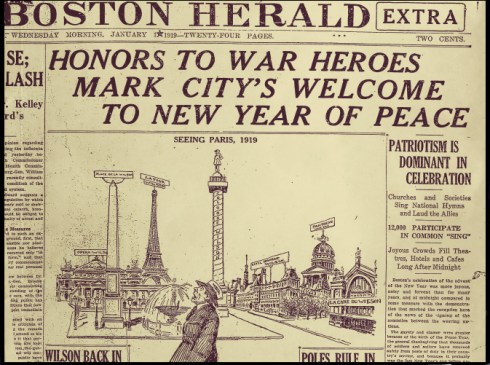


 Library of Congress & National Museum of American History.




 From the brand new Hawthorne’s birthplace sign to the House of the Seven Gables, and then back to Herbert Street and “the house that Hawthorne hated” via Derby Street and the Custom House.


 The Captain William Lane House (with such a cheery laundry/mudroom! and decorated by Mr. Frank Bergmann who trims (other meaning) all my shrubs and trees; the Josiah Getchell House and the Thomas Magoun House along Derby Street–all absolutely charming.


 I’m just obsessed with the staircases now–two very different ones, from the Brookhouse Home (1810-11) and the Ives-Webb-Whipple House (by 1760). More from the latter–one of my favorite houses in Salem which is now for


 The very festive Brookhouse Home and very serene St. Nicholas Russian Orthodox Church, on Forrester Street.






