Tag Archives: Historic Preservation

Rocks Village

We have had the longest stretch of horrible humid weather in my memory: it’s been hot too, but it’s the humidity that gets you, of course. The only place I’ve really been comfortable is my car, and so when I drove up to Maine for vacation last week I took a diverted and long route to get there by giving myself a silly challenge: I had to cross the two rivers on my way–the Merrimack and the Piscataqua–on bridges that I had never traversed before. Going out of the way is one of my favorite things to do so this was a characteristic challenge. I can only do it when I’m on my own, as my husband has no patience for meandering, but he and I had conflicting obligations last week so we were in separate cars (the key to a happy marriage for us). My challenge turned a trip that normally takes one hour into a four-hour excursion (with stops along the way) and I was able to arrive in Maine just in time for cocktails on the porch. My route took me slightly west to Haverhill in Massachusetts and then northeast through New Hampshire to Dover: I had crossed the big bridges in both of those cities but not the smaller ones, over the Merrimack from West Newbury to Rocks Village in Haverhill and over the Piscataqua from Dover to South Berwick, Maine. I think I have probably been on both of these bridges but not for quite some time, so they still count! Going further west and north would have been a bit silly, even for me. I braked for darling houses, of course, and found my first cluster right over the bridge in Rocks Village, a colonial village in East Haverhill right on the river. Situated at a nexus of old roads leading to and along the Merrimack, Rocks Village emerged as a center of trade and industry in the eighteenth century but was bypassed as Haverhill became a bustling industrial center in the nineteenth. It has a slightly lost-in-time feeling about it, even though the owners of its charming houses are clearly keeping up appearances.

Rocks Village 7

Rocks Village 8

Rocks Village 6

Rocks Village

Rocks Village 14

Rocks Village 13

Rocks Village 9

Rocks Village 12

Rocks Village 11

Rocks Village 10

Rocks Village 3

Rocks Village 5

Rocks Village 1

Rocks Village 4

Right over the bridge from West Newbury you encounter the old tollbooth and the village Hand Tub House (for which the Rocks Village Memorial Association is raising restoration funds) and then all these wonderful houses. This is not an exhaustive portfolio, but my favorite is the last one above: interesting proportions, though you can’t tell from my photograph that it’s a saltbox. There’s a lot more to see in Haverhill but this village seems like a place apart: indeed, you can’t even find it on any of the maps of the bustling nineteenth-century city, which emphasize factories above all. After some leisurely searching, I finally found it on a map of the Newburys, dating from just about the time of the construction of the Hand Tub House.

Rocks Village Newburys MapRocks Village and Bridge on the 1831 map of the newly-divided Newburys (Newbury, Newburyport & West Newbury), Leventhal Map Center, Boston Public Library.


A Huddle of Houses

Last weekend we were up in New Hampshire again as I continued my search for the perfect white antique 3-bedroom (maybe four, no more!) summer house. I was pretty fixated on Tamworth last summer; this summer I’ve decided to explore other regions of the Granite State. Even though my husband may be accompanying me, he’s not really engaging in the search: as he said to me after we found the perfect cottage in Jaffrey (see below): we have an old house that we have to take care of in Salem, why would we buy an old vacation house that we have to take care of when we are on vacation? Well, he has a point, but still, I press on. This Jaffrey house was on a road of perfect white houses leading to a pond with Mount Monadnock in the distance. I got so excited (by the houses, not the pond or the mountain) that my husband quite literally left me on the side of the road (“you should be alone”) and drove off for a bit, returning to find me in front of the cottage with several other people who had stopped to admire it. And here it is:

Huddle 1

Huddle 2

Huddle 3Palpitations.

Yes, I trespassed. But only after a couple in a convertible stopped and did so first! The house is empty, and the next-door neighbor came over and told us all about it, including the “amazing” terraced gardens which once descended down the hill. I saw the remnants—or maybe I should say the outlines— of those gardens, which of course put me in even more of a state of frenzy as there is nothing more engaging than the ghost of a garden. It’s a beautiful property; I’m sure someone has snapped it up already–let me just check. Ummm….not yet (as of 8/2/18). And here are more lovely white houses, in pristine condition, on the same road as what I now know to be the Benjamin Robinson Cottage, and also a few from the neighboring town of Hancock, which is very charming. I had originally titled the post a row of white houses, but then when I decided to include the Hancock houses that did not quite work, so I searched for another collective noun for houses and came up with huddle, which seems perfect.

The road to the cottage (and Thorndike Pond), Jaffrey:

Huddle Thorndike

Huddle Thorndike 6

Huddle Thorndike 7

Huddle Thorndike 8

Huddle THorndike 9

Huddle Thorndike 5

Huddle Thorndike 4

Huddle Thorndike 2

In Hancock:

Huddle 6

Huddle 5

Huddle 8

Huddle 4Can you believe this amazing DOUBLE HOUSE!!!!!!


A Viking Ship, Two Black Hats, and One Special Street

Despite the fact that I am a middle-aged woman rather than an adolescent boy, I was absolutely determined to see the reproduction Viking ship Draken Harald Hårfagre as it sailed into Plymouth Harbor yesterday. Plymouth is just one of the stops on the ship’s east coast tour, and it was the most convenient for me in terms of time and geography, so down to the South Shore I went. It was a humid day and all was gray as we waited for a pending storm and the ship, which slid into Plymouth Harbor very gracefully. I had hoped to see it under sail, but of course that wasn’t going to happen in the wide, calm harbor. You (and I) will have to see it under sail here. I always enjoy seeing the juxtaposition of “old” and new vessels; of course Plymouth has that all the time with the Mayflower II in the harbor—but the Draken is so much more “alien”.

Plymouth Adventure 15

Plymouth Adventure 2

Plymouth Adventure 20

Plymouth Adventure 3

Plymouth Adventure 4

Plymouth Adventure 5

Well, that’s it for the ship (which will be in port until Friday evening and then it’s going down the coast). Both before and after its arrival I occupied myself in my usual way: looking at old houses and comparing Plymouth to Salem as a tourist destination and purveyor of local history. Even though they are very different places, I can’t help making comparisons between these two New England ports, put on the map by their seventeenth-century origins and happenings as symbolized by two omnipresent black hats: of the Plymouth Pilgrim and the Salem Witch. Indeed, Salem and Plymouth have both been on the heritage map for quite some time, whether it be for educational or tourism purposes.

MA MAP 1966Colonization in America visual wall map, 1966, prepared by the Civic Education Service, Washington, D.C.; David Rumsey Map Collection.

In terms of physical size, Plymouth is one of the largest towns in Massachusetts, whereas Salem is among the smallest cities. Plymouth’s population is actually larger, I was surprised to realize, but Salem’s is much more concentrated. Salem is urban and closer to Boston; Plymouth doesn’t quite feel “suburban” to me but I guess it is. Both places are county seats and have vibrant downtowns and tourist-based economies. Both towns are “historic” but in very different ways: Salem’s history is predominately commodified while Plymouth is more committed to public history. As a heritage destination, Plymouth is what Salem would be if the Peabody Essex Museum had not absorbed and essentially obliterated the Essex Institute: its Pilgrim Hall Museum (founded in the very same decade—the 1820s–as the Essex Historical Society, one of the Essex Institute’s founding organizations) and Plymouth Antiquarian Society serve as public repositories and interpreters of the history of “America’s Hometown”. This makes for a very different projection. I’m not trying to pass judgement here (although regular readers will know how I feel): Plymouth seems to have preserved quite a bit of its “ye olde” parochial identity whereas we all know that the Peabody Essex Museum is a very sophisticated, global institution.

Plymouth Adventure 14

Plymouth 16

Plymouth Adventure 13The Jabez Howland House is presented much like Salem’s “Witch House”, as a singular survivor and link to the seventeenth-century past.

Both Plymouth and Salem have impressive inventories of historic structures, although their waterfronts were altered considerably by twentieth-century state and federal initiatives designed to highlight their maritime heritages, ironically: the preparations for Plymouth’s tercentenary in 1919-1920 cleared out its unsightly wharves and created Pilgrim Memorial State Park while the Salem Maritime National Historic Site was created in a similar (but less radical) manner in the next decade. Salem has more concentrated historic districts but Plymouth has several special streets too: on this particular trip I could not get enough of Leyden Street (below) in particular. So many brick- or shingle-ended houses! And so few Federals, both compared to Salem and even the towns just to the north, Kingston and Duxbury. Both Plymouth and Salem had spectacular Tercentenary pageants and parades, and Plymouth is definitely gearing up for its 400th in 2020: Salem, I’m not so sure.

Plymouth Adventure 9

Plymouth Adventure

Plymouth Adventure 10

Plymouth Adventure 11

Plymouth adventure 12Leyden Street, with the storm coming in.


The Most Beautiful House in America (and the Power of Place)

On a very humid Friday I spent a precious hour in the most beautiful house in America: the Gardner-Pingree House, built here in Salem in 1804 and widely acknowledged to be Samuel McIntire’s masterpiece. The house has experienced several refurbishments following its donation by the Pingree family to the Essex Institute in 1933, and its most recent refresh (1989) remains definitive, exposing the colorful and crafted world of a merchant in the midst of Salem’s golden age. With the merger of the Institute and the Peabody Museum in 1992 and the consolidation of the Peabody Essex Museum (PEM), the house remains a seldom-scene showpiece, and also a symbol of the commitment of the Institute to Salem’s material heritage. Actually, to be fair, the house has served as a the setting for an interactive performance I attended a few years ago, and is apparently open for daily tours, but I can never figure out when from the PEM’s inscrutable website (you try!) so when I saw that it was going to be open all afternoon on a designated “Free Fun Friday,” I beat it over there.

Gardner Pingree Exterior

Gardner Pingree 2

Gardner Pingree Detail

Gardner Pingree best

Gardner Pingree Kitchen

Gardner Pingree 4

Gardner Pingree 5

GP collage

Gardner Pingree Back parlor

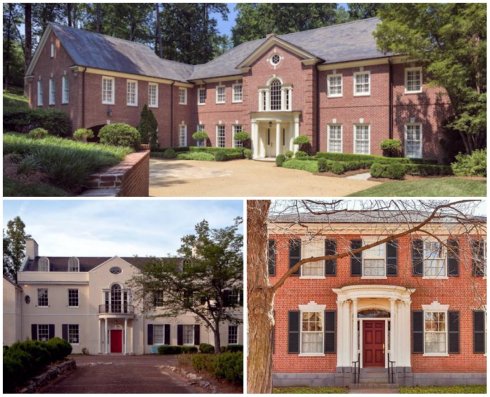
It is an absolutely beautiful house, inside and out: I remain overwhelmed by the 1989 restoration and its ongoing ability to both accentuate the interior and somehow also make it more accessible and intimate. It is a storied house. It is a much-documented house: I did a cursory review of twentieth-century historical architectural texts and found it in nearly every one. It is an influential house: especially its entrance, which has been replicated on several stately suburban homes (oddly juxtaposed with houses which do not also replicate the Gardner-Pingree’s perfect proportions).

Gardner Pingree Detroit Publishing Co 1906 LOC

Gardner Pingree collage 2

Gardner Pingree Mansions of Massachusetts

Gardner Pingree Parlor

Gardner Pingree CollageDetroit Publishing Co. photograph of Gardner-Pingree, 1906, Library of Congress; Albert MacDonald, Old Brick Houses of New England, 1917; Mansions of Massachusetts, 1977; the front parlor in the 1940s,houses in Atlanta and Brookline, MA supposedly inspired by the Gardner-Pingree.

But it’s also a powerful house, in its original situation (unlike the Crowninshield-Bentley and Ward houses to its side and rear, also part of the PEM’s”Essex Block Neighborhood” of historic houses, which the Essex Institute referred to as an “outdoor museum”) overlooking Salem’s original main street and the former Essex Institute buildings which housed the Phillips Library collections up until their removal from Salem in 2011. As all of you no doubt know, this was supposed to be a temporary move but has now been made permanent: Salem’s Phillips Library is now ensconced in an industrial building off the highway in Rowley. The PEM has presented several sound arguments for this move–most grounded in the priority of stewardship rather than access–but also one which I never quite understood: the scholarly synchronicity of having material collections and texts in close proximity. But when you stand in this house right next door to where Salem’s historical archives were housed for so long, you can see the connection–but in this case it counters PEM’s rationale for archival relocation. The house—like all of PEM’s  houses—are material objects as well, and the textual context of its construction, embellishment, and occupation has now been removed. I felt this so strongly when I was in the second-story southwest bedroom: a very beautiful room which was also the site of sensational murder, of Captain Joseph White—the third owner of the house–in 1830. Looking at the site of the now-former Phillips Library from the western window of this room, I realized that all the questions that I had about this house could not be answered by going next door, but only by going to Rowley: there is no synchronicity in that reality!

GP PARLOR

GP PARLOR 2

GP PARLOR 3

My questions–and where the answers can be found: in the Phillips Library, in Rowley:  How did the Gardner Family transform this parcel of land into “Gardner’s Corner” over the 18th century? What are the details of the spectacular rise and fall of the fortunes of John Gardner (1771-1847) who built this beautiful house and was only able to live in it for six years before selling it to his brother-in-law, Nathaniel West? Of course the War of 1812 had much to do with the fall, but I’d like to know more, and there are boxes of Gardner family history in the Phillips (MS 147). What was the extent of the slave trading of the murder victim, Captain Joseph White? (Log 9, for White’s brigantines Hind and Eliza, and MSS 0.188, William Fairfield’s account of a slave mutiny aboard the Felicity, also owned by White). I don’t think I have any questions about the murder and equally-sensational trial, which apparently inspired Edgar Allan Poe, Nathaniel Hawthorne, and Parker Brothers, but I’d like to know how the Adroit Fire Club (Delay Not) worked, as well as the sources of the Rumford Roaster, and all about the (again!) rising, falling, rising and diverse fortunes of the two David Pingrees (MS 901). Family histories, house histories, Salem’s history: they’re all connected, of course.


Hawthorne Summer

Every single year I think about Nathaniel Hawthorne in the first week of July, as his birthday was on July 4, but this particular summer he—or his inspiration–is everywhere in Salem as this year marks the 350th anniversary of the house most closely associated with him: the House of the Seven Gables. In some ways, the Gables is as much of a creation as the story after which it was named, but it’s still a 350-year-old house overlooking the harbor, and therefore a standing symbol of Salem’s multifaceted past: in this year when so much of the city’s historic fabric has been removed by the Peabody Essex Museum I believe that its existence–and the role it plays in our city today–is more important than ever.

Gables PC Harvard

Gables Harvard 1910The newly-restored House of the Seven Gables, 1910, Harvard Fine Arts Library Postcard Collection
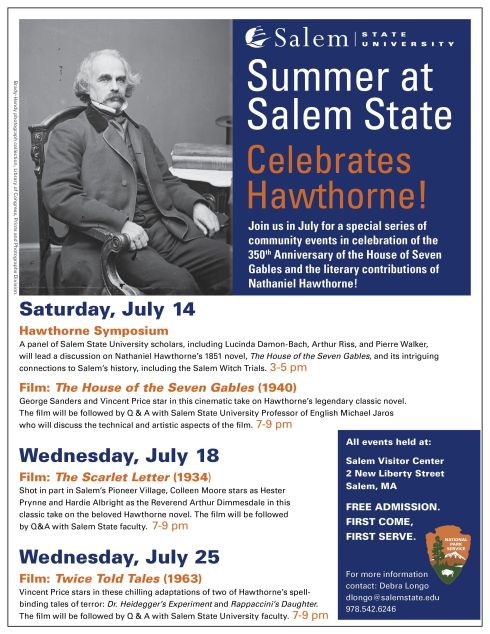
Not only does the House of the Seven Gables Settlement Association serve as a solicitous steward of this iconic house, it maintains a packed schedule of programming, continues to fulfill the social welfare mission of its founder, Caroline Emmerton, and partners with other regional institutions to interpret and present Salem’s history and culture. Even though its focus is limited necessarily, in many ways it is as close to a historical society as we have in this “historic” city. Both the organization and the House stand as authentic and educational antidotes to Salem’s more sensationalistic offerings. And again–given what has happened to Salem over this past year, it’s more important than ever that the city’s existing historical organizations work together to shore up—and celebrate–our heritage. So I’m particularly happy to see the first big Hawthorne event of the summer: an ambitious and aptly-titled public reading called “Enduring Hawthorne: A Marathon Reading of Nathaniel Hawthorne’s The Scarlet Letter”, a collaboration between the Gables, Salem Maritime National Historic Site, the Salem Athenaeum, and the Essex Heritage National Area on June 7 in front of the Custom House. The following weekend, Salem State University will screen the first film of a three-film series based on Hawthorne novels at Salem Maritime’s Regional Visitor Center, with a preceding symposium in which English faculty will discuss the historical context of The House of the Seven Gables. Then we will see the 1940 film, with The Scarlet Letter and Twice-Told Tales coming up on successive Wednesdays in July–with Q & A sessions after both. Scenes from The Scarlet Letter (1934) were apparently shot in then recently-constructed Pioneer Village, so I’m pretty excited to see that film in particular.

Summer at Salem State July 2018_Web Version

Scarlet Letter 3 Still from The Scarlet Letter, 1934. Pioneer Village?

With August comes Gables Fest: Celebrating 350 Years of Stories and Songs, a day-long event on the 4th which will take attendees on a musical “journey” through the history of the Gables (with food and drink) and a collaboration with another historic site celebrating a big anniversary this year: the Marblehead Museum’s Jeremiah Lee Mansion, built in 1768. Through “Architectural August” there will be architectural tours, visiting member events, and a comparative focus on these two structures built a century apart.

Interesting Houses collageFrom Burroughs & Company’s Interesting Houses of New England, 1915: with a photograph of the Gables before its restoration/recreation.

Remove not the ancient landmark, which thy fathers have set. (Proverbs 22:28)


The Last Summer of White Court

The century-old Classical Revival mansion in nearby Swampscott which served as the “Summer White House” for Calvin and Mrs. Coolidge in 1925 is not long for this world, as just last week the Swampscott Historical Commission agreed to reduce the requisite demolition delay ordinance period to just 90 days in return for its purchasers’ agreement to salvage and reproduce significant architectural elements as they transform the estate into 18 condominiums. Looking at all of the old photographs of White Court, which was designed by architect Arthur Little and built near his family’s summer home on Little’s Point, “reproduction” seems unlikely; I can’t speak to salvage. In any case, the mansion will be demolished, and along with it will go a material reminder and symbol of a notable era in Swampscott’s history, a golden era when the residence of the President drew many eyes to this seaside town.

White Court 1900

White Court Arrival

Coolidge firstWhite Court in 1900, Bain News Service, Library of Congress; The arrival of President and Mrs. Coolidge at White Court in Swampscott in June of 1925, and the pair with one of their white collies (either Rob Roy or Prudence Prim ) at the estate during the summer, University of Massachusetts Amherst Libraries Special Collections and University Archives Alton H. Blackington Photograph Collection, ca. 1920-1963.

The Coolidges were welcomed warmly and seen about Swampscott and surrounding towns occasionally: according to the Calvin Coolidge Presidential Foundation blog, the President worked from an office in Lynn, sailed on the presidential yacht Mayflower docked in Marblehead, and attended services with Mrs. Coolidge every Sunday at the Salem Tabernacle Congregational Church. There was not a lot of entertaining, as the Coolidges had lost their sixteen-year-old younger son, Calvin Jr., just a year previously. There were many strolls around the six-acre seaside property, white collie alongside, apparently: we only get to see one such stroll, right after the Coolidges arrive when the press were clearly on hand to see them settled into their summer home. Their smiles come and go; this is a dutiful walk—I’d like to see them on a more casual stroll but I’m glad the photographers were not enabled to intrude for too long. We have many photographs of their activities off the estate however: this was a well-documented presidential vacation!

Coolidge Leslie Jones 7

Coolidges Leslie Jones 5

Coolidges Leslie Jones 3

Coolidges Leslie Jones 6 BPL

Coolidges White Court Leslie Jones Close Up

White Court SalemLeslie Jones photographs of President and Mrs. Coolidge at White Court, Swampscott, 1925, Boston Public Library; the Coolidges attend the Tabernacle Church in Salem, July 1925, Blackington Collection, University of Massachusetts.

I felt like I was intruding yesterday morning when I drove over to Little’s Point to see the condemned mansion, which was very much in the midst of a construction zone. It didn’t seem possible to walk down its long entry lane (which was also marked private) to snap a photograph, so I have no “now” to contrast with all of my “then”. The last time I was on the premises was a couple of years ago, when the mansion was the main building of Marian Court College, a Catholic commuter college operated by the Sisters of Mercy from 1964 to 2015. There were institutional additions to its exterior, and I did not see the interior, but the core of the building looked pretty much the same as it did in that spotlight summer of 1925. But apparently its foundation has deteriorated beyond repair, and so White Court must cease to exist, come September.

White Court Interior HNE

White Court Leslie Jones BPL The drawing room of White Court in its residential era, Historic New England; an exterior view by Leslie Jones, Boston Public Library.

Appendix: Thanks to Jonathan for informing me that White Court was the site of Northshore Magazine’s “Best of the North Shore” awards just last year: great photographs of the mansion below and more here. Also, in return for their reduced demolition delay period, the developers have agree to document the house thoroughly, so we will (at least) be able to see detailed architectural photographs at some point.

White Court 2017

White Court 2017 2


A Jewel Box on Mall Street

Just off Salem Common was a rather nondescript house, long consigned to institutional use, which was rescued by a couple who transformed it into what can only be described as a show house, with every single surface polished and embellished to perfection. Everyone in Salem watched the exterior metamorphosis with great interest, and then the doors of One Mall Street were opened up for the 2016 Christmas in Salem house tour and we were able to see inside, where everything was color and light, with more texture and detail than one could capture at first impression. That’s why I was so fortunate to be invited back into One Mall Street a month ago, and shown around by its owner-restorers, whose plan was to strip the c. 1800 house down to its studs and then rebuild it, with the best materials and more classical detail than its original builder could afford. A sun-splashed courtyard on the eastern side of the house (once an asphalt driveway) provided the orientation, and the house’s own “bones” the inspiration. The end result is a house that is nondescript no more.

jewelbox31

Jewel box 3

Jewel Box Macris

jewelbox 21

As you might guess from the renderings just above, one half of this restoring couple is an architect: this is not a shoemaker’s-family-has-no-shoes scenario! Clearly this project was a labor of love. And now that it is complete, the family is moving on to a new one—in Vermont— and One Mall Street is now for sale. I can’t imagine a house in more move-in condition: essentially it’s been rebuilt from (below) the ground up: from the basement bar and workshop to the attic apartment. This house’s past is a bit murky (it was moved to its lot in 1906; no is really sure from where) but its future is clearly very bright.

Jewel Box Collagejewel box 30

jewel box 31

jewelbox 23

jewel box 15

jewel box 13

jewel box 14

Above: One Mall Street in Salem today and in 1997 (MACRIS); various plans, the beautiful entrance hall and stairway, living room, kitchen, dining room, study, and back stairway. Below: more staircases, the amazing more-than-finished basement, complete with bar, pool table, and workshop—and that ceiling! This house has the most beautiful ceilings I have ever seen: I came right home and called the plasterer.

staircase collage

basement collage

Jewel box 33

jewel box 11

jewelbox30Listing for One Mall Street, Salem:  https://www.raveis.com/raveis/72311320/1mallstreet_salem_ma?ROWNUM=1&page=1&sortdir=DESC&sort=price&TOTAL=27


Remember the Armory

The opposition to the Peabody Essex Museum’s removal of Salem’s historical archives to an industrial park in Rowley incorporates a range of perspectives: some people have never been in the Phillips Library but nevertheless have been waiting for its return; others have very concrete memories of childhood forays or later visits to research some specific aspect of their Salem past: their house, their neighborhood, their family. Everyone had great expectations: as the Museum leadership closed the Library in 2011 with promises to return in two years, only to disclose the Rowley move six years later, under duress. Expectations are a powerful motivating force, but so too is distrust: and for those of longer Salem residence the latter is clearly apparent. For them, the PEM’s latest move (literally and figuratively) falls into an established pattern of behavior that has broken trust with the Salem community. And the event that looms largest in this pattern is the demolition of the storied Salem Armory in 2000, under the auspices of the Peabody Essex Museum, which had previously signed a memorandum of agreement to preserve and incorporate the Armory’s headhouse into its expansion plans. Only the Armory entry arch remains on Essex Street, right next door to what used to be the Phillips Library, a constant reminder of what was and what was not preserved.

Armory 2

Salem Armory LOC

Armory Arch

The Salem Armory in 1992, ten years after a ravaging fire, and the year of the Memorandum of Agreement by which the “Museum Collaborative” promised to preserve its headhouse. This was also the same year that the Essex Institute and the Peabody Museum of Salem were merged to form the Peabody Essex Museum, which was still bound by that agreement. Library of Congress.

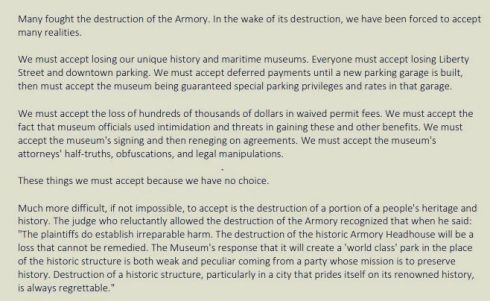
The Armory story–of its rise, role, and fall–has been written about many times, and well: the preservation report and narrative for the MOA is here, some colorful context is here, and the story in parts, right up to arrival of the wrecking ball, is here. But one of the most poignant accounts of the Armory (or of any building’s destruction, frankly) that I have ever read is a Letter to the Editor (of the Salem Evening News) written by Salem architect Staley McDermet in 2002, two years after its demolition. Mr. McDermet asks for an apology that I don’t think he–or we–every received, and goes on to document everything that happened. Indeed, the letter is historical in terms of both intent and subject, but it is also a very timely document, in light of the PEM’s recent actions and their explanations for actions in the past, so timely that I thought it should be “published” again.

Armory text 1

Armory text2

Armory text 3

Armory text 4


Unobstructed Views

My self-education in historical architectural photography is now quite stalled in the realm of the photogravure, and I just can’t see enough tonal prints of old buildings, preferably but not necessarily of the New England variety. There is a slim volume titled Under Colonial Roofs by Alvin Lincoln Jones with forty stunning photogravures from negatives by Charles Webster that I keep by my bedside but I like the Internet Archive copy even better because it is annotated by a snarky little anonymous note facing the title page: the first good photographic study of New England’s historic houses was Alvin Lincoln Jones’ Under Colonial Roofs which appeared in 1894. The pictures, which are of a high quality, show us many buildings that have since disappeared. The picture of the Paul Revere House, when compared to a modern view, gives us some idea of how drastic the 1907 restoration must have been. Jones’ picture leads me to conclude that it is very easy to over-restore a building. I wonder what he/she thought of the coincidental restoration of the House of the Seven Gables! The 1894 version of the Paul Revere house is in fact very revealing, as is that of the Wells-Adams House, also in the North End, which would come down in the very same year that Under Colonial Roofs was published.

undercolonial roofs

undercolonialroo00jone_0081

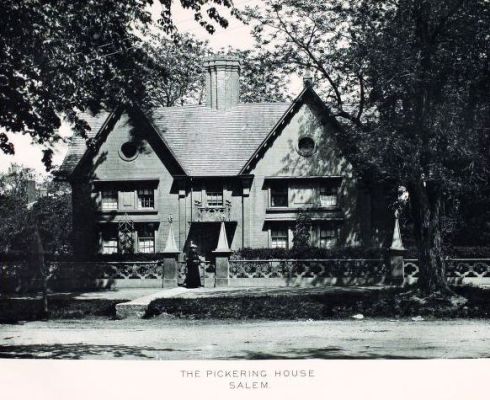
Jones showcases only two Salem houses, a very un-restored Corwin/Witch House, which he calls the Roger William House as it is several years before Sidney Perley disproved that connection, and the Pickering House, which looks then pretty much like it looks now. There are so many more I wish he had included! But images of Salem’s “ancient” houses were being dispersed far and wide by Frank Cousins in the 1890s, so I can understand his sparing coverage. There are lots of Essex County houses in the volume: I was particularly drawn to the Cobbett House on East Street in Ipswich, which appears to be no longer with us, the striking image of the Whipple House (again–in its un-Colonial-revivalized state) and the Peaslee Garrison House up in Haverhill, which looks like it could have been built in East Anglia.

undercolonialroo00jone_0106 (1)

undercolonialroo00jone_0111

undercolonialroo00jone_0146

undercolonialroo00jone_0201

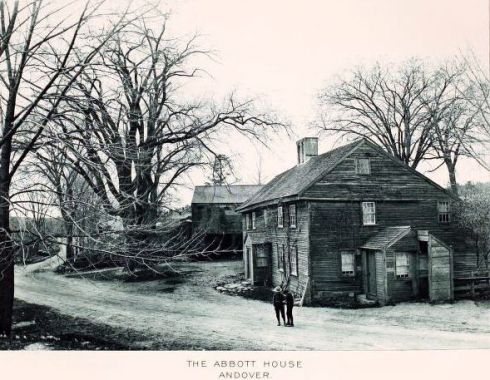
Jones takes us to all of the usual houses in Lexington, Concord and Duxbury, but does not venture onto the Cape or “out west”. Perhaps the anonymous note-inserter is correct: there is something about the untouched, organic images of two houses that I am familiar with—the Abbot house in Andover and the Peter Tufts House in Medford (which Jones calls the “Cradock House”) that are so very revealing, even more than the photographic technique. These houses would survive the twentieth century: not so the Barker House in Pembroke, then boarded-up, overgrown and abandoned.

undercolonialroo00jone_0216

undercolonialroo00jone_0223 Cradock House

undercolonialroo00jone_0343 Barker House Pembroke


We Need Louise!

If you haven’t noticed, I’ve become a bit obsessed with the prospect of an exiled and extracted Phillips Library; even though I’m living through it, it’s still difficult for me to grasp how this could happen to a city with as rich a heritage as Salem—-to any community really. I just don’t understand how or why the Trustees of the Peabody Essex Museum could acquiesce to such a radical policy, but then again, I don’t have many insights into the role(s) of contemporary trustees: I am governed more by characterizations from the past than present examples. I can suppress thoughts of Salem losing nearly all of its material history for a day or two, but then they come raging back: in dreams (or nightmares), first thoughts upon waking, and last thoughts at the end of the day. Lately I’ve found myself conjuring up people from the past and asking (myself–not them!) what they would think or do in this situation: Dr. Henry Wheatland, who devoted his life to the Essex Institute by all accounts, or James Duncan Phillips, the great Salem historian after which the Library is named. These men would not be happy, and they would make their unhappiness known, no doubt. But I think this particular crisis calls for another Essex Institute trustee from the more recent past: the pioneering preservationist Louise du Pont Crowninshield (1877-1958). I just know she would never let this happen.

Louise 1900 wedding

Francis & Louise du Pont Crowninshield and bridesmaids (+dog) on their wedding day, 1900 (Hagley Museum & Library)

Louise was a Gilded-Age princess: the heiress to the du Pont industrial fortune, raised at Winterthur, and married to Boston Brahmin (with Salem roots) Francis Boardman Crowninshield in 1900. She mixed in all the right circles but was obviously not content to just play and party: like her brother Henry, she was an energetic student and collector of early American material culture, and this passion brought her into the early preservationist movement. After restoring her family’s original homestead, Eleutherian Mills, she became involved with the rebuilding and restoration of two historic Virginia properties related to George Washington: Wakefield, his birthplace, and Kenmore, the Fredericksburg plantation that was home to his sister and her family. Crowninshield then worked her way up the east coast, participating in a succession of preservation initiatives, including Independence Hall in Philadelphia and several Massachusetts properties: Gore Place in Waltham, the Lee Mansion in Marblehead (where she and her husband summered at a beautiful estate on Peaches Point), the Wayside Inn in Sudbury, the Mission House in Stockbridge, and two Essex Institute houses: Peirce-Nichols and Gardner-Pingree. Her interest and investment in another Salem house, the Derby House, was integral to the establishment of the Salem National Historic Site as the first national historic site in the NPS. She was one of the founding trustees of the National Trust for Historic Preservation in 1949 and is the namesake of its most prestigious award.

louise-du-pont-crowninshield1

Louise du Pont Crowninshield in the center of the “Kenmore Ladies”, 1930s.

Louise du Pont Crowninshield was a powerful woman: so powerful that the substantial contributions she made towards the restoration of the Gardner-Pingree house in the 1930s entitled her to dictate (apparently–I’m relying on written hearsay here) that no mention be made of her relative-by-marriage’s key role in the savage murder of Captain Thomas White in the house in 1830 when it was opened for tours a century later, and to place furniture in the Derby House that was perhaps a bit “old” for its period. But her capital and connections were utilized overwhelmingly for the public good rather than vanity or recognition. She was committed: to her belief that Americans will be better for having around them some visible remains of their past, as well as to the importance of place in general and Salem in particular. She served on the boards of both the Essex Institute and Peabody Museum, and as President of the Salem Maritime Trust as well. If Mrs. Crowninshield was alive today I have no doubt that she would spare no expense of her cultural capital (telling her Marblehead neighbors and fellow trustees: we are not going to do this to Salem), and perhaps also her capital, to ensure that the Phillips Library was returned to Salem, adjacent to the buildings in which she invested so much of herself, and which bear her name. We need her now.

Louise Collage

CB

CB2

Helen Comstock’s influential 1958 coffee-table book 100 Most Beautiful Rooms in America was a veritable memorial to Louise du Pont Crowninshield in the year of her death, with pictures of Winterthur, Kenmore, and (above), a Peirce-Nichols bedroom, the Crowninshield Memorial bedroom in the Gardner-Pingree House, and the Lee Mansion parlor. A true memorial is the Crowninshield-Bentley house, which was removed to the Essex Institute campus from its original location further along Essex Street and restored by subscription in 1959-60 in tribute to Mrs. Crowninshield. (Love these historic house pamphlets published by the Essex Institute in 1976-78—scoop them up if you can find them).

P.S. And of course there are Crowninshield papers in the Phillips Library deposited by Mrs. Crowninshield, as well as other purchased and donated in her memory.