As tragic and interesting as the Salem Witch Trials are, they are still somewhat limited in the scope of characters and duration. So in the constant and evolving effort to market anything and everything about them, a bit of cultural appropriation always takes place: I see many images from Europe’s longer reign of witch-hunting used in Salem rather indiscriminately every year, most prominently the storied “swimming test”, and the Salem Witch Museum features a “strong Celtic woman, diminished and demonized by the church fathers in the middle ages” even though the myth of the midwife-witch has long been consigned to folklore by European historians. A very popular and creative “immersive media game theater” company called Intramersive Media here in Salem is staging the fourth chapter of their “Daemonologie” series this October at PEM’s Assembly House: an experience entitled “Smoke and Mirrors” centered on a seance in 1849. (I really wanted to go because I haven’t been in the Assembly House forever but that of course would mean staying in Salem for the October weekend performances which I just can’t do; in any case I think they’re sold out!) Now there is only one Daemonologie for me, the famous book by King James VI of Scotland (soon to be King James I of England) published first in 1597: a text that impacted how “witches” were perceived and prosecuted once James acceded to the English throne in 1603. But I don’t think these performances have anything to do with that: it’s just a name: though James perceived witchcraft very personally and perhaps that is the meaning here.

 You can read the entire first edition of the Daemonologie of King James by “turning the pages” at the British Library here; Alan Cumming made a brief appearance as a pretty amazing King James in the Thirteenth Doctor’s Witchfinders episode last year.
But I saw the absolute best “transportation” and reincarnation of an icon of British witchcraft just this weekend, standing on a stool in front of the Peabody Essex Museum just before I went in for my new wing tour: Matthew Hopkins, the “Witchfinder General” of Civil-War England! Hopkins was a rather unsuccessful East Anglian lawyer who took advantage of the conflict between Crown and Parliament to proclaim himself the official Witchfinder General, vaguely commissioned to discover, prosecute, and execute “witches” as he crusaded from town to town in his native country. Villages would pay him for his troubles, and consequently he gained both money and fame as he and his associates went about their business between 1644 and 1646, eventually executing between 230 and 300 people for witchcraft, employing uncharacteristically-English torture techniques in the process. The image of Hopkins was transmitted across England in his The Discovery of Witchcraft (1647), and so I immediately recognized him as a familiar figure standing on a Salem street. The depiction was quite good: kind of a combination of the seventeenth-century illustration with (a younger) Vincent Price’s profile in the 1968 film Witchfinder General.
 British Library version here.
After I got out of the Peabody Essex, I approached this Witchfinder General and asked him if he knew who Matthew Hopkins was and he certainly did. I was informed that Matthew Hopkins was never officially licensed by any authority in seventeenth-century England, but he, the Salem Witchfinder was. The City of Salem had provided his license, a bright pink badge which he displayed. I certainly had no argument with that; he was entirely correct. That was about the extent of our interaction: he allowed me to take his photograph for free but I had to pay if I wanted one with him with my hands encased in his portable stocks. I said no thank you and off I went. So here we have a very official Witchfinder in the Witch City. I’ve been to Manningtree, the beautiful little Essex village where the reign of terror of Matthew Hopkins began, several times, and I’ve never seen him there: no doubt its residents have shunned him, but of course he’s perfectly welcome here in Salem, where all is good clean (licensed) fun.


 The (official) Witchfinder General in Salem, September 30, 2019.


 It seems as if Timothy Lindall’s gravestone has always been in the spotlight.


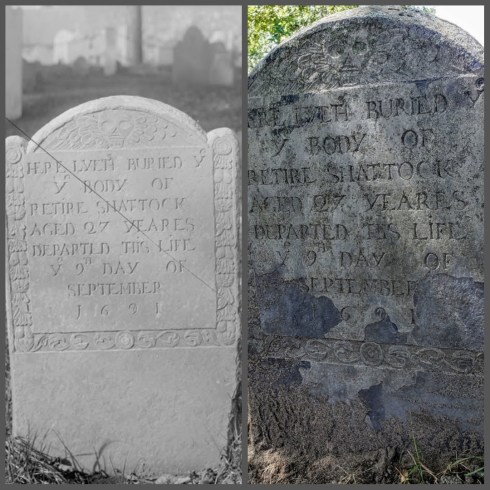
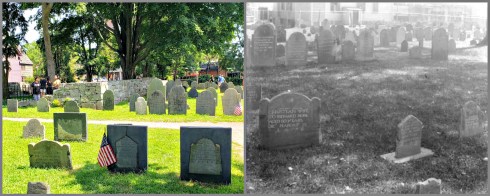
 I feel particularly bad for Mr. and Mrs. Nutting, put to rest in a lovely calm neighborhood and now in the midst of the Salem Witch Village! And I really wish that Cousins had photographed my very favorite Charter Street gravestone: that of Mr. Ebenezer Bowditch. What are those carvings? Does anyone know?
 Old Burying Point Cemetery, Charter Street, Salem, October 2017 & 2018.


 The Old Burying Point on Charter Street in mid-August.
 The Old Burying Point in October via @Linden Tea on Flickr.

 Apparently over 1.5 million people visit Salem each year, with nearly 54% of that number in the month of October: for many of those 800,000 or so (I am severely math-challenged), this ⇑⇑ is historical interpretation.

 Carnival Confusion: a City ordinance against mechanical rides on the Common prohibited the annual carnival there, so it was relocated to the middle of Federal Street, but somehow there are electrical rides on the Common as well. This is all very confusing to me, but a colleague of mine commented that the Federal Street location was ok, as those columns on the Greek Revival courthouse are Egyptian Revival, so the Pharaoh fits right in.
 22 Andrew Street: a beautiful Federal (built 1808) located on a lovely street right off the Common (which will not be the site of a carnival for much longer): looks like its
  One Forrester Street is right on the Common—it looks Federal but was actually built in 1770. When I first moved to Salem this was the home of a lovely woman whose family had owned it since the 19th Century. It’s been cherished throughout its history, and is still for
  The Stephen Daniels House is a first-period house which just came on the


 Contemporary postcards of Town House Square; Ridgeway Stereopticon Advertising Co., trade card, Boston Athenaeum (I imagine the Salem screenings looking like this); a great photograph of the famous White Angel handtub from the PEM’s Phillips Library, published in Pediment ‘s Salem Memories, Volume II and available


 Salem Common in 1836 and 1863: Historical Collections of Massachusetts by John Warner Barber; Fitz Hugh Lane for Moore’s Lithography, Art Institute of Chicago, Museum of Fine Arts, Boston.


 All newspaper articles from the Boston Globe: playground festivals in 1916 and 1923, a film for the troops in 1918, a farmer’s market in 1920 (Historic New England), the celebration of the opening of the Hawthorne Hotel in 1925 and the stage for the Tercentenary pageant in 1926, Salem State University Archives and Special Collections; a protest against the processing tax during the Depression, and an unfortunate death on Salem Common.


 The two memorials: Proctor’s Ledge this summer; downtown in October 2015.


 Map by John S. Dykes, Boston Magazine