Tag Archives: great houses

Storybook Structures 3.0

My preference for classical American architecture does not stop me from seeking out more whimsical structures: the “storybook” style of the interwar years is a particular obsession, though there are not many examples in our region. One of my very favorite Salem houses, which I wrote about here and check in on often, is classic storybook, as is Santarella in western Massachusetts. Most of the houses below would probably be classified more as Arts and Crafts or “eclectic” houses by architectural historians, but it’s all in the details for me: a few fanciful touches makes the grade. The first house, which is situated on a street that runs parallel to ours here in Salem, has long fascinated me. It was built on a swath of land that was devastated by the great Salem fire of 1914, I think shortly afterwards, both because it was the city’s policy to rebuild as soon as possible, and the appearance of similar (but not identical) structures in building periodicals from the World War One era.

Storybook 022

Storybook Low Cost Homes

Storybook 019

A Salem cottage, and its inspiration? Rendering from Richardson Little Wright’s Low Cost Suburban Homes; a Book of Suggestions for the Man with the Moderate Purse (1916).

This next house is right around the corner in the same Salem neighborhood, but it fortunately survived the fire. The main structure dates from the 1840s, but a very fanciful wing was added at some point after the turn of the century. The entire composition is really charming, as you can see:  even the fence.

Storybook 008

Storybook 011

Storybook 014

The towns that line the coast just south of Salem, heading towards Boston, have rich inventories of older houses, many with whimsical details. These next two houses definitely date from before the storybook era (if indeed there is one): they are essentially and eclectically Victorian. But how can I resist including Moorish and Norman “castles” in this company?

Storybook Structures 060

Storybook Structures 046

Storybook Victorians in Swampscott (top) and Lynn (bottom), Massachusetts.

Storybook intersects with all of the other architectural styles of the first decades of the twentieth century: Arts and Crafts, Cottage, Tudor Revival, among others. These last two houses, in Swampscott and Nahant respectively, illustrate this assimilation. The first house, with its spectacular slate-tiled roof, looks like an embellished bungalow, while the second is (unmistakably) an all-American Tudor. But  both have that fairy-tale feel, accentuated by their settings.

Storybook Structures 066

Storybook Structures 053

lowcostsuburbanh00wrig_0030

Swampscott and Nahant cottages, and a photograph from Wright’s Low Cost Suburban Homes (1916).


Purple Reigns

I was looking at pictures of the recent commemoration of the 60th anniversary of Queen Elizabeth’s coronation, and even the Anglophile in me thought: aren’t they done? Haven’t the British been celebrating anything and everything for the past several years? Enough. But I did like this one photograph of royal purple banners, and it inspired me to find some purple in my own city. I’ve been working my way through the palette of paint colors here in Salem for several years, beginning with Old Orange Houses, so it’s all about purple today.

Purple Reigns in London

Purple banners in London last week and Salem (and one Marblehead) houses below:

purple reigns 058

purple reigns 057

One of my favorite houses in (south) Salem, a mid-nineteenth-century extended “cottage” that extends for quite a bit and is set on a very nice property. Love these long windows on the side and the purple-with-green paint scheme.

Purple Reigns 2

purple reigns 063

A purple Salem triple-decker, and a c. 1710 house in nearby Old Town Marblehead.

purple reigns 071

purple reigns 075

Side by side in North Salem, an 1830 house and one from the turn-of-the-century or after (not quite sure about this style; it almost looks storybook to me. This house is a very, very, very pale greyish purple with purple trim and it is for sale now–no, under agreement; I just checked).

purple reigns 086

purple reigns 091

Two High Victorian houses in purple on Federal Street.


Summer Arrives

Summer arrived in Salem in a big way this past weekend with several days of 90+ degree heat; it felt more like early August than June. This is a bit of an aberration, and we should be back in the 70s this week (it’s raining this morning). I braved the heat and went out into the garden, armed with a quart of “half-and-half”, half lemonade, half unsweetened strong black iced tea–my second favorite summer drink (after gin & tonics). On Sunday I was able to have a few of my VERY favorite summer drinks out in the garden of the Salem Athenaeum, at the annual garden party. This event is timed to coincide with the blooming of the massive multicolored rhododendrons in the garden, and I think the timing was perfect this year.

Summer 041

Summer 026

Summer 033

Summer 012

Summer 054

At home the lady’s slippers have arrived and the catmint is in full bloom, beckoning Moneypenny. On a less happy note, someone stole my three large planters–filled to the brim with hydrangeas and Memorial Day flags!!!!–as well as my neighbors’ in the middle of the night. Not a tragedy obviously, but sad that someone would do this.

Summer 103

Summer 062

Summer 101

Summer 114

Path leading into the garden of the Salem Athenaeum, lined by huge rhododendrons, which frame a beautiful 18th century house next door. Another beautiful house, on Chestnut Street, with the street’s only surviving Elm tree in front. I’m on a quest to find all the elms I can this summer, so if you know of a particularly majestic one in eastern New England, please let me know!


Period Rooms

The “period rooms” installed in many museums are always the first place I go, but as I often find myself wandering about alone, I’m not surprised that there are efforts afoot to instill a bit more life into them. Our major museum here in Salem, the Peabody Essex Museum, doesn’t even have period rooms even though I believe that its predecessor, the Essex Institute, pioneered such installations with its George Francis Dow-designed rooms from a century ago. The PEM owns entire historic houses, however, so one can certainly understand the reluctance to consign precious exhibition space to static rooms. The Museum of Fine Arts in Boston retains its period rooms, and has just added a seventeenth-century English drawing room to their assemblage of suites.

I know of a several projects aimed at revitalizing period rooms from the past few years, but there must be many more. Just recently, the “All America House” exhibit at Woodlawn Plantation in Alexandria, Virginia opened, the result of a collaboration between the National Trust for Historic Preservation, Woodlawn’s owner, and MADE: In America, a nonprofit organization, in which teams of students from the University of North Carolina at Greensboro, George Washington University and the Corcoran College of Art + Design were charged with creating a home for a modern family in the historic rooms at Woodlawn, working with the Woodlawn staff and mingling antiques from the collection with new furniture designed and manufactured in the United States. The goal was the creation of rooms which “referenced the many layers of history embodied at Woodlawn over the last 210 years”. Below are before and after pictures from the National Trust’s blog, with the pristine period parlor above and the “All-American” parlor below.

Woodlawn

Period Rooms Woodlawn I NTHP

Period Rooms Woodlawn 2 David Wilson

Woodlawn Plantation and its front parlor, before (National Trust for Historic Preservation photograph) and after (David Wilson).

I love the All America parlor designed by the students (and how great that students were recruited for this project rather than Big Famous Designers): it’s a similar aesthetic to my own house (or at least a style I’m striving for) but clearly it represents a historic era–say the heyday of Woodlawn as a working plantation–less than it does our own time. Nevertheless, people love the contrast of past and present, and such approaches can encourage engagement–the goal of every history educator or interpreter.

Another interesting attempt to revitalize period rooms was the Brooklyn Museum’s Playing Houseactivation” from a year ago, in which modern artists working in various genres (Ann Agee, Anne Chu, Mary Lucier and Betty Woodman) were invited to place site-specific artworks in eight of the Museum’s 23 period rooms. Again, the goal was the merging and juxtaposition of past and present, creating new perspectives on both.

DIG_E_2012_Playing_House_Canes_Acres_Plantation_PS6

DIG_E_2012_Playing_House_Schenck_House_view1_edited_PS4

The Brooklyn Museum’s Cane Acres Plantation period room (late 18th century) with abstract pottery “placemats” and sculptures by Betty Woodman and textile “flowers” and cloths by Anne Chu; video installation by Mary Lucier in the dining room of the seventeenth-century Jan Martense Schenk house.

I wish I had gone to the exhibition in person because the pictures seem to present the period rooms as mere backdrop for the modern art and I’m sure the real experience was much more interactive. One last attempt to inject life into a dusty period room was the recent Supper with Shakespeare collaboration between the Minneapolis Institute of  Arts and British food historian Ivan Day. Mr. Day created a desert display for the Institute’s c. 1600 Tudor Room which featured a sugar castle centerpiece and tarts made from period recipes, placed on a table set with period cutlery and serving ware from the Institute’s collection, so people could see how these still things–table, chairs, plates, knives–were used in their own time.

MIA Tudor Event

Supper with Shakespeare display at the Minneapolis Institute of Arts; photograph by Ariana Lindquist for the New York Times.


Panoramic Papers

Last night there was a “scholarly soirée” here in Salem, during which the amazing pictorial woodblock-printed wallpapers of the French manufacturer Zuber et Cie were presented from a variety of perspectives. I learned a lot:  certainly too much to put in one blog post! So consider this a mere synopsis. The event, which was co-sponsored by the French American Intercultural Relations and Exchanges (FAIRE), The Bowditch Institute, and Salem Maritime National Historic Site and held at the latter’s Visitors’ Center, featured an array of speakers, who introduced the large audience to Zuber et Cie wallpapers in general and the “Views of North America” (1834) in particular. There were actually lots of introductions, including a very succinct survey of the potential market for these expensive French wallpapers in mid-nineteenth century Salem by SMNHS Historian Emily Murphy and the charming observation of the French Consul General for Boston that the panoramic Zuber wallpaper installed in the dining room of his official residence in Cambridge facilitated conversation (and I suppose diplomacy). Then the soirée was turned over to three panelists, Isabelle DuboisBrinkmann, Curator of the Musée du Papier Peint, Joanna Gohmann, Doctoral Candidate in Art History at the University of North Carolina at Chapel Hill, and James A. Abbott, Curator of  the Johns Hopkins University Evergreen Museum & Library , who examined, in succession, the early history of the Zuber firm and its manufacturing processes, the idealized images they produced, and the revitalized interest in their panoramic designs sparked by Jackie Kennedy’s redecoration of the White House in the early 1960s. This last topic is obviously the most accessible: most people would recognize at least the general image of these landscapes from official White House pictures of the Diplomatic Reception Room, in which antique panels (rescued from a doomed Maryland house) of Zuber’s idealized North American panorama were hung with great care.

Zuber et Cie diplomatic-room-2010

Zuber White House

Zuber Boston diplomatic-room-wallpaper

Pictures of the Diplomatic Reception Room at the White House with its Zuber et Cie panoramic wallpaper, 2010 & 1963, and a detail of “Boston Harbor”, White House Museum.

All of the panelists had very interesting things to say, but I was particularly impressed by Ms. Gohmann’s analysis of the idealized images of these manufactured “views” of North America in the 1830s. She pointed out that they were created for the French market more so than the American one, and crafted to portray a perfect American Republic–characterized by the equality, prosperity, and inter-connectivity of all of its citizens–just as French Liberals were trying to create their own ideal Republic. America had to be the model, the way forward, and so things that weren’t so perfect, like SLAVERY, were “whitewashed”, as African-Americans are shown freely intermingling with European-Americans, even in depictions of the South. You see American prosperity in the depiction of Boston Harbor above, and equality and inter-connectivity in the detail from “West Point” below.

Zuber West Point

Detail from Zuber et Cie’s “West Point”, Myers Fine Art & Antiques Auction Gallery.

Just fascinating. It’s almost Utopian wallpaper, but still projecting a “historical” image. I must brush up on my July Monarchy. And then we jumped forward a century and more to the Kennedy White House, Mrs. Kennedy’s aspirational redecoration, and the key role played by Zuber wallpaper, which was installed not only in the Diplomatic Reception Room but also in the First Family’s private dining room. What was designed as a French galvanizing image become an American one.

The Zuber firm is alive and well, still manufacturing its pictorial and panoramic wallpapers. It’s interesting to see them in a modern setting, emphasizing their timeless style. And for other designs, there is a large digitized collection at the Smithsonian’s Cooper-Hewitt Museum (including the very popular “El Dorado”, if you want to see an idealized image of South America) and the Down East Dilettante has a nicely-illustrated post on the “Decor Chinois” pattern. There is at least one Salem dining room papered with Zuber panels:  the White Silsbee House (1811) at 33 Washington Square, which just happens to be for sale at the moment (so we can take a peek inside).

Zuber David Netto 2005 Elle Decor

Zuber et Cie 33 Washington

Zuber Les Zones Terrestres detail

A more recent print of “Views of North America” in a bedroom, Elle Decor, 2005; The dining room at 33 Washington Square with its Zuber “Les Zones Terrestres” paper, and a detail.


Carriage Houses

I was getting a bit depressed with all the devastation and demolition of the last few posts, so I went searching for structures that have survived:  not too difficult a task in my neighborhood. The weather is odd here (for January):  quite warm, foggy, air filled with moisture but no rain or snow. Rather dreary, really, as you can tell from the photographs. On dark days like these in the midwinter the built landscape really stands out, with no natural landscape to frame or cloak it. For some reason, on my walk yesterday I was particularly noticing the outbuildings rather than the facades:  Salem has many great carriage houses, most in pretty good condition.  This is impressive to me:  it’s hard enough to preserve a big old house, but keeping an ancient ancillary building in good shape is a true commitment. We lost our carriage house long ago:  it is evident on the late nineteenth-century street atlases of Salem, but after the turn of the century, it’s gone.

I don’t have anything similar for Salem, so I want to start with an image of  the Valentine-Fuller house in Cambridge, Massachusetts:  Mr. and Mrs. Fuller are on horseback in their carriage-house courtyard, circa 1890:  this seems like the peak time for carriage houses to me.  After that, they would either come down or be preserved as storage structures or garages. This house, which was built in 1848 on Prospect Street, was demolished in 1937, along with its outbuildings (oh no, more demolition).

HABS, Library of Congress

Back in Salem, carriage houses can be found in several neighborhoods, so this is just a sampler, or part one.  On the street where I live, Chestnut Street, there are some amazing carriage houses, several of which are laid out a considerable distance from their main houses so you really don’t get the courtyard effect that you see above. On one side of the street, a completely new parallel street, Warren Street, was laid out as an access route to these buildings. The photographs below are all of Warren Street carriage houses that belong to mansions on Chestnut, but two of them appear quite capable of fulfilling an independent existence.

Carriage Houses 006

Carriage Houses 007

Carriage Houses 008

Essex Street, which was the colonial (and remains the present) main street of Salem, runs parallel to Chestnut on the other side: because of its early settlement, it features many beautiful carriage houses–primarily wooden rather than brick. In the general vicinity of the Salem Public Library, stalwart structures peak out from behind the streetscape, particularly visible at this time of year.  Behind this trio of houses–Georgian, Colonial Revival built on the site of a pulled-down Federal at the turn of the century, and Federal–are some of my favorite carriage houses on the street and in Salem.

Carriage Houses 015

And then just across the street from the library, there’s this wonderfully restored Greek Revival, with its NEW carriage house aligned perfectly with what I assume are later nineteenth-century additions, creating a nice sense of enclosure for its yard.  Just a little down the street, is a (nearly) matched pair of Federal houses dating from about 1800, both of which have great carriage houses.  As you can see, carriage-house cupolas abound on Essex Street!

Carriage Houses 013

Carriage Houses 019

Carriage Houses 021

Essex Street LOC

Essex Street, circa 1910. Detroit Publishing Company/ Library of Congress

On my way across town to the Common, I stopped to take a photograph of a very controversial Federal Street carriage house.  It appears to belong to the very stately Victorian that was converted into condominiums a few decades ago, but actually is part of an adjacent property whose owner tried to do the very same thing with his carriage house at the same time (this was all before I came to Salem, so I’m not that clear on the details).  When he did not get approval, he moved out of his Federal Court house and let it and the carriage house rot. So this is the result, 20+ years later.

Carriage Houses 024

As this is the birthday week of Salem’s famed architect Samuel McIntire, I’ve got to feature some McIntire carriage houses which, again, is not difficult to do. Everybody’s favorite McIntire house, the Gardner-Pingree house, has a charming carriage house in back which has a slightly smaller stature, in keeping with the general scale of the house.  There’s a restoration project going on there now, so I’m sorry that the pictures give a work-site impression, but you can still see how great this outbuilding is.

Carriage Houses 028

Carriage Houses 033

Just next door, another house owned by the Peabody Essex Museum features one of the most prominent carriage houses in town:  the Andrew Safford House was built after McIntire’s in 1811, but you can see his influence in both the main house and the carriage house, both of which overlook Salem Common. When it was built in 1819, this was one of the most expensive houses in America, and it remains very impressive, nearly two centuries later.

Carriage Houses 040

Safford House

Carriage Houses 037

Safford Stable 1939

The Andrew Safford House and Carriage House, yesterday and in 1910 & 1939 photographs, Library of Congress.

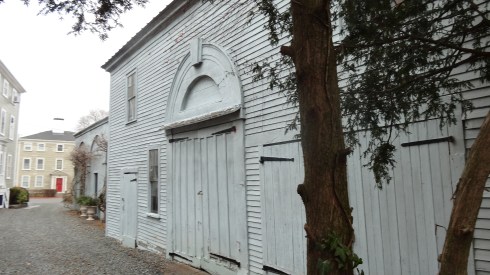
Finally, my very favorite Salem carriage house.  The Clifford Crowninshield House (1806) is a McIntire house located on another corner of the Salem Common, just across from the Safford house. Behind the main house, almost hidden really, is a wooden carriage house with an elegant stature and very intricate details:  every time I pass by it makes me smile.
Carriage Houses 049

Carriage Houses 043

Carriage Houses 042


Queen Anne and Napoleon III

We spent Thanksgiving in Saratoga Springs, New York, a city that on first impressions is as “Victorian” as Salem is “Federal”. I wasn’t able to spend the entire long holiday weekend there (and I was sick most of the time I was there), so I didn’t go on a long architectural/photographic walking tour as is my typical inclination, but I did dash down North Broadway, which is lined with Gilded Era mansions, as well as a few downtown side streets. I’m going back for more soon. Even before the quick trip to Saratoga, I had been thinking about Victorian houses here in Salem, and how I’ve never really done justice to this broad category of architecture. There are so many subcategories and styles!  I’ve always been a bit confused about two in particular:  Queen Anne and Second Empire. Not the styles of these houses, which are easily recognizable with their towers, turrets, and mansard roofs, but the names:  how did these thoroughly American houses get named for the last Stuart monarch, who reigned in Britain a full 150 years before a “Queen Anne” house was built across the Atlantic, and the French Second Empire ruled by Napoleon III (which was at least contemporary with Second Empire houses here in America)?  These names seem to imply a cultural imperialism that is incompatible with the assertive American spirit of the later nineteenth century, but then again, I’m neither an American historian or an architectural one, so my impression could be incorrect.

Queen Anne (r. 1702-1714) in 1705 by Michael Dahl, and an carte-de-visite of Napoleon III (r. 1852-70), National Portrait Gallery, London.

I can understand the use of the term “Victorian” for nineteenth-century houses on both sides of the Atlantic, as Queen Victoria really dominated her long era, but Napoleon III was no Queen Victoria! I suppose the rebuilding of Paris–the cultural center of the world–in Second Empire style during his reign provides the general explanation for the use of that term over here. The use of “Queen Anne” remains a mystery to me, but here are a couple of Queen Anne houses:  the first one in Saratoga, the second in Salem. There are several great Queen Anne houses in Salem, mostly outside the city center, but this more compact example is just a few steps from the Common:  it seems to feature all the characteristic details of the style in a much smaller footprint than the grand Saratoga house. This is a house that even a Federal fan such as myself could love.

The Second Empire style was forged by the Haussman Plan, a comprehensive urban planning initiative in Paris commissioned by Napoleon III and administered by Georges-Eugène Haussmann between 1853 and 1870. Much of central “old” Paris was swept away and replaced by grand boulevards and squares lined with mansard-roofed and embellished multi-story buildings made of “sanitary” stone. The “haussmannization of Paris” was projected to the world via serial publications and French paintings, creating an international style.

Images of the new boulevards of Paris, 1850s-1870s, Victoria & Albert Museum, London.

When I walk down the streets of Salem, I see structures, small and large,  that seem to be inspired by the Second Empire style:  American translations in a “colonial” context. Lafayette Street gives off a “French” impression in more ways than one, and not far from the Queen Anne house, just off the Common, is a multi-family painted-brick house that comes close to the French standard, at least to my untrained eye. The Salem house that really reads Second Empire to me, however, is over on my side of town, on upper Essex Street.  Even though Bryant Tolles (in Architecture in Salem:  an Illustrated Guide,1983) refers to it as reflecting “French Academic and High Victorian Italianate” influences, the Putnam-Balch House, which was built at the height of the Second Empire style, always reads “Paris, 1870s” to me. This majestic mansion, somehow all the more extravagant because it is built of wood, really dominates the streetscape with its sheer presence:  it once served as an American Legion post and has recently been restored.


In Living Color

The first picture below sums up Salem at this time of year:  a ghoulish figure in a shop window (with yellow crime scene tape) and the reflection of the beautiful Federal house across the street. October is a very vivid month, in more ways than one. With my general disdain for witchcraft tourism, I tend to focus on the more natural and architectural attributes of our city, but even I can be amused by clever Halloween displays–I like this one, even though it was hard to photograph. Not quite so subtle, but an easier vignette to capture on film (at least in its entirety) is the annual display in a residential alley off Derby Street:  tourists are there all day long in October.

When I was looking for pink houses the other day, I found lots of other colors as well, so this post is much less monochromatic.  The doors really popped; Salem does not seem to have any of the trendy yellow and chartreuse doors that have been much-featured in shelter magazines in the last few years, but nearly every other color is out there.  Here are just a few colorful doors, beginning with one of the most photographed entrances in the city, right across from the House of the Seven Gables.

Of course, the turning leaves are also a source of vibrant displays of color at this time of the year. You can’t really tell in a more urban environment, but it seems like the colors are particularly intense this year to me, and the trees are peaking at different times. A case in point is this pair of trees on Essex Street, one completely bare, the other just past peak. Many tree are still mostly green, quite late in the season. I love the leaves on the back of this weathered house by the water.

Now in what other city could you see a whirligig framed against onion domes?  This is the St. Nicholas Russian Orthodox Church, built in 1908 for immigrants from Poland and Russia who came to work in the leather factories of Salem and Peabody. It’s on Forrester Street, off Salem Common, but I took this shot while examining a garden one street over–hence the whirligig.


Seeing Pink

Black and orange are the predominant colors of the season but I was looking for pink this weekend. Pink houses, large and small, can be found all over Salem but primarily in the outlying neighborhoods away from the center historic districts. While colonial houses can look lovely in pink, this custom seems to apply more to Charleston and Savannah than it does to New England:  pink is just not a Puritan color!  So most of Salem’s pink houses are Victorians, with the exception of a very bright Greek Revival on Winter Street just off the Common, and a little Georgian house in dusty salmon pink right off Derby Street.

And on the other side of Derby Street, overlooking Derby Wharf, the Friendship, and the Custom House, a pink triple-decker, another iconic New England architectural style.

I kept walking east:  downtown was full of tourists and motorcycles, the weather was beautiful, and I knew that I’d find some pink house in the Willows. Salem Willows is a late Victorian park with an adjacent residential neighborhood of structures that were built as seasonal cottages in the later nineteenth and early twentieth centuries. All of these houses have been transformed into year-round residences, and it’s a colorful neighborhood with few preservation encumbrances. There was a full spectrum of pink here, from shocking Schiaparelli to the very pale color of the Gothic Revival cottage overlooking Juniper Point Beach.

Back in town, I turned left and walked down Lafayette Street, which was a grand boulevard of painted ladies before the great Salem Fire of 1914.  Some survived, and Colonial Revival residences replaced those that did not:  one has a conspicuous pink and light gray color scheme that you cannot fail to notice.  On a side street Lafayette, there’s a lovely late 19th century pink house, with an adjacent three-car garage, also in pink.  And way down the road, almost on the Marblehead line, is a “Scooby Doo” eclectic Victorian overlooking Salem Harbor dressed in faded pink.  I was losing the light by this time, as you can see.

These are all great houses, but I must admit that my two favorite pink houses are not in Salem. One is the Justin Morrill homestead in Strafford, Vermont, which I’ve already featured in a post, and the other is the Roseland Cottage in Woodstock, Connecticut, which is owned and operated by Historic New England. Both are assertively Gothic Revival structures–“Gothic” and pink are two descriptive terms which are seldom linked together, but in these two cases we have notable exceptions!

Roseland Cottage, Woodstock, Connecticut, 1846.  Historic New England.


Which Witch House?

One reason that I’ve been an ardent preservationist for most of my life is my belief that buildings hold extraordinary power–even more power, I think, than unbuilt spaces, no matter how beautiful. I can’t imagine a better example than Salem’s “Witch House” (more formally and accurately known as the Jonathan Corwin House), a structure that represents both the most tangible connection to the Witch Trials of 1692 as well as a symbol (and vessel) of Salem’s modern transformation into the “Witch City”. The Witch House seems to reflect the evolving aspirations and perceptions of the city that surrounds it:  for much of the nineteenth century, it was referred to as the “Roger Williams House”, a designation that tied it to the seventeenth-century minister who left intolerant Salem for free Rhode Island rather than the witch-trial Judge Corwin from a generation later. Freedom of conscience versus irrational jurisprudence.

The Witch House today and in an 1886 card by Edwin Whitefield, author/illustrator of Homes of our Forefathers.  Whitefield’s images seems to be based on that of Samuel Bartoll’s 1819 painting, in the collection of the Peabody Essex Museum.

The early architectural history of the Witch House is a bit mysterious (a study has been commissioned by the city, but I haven’t seen the results yet), but most experts believe that it dates from much later in the seventeenth century than Roger Williams’ time in Salem. All of the above images, those from the nineteenth century and just yesterday, might be idealized images of this fabled house. We do know that Jonathan Corwin acquired a structure in this location in 1675, and that he served on the Court of Oyer and Terminer which tried the accused “witches” of 1692. That fact alone seems sufficient for the house’s transformation into the “Witch House” much later, after it left the possession of the Corwin family in the mid-nineteenth century. More than anyone, the person responsible for this identification was George Farrington, an entrepreneurial Salem apothecary who definitely emphasized the witchcraft (rather than Williams) associations of his new place of business:  Farrington grafted a box-like shop onto the house and sold medicines in bottles with a flying witch insignia, anticipating the marketing strategies of Daniel Low decades later and many Salem businesses today. He also published images of  the “old witch house”, effectively establishing that identity.

The Witch House in the mid-nineteenth century:  very influential photographs by Frank Cousins of the front and rear of the house just prior to Farrington’s purchase in 1856 (the house had acquired a gambrel roof in the mid-eighteenth century), a Deloss Barnum photograph from the 1860s, after Farrington’s pharmacy had been attached to the house, an “Old Witch House” stereoview published by Farrington, and a Farrington medicine bottle from the 1880s as pictured in a recent ebay auction.  All photographs from the Robert Dennis Collection, New York Public Library.

For nearly a century, the Witch House was configured as a strange (maybe not for Salem) combination of business and tourist attraction and thousands (maybe more) of postcards were issued, fixing and broadcasting its identity. In the decades before and after World War I, when Daniel Low was marketing its witch spoon and other witch wares nationally, there seems to have been a marked increase in the number and variety of Witch House cards. There are also some interesting private photographs of the house from this era, confirming its conspicuous place in Salem’s urban streetscape.

Two photographs of the Witch House in the 1890s from the Schlesinger Library at Harvard, and postcards from 1900, 1901, 1906, 1908, 1911 & 1922.  Just a random sampling of many on the market!

The 1940s was a decade of transformation for the Witch House, when it came to represent preservation–but also profits: change and continuity. With the planned widening of North Street, a main thoroughfare in and out of Salem, the house was threatened, and its survival (along with that of the adjacent Bowditch House) became the rallying cry for the formation of  Historic Salem, Incorporated and its subsequent restoration under the direction of Boston architect Gordon Robb (who had worked on Colonial Williamsburg as well as another famous Salem seventeenth-century structure, the Pickering House). Moved to a more secure northwestern position on its lot, its shop detached and gables rebuilt, the Witch House was opened to the public in 1948 by the City of Salem, and it has been doing steady business ever since.

The Witch House in 1940 (HABS photograph by Frank Branzetti, Library of Congress), 1945 & 1948.

For more on the evolving perception, and structural history of the Witch House, see Salem’s Witch House:  a Touchstone to Antiquity (The History Press, 2012) by Salem architectural historian John Goff.


