Tag Archives: Food and drink

Getting Ready for the Fourth

Salem celebrates the Fourth of July in a big way, with a Horribles parade at Salem Willows in the morning and fireworks accompanied by an orchestra at Derby Wharf in the evening. The Fourth is not perhaps as big an extravaganza as it used to be a while ago when a huge bonfire of barrels ruled the day (or night) in our city, but it is still big. I walked around and saw everyone putting out their colors today, and past the rather sad-looking Friendship which is missing its masts and getting hauled out for repairs the day after the holiday. The money shot of Fourth of July photography is the fireworks against the rigging and sails of the Friendship, so this year Salem photographers are going to have to be very creative! I put my own bunting on the house and stocked the refrigerator: my only regret is that I failed to make the famous Fourth of July punch featured on Chestnut Days past and in the 1947 Hamilton Hall Cookbook: apparently it takes two months to “ripen” so two days will simply not do.

Fourth Home

Fourth 8 Chestnut

Fourth Chestnut

Fourth Essex

Fourth House Carlton St

Fourth House Williams Street

Fourth Derby Wharf

Fourth Collage HH

Fourth Windowboxes

Festooned for the Fourth on Chestnut, Essex, Carlton, Williams and Winter Streets in Salem, the mastless Friendship, and the 1947 recipe for Fourth of July punch–too late for this year but keep in mind for next.

Save

Save

Save


Searching for a Spring Wine

May–my favorite month of the year, representing the end of the school year, high time for gardening, that perfect shade of soft spring green, my anniversary, and a kind of wistful merriment which is actually more academic than experiential–because I’m generally too busy in May to engage in such merriment. But I always feel like the need to find a celebratory drink to toast to the spring, and the summer to follow. The traditional beverage is May Wine (Maiwein), which I have made on several occasions: a sweet white wine infused with sweet woodruff and a few other additions. My sweet woodruff has yet to really appear, much less bloom, so I don’t think that’s going to work this year. So I went backwards in time and beverage books looking for something new/old, beginning with George Edwin Roberts’ Cups and their Customs (1863), which has a fantastic title page but not much else.

Spring Wine Cups and Their Customs

Then I went way back to the sixteenth century and a favorite “receipt” book, Thomas Dawson’s The Good Huswife’s Jewell (parts one and two): here there are medicinal waters but nothing to accompany May merriment. In the Elizabethan age, that would be left to a host of imported wines, I think: malmsey, sack, claret, canary, brandy. Heavy, sweet wines which are not appropriate for Spring in any case. Jump forward to the mid-seventeenth century and a trio of popular “celebrity” cookbooks featuring the recipes of Charles I’s exiled and widowed Queen Henrietta Maria, ostensibly penned by her personal chef: The Queens Closet Opened. Being Incomparable Secrets in Physick, Chyrurgery, Preserving, Candying, and Cookery, A Queen’s Delight; or, the Art of Preserving, Candying and Cookery, and The Compleat Cook, all first appearing in 1655. I looked through a later, lovely digitized edition of A Queen’s Delight at the Beinecke Library at Yale and found several fruity “country wines”: raspberry looks good, “water of time for the passion of the heart” interesting.

Queens Delight Yale Bodleian Cover

Queens Delight Yale Bodleain

Queens Delight Yale Bodleain 2

Queens Delight 5 Yale

Over the course of the seventeenth century, Englishmen (and women too, I assume) were realizing that their dependence on imported foreign wines was not in their personal or national interests and searching for domestic substitutes. A succession of tracts appeared encouraging the planting of orchards and providing recipes for cider, perry, and a host of fruit wines. One of the most influential of these publications was John Worlidge’s Vinetum Britannicum: Or, a Treatise of Cider, and Such other Wines and Drinks that are extracted from all manner of Fruits Growing in this Kingdom (1676). As its title page illustration suggests, this is a rather practical publication: I really don’t have the inclination to make cider but perhaps I could buy some and doctor it up?

Spring Wine Folger

Worlidge

So that idea brought me to one of my favorite modern books:  Amy Stewart’s The Drunken Botanist. The Plants that create the World’s Great Drinks. Two of Stewart’s recipes could be candidates for my “toast to spring” drink: cider cup, an adapted version of medieval dépense made by combining hard cider with fruits and ginger beer (or ale), and Kir Normand, in which crème de cassis is mixed with cider. Or I could just pick up one of Salem’s own Far from the Tree ‘s seasonal ciders and leave it at that!

Drunken Botanist

Cider Collage

Buy Local; or Why invent the Wheel?


Scraps of Salem History

Moving on from rocks to paper today, as it is time for a more ephemeral and less serious topic. I am by no means a serious collector, but I seek out and purchase ephemera pretty consistently, generally but not exclusively Salem items. Things have to appeal to me both aesthetically and historically, and I love unusual fonts and illustrations as well as things that are architectural or zoological. I have several folders of stuff, but certainly not boxes. Trade cards continue to be an ephemeral favorite, but I seem to be buying a lot of programs lately, as well as various “visitors’ guides” to Salem: these serve as my guide to the city’s changing identity over time. Is the emphasis on Witch City or “Old Salem” or the China Trade or the city of Hawthorne? Somehow it doesn’t seem possible for Salem to be all of these things simultaneously for the authors and editors of the guides in my collection, but the programs of the various historical “pageants” that occurred over the period from 1890 to 1930 reflect a more comprehensive (though wildly historically incorrect) approach. One of my favorite recent purchases is the program for a concert/pageant sponsored by Salem’s G.A.R. Post in 1895 entitled Historic Salem Illustrated. Representing Epochs in the History of Salem from the Time of its Settlement up to the Present Year with really cool illustrations of each “epoch” (“Indian”, Colonial, Revolutionary, Commercial, “Patriotic” (basically the Civil War), and “the Present or Electric Period”) by George Elmer Browne (1871-1946) who later emerged as an important Cape Ann/Provincetown artist. The historical vignettes, set to music, include “Chief Naumkeag welcoming the Puritans”, a tableau of Colonial punishments, and “The Blue and Gray of 1895”. What better way to tap into this particular historical perspective?

Salem Scraps GAR Programp

So here is a random sampling of some recent additions to my ephemera files, along with some things I haven’t featured before and some notes about why I like these scraps of paper and what I have learned from them, starting with some items I chose completely for their aesthetic qualities, and more particularly, their fonts: even though Salem: its Representative Businessmen and Points of Interest is from the “Electric Age” (1893) and the menu from the Calico Tea House (in the Hawthorne Hotel) is from the Atomic Age (1953) they have a similar aesthetic quality. On the menu in 1953: “Witch House Chicken”, “Derby Wharf Scrod”, and “Seven Gables Salad”. Still in the realm of color, a few trade cards from the first decade of the twentieth century (I think): the first is a very unusual view of the Custom House, and the second features cute rabbits. And how can you beat insects and architecture! A program for an Essex Institute “Social Evening” in 1868 at Hamilton Hall which featured all these creatures viewed under a microscope with musical interludes (LOVE this snail), followed by a program for the annual meeting of the members of the Salem Club in 1914 and a ticket (multiplied) to the 1952 Chestnut Street Day house tour which was held sporadically from the 1920s to the 1970s (it would be great to revive this event).

Salem Scraps in color

Salem Scrap 1910s PC Custom House

Salem Scraps TC Burnett

Program Final

Salem Scraps Snail

Salem Club 1914

Salem Scraps CSD 1952

It’s a lot easier to find things that our intended for an external audience–advertising and tourism pieces basically–than the entomological item above, or the G.A.R. or Salem Club programs. Salem really crafted and disseminated its image from at least the 1890s on and so there is a sea of promotional materials out there: brochures for walking, trolley and automobile tours, little pamphlets of photographic “glimpses” of Old Salem (besides postcards of which there are oceans). Witch City is nothing new, but it was definitely less all-encompassing a century ago, or fifty years ago, or at any time before the 1980s. One thing that you definitely notice when you look over older promotional materials is a consistent emphasis on Revolutionary Salem that is absent now. If you want to be a specialist collector, you could form a collection out of paper items created for the 1926 Salem Tercentenary alone, and at its center would be the Highlights in the History of Salem pamphlet published by the Salem Evening News, which has the perfect title for an ephemeral history.

Salem Scraps 1896

Picture2

Picture1

Salem Scraps 1926


Christmas without Stockings

Our stockings were hung on the mantle with care but I wore no stockings with my Christmas dress:  it was far too hot! It was 69 degrees by my last observation, the warmest Christmas in greater Boston since 1932. That’s a bit deceptive though, as I did a little research (weather history–now there’s a rabbit hole!) and found that Christmases in the high 50s/low 60s degree range were not all that uncommon in the twentieth century. There were windows open throughout the house, I was cooking with the back door open, we had drinks and appetizers out in the backyard. People wanted to spend time outside, so the usual mid-afternoon Christmas feast was pushed up to evening, along with the presents. So many thoughtful ones, including a cocktail shaker shaped like a 1950s rocket from my stepson and a necklace with a propeller charm from my husband—and new chimneys, of course. The only low point of the day was a jammed (by me, and too many potato peelings) garbage disposal, for the third year in a row. Like clockwork.

Chimneys and Mantles 2 005

Christmas Stockings 040

Christmas Stockings 055p

Christmas Stockings 037

Christmas Stockings 028

Christmas 2015: out back and front, a green and misty morning giving way to sun, oysters outside, Bette Davis’s adorable hat in The Man who came to Dinner (1942), too sunny for Christmas dinner!


The Eyes of Saint Lucia

The astronomical winter solstice will not occur for a week or so, but the shortest day on the Christian calendar is that associated with the Feast of Saint Lucia or Lucy, occurring on December 13. John Donne referenced this connection in his poem A Nocturnal upon Saint Lucy’s Day: ‘Tis the year’s midnight, and it is the day’s,/ Lucy’s, who scarce seven hours herself unmasks;/ The sun is spent, and now his flasks/ Send forth light squibs, no constant rays;/ The world’s whole sap is sunk;/ The general balm th’hydroptic earth hath drunk,/Whither, as to the bed’s feet, life is shrunk,/ Dead and interr’d; yet all these seem to laugh,/ Compar’d with me, who am their epitaph.

Lucia’s story is part late antique and part late medieval: the earliest accounts depict her as a young virgin martyr from Sicily who was put to death in the Diocletian persecution at the beginning of the fourth century. She had devoted herself to Christ following the miraculous recovery of her mother from chronic “bloody flux” (dysentery) and afterwards devoted herself to distributing her not-inconsiderable dowry to the poor of the island. Her spurned betrothed turned her over to the Roman authorities, and she was tortured and threatened with “fouling” in a brothel. Her virtue and virginity were maintained by another miraculous intervention which rendered her body immovable, but she was martyred by a sword to her throat (after burning also failed). Her veneration seems almost immediate, and by the sixth century Lucy’s story had spread through much of Europe. Her association with “light” (lux in Latin) seems to come principally from her name, but in the later medieval era she also became a patron saint to the blind and those with eye diseases: we increasingly see her with attributes of eyes (generally on a plate) from the fourteenth century on, and this depiction becomes standard with the Renaissance.

Lucy's Eyes BL

Lucy Francesco_del_Cossa

lucy-web3

British Library MS Additional 22310 (Venice, 1460-70); Francesco del Cossa, Saint Lucy, 1473-74, National Gallery of Art (and detail); Francisco de Zurbarán, Saint Lucy, 1625-30, National Gallery of Art, Washington.

Once Lucy became associated with both light and sight, the eyes appear in her depictions and then a story is constructed and grafted onto her hagiography–but it has variations: sometimes Lucy is punished for her vision of the end of Roman rule by the gouging out of her eyes before her martyrdom; in other accounts she gouges them out herself to repel her pagan fiance. Each tales develops its own embellishments: Lucy’s eye’s were so beautiful that both the emperor Maxentius (whose reign would soon end according to her “vision”) and her evil and equally pagan betrothed wanted them gone; Lucy’s faith was so strong that she sacrificed her most beautiful feature so that she could “see” in only that way.

The Martyrdom of Saint Lucy, Watercolor, n.d., Wellcome Library and Images, London.

The equation of “light” with “sight” in these ways, over time, is just one interesting aspect of Lucy’s veneration. Another is its durability–and its range: even after the Reformation she maintained her stature in Protestant Europe and even increased it in largely Lutheran Scandinavia. Lucy/Lucia is venerated in parts of Italy and eastern Europe too, but it’s the Scandinavian rituals that really interest me, because I can’t quite figure out whether they are a continuation or “invention” of tradition. As the first references to Lucia rituals are in the eighteenth century and the first national processions in the twentieth, I’m guessing the latter, but clearly they had a cultural basis that was rooted in both the Christian and pre-Christian past. On December 13, white-clad, red-sashed “Lucias” lead singing processions out onto the streets wearing head wreaths made of lit (by wax or battery) candles; in the home, the household Lucia serves her family a substantial breakfast of special saffron buns (lussekatter–with raisin “eyes”!) after the long winter’s night. These Lucias bring light into their world on the darkest day of the year, when there is none.

Lucia Christmas Morning 1923

st-lucia-saffron-buns-vertical

Photogravure of St. Lucia’s Day, 1898, Wellcome Library; The crowned Lucia at this year’s Festival of  St. Lucia at York Minster, sponsored by the York Anglo-Scandinavian Society (© Ian Forsyth/Getty Images); Carl Larsson’s Christmas Morning, published in “Lasst Licht Hinin”; St. Lucia’s Day Saffron Buns at Simply Recipes.


Small Business Salem

After a beautiful warm Thanksgiving week it was rather depressing to wake up to a cold, dark, and rainy Small Business Saturday here in Salem. We were playing football in what seemed like 70-degree weather yesterday up in Maine! I’m a big advocate of shopping local and small, not just during the Holidays but all year round. I think small business owners are absolutely heroic, particularly retailers in this internet age. The day before Thanksgiving I found myself with lots of errands to do and lots of things to buy, even though I wasn’t even cooking: off I went to the tailor, the newest French bakery, the wine store, and the cheese shop, all on foot. I’m sure I could have saved myself time and money if I had just driven to Vinnin Square (where all the big stores are), but I wouldn’t have learned that the tailor’s mother-in-law grew up in the same French town as one of the purveyor of macaroons, I wouldn’t have been able to wish several friends Happy Thanksgiving, and I wouldn’t have garnered any praise for my recent letter-to-the-editor protesting Haunted Happenings’ toll on our ancient cemeteries. Today I went out in the rain just to see who was out and about: I prefer to do my own Christmas shopping just a few days before Christmas in a single day (or maybe two) with a long lunch break.

Salem Small Business 020

Salem Small Business 022

Caramel Macaroons

Salem Small Business 032

Salem Small Business 047

Salem Small Business 042

Salem Small Business 050

Salem Small Business 052

A very random sampling of Salem wares on Small Business Saturday: vintage Christmas ornaments (including those of a political nature) at Witch City Consignment; macaroons at Caramel; fish prints at Joes Fresh Fish Prints at Pickering Wharf, a selection of teas at the Jolie Tea Company, the new tea shop/room across from the Hawthorne Hotel, rainy window and manly items at The Marble Faun.

There were people downtown, so hopefully all of Salem’s merchants had good day. In the 20 years that I’ve lived here, the retail scene has definitely improved (particularly retailers of food and beverages) but it still looks a bit challenging to me. There are many visual and literary reminders of the “golden days” before the construction of the Northshore Mall in nearby Peabody when Essex Street was clearly bustling year round, and neither its transformation into a pedestrian mall in the 1970s or the commencement of Haunted Happenings in the 1980s has been able to bring back that dynamic customer base. It’s a different commercial era for sure, but if we want a vibrant downtown offering more than witch kitsch it’s our obligation to get out there and consume: it’s a Salem tradition.

Salem Bakery

Filene's 1856 Pavilion

Filene's 1880s

I just discovered several new archives of Salem photographs which really focus on business, so here’s some historical perspective and inspiration. Above: delivery carriages for Hyman B. Miller’s Bakery on May Street in 1913–these buildings would all be wiped out by the Salem Fire in the next year, but Miller rebuilt his business (Collections of the American Jewish Historical Society). Below, the original Salem Filene’s in 1856 and 1881: this is a business which grew to become one of the biggest regional American department stores in the twentieth century (AJHS Collections and Archives of the Credit Union National Association, Inc.).


Salem Spirits

After the various map posts, which go viral immediately and retain a steady following thereafter, the most popular posts on my blog have been those focused on spirits, in particular an examination of a peculiar Salem drink from colonial days named Whistle Belly Vengeance and the story of a libelous temperance pamphlet directed at the wealthy rum distiller who happened to build my house. I can understand why: there’s just something very alluring about alcohol! The process of distillation, in particular, has always had a rather mysterious and even diabolical reputation, from the days of alchemy to that of Nathaniel Hawthorne, when a certain ambitious temperance minister named George Cheever targeted the largest rum distiller in town, John Stone (who built my house and styled himself Deacon for his role at the First Church of Salem) in an allegorical pamphlet entitled  The Dream, or, The True History of Deacon Giles’ Distillery (1835). In the thinly-veiled Deacon Giles, who concocted barrels of cholera, murder, fever and delirium with the aid of his demon workers, Deacon Stone saw the inverse of his pious self: both men were (hypocritical) bible-society members, both lost relatives in the diabolical vats of their distilleries, both had alcoholic sons, both made demon rum. Stone sued for libel and won, but Cheever became a cause celebre and temperance hero during the trial. His little story was reprinted for a national audience, and within the next decade Stone’s largest distillery was converted into a sawmill.

Deacon Giles Frontspiece 1835

Domestic and Demonic Distillation: Rebecca Tallamy’s Book of Receipts. Written in the margins and blank spaces of a copy of John French’s Art of Distillation, 1651, Wellcome Library, London; the frontspiece to George Cheever’s True History of Deacon Giles’ Distillery, 1835, New York Public Library Digital Gallery.

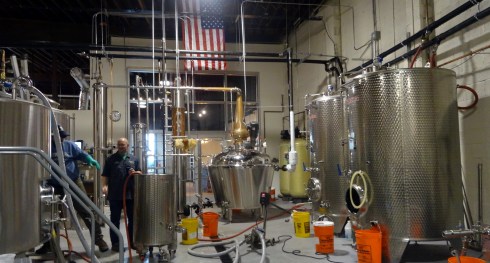
But now Deacon Giles, and rum distillation, has returned to Salem in the form of a new (and real) craft distillery named after the fictional distiller. Deacon Giles Distillery, located just off Canal Street, not only reflects the current appetite for crafted spirits, but also Salem’s rich rum-selling past. Rum is as “Salem” as the Witch Trials of 1692, Samuel McIntire, Hawthorne, and (unfortunately) Halloween: with eight distilleries in operation in 1821 and a reputation for the best “New England” rum around, the city logically became the target of the evangelical temperance movement in the next decade. It wasn’t just all about Deacon John Stone! And as the distillers were walking me around their beautiful “still house” this afternoon while talking about their triple-distillation process and pursuit of “purification”, I couldn’t help but think back to the days of the medieval alchemists, who also pursued the ultimate quintessence, or “elixir of life”, through a multi-step process in which distillation, the next-to-less step, effects the ultimate purification.

Spirits 121

Spirits 106

Spirits 112

Spirits 117

Spirits 103

Deacon Giles Distillery, 75 Canal Street, Salem: Tasting Room mural, the distillers at work, the products–Liquid Damnation Rum and Original Gin.

Deacon Giles was aided by the path which Salem’s craft hard cider brewery, Far From the Tree, paved and the amendment of the Salem zoning ordinance to allow Massachusetts Farmers Series licenses allowing them to produce, pour, and sell. Both businesses have great tasting rooms and really knowledgeable people eager to tell you all about their products while you sip them. I was really tempted today, but I didn’t think having a swallow of rum (or more) was a good idea when I had class in an hour!

Spirits 085

Spirits 091

The Far From the Tree Tasting Room on Jackson Street in Salem and two Far from the Tree ciders: they also have Rind (my favorite–but I think it is a seasonal variety), Spice, and several others. These ciders are great because they are really dry, as advertised. Next up: Notch Brewing on Derby Street!


Wooden Water Pipes

There are holes all over Salem, granting access to traces of our infrastructural past below. Lots of utility projects this summer, and even now, and each time I see men’s (it is always men) heads semi-submerged I run over to see what I can see. Generally, it’s just road layers and cobblestones–not very exciting. So when a friend posted a picture of the wooden water pipes uncovered during a big project on Boston Street, I got over there as quickly as possible. And there it was, just one pipe in pieces, except where it opened up into the property from the street. Amazing!

WWPipes

WWPipes 2

WWPipes 3

I am fortunate to have an archaeologist/historian and an architectural historian among my colleagues, so I obtained the essential information about how this pipe came to be on Boston Street relatively quickly. Apparently Boston, Salem, and Portsmouth, New Hampshire were laying such pipes in the 1790s, initiatives of incorporated aqueduct companies which were formed by the merchant communities of all three cities. In the case of Salem, the Salem and Danvers Aqueduct Company was established in 1797, “for the purpose of supplying the inhabitants generally of Salem and Danvers with pure spring water”, and in the spring of 1799 water began running through wooden pipes (pine was preferred) to the properties of its subscribers. The first reservoir was on Gallows Hill, in relatively close proximity to Boston Street. According to the Company’s history, demand was ever-increasing: the 3-inch-wide pipes were replaced by 5-inch pipes in 1804, iron replaced wood in the 1850s, at around the same time that the still-beautiful Spring Pond, bordering Salem, Lynn and Peabody (then South Danvers) became the primary reservoir, supplying the city of Salem with “the elixir of life” as author Samuel W. Cole observed in 1858. There were many leaking issues too, and the extraordinary craftsman/engineer Benjamin Clark Gilman (1763-1835) from Exeter, New Hampshire was called in to fix them, based on his experiences in Boston, Portsmouth, Exeter, and New London, Connecticut. Industrial demand kept the pressure on the Salem system, and in 1869, the private Aqueduct Company transferred the ownership of its corporation to the city of Salem.

Water Receipt 1844

Water Works Map 1893

Lynn Mineral Spring Hotel

Lynn Mineral Springs Hotel ad

Subscriber receipt, 1844, Peabody Institute Library. Note the stipulation about wasting water! 1893 Map of part of Lynn and Salem, including Spring Pond, which indicates the main water route–Wenham Lake soon replaced Spring Pond as Salem’s reservoir; The famous Lynn Mineral Springs Hotel at Spring Pond–later the Fay Estate–from Alonzo Lewis’s History of Lynn, 1844; 1831 advertisement for the Hotel, Boston Evening Transcript.


Oyster Square

Time to return to the very basics of life:  food, and plumbing! Today I’m thinking about oysters, and up next I’ve got a special post on wooden water pipes. Oysters–their harvest, sale, and consumption–have always been big business in Salem: Wellfleet is hardly the only Massachusetts oyster town! At present we have three restaurants which feature oyster bars: the excellent Turners Seafood at the Lyceum, the oddly-named Village Tavern Grill & Oyster Bar, and the relatively new and very popular Sea Level Oyster Bar on Pickering Wharf. In the past, Salem probably had many more oyster establishments that were also actual oyster bars, as this particular commodity has evolved over time from a working man’s food to a bit more of a delicacy. Today, Salem’s many restaurants are spread out across its downtown, from the water to the train station, but in the past they were concentrated in the area around the Old Town Hall or Market House. Derby Square and Front Street today are still busy commercial spaces while an adjacent alley that served as an “Oyster Row” of sorts a century or more ago is now silent: yet Higginson Square still bears the signs of its purveying past.

Higginson Square

Higginson Square 2

Higginson Square 3

The large brick commercial buildings on the east side of Higginson Square were built between 1895 and 1915, replacing earlier, smaller structures that served as dining rooms, bars, and wholesale purveyors of oysters and other foodstuffs. Their surviving shop windows indicated that they were functioning as retail establishments in the twentieth century too, but I don’t think this remained a restaurant row. These building have Derby, rather than Higginson, Square addresses now, but the one adorned with the fire escape was the earlier site of the Remond residence/restaurant/and oyster operation at 5 Higginson Square operated by John and Nancy Remond, the parents of Salem’s pioneering African-American abolitionists Charles and Sarah. The spotlight is always on the Remond children (a new park named after them is in the works now) but I’ve always been more interested in their entrepreneurial parents, who operated several businesses in Salem. Surviving advertisements for Remond oysters (“Let them be roasted, stewed, or fried; Or any other way beside; You’ll be well served, or ill betide”) indicate that the North Shore was no longer viable oystering ground in the mid-nineteenth century, as John was bringing in large supplies of oysters from Wellfleet and New York, enough to operate a veritable wholesale monopoly in Salem.

Oyster Square Trade Card

Oyster Trade Card SSU 2

Oyster Trade Card SSU

Oyster Trade Card 2

Oyster Square Trade Card Lynn

Trade cards from the collection of Salem State University Archives and Special Collections and the Digital Commonwealth–I had to include the Lynn fish! The Remond businesses came a bit too early for these cards. Below–Salem’s 19th century Market Square, where oyster and other eating establishments were clustered. Higginson Square is marked in blue.

Salem 1851


Cakes for Souls and Spouses

Some day, some night, I swear I am going to offer the hordes of Halloween trick-or-treaters that darken my door traditional soulcakes rather than Kit Kats or Butterfingers: now that would be asking for a trick! I think about doing this every year but never follow through: I’m too scared of the consequences, I think, or lacking in confidence in my ability to produce some decent looking cakes. I have already purchased my requisite 1400 pieces of candy so I’ll probably chicken out this year too. Soul cakes are often described as a cross between a biscuit (in the English sense, or an American cookie) and a scone, and sometimes as shortbread: there are lots of recipes available on the web, many adopted from early modern cookbooks. If I were going to go for it, I would probably go with one of the two recipes available here, my go-to source for food history. I suppose that the cakes are more appropriately distributed on All Saints or Souls Day (November 1 and 2), but no one will be coming to my door then: Salem will be returned to its residents! In any case, my Halloween cakes would be perfectly respectable with recognition of the pre-modern Hallow-Tide, which covers all three Hallowed days: from All-Hallows Eve or Halloween on 31 October through All Saints and All Souls Days. These Christian days were superimposed upon earlier Pagan holidays and traditions, creating a period in which the dead and the living were particularly close, and could affect one another’s fate. The medieval Christian view was that this was a time that the living should be working to get the dead out of purgatory, so bells were run, prayers were said, and gifts were given–in the form of cakes disbursed to bands of “soulers” who went from house to house singing ancient souling songs and offering prayers for the dearly departed. After the Reformation and the disappearance of a soul-packed Purgatory in most of Protestant Britain, souling evolved into outright begging, and eventually (jumping the Atlantic) into trick-or-treating. If there was no English Reformation, I wonder if we would all still be giving out soul cakes? Probably not.

Souls 17th Century

Soul-Cake-Main

soulcake

Seventeenth-century Souls, simply existing and ascending directly to Heaven without stopping at Purgatory–they don’t need any prayers or cakes! (Karel van Mallery after Jan van der Straet, Antwerp, 1609 and Johannes Amos Comenius, Orbis sesualium pictus, Nuremburg, 1658 , both Wellcome Library Images); Shropshire Soul Cakes, from a recipe available here, and a more modern Halloween cake on an early 20th century postcard.

Another cake long associated with Halloween in parts of the British Isles, most particularly western Scotland and the Isle of Man, is dumb- cake, very simple, salty grain and water cakes baked in the fire by unmarried women at midnight, with the aim of revealing their future spouses. While holding the pan, they were said to recite an ancient rhyme—Two must make it, two must bake it, and two must break it— and afterwards their future mates would be revealed in their dreams. Presumably the word “dumb” is a variant of “doom”, the Old English word for fate or destiny, although I’ve also read that the girls were supposed to remain mute while they baked the cake (then how would they recite the rhyme?). This kind of “divining for husbands” takes many different forms (cabbage-pulling, mirror-gazing) on both sides of the Atlantic, and survives in the form of various cultural expressions into the twentieth century.

Dumb Cake Play 1907

Halloween cake postcard

Title and first page of the play entitled The Dumb-Cake by Arthur Morrison and Richard Pryce, London, 1907, and an early twentieth-century variant of a dumb cake on a postcard from the same era.