Tag Archives: folklore

Krampus Cards

Krampus, that dark monstrous creature, cloven-hoofed, horned, hairy, and long-tongued, the antithesis of Saint Nicholas but also his companion, somehow did not make it across the pond with Old St. Nick’s descendant, Santa Claus–actually, he didn’t even make it across the English Channel. I’m not sure why not, except for the fact that he is a repulsive creature, who constrains mischievous children in his basket and carries them off to somewhere bad. So who wants him? Well apparently we do now, with the new Krampus film opening tonight and Krampusnacht festivals on the rise both in the old world (especially his native Austria, Switzerland and Germany) and the new on December 5th, the eve of the feast of St. Nicholas. He’s big in Los Angeles now, and Philadelphia, and also apparently Salem: can you imagine a better environment for Krampus than modern Salem?

Krampusnacht Austria

Saint Nicholas and Krampas

Krampus in the drawing room 1812-13

Krampuses getting reading for Krampusnacht in Stubaital, Austria, 2013, photograph by Sean Gallup/Getty Images; St. Nicholas bearing gifts and Krampus carting children away, two cards from the Christmas pictures by Raschka series by Raphael Kirchner, Museum of Fine Arts, Boston; Krampus sneaking into the drawing room behind St. Nicholas, from The Journal of Carl Baumann written 1813-25 by Franz Paumgarrten.

In his latest incarnation, Krampus seems a lot scarier now than he did a century or so ago, when he appeared regularly on Krampuscarten, holiday postcards issued in much of central and eastern Europe. He’s always been a beast, but he was a comical and/or polite one (almost knocking on the parlor door above!) at that time. His origins are somewhat obscure: his appearance mirrors the pagan or Neo-Pagan horned god but also the Christian devil. He seems like the embodiment of assimilated and dualistic Christianity to me, chained to remind everyone that as demonic as he may be, he is still under the command of God. According to all the “sources”, which cite one another but never the primary source, he becomes the companion of St. Nicholas at some point in the seventeenth century, and with the “invention of Christmas” and all of its “traditions” in the nineteenth century he assumes a major role in the festivities. Given his alpine origins, the most creative Krampuscarten are those created in Austria, in particular by the artists working for the Wiener Werkstätte before the First World War. These art nouveau Krampuses are a bit more stylized and whimsical than many of their more generic postcard counterparts, and they tangle with adults as well as children. Once men in Krampus masks begin to appear at the doors of their sweethearts on interwar cards, you know the Krampus has lost his sway.

Krampus and St. Nicholas WW 3

Krampus Koehler MFA

Krampuscarten by Wiener Werstätte artists Mela Koehler (1911), Arnold Nechanksy (1912) from the Neue Galerie and Josef Diveky (1909), Jutta Sika (1912) and Dora Suppantschitsch (1907), Metropolitan Museum of Art.

Appendix: A “Krampus versus Kringle” window at the Gulu-Gulu Cafe here in Salem snapped by my friend Lance Eaton—he’s going to put it on his own blog, but I’ve got it up first!

Krampus versus Kringle Eaton


Cakes for Souls and Spouses

Some day, some night, I swear I am going to offer the hordes of Halloween trick-or-treaters that darken my door traditional soulcakes rather than Kit Kats or Butterfingers: now that would be asking for a trick! I think about doing this every year but never follow through: I’m too scared of the consequences, I think, or lacking in confidence in my ability to produce some decent looking cakes. I have already purchased my requisite 1400 pieces of candy so I’ll probably chicken out this year too. Soul cakes are often described as a cross between a biscuit (in the English sense, or an American cookie) and a scone, and sometimes as shortbread: there are lots of recipes available on the web, many adopted from early modern cookbooks. If I were going to go for it, I would probably go with one of the two recipes available here, my go-to source for food history. I suppose that the cakes are more appropriately distributed on All Saints or Souls Day (November 1 and 2), but no one will be coming to my door then: Salem will be returned to its residents! In any case, my Halloween cakes would be perfectly respectable with recognition of the pre-modern Hallow-Tide, which covers all three Hallowed days: from All-Hallows Eve or Halloween on 31 October through All Saints and All Souls Days. These Christian days were superimposed upon earlier Pagan holidays and traditions, creating a period in which the dead and the living were particularly close, and could affect one another’s fate. The medieval Christian view was that this was a time that the living should be working to get the dead out of purgatory, so bells were run, prayers were said, and gifts were given–in the form of cakes disbursed to bands of “soulers” who went from house to house singing ancient souling songs and offering prayers for the dearly departed. After the Reformation and the disappearance of a soul-packed Purgatory in most of Protestant Britain, souling evolved into outright begging, and eventually (jumping the Atlantic) into trick-or-treating. If there was no English Reformation, I wonder if we would all still be giving out soul cakes? Probably not.

Souls 17th Century

Soul-Cake-Main

soulcake

Seventeenth-century Souls, simply existing and ascending directly to Heaven without stopping at Purgatory–they don’t need any prayers or cakes! (Karel van Mallery after Jan van der Straet, Antwerp, 1609 and Johannes Amos Comenius, Orbis sesualium pictus, Nuremburg, 1658 , both Wellcome Library Images); Shropshire Soul Cakes, from a recipe available here, and a more modern Halloween cake on an early 20th century postcard.

Another cake long associated with Halloween in parts of the British Isles, most particularly western Scotland and the Isle of Man, is dumb- cake, very simple, salty grain and water cakes baked in the fire by unmarried women at midnight, with the aim of revealing their future spouses. While holding the pan, they were said to recite an ancient rhyme—Two must make it, two must bake it, and two must break it— and afterwards their future mates would be revealed in their dreams. Presumably the word “dumb” is a variant of “doom”, the Old English word for fate or destiny, although I’ve also read that the girls were supposed to remain mute while they baked the cake (then how would they recite the rhyme?). This kind of “divining for husbands” takes many different forms (cabbage-pulling, mirror-gazing) on both sides of the Atlantic, and survives in the form of various cultural expressions into the twentieth century.

Dumb Cake Play 1907

Halloween cake postcard

Title and first page of the play entitled The Dumb-Cake by Arthur Morrison and Richard Pryce, London, 1907, and an early twentieth-century variant of a dumb cake on a postcard from the same era.


Turnip Ghosts

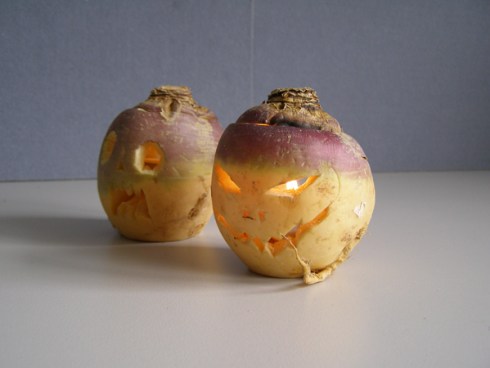
There is a great quote from the prolific and eminently quotable British writer G. K Chesterton about ghosts–or really belief– in general which references turnip ghosts in particular: I am quite ready to believe that a number of ghosts were merely turnip ghosts, elaborately prepared to deceive the village idiot. This is from a column in the Illustrated London News in 1936: the assumption is that his audience would immediately understand the phrase “turnip ghost”, and as they were British, they probably did. An American audience would and does require some translation. A turnip ghost refers literally to a Jack o’lantern made out of a turnip (but I would also include turnip-headed scarecrows)–something out there in the fields that was not a real ghost but that could create fear–a bugaboo (the best word ever). Old World turnips predated New World pumpkins as the material of choice for All Hallows Eve Jack o’lanterns, and remained predominate for some time, both in the British Isles and on the Continent. And you can easily see why: turnips are scary.

OLYMPUS DIGITAL CAMERA

Turnip Seed Packet Ghosted

Turnip Jack o’ lanterns from Work of Fiction (+directions); my own ghosted turnip seed packet.

The turnip-headed scarecrows are equally eerie: they turn up on Halloween postcards from the early twentieth century in both the United States and Europe, but are not exclusively tied to the holiday. Turnips just easily lend themselves towards anthropomorphic expressions.

Turnip Halloween Card

Turnip Head Howl's Moving Castle

Turnip Head Shakers

Vintage Halloween card, c. 1920; the Turnip-head scarecrow from  Hayao Miyazaki’s Howl’s Moving Castle; Vintage salt & pepper shakers available here.

I bought some turnips the other day–larger ones from a farm up north and smaller ones at our farmers market–with the intent to carve them into something scary, but I’m not sure I can do it–even with Martha Stewart’s assertive advice. They don’t have the soft insides of a pumpkin, and they are much more diminutive. I might chicken out and merely draw on them, because I’m not sure that I want to put in the time and effort: every single time I’ve carved out a pumpkin it has been stolen days before Halloween, and I’m sure my little turnip lanterns would be even more vulnerable!

Turnips 093

Martha Stewarts Turnips

My turnips and Martha’s creations: I might just settle for the turnips (and radishes) in a dish decoration, lower right. See a very scary traditional turnip Jack o’lantern here.


Witch Houses

Central to Salem’s evolution as the Witch City was the Witch House, a first-period structure that was the residence of one of the Trials’ judges, Jonathan Corwin. It was referred to as the Witch House back in the nineteenth century, when it housed a number of businesses–a longstanding drug store, later an antiques shop–and looked quite different than it does today, but it really became the Witch House when its evolving image was published on variant postcards from around 1900 on. The Corwin House acquired its seventeenth-century look in the middle of the twentieth century through a “restoration” under the direction of Boston architect Gordon Robb, and was opened to the public as the official “Witch House” by the city of Salem in 1948. As I’ve written about this House and its history before, I want to widen its context today by featuring some other Witch Houses, near and far, past and present, material and immaterial. There are at least two other houses in Essex County which were identified as such on postcards from a century ago, a time when there was a limited effort to turn the entire region into “Broomstick Country”. This was historically correct–the “Salem Witch Trials” were indeed a regional phenomenon–but commercially tricky, so Salem eventually claimed its exclusive title as the one and only “Witch City” with the Witch House.

The Old Witch House--Scene of Examinations at Salem. Illustration from Columbus and Columbia (Manufacturers' Book Co, c 1893).

Witch House Salem 1905

Witch House Danvers

Witch House Rockport 1910

Salem’s “Witch House” in 1893 (Columbus and Columbia Manufacturers’ Book Co, c 1893) and 1905: the George Jacobs “Witch House” in Danvers in 1907 (located in what was then Salem in the seventeenth century) and Rockport’s “Witch House”, also known as the “Old Garrison House” and still standing, in 1910. Supposedly two brothers from Salem built this house as a refuge for their accused sister or mother (depending on the source).

Farther afield, Witch Houses don’t have anything to do with witch trials: they just look like the sort of gothic structure that a romanticized witch might inhabit, like the Spadena “Witch’s” House in Beverly Hills, California, a storybook-style house built in 1921, or the famous Carl Van Vechten photograph of a long-lost “Witch House” in rural Maine during the Depression. The fairy-tale witches of the nineteenth century had created a more whimsical images of their houses in the twentieth, and clearly gables were seen as integral architectural details, so it is quite suitable that Salem’s Witch House would soon be enhanced with several.

witchshouse1

Witch House Van Vechten

Witch House Pyle 1887

Witch House Key Nielsen 1921

The California “Witch’s House’ in its original Culver City location, courtesy Beverly Hills Heritage; Carl Van Vechten, “Witch House”, 1936, Library of Congress; the Prince visits the Witch’s House in Howard and Katharine Pyle’s The Wonder Clock: or, Four & Twenty Marvelous Tales, Beind One for Each Hour of the Day (1887); The Witch’s confectionary cottage from Hansel and Gretel, by Kay Nielsen (1921).

Even farther afield in terms of both space and time is the woodcut print of a Witch House from the later sixteenth century by an anonymous English artist. This image, quite unusual as witches were generally depicted outside, in the wild, at this time, is often cited as appearing in the Swiss theologian Thomas Lieber (Erastus)’s Two Dialogues Concerning the Power of Witches (1579), but as Charles Zika points out in The Appearance of Witchcraft. Print and Visual Culture in Sixteenth-century Europe, the image appears to have been simply inserted into a 1579 English edition. Another fantasy house, although in this case it’s more about the exit than the architecture!

Witch House 1590


Fabled Friday the 13th

What’s wrong with Fridays that fall on the 13th day of the month? I thought I might try to uncover the foundations of this supposedly long-held western superstition but as is generally the case, all I found was a mishmash of “biblical”, “medieval”, and mostly-Victorian assertions. The biblical basis is the Last Supper, at which there were thirteen attendees including Jesus of Nazareth and his betrayer, Judas Iscariot, followed by the fateful/fatal Friday on which Jesus was crucified. Somehow, somewhere (the story goes) the gathering of 13 and the Friday execution are assimilated to create a dreadful day on which evil or (in Chaucer’s middle English verse) “mischance” can occur: And on a Friday fil al this mischaunce (The Nun’s Priest’ Tale).

Friday 13 Flinch Cards

There is an entire book about the number 13 and its associations are easily discerned, both negative (the antithesis of the perfect 12; 13 steps to the hangman’s noose; the 13th tarot card represents death; Apollo 13) and positive (a baker’s dozen; thirteen colonies, the thirteenth amendment), but the customary connection between the number and the day is a bit more elusive. One particular Friday the 13th that is often mentioned is Friday, October 13, 1307, the date on which the Order of the Knights Templar in France were formally indicted by King Philip IV “the Fair”, so that he might confiscate their vast wealth during the first years of the Avignon Papacy which rendered them defenseless. Certainly the Templars have resurfaced in the last decade or so with the publication of Dan Brown’s incredibly popular Da Vinci Code, but the Victorian era–a golden age of fraternalism–was also intensely interested in this suppressed and secretive order, and the fates of its members.

Royal 20 C.VII, f.44v

Tarot Cards XIII

British Library MS Royal 20 C VII, f. 4v: Templars being burnt at the stake; Tarot Cards no. XIII, representing Death, from the later 15th century (Victoria and Albert Museum Collection) and the later 19th century (see here for the full deck).

In the first decades of the twentieth century, this particular Black Friday (preceding our own commercial one) seems to have been become firmly established. There was the bestselling novel of Thomas William F. Lawson about a plot to bring down Wall Street on Friday the 13th (by sheer coincidence [?], the author’s namesake 7-masted schooner sunk on Friday the 13th) and then, in an obvious nod to the general acceptance of the day, Miss Rose Cade was crowned Queen of the Lemons on Friday, February 13, 1920.

Friday 13th.

Friday 13 Queen of the Lemons Rose Cade

Miss Rose Cade as Queen of the Lemons in California, February 13, 1920, Library of Congress Prints and Photographs Division.


Snow Light

I’ve got nothing…but snow: sorry, worldly readers, I must feature snow yet again! With another 17 inches deposited from this weekend’s storm, we are now up to about 7 ½ feet by my unofficial calculation. We’ve got two major ice dams over our bay windows (thanks Victorians!!! the 1820s house is tight as can be) that have been depositing incessant drops of brown water into our house over the past few days, and I woke up happy this morning because it was so cold that the leaking stopped…for awhile. That about sums it up. You do develop perspective when you go through a prolonged period of weather adversity, and begin to focus on the light at the end of the tunnel. I’m not sure that our tunnel is coming to an end yet (it’s only February!), but I did see a lot of light this weekend. Saturday night we walked to dinner through the snowy streets and I noticed it was so light outside, and when we returned home it seemed lighter still. What the weatherman was calling a blizzard was intensifying, and the sky was an eerie light gray–I almost expected to see the famous Boston Yeti out back….and there he was!

Snow again 009

Yeti in Salem Feb 14

Sorry it’s so blurry–I can’t venture out back because we haven’t shoveled, so this (these) picture(s) was taken through my dining room window, while it was snowing.  And yes, this is a rather pathetic attempt to place the Boston Yeti in Salem; he/she lives in Somerville, I believe. Seriously, that snow-lit sky was beautiful on Valentine’s Day evening, even though it meant ever more snow.

Snow again 026

Snow again 045

And yesterday, blustery cold. Behold the inside of my second-floor library window, with major ice-dam leak above: all clear and dry today, for now. I promise: this is my last post on snow!

Snow again 2 006

Snow again 2 002

Snow again 2 012


A Very Porcine New Year

Along with four-leaf clovers, chimney sweepers, mushrooms, and horseshoes, pigs were the most common symbols of good luck for the New Year a century ago, and they appear on all sorts of greeting cards for that purpose. This is a tradition that is more continental than British, and more eastern European than western–although some of the most charming New Year’s pig postcards I have seen are French. The lucky pig does not seem to have taken hold in New England expressions–even those by the Polish-born Louis Prang–but in New York State (or more specifically, Saratoga Springs), smashing a peppermint variety heralds in the New Year. Traditional New Year’s Day fare from central Europe features pork as well, though this seems a bit contradictory to me–why would you want to eat your lucky charm? Best wishes to everyone for a joyful 2015: may we all be as happy as veritable pigs in clover!

The best pigs are from Vienna……Carl Josza, Raphael Kirchner (c. 1899-1900), and more Mela Koehler (c. 1910), from the Lauder Collection at the Museum of Fine Arts, Boston.

Porcine New Year

Porcine New Year MFA 2

Porcine New Year Koehler 1

Porcine MK MFA

Porcine New Year 1910 Koehler MFA

Skiing (Swedish) and Skating (French) pigs, c. 1914-1915

Porcine New Year Swedish pre-war

Porcine New Year 1915 Skating

German postcards from the Spehr collection, available here: all the symbols (minus mushrooms) from 1908, and a pig on top of the world in 1915.

Porcine Postcard New Year's

Porcine New Year 9 World


Mummers Mumming

A 14th-century manuscript in the Bodleian Library contains the first illustration of mummers, costumed players or “guisers” performing occasionally out-of-doors in a merry band, for amusement and/or some form of compensation. These mummers, wearing masks of stag, rabbit, and horse heads, are in good company: accompanying them in the margins of this cycle of Alexandrian romances are knightly puppets, dancing monkeys, hunting hares, monks and nuns on piggyback, and monstrous men. There is nothing, absolutely nothing, to associate their appearance with Christmas revelry in the text of the manuscript, but several centuries later the Jacobean playwright Ben Jonson did just that in his 1616 Christmas Masque, in which the progeny of Father Christmas personify and epitomize the main institutions of the season: “Mis-Rule, Caroll, Minc’d Pie, Gamboll, Post and Paire, New-Yeares-Gift, Mumming, Wassail, Offering, Babie-Cake”. And from that point on, mumming was an essential part of the Merry Old English Christmas, as described by a succession of English social “historians” in the eighteenth and nineteenth centuries. From his American heritage perspective, the novelist Washington Irving (whose biography of Christopher Columbus laid the very solid foundation for the Flat Earth Myth), contributed to this association with his Bracebridge Hall sketches, first published in 1820. Mumming is part invention of tradition, part social commentary in the industrializing nineteenth century, both a sentimental look back to the way things were in a supposedly-simpler society and a controlled expression of seasonal “misrule” by the villagers or the workers for that society.

mummers_illuminated Bodley

Mummers 14th 19th c.

Bodleian MS Bodley 264, f. 21v: The Romance of Alexander in French verse, by Flemish illuminator Jehan de Grise and his workshop, 1338-44, with additional sections added in England c. 1400; Illustration from Old England, A Pictorial Museum, edited by Charles Knight (James Sangster & Co, c. 1845).

In the vast revival (or creation) of Merry Old Christmas that occurred over the nineteenth century, one book really stands out for me: Thomas Kibble Hervey’s The Book of Christmas:  descriptive of the customs, ceremonies, traditions, superstitions, fun, feeling, and festivities of the Christmas Season (1836). This is really a delightful book, made more so by the original illustrations by Robert Seymour. Hervey presents mumming as traditional custom and folklore, in the company of Morris and sword dances, regional plays and London pantomimes, and Christmas caroling, and definitely de-emphasizes the misrule. And Seymour’s illustrations (which you can see almost in their entirely here) depict the Christmas that we all want to have. Their audience was perhaps interested in escaping the increasingly-complex world that was being created by industrialization and urbanization, but it is rampant Christmas commercialization that makes me want a Merry Old Christmas with mummers, whether it was real or not!

book-of-christmas-05

book-of-christmas-07

book-of-christmas-16

Hervey’s Book of Christmas (1836), with illustrations by Robert Seymour,University of St. Andrews Special Collections.

Modern Mummers (excluding those from Philadelphia–a whole other story!):

Mummers Eurich 1952

Mummers 1980s

Mummers, 1952, Frank Ernst Eurich, Brighton and Hove Museums and Art Galleries; Fritz Wegner commemorative stamp for the 1981 GB Folklore series.


What I Want Now: Green Men on Plates & Paper

The acquisitive instinct in me has been kicking in lately, which I think is a good thing. I’ve been working very hard for the past year or so, and focusing on more material things gives my mind a rest. It’s really all about the search: I don’t have to buy, I can just look (really)!  Looking around, I get little short-lived obsessions, and right now I’m very focused on the creations of the prolific artistic partnership of Kahn/Selesnick, whose work spans decades and genres and explores a myriad of alternative historical and futuristic themes in ways that are both conceptually and visually panoramic. Be prepared to be submerged into other worlds if you check out their website or those of any of the galleries that showcase their work, most of which is way beyond my ability to acquire except, perhaps, for a few of their Green Men. When I was browsing around the online shop of the Morbid Anatomy Museum (which has quite an eclectic collection, let me assure you), I became immediately fixated on the Kahn/Selesnick calendar plates, which feature a different Green Man for each month, and then I was off on a mission in search of more.

Green Man November

Green Man November 2

Green Man December

Green Man December 2

I think I can swing one or two plates (of course I want them all) but the Green Man photographs are a bit too dear for me. I would love a few of the amazing hand-colored “souvenir” playing cards from Kahn & Selesnick’s Eisbergfreistadt (a fictitious independent city-state located on a Baltic iceberg in the 1920s) series, but they seem to be long sold out, so I suppose my only paper option is a seed pack designed by the dynamic duo for Hudson Valley Seed Library. I can frame it!

on a flowering path_d

Green Man Garden Suburb

PicMonkey Collage

teddy_bear_done

Kahn/ Selesnick “On a Flowering Path” and “The Green God” photographs @ the Carrie Haddad Gallery; Eisbergfreistadt playing cards at the Kahn/Selesnick online store; and sunflower seed pack at Hudson Valley Seed Library. More Green Men.


Of Mice and Martyrs

On this day in 1555, two of the three “Oxford Martyrs’ were put to death for their manifest Protestant heresy by the government of her Catholic Majesty Queen Mary I, an event which went a long way in cementing her historical identity as “Bloody Mary” after Protestantism was re-established in England. Bishops Hugh Latimer and Nicholas Ridley did not leave the country with her accession, like many of their conspicuous co-religionists, and so they paid the ultimate price along with the former Archbishop of Canterbury Thomas Cranmer, who was sent to the flames several months later. In his passionate and polemical account, Actes and Monuments, John Foxe illustrated the onset of their valiant deaths–just before the flames were lit– and recorded Latimer”s final words: “Be of good comfort, Master Ridley, and play the man; for we shall this day light such a candle, by God’s grace,  in England, as I trust shall never be put out.”

Mice Foxe

I thought I would take the occasion of this dark anniversary to explore a long-held connection between Mary’s most prominent martyrs and the children’s nursery rhyme Three Blind Mice. It seems like an odd pairing, but I have a distinct childhood memory of my mother telling me that Queen Mary was the mean farmer’s wife who cut off the tails of the three blind (-folded, apparently, or blinded by the light? or blinded by Protestantism?) mice/bishops/martyrs. Now she definitely had a Protestant bias, but she didn’t make this tale up–it’s been out there for a while, and the internet has done much to turn it into “fact” without much basis. Is there any? It sounds plausible, as seemingly-innocent nursery rhymes and fairy tales often have darker hidden meanings, but there are a few problems–and very little evidence–for any connection between the mice and the martyrs.

MICE Nypl 1918

Mice Nursery Songs

The most apparent problem is one of perspective: how could an account which portrays the Queen as a malicious woman (sometimes a miller’s wife, or a butcher’s wife, before she becomes exclusively the farmer’s wife) who carves off the tails of mice also portray those very same mice (bishops) as “blind”? It’s not clear whether there is an anti-Catholic or anti-Protestant bias here–certainly if it is the former the mice should be not only able to see the light but also enlightened:  they are the light, according to Latimer’s quote. But the biggest problem is any kind of contemporary allusion: the first reference to the rhyme (or “round”) occurs in a little 1609 ballad book, Thomas Ravenscroft’s Deuteromelia, or, the Second Part of Musicks melodie, or melodius Musicke, of Pleasant Roundelaies; K. H. mirth, or Freemens Songs, and such delightfull Catches as nothing more than a little ditty–whether it reflects an earlier verse I do not know. When it reappears in the various Victorian nursery rhyme compilations, it’s pretty much the recognizable standard. Something either happened in the interim or we have yet another example of the Victorian “invention of tradition”. In any case, there is no obvious hint of a Marian subtext in its first appearance. And there are far too many “generally accepted” references in the scholarly literature–I’m coming to the conclusion that the mice were just mice and the farmer’s wife wanted them out of her kitchen.

Mice Homer 1858Mice Paula Rego 1989 V and A

Illustration credits:  John Foxe, Actes and Monuments, 1563 edition; Jessie Wilcox Smith, 1918, New York Public Library Digital Gallery; Joseph Moorat, Thirty OldTime Nursery Songs, 1912 (Illustrated by Paul Vincent Woodroffe); Winslow Homer illustration from The Eventful History of Three Blind Mice, 1858; Paula Rego, Three Blind Mice, 1989, Victoria & Albert Museum