Tag Archives: Flora and Fauna

Very Odd Apples

My title actually refers to tomatoes rather than apples, a great example of a New World crop that was introduced into Europe though the “Columbian Exchange” and then brought back to America in the eighteenth century. Like another consequential import from the western hemisphere,  the potato, the tomato was slow to find acceptance among Europeans, primarily due to its first introduction in print by the Italian physician and botanist Pietro Andrea Mattioli (Matthiolus) in his 1544 Commentaries (the tomato page from a 1590 edition is below).  Matthiolus refers to the tomato as a “poma aurea” or golden apple, which is generally taken as evidence that yellow tomatoes preceded their red counterparts across the Atlantic.


Matthiolus tells his readers how to eat the tomato (fried in oil with salt and pepper) but he also classifies and compares the new vegetable (fruit?  He is confused as well) to the mysterious magical mandrake, which gives it a rather malevolent reputation in the early modern era.  Northern naturalists included the tomato in their “new” herbals in the sixteenth century, with name variations but the same magical associations. Conrad Gesner stressed the aphrodisiac qualities of mandrake but maintained its connection to the new plant in his Historia Plantarum (1553),  and thus “golden apples” became “love apples” (and sometimes “wolf’s peaches”) in northern Europe while in Spain the term “Moor’s apples” prevailed.  The most beautiful herbal of the sixteenth century, Leonart Fuchs’ De historia stirpium, included an illustration of the tomato in its later editions, as did Rembert Dodoens’ Cruydeboeck:

The most comprehensive herbal issued in sixteenth-century England, John Gerard’s Herball, was primarily plagiarized from Dodoens’ earlier work (there was a lot of “sharing” in the early modern publishing industry), but Gerard was a gardener who experimented with tomato cultivation (and consumption) himself.  He found the plant to be “of rank and stinking savour” and added this commentary:  In Spain and those hot regions they use to eat the Apples [of love]  prepared and boiled with pepper, salt, and oil:  but they yield very little nourishment to the body, and the same naught and corrupt.  Likewise they do eat the Apples with oil, vinegar, and pepper mixed together for sauce to their meat, even as we in these cold countries do mustard.”  An early reference to tomato sauce, this observation also tells us a lot about the difference between Mediterranean and northern European cuisines, then and now!

Taking their cue from Gerard, the tomato was scorned in Anglo-American cuisines until the modern era, despite efforts by such varied advocates as Thomas Jefferson, who cultivated tomatoes at Monticello, and the Neapolitan artist Michel Felice Corne, who escaped the Napoleonic Wars by departing Naples in 1800 on one of Elias Hasket Derby’s Salem-bound ships, the Mount Vernon.  Corne lived and worked in Salem for the next six years, ostensibly introducing both Italian painting techniques and Italian tomato sauce to the town, but Salemites would have none of the latter.  It would take another half-century or so, and a huge wave of Italian immigration, for “love apples” to become American (again).

Michel Felice Corne, The Ship Mount Vernon of Salem Outrunning a French Fleet

An 1869 Advertisement, Library of Congress


Wedding Flowers

 Yes, flower bells rang right merry that day,        

When there was a marriage of flowers, they say

In honor of the royal wedding, I’m featuring a charming Art Nouveau picture book, Walter Crane’s A Flower Wedding.  Described by Two Wallflowers.  Originally published in 1905 by Cassell & Company in London, the book has recently been republished in a facsimile edition to mark the Victoria & Albert Museum‘s current exhibition The Cult of Beauty:  the Aesthetic Movement, 1860-1880 (and perhaps another big occasion?)  I snatched up a first edition years ago, long before I knew what I had.

Walter Crane (1845-1915) was a well-know children’s book illustrator as well as an Arts & Crafts designer of wallpaper, textiles and other decorative arts. I suppose that A Flower Wedding is a children’s book, but it is quite a sophisticated one.  There’s a simple plot line narrating the wedding of “Lad’s Love” (another name for Sweet William)  and “Miss Meadowsweet” in which all the participants and guests are flowers drawn in human form .  Here are the bride’s attendants and mother, along with a very prominent guest, “Good King Henry” (one of my favorite herbs).

And before all of London, they were wed.


Renaissance Rabbits

Yesterday I found myself thinking and teaching about the intersection of science and art in the Renaissance quite a bit.  At one point I was lecturing on this topic with the visual aid of an older powerpoint presentation in which I had inserted a slide of Albrecht Durer’s Young Hare as a perfect illustration of observational art.  And suddenly it seemed as if I was seeing this image for the first time, so struck was I by its perfect depiction of an everyday animal.

I keep forgetting; it always stops me in my tracks.  I hope this particular image isn’t becoming too commonplace; Ballard Designs produced a cheap canvas wallhanging last year that both horrified and attracted me.  Rabbits are interesting because they so very familiar and unthreatening, but at the same time useful for social commentary.  In the medieval period, for example, you occasionally see a reversal “hunting hares” vignette in manuscript marginalia, where rabbits are the hunters (of hounds and men) rather than the hunted:  a classic world-turned-upside-down scenario.  In the Renaissance, the rabbit adds a touch of realism and familiarity to paintings and serves as a useful subject for illustrators striving to prove their technical skills.

Below are four fifteenth-century images of rabbits demonstrating the transition from anthropomorphic actors to observed objects, all from the British Library Digital Catalogue of Illuminated Manuscripts:  baking and jousting (with a snail! on a monkey’s back! And the snail’s monkey is on stilts) rabbits from marginalia, a rabbit illustrating a celestial chart, and a page from an Italian herbal.

British Library MS Lansdowne 451

British Library MS Harley 4379, Froissarts Chroniques

British Library MS Arundel 66, 1490

British Library MS Sloane 4010

After the sixteenth century turned, a succession of Renaissance bestiaries were issued with updated, “scientific” information about the beasts of the world (both ordinary and exotic) and detailed accompanying illustrations.  The most popular Renaissance bestiary by far was the Swiss naturalist (and alchemist) Conrad Gesner’s five-volume Historiae Animalium (1551-1558) which features a charming illustration of a rabbit, shown below, along with an English “cony” from Edward Topsell’s translation and abridgment of Gesner, The Historie of foure-footed beastes (1607).

All rabbits represented sexuality and fertility (then as now), but apparently white rabbits symbolized a special virginal type of fertility, hence its prominent placement in Titian’s Madonna of the Rabbit (1530; the Louvre), shown below. 

An even rarer breed of rabbit, perhaps the victim of some genetic disorder or the predecessor of the legendary jackalope, is the horned rabbit, or “Raurackl”, pictured in a print from the Flemish artist and illustrator Joris Hoefnagel’s Animalia Qvadrvpedia et Reptilia (1575-80).

Even with his more familiar companions, this rabbit presents a rather unsettling image; best to return to where I began, with realistic and reliable representation of the common hare.  This last image (Crouching Hare)  is from my favorite seventeenth-century observational etcher, Wenceslaus Hollar, whose works are accessible at the University of Toronto’s Wenceslaus Hollar Digital Collection.


The Crowninshield Elephant

Western encounters with the eastern elephant commenced with the display of its military might in the ancient era and intensified after the Crusades.  Before the eighteenth century, Europeans had few opportunities to see an elephant, but they had been exposed to elephants in lore and legend and script and print for years.  They could read (or hear) about King Henry III’s elephant in the thirteenth century, Pope Leo X’s elephant in the sixteenth century, and the natural histories and travel narratives of the early modern era contained ample references and images to elephants, ever the symbol of the exotic east.  So by the time we get to the later eighteenth century, there was certainly enough curiosity and demand to justify the effort and expense of bringing elephants to urban areas on both sides of the Atlantic where they could be seen (in the flesh) and touched.

Henry III’s Elephant (a gift from the French king Louis IX),from the Chronica Majora of Matthew Paris, c. 1235-59. Parker Library, Corpus Christ College, Cambridge University

Pope Leo X’s Elephant (a gift from the Portuguese king Manuel I), c. 1515, from a drawing by Raphael

John Johnston, Historiae Naturalis, 1657

The man who brought the first elephant to America on April 13, 1796 (215 years ago today!) was Captain Jacob Crowninshield (1770-1805), future member of Congress and Secretary of the Navy appointee and a member of one of Salem’s most dynamic and upwardly mobile families.  Within a century of their arrival in the America at the end of the seventeenth century, the German Kronenschiedt family had transformed themselves into the thoroughly American Crowninshield shipping dynasty, and they were on the verge of transforming their economic power into political and cultural influence in the new nation.  Jacob was one of five Crowninshield brothers who maintained the family shipping business in the Federal era, bringing valuable international goods such as tea and pepper back to Salem.  A Crowninshield ship, the Minerva, was the first Salem vessel to circumnavigate the globe in 1802.  Though the Crowninshield Wharf no longer stands, three prominent Salem buildings still testify to the family’s wealth and influence in Salem’s golden era:  the family’s first Salem homestead, the  Crowninshield-Bentley House (1727-30) on Essex Street, the Crowninshield-Devereaux House (1806, designed by Samuel McIntire) on Salem Common, and the present day Brookhouse Home for Aged Women on Derby Street (1810-12).

View from Crowninshield Wharf, George Ropes Jr.  Peabody Essex Museum

View from Crowninshield Wharf, George Ropes Jr. Peabody Essex Museum

The Crowninshield-Devereaux House in 1941, HABS, Frank Branzetti, Photographer. Library of Congress

By all accounts, Jacob Crowninshield looked upon the elephant as an investment, and it was a good one.  After docking in New York City with the young (2 or 3 years depending on the source; she certainly grew considerably after her arrival in America) Indian elephant which had purportedly cost him $450, he sold her to a Philadelphia man named Owen for $10,000.  Owen and his partners put the nameless elephant on tour, and you can follow her progress up and down the eastern seaboard through the newspapers.  The first notice below is from a newspaper in Aurora, New York, while the illustrated broadside (from the Peabody Essex Museum, but available in digital form at Salem State’s Landmarks of American History website: Becoming American: Trade, Culture and Reform in Salem, Massachusetts, 1801-1861) indicates that the elephant was on display in Boston (and later Salem) in the late summer of 1797, 18 months after its arrival in America.  And after Crowninshield’s elephant, a succession of elephants (Old Bet, Little Bet, Columbus) went on tour until about 1820, after which the Asian elephant was viewed as decidedly less exotic.

Advertisement for the Elephant Columbus in the Boston Columbian Centinel, December 13, 1817

P.S.  If you want to hear another version of the story of Crowninshield’s elephant, you can download “Captain Crowninshield” from the Philadelphia band Cheers Elephant’s cd Man is Nature.


Something about Cherries

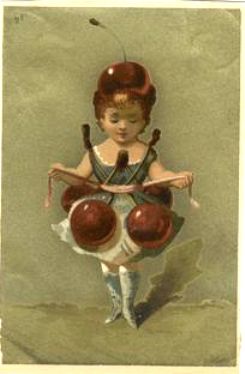
When you put Japan and America and Spring together you automatically get cherries, right?  I have these cards in my ephemera file (under “fruit people”, a surprisingly large category) and was never sure what to do with them or how to tie it them to anything I’ve been writing about, but then I realized (from the Library of Congress’s Today in History site) that this weekend marks the anniversary of the first planting of the Japanese cherry trees in Washington in 1912, so there you go.  I love the sentiment on the first card (Cheer Up!  Cherries are Ripe) and it is clear from the last two that cherries make everything better, even cough syrup.


At about the same time that drug and beverage companies were adding cherry flavor to their recipes (the first “organic” additive) thousands of Japanese cherry trees were planted in Washington. I’ve seen the spring cherry blossoms in Washington several times, and they are beautiful.  You would think that a gift of friendship from Japan to the United States would be a simple and somewhat spontaneous gesture but apparently it took some time to germinate.  The woman behind Washington’s cherry trees was Eliza Ruhamah Scidmore, one of many Americans who travelled to Japan during the Meiji Restoration, fell in love with its landscape and culture, and wanted to take something back home (I wrote about another here).  It took Miss Scidmore, a writer, photographer, and the first female board member of the National Geographic Society, several decades to bring about the planting of Japanese cherry trees in her native Washington.  The key moment came when she was able to convince First Lady Helen Herron Taft of this necessity, and on March 27, 1912 Mrs. Taft and the wife of the Japanese Ambassador planted two Yoshino cherry trees on the Potomoc River’s Tidal Basin bank, the first of over 3000 donated to the United States by Japan in that year.  In 1965, another 3800 trees were sent over by Japan, further identifying the American capital with cherry blossoms.

The Tidal Basin in the late 1920s, Theodor Horydczak photograph, Library of Congress

Crowning the Queen of the Cherry Blossoms (the daughter of the Japanese Ambassador) in 1937, Library of Congress


Miss Scidmore was not the only westerner entranced by Japanese cherry trees.  More locally, Charles Sprague Sargent, the first director of the Arnold Arboretum in Boston, employed intrepid “plant hunter” Ernest Henry Wilson to find just the right Asian cherry tree varieties for the park.  The two men are pictured below in 1915, before a flourishing specimen.  Salem’s famed horticulturist Robert Manning was also an admirer and cultivator of cherry trees, though more of the “English” variety (brought to England from the Continent by Henry VIII in the early sixteenth century) than the Asian ones.

Cherries from Robert Manning's Book of Fruits, 1838

Of course, the other reason why Miss Scidmore wanted cherry trees installed in Washington was their connection to its namesake, the first President.  All forms of popular culture from the period make it clear that Washington the man was inextricably intertwined with the cherry tree he cut down as a boy (thus revealing his truthful nature):  what better way to compensate for this mistake than by planting thousands of replacements in Washington the city?

Washington trade cards and Journal magazine cover from New York Public Library Digital Gallery; Washington cherry jell-o advertisement, Duke University Library Ad* Access Collection.


Springing into the Seventeenth Century

Despite the fact that it’s not exactly New England’s shining season, I love spring.  It’s my favorite season by far; I even get a little glum when it turns into summer.  It’s just such a hopeful time, and so dramatic; one year I watched the grass turn green in an afternoon. There are signs of spring in the garden (goldfish awakened from their states of hibernation, little green buds on shrubs and trees), but we sustained so much tree damage this past winter that I kind of dread going back there for long, yet.  I did put a pot of hellebores—my harbingers of spring–on the front stoop, but that’s the extent of my spring “gardening” so far.

Instead of tending to my garden, I’m going to welcome spring in my closet by indulging in a biannual ritual:  the changing of the clothes.  I’m also putting together a series of lectures on the “consumer revolution” of the seventeenth century this week, and am consequently indulging in another passion:  perusing the works of  Bohemian artist Wenceslaus Hollar (1607-77).

Hollar escaped war-torn central Europe and ventured to England with Thomas Howard, the Earl of Arundel, to document the “Collector Earl’s”  large and growing collection through his amazingly-detailed etchings.  Hollar’s work did not end with Lord Arundel’s collection; he went on to document many aspects of his adopted country’s society and culture in over 2700 etchings, most of which were printed.  Hollar’s focus and images are so varied that he really transcends the role of artist and becomes a “photographer” of sorts, capturing the street life, architecture, and events of his age.  It’s not just Hollar’s range, though, it is the details, and the texture,  that he infuses into every work that makes his images so captivating.  My students love them, and so do I. 

Hollar’s skill at capturing surface detail is particularly apparent in his depictions of clothing, which two of his print collections, The Severall Habits of English Women and The Seasons, do so vividly.  So here is Spring, represented by a fashionable young noblewomen in mid-seventeenth century England and several seasonal pastoral scenes, all from the Wenceslaus Hollar Digital Collection at the University of Toronto:


An Assemblage of Owls

Inspired by news and a great photograph of a big barred owl that has recently taken up residence in south Salem, I assembled a little group of owls on my bedroom mantle.  Several of these guys come from the two connected shops on Front Street in Salem,  Roost and the Beehive, which I stop by with increasing regularity.  I love printed and figural representations of birds and animals and am rather enthusiastic about displaying them in our home:  elephants are always around —to the point of near-tackiness and maybe beyond—and I’ve gone through bear, deer, swan, snail, and rabbit phases with little restraint.  I’m thinking about foxes for the future.  I had a brief bout with owls this fall and thought I was done, but apparently not.  A passing glance at that great owl on McKinley Road drove me to retrieve my “owl box” in the basement and to my favorite medieval bestiary, the “Salisbury” Bestiary from circa 1250, for the images below.  To illustrate the increasingly realistic (and scientific) perception of the owl, I’ve also included images from Konrad Gessner’s Histories of the Animals (1551-58), one of my favorite teaching texts because of its beautiful woodcut illustrations and its nascent empiricism, and John Gould’s more recent Birds of New Guinea and the Adjacent Papua Islands (1875).


Past and Future Plants

My Christmas tree is en route to its final destination, the annual bonfire at Dead Horse Beach at Salem Willows, and I am perusing garden catalogues, the focus of every gardener I know in January and February.  I love my White Flower Farm catalogue, which seems to arrive precisely on January 2 every year, as well as those from Perennial Pleasures in Vermont and Select Seeds in Connecticut, but even with its beautiful photographs and substantive descriptions of plant culture I have to admit that it cannot compare to its counterparts of a century earlier in terms of pure aesthetics.  Late Victorian and early twentieth-century seed catalogues are truly works of art, as illustrated by these covers from Boston and Marblehead nurseries, all from the Smithsonian Institution Library.

My Salem predecessors a century or more ago might have purchased their seeds and plants from these local purveyors, but THEIR predecessors had an extremely prestigious horticulturalist immediately in their midst:  Robert Manning, Nathaniel Hawthorne’s uncle and one of  the founders of the Massachusetts Horticultural Society.  Manning (1784-1842) maintained a large orchard and nursery in then-pastoral North Salem or North Fields adjacent to his homestead at 33 Dearborn Street (very recently featured on Historic Salem‘s 31st annual Christmas in Salem house tour) which was said to feature over 2000 varieties of fruit trees, half of which were pear cultivars.  He was THE pear and fruit-tree expert, a title that was solidified with the publication of his Book of Fruits:  Being a Descriptive Catalogue of the Most Valuable Varieties of the Pear, Apple, Peach, Plum and Cherry, for New-England Cultures in 1838, a standard work that was frequently reprinted in the mid-nineteenth century under the title The New England Book of Fruit.


Oh Deer!

Why is it that the warm and festive decorations of Christmas look so wilted, glitzy and gaudy in the cold clear light of early January?  One really craves Scandinavian simplicity at this time of year.  I chose a reindeer theme for this year’s holiday decor and now I’ve got alot of deer to pack away, along with ornaments and other embellishments.  In addition to the reindeer head measuring cups from Anthropologie and the John Derian plates on our marble mantles, my favorite reindeer this year is the fabric wall hanging from Middleburg Folk Art Studio.