Tag Archives: ephemera

Collecting Salem on Etsy

Time for another Etsy post, motivated by finding one of my very favorite Salem books on the site:  Salem Interiors by Samuel Chamberlain (1895-1975).  Chamberlain was a Marblehead-based photographer, artist and author, whose books of New England photographs are now classics–and very collectible.  The 1950 edition on Etsy looks like it is in great condition and is very reasonably priced.  Just click on the image (and those following) and you’ll get to the Etsy listing.

I’m not one to promote Salem witch items, but there is an amazing collectible plate on Etsy right now:  an early (circa 1900) souvenir plate rimmed with 18 little witches made by the Petersyn Company of Passaic, New Jersey.  For a witch plate, this one is quite charming, relatively rare, and well-priced. This is one of the earliest porcelain expressions of “Witch City”.

There are some lovely Hawthorne editions on Etsy now, including several that are very collectible, like a 1930s edition of Tanglewood Tales with illustrations by the short-lived artist Virginia Francis Sterrett, whose flying dragon seems like a good companion for the Salem witches.

Lots of carte-de-visite and cabinet cards from Salem’s many turn-of-the-century photographers:  a “young dark-eyed woman in a walking suit” taken by the Cook Photograph Studio in the 1890s, a “beautiful Victorian woman in a romantic, angelic pose” from the 1880s, and a “lambchop whiskered” man (love these Etsy descriptive titles!) photographed by the Bonsley and Moulton Studio. I tend to like the typography as much (or more) as the photography.

Vintage Game collectors can always find Parker Brothers products on Etsy.  I have never seen or heard of this “reading” game called Peter Coddle’s Trip to New York but it looks interesting, and I’m intrigued by all these scraps of ephemeral paper; it’s a miracle they survived this long.

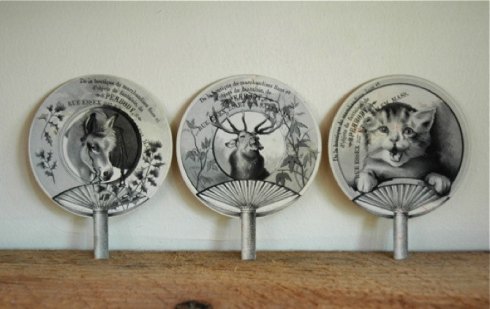
And finally, some amazing pieces of advertising ephemera:  three advertising fans, in French, for the Peabody’s Dry and Fancy Goods Bazaar in downtown Salem.  Salem had a large and growing French-Canadian population in the first half of the nineteenth century, and I suppose this was the target audience for the fans, which feature a stag, a pony, and (of course), a kitten.


Little Folks and Black Cats

A little window into the publishing world of turn-of-the-century Salem and Boston today.  I found it difficult to reconcile the very divergent titles of the prolific Salem publisher Samuel Edson Cassino until I uncovered the family history behind the family business.  The S.E. Cassino Company is best known for producing children’s literature, both periodicals like the long-running Little Folks.  The Children’s Magazine (1897-1923) and charmingly-illustrated texts like Edith Francis Foster’s Mary’s Little Lamb:  a Picture Guessing Story for Little Children (1903).

These publications contrast sharply with the other Cassino titles, issued in Boston rather than Salem, primarily scientific compendiums like the annual Naturalists’ Universal Directory.  It turns out that Samuel Edson Cassino, a trained naturalist who married into a prominent North Shore family and turned to publishing, focused on his own interests down in Boston and left the newer (and I suspect more profitable) branch of his business to his daughter Margherita Cassino Osborne, an 1899 graduate of Radcliffe College.  Margherita not only edited Little Folks and several other serial publications (and later put out her own children’s books) but seems to have managed all of the Salem publishing operations, along with her second husband Frank Wellman Osborne.  The Cassino catalogue acquired another–even more diverse–serial title in 1912:  the very interesting early science fiction Black Cat magazine, founded by Herman D. Umbstaetter in Boston in 1895.  The operation of Black Cat were moved from Boston to Salem (which must have seemed appropriate to everyone, as this was just when Salem was beginning to transform itself into “Witch City”), and was managed by Mr. Osborne until its demise in 1920.

The family business was certainly profitable but there’s a (relatively, materially) tragic chapter in the Cassino story as well:  their stately mansion on Lafayette Street, pictured below in 1910, was completely destroyed by the Great Salem Fire of 1914.


Steam Power

I’ve been doing some research on Salem manufacturers in the late nineteenth and early twentieth centuries for an upcoming fundraising event at the Salem Athenaeum with a steampunk theme (lots more on this later) and am a bit overwhelmed:  there were so many.  America was certainly a country of makers a century ago; now it seems like we’re mostly sellers. Anyway, since I’m taking the steam in steampunk literally I have found myself focusing on all sort of machinery makers in general and the Locke Regulator Company of Salem in particular.  This company, founded by two New Hampshire brothers, Nathaniel and Alpheus Locke, who came down to Salem to make their fortune, grew from a back-of-the-barn operation in the 1870s and 80s to big business after its incorporation in 1902.  The large Locke factory, pictured on the first piece of “industrial ephemera” below (from 1910), was located on the banks of the North River in Salem, now the site of a junkyard and a car wash.  According to the claims of the last advertisement below, by 1913 the Company was the largest Manufacturers of Steam Vehicle Parts & Fittings in America.

The Company experimented with automobile manufacture in the first decade of the twentieth century (that’s another dynamic industry at this time; it seems like every town or city of a certain size had several small automobile makers within its midst), building a little “runabout” called the Puritan, but I think they must have soon realized that their future was in parts.

a 1902 Puritan steamer from the Early American Automobiles website; Locke shears from the same year.

The Locke Regulator Company appears to have been a family business, both before and after its incorporation and period of dynamic growth.  Alpheus retired from the business  in the 1890s, but Nathaniel continued on, with his brother-in-law, son, and son-in-law all working for the company at one time or anotherTheir factory was in North Salem, as were their residences, primarily on or in the vicinity of Dearborn Street, very close to the threatened homestead of another prominent family that I wrote about in my previous post.  The Ropes family and the various Lockes were neighbors, and perhaps friends.  At the turn of the last century, Nathaniel and his wife Sophronia were living on one side of Dearborn Street, in a “new” house built for them in 1874, while their son Albert was living almost just across the street, in an even newer (and bigger) house built for his family in 1896.

Dearborn Street just before World War One; the Albert N. Locke House yesterday.


Calendar Girls

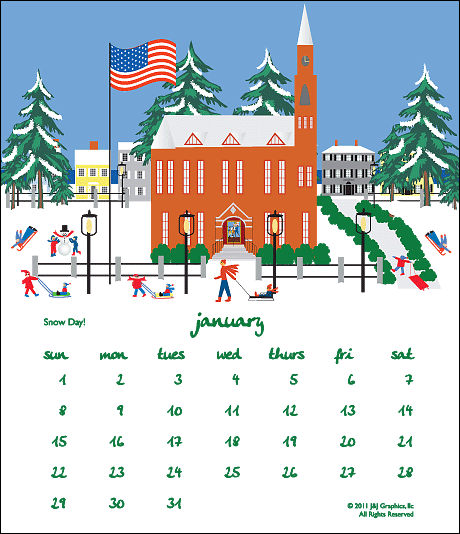
I’m a bit late for a calendar post, but then again I always buy my calendars after January 1st–sometimes well after January 1st.  While I’m not likely to engage in consistent sale-shopping or coupon-clipping, for some reason I get great pleasure from buying my annual calendars after they have gone on sale.  We usually purchase a “North Shore Folk Art” calendar from J & J Graphics at the Peabody Essex Museum shop for our refrigerator, and sometimes I even wait until they have their big January sale (this year it’s on the weekend of the 20th-22nd, definitely worth a visit if you’re in our area).  I’ll post January right here so I know what the date is until I get my own.

Upstairs in my office I generally pick something a bit more girly, whimsical, botanical, historical..whatever catches my eye.  Right now I’m liking this ethereal calendar from Irena Sophia, already on sale on Etsy!  I like the September and October girls–and Miss foxy February.

Calendars are an important form of ephemera that I haven’t featured on the blog yet, so why not now?  At the same time, they are among the timeliest and most artistic of genres.  And like all the pieces of paper we’ve examined over the last year–postcards, trade cards, book plates–they emerged as a mass-produced product in the later nineteenth century, coincidentally with the development of chromolithography.  I love the calendars from the “Penfield era”, from about 1890 to 1920, when the distinctive designs of illustrator Edward Penfield (1866-1925) graced the covers of magazines and the pages of the new poster calendars much more than those that came later with their Vargas-inspired pin-ups.  My “calendar girls” kept their clothes on!

Penfield calendars for 1897 and 1906 from the Library of Congress, above, and the work of some of his predecessors below (so you can see what an impression he made on turn-of-the-century graphic design):  an 1876 advertisement calendar for cigars and champagne, and two calendars by Boston-era publishers, also from the Library of Congress.

Calendars from Penfield’s fellow art nouveau illustrators  Louis Rhead (for Prang) and A.B. Wenzell for 1897 and 1899 are below, along with another rather less-artistic 1907 Boston calendar, for the beloved Necco wafers, all from the New York Public Library.


Numerical New Years

I’ve collected a sequence of New Year’s Day cards (+ one poster) from a century ago, when separate New Year’s Day greeting cards were issued by the thousands, both in America and Europe.  The collective “Season’s Greetings”/ “Happy Holidays” cards began to dominate the message after World War II, with the consequence that New Year’s now seems to be a mere afterthought of the Christmas celebration.  New Year’s Day cards are interesting because they feature an assortment of trans-Atlantic traditions and tropes which are supposed to bring good luck in the next year:  pigs are very popular, as are the traditional horseshoes and clovers. There are babies, of course, and the occasional champagne glass or bottle. For some reason, mushrooms appear on a lot of cards, particularly European ones, sometimes with gnomes, sometimes not.  I thought I’d feature “year” cards–in chronological order–from the first decade and a-half of the twentieth century, from my own collection and that of the New York Public Library Digital Gallery.  First off, cards from Germany and Switzerland, followed by my very favorite card (1904):  a lady on a pig against a background of four-leaf clovers, holding a glass of champagne. And mushrooms!  How lucky can you get?

“Smoking New Year’s”, evoking the two-faced Janus, by artist and illustrator Frank Graham Cootes (1879-1960).


Bits of Holly History

It occurred to me that holly–the traditional symbol of Christmas and Winter–is often paired with something and seldom presented on its own.  The “holly and the ivy” is the best example, but there are many others, like this stylized little image of holly and a lyre on the cover of a Christmas concert program from 1898.  I found the program in a dusty box of sheet music at a yard sale a couple of years ago, and opened it just the other day.

That same day I also checked in with the blog of the Met’s Cloisters Museum, The Medieval Garden Enclosed, to find the “holly girls” decorating the museum’s arches with holly.  So beautiful!  I have both interior and exterior arched doorways and several flourishing holly bushes–I wonder if I could do this next year?  Probably not, but at least I can think about it.

Holly is often pictured in the margins of medieval manuscripts (usually with ivy, its companion plant) and seems to have had many associations and virtues, all positive.  With its bright red berries blooming in December, it represents light, warmth and hope, joy and goodwill.  It has always been a protective plant:  against poisons and demons, even lightning.  With the coming of Christianity, it came to be associated both with the Virgin Mary and the blood (berries) of Christ.  In the early modern era, the holly tree was prominently linked with the ars nova of printing, notably on the title age of Leonhart Fuchs’ De historia stirpium commentarii insignes (“New Herbal”, 1542-43).  The title-page device of Basel printer Michael Isengrin features a holly tree with a printing-house platen amongst its branches,representing its increasing secular symbolism.

And here are two more holly herbal images from Elizabeth Blackwell’s Curious Herbal  (1739) and Francois Andre Michaux’s North American Sylva (1819).  Blackwell illustrated her own book, while Michaux called upon one of the most famous botanical illustrators of his day, Pierre Redoute.

In the nineteenth century, the holly becomes the stereotypical holiday plant through advances in lithography and the emergence of the dynamic greeting-card industry, which produced millions of holly-embellished holiday cards.  But there were other images of the plant out there too:  elaborate theatrical costumes, ceramics, cigarette cards.  The collection of the Victoria & Albert Museum encompasses a large collection of costumes from the London theater, including these two creations by “Wilhelm” (William Charles Pitcher) for productions in the 1890s:  Holly personified, with Mistletoe and alone.  From the same era and collection is the Minton “Four Season” tile, with holly representing winter.

And then there were so many cards: cigarette cards for advertising, Christmas and New Year’s cards for “greeting”.  The first card below, issued by the Duke’s cigarette company in the 1890s, is part of a “Language of Flowers” series, which associated holly with “foresight”.  The second and third are British and from the 1920s, illustrating the uses of the (hard) holly wood (chess sets and teapot handles, apparently) and the boy scout “holly patrol” badge.  How the holly has “evolved”:  from the blood of Christ to the boy scouts!

And finally two greeting cards, both from the vast collection at the New York Public Library Digital Gallery like the cigarette cards above:  a simple New Year’s Day card from the turn of the last century and a birthday card of similar vintage on which holly is paired with something I’ve never seen before:  turquoise?


Juleneg

I don’t have a drop of Scandinavian blood in my veins, but I really love the northern European custom of Juleneg, in which a wheat sheaf is attached to a roof gable or adjacent pole or tree at Christmas time.  Elves or fairies are often pictured affixing these “Christmas bundles”– holiday feasts for the birds.  The wheat sheaf is so symbolic; for us it tends to symbolize the harvest, but it can also represent sustenance through the winter and hope fulfilled:  what better Christmas message?  I think we should adopt the Juleneg custom, especially here in Salem, where wheat sheaves have the additional connection to Samuel McIntire, the architect of our beautiful Federal city.

Wheat Sheaves for Christmas:  a Juleneg card from 1911, a McIntire mantle and pin from the PEM shop, the cover of a Federal-era snuffbox, and proofs for chromolithographic Christmas cards from Prang of Boston, 1880s (New York Public Library Digital Gallery).


Green (Room) Christmas

Apparently it was “Silent Cal” Coolidge who initiated the customs of both the national Christmas Tree (in 1923) and the presidential Christmas Card (in 1927).  The former began as a subtle promotion for Coolidge’s state of Vermont, which sent along the tree, while the latter custom seems to have emerged from Mr. and Mrs. Coolidge’s sincere appreciation for the large number of condolence and Christmas cards they received after the sudden death of their youngest son from blood poisoning in 1924.  The Christmas Cards from the Coolidge, Hoover, Roosevelt and Truman administrations are pretty sedate, which makes sense considering they were issued in an era dominated by the Depression and World War, but things begin to liven up with the Eisenhower and Kennedy eras:  could White House Christmas cards be signs of the times?

I was going to showcase chronological Christmas cards by administration, but frankly the pre-1960 ones were pretty boring.  A completely representative example is this 1941 card below,  but its simplicity and sedateness is understandable–this was only a few weeks after Pearl Harbor.

The first National Christmas Tree, 1923; Library of Congress; the Roosevelt 1941 Christmas Card, White House Historical Association.

Looking at all these cards, I became fixated on those showing White House interiors in general, a tradition that began with the Kennedy Administration, and the Green Room in particular:  I’m a big Red Room fan too, but the Green Room Christmas cards really capture the essence of the season for me.  So here they are:  Green Room Christmas cards from the Kennedy, Reagan, and Clinton administrations.  The first one, by illustrator Edward Lehman, is obviously the most poignant (and valuable), as it was issued only a few weeks after President Kennedy’s assassination to only a select few–primarily White House staff.  Twenty years after the Lehman image, interior designer Mark Hampton reproduced the newly-redecorated Green Room in watercolor for the Reagan’s 1983 Christmas Card.  And finally, the Clinton’s 1996 Christmas card by artist Thomas McKnight.

The Green Room decorated for the Holidays this season, with wreaths and trees made of recycled newspapers and magazines, illustrating the theme “Reflect, Rejoice, and Renew”.


Prang of Boston

Last month, the Peabody Essex Museum here in Salem opened a year-long exhibition of seldom-seen treasures from its Phillips Library entitled Unbound, Treasures from the Phillips Library at PEM.  Even though the exhibit includes a leaf from the Gutenberg Bible and original transcripts from the Salem Witch Trials (which, pardon my rant, are public records and should be more generally accessible), the most compelling visual images in the exhibition are the progressive proofs for a lithographic portrait of Ludwig von Beethoven produced by Louis Prang  & Company of Boston in 1870.  The collective image is very modern in its repetition and perspective, and also illustrates the intensity of the chromolithographic process.

Progressive Proofs from the Phillips Library, PEM, and the finished portrait from the New York Public Library Digital Gallery.

Prang & Company was the color printer for most of the second half of the nineteenth century.  Louis Prang learned the art of color lithography in Germany and perfected it in Boston, where he produced reproductions of great works in the spirit of “the democracy of art”.  He was a also a practical printer who produced thousands of cards, calendars, and advertisements for his always expanding market. Prang’s “views”, whether artistic, historical, or scenic, seem to have a strong American  theme; he had fled Europe right after the tumultuous revolutions of 1848 and clearly valued American democracy as well as cultural democracy.  Here are some of my favorite Prang prints from the Library of Congress and New York Public Library; given the business locale, the Boston Public Library also has a large collection of Prang prints.

A very diverse assortment from the Library of Congress:  the popular bird’s eye view of Boston (1877), a kitchen view  from Prang’s Aids for Object Teaching (1874), a baseball game(1887), and an undated still-life.

I find Prang’s advertising posters even more appealing than the products they are peddling, especially as we get closer to the turn of the century and art nouveau imagery.  Here are a few advertisements from the New York Public Library Digital Gallery, both from the 1890s.

Prang is also an important figure in the history of ephemera, quite apart from chromolithography, because of his pioneering role in the emerging greeting card industry.  I’ve seen him referred to as the “father” of the Christmas card (and the Valentine’s Day card, and the Easter card, etc…) more than once.  I’ll post some Prang cards a bit later in the season, but for now, just a preview.


Stars, Stripes and Turkeys

A century or so ago, Thanksgiving seems to have been commemorated as one of our most patriotic holidays, on a par with Independence Day.  Its gradual transition from custom to national holiday was definitely accelerated by wars:  the Revolutionary War, the Civil War, and World War II all brought official recognition of a day of collective and public thanks-giving in November.  In 1789, George Washington signed a proclamation designating November 26 a day of national Thanksgiving, and in the midst of the Civil War President Lincoln proclaimed that the last Thursday of November be “set apart as a day of thanksgiving and praise”.  During another time of national crisis, just after the attack on Pearl Harbor, Congress gave its official seal of approval for the last-Thursday holiday in an act that was signed by President Roosevelt on December 26, 1941.  Along with wars, the constant flow of immigration no doubt also motivated the celebration of Thanksgiving as a unifying, national (and also increasingly secular) occasion, and the postcards below really reflect that message.  They are all from the first decade of the twentieth century, a peak period for European immigration into the United States, and the vast postcard collection of the New York Public Library.

The New York Public Library also has a large collection of historic restaurant menus, many of which are digitized, allowing you to chart changing culinary traditions.  The standardization of Thanksgiving fare and the official recognition of the holiday definitely go hand in hand.  Having spent several Thanksgivings in Britain, I found this menu cover from the 1906 Thanksgiving Day Banquet put on by the American Society in London particularly appealing, and it also reflects the language of both Washington’s and Lincoln’s earlier proclamations, which called for the national day of Thanks-giving to be celebrated by Americans everywhere.