Tag Archives: ephemera

Salem Murder Mystery

For some time I’ve been curious about the death of a patent-holding, pioneering Salem photographer named George K. Proctor in 1882:  I’m not sure whether he died by his own hand, or that of his wife, so while his death might not have been murder, it remains a mystery to me (and I could not resist the dramatic title).

First a little about his life. Proctor operated what looks like a successful photography business here in Salem from the early 1860s until his death. Part of his success was no doubt due to his marketing techniques, and part due to the process for which he received a patent (no. 83,545) in 1868 for an artificially-lighted, oval-shaped photographic room which allowed photographs to be taken with a 15-second exposure, day or night. His studio on Essex Street produced tintypes and stereoviews upon commission and for sale, including this charming portrait of an anonymous woman, captured early in Proctor’s career (and at the very beginning of the Civil War).

Proctor 1861

Proctor 1861 back

G.K. Proctor, Anonymous Woman, 1861, Salem, Massachusetts.  Prints and Photographs Division, Library of Congress.

The instant I saw this image I wanted to know more about this woman, and the man who captured her on film. Sadly, I haven’t been able to turn up anything on her, and just a bit more on Proctor. He was a prolific photographer (or photographist, as he is sometimes called) so many of his images survive, but most of the literary and documentary evidence of his life is primarily concerned with his death. Before I get into that, a few more of his images, which do seem to fall into two categories:  the tintype portraits like that of the woman with the Mona Lisa smile above, and stereoviews of scenes that he captured while traveling around the region in his special photographic van and marketed in collections entitled “Views of Salem and Vicinity” and  “American Views”.  The Chestnut Street header at the top of my blog is a Proctor view, as are those below, all from the Dennis collection of the New York Public Library Digital Gallery.

Proctor Essex Street

Proctor Students

Proctor Funeral Car NYPD

Essex Street, Salem, unidentified students (and their teacher?) on the steps of their unidentified school, and the interior of a Peabody funeral car, 1870s stereoviews by G.K. Proctor, NYPL Digital Gallery.

With this last (strange) image providing some sort of segue, I’ll turn to the circumstances of his death in 1882. Mr. Proctor was found unconscious in the basement of his home (I’m not sure of the address:  according to the Salem Registers, he and his family seem to have moved between Endicott, Essex and Bridge Streets every two years or so but in 1882 they appear to have been living on Dodge Street) by his wife Sarah on the morning of July 27, 1882. She summoned the authorities, who confirmed that he was dead. From that point on, I followed the story in the New York Times, which was much more forthcoming than the local papers. The original judgment of natural causes quickly turned to suspicions of suicide and/or murder. And Mrs. Proctor quickly became the prime suspect.

Proctor NY TIMES 1882

And what did the District Attorney decide to do?  According to The New York Times, Sarah Proctor was arrested for the murder of her husband some two and a half years later. In a short article headlined Charged with her Husband published on February 2, 1885, the Times reported:

Proctor New York Times February 3 1885

So I expected to find a trial, but instead all I have found is a brief note in the 1886 Annual Report of the Massachusetts Commissioners of Prisons indicating that the case of Mrs. Proctor, indicted on charges of murdering her husband, was discharged by the state Attorney General. No details, no explanations as to why, no news of a longlost suicide note finally brought to light!  That same year, there was another legal action involving Sarah Proctor: a suit brought against her by her daughter Lilla (Proctor v. Proctor, 141 Mass. 160) referencing money rather than murder. Lilla, who was a minor, had nevertheless removed herself from her mother’s house (now in Beverly), moved in with her aunt in nearby Malden, and become engaged. There was an accusation that Sarah “was not maintaining an establishment or family home”, and several references to the “difficulties” that existed between mother and daughter, but basically what Lilla wanted was her promised inheritance, or one-third of Proctor’s estate, which was still under the control of Sarah and her fellow trustees. The judge ruled in Lilla’s favor, and there is no further mention of either of them in the legal records. I am left wondering why, and how, the charges against Sarah Proctor were dismissed, and what, or who, caused George K. Proctor’s death.

Appendix: see another charming Proctor tintype portrait here.


A Two-Comet Year

Looking forward to the year ahead, as we all tend to do at this time, I notice that not only is this the “year of the snake” and the year of the (Pantone) color emerald green, but also a year in which there will be two great comets visible in the northern hemisphere. I’m working on an academic project on changing perceptions of wonder in the early modern era, and few things were as wonderful as a truly “Great Comet” blazing a very visible trail through the sky, so this is one of those times where past and present, scholarship and blog intersect, which is very exciting. It’s a rare year that one comet is visible to the naked eye, so the possibility of two is extraordinary. Comet PANSTARRS will be the first comet of 2013, appearing only in the southern hemisphere for the first two months of the year, but by the middle of March it should be visible in the north. The recently-discovered Comet ISON, so bright that it might even be visible at daylight if it doesn’t break apart or flame out, will make its appearance towards the end of the year.

Both before and after the sixteenth century, comets were portents of a potentially cataclysmic event or great change:  plague, earthquake, the fall of a regime, all of course the wrath of God bearing down on sinful people. Omens were always ominous. In political terms, comets were “the terror of kings”, and one of the first images of a comet, likely Halley’s comet, is in the eleventh-century Bayeux Tapestry, which records the Norman Conquest from the Norman point of view. Isti mirant stella:  they gaze in wonder at the star, blazing over King Harold II’s head, foretelling his defeat and death.

comet Bayeux

Halley’s Comet did not return until 1456 (when it was associated with the conquests of the Ottoman Turks in eastern Europe), but there were bright “hairy” stars recorded by European chroniclers in 1264 (predicting the death of Pope Urban IV) and 1402 (again–the advances of the Turks).  The first image below, from a fourteenth-century illuminated manuscript, shows a man looking upon a particularly bright (and hairy) comet with wonder, a mixture of fear, awe, and curiosity, and I think that balance tips towards the latter in the early modern era. As evidence, look at the amazing second image below, of what I often describe in class as a “comet party” viewing (and drawing) the Great Comet of 1577:  these people are not quaking in fear; to the contrary, they look rather celebratory.

Royal 6.E.vi,  f. 340v. detail

Comet of 1577

British Library MS Royal 6 E VI, c. 1360-75, England; Woodcut by Jiri Daschitzsky, Von einem Schrecklichen und Wunderbahrlichen Cometen so sich den Dienstag nach Martini M. D. Lxxvij. Jahrs am Himmel erzeiget hat (Prague: Petrus Codicillus a Tulechova, 1577).

The changing perception of comets isn’t quite as straightforward as these two images indicate; in fact, early modern descriptions and representations of comets are a mixed bag, some very “scientific”, others very allegorical. Below, two sixteenth-century men of science depict comets of their time in very different ways:  while Peter Apian attempts to chart the course of the comet of 1532, physician Ambroise Paré presents blazing stars as fearful “swords of the heavens”, like the “mortal darts” of John Milton’s Paradise Lost a century later:  Incensed with indignation, Satan stood Unterrified, and like a comet burned, That fires the length of Ophiuchus huge In th’ arctic sky, and from his horrid hair Shakes pestilence and war.

comet_1532_apian-l

L0021174 Ambroise Pare, Les Oeuvres, 1579: fearful comet

The comets of Peter Apian (1532) and Amboise Paré (1579), Wellcome Library, London.

The comets of the seventeenth century provoked fear and trepidation, but they also provided empirical celestial evidence of a more predictable universe.  The Great  Comet of 1680 (to which ISON might be connected) was viewed through the telescope and utilized by Newton to verify the accumulated theories and hypothetical laws of the previous century and therefore “complete” the Scientific Revolution, and the Comet of 1682 became “Halley’s Comet” after his colleague Edmund Halley utilized historical and scientific analysis to connect it to comets of the past and the future.  I don’t really see much of this rational spirit on display over here in the New World, where Increase Mather called the Comet of 1680 a “terrible sight indeed” and the colonial government of Massachusetts proclaimed a general fast in order to cease “that awful, portentous, blazing star, usually foreboding some calamity to the beholders thereof.”

Comet of 1619 BM

Comet over Rotterdam Verschuier1680

Engraving of the Comet of 1619 after Adriaen van de Venne, British Museum; The Great Comet over Rotterdam, December 26, 1680 by Lieve Verschuier, Historisch Museum, Amersterdam (note the crowd below with their measuring devices).

In the eighteenth and nineteenth centuries, especially after Halley was proven posthumously correct with the return of “his” comet in 1758, comets were perceived with a more modern sense of wonder on the part of both the scientific community and the general public. The blazing comet of 1811 inspired all sorts of cultural expressions, and was tied to a positive outcome (for once):  a conspicuously good year for wine production. And even better than wine (or at least on a par), the return of Halley’s comet in 1835 inspired a completely new category of jewelry:  comet pins.

Comet of 1811 Thomas Rowlandson BM

Comet Brooch, France V and A

Thomas Rowlandson’s caricature of comet-viewing in 1811, British Museum; French paste comet brooch, c. 1950, Victoria & Albert Museum, London.


Twelfth Night

The Twelve Days of Christmas (finally) conclude this weekend with Epiphany, or “Twelfth Night”, marking the arrival of the Three Kings from the East in Jerusalem so that they might adore the baby Jesus. Once again, however, biblical traditions merge with earlier ethnic ones, creating hybrid celebrations and customs. In western Christian culture, Twelfth Night was a big party night before the nineteenth century, the peak of the Christmas season rather than the afterthought that it is today. I’m wondering if that is changing, however: there have always been Epiphany services in churches in our area but this particular year I’ve been invited to three Twelfth Night parties. Maybe people are getting fed up with the sheer consumerism of Christmas Day and refocusing on the social and festive aspects of the holiday season through Twelfth Night.

Hans_Memling_-_Adoration_of_the_Magi_-_WGA14816

Twelfth Night Magi MS

Two Renaissance views of the Adoration of the Magi:  by Hans Memling (c. 1470, Museo del Prado, Madrid) and British Library Egerton MS 2125, Ghent, early sixteenth century.

Twelfth Night traditions vary from place to place and time to time, but there are some constants:  there is always feasting, there are always cakes, and there is generally some sort of performance that involves role-playing, often world-turned-upside-down role playing, such as Shakespeare’s cross-dressing Viola of Twelfth Night; or, What You Will, which was first performed in 1602 as part of the festivities. This particular play survives because it was included in the 1623 First Folio, but it is just one of many Twelfth Night masques that were staged in the sixteenth and seventeenth centuries for both elite and popular audiences.

Twelfth Night Viola

Twelfth Night Masque 1607 costume

Viola’s duel with Sir Andrew Ague Cheek, 1788 print by H.W. Bunbury, Victoria & Albert Museum, London; printed edition of a masque performed for King James VI on Twelfth Night,1607.

Twelfth Night celebrations also have to include a cake, but there seem to be many recipe variations:  spiced cakes, fruit cakes, sugared “Kings’ Cakes” with multicolored icing or little crowns on top, “rich cakes”,Martha Washington’s “Great Cake”.  I particularly like the recipes from Colonial Williamsburg and the Folger Shakespeare Library:  these cakes are rather dense, alternatively brandy-soaked, and to be really authentic they should be baked with surprises inside that relate to the Twelfth Night festivities: a bean, a coin or a trinket representing the baby Jesus, perhaps a slip of paper to be safe. At parties in the past, the guest who found the prize in his/her slice became the king or queen of Twelfth Night. Some old recipes refer to the insertion of both a bean (for the king) and a pea (for the queen), so two “sovereigns” can rule over the festivities. Again, the world is turned upside down–for a night. And of course, as the last image illustrates, everybody wants to be King, even if it was just “King of the Bean”.

twelfth-night-the-king-drinks-by-david-teniers-the-younger-1339626083_b

Twelfth Night Cake 1841 BM

David Teniers the Younger, Twelfth Night (the King Drinks), 1634-40, Museo del Prado, Madrid; 1841 editorial cartoon, British Museum.


Old Wethersfield

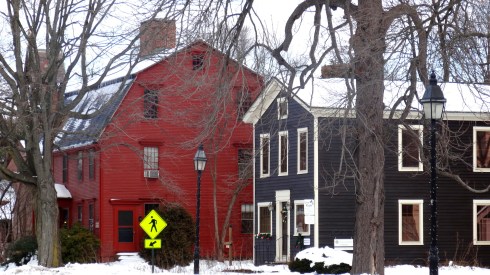
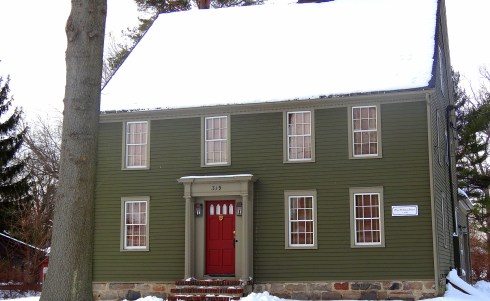
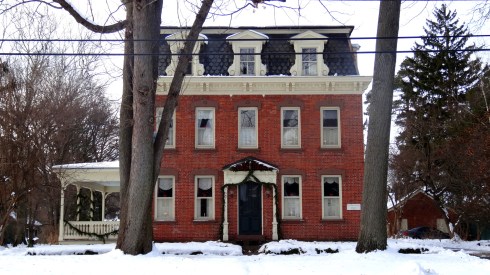
Whenever I’m heading home from New Jersey or New York or points south, I always like to stop in at Old Wethersfield, Connecticut:  it’s a beautiful village just off the highway and just outside Hartford:  a convenient respite for a weary traveler. Old Wethersfield is a National Register Historic District, comprising 100+ houses from the seventeenth, eighteenth and nineteenth centuries situated along a main thoroughfare and a slender rectangular green, which is part of the larger town of Wethersfield. I had two restless guys with me yesterday but they still let me stop for a bit, to take pictures of some of my favorite houses and briefly run into Comstock, Ferre & Company, which has been selling heirloom seeds for two centuries. Wethersfield is known not only for its colonial architecture, but also for its venerable seed companies, including Comstock and the Charles C. Hart Seed Co. in the present and a whole host of provisioners in the past. The most profitable product of these companies, a red “Wethersfield Onion”, even gave the old town the nickname “Oniontown” for a while. I am also compelled to mention Wethersfield’s fascinating/notorious founder, John Oldham, who was exiled from the Plymouth Colony for “plotting against pilgrim rule” and went on to establish settlements in Hull, Gloucester, and Watertown, Massachusetts, and eventually Wethersfield, the first English settlement in Connecticut. (Oldham seems to have rubbed shoulders with Salem’s founder, Roger Conant, on more than one occasion). Travel and Leisure magazine just designated Old Wethersfield one of America’s “prettiest winter towns”, and it certainly appeared so yesterday afternoon with snow lining the brick sidewalks and artfully draped on the colorful colonial houses.

Just a small sampling of Old Wethersfield, New Year’s Day 2013:

Wethersfield 052

Wethersfield 046

Wethersfield 044

Wethersfield 045

The plaques and signs refer to the house above, as in the case of one of Old Wethersfield’s most famous houses, the Webb House, pictured below with its neighbors.

Wethersfield 080

Wethersfield Webb House 083

Wethersfield 084

Wethersfield 074

Wethersfield 077

Wethersfield 076

Wethersfield 086

More!!! And as you can see, there are “newer” houses in Old Wethersfield too.

Wethersfield 091

Wethersfield 092

Wethersfield 056

Wethersfield 053

Wethersfield 060

Wethersfield 090

The Comstock building, obviously a livelier place in the summer but still very much open, and an 1899 seed catalog cover featuring the Wethersfield Onion, the “greatest onion on earth”,  from the Smithsonian Institution Libraries’ Collection.

Wethersfield 049

Wethersfield Onion Smithsonian


Colonial Chocolate

Salem can lay claim to at least one candy title–Ye Olde Pepper Candy Companie, established in 1806, claims to be “America’s oldest candy company” and is still manufacturing the gibralters and black jacks that established its reputation. But the other day I came across a trade card in a digital archive which I thought could lead to another title for our fair city:  oldest commercial chocolate manufacturer.  The card (which gets no bigger, sorry) advertises the business of Gideon Foster, Chocolate Manufacturer, and dates from 1780–the same year that the famous Walter Baker & Co., Ltd. chocolate company was founded in Dorchester Lower Mills.  Perhaps Foster beat out Baker by a few months!

Chocolate 1780

Chocolate Bakers factor

Chocolate Baker 1929

Bakers Christmas

Advertising Chocolate, 1780-1829. Baker images courtesy The Dorchester Atheneum.

Alas, I don’t think Salem can claim the chocolate title, for two reasons.  The Baker Company can be dated even earlier than 1780, to when Walter Baker, a Boston physician, established a partnership in 1765 with English chocolatier John Hannon. When Hannon departed for Europe in 1780, never to return, Baker continued to run the company under his sole ownership, and it expanded dramatically through the nineteenth century under his heirs and the twentieth century under the successive ownership of  General and Kraft Foods (leaving Foster’s little company in the dust!)  The other reason is that while Gideon Foster is associating himself with the commercial mecca of Salem,on his trade card, his chocolate mill was actually located in the nearby village of South Danvers, now Peabody; in fact, Foster’s well-preserved Federal house serves as the headquarters of the Peabody Historical Society.

That matter settled, I still have my questions. Why were these two prominent men so focused on the production of chocolate during the Revolutionary War?  Wasn’t chocolate a rather trivial pursuit at this particular time? Foster was General Gideon Foster, hero of the Battles of Lexington and Concord, later at Bunker Hill and the siege of Boston, but back in Peabody making chocolate by 1780:  was chocolate manufacture a matter of national necessity?  Probably not, but it was definitely a substantive commodity in the eighteenth century, viewed as nutritional, medicinal, and sustaining–almost like food. But it was also a beverage (we are generally talking about drinking chocolate at this time; candy bars come later) that some thought had the potential to replace the almighty tea. Thomas Jefferson certainly thought so; in a 1785 letter to John Adams he predicted that “Chocolate. … By getting it good in quality, and cheap in price, the superiority of the article both for health and nourishment will soon give it the same preference over tea and coffee in America…”

Here in Salem, and in the present, my favorite source for chocolate is the decades-old Harbor Sweets, where I started my Christmas shopping today (with less than two weeks to go–classes complete, papers and final exams to grade!)  Even if you don’t have chocolate on your list, this is a great place to go for its Santa’s workshop ambiance, as well as the free samples.

Chocolate Harbor Sweets


Saint Nicholas

Today is the Feast Day of Saint Nicholas, (270-343) who evolved, through the centuries, into Santa Claus, because of his legendary roles as a protector of children and secret gift-giver. This was quite an evolution, in more ways than one! Nicholas is known alternatively as Nicholas of Myra, as he served as Bishop of that southern Turkish city (now called Demre) for much of his life, and Nicholas of Bari, as his relics were removed to southern Italy in the eleventh century. The Italians who confiscated the relics of the revered Saint claimed that were acting in the name of “security”, as Myra was increasingly vulnerable to Muslim attacks, but one could certainly ascertain that it was a case of simple theft. There are many stories associated with Nicholas’s holy works, so many that he is also referred to as Nicholas “the wonder-worker”, but the most popular relates a rather dark tale in which Nicholas visited an inn during a regional famine, and quickly discerned that the innkeeper had chopped up three boys and encased them in brine to sell them as pickled pork.  Nicholas brought the innocents back to life, and evolved into the savior of children who found themselves “in a pickle”.

Nicholas of Bari Stowe Breviary BL

Nicholas BM Dutch

Nicholas BM Flemish

British Library MS Stowe 12, “The Stowe Breviary”, 1322-25; Dutch woodcut print, 1480-1490, and hand-colored engraving from a Flemish prayer-book by the “Monogrammist M”, 1500-1525, both British Museum.

Images of Nicholas with the resuscitated boys (in their pickle barrel) can be found in all manner of religious texts from the medieval and early modern eras, as illustrated by those above, and were also the single focus of a succession of paintings and prints from the Renaissance and after. When Nicholas is not in the company of the boys, he is often pictured with the young women whom he saved from lives of prostitution by secretly gifting their father with gold for their dowries, another work of wonder that solidified his connection with the young (and vulnerable).

Nicholas Met Boys

Nicholas Met Dowry

Two altarpiece panels representing the holy deeds of Saint Nicholas by Bicci di Lorenzo, 1433-35:  Saint Nicholas Resuscitating Three Youths and Saint Nicholas Providing Dowries, Metropolitan Museum of Art.

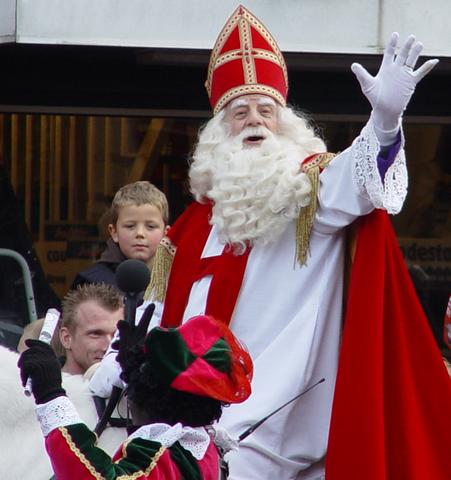
The religious history of Saint Nicholas is pretty easy to reconstruct, but when hagiography meets folklore it gets a bit more confusing. One thing is certain: the transformation of the saint into the jolly dispenser of gifts is much more a phenomenon of western Christian culture than it is of the Orthodox Church, which still recognizes Saint Basil of Caesarea as the benevolent gift-giver (on his feast day of January 1).  The other factor that seems pretty clear is the role of the Reformation. The modern Santa Claus seems to be an amalgamation of the Dutch and Flemish Sinterklaas, the English “Father Christmas” and a secularized Saint Nicholas. While the Dutch Sinterklaas still arrives on the eve of St. Nicholas, wearing a Bishop’s hat and bearing a staff, the Protestant prohibition of his veneration gradually transformed him into a secular figure. Across the English Channel, a similarly-dressed (and aged), “Father Christmas” reemerges only after the Reformation and Revolution, when the Restoration ushers in a return to the “merry old England” of memory. And when these figures cross the Atlantic, the melting pot of American culture (and Coca Cola) gradually transforms them into our very own Santa Claus.

Nicholas Print 1604p

Nicholas Sinterklaas

Nicholas Father Christmas 1890 Vand Ap

Engraving of Saint Nicholas by Antonius Wierix, 1604, British Museum; Sinterklaas celebration in Amsterdam, 2011, and a Father Christmas card, c. 1890, Victoria & Albert Museum.


Christmas at the Willows

This weekend’s Christmas in Salem tour is focused on Salem Willows, for the first time (I think!) in this storied event’s 33-year history. The tour has developed its large following by opening up historic homes in the city’s central historic districts (McIntire, the Common, Derby Street), but every once in a while it branches out to showcase an outlying neighborhood: North Salem a few years ago and now the Willows. Eight homes are on the tour, all decorated for the season. By the time you are reading this, it’s too late to purchase tickets online, but they will be available at the Bentley School (25 Memorial Drive, Salem) on Saturday and Sunday. Christmas in Salem is the major fundraiser for Salem’s preservation organization, Historic Salem, Incorporated, and as such, it enables HSI to continue its preservation advocacy and outreach.

In terms of preservation, the Willows (or more formally the Juniper Point residential neighborhood, which is adjacent to the historic Willows municipal park) has been a bit vulnerable in recent years, given its desirable coastal location, its lack of historic district restrictions, and the transformation of its summer cottages to year-round residences. There have been some rather aggressive additions and an unfortunate teardown a few years back.  But the majority of the neighborhood’s close-knit Victorian and early twentieth-century dwellings appear perfectly preserved, and they provide a nice backdrop for a seaside Christmas stroll.

Willows Salem State

Willows 012

Willows SSU

A Craftsman cottage (not sure if this is on the tour–it’s just one of my favorite houses) in Salem Willows, framed by two early 20th century doctored postcards from the archives of Salem State University.


Cranberry Picking

“…as why are Strawberries sweet and Cranberries sowre, there is no reason but the wonderfull worke of God that made them so…”.  John Eliot, the Puritan “Apostle to the Indians”, used the “American” name rather than the preferred English fenberry (variantly bear-berry and mosse-berry) in his 1647 treatise The Day-Breaking if not the Sun-Rising of the Gospell with the Indians in New-England, one of several seventeenth-century references to the sour little berry that was so common in Massachusetts. Along with corn, this was one native American crop that captured the attention of  the English early on–though most of their efforts seem to have been directed at transforming cranberries into something sweeter:  syrups, tarts, sauces.  They could not ignore a berry that ripened in the winter!

One last Thanksgiving weekend post on a fruit that remains one of Massachusetts’ few commercial crops, although we are no longer the country’s leading producer:  that title is now claimed by Wisconsin.  Still, there’s a major harvest every year starting in late September, and it’s a beautiful sight to see.  I just couldn’t make it down to the southeastern part of the state this busy semester, but here’s a great recent photograph of a bog at the A.D. Makepeace Company in Wareham, one of the state’s oldest producers.

Photo credit:  Charlie Mahoney for the Boston Globe; 1907 Makepeace Co. cranberry sign,Etsy.

The conditions of cranberry picking have changed a lot over the last century, for the better. Documentary photographers like Lewis Wickes Hine focused on the industrial exploitation of child and migrant labor in the early nineteenth century, and contemporary photographs of very small children, native Americans, and newly-arrived Europeans (in the case of southeastern Massachusetts, primarily Portuguese “bravas” from New Bedford, led by bog bosses called padrones) abound.

Portuguese cranberry pickers at the Eldridge Bog in Rochester, Massachusetts, and the “tenement” that housed them, September 1911, and a boy “scooper” at the Makepeace Bog. The caption of the last photograph reads: Gordon Peter, using scoop with metal teeth not covered. Said 10 years old. One of the smallest scoopers that we found. Usually scooping is done by adults. Been picking 3 years. Location: Makepeace near Wareham, Massachusetts. Lewis Wickes Hine, Library of Congress.

The pictures above contrast sharply with the recent photograph of the cranberry harvest at Makepeace, but also with artistic representations of cranberry picking in the nineteenth and twentieth centuries. Two paintings that fall on either side of Hine’s photographs are Eastman Johnson’s Cranberry Pickers, Island of Nantucket (1880) and Provincetown artist Ross Moffett’s circa 1930 Cranberry Pickers. Moffett’s modernistic representation of the workers in their spare Cape Cod context is a lot bleaker than Johnson’s more romantic image, but both artists seem to focus on the landscape at least as much as on the pickers.

Eastman Johnson, Cranberry Harvest, Island of Nantucket, 1880, Timken Museum of Art, San Diego; Ross Moffett, Cranberry Pickers, c. 1927-30, Smithsonian American Art Museum.


Pilgrim Pants

Eat, drink and shop: the association of Thanksgiving and commerce is nothing new.  Pilgrims were used to pitch almost everything in the later nineteenth and twentieth centuries:  not so much now.  I’ve seen pilgrim advertisements for all sorts of food and drink, which is understandable, but there were also lots of ads for various types of clothing, which is not really that logical an association; after all, one does not think of the Pilgrims as fashionable. That was not the pitch, however, for the famous “Plymouth Rock $3 pants”, which all New England men apparently wore in the later nineteenth century. Rather, the appeal was affordability and durability; these pants were stalwart and persevering, just like Pilgrims. The very collectible lithograph below, from the archives of both the American Antiquarian Society and the Boston Athenaeum, is a play on the classic Landing of the Pilgrim Fathers painting by Charles Lucy. This painting was turned into multiple prints and postcards before World War I, so it’s only natural that it became the basis of a very anachronistic advertisement.

Plymouth Rock $3 Pants lithographic advertisement by G.H. Buek & Co., 1885, American Antiquarian Society; 1915 postcard print of Charles Lucy’s Landing of the Pilgrim Fathers, New York Public Library Digital Gallery.

The other article of clothing commonly associated with Pilgrims, primarily before World War II, were socks, which don’t have to be very fashionable. The Pilgrim brand of clothing, one of Sears’ most long-running (1905-1964), started with socks, and took off from there. While Pilgrims didn’t always appear in ads for this line, they definitely established the brand in the first decades of the twentieth century. Women’s “Pilgrim Positive Wear”, guaranteed to last for six months, were advertised everywhere. Other companies followed suit with ads that featured Pilgrims wearing durable, seldom-in-need-of darning socks. Just one more thing to be thankful for, according to the Norman Rockwell-illustrated ad in the Thanksgiving 1922 edition of the Saturday Evening Post.


Calligraphic Cats

I was watching a mash-up rebroadcast of Antiques Roadshow the other night when a pair of Victorian calligraphic drawings suddenly appeared, including one very charming cat. You can see the appraisal–with appraiser Carl Crossman stating that he and his colleagues have seen plenty of calligraphic deer and eagles but few cats–here. Crossman loved the cat (and valued it at around $3500-$4000) and so do I, so of course I had to find one for myself. Calligraphy has always been a more integral feature of Islamic and East Asian art than that of the West, and I found some nice Asian BIG cats, but domestic calligraphic cats from Europe and America were indeed difficult to track down.

Calligraphic Tigers from Japan (18th century) and Pakistan (19th century), Victoria & Albert Museum, London.

In the west, calligraphic drawings seem to emerge first in the general instructional workbooks of eighteenth- and nineteenth-century tutors and their students. The owl and the pussycat below, which come closest to capturing the charm of my beloved Antiques Roadshow cat, were drawn by Dutch instructor Jacob Labotz for his students to copy and thus perfect their hands. So I started my search through the available instructional texts, starting with the later seventeenth century and working my way up to the later 1800s, when “flourishing” offhand calligraphy, combining writing and drawing, flourished. Mr. Crossman was correct: I found lots of birds (more doves than eagles), and no cats.

“Mary Serjant her book scholler to Eliz Bean Mrs. in the art of writing and arithmetick”, 1688, Beineke Rare Book and Manuscript Library, Yale University.

I expanded my search to include museum collections, antique-shop inventories, and auction archives and could only find more calligraphic birds, in addition to a few horses and donkeys, rabbits, the occasional dragon, and this wonderful elephant, produced in Ohio in the mid-to-late nineteenth century. I would have snapped it right up if it was not already sold.

This elusive elephant inspired me to dig deeper and reminded me of an image that I do have:  a calligraphic deer in the form of a John Derian tray:  perhaps the source could lead me to a similarly drawn cat? Fortunately the Real PenWork. Self-Instructor in Penmanship (Pittsfield, MA: Knowles & Maxim, 1881) is available online:  there I found my deer, along with flourished and fanciful birds of all feathers, fish, horses, and a big cat.

I’m going to keep looking for the perfect Spencerian calligraphic cat drawing, but in the mean time I think I’ll settle for yet another John Derian plate (I’m embarrassed to count how many I have), because this one comes very close to my feverishly-sought-after feline.