So I have just finished converting my lecture courses into online formats: difficult to do midstream. A well-designed online course is a beautiful thing, but if a course is based on a more personal form of delivery and has to become virtual overnight there are going to be challenges. Fortunately, I teach history, and not a discipline that requires a lab or a studio: I can’t imagine what those professors are going through! And I also feel very fortunate to be able to depend on a variety of institutions—libraries and museums—which have made so much of their collections accessible AND provided road maps and guides to these same texts and images in the form of interpretive essays, questions for consideration, and extra-special digital features. I’ve had digital content in my courses for the last decade or so, but again, a course based on all-digital content is another thing entirely. I could not have accomplished such a thing—in such a short time— a decade or so ago; I can now, thanks to the diligent and creative efforts of these institutions, which take the “education” and “engagement” directives in their missions seriously. So here’s my top 10 list, with one qualifier and one comment: 1) I teach medieval and early modern European history and world history, so this is not going to be a US-centric list; and; 2) these institutions are focused on general education, not just formal education: they have made their collections accessible to those who have more casual or independent interests as well as those working within a curricular framework. (oh, and this list is in no particular order and is by no means exhaustive).
1. The Newberry Library, Chicago: For an American library, the Newberry has very rich European collections and it has created online exhibitions and curated primary source sets that I find invaluable for my courses: its librarians and fellows are very attuned to key curricular and historiographical trends. The Newberry is also a leader in American history and culture in general and local history in particular: it just won the top prize for “Oustanding Public History Project” at the National Council on Public History’s virtual conference for “Chicago 1919: Confronting the Race Riots”. Digital Newberry offers about a million high-resolution texts and images: this is a small fraction of the library’s collection but still quite a lot to see.
 Theodor de Bry’s famous 1594 engraving showing Amerindians pouring molten gold into the mouths of Spaniards driven by insatiable lust for the stuff.
2. The Heilbrunn Timeline of Art History at the Metropolitan Museum of Art: is a timeline which pairs works of art from all eras and regions of the world with curatorial essays. You can search by region, by period, or by theme, and there are many thematic essays to explore: one leads to another and before you know it, hours have gone by. I teach with images, so this is the first place to I go to find perfect visuals for my presentations, but I also encourage my students to explore this resource themselves. And they do.
 Jan Steen, The Dissolute Household, 1663-64.
3. Speaking of timelines, check out the British Museum’s History Connected: A Museum of the World, in which objects can be explored across time and place while visualizing connections, the essential links of world history, and listening to curators share their expertise and perspectives. This is the result of a partnership between the Museum and Google: Google Arts and Culture can provide a engaging platform for a cultural institution to broaden their reach in more ways than one, but there needs to be some intent in terms of design and curation. Some institutions just share images of their objects and leave it at that (I’m looking at you, Peabody Essex Museum: 323 objects; 2 stories, but what BIG story is being told? And could we possibly have some more Salem objects?): this is parking, not driving engagement.
 It’s all about connections at the British Museum (above) and the Rijksmuseum (below).
4. Another exemplary Google partner is the Rijksmuseum: which offers up 164,511 objects, 11 stories, and 8 museum views, taking us right into the building. We can “walk” around the galleries, focus on particular paintings, examine them in “street” or catalog views, organize them in chronological order, discover connections to other works. The collection is so comprehensive (though again, only a fraction of the museum’s 8 million objects), and the connections go on and on, in all sorts of directions.
5. This semester I really need to get my students into the Vatican, as I’m teaching the Renaissance and the Reformation, and that particular place is a powerful connecting link between the two eras and movements: while a succession of Renaissance popes reveled in its creation and majesty, Martin Luther was repulsed by it. The Vatican Museums‘ website features 360-degree tours of many rooms and a more virtual experience with headsets, but just getting us into those spaces will be fine.

6. Anniversary Digital Exhibitions: Both private and university research libraries characteristically observe historical anniversaries by putting together digital exhibitions of images and texts. 2017 was the anniversary of Luther’s 95 Theses and the beginning of the Reformation, so there were many such exhibitions which are now archived: two of my favorites are Cambridge University Library’s Remembering the Reformation and the University of Arizona’s Special Collections Library’s After 500 Years: the Protestant Reformation. This year, digital exhibitions on the anniversary of Woman suffrage abound: see my previous round-up here.
7. Digital Bodleian: 914,832 images and counting at the digital portal of Oxford University’s Bodleian Library, through which you can do your own curation and share “collections” with students (or friends!). A very diverse and visual database, including some great ephemera, which I also love to teach with: I’ve got to cover both the “old imperialism” and the New in my European and World History courses, and I think some educational ephemera will illustrate the transition.

8. The British Library, of course, because it has everything. I like the smaller, more curated collections, the “Turning the Pages” feature for complete texts, and when I am teaching medieval history (not this semester), the digitized illuminated manuscripts collection is indispensable. This is my favorite image of Henry VIII: from another anniversary exhibition and his own personal psalter: in the bedroom!

9. Harvard Digital Collections, of course, because they have everything: 6 million objects assembled from all of Harvard’s libraries, which you can search through with purpose or browse through an array of diverse topic collections. Because Salem is so source-challenged, I’ve come to rely on the Colonial North America collection quite a bit for this blog, but I use several of the other collections regularly for teaching. Then I just jump in from time to time: another rabbit hole: tread with caution!
10. IDEA: Isabella D’Este Archive at the University of North Carolina: I wanted to include one specialized site which demonstrates the full potential of what digital learning can encompass, and this is it. IDEA is an open-access digital “environment” dedicated to the life and letters of Isabella D’Este, the marchesa of Mantua (1490-1539). Isabella was by no means a “representative” Renaissance woman, but she left a blazing multi-disciplinary, interdisciplinary trail, which is explored here in creative ways, including a wonderful, truly virtual, replication of her personal studiolo. I love to go here/there, and I bet you will too.
 The incomparable Isabella D’Este and a site worthy of her.


 Boston Street in the 1890s from the Frank Cousins Collection of Glass Plate Negatives as the Phillips Library, via Digital Commonwealth; the Trask Homestead/Black Horse Tavern on Boston Street—exterior and interior—in 1901, New England Historical and Genealogical Register Volume 55; the Symonds Chest which was once in the front parlor of the Trask homestead/Black Horse Tavern, Yale Digital Collections; 94-95 Boston Street, once Frye’s Tavern, now partly a tattoo parlor.


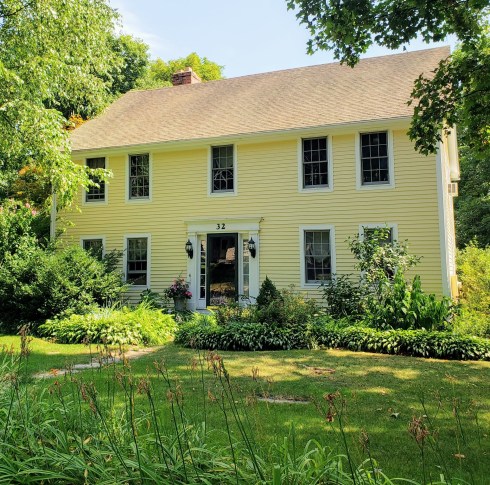


 The John P. Felt House on Federal Court past and present: despite a rough last half-century or so, the house is still standing in good form, lacking only its widow’s walk and shutters.
 Barton Square has been pretty much annihilated.
 Change and continuity on Bott’s Court: old house on the left, newer (both 1890s) houses on the right. Cousins is showing us the demolition of the former house on the right with his preservationist eye.
 Kimball Court present and past: Cousins is showing us the birthplace of Nathaniel Bowditch below: this house is in the top right corner above. In front of it today is a house that was brought over from Church Street during urban renewal in the 1960s when that street was wiped out.
 18 Lynde Street: this appears to be the same house, with major doorway changes.
 The house on Mall Street where Nathaniel Hawthorne wrote the Scarlet Letter: there was an addition attached to the house at some point in the 1980s or thereabouts.
 134 Bridge Street: As a major entrance corridor–then and now—Bridge Street has impacted by car traffic pretty dramatically over the twentieth century; Cousins portrays a sleepier street with some great houses, many of which are still standing—hopefully the progressive sweep of vinyl along this street will stop soon.
 17 Pickman Street seems to have acquired a more distinguished entrance; this was the former Mack Industrial School (Cousins’ caption reads “Hack” incorrectly).
 Great view of lower Daniels Street–leading down to Salem Harbor–and the house built for Captain Nathaniel Silsbee (Senior) in 1783. You can’t tell because of the trees, but the roofline of this house has been much altered, along with its entrance.
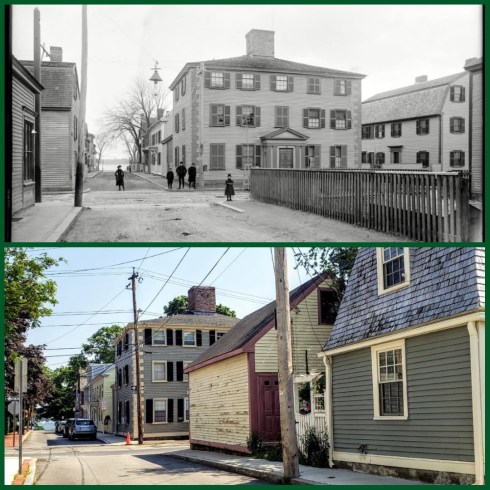 Hardy Street, 1890s and today: with the “mansion house” of Captain Edward Allen still standing proudly on Derby Street though somewhat obstructed by this particular view. You can read a very comprehensive history of this house
 There is a facsimile edition, but how amazing to see the original 1693 maritime atlas of Pierre Mortier, the “most expensive sea-atlas ever published in Amsterdam in the seventeenth century” according to the eminent Dutch cartographical historian Cornelis Koeman. Stunning plates of beautiful European ships: here is a “Tartane de Pesche”.
 Mr. Monroe at the 1/11/18 public forum at PEM.


 Is the Red Line going to take us across North Street to the beautiful Peirce-Nichols House? Of course not, sharp left to the Witch House, after we’ve just been to the Witch Dungeon Museum.
 Two empty courthouses downtown: can’t ONE play a key public role?
 Thank goodness for Wicked Good Books and the Hotel Salem, otherwise there’s not a lot going on on the Essex Street pedestrian mall, day or night.


 Bridge Street Neck was not “home to a large population of African Americans” in the 19th century: just check the city directories!


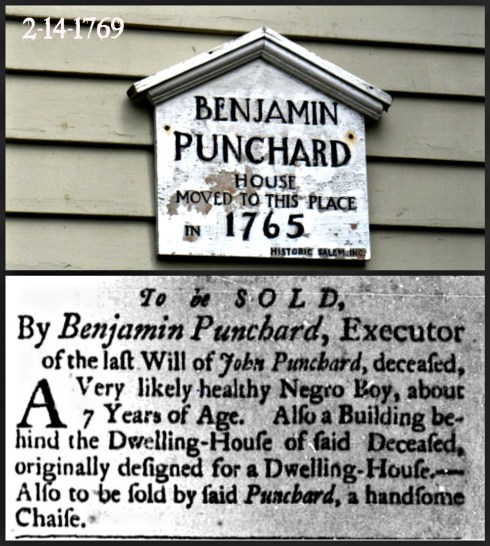


 All Essex Gazette


 Boston Evening Post and Essex Gazette
 Samuel Gardner’s sugar box, collections of the Museum of Fine Arts, Boston.

 Mr. James Kences of York, Maine protesting the imminent removal of Old York’s archives to a collections center in nearby Kittery, utilizing the same by-law precedent that we’ve employed here in Salem. Photo of Mr. Kences by Rich Beauchesne/Seacoastonline.
 A romantic rendering of what might have been—if the PEM had fulfilled its promises to develop the Salem Armory and preserve the Phillips Library: not sure about the new situation of the John Ward House but it’s been moved once before. Not sure of the source or date either–I found it unlabeled on social media. Obviously the PEM went in quite a different direction.

 In my open


 Views of the Jonathan Corwin “Witch House” in 1947, 1926, and 1920 by Harry L. Sampson and Henry Peabody, Keystone-Mast Collection, UCR/California Museum of Photography, University of California at Riverside.


 Nathaniel Hawthorne’s birthplace in its original location in 1926 and 1897 (Underwood & Underwood); the newly-built Pioneer Village in 1930, Keystone-Mast Collection, UCR/California Museum of Photography.

 Three 1926 images: the entrance to the Old Custom House, the House of the Seven Gables, and the Roger Conant Statue, Keystone-Mast Collection, UCR/California Museum of Photography.
 Just a few negatives listed in the 1925 Catalogue of Negatives in the Essex Institute Collections, which is available




 The Kittredge Mansion & gate in HABS photographs from 1940-41, Library of Congress.


 The Sheffield Patent, 1623, Phillips Library, Peabody Essex Museum; Title page of Thomas Maule’s New England Pesecutors Mauld, 1697;