Tag Archives: design

Silver Substitute

I spent the latter part of the long July Fourth week with family in southern Maine, engaging in some leisurely antiquing along Route One.  Our first stop was one of my long-time favorite shops, R. Jorgensen Antiques in Wells, which is always a lovely place to visit:  amazing furniture, beautiful grounds, friendly owners.  Usually I’m exclusively focused on the big pieces at Jorgensens, particularly tables:  I really can’t imagine a better place to buy an antique dining table.  But while I was gazing longingly at a pedestal table that seats eight but could be magically transformed into a Pembroke table that you could push against the wall, my eye fell on several smaller items: a “silver” tea set that was really pottery in disguise.

I thought I was familiar with lustreware but apparently not.  Many of my pearlware pieces have copper lustre bands, and you see the pink lustreware everywhere, but I had never seen pieces completely dipped in silver or platinum glaze, in such an alchemical and egalitarian way.  Silver for everyone!  This particular tea set is Edwardian, but looking around I found items from the early nineteenth century onwards.  Here are some of my favorites, all dating from the decades immediately following the invention of the glazing process in Staffordshire around 1805:  two lead-glazed earthenware coffeepots with platinum lustre decoration from about 1810-1820, and a two-handed cup, two decorated jugs, and an urn from the same period and region.  I also checked out auction results for similar items over the past few years and found that they are surprising affordable: could there be a new collection in my future?

Silver lustreware from the collection of the Victoria & Albert Museum, London, with the exception of the last two pieces:  decorated jug at Appleby Antiques and urn at the Metropolitan Museum of Art, New York.


Out and About in Concord

Yesterday was Patriot’s Day here in Massachusetts, commemorating the Battle of Lexington and Concord (even though it actually happened on the 19th; it’s a convenient long weekend for state employees such as myself).  My own Patriot’s Day tradition is to walk the Battle Road through Lexington, Lincoln and Concord, sometimes with a crowd, sometimes with just my immediate family, sometimes by myself.  This year I was all by myself, so I thought I might run the route rather than walk it, but I completely wimped out because of the heat:  it was in the high 80s, making it a very uncomfortable day for Boston marathoners (the other big event of the day).  I did walk most of the route, then I bailed and had lunch and went shopping in Concord Center.  Not very patriotic!

Concord is a stunning town, full of beautiful houses and lovely landscapesNathaniel Hawthorne definitely preferred his beloved Wayside to any of his Salem dwellings, I must admit.  Salem was a little busy for him in the middle of the nineteenth century, and he always felt the burden of his family’s witch-hunting past there.  Concord was bucolic, but not so isolated that he couldn’t find interesting people to talk to like the Alcotts (from whom he bought his house) and Ralph Waldo Emerson.

I’m always impressed by the variety of historic houses in Concord.  There are lovely colonial houses, but also houses in the full spectrum of nineteenth-century styles:  vernacular farmhouses, Greek and Gothic Revivals, Victorians,  and lots of center-gabled houses that I associate more  with New York than New England.  It is a wealthy town, so it has its share of Mcmansions too.  Here are a few photographs of some of my favorites, but I could have snapped many more.

Flags and banners all around Concord for Patriot’s Day; with the heat, it seemed more like July 4th than April 16th.  The tower on the last house above mirrors Hawthorne’s “writing tower” at the Wayside, below in 1910 Detroit Publishing and 1941 HABS photographs.

I have long admired the stone Gothic Revival house below:  look at the windows, the trim, the fence!  It’s spectacular.  Behind it is Concord’s hillside cemetery, with flags for Revolutionary War veterans.

More Concord houses:  a very random sampling.

A colonial house with a stone-like facade, the Old Manse, Hawthorne’s other Concord address, where he and his bride Sophia stayed after their marriage, an amazing house across from the Old Manse–its additions go on and on, a pristine colonial which is just over the line, in Lincoln, and my newest Concord house.

There’s a lot more to do in Concord than just walk around and take pictures of houses.  There is great shopping in its center, including one of my very favorite shops called Nesting on Main and a really neat kitchen shop, among others.  There are the Wayside and Orchard House museums and the great little Concord Museum, of which I am completely jealous for Salem, which deserves a dedicated history museum just as nice.  The Concord Museum gives you a great chronological timeline with period rooms and furnishings, and also has revolving exhibitions:  currently they are featuring 70+ treasures from the Massachusetts Historical Society’s collection arranged in an exhibition entitled The Object of History.

Tabletop items at Nesting on Main, Ralph Waldo Emerson’s study in the Concord Museum, along with the portrait of Dorothy Quincy, circa 1720 by an anonymous artist, part of “The Object of History:  Colonial Treasures from the Massachusetts Historical Society”, on view until June 17.

And then there is Walden Pond, which was very crowded this particular hot APRIL afternoon.


Salem Swags

There is no more prominent motif of late eighteenth- and early twentieth-century design than the swag; it’s almost universal.  At least that’s my perspective from here in Salem, where I am literally surrounded by swag-embellished buildings. It certainly was a favorite feature of Samuel McIntire and his imitators, and on a nice Spring walk I suddenly took notice of all the swags around me and captured some of them on film.  Actually before I left for my walk I crawled out onto the flat roof of the apartment on the side of my house for a unique perspective of McIntire’s exterior drapery swags inserted into the brick north wall of Hamilton Hall, along with his famous eagle.

And then I was off, in swag heaven.  Right around the corner, across from where McIntire’s house once stood and now sadly no longer does, there is a lovely entrance with swag detail on the Georgian Eden-Browne-Sanders house.  The house predates McIntire, but the entrance has been attributed to him or his son.  Two streets over, on Federal Street, is a McIntire masterpiece, the Cook-Oliver House, with swags galore, embellishing both exterior and interior doors.  More McIntire swags grace the Peirce-Nichols fence urns (and a mantle inside) further down Federal Street, and the Derby summer house on the grounds of the Gardner-Pingree House downtown.

Frank Cousins photographs of a Cook-Oliver doorway and a Peirce-Nichols mantle, 1910-13, New York Public Library Digital Gallery.

Of course McIntire was a genius but he had a lot of inspiration:  swags had been around for a while before he started carving them in Salem. Thomas Sheraton’s Cabinet-maker and Upholsterer’s Drawing Book (179193) is full of them, and he is hardly the only source.  I’ve just been discovering the incredibly prolific British architect Sir William Chambers (1723-96) who also drew his share of swags. They even turn up on petticoats in the 1790s.

Pencil sketch for a panel by Sir William Chambers, pen and ink sketch for a candle urn by Chambers’ studio, c. 1770, and petticoat design by a Miss Vernon, c. 1792, all courtesy of Victoria & Albert Museum, London.

Back in Salem, there was a swag revival a century later when the Colonial Revival influence swept through the city.  On Essex Street, which is really Salem’s Main Street, there are several Colonial Revival houses which are almost festooned with swags.  For me, these 1890s swags seem to lack the delicacy, depth and detail of those of a century earlier, but I still think they work.  The last house is actually a colonial house, built in 1762, transformed into Colonial Revival house, swags and all, in 1893.


The Folly Cove Designers

This past weekend I made a major score when I encountered a long-sought item:  a placemat depicting Chestnut Street  in Salem made by Louise Kenyon of the Folly Cove Designers in the 1950s or early 1960s.  Though it is in rather shabby condition, I snapped it right up, as I have long wanted a piece of Folly Cove and now I have one depicting my own street!

The Folly Cove Designers were a collective of textile artisans working in the Lanesville section of Gloucester, Massachusetts from the 1940s through the 1960s.  Inspired by the Arts & Crafts movement and founded by illustrator Virginia Burton Demetrios, the designers carved their own linoleum blocks and produced linens, clothing, and upholstery fabric for their own houses and also for sale.  There was a strong educational mission connected to what essentially became a guild:  aspiring Folly Cove Designers completed coursework (designed by Demetrios, apparently as innovative an educator as she was an illustrator and designer) as well as a “masterpiece” (a term that originated in the medieval craft guilds), which, if it met with the approval of a jury made up of revolving members of Folly Cove, was produced and offered for sale under the trademark of the Designers.

After Virginia Burton Demetrios’s death in 1969, the guild dissolved, but one of the earliest Folly Cove designers, Sara Elizabeth (Halloran) continued the block printing tradition in Lanesville until her death in 2009.  The Sara Elizabeth Shop is still open for business, selling old and new Folly Cove designs on fabric and paper at both their shop and their website, which is also a good source for Folly Cove history and the block printing process.

The printing process:  as demonstrated in a 1945 Life article (“Yankee printers get National Recognition”), as well as by the still-working Acorn press at the Sara Elizabeth Shop.  Below, Virginia Burton Demetrios and her students/designers from the Life article.  The piece in the center (by Demetrios) is called Diploma, because it was given to a new designer, framed, after they had sold their first block print. Note the footstomping (or stamping) phase of the production process.

My Chestnut Street print is not really representative of a Folly Cove design, though the guild was indeed made up of individual designers with individual visions.  Still, there are a lot of floral and naturalistic themes, and some very whimsical images, particularly of animals.  The concentrated Finnish population in mid-twentieth century Lanesville might have asserted a Scandinavian influence on the prints (though they are far from Marimekko!), as several members of this community became Folly Cove designers.  On the other hand, some of the patterns look positively Elizabethan to me.  The Cape Ann Museum in Gloucester has a very strong Folly Cove collection, including sample books and archival materials as well as textiles (in fact, the Museum recently purchased the block which produced my print).  You do run across Folly Cove products in antique shops and at auctions in our area as well:  Blackwood/March Auctioneers in Essex always seem to have lots.  Essex antiques dealer Andrew Spindler currently has several Folly Cove patterns available in his 1stdibs shop, including one of my favorites, Gossips, and some pillows covered in a perennial favorite, Lazy Daisies.

A few more of my favorite Folly Cove prints:  two designs by Zoe Eleftherio and Elizabeth Jarrabind’s Turtles, and (to set the scene) a Maurice Prendergast painting of Folly Cove from 1910-15.


Utopia, not Dystopia

Last week was a bit unnerving, unsettling, disconcerting.  Not only because of the unseasonably warm weather, but also because of a word (or two):  dystopia or dystopian.  The opposite of utopia, not a perfect, elusive place, often in the future, but rather a repressive and hostile place, definitely in the future, where individual freedoms are subjected to some all-powerful system. Whenever I was near a radio or a television,  I kept hearing that word, at least 20 times, more than I have ever heard that word in my life.  The primary contexts for the word were reviews of the Hunger Games film, set in a decidedly dystopian future, and related stories about the popularity of dystopian themes in young adult fiction, which is itself disconcerting.

As is always the case when things are not just quite right for me, I retreat to the past.  What better way to counter dystopia in the present than with some utopias of the past?  I really don’t know that much about ancient history, so I skipped the Garden of Eden, the Isles of the Blessed and Elysian Fields and went back to the Renaissance Utopia, Thomas More’s 1516 book, and then moved forward, more happily, toward the present.

Early Modern Utopias:  More’s Utopia, Tommaso Campanella’s City of the Sun (1602), Bartolomea del Bene’s City of Truth (1609), and Francis Bacon’s New Atlantis (1624).

As you can see (you’ll have to take my word on the cropped Bacon image), all of these utopias are self-contained islands or cities, apart from the corrupt world, and their very existence is a commentary on that world.  It’s also very interesting to me that in these four works, two written by Englishmen and two by Italians, a distinct nationalistic vision of utopia has emerged:  More and Bacon have located their utopias on islands and Campanella’s and del Bene’s utopias are walled cities.  The Italians seem to think they can find utopia through urban planning, which was both an artistic and a logistical enterprise. Not only did the Italian Renaissance inspire and create paintings like Piero della Francesca’s Ideal City (c. 1470) but also the Venetian “development” of Palmanova in 1593, a real “ideal city”.

With the coming of industrialization in the modern era, cities could not possibly be utopian.  The ideal life/world could now only be found in a long-lost Arcadian past or a pastoral enclave in the present.  American utopianism in the nineteenth-century seems to be best represented by the romantic landscapes of the Hudson River Valley school, like Thomas Cole’s Dream of Arcadia below, and social experiments like Brook Farm here in Massachusetts, where Nathaniel Hawthorne spent a few (apparently miserable) months in 1841.  A young and struggling writer at the time, Nathaniel clearly did not find his utopia at Brook Farm:  too much manure.

Thomas Cole, Dream of Arcadia, 1838. Denver Art Museum.

Joseph Wolcott, Brook Farm with Rainbow, 1845. Massachusetts Historical Society.

I’m not sure how the quest for utopia has fared in the twentieth century, and into the twenty-first.  Have we given up on it?  Are utopian ideas and ideals so personal that we don’t have a collective cultural vision?  Is is all about dystopia?  At least in the first part of the century, and despite the dreadful First World War, the Bauhaus movement was definitely driven by utopian ideals as well as the passion for modernism and the desire to integrate art, design and technology.  All of these goals are exemplified by the title and the typography of their publications from the early twenties:  the volumes of  Utopia:  Dokumente der Wirklichkeit (Utopia: Documents of Reality) were designed by Oskar Schlemmer in a style that still looks modern today.

An etching by the American artist Peter Larsen from just about the same time as the beginning of the Bauhaus School shows a decidedly more inaccessible Utopia, like that of Thomas More.  So we’re right back where we began, with those who believe that Utopia is within reach, or at least worth striving for, and those that believe it’s just a fantasy.

Peter Larsen, Utopia,1919. Smithsonian American Art Museum.


Letterpress Love

The revival of traditional letterpress printing in this past digital decade is a very interesting trend to me; or perhaps my impression is incorrect and letterpress never went away.  It does seem like small letterpress printers are popping up everywhere, hopeful signs that craftsmanship is still valued–even pursued–in an age of mass and massive production. I wanted to feature some local letterpress printers for this pre-Valentine’s Day post and I found quite a few, but very few of them were really offering valentines, which makes perfect sense:  their business is a bespoke one, and custom-ordered Valentine’s Day Cards are probably pretty unusual (and unprofitable).  I did find a few, and I broadened my search a bit to include letterpress offerings on the neat (and new-to-me) site Felt & Wire Shop and Etsy.

I’m looking for rather streamlined Valentine’s Day cards this year:  no cutesy animals, only minimalist hearts, typographical motifs, and beautiful printing, although a quirky card always catches my eye.  The cards below particularly appealed to me, beginning with one from a local printer: B.IMPRESSED.  Just click on the image to get to the source.

I had to put one animal-themed card in here, plus this is beautifully printed.

A bit overtly romantic for me but again, beautifully printed.  The bleeding hearts look like BLEEDING HEARTS.

Not a valentine, but a great photograph (by Maggie Holzberg) of an example of some very nice printing and the “bite” of type into paper, from the Massachusetts Cultural Council’s Folk Art & Heritage Apprenticeship Program.


Robinson Crusoe Style

I love little plates.  I have stacks and stacks of old and new desert plates, salad plates, appetizer plates, saucers, and plates which seem to have absolutely no purpose beyond decoration.  I hang them on the wall, I display them on mantels and bookcases, and then they go back into the stacks when I realize that there are just too many plates around. One of the few categories–or actually sub-categories–of plates that remain constantly on view are my Staffordshire “Robinson Crusoe” children’s plates, dating from the mid-nineteenth century.  Somehow they just manage to keep looking good to me, or maybe it’s because I don’t go into the third-floor bedroom in which they are displayed very often.

Children’s plates were produced in large numbers in the nineteenth and early twentieth centuries and are consequently a relatively easy thing to collect (Best Books:  Noel Riley’s 2-volume Gifts for Good Children. A History of Children’s China, 1790-1890). I have some which feature Benjamin Franklin maxims, domestic scenes, free trade slogans, animals, and the alphabet,but the Robinson Crusoe plates are my favorite even though they are in far from perfect condition:  they are octagonal, transfer-printed (rather sloppily), and then “painted” with rather abstract strokes, as if the children themselves “colored” them, and most of them have a hairline fracture or two.

Daniel Defoe mined several true tales, most prominently that of Alexander Selkirk, a Scottish sailor who was marooned on a remote island off Chile (now called Robinson Crusoe Island) from 1704 to 1709  to come up with his elemental castaway story, Robinson Crusoe, in 1719, and the flood of texts, prints, plates and plays thereafter testify to its continuing popularity well into the twentieth century.  According to the digital exhibition at the Lilly Library of Indiana University, the book has never been out of print.  The title page from the Lilly collection is below, with my favorite edition, published in 1900 with illustrations by Louis and Frederick Rhead.

Editions of Robinson Crusoe published specifically for children seem to have the best illustrations.  To make the story more accessible, sometimes Crusoe is transformed into a boy, and there was even a “little Miss Robinson Crusoe” in the 1920s.  From the vast collection of historical children’s literature at the University of Florida, here’s a few of my favorite images:  a rather ominous empty Robinson Crusoe suit from the title page of an 1845 English edition, the cover of an 1896 American edition illustrated by Walter Paget, and several pages from a Willy Pogany 1914 edition.

Robinson Crusoe shows up not only in books but also on all sorts of prints:  he’s an early cartoon-strip character, an advertising device, and the subject of all sorts of dramatic presentations.  He even shows up on wallpaper, back in the nineteenth century, and more recently on a Christopher Moore design for Lee Jofa.

1809 print by B. Tabart & Company and 1894 program for Robinson Crusoe play at the Drury Lane Theater, London, Victoria & Albert Museum; Advertisement for Fancy Dress Costumes, including the “Miss Robinson Crusoe”, New York Public Library Digital Gallery; Robinson Crusoe wallpapers from the Victoria & Albert Museum (circa 1875) and Christopher Moore/Lee Jofa.

And for the final touch (and also from the Victoria & Albert), a pair of “Robinson Crusoe” sunglasses manufactured by Oliver Goldsmith Eyewear in 1962, and apparently quite popular for a time.  So there you are; certainly very few characters can make the leap from plates to sunglasses.


Little Folks and Black Cats

A little window into the publishing world of turn-of-the-century Salem and Boston today.  I found it difficult to reconcile the very divergent titles of the prolific Salem publisher Samuel Edson Cassino until I uncovered the family history behind the family business.  The S.E. Cassino Company is best known for producing children’s literature, both periodicals like the long-running Little Folks.  The Children’s Magazine (1897-1923) and charmingly-illustrated texts like Edith Francis Foster’s Mary’s Little Lamb:  a Picture Guessing Story for Little Children (1903).

These publications contrast sharply with the other Cassino titles, issued in Boston rather than Salem, primarily scientific compendiums like the annual Naturalists’ Universal Directory.  It turns out that Samuel Edson Cassino, a trained naturalist who married into a prominent North Shore family and turned to publishing, focused on his own interests down in Boston and left the newer (and I suspect more profitable) branch of his business to his daughter Margherita Cassino Osborne, an 1899 graduate of Radcliffe College.  Margherita not only edited Little Folks and several other serial publications (and later put out her own children’s books) but seems to have managed all of the Salem publishing operations, along with her second husband Frank Wellman Osborne.  The Cassino catalogue acquired another–even more diverse–serial title in 1912:  the very interesting early science fiction Black Cat magazine, founded by Herman D. Umbstaetter in Boston in 1895.  The operation of Black Cat were moved from Boston to Salem (which must have seemed appropriate to everyone, as this was just when Salem was beginning to transform itself into “Witch City”), and was managed by Mr. Osborne until its demise in 1920.

The family business was certainly profitable but there’s a (relatively, materially) tragic chapter in the Cassino story as well:  their stately mansion on Lafayette Street, pictured below in 1910, was completely destroyed by the Great Salem Fire of 1914.


Calendar Girls

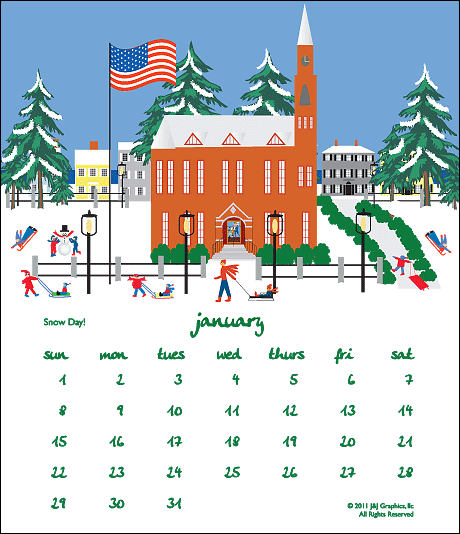
I’m a bit late for a calendar post, but then again I always buy my calendars after January 1st–sometimes well after January 1st.  While I’m not likely to engage in consistent sale-shopping or coupon-clipping, for some reason I get great pleasure from buying my annual calendars after they have gone on sale.  We usually purchase a “North Shore Folk Art” calendar from J & J Graphics at the Peabody Essex Museum shop for our refrigerator, and sometimes I even wait until they have their big January sale (this year it’s on the weekend of the 20th-22nd, definitely worth a visit if you’re in our area).  I’ll post January right here so I know what the date is until I get my own.

Upstairs in my office I generally pick something a bit more girly, whimsical, botanical, historical..whatever catches my eye.  Right now I’m liking this ethereal calendar from Irena Sophia, already on sale on Etsy!  I like the September and October girls–and Miss foxy February.

Calendars are an important form of ephemera that I haven’t featured on the blog yet, so why not now?  At the same time, they are among the timeliest and most artistic of genres.  And like all the pieces of paper we’ve examined over the last year–postcards, trade cards, book plates–they emerged as a mass-produced product in the later nineteenth century, coincidentally with the development of chromolithography.  I love the calendars from the “Penfield era”, from about 1890 to 1920, when the distinctive designs of illustrator Edward Penfield (1866-1925) graced the covers of magazines and the pages of the new poster calendars much more than those that came later with their Vargas-inspired pin-ups.  My “calendar girls” kept their clothes on!

Penfield calendars for 1897 and 1906 from the Library of Congress, above, and the work of some of his predecessors below (so you can see what an impression he made on turn-of-the-century graphic design):  an 1876 advertisement calendar for cigars and champagne, and two calendars by Boston-era publishers, also from the Library of Congress.

Calendars from Penfield’s fellow art nouveau illustrators  Louis Rhead (for Prang) and A.B. Wenzell for 1897 and 1899 are below, along with another rather less-artistic 1907 Boston calendar, for the beloved Necco wafers, all from the New York Public Library.


Wrapped in Wool

Getting all the Christmas stuff out of the house (which you should never do on New Year’s Day according to custom but always want to) leaves mantles and bookcases and other household surfaces looking bare.  I like the look of austerity after so much abundance in December, but still need to inject some warmth into my big old house.  I think I can get both with a few pieces of “cable knit ceramics”: pottery that looks like a sweater!  I’m late to this design trend (as usual) but it really appeals to me right now, in my post-Christmas, January mood. I can wrap myself in wool and my house too.

Here are some examples of what I’m looking at/for:

Cable-knit sweater bowls from Etsy seller reshapestudio.

“Knitware” collection tumblers and vases from Brooklyn potter Alyssa Ettinger.

“Knit Vases” from British artist Annette Bugansky.

“Wave” sweater vases from IlluStration.

If you want a soft sweater texture for your accessories rather than a faux surface one, you can buy wool-wrapped vases like the ones from Ferm Living pictured below, or easily make your own by wrapping, gluing, and/or sewing an old sweater sleeve around a cylindrical glass vase.  Pinterest can direct you to many sites with examples and instructions; I liked the ones below.

“Sweater vases” by Ferm Living at Velocity Art & Design; upcycled sweater-covered mason jars from DIY Crafts.

Now that we’re in the realm of textile arts, let’s move on from pedestrian vases into more exotic fare:  look at these amazing sweater-wrapped “domestic trophies” by Rachel Denny:

Red cable-knit deer head and blue cashmere “Clover” bunny at racheldenny.com

And finally, if you just want to sink into a cozy sweater yourself , how about this custom-made cable-knit slipcover?

Hand-knitted armchair slipcover by Etsy seller BiscuitScout.