Tag Archives: Decorative Arts

Art or Advertising?

I’ve been fixated on this little watercolor painting below ever since I spotted it in the archives of Northeast Auctions a few months ago. Described as a “watercolor trophy with flags and banner with landscapes”, it was painted by C.C. Redmond of Salem in December of 1880. For me, this little image begs the perennial question:  is it art or advertising?

Trade Sign C.C. Remond 1880

I find this question difficult to answer when it concerns bespoke items, produced not for a mass market but for a single customer or client, and the amazing prices that nineteenth-century trade signs fetch at auctions seems to confirm their artistic status. I wish I had found this watercolor “sign” (?) in an auction listing rather than an archive, because I would have snapped it up:  I love the combination of  lettering and landscapes, and the patriotic symbolism and Salem connection make it even more appealing. Searching around for more information about Redmond, I became even more confused about the art vs. advertising question, as he seems to have presented himself as both artist and “advertiser”, whether out of voluntary inclination or economic necessity I do not know. Charles C. Redmond’s life was short (1850-1889) and busy: he was born in northern Maine, enlisted in the Civil War at age 15 and saw action, and ended up in Salem after the war. He hung his own sign in front of his Essex Street shop in the later 1870s, and the Salem Directory for 1886 includes the following advertisement:  Charles C. Redmond, Sign and Ornamental Painter. Particular attention given to all kinds of Portrait and Landscape Painting. Scroll work on wagons, coaches, etc…243 1/2 Essex Street Salem. Redmond was active in the Salem G.A.R. post, and when Lieutenant-General Philip H. Sheridan visited Salem in 1888, his portrait was painted by Redmond, who was described in a souvenir pamphlet from the following year as “a local artist now deceased, who was possessed of rare genius in line of work”. According to the Smithsonian’s Catalog of American Portraits, Redmond painted at least two other portraits before he died, of Salem photographer-entrepreneur Frank Cousins and President Ulysses S. Grant (whose birthday is today!). Both portraits are in the collection of the Peabody Essex Museum here in Salem, but I don’t think they’ve been on view for quite some time.

I would love to see these Redmond portraits (especially the Cousins one; I know what Grant looked like), but I would really love to see more Redmond signs. I searched and searched through all my sources, but no luck. I did find some contemporary wooden signs made in Salem by Redmond’s competitors, but I imagine his to be more “artistic”–whatever that means! (Perhaps these beautiful “spectacles” with some fancy scrollwork naming their maker).

Trade Sign Salem 1880s Pollack Antiques

Trade Sign Spectacles Aldrich

Shoemaker’s trade sign made in Salem c. 1880 and signed “Manderbach”, Pollack Antiques; Spectacle sign by E.G. Washburn, New York City, c. 1875-1900, Abby Aldrich Rockefeller Folk Art Museum.


Patriotic Patterns

Given my armchair observance of Patriots’ Day, and then everything that happened on that sad day (and is still happening), I thought I’d retreat into a safe material world and examine some of the patriotic products that were produced in the decades after the American Revolution, some in the new country and some for the new country. It seems appropriate to continue exploring expressions of patriotism; after all, the real anniversary of Lexington and Concord is today. Right after the Revolution (literally) home furnishings which reflected the revolutionary spirit were produced both in this country and oddly enough, in Britain. Maybe it’s not odd:  Britain was in the midst of the Industrial Revolution which was initiated by what I’ve always considered a uniquely pragmatic entrepreneurial attitude. I wish I could see the imagery more clearly in this first woodblock-printed wallpaper, but obviously it has deteriorated with time. Here is the catalog description from the Cooper Hewitt Museum: perhaps it will help you make out the Lexington Minuteman and his associates: Beside an Indian maiden, representing America, a patriot tramples British laws underfoot and extends the declarations of July 4, 1776, to Britannia, who weeps over a pedestal containing an urn, or a tomb. The whole is contained within a curtained arch. Printed in black, white and gray on a light colorless ground.

Patriotic pattern Minuteman

This paper was produced in America in the last quarter of the eighteenth century, the same time as the textiles below, which are obviously in much better condition: The Apotheosis of Benjamin Franklin and George Washington  is a copperplate-printed toile fabric produced in several colorways in Britain between 1785-1800, right after the first big defeat of the British Empire. I love George Washington’s leopard-driven carriage!

Patriotic pattern Apotheosis Winterthur 2

Patriotic Pattern Apotheosis

Patriotic Pattern Apotheosis Bed Valence Dumbarton

Apotheosis of  Benjamin Franklin and George Washington fabrics in black and red colorways, collections of the Winterthur Museum and the Society of the Cincinnati; bed valence at Dumbarton House/National Society of the Colonial Dames of America.

British pottery manufacturers were also quick to take advantage of the newly-independent emerging American market. Even if you’re just a casual picker, I’m sure that you have run into some of the blue-and-white transferware of the Clews Brothers, James and Ralph, decorated with American scenes and symbols at their factory in Cobridge, England in the 1820s and 1830s. You see it everywhere, in all sorts of forms.

Patriotic Patterns  Clews at Skinner Auctions

Patriotic Patterns Clews Platter Skinner

“American” transferware, including a “States Design” platter below,  made by James and Ralph Clews in England,c. 1819-36, Skinner Auctioneers Archives.

And how many gilt mirrors emblazoned with eagles were produced in the Federal era (or reproduced afterwards)? So many, and again, produced in all shapes and sizes in both America and England. Below is a particularly nice eglomise (reverse-painted) example featuring the USS Constitution made in Providence by Peter Grinnell & Son right after the War of 1812. And from the next decade, a beautiful “patriotic overmantle painting” from a Rockport, Massachusetts home. It is tempera on plaster (I’m wondering how they took it off the wall???), and sold for $61,ooo at a Christie’s auction in 2008.

Federal Mirror Eglomise Providence

Patriotic Overmantle painting Rockport MA

This last painting does not really qualify as a commercially-produced product or a pattern, but it is so beautiful I wanted to include it. My last item–a handmade woven wool and linen coverlet with patriotic themes and symbols–dates from the mid-nineteenth century (1851 to be precise), just before patriotism becomes divided and divisive with the coming of the Civil War. Actually, even before 1850 the Abolitionist and Temperance movements produced their own patriotic/promotional objects. This lovely coverlet expresses a more personal patriotism, but also one in keeping with the functions of these other objects:  Americans wanted the symbols and imagery of their new nation on their walls, on their tables, and on their beds.

Patriotic Woven Wool and Linen Coverlet 1851 Skinnersp

Addendum:  Last night on Salem Common: thousands walking, running, praying in support of Boston.

Salem News David Le Staff Photo

Salem News:  David Le/Staff Photo.


Panoramic Papers

Last night there was a “scholarly soirée” here in Salem, during which the amazing pictorial woodblock-printed wallpapers of the French manufacturer Zuber et Cie were presented from a variety of perspectives. I learned a lot:  certainly too much to put in one blog post! So consider this a mere synopsis. The event, which was co-sponsored by the French American Intercultural Relations and Exchanges (FAIRE), The Bowditch Institute, and Salem Maritime National Historic Site and held at the latter’s Visitors’ Center, featured an array of speakers, who introduced the large audience to Zuber et Cie wallpapers in general and the “Views of North America” (1834) in particular. There were actually lots of introductions, including a very succinct survey of the potential market for these expensive French wallpapers in mid-nineteenth century Salem by SMNHS Historian Emily Murphy and the charming observation of the French Consul General for Boston that the panoramic Zuber wallpaper installed in the dining room of his official residence in Cambridge facilitated conversation (and I suppose diplomacy). Then the soirée was turned over to three panelists, Isabelle DuboisBrinkmann, Curator of the Musée du Papier Peint, Joanna Gohmann, Doctoral Candidate in Art History at the University of North Carolina at Chapel Hill, and James A. Abbott, Curator of  the Johns Hopkins University Evergreen Museum & Library , who examined, in succession, the early history of the Zuber firm and its manufacturing processes, the idealized images they produced, and the revitalized interest in their panoramic designs sparked by Jackie Kennedy’s redecoration of the White House in the early 1960s. This last topic is obviously the most accessible: most people would recognize at least the general image of these landscapes from official White House pictures of the Diplomatic Reception Room, in which antique panels (rescued from a doomed Maryland house) of Zuber’s idealized North American panorama were hung with great care.

Zuber et Cie diplomatic-room-2010

Zuber White House

Zuber Boston diplomatic-room-wallpaper

Pictures of the Diplomatic Reception Room at the White House with its Zuber et Cie panoramic wallpaper, 2010 & 1963, and a detail of “Boston Harbor”, White House Museum.

All of the panelists had very interesting things to say, but I was particularly impressed by Ms. Gohmann’s analysis of the idealized images of these manufactured “views” of North America in the 1830s. She pointed out that they were created for the French market more so than the American one, and crafted to portray a perfect American Republic–characterized by the equality, prosperity, and inter-connectivity of all of its citizens–just as French Liberals were trying to create their own ideal Republic. America had to be the model, the way forward, and so things that weren’t so perfect, like SLAVERY, were “whitewashed”, as African-Americans are shown freely intermingling with European-Americans, even in depictions of the South. You see American prosperity in the depiction of Boston Harbor above, and equality and inter-connectivity in the detail from “West Point” below.

Zuber West Point

Detail from Zuber et Cie’s “West Point”, Myers Fine Art & Antiques Auction Gallery.

Just fascinating. It’s almost Utopian wallpaper, but still projecting a “historical” image. I must brush up on my July Monarchy. And then we jumped forward a century and more to the Kennedy White House, Mrs. Kennedy’s aspirational redecoration, and the key role played by Zuber wallpaper, which was installed not only in the Diplomatic Reception Room but also in the First Family’s private dining room. What was designed as a French galvanizing image become an American one.

The Zuber firm is alive and well, still manufacturing its pictorial and panoramic wallpapers. It’s interesting to see them in a modern setting, emphasizing their timeless style. And for other designs, there is a large digitized collection at the Smithsonian’s Cooper-Hewitt Museum (including the very popular “El Dorado”, if you want to see an idealized image of South America) and the Down East Dilettante has a nicely-illustrated post on the “Decor Chinois” pattern. There is at least one Salem dining room papered with Zuber panels:  the White Silsbee House (1811) at 33 Washington Square, which just happens to be for sale at the moment (so we can take a peek inside).

Zuber David Netto 2005 Elle Decor

Zuber et Cie 33 Washington

Zuber Les Zones Terrestres detail

A more recent print of “Views of North America” in a bedroom, Elle Decor, 2005; The dining room at 33 Washington Square with its Zuber “Les Zones Terrestres” paper, and a detail.


Spring Fancy (Chairs)

The combination of the Metropolitan Museum’s current exhibition, Plain or Fancy? Restraint and Exuberance in the Decorative Arts and the onset of Spring (even though it looks very much like winter here) got my thinking about “fancy” chairs. I use this term very liberally, probably too liberally, to refer to any decorated chair with a vaguely  Sheraton and/or Empire profile produced in America in the second quarter of the nineteenth century. I have maybe 7 of these chairs, which represent the full spectrum of fanciness, from basic Hitchcock models with stenciling to hand-painted examples which I think are a bit more special. I have had more, I could buy more–they’re everywhere and I love them. I can’t imagine how many of these chairs were made:  certainly Lambert Hitchcock started the trend with his Riverton (then Hitchcockville), Connecticut factory in the 1820s, but he must have had many imitators because there are so many fancy chairs out there. Several of my fancy chairs  (the ones that are less fancy) have cushions which I had custom-made, and it’s a spring ritual to take the cushions off for the warmer seasons, exposing the rush seats, just as I put slipcovers on some of my upholstered chairs.

The (English) Sheraton inspiration and some of my chairs, the American interpretation: from fancy to plain.

Fancy Chairs Sheraton

Fancy Chair Green2

Fancy Chair music

PicMonkey Collage

Fancy Hitchcock Chairs

You still see fancy chairs in Salem dining rooms today, but the photograph below shows a room from 1916 (not sure in which house; it’s from an article in the long-defunct Mentor magazine), well after the fancy craze was over. These chairs endured and became classic, and their style was revived multiple times in the twentieth century. Back in their heyday, the prolific New England folk artist Joseph H. Davis (active 1832-37) featured very fancy chairs in many of his parlor portraits, like that of Mr. Demeritt below.

Fancy Chairs Mentor 1916

Fancy Chair Joseph H. Davis

Joseph H. Davis, John F. Demeritt, probably Barrington, New Hampshire, 1836, American Folk Art Museum, New York.

Because of a number of factors–the sheer number of chairs that were made, both in the “fancy” period and after, the great variety of chairs, and the range of imperfections on their painted surfaces–you can find these chairs pretty easily in New England, and often for a very good price. I was looking through the sold lots of several auctions at Skinner this month, and found the groups of chairs below: the entire first lot, a set of 6 chairs made in Newburyport in 1825, went for a little over $1000, while the pair of grain-painted and gilt-stenciled chairs went for $615.

987293

987293_view 02_02

Fancy chairs grain painted and gilt stenciled 1825 Skinner 615

Then again, these are rather restrained examples of the “Fancy” style, which encompassed not only furniture but all of the decorative arts in the second quarter of the nineteenth century. One of my very favorite exhibitions at the Peabody Essex Museum here in Salem was American Fancy: Exuberance in the Arts, 17901840, on view in 2004 (curated by Virginia antiques dealer Sumpter T. Priddy III, who appears to have made the study and appreciation of “Fancy” his life’s work and who wrote the beautiful companion volume). Talk about exuberance! Chairs and settees were a big part of this exhibition, and it was clear to me that the most fancy chairs were not made in New England but in the mid-Atlantic, in Baltimore to be precise. The “Baltimore Fancy Chair” makes all others pale in comparison (and fetches prices that indicate its enduring appreciation) but I think I prefer my own chairs–less perfect, less brilliant, less valuable, but still fancy.

PicMonkey Collage

More variations on the fancy chair:  a Baltimore chair by the Finlay Brothers, c. 1815-20, Metropolitan Museum of Art, New York; Portrait of Mrs. Edgar Paschall (Martha Eliza Stevens) by unidentified artist, 1823, National Gallery of Art.


Cake and the Custom House

This weekend marked the 75th anniversary of the Salem Maritime National Historic Site, the first federal heritage site (as opposed to national park) in the nation. On Sunday, a spectacularly clear and cold day, the staff of Salem Maritime presented a program of commemoration and appreciation which included lovely succinct speeches, cake, and the opportunity to wander around all of the site’s buildings at leisure. As usual, I was short on time (with a stack of midterms waiting at home), so I went straight for the Custom House (after my cake, of course), which I had not been inside for quite a while. In retrospect I wish I had had time for the Derby House as well, as it has recently been restored. But that’s alright, I can easily go back at another time–I live here.

Custom House Cake

Custom House 012

Custom House 014

Salem has been a port of entry since 1649, so there have been a succession of custom houses:  this one, built in 1819, is the last, and while beautiful, it’s a bit of a white elephant really. It was built by a new American government that expected Salem’s dynamic trade to keep expanding, but it declined precipitously almost as soon as the cornerstone of the new building was laid. In his introduction to The Scarlet Letter, Nathaniel captures this decline better than anyone possibly could, as he was a first-hand observer working (or watching) from this very custom house. Writing in 1850, he observed:  The pavement round about the abovedescribed edificewhich we may as well name at once as the CustomHouse of the porthas grass enough growing in its chinks to show that it has not, of late days, been worn by any multitudinous resort of business. In some months of the year, however, there often chances a forenoon when affairs move onward with a livelier tread. Such occasions might remind the elderly citizen of that period, before the last war with England, when Salem was a port by itself; not scorned, as she is now, by her own merchants and shipowners, who permit her wharves to crumble to ruin while their ventures go to swell, needlessly and imperceptibly, the mighty flood of commerce at New York or Boston.

Economic stagnation and historic preservation can often, ironically, go hand in hand, and as stately as it is, I’ve always thought that the Custom House has that air of a building that time forgot, where the front door was shut long ago and seldom opened afterwards. There is “minimal” interpretation, which I prefer, just old rooms without people–and the tools of the trade.

Custom House 049

Custom House 055

Custom House 057

Custom House 061

Custom House 062

The one room that doesn’t look like everyone just picked up their things and left has a HUGE gold eagle in it: this is the original eagle crafted by Salem woodworker Joseph True and installed at the front of the Custom House in 1826. When it was found to be seriously deteriorated, it was removed, restored, and replaced with a fiberglass copy in 2004. The rooms across the second-floor hall, with their period furniture on which are randomly-placed papers, really reinforce that abandoned ambiance.

Custom House 069

Custom House 075

Custom House 078

I particularly love the entrance of the Custom House, with its fanlight and sidelights, and then of course there’s the view, of Derby Wharf and the Friendship. Below, the Custom House in 1906 and this past weekend. It was a beautiful bright day, but as I write everything you see is covered with snow, again.

Custom House 1906

Custom House 010


The Art of Letters

I wanted to follow up my Post Office post with one featuring the art of letters, but I’m not sure exactly how to categorize these images:  these are not examples of typographic art, as they feature script rather than print, or ephemeral art, because I’m including works of art which feature letters as well as a few letters that I believe rise to an artistic level.  I looked up “scriptural art”, but that category seems to be reserved for religious works, and scribal art for calligraphy.  So that leaves me with the rather bland title “the art of letters”.***  It happens that some of my favorite images have a focus on reading or writing letters, or present an assemblage of writing materials, or a scrap of paper, with writing, that makes us wonder what’s going on here?  what does that letter say?  The letter is a great device to draw us into the painting: we want to read it!  Look at the note in the hand of this Victorian governess in Richard Redgrave’s 1844 painting:  it–or rather her reaction to its contents–has separated her from the “lighter” children under her watch. The painting was exhibited with the quotation “She sees no kind domestic visage here”, indicating that the letter brought memories of a missed home at best, and news of a death in her family at worst.

Letter Governess

Richard Redgrave, The Governess (1844), Victoria & Albert Museum, London

My very favorite letter painting doesn’t really delve into the emotional aspects of letters and their reception, but rather it presents us with a trompe l’oeil display of printed and writing materials:  an early modern bulletin board!  This is a very ephemeral painting in several ways:  the newspapers and almanac represent the “news” of Queen Anne’s accession in 1702, as does the medal representing her grandfather, Charles I. The painter has included his “signature” on the folded sheet in the center. I love trompe l’oeil in general, but this particular painting has captivated me since the first time I laid eyes on it several years ago; I think that George Tooker’s 1953 painting, The Letter Box, is its perfect companion piece.

Colyer Tromp l'oeil

George_Tooker_The_Letter_Box

Edward Collier (Collyer), Trompe L’Oeil with Writing Materials, c. 1702, Victoria & Albert Museum, London; George Tooker, The Letter Box, 1953, Hirshorn Museum and Sculpture Garden, Washington, D.C.

Moving back to my period, I noticed a while ago that the Tudor court painter Hans Holbein the Younger often included scraps of paper with writing, tucked into a book, laying on a table, or even posted to the wall, in a number of his portraits. The well-known portrait of Thomas Cromwell (of whom I am a fan) is a good example, as is the amazing portrait of Georg Gisze, a German merchant stationed in London (like Holbein). I think the use of written and writing materials is a bit more straightforward here:  Cromwell wants to present himself as a pious public servant and a master of the (written) law, while Gisze is an equally-earnest man of business who holds in his hand a letter from his brother, back home.

Cromwell Frick Collection

Hans-Holbein-the-Younger-Portrait-of-Georg-Gisze-Oil-on-Wood-Panel-1532-Staatliche-Museen-Berlin--904x1024

Hans Holbein the Younger, Portrait of Thomas Cromwell, 1532-33, Frick Museum; and Portrait of Georg Gisze, 1532, Staatliche Museen, Berlin.

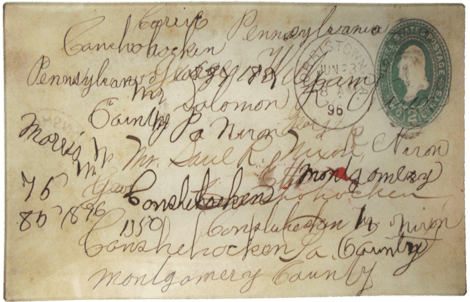
I’m including a few actual letters in this post, both because I spent quite a bit of time searching through the digital collection of the National Postal Museum at the Smithsonian for my last post and because many of the letter “covers” in this collection do rise to the level of art, in my humble opinion. The range is incredible, encompassing patriotic examples from all the American wars, letters from the prisoners of those wars which were delivered in specially-marked envelopes, and letters delivered by planes, trains, and zeppelins. These covers are also a way to look at print and script together. This first envelope, from my own collection, was issued by the Locke Regulator Company of Salem in 1899 (as you can see by the postmark), and then there’s a letter from a Union prisoner of war from 1864 and a letter carried out of Paris by balloon in 1871.

Scan0004p

Letter from Union Prisoner of War

Letter Smithsonian

Covers from 1864 & 1871, National Postal Museum, Smithsonian Institution.

These letters look like likely candidates for a John Derian decoupage tray to me: that man loves his fonts and scripts!  But letters moved to the foreground in the decorative arts a while ago, as exemplified by the beautiful silver cigarette case below, “postmarked” in 1903. I wish we could bring these cases back (with an alternative use), and while we’re at it, letters too!

LT-Script-Sampler_1_large

Silver Cigarette Case Albert Barker Ltd London

John Derian “Sample Script” decoupage tray; Silver cigarette case by Albert Barker, Ltd., London, Collection of the Victoria & Albert Museum.

***EPISTOLARY Art!!! As recommended by Secret Gardener, who has one of the most beautiful blogs out there.


Great Ghosts

Before I moved to Salem, Halloween was all about ghosts for me, not witches. I’m not sure how I became fixated on them as a little girl, but once I grew up I’m sure I made the connection because of the historical origins of Halloween:  the eve of All Hallows’ or All Saints’ Day (with earlier pre-Christian foundations), an evening when thoughts were on those who had passed.  So when I came to Salem and it was all about witches, I was actually a bit confused; I still don’t really grasp the connection between the 1692 Witch Trials and Halloween (besides commerce), but apparently I am the only person in this city who fails to do so. I have fulfilled my Halloween obligations by buying a bucketful of candy which I will hand out tonight, and in the mean time I can celebrate the holiday in my own way:  by focusing on ghosts.

Some favorite ghosts, starting with my very favorite historical person, Queen Elizabeth I, confronting Napoleon in 1803.  The British always call on Elizabeth when they are in trouble. Here she shows him an image of the burning Spanish Armada and proclaims look at that and tremble!!!  Elizabeth’s ghost is followed by that of another monarch, Louis XVI, protesting Napoleon’s theft of his throne.

Isaac Cruikshank satirical prints,1803-1804, British Museum, London.

In the later nineteenth century there was a spirited effort to catch ghosts on film, leading to the production of many “spirit photographs” as well as to any equally enthusiastic effort to prove that these images were faked with double exposure and other techniques. For some reason, several spirit photographs feature children, as in the one below, entitled Their Guardian Angel. From the same year, a “staged” photograph by Henry Ridgely Evans (who referred to himself consistently as “Dr.”), an amateur magician who investigated spiritualism at the turn of the last century.

Their Guardian Angel, C.H. Graves, publisher, Victoria & Albert Museum, London; spirit photograph by Henry Ridgley Evans, from his book Hours with the Ghosts or Nineteenth Century Witchcraft: Illustrated Investigations into the Phenomena of Spiritualism and Theosophy (1897).

And now for some “ghosts” from the world of art and design.  Philippe Starck’s “Ghost” chair is pretty familiar to me, but a more recent discovery is the even more whimsical Ghost Clock of Wendell Castle.  The possibilities seem unlimited for ghost furniture.

Kartell “Ghost Chair” by Philippe Starck, 2002, Philadelphia Museum of Art; “Ghost Clock” by Wendell Castle, 1985, Smithsonian Museum of American Art.

Looking forward to our next big holiday, a final “Thanksgiving Ghost” from the Victorian illustrator Oliver Herford:

Oliver Herford, A Thanksgiving Ghost, 1885.


Variations on Blue and White

I’ve never been a blue person; there is no blue in my house except for my turquoise dining room which I think of as green.  When I went through my transferware phase, I collected red (pink) and white rather than the more attainable blue and white, and in the summer time, when it seems like all of my favorite shelter magazines feature blue and white portfolios, I leaf quickly through.  That said, I have been quite taken by the latest installation of the Peabody Essex Museum”s ongoing “FreePort” exhibitions, through which contemporary artists engage with and respond to the museum’s collections, creating completely new works in the process.  FreePort [No.005]:  Michael Lin takes the traditional blue and white of Chinese export ware and runs with it, as Mr. Lin has emblazoned the armorial and heraldic crests of porcelain produced in China for the European market on the staircase walls and floors of the Museum’s Asian Export galleries.  The effect is modern and baroque at the same time.

And then, as  if these vibrant blue-and white walls and floors were not enough to make us look at plates in a completely different way, Lin also produces a mass of “Mr. Nobodys”, the first Chinese representations of Europeans, with their anonymity enhanced by the massing, and their commercial qualities (we are talking about the Chinese export trade here) enhanced by the fact that you can buy one in the PEM Museum Shop.

For comparison’s sake, another Mr. Nobody from the collection of the Victoria & Albert Museum, London.  This one, however, was produced in England in the later seventeenth century.

The motifs and the figurines are interesting examples of cross-cultural exchange, an important dynamic in world history.  I can’t imagine a better way to (literally) illustrate it.  The Lin installation reminds me of another artistic expression, Blue and White by the Silk Road Ensemble, a multimedia performance that traces the migration of blue-and-white porcelain around the world.

This is a big task, because there are a lot of varieties of Asian-influenced blue and white porcelain and pottery:  delftware, fritware, transferware, just to name a few. Blue and white earthenware is everywhere, crafted in very diverse forms, over many centuries.  Here are two particularly disparate examples:  Iranian rasps in the form of shoes from the eighteenth century, and an image of omnipresent “oriental” planters from Victorian England.  Because I was so inspired by Lin, I tried my hand at my own blue and white Salem fabric design via Spoonflower with limited success:  Samuel McIntire’s sheaths of wheat look a bit too tropical in blue!  Obviously Christopher Dresser’s stenciled ceiling (a nice counterpart for Lin’s walls and floors) is much better.

Fritware and late 19th century songsheet, Victoria & Albert Museum, London; design for a stenciled ceiling, Christopher Dresser, Studies in Design, 1876.


Pine Cone Time

(Having spent more time than I have trying to determine whether “pinecone/ pine cone” is one word or two, I’m opting for two).  Along with the Christmas tree, there is no more omnipresent natural motif at Christmas time than the pine cone, which is rather ironic, given its decidedly pagan roots.  In classical mythology, the pine cone is most prominently featured on the thyrsus, the staff held by Dionysus and his bacchanalian cohorts.  The thyrsus is made from a stalk of fennel topped by a pine cone, representing the farm, the forest, and all sorts of fertility; in both classical and more modern imagery it is more representative of revelry than religion.

A.E. Becher, Bacchanal Scene (with pine cone-topped thyrsus leading the way, in left-hand corner),1903

With the coming of Christianity, the pine cone fades into the background as a natural motif and a way to bring some “life” indoors during the long winter.  I’ve seen pine cones in medieval manuscripts, but I think they become more apparent in early modern decorative arts.  Pine cone knobs are common features of eighteenth-century porcelain, like this beautiful coffee pot from the 1730s.  Fabrics and wallpapers also featured pine cones in the eighteenth and nineteenth century, as they do today.

Mulhouse Fabric, 1830s, Victoria and Albert Museum

Cotton Pine Cone fabric from the Whispering Pines Catalog.

Even if pedestrian pine cones don’t make it into the final product, they often served as objects of study for artists.  The two charming studies (made between 1950-75) by Samuel Chamberlain (also a brilliant photographer, whose Salem Interiors remains one of my favorite books) in the Smithsonian’s Archives of American Art illustrate his composition process.  The pine cone comes into its own in the recent drypoint by Jake Muirhead, from the Old Print Gallery.

Pine cones remain a popular element of seasonal decor because they’re so affordable (free!), accessible and flexible:  you can make ornaments, garlands, swags, topiaries, tablescapes, and wreaths out of pine cones, or just scatter them around.  And when the holidays are over and the glitter goes away, the pine cones can remain until the Spring, when more signs of life begin to appear.  Here are a few pine cone items that transcend holiday decor, and could (I think) be made at home (relatively) easily.

Pine cone garland from Anthropologie, map “pine cone” ornament from Turtles and Tails, and rustic pine cone mirror from Wisteria.