Tag Archives: Colonial Revival

Old Salem Settings

One of the chapters I wrote for the forthcoming (on January 6!) Salem’s Centuries was on the Colonial Revival, and in it I  explored Salem’s experience of that cultural movement as well as Salem’s influence in that cultural movement. I am no art historian, so my purview is very broad, and more focused on popular distillations of “Salem style” than original creations.  There were so many references to “Old Salem” in the first three decades of the twentieth century; now when you hear that phrase it is generally referring to Old Salem Museum & Gardens in North Carolina. But in the 1920s and 1930s, you could buy silverware, furniture, rugs, wallpaper, draperies, and ceramics influenced by “Old Salem.” One product that was particularly effective at conjuring up an image of a very romanticized Salem during its commercial heyday was the “Old Salem” line of china manufactured by Copeland starting in Salem’s tricentennial year of 1926 into the 1950s. This was a “Blue Room” issue marketed under Copeland’s original name Spode, for extra transferware sentimental appeal. I think it was first issued in a polychrome pattern, but the blue-and-white version really took off in the U.S., if advertisements and auction lots are any indication.

I’ve included a snip of text from a House Beautiful feature on “colonial” dinnerware from the 1930s in this last image because there’s a lot there/here. First of all, I love this line about how Old Salem the pattern evokes Old Salem the place, a place lost in time, when “the shoe factories had not yet banished the salty flavor of its existence.” Very Colonial Revival. The author wants to emphasize the pattern’s revival and continuity: it was originally produced back in that “salty” past and New Englanders have always bought Spode. I do find the “original production” assertion a bit confusing as the pattern does indeed feature ships, though not exclusively Salem ships, and the settings are clearly European. In fact, Old Salem, which was produced with old copper plate transfers of Italian views, is kind of a composite view in several ways: old world, new world, maritime, floral, all fused together by the magic of transferware for Salem’s 400th and America’s 150th.


A Colonial Revival Dining Room

I wrote the chapter on Salem’s Colonial Revival movement in our forthcoming book Salem’s Centuries, an effort that I think was pretty ballsy given that I am neither an American historican or an art/architectural historian. You can be sure that I had both types of experts read it before submission and it has been peer-reviewed several times before publication! I felt confident because I took a biographical and cultural history approach, utilizing the work and lives of Salem exemplars Frank Cousins, Mary Harrod Northend, George Francis Dow, and Caroline Emmerton. They were all so respectful of Salem’s material heritage and more than a bit fearful of change. What we now label the Colonial Revival does seem to have been a movement in Salem, fueled as much (I think!) by nostalgia as by a desire to preserve, and its connections to the fledgling preservation movement in the early twentieth century are what interest me particularly. So while I have a sense of the Colonial Revival as a cultural movement, I am far from any aesthetic understanding, although I think I have made some strides in that direction by working at Historic New England’s Phillips House over these past two summers. The house’s dining room, in particular, a great example of the assertive effort of Salem and Boston architect William Rantoul to “marry” its later-19th century back to its Samuel McIntire front, has become my ideal Colonial Revival room. It all started with the alcove for me. I had seen Rantoul’s colleague and contemporary Arthur Little’s alcove in Caroline Emmerton’s house on Essex Street in person and in renderings (the cyanotype below is from a Little & Browne album in the collections of Historic New England), and it just seemed so Colonial-esque to me, so when I saw some semblance of an alcove in the Phillips’ dining room, it all made sense.

As you can see, Rantoul’s alcove is not nearly as enclosed as that of Little, but the former still carved out that space, removing a staircase for the symmetrical china cabinets and fireplace, delineated from the rest of the room by that strident ceiling moulding. He had modernized the systems for the Phillips after their purchase of the house in 1911: there was no need for that fireplace other than to enhance the “colonial” ambiance, which is also provided by the great Joseph Badger portrait of Phillips relative Thomas Mason (c. 1770-75) with his pet squirrel. I’m not even sure you would call this space an alcove, much less a nook, but it’s the semblence that creates the aura of the past in this large light-filled room.

Frankly this chair annoys me but I understand why it’s there.

Of course, the furnishings set the scene as well, and authors of decorating books from the teens and twenties always advised their readers that they should avoid placing items “of a set” if they were to attain that authentic Colonial look. It was relatively easy for the Phillips’, with their multi-generational wealth and trove of possessions from different places and times, to achieve the desired layered look. Their dining room seems to have attained the general “Colonial feeling” recommended by Helen Koues in her popular manual On Decorating the House (1928), in which the walls and woodwork are light in value, the furniture is mahogany or brown mahogany, silver is shown, and side lights or chandeliers may be in silver with glass prisms, or some fixture Colonial in feeling. Andirons and fireirons are of brass or brass and iron, and the china displayed is of Wedgwood in patterns of the eighteenth century. Of course, Stephen and Anna Phillips were both from old Salem maritime families, so their Wedgwood (and Limoges) is supplemented by a dazzling display of East Asian ceramics.


Happy Birthday Hawthorne Hotel

This week marks the 100th anniversary of the opening of the Hawthorne Hotel, which has been at the center of so much of Salem’s social and civic life for a century. One thinks of a hotel as a place for visitors, and I suppose that has been the Hawthorne’s primary function, but its hospitality has long been extended to Salem residents as well through its many public spaces and busy calendar. I really can’t think of any other space/place in Salem where residents and tourists intersect so often and so naturally, except for perhaps the adjoining Salem Common. I was thinking about my own personal connection to the Hawthorne and I came up with an impressive list: in addition to attending many events there (including weddings, political debates, annual meetings, lectures, department retreats), I met my husband there! And more recently, I attended a memorable meeting over which then Attorney General (now Governor) Maura Healey presided, with then Mayor (now Lieutenant Governor) Kim Driscoll seated on her left, in which the fateful location of Salem’s archives was discussed. I could go on and on: I’m sure every Salem resident has their own Hawthorne Hotel list. The connection between Salem people and the Hawthorne has been strong from the beginning, as the Hotel was a Chamber of Commerce initiative with subscribed funding by more than 1000 residents, who turned out in force for its opening on July 23, 1925. For the 100th anniversary on this coming Wednesday, the Hotel is asking for public participation yet again: to recreate this first photo for 2025. I’m so happy about this idea, a rare example of Salem’s history actually being made public.

First photograph: Henry Theriault Collection, Salem State University Archives and Special Collections, Salem, Massachusetts; 2nd and 3rd, Nelson Dionne Salem History Collection, SSU Archives and Special Collections. SSU Archives and Special Collections maintains a Flickr album of Hawthorne Hotel images.

The Hotel got a HUGE response upon its opening. Headlines in all the local papers, including the society rag The North Shore Breeze which praised its Colonial decor and its multitudes of bathrooms and public spaces. The Breeze had a very elite “Gold Coast” perspective, so Salem only pops up in advertising for its many shops generally, but in the late July 1925 issue there was even a poem (or “picture-dream”) inspired by the Hawthorne!  A few years later, Architectural Forum published a portfolio on the hotel, formally credited to the architectural firm of “Smith & Walker and H.L. Stevens and Co., Associates” but widely acknowledged to be the work of Philip Horton Smith, who was putting his Colonial Revival stamp all over Salem in the 1920s. Of course the Salem Marine Society “club cabin” installed on the hotel’s top floor received rave reviews everywhere. The historical context is important for both the creation and reception of the new hotel: this was a decade after the Great Salem Fire, and the year before Salem’s much-anticipated tercentenary: the new hotel seemed to signal the message we’re back and we want you to come celebrate with us.

July 21-24, 1925 headlines in the Boston Glove and Lynn Daily Item; Flag-raising photo from the Hawthorne Hotel Collection at the SSU Archives and Special Collections & poem from North Shore Breeze, July 1925; Architectural Forum, December 1929.

In terms of marketing, the Hawthorne emphasized COLONIAL above all until the late twentieth century, but it’s interesting to survey other advertising adjectives. There was definitely an early emphasis on fire safety, given the experience and impact of the Fire. To be fireproof, a structure had to be modern, so the Hawthorne was deemed modern and colonial at the same time: one advertisement labeled it “the most modern hotel between Boston and Portland.” Even in its opening decade, the Hotel was appealing to motorists more so than train passengers, and it emphasized its “ample parking.” It was comfortable, convenient, and a the “centre of historic interest and famous traditions.” While there was a general colonial aura to its exteriors and interiors for decades after its opening, the Hawthorne clearly associated that word with Salem’s golden era of overseas trade, and it emphasized that connection in multiple ways, from the names of its public spaces (the “Main Brace” bar, the “Calico Tea House” restaurant, and the Zanzibar grillroom) to the “historicards” it sold in its lobby, created by Johnny Tremain author Viginia Grilley. I love these old menus—they are almost like reference works!

There is a marked subtlety in references to the Witch Trials in contrast to other Salem institutions, but that changes a bit after Bewitched came to town in 1970, which you can easily understand, as Samantha and Darren Stephens stayed at the Hawthorne, or the Hawthorne Motor Hotel, as it was called at the time. There are periodic name changes: I think the progression is Hotel Hawthorne, the Hawthorne, Hawthorne Motor Inn, Hawthorne Inn, Hawthorne Hotel, but I could be wrong. Like any professional and profitable hostelry, the Hawthorne has to welcome everyone, and so it seems that witches have overtaken mariners over these past few decades. The weddings, annual meetings, and convention continue, however, as does the hotel’s seemingly timeless appeal, enhanced by advantageous associations (particularly the Historic Hotels of America registry), interior updates, clever marketing, and that still-strong public connection. I dipped into one of the hospitality and tourism databases available to me at Salem State and found Hawthorne references to its impressive visitor stats, its haunted character (I’m not going there), its generous pet policy, and its rooftop ship’s cabin. The more things change the more things remain the same, and Salem’s now-venerable hotel seems poised for another busy century.

The Hawthorne from the 1920s through the 1990s: all images from the Hawthorne Hotel Collection at SSU Archives except for the 1930s (Visitor’s Guide to Salem, 1937) and 1950s (Phillips Library); a feature on the Salem Marine Society’s recreated ship’s cabin on the top floor of the Hawthorne in Yankee Magazine, 2015 (photo by Carl Tremblay); the Hotel’s 60th Anniversary celebration in 1985.

Hawthorne Hotel Birthday Block Party on July 23, 5:30-7:30: https://www.hawthornehotel.com/event/hawthorne-hotels-100th-anniversary-celebration/


When Salem was Pretty

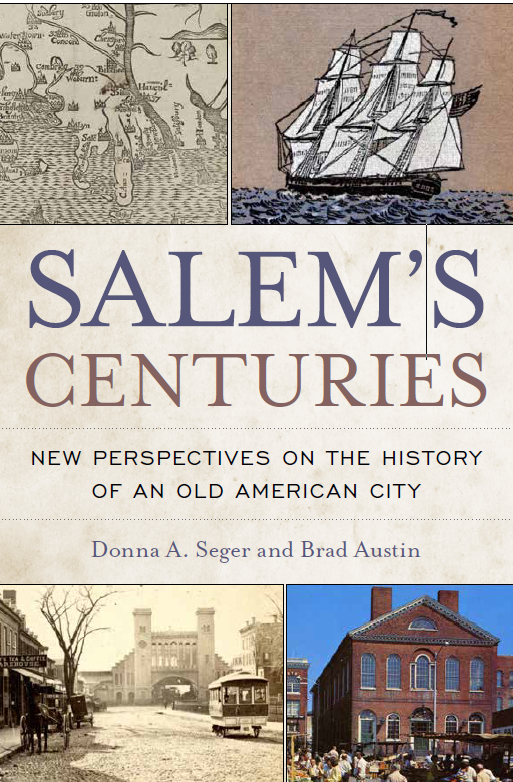
The Salem visual vibe is darker now, and focused firmly on “Gothic” rather than Federal or Colonial, but the Witch City used to be pretty. I wrote the chapter on the Colonial Revival in our forthcoming book Salem’s Centuries. New Perspectives on the History of an Old American City (for which we have our cover, and a production schedule, and a publication date coming soon!), spotlighting four Salem “influencers” who emphasized the city’s beauty and craftsmanship through various cultural initiatives: Mary Harrod Northend, Frank Cousins, George Francis Dow and Caroline Emmerton.  They were so successful that Salem coasted into a period of being known primarily for its architectural and aesthetic heritage that lasted well into the 1960s, an image that was sustained by the Essex Institute’s house museums and the very public battle over urban renewal. A succession of commercial and graphic artists celebrated Salem through their accessible imagery, and we see Salem grouped with Colonial Williamsburg, Historic Deerfield, Sturbridge Village, Mystic Seaport, and other traditional heritage destinations. In today’s competitive tourism realm Salem has pulled ahead of (or moved behind?) that pack by emphasizing horror over beauty, Gothic over Federal, and darkness over light. At least that’s the projection I see in so many shop windows and on so many websites, but I think I better do some more searching in the real world. There are also many AI images of a Salem that doesn’t even exist, a concocted Victorian-Gothic world with black cats and cute witches, but also church spires! Fantasy Salem is even more idealistic than what came before, depictions in color and black and white of well-manicured car-free streets and stately houses, a “city of treasures” according to Katharine Butler Hathaway.

Some of my favorite images of Salem from the 1920s to the 1960s: Felicie Waldo Howell’s “Spring on Chestnut Street” + various houses; shelter magazines LOVED Salem in the 1920s; Rudolph Ruzicka made several Salem prints; interior vignettes from House & Garden, June 1939;Chestnut Street scenes from Philip Kappel and Samuel Chamberlain; LOVE these notecards from Nantucket artist Ruth Haviland Sutton; the “Silent Traveler,” Chiang Yee’s view of the Custom House.


A Salem Women’s History Tour

For International Women’s Day today, I thought I would put together a walking tour of Salem women’s history. Of course, every street and every building in Salem has traces of women’s history, most of it hidden from us. I would like to include more than “notable” women on my tour, and I think I’ve busted out that category a bit, but there’s still a lot of work to do and a lot more to learn. I decided to limit the tour to existing buildings, so it definitely skews towards the nineteenth and twentieth centuries. I read revews of Salem walking tours occasionally, mostly because I want some sign of hope that Salem tourists are interested in topics other than the Salem Witch Trials, and that’s the number one complaint: we stood on the sidewalk looking at a parking lot. If they were interested in something other than the Salem Witch Trials, they would no doubt see more buildings and places than parking lots. So my tour is all about buildings, and the women who lived in them. Beware if you want to do it yourself: it’s a long tour—I easily got in my 10,000 steps!

We’re starting on Derby Street, right next to the Custom House, at 1) The Brookhouse Home for Aged Women. Not only is this a McIntire building and an early (1861) example of a privately-established residential home for senior women, but it was also the home of Massachusetts congressman and Secretary of the Navy Benjamin W. Crowninshield, whose wife Mary was quite the Washington socialite: her letters are very revealing about the social scene during the administrations of Presidents Madison and Monroe in general and Dolley Madison in particular. Mary Crowninshield spared no detail, either of drapery or dress trimmings.

Then it’s on to another impressive brick Federal house turned social institution, 2) the Woman’s Friends Society on Hawthorne Boulevard. Founded in 1876 as a residence and employment “bureau” for younger women, the Society acquired its impressive brick double house from Salem’s famed philanthropist Captain John Bertram and his daughter Jennie (Bertram) Emmerton, the mother of Caroline Emmerton of House of the Seven Gables fame. So it is the Emmerton House, and it continues in its original mission. Lots of women’s stories to tell here, as it also became a center for social work, craft eduction, and public health initiatives.

We walk westerly on Charter Street until we come to the so-called 3) Grimshawe House where the famous Peabody sisters lived and where Nathaniel Hawthorne courted his future wife, Sophia. This house was built around 177o and educators Elizabeth and Mary lived here between 1835-1841 with said Sophia, their parents and brother. It has been in decline for most of the second half of the twentieth century, serving as a eerie gray neighbor of the Charter Street cemetery, but last year signs of restoration (and color) appeared.

Now we’re walking towards the McIntire Historic District along Front and Norman Streets and then we’re on Chestnut. There are quite few houses on this street worth noting in relation to women’s history, but I limited myself to 4) Mrs. Parker’s house at #8, 5) Hamilton Hall; 6) the Phillips House, and 7) a Caroline Emmerton-commisioned house. My neighbors just across the street live in the beautiful house occupied by Mary Saltonstall Parker, an author and artist at the turn of the last center. Mrs. Parker loved traditional crafts and antiques and wrote about both in a succession of small books which reflect the Colonial Revival movement, but she was also a “maker” herself and one of her embroidered samplers was on the cover of House Beautiful in 1915. Hamilton Hall is a veritable monument to women’s history, including the work of the Remond family, all those festive fundraising fairs in the nineteenth century, debutante assemblies and the lecture series sponsored by the Ladies Committee in the twentieth. And schools! Dancing schools and “dame schools,” including that of Lucy Stone in the 1880s below. I certainly learned a lot about a variety of women working at the Phillips House this past summer, including ladies of the Phillips family and their staff, but I wanted to spotlight this house at was also the home of Caroline Howard King, the author of one of the most popular (and literary) Salem memoirs, When I lived in Salem. Before the house was the Phillips House, it was actually a genteel boarding house, and Caroline lived there from the 1890s until her death in 1907, I believe. The last house below is Caroline Emmerton’s commissioned copy of the Derby House by architect William Rantoul: it completes the street.

Over on Essex Street, we stop at the venerable 8) David Mason House⁠. Notable for its namesake occupant’s role in Leslie’s Retreat in 1775, more than a century later it was purchased and restored by the prolific author and suffragist Grace Atkinson Oliver, who also served as a member of Salem’s School Board. Across the street is the 9) Quaker Cemetery, where one can reflect on the persecution of Salem’s Quakers in the seventeenth century, including Cassandra Southwick and her daughter Provided. Further down the street towards downtown are 10) the Cabot-Endicott-Low House, childhood home of Salem’s only “dollar princess,” Mary Endicott Chamberlain Carnegie, pictured below just before she presented her stepdaughters to Queen Victoria, of whom she was reportedly a favorite, 11) Caroline Emmerton’s stately house and 12) that of Susan Osgood, another preservationist of sorts, who was the niece of Salem’s first, Joseph Barlow Felt, who was married to Abigail Adams’ niece, also named Abigail. Because the Felts had no children, a lot of her aunt’s things ended up with Susan, including items that Abigail Felt inherited from HER aunt Abigail Adams. Susan donated Abigail’s Inauguration dress (+ slippers!!!) to the Smithsonian Institution, where they reside in the First Ladies exhibit.

Through the Ropes Garden and over to Federal Street and the 13) home of Salem’s first female physician, Dr. Sarah Sherman. She was an amazing woman, who was also elected to the School Board in 1879, the first “school suffrage” election in Salem. Then we will walk towards downtown, cross North Street, and visit two Lynde Street houses, home to two accomplished Marys. First up is the 14) house of Mary Bradford Hagar, who served as the chair of the Salem Ladies Centennial Committee in the 1870s, which organized Salem”s exhibits for the Centennial Exhibition of 1876. Her committee did such a great job that it won national acclaim, and 100 years later in 1975, the Essex Institute mounted a re-exhibition. Next is the 15) house of Mary Harrod Northend, the prolific author of everything “Old Salem” in the early twentieth century. A very Colonial Revival street!

Salem walking tours always stop at the 16) Lyceum Building, now Turner’s Seafood Restaurant, on Church Street as it was supposedly the site of the first Witch Trial victim Bridget Bishop’s orchards, but I would include it on my tour because it was the site of so many meetings of Salem’s Suffrage Society from the 1870s on. I’m cheating a bit here as the present Lyceum building was not the one in which Salem’s Suffragists met: there was an earlier wooden structure on the same site. Like so many sites in central Salem, it is historic in more ways than one. Walking towards the Common, I think I would stop at the Peabody Essex Museum’s 17) Bray House, because it is so cute and also because Salem’s most successful commercial artist, Sarah Symonds, had a workship and retail space there.

I want to include at least one house on Washington Square on my tour, so I think I’m going with the present-day 18) Bertram House. What does this former home for aged men and current assisted living facility for both genders have to do with women’s history? My link is another Endicott and preservationist, Clara Endicott Sears (contemporary and cousin of Mary Endicott), who wrote a charming childhood memoir of life in this house with her grandparents entitled Early personal reminiscences in the old George Peabody mansion in Salem, Massachusetts (1956). The Bertram House overlooks the Common, where a grand historical pageant was present for the Salem Tercentenary in July of 1926: its author was Nellie Stearns Messer, who lived at 19) 15 Oliver Street, pictured just below. By all accounts that I have read and heard, she seems to have been a very active mid-century public historian, before that term was used. In addition to the Tercentenary pageant, she also wrote very substantive histories of the Tabernacle Church and Ropes House. We then walk northward towards Pleasant Street, and the 20) home of one of Salem’s most notable entrepreneurs, Charlotte Fairfield. Charlotte ran a coal company that undercut Salem’s coal cartel in the first decade of the twentieth century, and received lots of attention in the Boston papers for doing so. Independent indeed.

For the last leg of the tour we’re going to swing over to Pickman Street to see the building which houses the 21) Esther C. Mack Industrial School for Girls from the 1890s through the 1920s. Established by a large bequest in the will of its namesake, the school taught what we would call domestic rather than “industrial” skills, mostly sewing and cooking, to young girls and had quite a few collaborations with the Woman’s Friend Society. The photograph below, by Mary Harrod Northend, is of a sewing class. So many progressive women in Salem at this time: I haven’t even touched on the House of the Seven Gables except for showcasing several properties associated with its founder, Caroline Emmerton, or any of the public health and cultural initiatives of this era. This is why I get more than a little frustrated with the continuing almost-exclusive focus on 1692 in this city: it excludes so much history in general, and so much women’s history in particular. But we’ve walked enough for one tour, so I propose crossing the Common, perhaps taking a peak and the 22) birthplace of prominent Salem artist Fidelia Bridges, and then popping into the tavern at the Hawthorne Hotel for a drink, and a toast to the ladies.

Map made by John Northey for the Bicentennial in 1976: as you can see, there’s a lot more land to cover.


The Salem Tercentenary, 1926

As I’ve been finishing up the manuscript of our 4o0th anniversary volume, Salem’s Centuries, I’ve been writing and thinking about Salem’s 300th anniversary quite a bit. For some reason I thought that I had already posted about this big event on this unwieldly blog, but I haven’t. Quite a lot is out there—the archivists at the Salem State University Archives and Special Collections oversee an ever-larger collection of historical photographs of Salem, many of which they have uploaded to Flickr, and among them are some great Tercentenary views. This is really the best place to go for local history, including an array of blog posts which put their collections in context. So maybe, in my writing-and-teaching-brain-fog, I confused their output for mine? I don’t know, but there’s certainly no Tercentenary post here so I thought I’d pull one together. I’m quite impressed by the activity of the 1926 Tercentennial but it was certainly more celebration than reflection. This was not a moment to be at all critical about the city’s past; this was a party! Beginning on July 3, 1926 and commencing on the 10th, city residents were feted by parades, street parties, reunions, balloon ascensions, a big ball, a field day, a firemen’s muster, a bonfire, various illuminations, and concerts, concerts, and more concerts. Many people were involved in the planning, at least hundreds if not more. Starting in 1924 a general committee came together, followed by the appointment of chairs of the various subcommittees: the bonfire, music, fireworks, the horribles parade, sports, the military, civic, and historical parade, historical exercises, banquet, costume ball, floral parade, firemen’s muster, entertainment and publicity. Then the work began and there were some alterations: a “great” civic and military parade was severed from the floral and historical parade when it became apparent that the consolidated parade would be very, very long and that the guest of honor, Vice-President George Dawes, could be in Salem only for a short period of time. (President Coolidge was invited to the Tercentenary shortly after his election and I have no idea why he couldn’t turn up—it seems like a slight, as didn’t he summer in Swampscott?) The planning seemed to go smoothly but I have no real insights into subcommittee deliberations—I’m not sure where the meeting meeting minutes are, or if there were any. But they seem to have thought of everything, including a temporary “hospital” installed in the Phillips School overlooking Salem Common. The one big pre-celebration problem that surfaced was in relation to one of the big arches erected at the entrances to the city, specifically the arch at the Salem-Beverly Bridge. Once completed, a furor arose: it said “Greetings” rather than “Welcome” and on the wrong side! Greetings was simply not welcoming enough, and people leaving the city and crossing over to Beverly were being greeted! It cost the princely sum of $700 to fix this arch sign but it had to be fixed and so fixed it was.

I think that was it for the missteps, and then came July, and they were off! Here’s the schedule:

Sunday the 4th: Bells ring all over the city, followed by religious services, and then a huge band concert on the Common. Presumably this is what the brand new bandstand was built for, but as the band consisted of “300 pieces” I don’t think all those musicians could have fit in there. In the evening, a 100-foot bonfire was set ablaze (we are right in the midst of Salem’s big July 4th bonfire craze at this time).

Monday the 5th: The “Grotesque, Antiques & Horribles Parade” featuring Salem schoolchildren in costume competing for prizes (this is another Salem/North Shore July 4th tradition).

We are the Freaks Float, Nelson Dionne Salem History Collection, Salem State University Archives and Special Collections, Salem, Massachusetts.

Tuesday the 6th: Tours of old Salem homes open for the occasion, many, but not all, on Chestnut Street, and an exhibition of “treasures brought to Salem by the sea captains of old days.” In the evening, a balloon ascension at Salem Willows and an “illumination” of US Navy vessels in Salem Harbor.

Wednesday the 7th: the “Great” Parade, with Vice-President Dawes in attendance. This was followed by an historical address on Salem Common, another band concert, and fireworks.

Vice President Charles G. Dawes, Mayor George J. Bates, Governor Alvan T. Fuller, and Congressman William M. Butler; Nelson Dionne Salem History Collection, Salem State University Archives and Special Collections, Salem, Massachusetts.

Thursday the 8th: Family reunions for “Old Planter” families; I’m not sure about everyone else. The first Chestnut Street Day, which was quite the event, and a field day on the Common. The Tercentenary Ball was held that evening at Salem Armory.

Friday the 9th: The other parade, the “Floral and Historical Parade.” (I just love the idea of this– flowers and history!)

Floral Float No. 9, 1926 and Brig Leander Float, Leland O. Tilford photographs, Salem News Historic Photograph Collection, Salem State University Archives and Special Collections, Salem, Massachusetts.

Saturdy the 10th: A huge firemen’s muster on Salem Common, yet another parade and band concert, and fireworks on Gallow Hill.

Quite a success I think, and there were some cultural consequences too. One thing I’m curious about is Salem artist Phillip Little’s “huge” painting of Derby Wharf at the beginning of the nineteenth century: it was commissioned by the Naumkeag Steam Cotton Company for a big home exposition in the spring of 1926 and supposedly shown in Salem for the Tercentenary, but I’m not sure where or when. And where is it now? I want to see it! Since I have not seen it, I have to say that my favorite Salem Tercentenary painting remains Felicia Waldo’s impressionistic view of the first Chestnut Street Day.

Felicie Waldo Howell, Salem’s 300th Anniversary, 1926, Christies.

These civic celebrations can seem frivolous on the surface, but they also reveal a lot about the communities which are putting them on. Much of these activities would have been very familiar to Salem people in 1926: they were used to parades, and old home days, bonfires and annual field days, in which children from every neighborhood competed against each other in a variety of athletic activities on Salem Common. It’s a huge generalization which deserves much more documentation and explanation, but Salem seems much more focused on its residents than its visitors at this time, and for much of the twentieth century. The comments and the coverage from 1926 indicate that what was really new about the Tercentenary were the open historic houses throughout the City, and on Chestnut Street in particular. The national house and garden magazines went crazy with the coverage! Chestnut Street Day was so successful that it was repeated on four more occasions, with the last one occurring in 1976 (there are some great Samuel Chamberlain photographs of later Chestnut Street days from the Phillips Library at Digital Commonwealth and here). And there was nary a witch in sight in 1926, certainly not on the official Tercentenary medal.


The Elizabeth Perkins House

One of the chapters I’m working on for Salem’s Centuries this summer is about Colonial Revival Salem, or should I say, a group of antiquarians who lived and worked in Salem from about 1890-1930 who were dedicated to preserving and promoting any and everything about Colonial-era Salem in their time and for the future. Our book is a work of social history, so our focus in on Salem people. But when it comes to the various expressions of the Colonial Revival movement, if you can call it that, I’ve always found that individuals and their often-passionate attachments to the past are so important, and this is particularly true in the case of the Elizabeth Perkins House, one of the Old York Historical Society’s  properties that has recently been reopened. For some reason, this is the one Old York house that I’ve never been inside, and I’d always heard that it was a perfect example of Colonial Revival influence in this region, so I was pretty eager when I showed up for my tour this past Friday.

The Elizabeth Perkins House of the Old York Historical Society, looking over the York River, Sewall’s Bridge and the Hancock Warehouse beyond. Its restorers, expanders and occupants: Mary Sowells Perkins and Elizabeth B. Perkins (photo on right from Old York Historical Society as featured in a very helpful Willaim & Mary 1988 thesis by Melisssa Mosher shows Elizabeth Perkins in front of the house).

This house is absolutely central to the preservation history of York as its early 20th century occupants, Mary Sowles Perkins (1845-1929) and her daughter Elizabeth B. Perkins (1869-1952) contributed it and several other structures (the Old Gaol, Jefferds Tavern, the old Schoolhouse, and the John Hancock warehouse) to what would eventually become the Old York Historical Society as well as encouraging other preservation efforts. So it seems right that Old York’s administrative offices have been relocated to this site as well. There was a whirlwind of restoration, expansion, embellishment and entertaining after the Perkins family purchased the house in 1898: they were from New York, and seem to have known everyone. Mark Twain came over from his summer rental across the river to use their telephone, the first one in York, and in 1905 they hosted the grandest party of the era: a Japenese-themed fête to celebrate the conclusion of the Portsmouth Peace Treaty ending the Russo-Japanese War of 1905 with over 700 guests in attendence. The tour really focused on their house, so much so that I’m not really sure of its pre-Perkins history. Old York is dating the house to around 1730 now, which seems about right to me, but I have postcards from my childhood (showing the house exactly as it looks now and at the time of Perkins’ death in 1952) bearing the date of 1680. The one below of the dining room shows the very “colonial” room that the Perkins created but also one of its most off-putting features for me—the electrified girondoles along the back wall.

Postcard of the dining room from 1960s or 1970s? I think it is a rule that every Colonial Revival house must have Hessians!

At first the house seemed to me like one of those sprawling recreations/creations which Mary Harrod Northend, one of the Colonial Revivalists in my Salem chapter, showcased in her Remodeled Farmhouses (1915) and I immediately wanted to know if Harrod knew either of the Perkins women–the two Marys were of the same generation. But inside, besides the dining room, it felt a little different to me than standard Colonial Revival: I guess there is no standard Colonial Revival because it is often an individual expression. The parlors of the Perkins house felt very traditional to me, but also more cosmopolitan, more worldly, more lavish, more of a mashup between past and present than a “period rooms”. A case in point would be this wonderful 20th century copy of an earlier portrait: this modern woman dressed in period costume just like Elizabeth Perkins above (well, a bit more elegantly). I love this portrait!

Hooked rugs abound of course, but the Perkins ladies were great travelers so that accounts for the worldliness of their rooms and all the interesting assemblages. Now I’m wondering about comparative Colonial Revival settings: if you’re trying to create and preserve a “colonial” home in the country it’s a different experience than in the city, where change is so much more apparent—and threatening. My Salem people, including Harrod, Frank Cousins, George Francis Dow, Caroline Emmerton and Daniel Low, are living and working in an environment of constant development, fire, pollution, and immigration: it seemed like things were being swept away. The Perkins ladies were facing none of that in York, so I’m thinking that they didn’t have to be quite so strident in their pusuit and preservation of the Colonial. Just a thought.

Front parlors and a very traditional entry; love the 17th century “open-back” ??? chairs.

Loved the Currier & Ives presidential prints in the guest bedroom, which also has an en suite bathroom. The other bedrooms, including that of Mrs. Perkins above, have that “just left”/ I was just reading……. feeling, which is very Colonial Revival too: George Francis Dow pioneered the use of the folded-newspaper-by-the-gentleman’s chair motif in his period rooms in Salem, I believe.

Tours every Friday and Saturday available here.


Mid-Atlantic Majesty

This has happened to me before: I have this notion of Boston/Salem pre-eminence in all material Federal, and then I see something from Philadelphia or Baltimore, or on my most recent trip New Castle, Delaware. I visited three museums on my recent spring break trips to the Delaware River Valley: at the Court House Museum in New Castle I learned all about Delaware’s nearly simultaneous separation from Great Britian and Pennsylvania, at a return visit to Winterthur I saw some old favorites and learned some things from new perspectives in the galleries, and at the Read Museum and Gardens I was quite simply blown away by the magnificence of a mansion built and embellished by Philadelphia craftsmen in down-river Delaware. The Read House, a National Historic Landmark owned and operated by the Delaware Historical Society, was built by George Read II, the son of a signer of the Declaration of Independence and Delaware Constitution, between 1797 and 1804 on New Castle’s the Strand, running alongside and overlooking the River. Its size (14,000 square feet) and scale and surrounding gardens give it a majesty that rivals the grandest urban townhouses of the era, evident even before you step inside. And then you step inside! The Gardner-Pingree House here in Salem used to be my standard for Federal perfection, but now I think it has been surpassed.

There’s just something about the scale of this house: everything is about a foot  or two bigger than you expect it to be, or I expected it to be, with my Massachusetts standards. But it’s not just about size, of course, it’s the details that make this mansion truly majestic: the plaster, the woodwork, the hardware. Mr. Read had to have the best of everything, and that meant everything Philadelphia. And as he didn’t really have the brilliant career of his father and namesake, this mansion represents something quite beyond his means, and something that could not remain in the family for very long after his death. It passed to a succession of owners, but fortunately remained relatively intact. In 1920 Philip and Lydia Laird acquired the property and installed a “ye olde British pub” for prohibition entertaining in the basement while also amplifying a Colonial Revival image for the rooms upstairs. Mrs. Laird bequeathed the house and grounds to the Delaware Historical Society in 1975, and a comprehensive (and ongoing) restoration ensued. My tour began in the prohibition pub, but I’m going to leave it until the appendix as I want to showcase the house as a contemporary visitor might have entered it, but it is a great cue that you’re about to enter a house which has both “Colonial” and Colonial Revival elements. (I’m putting Colonial in quotes as all the Colonial Revivalist authors I know extend that period up to about 1820, very conveniently).

Double Parlor: just a complete WOW. I couldn’t catch my breath! Fortunately I had a charming guide who told  me everthing I wanted to know because I couldn’t manage to ask. This was your not-so-standard convertible double parlor which served many occasions and capacities: Mr. Read set up his office in what is now the dining room across the hall, so the front (peach) parlor served as a dining room in addition to other functions. Amazing “punch and gouge” carving by Philadelphia craftsmen EVERYWHERE. The (nearly) floor-to-ceiling windows in the rear (green) parlor open up at the bottom, creating doorways to the garden outside. Across the hall (featuring more punch & gouge and unfinished floors to facilitate clearning, according to my guide is the Lairds’s Colonial Revival dining room.

The Dining Room: features a scenic hand-painted mural of a romanticized “Colonial” New Castle from the 1920s with the “three flags” messaging that I also saw at the Court House Museum. William Penn landed in New Castle in 1682, very close to the Read House, and he is pictured being greeted by Dutch, Swedish, and English settlers as well as a members of the native Lenape tribe. On (back) to the kitchen…………..where there was a surprise!

The Kitchen: has a variant Rumford Roaster! My guide explained to me that Mr. Read had to have the best of everything, and the latest technology, so of course he had to have a Rumford Roaster, but somehow the original Rumford design was adapted: the second photograph is the Read House and the third is Hamilton Hall’s roaster right next door to me in Salem: as you see the firing compartments (for want of a better technical term) have been moved over to the main hearth. This was tremendously exciting to me as we have SEVEN Rumford Roasters in Salem and this was quite different! The first photograph in this group shows the bell display for service; the last,  a warming station for dishes and plates, also quite ingenious. And on to a few singular shots and details:

Details, a model New Castle house, and Mrs. Read’s bedroom: how to summon servants, door hardware, stair detail, a model of another New Castle house (and more of the unfinished floors), and lots of soft furnishings in Mrs. Read’s bedroom. Regarding service and the many hands that must have been required to maintain this large house, I did ask about slavery, which was legal in Delaware right up until the ratification of the thirteenth amendment (which it notably did not participate in—OR the 14th and 15th!). Reseach is still ongoing, but account books indicate that the Reads’ cook was a free woman of color.

Appendix: the taproom downstairs, which I prefer to call the “Prohibition pub,” and back in its heyday.


Daniel Low and the Art of Advertising

Very often, one of Salem’s longest-running and best-known businesses, Daniel Low & Company, is reduced to a pioneering seller of witch wares with their souvenir witch spoons and other “memorabilia” issued before, during and well after the very important Bicentennial of the Witch Trials in 1892. It all started with a spoon, say the proponents of witchcraft tourism, long ago: we didn’t start it! And they are not wrong: the Company certainly sold its share of witch spoons, plates, dishes, thimbles, scissors, and more unusual items like “penwipers”. But Daniel Low & Co was also a Salem institution for over a century: evolving from its jewelry and silver foundations to a major purveyor of all manner of decorative accessories for the home over its long history (1867-1994). It “sold Salem” in more ways than one: if you visited its landmark store, situated in Salem’s most historic square in the former site of its First Church, you would see not only floors of display cases but also “unique antique rooms” featuring reproductions of Salem’s more traditional products; if you ordered from the annual Daniel Low year book you would receive a receipt bearing an illustration of an historic Salem structure as well as a copy of the company pamphlet The Salem Pilgrim. 

You could write a book entirely on Daniel Low’s advertising methods and campaigns: there’s just so much information and copy. The company advertised both locally and nationally: to support both its wondrous store and its annual year book, issued from the 1890s into the 1960s (I think—I can’t find the end date). But it’s not just the means by which Daniel Low reached out and reached in to homes across America, it’s the messaging. The store’s advertising philosophy was expressed in a number of speeches and articles by Robert R. Updegraff, its manager of publicity, from the teens into the thirties. Everything I read by Updegraff, who seems to have been a pioneering practicioner of the new “art” of advertising, reminded me of Don Draper’s Kodak carousel pitch in Mad Men: aim for the heart, and treat your customers like neighbors. Only a year into his job, Mr. Updegraff summarized his pitch and his profession in a serialized article entitled “The Story of the Year”:  One thing is sure, the advertising man who is to be the real power in the future will be the man who stops thinking in terms of type and borders and magazines and billboards and street car cards and printing presses and halftones. He will think in terms of neighborliness and life. He will write simple, sincere, friendly messages to these neighbors of his. He will think and write in terms of ideas, emotions, experiences, merely using words as vehicles to convey his message and printing presses to multiply it. He will use illustrations only when they tell the story better than the same amount of space used in words. His advertisements will be efficient because they are sincere and have the beauty of truth. And they will be effective. [Macleans magazine, September 1913]. Updegraff believed that Salem’s past could be utilized to emphasize sincerity and exemplify the “beauty of truth”: not its witch-trial past but rather a more hopeful, gilded, and gentle “old Salem.” In a 1914 article in Printers’ Ink he elaborates on how the imagery of truly Colonial Salem conveyed an atmospheric sincerity in the Daniel Low Year Books which began offering “glimpses of old Salem” from that time until the 1950s.

A half-century of Daniel Low & Co. Year Books: from Historic New England, Salem State University Archives and Special Collections Flickr photostream, Harvard University Digital Collections and my own collection.

Glimpses of Old Salem was a constant, but not Daniel Low’s exclusive pitch: it aimed to be a traditional-yet-modern “Treasure House” too, a phrase that was adopted by the Essex Institute and applied to all of Salem from the mid-century: before Witch City crowded out all other messaging at its close.


The Wentworth-Gardner House

We were in York Harbor all last week with family and friends, several of whom had never been to this region of New England before. So I was a bit of a tour guide, in my fashion. On a morning tour of Portsmouth, we passed by my favorite house in town, the Tobias Lear House, as well as its more famous neighbor, the Wentworth-Gardner House, one of the most famous Georgian structures in the country. I’m very familiar with this house, but for some reason I’ve never been inside, and the door was open with a flag out front, so in I went, forgetting all about my companions. They followed me, but I really gave them no choice in the matter! We had a lovely tour with a very knowledgeable guide, and the house was ever more stunning than I imagined. I’m kind of glad that I had never been in before, as this house is probably the best example of the entrepreneurial antiquarian Wallace Nutting’s material and cultural impact in New England and I’ve come to appreciate him only recently. Nutting purchased the house in 1915 and added it to his collection of “Colonial Pictorial Houses” after his restoration, and thus it became one of the more influential representatives of the “olden time” in his time and the Colonial Revival in ours. Images of Nutting’s wispy colonial ladies in its midst are scattered throughout and a room is devoted entirely to his work.

The Wentworth-Gardner House in Portsmouth, New Hampshire: present and before Wallace Nutting’s purchase in 1915; the amazing center hall with a stairway re-installed by Nutting, and one of his colonial ladies descending (from a large collection of Nutting images at Historic New England).

The houses was built by Mark Hunking and Elizabeth Rindge Wentworth in 1760 as a wedding gift for their son Thomas, who lived in it until his death in 1768. It was owned and occupied by Major William Gardner from 1793 to 1833, and thereafter by his widow. In the later nineteenth century the grand mansion became a rooming house as its South End neighborhood declined, and then Nutting came to its rescue! As you can see, his most extensive restoration was to its exterior, but the reinstallation of the stairway was a major undertaking as well. I know that the pineapple was a customary colonial symbol of hospitality, but I can’t help but wonder if Nutting was inspired by Salem’s “Pineapple House.”

Nutting’s restored doorway (Historic New England) and Salem doorheads from the 1895 Visitors’ Guide.

Nutting sold the house to the Metropolitan Museum of Art just after the close of World War I, initiating the threat of removal to New York City that was itself removed by the onset of the Depression. After a brief stint of stewardship by the Preservation of New England Antiquities, the Wentworth-Gardner (and adjoining Lear house) House was acquired by a group of local preservationists who eventually became known as the Wentworth-Gardner Historic House Associates in 1940. It’s just a great place to visit: so many wonderful structural and decorative details, including the wonderfully carved mantel in the front left parlor (another one of Nutting’s reinstallations), the newly-installed reproduction eighteenth-century flocked wallpaper, the very Colonial Revival kitchen with its steep steps leading to upstairs, several great bedchambers (I couldn’t call them simply bedrooms), the Wallace Nutting room, and a very nice exhibition on historic preservation in Portsmouth. I remain so impressed by this small city with all of its historic houses, in wonderful condition and all open to the public. It’s a great example of community commitment to material heritage and the importance of having several institutional stewards thereof, rather than just one or two.

Georgian and Colonial Revival styles/worlds merge in the Wentworth-Gardner House, Portsmouth, New Hampshire.