Tag Archives: Christmas

Christmas with Barbara

I love classic films, so naturally my favorite television channel is Turner Classic Movies:  I often have it on in the background when I’m home, as you never know what–or who–might turn up!  This month, I have to admit that it’s been on even more than usual, as December’s “Star of the Month” is Barbara Stanwyck, my very favorite movie star.  No one comes close to Barbara in her ability to fill the screen and capture her audience’s attention, in my opinion; certainly no actor or actress in the present (a time when movie stars seem much smaller), and perhaps only Cary Grant and Bette Davis in the past. I love everything about Barbara:  her toughness and her vulnerability, her flexibility, her stature, her walk, her ability to sit a horse, her little cropped jackets, her obvious professionalism. There is a sense of inner “simmering” in her that I find captivating, and I think she chose her roles very well. I find even her early 1930s movies–in which she seems to be playing the same downtrodden character again and again–watchable, but she really comes into her own in the 1940s, when she became the highest paid woman in America.

Barbara 1940s

Miss Stanwyck at the height of her power and popularity, Billy Rose Theater Collection, New York Public Library Digital Collection.

Two of my favorite Stanwyck films happen to be Christmas movies: Remember the Night (1940) and Christmas in Connecticut (1945). For as long as I can remember, I have generally watched both at least once during the holiday season, but this particular month I seem to be watching them again and again, so many times that I almost feel like I’m having Christmas with Barbara!

Remember-the-Night-321473cd

Christmas-in-Connecticut-d4c67732

I think most people have heard of or seen Christmas in Connecticut, and it is certainly a wonderful film with a charming Barbara (and a great supporting cast), but she is even more endearing in Remember the Night.  This movie, the first of what I think were three pairings with Fred MacMurray, shows the actress in transition from her 1930s vulnerability to her 1940s confidence:  she is both sad and funny, tough and vulnerable, skittish and resolute. MacMurray plays a New York City Assistant District Attorney who prosecutes Stanwyck’s shoplifter character in a Christmas Eve trial:  when he realizes 1) that the joyful jury will let her off in a collective display of Christmas spirit; and 2) that she is a fellow Hoosier, he postpones the trial until the New Year, bails her out of jail, and offers to drive her home to Indiana for the holidays as he is heading home himself (you have to suspend some  judgement here). On the way west, back to the country, they have various escapades and encounters that bring them closer together. One of the most poignant scenes in the film is when they arrive at her childhood home and face her dreadful mother; Fred will not let her stay there and he whisks her away to his own mother, the polar-opposite perfect mom, played, of course, by Beulah Bondi, Mrs. Bailey from It’s a Wonderful Life!  On the farm, they celebrate Christmas the old-fashioned way and fall in love, always knowing that they’re going to have to go back to the big city, and the big trial, after the holidays. And they do: neither compromises their principles or their admiration for one another and so the “resolution” of the film provides a nice contrast to more predictable Christmas fare, including Christmas in Connecticut.

rememberthenight_1940_bts_01_1200_100820090459

Barbara Stanwyck and Fred MacMurray look over their scripts with director Mitchell Leisen in this behind-the-scenes shot, TCM Archives.

Actually, as I write this, I am realizing that there is a major similarity between Remember the Night and Christmas in Connecticut:  in both films a very urban Barbara has got to go to the country and experience an “old-fashioned” Christmas (complete with country dances in both films) in order to find herself. In Christmas, Barbara plays a Martha Stewart-like character named Elizabeth Lane who writes a monthly column about her bucolic married life in Connecticut, including elaborate menus for perfect home-cooked meals. The problem, which doesn’t become a problem until her publisher (Sydney Greenstreet) forces her to entertain a war hero named Jefferson Jones (Dennis Morgan) for the holidays, is that Elizabeth Lane is actually a single “career woman” who lives in a New York City apartment and relies on local restauranteur Felix Bassenak (a perfect S.Z. Sakall) for both her daily sustenance and recipes for her column. She cooks up a scheme with her editor, Felix, and her long-suffering architect beau (Reginald Gardner), whom she promises to marry in exchange for his perfect Connecticut country house, which becomes the setting for their deception. The house is so perfect, with its vaulted ceilings, picture window, and huge stone fireplace, that it is almost a character in the film. In crystalline Connecticut, many situations ensue, involving babies, a cow named Mecushla (there’s a big cow scene in Remember the Night as well), flapjacks, a horse-drawn sleigh, and rocking chairs, and in the midst of all this Elizabeth/Barbara and her war hero fall in love. It is 1945, it is Christmas, and all is well.

barbara 036

barbara 043

barbara 060

Barbara in my bedroom:  facing her architect fiancé (“when you’re kissing me, don’t talk about plumbing”), facing the war hero seconds later, and in her perfect little cropped Christmas jacket.


Red Christmas

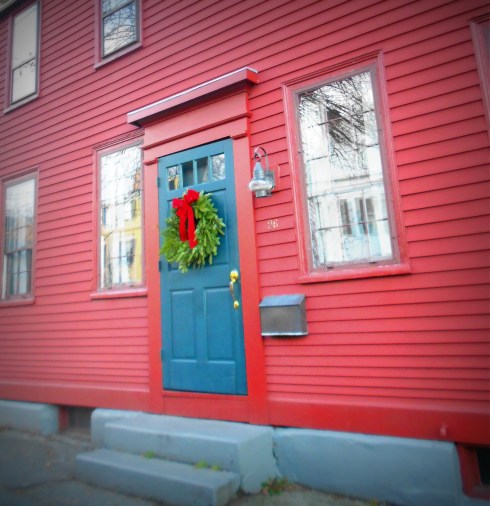
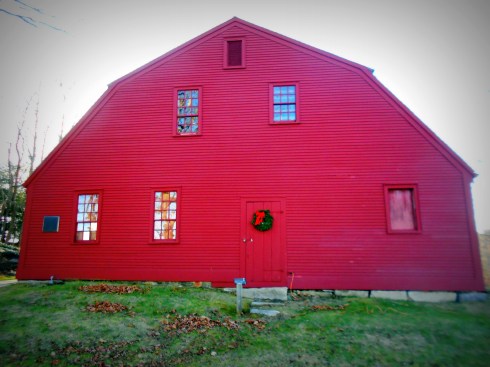
Even before I read a nice little article yesterday on how the holidays obtained their color themes, I was already planning to focus on red:  it’s been a dreary week and I needed a little cheering up. The red that we now associate with Christmas comes from an amalgamation of historical and cultural forces:  iconic images of St. Nicholas of Myra wearing red robes, holly berries and the apple props of medieval mystery plays, the Victorian poinsettia craze, the colorful depictions of Santa Claus by nineteenth-century cartoonist Thomas Nast, and the Coco-Cola Santa Claus of the early twentieth century. I’ve already covered Saint Nicholas in a lengthy post a week or so ago, so this perspective is going to be structural. Here are some of my favorite red houses, tastefully decorated for the season in typical understated New England fashion. I’m starting up north, in my hometown of York, Maine, where I happened to be last week before our weather turned dreadfully dreary, and then I’ll work my way home to Salem via Newburyport.

Two of the Historic House Museums of Old York:  the 1719 Old Gaol (Jail) and the 1754 Jefferds Tavern. As you can see, the gaol is situated on a little hill that overlooks York Village below. There is a large new barn-like structure attached to the tavern which I dont really care for (despite the fact that it is named after my wonderful high school guidance counselor) so Im showing a vantage point that excludes it.

treees 001

red Gaol 2

red gaol

treees 011

Heading south, I stopped in Newburyport–a city of white houses for the most part–and found two adorable colonial sideshingled houses on side streets in the south end.

red house Newburyport

treees 019

treees 021

Back in Salem, where there are not a lot of red houses, really. But there is venerable Red’s Sandwich Shop downtown, and the Manning house in North Salem, which was once in the midst of one of the most famous orchard nurseries in Massachusetts. This was the home of Nathaniel Hawthorne’s uncle, Robert Manning, a famous “pomologist” (an expert in the cultivation of fruit trees) and according to the sign, also a stagecoach agent–news to me. The last picture in this group is a rare red Greek Revival on Essex Street: you seldom see a house in this style painted red, as they are meant to mimic stone. From these pictures it appears we like our red houses with white trim in Salem.

Red's Sandwich Shop

red house North Salem

red Manning House

red greek revival

Finally, Nathaniel Hawthorne’s c. 1750 birthplace, moved to its present location adjacent to the House of the Seven Gables on the harbor in 1958 from downtown. A rather gnarly tree seems to be threatening it! And last but not least, a wonderful old (fishing?) shack on the other side of the Gables: a little worse for wear maybe, but still red and picturesque–it does seem to be crying out for a wreath at this time of year.

Red Hawthorne House

Red Hawthorne House rear

red shack


Saint Nicholas

Today is the Feast Day of Saint Nicholas, (270-343) who evolved, through the centuries, into Santa Claus, because of his legendary roles as a protector of children and secret gift-giver. This was quite an evolution, in more ways than one! Nicholas is known alternatively as Nicholas of Myra, as he served as Bishop of that southern Turkish city (now called Demre) for much of his life, and Nicholas of Bari, as his relics were removed to southern Italy in the eleventh century. The Italians who confiscated the relics of the revered Saint claimed that were acting in the name of “security”, as Myra was increasingly vulnerable to Muslim attacks, but one could certainly ascertain that it was a case of simple theft. There are many stories associated with Nicholas’s holy works, so many that he is also referred to as Nicholas “the wonder-worker”, but the most popular relates a rather dark tale in which Nicholas visited an inn during a regional famine, and quickly discerned that the innkeeper had chopped up three boys and encased them in brine to sell them as pickled pork.  Nicholas brought the innocents back to life, and evolved into the savior of children who found themselves “in a pickle”.

Nicholas of Bari Stowe Breviary BL

Nicholas BM Dutch

Nicholas BM Flemish

British Library MS Stowe 12, “The Stowe Breviary”, 1322-25; Dutch woodcut print, 1480-1490, and hand-colored engraving from a Flemish prayer-book by the “Monogrammist M”, 1500-1525, both British Museum.

Images of Nicholas with the resuscitated boys (in their pickle barrel) can be found in all manner of religious texts from the medieval and early modern eras, as illustrated by those above, and were also the single focus of a succession of paintings and prints from the Renaissance and after. When Nicholas is not in the company of the boys, he is often pictured with the young women whom he saved from lives of prostitution by secretly gifting their father with gold for their dowries, another work of wonder that solidified his connection with the young (and vulnerable).

Nicholas Met Boys

Nicholas Met Dowry

Two altarpiece panels representing the holy deeds of Saint Nicholas by Bicci di Lorenzo, 1433-35:  Saint Nicholas Resuscitating Three Youths and Saint Nicholas Providing Dowries, Metropolitan Museum of Art.

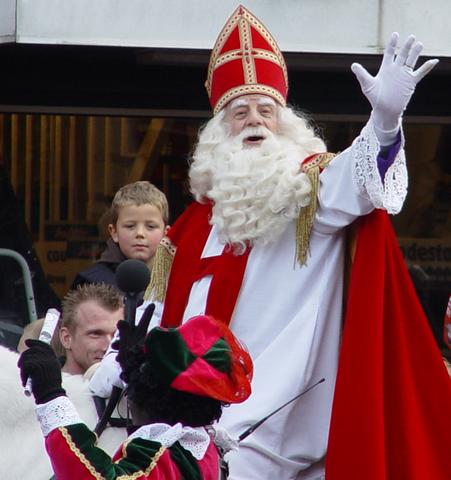
The religious history of Saint Nicholas is pretty easy to reconstruct, but when hagiography meets folklore it gets a bit more confusing. One thing is certain: the transformation of the saint into the jolly dispenser of gifts is much more a phenomenon of western Christian culture than it is of the Orthodox Church, which still recognizes Saint Basil of Caesarea as the benevolent gift-giver (on his feast day of January 1).  The other factor that seems pretty clear is the role of the Reformation. The modern Santa Claus seems to be an amalgamation of the Dutch and Flemish Sinterklaas, the English “Father Christmas” and a secularized Saint Nicholas. While the Dutch Sinterklaas still arrives on the eve of St. Nicholas, wearing a Bishop’s hat and bearing a staff, the Protestant prohibition of his veneration gradually transformed him into a secular figure. Across the English Channel, a similarly-dressed (and aged), “Father Christmas” reemerges only after the Reformation and Revolution, when the Restoration ushers in a return to the “merry old England” of memory. And when these figures cross the Atlantic, the melting pot of American culture (and Coca Cola) gradually transforms them into our very own Santa Claus.

Nicholas Print 1604p

Nicholas Sinterklaas

Nicholas Father Christmas 1890 Vand Ap

Engraving of Saint Nicholas by Antonius Wierix, 1604, British Museum; Sinterklaas celebration in Amsterdam, 2011, and a Father Christmas card, c. 1890, Victoria & Albert Museum.