
I’m still simmering with anger and frustration over Salem’s “new” “Heritage” trail, confined to the downtown, anchored by commercial establishments presenting the sad tale of 1692 with pathetic mannequins which inspire laughter rather than learning, marked by a line of yellow paint applied in an egalitarian manner to both new concrete and old brick. All of my original objections are still standing, but they’ve had almost a year to fester. I’ve lost faith in so many people and institutions: city councillors, various public officials, even fellow historians and organizations which I thought were committed to the preservation and presentation of Salem’s rich heritage. I don’t see any understanding of what heritage tourism is in the realm of official or quasi-official Salem, much less any desire to follow its path. Indeed I wonder what heritage means to the people who have put together this heritage trail.
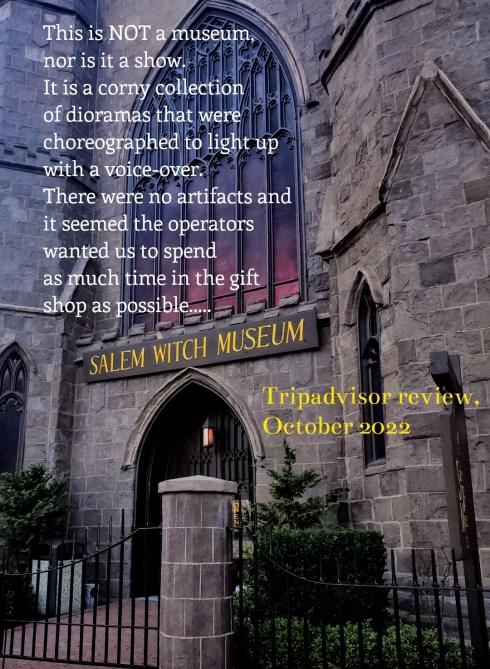

The words in the graphics above illustrate my concerns: a recent review of one of the two commercial institutions featured on the trail, the Salem Witch Museum, and some definitions of heritage by the Center for Heritage & Society at the University of Massachusetts, Amherst. I find the review to be very representative of those that the Salem Witch Museum has received, but of course, I am biased. There are certainly much better reviews, and there are also those which are substantive indictments: you can read them for yourself at the Tripadvisor site. But even many of the good reviews point out the dated nature of the presentation, the fact that the attraction is not a “Museum,” and its blatant commercialism. What is fascinating to me is that these reviews go back years (the Salem Witch Museum recently celebrated its 40th anniversary) and they are very repetitive, yet still the people keep coming and the dated dioramas endure: this is the most successful business in Salem, I believe, certainly the most successful attraction. There’s no attempt to update or improve the presentation, and why should there be? The people keep coming. But what does this institution have to do with Salem heritage and why does it have to be on the Salem Heritage Trail? The Witch Trials are certainly part of Salem’s heritage, though not, I would argue, as large a part as the City of Salem presents them to be—but that argument is certainly a lost cause! But is a dated diorama how we want to acknowlege this tragedy? Is there anything public or in any way reflective of the inclusion of the Salem Witch Museum on on the Salem Heritage Trail? The Salem Witch Museum will continue to be successful, no doubt, regardless of its inclusion on the Heritage Trail, so why can’t this one trail represent a more public and thoughtful presentation of Salem’s heritage in the fullest sense of the word? (I will never get an answer to this question)

I am not a tourism naysayer; I simply respect the past and want both Salem’s visitors and residents to experience its heritage in a layered and an engaging way. As I am writing this, I am looking up Chestnut Street as the Salem Trolley is making its way down, and I’m glad to see it. At least the tourists on board are exposed to more of Salem’s material heritage. It remains absolutely mystifying to me why the Salem Heritage Trail would not include the city’s oldest and largest Historic District, home to the Pickering House, the Phillips House, Hamilton Hall, the Salem Athenaeum, the Ropes Mansion, the Quaker Burying Ground, and streets of beautifully-preserved houses. There are no shops or restaurants or witch “attractions” over here: could that be the answer? Unfortunately the selection of paint in general, and that striking shade of yellow paint in particular, made the exclusion of residential historic districts a foregone conclusion: I know that most of my neighbors would welcome more walking tourists, but I doubt that many of them would like to see that yellow line run in front of their houses. The trolley is running past houses associated with a trio of brothers from a famous Salem family, the Bensons, and I’m wondering if the tourists on board are hearing anything about them, because I think their lives and works are representative of several important strands of Salem’s heritage. I’m sure Frank Weston Benson (residing at 14 Chestnut, 1862-1951) is getting a mention, as he was a pretty famous artist in his day, producing accessible paintings in a light-filled American Impressionist style as well as a succession of distinctive etchings primarily focused on wildfowl. His younger brother Henry (1866-1942) lived around the corner on Hamilton Street and served two terms as Salem’s mayor as well as the president of Salem’s largest business, the Naumkeag Steam Cotton Company. But I think it’s the brother between them, John Prentiss Benson (1865-1947), who is more evocative of an enduring Salem heritage, even though he seldom lived here in his adulthood (though he did design the massive and fantastic Colonial Revival mansion at 30 Chestnut Street).


A 1943 self-portrait by John Prentiss Benson and photograph of his younger self in Salem; Captain Samuel Benson of Salem as depicted by his grandson, John Prentiss Benson and Benson’s copy of “Reaper of Salem, S. Benson, Master, painted originally by Antoine Roux. All of the images and much of the text from this point on is taken from a lovely book entitled The Artistic Legacy of John Prentiss Benson, which was edited and published by the husband of Benson’s granddaughter in 2003. It’s really fabulous–with lots of family pictures and anecdotes.
I’ve never really appreciated maritime art, but I saw a painting that I really liked last week and looked at the signature: John P. Benson! I thought he was an architect by profession and an artist by hobby, but I was wrong: he had two careers, first architecture, then painting. This one painting took me down a rabbit hole of John P. Benson paintings, and I found some really lovely Salem ones, inspired by his birthplace and his heritage, primarily his descent from Captain Samuel Benson, of Reaper fame. All three Benson brothers plus their siblings grew up in an Italianate house which once faced the Common, on a site which is now the parking lot of the Hawthorne Hotel. Frank’s predisposition towards an artistic career was evident pretty early, as was John’s, but apparently there could only be one artist in the family so their father steered the latter towards the more practical architecture. He went to Paris for training, and returned to a job at the prestigious New York architectural firm McKim, Mead & White before setting up his own partnership. By all accounts, Benson had a successful architectural practice focused on the greater New York area, while living in Plainfield, New Jersey and later Flushing, New York with his wife Bessie and their four children. He retired from architecture in his later 50s and began painting full-time, primarily in his studio at a house called Willowbank in Kittery, Maine. He was prolific, and even though he had not lived in his native city since his departure for Paris, a notable number of his paintings are of Salem ships and harbor scenes.


Ship Eliza of Salem, Salem Coal Wharf, and Derby Wharf, John Prentiss Benson.
I particularly like a series of paintings which Benson produced as murals for his son Philip’s Cohasset home, entitled Salem Harbor memories. I trust that they still survive and I wish they could be on public view, because they are a perfect illustration of a family’s heritage and the endurance of a city’s heritage: it’s so interesting that these images were in the home of a man (Philip) who was not born in Salem, who never lived in Salem, but still saw Salem as part of his heritage. I’m not a fan of the witch trials vs. maritime history either/or debate as I believe that Salem’s heritage is both plus MUCH more but these maritime views are so poignant, especially in their invocation of memories which we can “enjoy, regret, and learn from” at the same time. Believe me, I know that the Benson brothers cannot compete with the suffering mannequins of the Salem Witch and Witch Dungeon Museums of the Heritage Trail. I think there are some other Chestnut Street stories that might be able to do so, but that’s not my point or my concern. If this trail was called the “Tourism Trail” or the “Witch City Trail,” I would have no concerns. But it isn’t: it’s called the Heritage Trail. So I ask my fellow Salem residents: does it represent your heritage?

A Memory of Salem Harbor, in Cohasset.


 Welcome to Essex, Connecticut!


 The road to Essex: Thompson houses, Roseland Cottage (which I visited just last summer), Prudence Crandall’s school in Canterbury, and one of the derelict buildings of the former Norwich State Hospital (with a glimpse of Mohegan Sun across the river).


 @Christie’s Images Ltd. The caption reads: Twas God the Word that spake it: And what that Word did make it, That I believe and take it.


 The Narbonne House of the Salem Maritime National Historic Site; John Ward and Crowninshield-Bently Houses, Peabody Essex Museum.
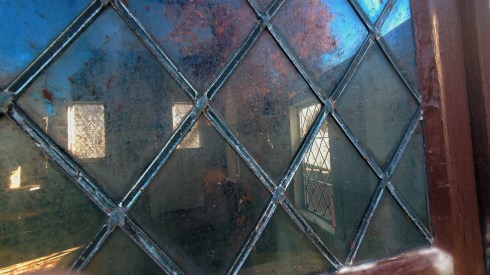 Window of Quaker Meeting House, Salem, Peabody Essex Museum.


 Hollyhocks in Cornish, NH and on the cover of early 20th centuy gardening books: Shelton (1906); Ely (1903); Bennett (1919); McCauley (1911); “Colonial” woman and hollyhocks in font of the John Ward House, Salem in a c. 1911 photo by Mary Harrod Northend; layout for a Colonial Garden from
 Sixteenth- and nineteenth-century hollyhocks: Wellcome Images; George Baxter’s print of Valentine Bartholomew’s Hollyhocks (1857), Victoria & Albert Museum.


 Ross Sterling Turner, Hollyhocks (1876), LA County Museum of Art; Eastman Johnson, Hollyhocks (1876), New Britain Museum of American Art; Childe Hassam, In the Garden (Celia Thaxter in her Garden) (1892); Smithsonian Museum of American Art; Abbot Fuller Graves, Portsmouth Doorway (1910), Peabody Essex Museum; Frederick Carl Frieseke, Hollyhocks (1911), National Academy of Design.


 The Mansion is made entirely of wood, but designed to give the appearance of an ashlar stone facade.


 Through the front door, you step into this amazing 16-foot-wide entrance hall which extends to the back of house, and it’s all about the central staircase and the handpainted English wallpaper panels, which extend up to the second floor. The house served as the Marblehead Bank for about a century after it left the possession of the Lee family and before it came under the stewardship of the Marblehead Historical Society, so the back and upper stories were closed off. According to Rick, visitors could strip of pieces of this wallpaper as souvenirs in the front part of the first-floor hall, so reproduction paper replaced those parts, but the most of the wallpaper is original and glorious. There is a grain-painted “banquet hall” to the left, and a parlor/drawing room to the right.


 Second-floor Chambers: the two front rooms are still of considerable size, but things get a bit cozier in the back. The blue-trimmed chamber is a suite of connected small rooms including one with odd proportions and amazing wallpaper! The room with all the yellow damask—a guest room according to Rick—is simply stunning. And you can see that the furniture is top-notch and very complementary.


 More saffron and more chambers on the third floor: I need these “bed chairs” or whatever you call them! Writing in bed is one of my favorite activities but it takes a toll on one’s back. These third-floor bedchambers were precious. I love this portrait of Miss Selman, the hatboxes, these curvy fancy chairs and settee. Two other rooms on the third floor were a catch-all room with a random collection of museum items (including sea chests with their charts still inside!) and a parlor/playroom/servant’s room in the rear, also filled with wonderful items. I’m not really focusing on the portraits in this post, but there are many interesting ones to see.






