Tag Archives: Architecture

The Wayfaring Chapel

To stick with cinema for just a bit, I’ve always believed that those in Salem who favor the maritime over the witchcraft in terms of tourism focus are handicapped a bit because Salem was not a whaling port like New Bedford. Merchants are simply not as dashing and courageous as whalers; there is no Hawthornian equivalent of Moby Dick. When I think of the latter, I must admit that images from the 1956 film come to mind much more quickly and vividly than detailed passages from the 1851 book, and the very first image that comes to mind is the passionate preaching of Father Mapple (Orson Welles) from that amazing pulpit shaped like the bow of a ship in a seamen’s chapel, or Bethel, packed with mariners. Both the preacher and the place were based on reality; in the case of the former, the “Mariner’s Preacher” of the Boston Bethel, Edward Thompson Taylor, and the Bethel was based on that of New Bedford, which is still standing (its original pulpit was not the elaborate one depicted in the film, but a similar one constructed to satisfy the tourists who made their way to New Bedford in increasing numbers due to the popularity of the film–a version of Salem’s Samantha statue).

Bethel

Bethel Collage

Orson Welles in John Huston’s Moby Dick (1956); The New Bedford Bethel or “Whaleman’s Chapel”, exterior and interior.

Like nearly every seaport of a certain size, Salem had a Seamen’s Bethel too, but it was a wandering one. It clearly existed in the early part of the nineteenth century (there is an extant sign, and several references to a chapel at the head of Phillips Wharf), but was reincarnated later on. The French Catholic parish, St. Joseph’s, purchased an old Bethel on Herbert Street in 1873, and then it turns up in two locations on Turner Street: first right on the water in the House of the Seven Gables’ front yard, and then alongside it on the street. A large bequest by Captain Henry Barr funded the construction of this later building in 1890-91, but a decade later newspapers across the country were commenting on Salem’s fading maritime glory, testified to by the fact there were simply not enough sailors in Salem to attend services in this new Bethel; consequently the YMCA took over the building in 1911. By the 1920s it was moved to another location on Turner Street to accommodate the expanding House of Seven Gables Settlement Association, and by the 1930s it was gone. The last picture of the Bethel below, taken by the Boston-based architectural photographer Leon Abdalian in 1929, was probably more notable for the blimp than the Bethel at the time!

Seamen's Bethel Salem on Water

Bethel on Turner

The Salem Seamen’s Bethel, 1914 and 1929, Boston Public Library.


One Photograph and Three (?) Mantels

Today I am featuring another lost Salem house that we can only “see” in the form of its surviving pieces and photographs–only one photograph, really, which I presume was taken just before it was demolished in 1856 to make way for the Salem Athenaeum’s new Plummer Hall (now part of the Peabody Essex Museum). This is the Nathan Read House (1793), designed by Samuel McIntire for a man who was not a Salem merchant and/or shipowner but distinguished himself nonetheless, as an entrepreneur and the inventor of such diverse machines as a steamboat with paddles, a nail-cutter, a self-winding clock, and a coffee-huller, as well as a congressman and judge. Read’s house was McIntire-made but Bulfinch-inspired and it is reminiscent of another Essex Street house that is no longer with us: the Ezekiel Hersey Derby House further along Essex Street–Salem’s commercial “high” street was too dynamic and valuable for residences, even ones as lovely as these. It’s a miracle that the Gardner-Pingree House survived. The Read House was short-lived but pretty imposing while it lasted.

Read House Salem MA

The Nathan Read House (1793-1856).

In 1799, Read sold the house to Captain Joseph Peabody, a very wealthy Salem shipowner, and eventually decamped for Maine. For the rest of its existence, the Read House remained in the Peabody family, who eventually sold it to the shareholders of the Salem Athenaeum. Joseph’s son Francis dismantled several McIntire mantels from the house before its demolition, and installed them at his summer house in nearby Danvers, the eighteenth-century “King” Hooper mansion, better known as “The Lindens”. There they remained until the 1930s, when the Lindens itself was dismantled, shipped to Washington, D.C. in pieces, and reassembled in the Kalorama neighborhood of the District. The intermediary (and short-term owner of the Lindens) in this transaction was up-and-coming antiques dealer Israel Sack, who arranged for the house to be measured and photographed by HABS architects and also sold some parlor paneling to the Nelson-Atkins Museum of Kansas City: the mantels appear in the HABS photographs (but looking quite different from previous photographs!) but not in the collections of the Nelson-Atkins museum, and they certainly don’t seem to be down in Washington (where the house is now for sale), so I’m not really sure where they are. The whole is demolished, but the parts are scattered: a not-uncommon Salem story!

McIntire Mantels Collage

McIntire Mantels HABS

Lindens Listingp

Lindens Living Room AD

Above: McIntire Mantels at the Peabody Essex Museum (upper right) and installed at the Lindens, Danvers, from Cousins’ and Riley’s Woodcarver of  Salem (1916) and Arthur Haskell photographs, 1934, Library of Congress. Below: the Lindens in its current Washington, DC location from its current listing, and its living room from January 2014 Architectural Digest. No McIntire mantel here!

See a related house story at the great blog Stories from Ipswich.


Samantha Should Go

If I were Queen of Salem for a day the very first thing I would do is smite Samantha. I like Bewitched and Elizabeth Montgomery as much as the next person, but a television character has no business occupying such a prominent parcel in Salem in statue form–especially such a bad statue. I think public art should either be beautiful or significant and Samantha is neither: she should go. I never really understood exactly how she was deposited right there, in Lappin Park on Town House Square, in June of 2005. It was a deal struck between the TV Land television channel, who commissioned the statue from StudioEIS in Brooklyn, then-mayor Stanley Usovicz, and the Salem Redevelopment Authority. Is she supposed to be with us forever? I was in one of my periodic disengagement-from-Salem-because-it-is-driving-me-crazy moods at the time so I wasn’t among the protesters, but even one of the statue’s creators admitted it was crass at the time:

“If I were one of the people who had a house on the beautiful common there, would I hate it?” asked Ivan Schwartz, sitting at a conference table last week and discussing the Samantha statue. “Yes, probably. But it seems like [Salem] was going down that path long before this TV Land thing ever surfaced.” (Washington Post)

Well, Mr. Schwartz is correct: Salem has been “Witch City” for quite a while, which is why my feelings towards Samantha have evolved: I don’t really want to destroy her anymore, I’d just like to move her–to a less prominent and more appropriate place–where she can represent Witch City rather than Salem. Maybe in front of the Witch Museum? That’s a perfect pairing.

Samantha Destination Salem

The Samantha Statue in Lappin Park (somewhat dressed for winter, but before our recent snow), courtesy Destination Salem.

So who or what could replace Samantha?  That is a difficult question, despite, or perhaps because of, Salem’s rich history.

An “old planter”?  Well we already have the magisterial statue of Salem founder Roger Conant by the Common. Unfortunately he is often mistaken for a “witch” because of his proximity to the Witch Museum as well–maybe he and Samantha could trade places? No, I think not.

Accused “witches”?  Well, we already have the subtle but stately Witch Trials Memorial on Charter Street. This is a reflective place (when it is not full of tourists eating sausage rolls on its memorial benches) deserving of its official status, but is could be supplemented by a more humanistic installation at Town House Square, I suppose. Statues of Bridget Bishop and George Jacobs–the victims from Salem Town?  Philip English–who escaped, survived, and sought revenge? My very favorite memorial to a witch-trial victim is the relief sculpture of Katharina Henot, burned at the stake in Cologne in 1627, in which she is paired with Friedrich Spee, a Jesuit priest who served as a participant/confessor in several witch trials before he wrote an extremely influential indictment of such proceedings (the Cautio Criminalis (1631)), on a facade of the Cologne City Hall. They are actually quite modern creations, one of 124 relief figures carved for the exterior of the Rathaus. The Lappin Park site is a courtyard, rather than a building, so I think we need to go for something/someone more freestanding.

Rathausturm Koeln - Friedrich Spee von Langenfeld, Katharina Henot

Samuel McIntire? Revolutionary War soldiers and sailors from Salem? Timothy Pickering? One of the Derbys? We already have a great statue of Nathaniel Hawthorne on Hawthorne Boulevard. The great philanthropist Captain John Bertram and/or his granddaughter Caroline Emmerton, founder of the House of the Seven Gables Settlement Association? If I had my druthers (which I would, because I would be Queen), I’d probably go with Captain Luis Fenollosa Emilio of the Massachusetts 54th, a Salem native and author of The Brave Black Regiment (1891). He fought with the 54th for three years and was the sole surviving officer of the ferocious battle of Ft. Wagner in 1863: he deserves commemoration somewhere.

Statue Emilio

Captain Luis F. Emilio of the Mass 54th and 23rd, Library of Congress.

If I step down from my throne, however, I think it’s probably best to install something less literal and more abstract or conceptual in this particular location: something that could speak to as many people as possible and really make both passersby and crowds stop and think (or at least stop). I could even go in a more whimsical direction: the people who like the Samantha statue generally mention its “whimsy” but I think whimsy has to emanate from good art and Samantha looks like she is sitting on a turd rather than a cloud. We can do better.

Just to get the ideas flowing, I rounded up some of my favorite installations: most are public, some I have seen in person rather than just in pictures, some are memorials and some are just “statues”, all are (in my humble opinion) just great.

Reading Chaucer Jackson

Philip Jackson (b. 1944), Reading Chaucer, Portland Gallery, London.

Statue Les Voyageurs Marseilles

One of Bruno Catalano’s Voyageurs in Marseilles–travelers with missing parts!

Statue Shoes Budapest

The extremely poignant installation of “Shoes on the Danube” in Budapest by Gyuala Pauer and Can Togny, dedicated “to the memory of the victims shot by Arrow Cross militiamen in 1944-45”.

leandro-erlich-pulled-by-the-roots-karlsruhe-designboom-03

A “house” with roots by Leandro Erlich at the Summer Festival in Karlsruhe, Germany via Designboom. (I would LOVE to see something like this in Salem–a 17th century house!)

Appendix: Just adding a few lines as this post was shared quite widely on Salem Facebook groups and there was a lot of commentary that readers of the blog won’t see. Lots of love for Samantha; she is widely credited (not the statue so much as the television character and show, which filmed in Salem in 1970-71) for saving Salem from the wasteland that it was becoming at that time. So the statue is seen as a symbol of revival through witchcraft tourism. Also: tourists love her so she should stay, she’s “whimsical” so she should stay. There were some people that supported a move: to the Willows & the Hawthorne Hotel in particular. No support for Captain Emilio!


A Shilling for Samuel

Today is the birthday of the man who literally made Golden Age Salem, expanding his woodcarving skills into architecture and interior decoration exemplifying the Federal style: Samuel McIntire (1757-1811). Frankly, I’m not sure Salem is McIntire-esque anymore but my corner of it is still McIntire world, and for that I am very, very grateful. My house is in the McIntire Historic District and every morning I look out my bedroom window at two McIntire structures: Hamilton Hall and the (recently sold) Captain Jonathan Hodges House at 12 Chestnut Street. Just around the corner on Cambridge Street is one of my favorite McIntire houses, the Thomas Butman House at #14. The microsite for the Samuel McIntire: Carving an American Style (2007-2008) exhibition at the Peabody Essex Museum is still up, so you can check out “his” Salem for yourself, but I am featuring another introduction on this day: a children’s book titled A Shilling for Samuel (1957) written and illustrated by Virginia Grilley.

McIntire Covers

Grilley seems to have been a well-known children’s book author in the 1950s and 1960s, and she also wrote and illustrated several books about the Salem of Nathaniel Hawthorne, the great “scribe” and “romancer”. She liked to conjure up historical places, in both words and pictures. A Shilling for Samuel is very much in the tradition of another example of mid-century Salem juvenile fiction, Carry on, Mr. Bowditch by Jean Lee Latham, which was published just the year before. In both books, Salem boys are inspired by the bustling, cosmopolitan environment all around them as well as their innate interests and talents to develop their specialized skills and make their way in the American way. In Grilley’s story, Samuel grows up along the water (in a house on Mill Street–could it be this one? I’m just not sure) and learns about carpentry and carving from his father, but his family wants a different life for him:  go to sea, young man, that’s where fortunes are made. Nevertheless he loves to carve and look at the  “strangely-shaped roofs” of his native town and seeks to replicate everything he sees around him in wood. The first shilling he receives for a carving, combined with the pattern books he spots in Mr. Shillaber’s bookshop, propel him on his life’s path. The rest is history–outside my window.

Shilling 6

Shilling 30

McIntire Bench Christies

Pages from Virginia Grilley’s A Shilling for Samuel; a mahogany McIntire window bench coming up in a Christie’s auction next week–certain to fetch many, many shillings!


Losing our Way?

One of the latest looming commercial developments in Salem is a proposal for a new showroom facility by the F.W. Webb Company, a large distributor of plumbing and HVAC parts, on an abandoned lot adjacent to its large brick building on Bridge Street. The lot was long occupied by the Universal Steel and Trading Company, which stored and processed scrap metal on the site, creating a contaminated cauldron from which they simply walked away, leaving the City to clean up the mess. Once the site was cleaned up–a process that took several years–the City put the parcel up for sale, and F.W. Webb was the only bidder. The public process by which the City divests itself of the site and the Webb proposal is reviewed by various city boards commenced last week, and consequently both the big picture and the little details are starting to emerge. Regarding the former, the jury’s still out for me–of course the proposed new building appears blandly “modern” and appears to have no connection to the existing Webb building–but this section of Bridge Street is not distinguished by structures of great architectural integrity. Where the terraced gardens of Federal Street houses once sloped down to the North River used car lots have more recently and characteristically occupied a filled-in Bridge Street, so you can argue that anything is an improvement. There are two “details” that do concern me at this point in the process, however: 1) the not-so-veiled threat inherent in the F.W. Webb proposal documents: this new building will allow us to remain in Salem and; 2) the loss of venerable public “way”called Beckford Way. This public path once accessed the riverfront but is now a trail to nowhere; nevertheless, it is still public property and will cease to be if the Webb proposal is approved.

Path 009

Webb Building

Path 001

Beckford Way

Bridge Street 2016 MA Boating and Fishing Access

NOW: The current Webb building on Bridge Street and the adjacent lot, now cleaned and paved, on which the company wants to build a new showroom building; rendering of the proposed new building and Beckford Way alongside the lot. A current map of Salem, with no Beckford Way.

I looked into the history of Salem’s public ways a bit, primarily by examining maps of the city in 1820, 1851, 1903 and 1916 in the Norman B. Leventhal collection at the Boston Public Library. It was an interesting exercise, through which you could clearly see the disappearance and/or transformation of myriad ways, courts, and even streets by projects that were both public and private. The nineteenth century privileged the train while the twentieth century was all about the car; the pedestrian lacked advocacy in both centuries. Sewall Street, once lined with houses, became a parking lot for the YMCA and adjacent developments; Liberty Street was absorbed by the Peabody Essex Museum just a decade ago. Now all of Salem’s “ways” exist only in condominium developments built out on Highland Avenue: they’re not even really part of the city.

Salem 1820 BPL

Bridge Street Before LC HABS

THEN: Jonathan Saunders map of Salem, 1820, clearly indicating Beckford Street’s access to the North River, Boston Public Library Leventhal Map Center; a map of the terraced gardens of Federal Street (a bit further west from the Webb property) before the River was filled in for the railroad and Bridge Street extension, HABS, Library of Congress.


Seeing Red

It’s finals week and getting reading for Christmas week so please excuse a few short posts. My house is not quite ready yet, but the rest of Salem is draped in red. No white Christmas this year for sure–we’ve had several 60 degree days this month and the forecast looks brown, even green, as the warm weather has resulted in some startling regrowth out there–much of my garden looks like it is still alive! I know you’ve seen a thousand pictures of Hamilton Hall here, as it’s right next door and a site of constant activity and attraction for me, but I popped in to see it decorated for the Christmas Dance (now called the Holiday Dance but I’m still going to call it the Christmas Dance) this weekend. It looks lovely, better empty really though I do love the Dance.

Hamilton Hall 016

Hamilton Hall 021

Hamilton Hall 023

Hamilton Hall 028

Hamilton Hall 041

Hamilton Hall 043

Hamilton Hall 062

Hamilton Hall 050

Hamilton Hall 054

Hamilton Hall 088

Downtown: Santa getting ready to ride, beautiful red berries in the Derby House garden, red door on Mall Street; next door at Hamilton Hall, exterior and interior.


Salem as Source

I’ve been fascinated by architectural drawings for as long as I can remember; actually I do remember the moment I was “caught”: I was in the attic at York Harbor, in my adolescence or early teens, when I encountered some very fundamental sketches made by my uncle Jeff, an aspiring architect. I never really knew him, and he never realized his ambition, as he died in a car crash on the Cape just after his graduation, at age 21. He was always a mystery to me, so when I saw these sketches they seemed like a clue. They drew me in, literally, and over time my appreciation for architectural studies evolved, through total immersion into the Renaissance in college and graduate school, historic preservation work, old house ownership, and marriage to an architect. Since I’ve been writing this blog, I’ve become increasingly aware of just how important Salem was to the burgeoning architectural profession in the later nineteenth century in general, and to the Colonial Revival movement in particular. The literary references are there, and the drawings, though mainly they are the work of New England architects. Just recently I’ve found a few more digital archives that contain sketches of Salem structures drawn by architects from other parts of the country. Today I am featuring the sketchbooks of two southern architects, William Martin Aiken and  Joseph Mordecai Hirschmann, who came to Salem for inspiration, forty years apart, in 1883 and 1923 respectively. William Martin Aiken was born in Charleston, South Carolina, but he studied at the Massachusetts Institute of Technology and worked in Cincinnati and later Washington, D.C., as the Supervising Architect of the Treasury Department. Joseph Mordecai Hirschmann was also a Charleston native, but spent most of his professional life working at the New York architectural firm of Walter and Gillette. Their professional papers, which include many drawings, are in the College of Charleston’s library and included in the Lowcountry Digital Library, a surprising sources for anything to do with Salem! But as institutions across the nation and around the globe digitize their collections, new sources of information pop up every single day.

SS Savannah Sketch SS Rockland Chapel

Before he came to Salem, Aiken sketched houses in Savannah, and after: Rockland, Maine.

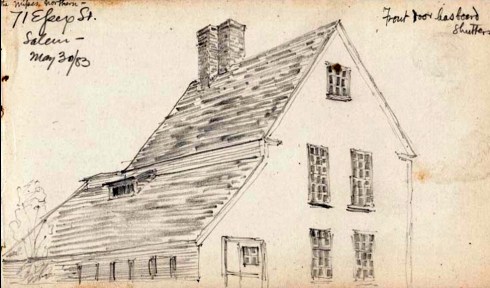
While in Salem, Aiken sketched the interior of the Pickman House on Essex Street, a famous Georgian house (then), now long gone, the first-period Narbonne House, also on Essex, a Derby Street door and an obviously early house which I can’t quite identify. The note reads “Temple Hardy”? Hardy Street? Help! (see what I mean about sketches being clues).

SS Pickman House

SS Narbonne House

SS 106 Derby SS Salem Hardy St

Where is/was this early Salem house?

His sketches indicate that Hirschmann wasn’t particularly interested in early architecture when he came to Salem: he went right to the McIntire District, where he sketched details: wrought iron fences, garden arches, classical columns. He was more of a note-taker than Aiken, and I particularly love his notation on the column sketch:  “very beautiful”.

SS Hirschmann Fences Sketch

SS Hirschmann Arch Chestnut Street Salem

SS Hirschmann Columns Sketch

The Architectural Sketches of William Martin Aiken and Joseph Mordecai Hirschmann, Lowcountry Digital Library.


A Closer Look: Salem 1854

I’m following up on a post from a couple of years ago on urban “bird’s eye” maps from the sixteenth and nineteenth centuries, which included a lithograph map of Salem from 1854 published by Endicott & Company and the Smith Brothers and based on an original aquatint by British born American artist John William Hill (1812-1879). I was impressed by this map at the time, but I didn’t really do it justice. Here’s what I said:  Here is a map that defies categorization:  it’s part panorama, part rendering.  The detail, perhaps a bit idealized, is amazing, especially if you view it with a zoom feature.  Yet the people are stick figures; it’s all about buildings and streets. Thanks to some close cropping by the folks at Princeton University’s Graphic Arts Collection blog, I now want to revise that view: Hill’s view of Salem in 1854 is far more humanistic than I thought. Now I’m more impressed than ever by this amazing artist, whose skills are on flagrant display in this map, and others. It’s that combination of aerial perspective and architectural detail that draws me in, very evident in the close-ups provided by Princeton.

salem-mass

salem-mass3

salem-mass4

Lithograph map of Salem, Mass., 1854 by J. H. Colen after John William Hill (1812-1879). Published by the Smith Brothers, 59 Beekman Street, New York. Graphic Arts Collection, Firestone Library, Princeton University.

Yes, the people are still a bit stickish and it is certainly an idealistic impression, but the material world on display still draws you (at least me) in: 6 over 6 window panes, 8 over 8 window panes, dormers, chimneys, laundry on the line. This is a city that seems to be in transition in its orientation, from water to land, as a lot of effort seems to have been spent on those wide (clean! far more clean than they would have been in actuality) streets, home to a few stray carriages now but later to be clogged with cars. Hill’s depiction of Charleston from a few years earlier displays the alternate water-to-land perspective. Moving out of the realm of street view maps (but still encompassing people) is his beautiful watercolor of Boston Harbor, from the same era and the same collection at Princeton, and the stunning New York from Brooklyn Heights, which was issued in several variant genres in the middle of the nineteenth century.

Hill Charleston 1851

Hill Boston Harbor 1853

Hill NY from Brooklyn Heights 1850s

Bennett Hill Brooklyn Heights

John William Hill’s Charleston, 1851 (hand-colored lithograph, Historic Charleston Collection); Boston, 1853, Graphic Arts Collection, Princeton University, and New York from Brooklyn Heights, Carmen Thyssen-Bornemisza Collection on deposit at Museo Thyssen-Bornemisza. Aquatint with engraving and etching of the latter by William James Bennett, 1837, New York Public Library.


Sleeping with George

Even though we live only steps away, we packed up a few things (very few, essentially wine) and headed off to The Merchant to spend Saturday night in the very same room in which George Washington slept when he visited Salem in late October, 1789. The Merchant is the newly-christened Joshua Ward House, built between 1784 and 1788 for one of Salem’s wealthiest merchants; it has a long and interesting history, but is now completely restored, refurbished, and rejuvenated. My husband worked on this project and I’ve always loved this house, so as soon as it opened (November 25) we booked a room: #3, George Washington’s room. It is beautiful, and very tastefully (and patriotically) appointed with a starry ceiling and antique eagle, but we couldn’t possibly limit our presence to just that one room as there was too much else to see: a beautiful central hallway and hotel taproom/lounge adorned in jewel-box colors, amazing woodwork everywhere, details, details and more details. I couldn’t stop touching banisters, doorways and mantels, sanded down to their eighteenth-century origins to reveal very clean lines and then repainted in glorious colors. Once we did retire, I must say we didn’t spend too much time communing with George as the bed (which looked to me like a big Georgian chair covered in blue velvet–it doesn’t show up in the pictures well) was so enveloping: we fell fast asleep and woke up to a sunny Sunday morning which cast the room, and the entire hotel, in an even more illuminating light. But sadly we had to go (trudge) home.

George 209

George 029

George 202

George 028

George 098

Merchant Collage 2

George 059

George 075

George 113

George 127

Above, entry hall and room #3 of The Merchant, night and day, with its starry ceiling. Below, window where Washington waved to the crowd outside in 1789, the taproom/guest lounge (with bottles found during the renovation), and back deck, other guest rooms, and a few more amenities (old architectural details/ new herringbone bathroom tile), back hallway and McIntire mantel.

George 132

George 049

George 027

George 160

George 186

George 181

Merchant Collage

George 167

George 190

The Merchant, 148 Washington Street, Salem; 978.745.8100.


The Town Dyer’s House

My interest in Salem’s historic architecture has been narrowed down over the past few years that I’ve been writing this blog: while I still appreciate most of our city’s older (let’s be generous and say pre-World War II) structures, I’ve become increasingly fascinated with its oldest buildings in general and those that were demolished in particular. I’ve developed a somewhat peculiar fascination with “lost” houses, a demolition expert of sorts!  I’m constantly wondering why some houses are deemed too important to be swept away and others were leveled with little comment. My focus in this post is a house that was almost as famous a “Witch House” as the actual “Witch House” that still stands at the turn of the last century, yet it was demolished with little or no opposition that I could detect. The Samuel Shattuck House, built by 1680 just a few steps away from the Jonathan Corwin/”Witch House” on Essex Street, actually had a more direct tie to the Trials that the latter: the accusations and testimony of its occupants, a dyer named Samuel Shattuck and his wife Sarah, led directly to the conviction and execution of the first victim of 1692: Bridget Bishop. This poor widow, not quite as notorious as depicted by a succession of historians who confused her with the tavern-keeping Sarah Bishop, nonetheless had several encounters with the Shattucks, bringing them oddly-sized scraps of lace for dyeing–perhaps for a poppet? The affliction of their son convinced them that she was up to some mischief, and so they testified with considerable detail and vehemence, even though these encounters had occurred twelve years previously. Bridget Bishop was executed on June 10, 1692, despite her consistent affirmations of innocence.

Jump forward two hundred years later, when the Bicentennial of the Trials was stirring up a cauldron of commemorative and commercial products: witch spoons, postcards and plates. Contemporary Salem guidebooks typically featured several Trial-related sites at this time:  the Witch House, supposedly the site of interrogations, Gallows Hill, the site of the executions, and the Shattuck House, a “scene of the crime” as well as the source of allegations. My major window into the world of lost Salem houses, photographer Frank Cousins, marketed his print of the “olde” Shattuck House with the label it was through evidence of the Shattucks that Bridget Bishop was convicted as a witch.

Cousins Shattuck House DUKE

Shattuck House and Gallows Hill

Shattuck House Salem BPL

Frank Cousins photograph of the Shattuck House, 315-317 Essex Street, in the 1890s and the same photograph in The Visitors’ Guide to Salem, Essex Institute, 1895; another late nineteenth-century view, Boston Public Library.

It was so notable in 1895, and 1897, and 1900, but by the end of 1902 it was gone, demolished to expose to view only the two huge chimneys….showing the clam shell clay in which the brick was laid before the days of stone and mortar according to the brief notice in the Boston Evening Transcript on October 30, 1902. No notice at all that I could find in the Salem papers! And so despite its Witch Trial connections, the Shattuck House passed quietly in the night (like the Hunt House, the Parkman House, and the Ruck House before it), only to be replaced by an indistinct Colonial Revival structure that served in a variety of capacities (Gainsborough’s Photography Studio when I came to town) before it succumbed to condo-izaton.

Shattuck House Salem

Boston Evening Transcript clip, October 30, 1902; sketches of the Shattuck House from Nooks and corners of the New England Coast by Samuel Adams Drake (1905) and The Romance of Old York by Herbert Milton Sylvester (1909).