Tag Archives: Architecture

Snow & Inaccessibility

Dear readers: I had a lovely plan for the blog this December, including light, frothy and festive posts about fairies, puddings, and GIN. But then the Peabody Essex Museum was forced to admit that they have no intention of returning the historical collections of the Phillips Library to Salem at a Historic Commission meeting on December 7, a day that shall forever live in infamy in Salem’s history—maybe. So now I am seeing a different kind of red than the holiday kind, and am going to have to process this development for some time, here and elsewhere. I’ve never lived in a time or place when a community’s heritage was so brazenly and cruelly threatened, and it’s pretty much all I can think about. Fair warning. I do feel a bit guilty about this, however, so I am going to intersperse my PEM post today, which addresses the issue of inaccessibility, with photographs of our first snow of the season. This will make for a rather incongruous presentation, but it’s the best I can offer at the moment.

Inaccessibility2

A few little scenes from Satuday’s public protest against the relocation of the Phillips Library’s collection– essentially Salem’s archives–to a large conservation facility in Rowley.

There are so many issues to address regarding this relocation/removal, primarily because the Museum (and by “Museum”, I am always referring to the Museum leadership; many curators and staff are part of the Salem community while the leadership and vast majority of of trustees live elsewhere, consequently there is a deafness and a disconnect on the part of the latter) is very slippery, and changes its rationales according to necessity–or audience. At the December 7th meeting, Facilities Director Bob Monk seemed to stress the importance of office space, and because that meeting made news, Executive Director Dan Monroe was pressed to come out with a statement, at long last, on the following day, in which he emphasized the inability of the existing Phillips Buildings, Plummer Hall and the Daland House, to accommodate the collection under proper conditions. This inability has presented the museum with a “great” opportunity, according to Mr. Monroe: to unify the Museum’s renowned art and culture collection with the Phillips Library collection at new 112,000-square-foot Collections Center located in Rowley. This new center, which keeps the Library collection accessible in Essex County, will become operational by mid-2018 and will feature highly secure, climate-controlled space for storage for the collections and extremely handsome and functional spaces for a Library reading room, staff offices, conservation, and other operations. The Library will continue to welcome researchers from around the world and PEM’s skilled librarians will continue to assist patrons during the reading room’s public hours. Mr. Monroe addresses accessibility several other times in his statement, and Mr. Monk also referenced accessibility on the 7th: “Our goal here is, really, to make the collections actually more accessible, not less”. Increasing accessibility is probably the one constant claim that the Museum has been making, since it shut down the Phillips Library in 2011 with promises to return in a few years. But they have not, and odds are that they will not.

Snow1

Snow 2

Snow 3

A little snow intermission! Now back to work. 

There are three types of accessibility relevant to this discussion: physical, demographic, and digital. Obviously Rowley (which is a lovely town by the way; I have nothing against it, I just don’t want Salem’s history to be located there) is distant from Salem and the PEM’s large warehouse will not be accessible by train or by foot, only by car. Nearly every single major independent research and/or museum library in the United States is located in an urban area reachable by mass transportation: the Phillips will be the first to be transferred in its entirety to a suburban satellite facility. Given its storied history which is so based on place, we can reasonably ask if the Phillips Library will simply cease to exist.

Snow 7

As to demographic accessibility, who are they going to let into their warehouse, their gated community? Monroe’s statement says “researchers”, which could include anyone and everyone: I guess we’ll find out at the public forum which was also announced in his statement on January 11 @ 6:00 at Morse Auditorium in the museum. The last issue I want to address is digital accessibility, because I think there are many misperceptions about this based on several articles dating from the time of the Phillips’ closure in 2011. Very little of the Phillips Collection has been digitized, surprisingly little for an institution which raised $650 million in its recent Advancement Campaign:  less than 100 of their 2 million manuscript items are accessible online, with an emphasis on the trivial (ocean liner ephemera and vintage valentines). What has been digitized is much of their catalog: we know what treasures are contained in the collection, we just can’t access them.

NEXT UP: DONORS.


Three Golden Balls

In Salem, December 5 has been celebrated as krampusnacht more often than St. Nicholas’s Eve over the past few years, but I’m following up on a post about the latter today. I want to connect the forerunner of Santa Klaus to pawnbrokers, through the symbolism of three golden balls. This is not an original association, but a reader referenced it several years ago, and I always wanted to connect the dots, so this day seems like a perfect time to do it! I think that the traditional pawnbrokers’ sign of three golden balls attached to a (straight or curved) bar is recognized universally in the west, or at least in Europe: here’s a John Crowther watercolor of Aldersgate Street in London in 1886 with both a traditional symbolic trade sign and a sign of the trade sign, and a photograph from Jeremiah’s Vanishing New York of an old pawnbroker’s sign that is apparently about to vanish—it might be already gone.

Three Golden Balls John Crowther

Pawnbroker sign NYC John Crowther, Aldersgate Street, London, 1886, Guildhall Library; the trade signs of the defunct S&G Gross Pawnbrokers in New York City from Vanishing New York.

Nearly everyone traces the origins of the three balls back to the Medici family for several reasons: the Medici crest features balls (palle) prominently, their financial roles in Renaissance Europe, which can somehow (not at all clear to me) serve as a predecessor for pawnbroking, and the fact that they were Italian, like the Lombards who became the first Christian moneylenders in medieval Europe, when usury (charging interest for a loan of money) was expressly against canon law. There is also an old yarn about a monster, Charlemagne, and the balls representing defensive dings in a shield, adopted by the Medici as proof of their valor, but I don’t think I need to delve too deeply into that tale. The Medici had as many as twelve balls on their crests before the fifteenth century, when they finally settled on six. Not three.

Three Golden Balls Medici MS 15th CThe Medici Crest with its distinctive six palle on the leaf of a 15th Century MS of Propertius, Elegies, Oxford University Bodleian Library MS Canon. Class. Lat 31.

Raymond de Roover, a prominent mid-century medieval economic historian, wrote a short article just after World War II in which he asserted a general connection between the heraldry of all of the moneylending families of late medieval Europe, each and every one featuring spheres on their crest to symbolize coins, and modern pawnbrokers’ signs. He discounts a distinct Medici connection, but also the St. Nicholas one that I favor, with the argument that such a marginal occupation as moneylending (and by association, pawnbroking) could not possibly be associated with as esteemed a saint as St. Nicholas of Bari (or more correctly, Myra), who was known, even beyond the expectations of your average saint, for his charity. But I believe that Professor de Roover is incorrect: perceptions of St. Nicholas clearly focus on the ball symbolism later associated with pawnbrokers, and one of the key links between these two disparate entities is the dowry, an absolute requirement for every Renaissance bride. The most famous example of St. Nicholas’s generosity, depicted time and time again by nearly every Renaissance artist, is the aid he gave to an impoverished family of three daughters of marriageable age: under cover of darkness he threw three purses (increasingly depicted as golden balls) through the window so that the girls would have dowries and avoid destitution or even worse, prostitution. From the mid-fourteenth century through the sixteenth, this scene is played out again and again on canvas: the paintings below represent the beginning and the end of this era–during which St. Nicholas was always pictured with his identifying attribute: the three golden balls.

Three Golden Balls SCALA_ARCHIVES_10310197649 1340s

Three Golden Balls ANGLIG_10313766773

Three Golden Balls AGETTYIG_10313913291Crivelli 1469

Three Golden Balls ANGAIG_10313967631 Paolo Veneziano, The Charity of St. Nicholas, 1430-45, Galleria degli Uffizi; Girolamo Macchietti, The Charity of St. Nicholas of Bari, c. 1555-1560; National Gallery of Art, London; Taddeo Crivelli, St. Nicholas, 1469, J. Paul Getty Museum; Sebald Beham, Saint Nicholas, National Gallery of Art, Washington, D.C.

This same period is also one in which public institutional charitable funds emerged, first the famous Monte delle doti, which enabled Florentine fathers to invest in the city’s public-funded debt and ensure a sufficient dowry when their daughters were of marriageable age, and later in the fifteenth century the Monte di pietà, a form of public-administered pawnbroking designed to provide an alternative to avaricious private moneylending. The Florentine state, and other states as well, were quite willing to engage in official lending, especially if it could finance its public debt and alleviate a pressing social concern at the same time. With its system of collateralized lending and low interest rates, the Monte di pietà, in particular, represented a beneficial Christian form of lending in contrast to the old Lombard system, inspired and reflected by all those images of the three-ball-bearing St. Nicholas, who eventually became the patron saint of pawnbrokers.

Three Golden Balls HGP 342650 (1) Canterbury

Three Golden Balls Boston Leslie JonesCoat of St. Nicholas on the Christ Church gate of Canterbury Cathedral, @Neil Holmes; Leslie Jones photograph of Boston pawn shop signs in the 1920s, Boston Public Library.


In Praise of Townhouses (and Small City Living)

This weekend will bring the (38th) annual Christmas in Salem house tour, centered on the “City Sidewalks” of downtown Salem, with decorated homes on Central, Crombie and Chestnut Streets open, along with a house on Hamilton Street. I love this tour: for me it highlights Salem at its best, showcasing the creative continuity of the city rather than exploiting one dark time, in stark contrast to that other big Salem event (yes, I’m referencing Haunted Happening, which I still can’t get out of my system). I’m not exactly sure what the “City Sidewalks” theme means, but for me it conjures up a streetscape of diverse buildings—large and small, residential, commercial and institutional–closely aligned together so to form a community characterized by the integration of all the activities of daily life: a city, and to be more precise, a small historic city like Salem. Maintaining the balance between all of these diverse structures is challenging: the materials, scale, and infrastructure of modern construction can be a constant threat. Consequently preservation and planning advocacy is absolutely paramount, and the proceeds from the annual Christmas in Salem tour go towards these efforts on the part of Historic Salem, Incorporated.

Townhouses Central

Townhouses Crombie

Townhouses Chestnut2Central, Crombie & Chestnut Streets, Salem

I am certain that the tour committee also wanted to emphasize the diversity of residential structures in downtown Salem, as everything from an above-the-shop flat (in a Bulfinch building no less) to a sea captain’s mansion (designed by McIntire of course) will be on view. They are all townhouses in the general sense of the word, but the more specific designation—a multi-level, semi-detached structure–will be represented on the tour as well. The two 1906 covers of The House Beautiful below illustrate my vision of winter/Christmas in an urban village of townhouses–and the one on the right features the Chestnut Street mansion of Pickering Dodge, who commenced the construction of one of the tour’s featured townhouses–just next door– for his daughter and son-in-law in 1828. Since I acquired my own townhouse, which was built just the year before on the same street, I’ve bookmarked images of townhouses—semi-detached and freestanding, exteriors and interiors—that have enhanced my appreciation of their functionality and design: first and foremost the two “party” paintings of Boston artist Henry Sargent in the collection of the Museum of Fine Arts. The Dinner Party (1821) and The Tea Party (1824). It might not be Christmastime, but it feels like it in these festive parlors. Another great townhouse interior painting is Robert Scott Tait’s A Chelsea Interior (1857-58) featuring the author Thomas Carlyle, along with his wife and dog in the parlor of their London townhouse:  again, likely not Christmastime, but the “shotgun” perspective is classic townhouse. The taller townhouses of the 1850s are featured in the wintry Street in Winter: Evening by an anonymous artist, who casts light on the city sidewalks from a shop window: in the next century all of those windows will be lit up, especially at Christmas time.

Townhouse collage2

Townhouse Dinner Party Sargent

Townhouse Tea Party Sargent

Townhouse Chelsea

Townhouses New England Street

Townhouse paperHenry Sargent, The Dinner Party & The Tea Party, 1820s, collection of the Museum of Fine Arts, Boston; Robert Scott Tait, A Chelsea Interior, collections of the National Trust; A Street in Winter: Evening, collection of the Museum of Fine Arts, Boston; I am very enamored of this townhouse wallpaper from the new Hearth & Hand/Magnolia collection at Target.

Christmas in Salem “City Sidewalks” Tour, December 1,2 & 3, 2017—more information and additional events here: http://salem.org/event/37th-annual-christmas-salem-house-tour-2/2017-12-02/.


New Developments on Essex Street

I was going to title this post “the good, the bad, and the ugly” but decided to stay a bit more neutral, and yet here I am leading off with this hackneyed phrase! That’s my preview, so beware. Essex Street, Salem’s venerable main street, ever in transition, is experiencing big changes yet again. First the very good: Salem’s newest hotel, the Hotel Salem, just opened in the old Newmark building at 209 Essex Street. It is a sparkling mix of mid-century modern decor superimposed on what feels like an earlier 20th-century building (it was actually built for the Naumkeag Clothing Company in 1895), complete with a marble staircase and a soda fountain-esque restaurant (called The Counter, not quite open) in the first-floor lobby (as well as a seasonal rooftop bar!). The entire hotel is oriented towards the street and all about embracing its bustling commercial past: it’s a great addition to Salem.

Hotel Salem Best

Hotel Salem Counter

Hotel Salem Lobby

Hotel Salem Lobby 2

Hotel Salem Details

Hotel Salem Staircase

Hotel Salem Bedrooms

Hotel Salem First

Now for the not-so-good. Say you’re sitting at that counter in the Hotel Salem lobby, drink nearby, peering outside onto Essex Street and planning where you’re going to go Christmas shopping next–the Counter will be open before Christmas I am informed. You probably can’t quite see it, but right next door is a great little independent bookstore, Wicked Good Books (above), which is a good start, but then where? You’re new to Salem: you don’t know that there is in fact good shopping a bit further down Essex Street in both directions, and on Central and Front Streets. All you see on one side is the Witch History “Museum” (quotations mine), more witch kitsch across the street, and on the other corner of Essex and Derby Square a vacant building that will house Count Orlok’s Nightmare Gallery come March. Not a lot of shopping possibilities there I would imagine, even when it is open. And then it gets uglier: as you look out of through the wide windows of the Hotel Salem in the other direction, beyond the old Almy’s clock, your eyes cannot avoid the hulking Museum Place Mall, recently rechristened the Witch City Mall. What happened to this building? The photographs from the 1970s show a rather imposing structure but at least one with some semblance of architectural integrity, later lost through artless adaptations and poor maintenance.

Essex Street 217

Essex Street Mall 2

Essex Street collage

East India PC

East India Square Tolles

Witch City Mall collageThe old Naumkeag Trust Bank Building (1900), soon to be Count Orlok’s Nightmare Gallery; Museum Place (Witch City Mall) shops and signs, today and in the 1970s (MACRIS and Bryant Tolles’ Architecture in Salem).

All I can say is ugh, but I’m not through with this block yet: across the way from the Mall the new Peabody Essex Museum building is rising and I am finding that my reactions to it are not what I thought they would be. It’s going to be very boxy, but I like the restoration of the streetscape: though lovely, the Japanese garden which was previously located on this site didn’t quite fill the space. It’s just a frame, so maybe I’ll change my mind, but right now the structure seems to emphasize the street qualities of old Essex (like the hotel), as opposed to the pedestrian plaza of the 1970s. Time will tell.

Essex Street PEM addition

Essex Street PEM addition2


Weekend at the Mt. Washington

My grandmother introduced me to two things of which I can never have enough: a parade of new dresses for back-to-school every fall and grand old hotels. One indulgence started early in life but endured because of my profession; the other started a bit later but is also still ongoing. It was a family tradition to stay at the Equinox in Vermont for long Thanksgiving weekends, and later the White Elephant on Nantucket, and the two of us traveled to a succession of historic hotels on an epic trip down the east coast and back twenty-plus years ago. Nana passed away just about a year ago after her 104th birthday, so I was thinking about her when I planned my last October getaway weekend at the Mt. Washington Hotel. Built in 1902 in a (Spanish) Renaissance Revival style that is meant to dominate, rather than blend into, its setting, the Mt. Washington was one of the last of the great Gilded Era New England resorts to be built before the onset of the automobile, and it remains a conspicuous survivor. I really only wanted to do two things from the moment we arrived on a sunny Friday afternoon: capture the hotel from every angle, and sit on the back veranda (drink in hand) and stare at Mt. Washington and the Presidential Range, like generations of guests before me.

MW 1

MW 2

MW3

MW 4

MW Veranda

The interior of the hotel has a formal-but-not-fussy aesthetic designed to frame the views outside and mix faded grandeur with modern comforts. In the central lobby, a large fieldstone fireplace “crowned” with a Moose bust contrasts with crystal chandeliers from the 1920s, which seems to be the decade that supplied most of the Hotel’s lighting–and glass inserts everywhere. A ballroom, dining room, several bars, and a domed conservatory are also on the first floor, along with the famous “Gold Room” where the International Monetary Fund agreement was reached in the closing year of World War II.

MW Interior2

MWLobby 2

MW Interior

mwi2

mwi

mwi3

Mount Washington collage

We had great weather on Friday and Saturday so I spent as much time as possible out on the 900+ foot veranda, watching the light and cloud patterns change over Mt. Washington every few minutes, especially at twilight, when I got my best picture (s) ever: behold below! No filters necessary: the sunset was gold and purple on Friday night.

MWView 5

MW View 3

MW View 4

MWView2

MWView

My husband was not content to hang out at the hotel all the time so we took a hike—where we happened upon a man playing his flute in the woods–and went to the top of Mt. Washington on the cog railway. When I was quite young, for some reason I read a book about all the people who died on Mt. Washington and these sad stories have always stayed with me so I’ve never been particularly drawn to the mountain, but our traverse did afford me several new vantage points of the Hotel—you can just see it in the valley down below from the summit in the next-to-last picture, a little bit of white encircled by green far far away. As usual, it’s man-made over natural for me!

mwe

mwe2

mw clouds

MW Train


Cole, Catskill and Creative Storytelling

On Saturday morning I drove straight across Massachusetts into New York State to Catskill, home to the Thomas Cole National Historic Site. The artist lived and worked at Cedar Grove, a bright, airy and porch-encircled Federal house overlooking the Hudson River and Catskill mountains, from 1833 until his premature death in 1848. Given the glorious weather we’ve been having this October, it was my intent to explore Cole country via the Hudson River School Art Trail, but I was waylaid by Cedar Grove and the village of Catskill: by the time I was done with both it was twilight. Oh well, next time, but at the very least I should have taken the Skywalk across the Hudson on the Rip Van Winkle Bridge to the majestic Olana, the home of Cole’s protege Frederic Edwin Church. These two men were linked in life and now their houses are linked thereafter. Cedar Grove was purchased by the Greene County Historical Society in 1988 and declared a National Historic Site in the next year: after an extensive renovation it was opened to the public on the 200th birthday of Thomas Cole in 2001.

Cole Cedar Grove

Cole1

Cole 13

Cole 14

As you can see, Cedar Grove is not a large house so how or why did I spend so much time there? It’s all about the interpretation: and the fact that it is such an inviting place to be: the public is invited to come in, wander around, take pictures (with no flash, of course), and even sit down, on blue-cushioned chairs that looks exactly like the period chairs on which Cole himself sat. His cape is draped casually on a bench; reproductions of his letters are scattered on every surface. By the time that this house museum was created, Cole’s works and papers had been long dispersed and ensconced in museum and archive collections: consequently the curators had to be creative in their interpretation. They have used the familiar–or rather the intimate, the aesthetic (striking paint colors throughout and modern art works in rotating exhibitions, plus reproductions of Cole’s works), and technology, in the form of Second Story’s immersive interpretations which plunge the visitor into Cole’s worldview and creative process. It’s very effective.

Cole 11

Cole Parlor

Cole 2

Cole 12

Cole Second Story Best

Cole Second Story 2

Cole Stairwell

Cole 10

Cole 9

Cole 4

COle 7

Cole 6

Cole 5

And then there was the Old Studio, where Cole worked, and the New Studio, and one of the loveliest outhouses (a three-seater) I have ever seen: a lot to appreciate. Some grounds: not as many as once were as a large parcel was taken for construction of the Rip Van Winkle bridge in 1935.

Cole Outhouse

I misjudged the time because our weather has been so warm: it feels like summer but the days are much shorter. Actually, I didn’t have as much time as I would have liked at Cedar Grove because I dawdled in Catskill, which was a happy surprise. It is one of those perfect New York State river towns, with a lovely main street lined with nineteenth-century buildings with more flourish and color than you’ll ever find in New England. Within were antiques, art, and food, and every narrow lot fronting the street that does not have a building on it has been turned into a perfectly-maintained little park. I don’t think I’ve ever been to a cleaner town. There was an old movie theater, of course, and a courthouse, and beyond the main street was the river on one side and neighborhoods of old houses on the other in many different architectural styles: stately Greek Revivals, eclectic Victorians, lots of those New York Italianates with compressed windows on the third floor. Certainly not Cole’s Catskill, likely much better, and I never say that when comparing the present to the past.

Cole Catskill

Cole Catskill 6

Cole Catskill 7

Catskill Clean

Cole Catskill 8

Cole Catskill 4

Cole Catskill 2

Cole Catskill 3

Catskill house

COle Catskill 5

Cole Catskill first


Engage and Retreat

This is the only October weekend for which I didn’t have travel plans which would get me out of Salem for the entire time: consequently I found myself at home on what is usually one of the worst days of Haunted Happenings, when hundreds of motorcycles invade the city for the annual MDA Annual Witch Ride. It’s for charity so we are not supposed to complain, but of course I always do because it seems like insult to injury–but this year it didn’t seem as loud or annoying as usual while I was hunkered down at home. On Friday and Saturday we were in Provincetown where my husband and stepson fished (and swam!) at the very tip of Cape Cod; I hung out with them for a while but then went into the very busy downtown. When it got too busy for me I retreated onto the side streets and up into the Pilgrim Monument which overlooks everything. It always amuses me to see this Renaissance campanile overlooking the outer Cape: it seems so out of place and such an odd monument to the Pilgrims who must be the most anti-Renaissance people I can think of—but somehow everything works in Provincetown.

And speaking of the anti-Renaissance, on the way home we were compelled by the cosplay enthusiasm of my teenaged stepson to stop at King Richard’s Faire, an annual Renaissance fair held in the wilds of southeastern Massachusetts. I don’t really think I can explain this experience in sentences and the only words I can come up with are cleavage and capes. Clearly historians of the Renaissance—myself included—have done a terrible job at articulating even its basic chronology as everyone from the Vikings to Marie Antoinette seemed to be present at this affair! And it was raining….so we were all mucking about in the mud. The only retreat from this nightmare was the car, where I happily read a book about the Mitford sisters until the men appeared. Then it was back to Salem on Saturday night for buses and motorcycles and a stack of papers on the Crusades to correct on Sunday. I retreated to the garden, where there was both (relative) peace and (still) quite a few flowers, thanks to our very warm fall.

Provincetown Beach

Provincetown Collage2

Provincetown Cottage

Provincetown Cottage 2

Provincetown downtownProvincetown above, including a colorful-yet-solemn “Silent Witnesses” installation beneath the Pilgrim Monument, bearing witness to victims of domestic violence; some 17th-century plague doctors at the Renaissance Faire in Carver below; that’s it for the Renaissance Faire pictures!

Renaissance Faire

Home in Salem: a peaceful day in the garden with Trinity and a distant roar. The blog has helped me keep track of changes in the garden better than any journal I’ve ever (intermittently) kept–and there’s a lot more green out there than in previous Octobers.Fall Garden 8

Fall Garden 3

Fall Garden 2

Fall Garden 5

Fall Garden 4

Fall Garden 11

Fall Garden 7

Fall Garden 12

Fall Garden


Doors of Deerfield

Last weekend I drove out to the Pioneer Valley and spent some time at Historic Deerfield, an outdoor museum of eighteenth-century houses located (and assembled) all along one street in the midst of fertile farmland. The museum was founded in 1952, and I’ve been there several times but never by myself, so it was nice to have the time and freedom to focus on whatever I wanted to–and what I wanted to focus on was doors. All I could see was doorways, and it seemed like I couldn’t look at each and every one for long enough. This is certainly not an original preoccupation: I saw the requisite “Doors of Deerfield” posters and postcards in the Museum Shop, where I also picked up a copy of Amelia F. Miller’s Connecticut River Valley Doorways. An Eighteenth-Century Flowering (1983), one of the “Occasional Publications” of the Dublin Seminar for New England Folklife, to take home with me. I expect that I may need to drive out west again very soon—and head south along the river—so that I can see all of these special Connecticut River Valley doorways. Living here in Salem, I’m used to historic doorways, but they are for the most part quite restrained in that Federal way, so these “western” doors provide quite the contrast in terms of detail. Miller agrees (or rather I agree with Miller): Connecticut River Valley doorways bear little resemblance….to doorways of the same period found one hundred miles to the east in coastal Massachusetts and Rhode Island towns.

So here are my favorite Deerfield doors, following Miller’s categorization of scroll pedimented doorways, triangular pedimented doorways, segmental pedimented doorways (apparently there are none in Deerfield?) and flat-top doorways. Plus a few more that defy categorization (at least for me): one of the nice things about Historic Deerfield is the interspersing of private homes among the museum buildings, and the former have great doors too.

Scroll Pedimented Doorways: 

Deerfield Ashley Scroll

Deerfield Ashley Scroll 2

Deerfield Dwight best

Deerfield Door Scrolled

Dwight House in Springfield

The Ashley House (1734) and Dwight House, built in the 1750s and moved to Deerfield from Springfield, Massachusetts. Miller includes a c. 1920 photograph of the Dwight house in situ in Springfield (above) and informs us that Mr. Henry Francis Du Pont purchased the door in 1924, and subsequently installed it first in his Long Island home and later at Winterthur. The Dwight House was moved to Deerfield in 1951, and a reproduction door was produced. I’m always aware of Salem houses being picked apart but really no Massachusetts house was safe!

Triangular Pedimented Doorways:

Deerfield Brown

Sheldon House text

Deerfield Red

The Sheldon House (1755), today and in a 1910 photograph in Miller’s text, and a private home across the street.

Flat-top Doorways: not sure these all fit the exact designation, but they have flat tops!

Flat-top Allen

Flat-top Allen doors

Flat-top Barnard

Flat-Top blue

Deerfield Yellow Garden

Deerfield Yellow Door

The Allen House (1734), home of Henry and Helen Flynt, the founders of Historic Deerfield; the Barnard Tavern (1795), with reproduction flat-top door on right and reproduction triangular-pedimented door on left; the beautiful BLUE Wells-Thorne House (1734) and two private homes in between. Not sure how to categorize this last doorway……….

The Federal houses of Deerfield, with their fanlights and transoms and rounded doorways, don’t look so unfamiliar to me: obviously the region was increasingly open to trans-Atlantic and national aesthetic influences in the later eighteenth and nineteenth centuries. As is the case with every outdoor or living-history museum that I’ve visited, you do get that still, out-of-time feeling, although the Deerfield experience is enhanced by the proximity of private homes and Deerfield Academy. Still, it was nice to return home to historic Salem, even though it’s a bit too lively for me at this time of year.

Deerfield Stebbins

Deerfield glass 5

deerfield glass 4

Deerfield Glass 3

Deerfield glass

Deerfield Printing

The Stebbins (1799), Williams (remodelled 1817) and Wright (1824) houses of Historic Deerfield; two adjacent private homes; the Wilson Printing Office (1816).

And of course we must have flagrant pumpkin displays for this time of year:

Deerfield Pumpkins


Exorcising my Anecdotes

We are now in the midst of Salem’s annual Haunted Happenings celebration, marking the fortuitous link between the tragic events of 1692 and that second-most festive of holidays, Halloween. I think this year’s festivities began sometime in September, and the calendar is packed through October 31: tonight is the annual parade, which used to be the kick-off event event but is now late to the party. As long-time readers of this blog will know, I’ve never been able to see the connection between innocent victims and festivity, but believe me, I’m in the minority, and the majority definitely rules on this matter in Salem. I was going to skip my annual rant this year because it is getting tiresome (for me as well as others, I’m sure) but this was a big year for witch-trial remembrance connected to the observance of the 325th anniversary of the Trials, and I heard several things in its course that I just can’t forget, so I thought I’d use this post to process a few anecdotes. Readers and followers of the blog have increased by quite a bit over the past year (for which I am very grateful!) so I also want to offer these new viewers some orientation: even though my blog is called streets of Salem, this is not the place to go for event listings and coverage of all the things going on in the streets of Salem in October–you should click over to Destination Salem or Creative Salem if that is what you are seeking. These are both very comprehensive and informative sites that serve as great guides to Salem happenings in October or throughout the year (because a lot does happen throughout the year). I cannot be your October guide because I will be either hiding in my house or getting out of town. Well, obviously that is an exaggeration: I must work after all, I will sneak out on mid-week mornings because Salem is very beautiful at this time of year, and there are several cultural events happening this month that I don’t want to miss. But after my re- and full immersion into the experience of Haunted Happenings a few years ago, I realized that I needed to keep my head down and my mind on the victims of 1692—or anything else.

So before I leave this subject for another year, here are the assertions which I have been contemplating ever since I first heard them. I know; I am a bad historian to utilize only anecdotal evidence, but this is a blog, not a book. These moments have lasted with me because I think they speak volumes.

Cotton Mather promoted Wonders of the Invisible World in the London papersThis fact (Mather’s publisher did put a notice for Wonders in several London papers in December 1692 and February 1693) was uttered by the executive director of Salem’s “Most Visited Museum” and a major beneficiary of Haunted Happenings, the Witch Museum, in the context of a panel discussion on the Proctor’s Ledge site in July of this year. There was a general discussion of how the Trials had became sensationalized over time, and this was her response, meaning, in essence, it began then–we’re not first. I thought it was rather astonishing to hear Cotton Mather, the contemporary apologist for the trials, used as a role model!

Cotton Mather Quinton Jones Cotton Mather and the Witch of Endor, by the extraordinary and eccentric Salem artist Quinton Oliver Jones (1903-1999), who is currently the subject of an exhibition at the Salem Athenaeum.

I have no doubt Elizabeth Montgomery the person would have spoken out against injustice in 1692, had she been here at the time. And her character, Samantha, DID just that !  This was a comment in response to a letter in the Salem News (not by me!) in opposition to the Bewitched statue, essentially asking why this statue of a fictional television character was located in Salem. Apparently the statue is not of Samantha Stevens, but Elizabeth Montgomery, who was an advocate for social justice….but nevertheless Samantha did stand up! What can you say in response to such thinking? Does real history even exist?

Bewitched Thanksgiving I must be honest: this a THANKSGIVING episode of Bewitched; I couldn’t find an image of Samantha at the Witch Trials so Plymouth had to stand in–but Puritans are Puritans, right?

You need a licenseThis happened just the other day: one of my colleagues, who is teaching a First Year Seminar (required for all freshmen at our university) on “Hamilton and Salem” took his students on a walking tour of Salem so that they could learn about, you know, Hamilton and Salem. Standing in front of old Custom House on Central Street and explaining what the (then-waterfront) looked like in 1800 when Hamilton did in fact visit Salem, a man came up to him and asked him which tour company he worked for. When my colleague replied that he was a history professor at Salem State taking his students on a walking tour, the man replied:  you can’t do that; you need a license (and stop blocking the sidewalk). My colleague (with a Ph.D., two books, and 15+ years of teaching under his belt) didn’t quite grasp that this man was trying to get him to stop teaching, so the man repeated himself, assertively: Stop. You need a license.

Exorcising 5 No teaching here!

The commodification of history has its costs. No doubt there are benefits too: the official line is that Haunted Happenings revenues offset taxes and many downtown businesses report that the Halloween season is the time when balance sheets move from red into the black. We hear about the benefits of Haunted Happenings a lot, but never about the costs, literal or otherwise. I can’t speak to the former, but in reference to my anecdotes I see: a declining historical empathy, a declining historical understanding, and…..increasing restrictions on free speech? (perhaps this is going too far but I find the last anecdote simply chilling, though I was relieved to read that unlicensed teaching is actually allowed in Salem). Certainly our ability to engage in a meaningful dialogue is limited by the constraints of official boosterism when questioning public policy is interpreted solely and simply as threatening private livelihoods and the collective refrain is embrace or retreat, love it or leave it–and stop whining.

Exorcising 1

Exorcising 2

Exorcising 3

Exorcising 4 A joyful walk down Federal Street yesterday (Salem IS beautiful at this time of the year–do come during the week, if you can)–but then I went downtown and saw that the Museum Place Mall has been renamed the Witch City Mall.


Where Angels Once Tread

We were so fortunate to be the recipients of an invitation to visit the vacation home of (very) close Salem neighbors and friends this weekend, and now we know why they’re always leaving town. Their house is located in Dublin, New Hampshire, overlooking the lake and at the foot of majestic Mount Monadnock—-which drew genteel and monied urbanites and scenery-seeking artists to its midst like a magnet in the later nineteenth and early twentieth centuries, creating a summer colony which shaped Dublin to a great degree, both in terms of its materiality and its vitality (not to mention the preservation of vast acreage). Our friends’ house was built by one of the founders of this colony: Miss Mary Amory Green, a great-granddaughter of John Singleton Copley, who became so taken with local artist and instructor Abbott Handerson Thayer (1849-1921) that she offered to build him a cottage/studio on her property. He took her up on her offer, and because he was apparently as enticing an instructor as he was an artist, a succession of artistic pilgrimages to Dublin ensued. So here we were staying in the house that began it all, itself a beautiful creation, both enhanced by and reflective of its setting.
Monadnock House Best

Monadnock House Best Entrance Fernlea, early morning: designed by Russell Sturgis for Miss Mary Amory Greene, 1882-1883.

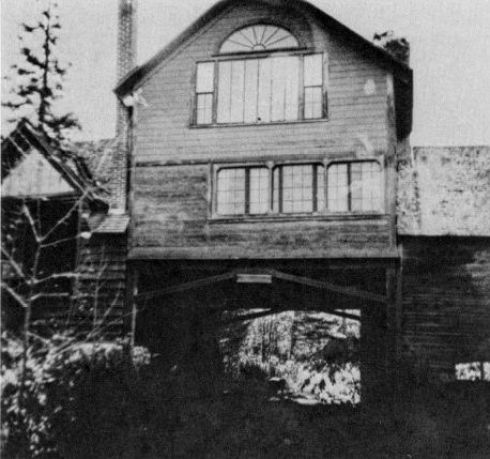
Unfortunately (for posterity but probably not for my friends), Thayer’s cottage was demolished around 1935. I began searching for images of it the moment I returned home, and as you can see below, it was more of a complex than a cottage as Thayer had some rather eccentric and austere ideas about living–and especially sleeping. Living in the age of that great “white plague”, tuberculosis, and losing his first wife to the dreaded disease, he came to believe that heat was a vehicle of its transition, a belief that his physician father apparently encouraged. The house that Miss Greene built for him was a summer house with no “conveniences”, and no alterations were made when he and his family took up year-round residence in 1901. Fires in the central house were allowed, but everyone had to retreat to open-air “sleeping huts” at the end of the day as Thayer believed that sleeping in the open, and in close communion with nature, was a particularly effective preventative against tuberculosis.

Monadnock Thayer

Monadnock Thayer Studio

downloadThe Thayer cottage complex and studio, and Gladys Thayer (Abbott’s daughter) in her sleeping hut, circa 1900. Nancy Douglas Bowditch and Brush Family papers, circa 1860-1985, Archives of American Art, Smithsonian Institution: cited in Susan Hobbs, “Nature into Art: the Landscapes of Abbott Handerson Thayer”, The Journal of American Art 14 (Summer 1982): 4-55.

And in this setting Thayer painted nature, portraits, and angels, who were not historical or theological figures but rather the characteristically-angelic women who crossed his path and touched his heart: all-the-more magnetic because of their humanity, and the wings that he gave them. You’ve got to be impressed by an artist who gave us both angels and camouflage!

Monadnock Dublin Pond Thayer Smithsonian

Monadnock 15

Thayer Angel 1903 MFA Abbott Handerson Thayer, Dublin Pond, New Hampshire, 1894, Smithsonian American Art Museum (painted as a gift for Stanford White); my early-morning view across from Fernlea; An Angel, 1903, Museum of Fine Arts, Boston.

I’ve got to leave Thayer territory and move on to Dublin at large: there are so many houses, so many stories, and I’m not even going to touch on the natural assets of the area. Probably one of the most famous public intellectuals and authors of the day (on a par with Mark Twain who also spent one summer in Dublin–is there anywhere Twain did not vacation?) was Thomas Wentworth Higginson from Cambridge, the so-called “Dean of Literary Boston” who built his Dublin cottage, the adorably-named “Glimpsewood” just down the Lake road from Fernlea in 1890. It’s now for sale. According to a very detailed 1899 article titled “Old Times and New in Dublin, New Hampshire (The New England Magazine, Volume 20) by George Willis Cooke, the colony was “complete” by about 1900, after several decades of steady cottage-building, although I think we should probably extend that up to World War One.

Monadnock glimpsewood collage

Monadnock cottages

Monadnock1

Monadnock 7

Monadnock 10

Monadnock 9

Monadnock 8

Monadnock 2

Monadnock 14

Monadnock Salem

“New” Shingle-style cottages, including a little gatehouse leading us up to the ruins of Pompelia, with its views of lake and mountain (torched by vandals in 1979), Our Lady of the Snows (1904), and a very charming boathouse; the “old” Eli Morse farmhouse, 1822, and the very new (1916) Colonial Revival “Skyfield” in nearby Harrisville, designed by Lois Lilley Howe, the founder of Boston’s first all-female architectural firm. This house apparently has several Salem mantels in it, and I need to determine from which house they were pulled.

The key to understanding Dublin is that it developed as one of several Gilded-Age alternatives to Newport: almost an anti-Newport. The “Old Times and New” article is very clear about this: the “summer resort” aims and methods have not found manifestation [in Dublin]. Almost exclusively the persons who have purchased and built in the town have sought a summer home for rest and recreation; they have not wished for society or fashion; and the life has been kept natural and simple. While there is a kindly interchange of social courtesies on the part of summer residents, any display of fashion or wealth has been discarded to a large degree and many interests bring persons together in a simple and unconventional manner. To keep to the ways of nature in yards, walks, roads and fields has been accepted as desirable; and an unwritten law has been adopted, that nature is to be interfered with as little as possible. Newport was shiny, marble grandeur for grandeur’s sake; Dublin was soft, shingled elegance for art’s (or nature’s) sake. I can completely relate to this aesthetic, having grown up in another anti-Newport, York Harbor, Maine, in a shingled summer cottage that was not quite winterized: I’m even wondering if my own father might have been exposed to the Thayer regimen!

A Harrisville appendix: driving to the town next door (in my host’s ’56 Morgan) and there we are in another archetypal New England setting: the small mill town, perfectly preserved.

Monadnock 6

Harrisville collage