
I turned my return trip from a mid-Atlantic family/research weekend into a day trip focused on New Jersey’s Revolutionary history which is, of course, plentiful. I had been to the battle sites of Princeton, Trenton, and Monmouth before, but never to Morristown, so that was my focus. And I snapped a few photos at Monmouth as well, just because I was driving by and everything was so green. But mostly I was in Morristown, where General Washington located two winter encampments during the Revolution, in 1777 and 1780. The town’s location was strategic then, and convenient now, not too far from either New York City or Philadelphia. It has a lot to offer the tourist seeking historical places, but its vibrant downtown is evidence that it is not altogether focused on the past: destinations that deliver for both visitors and residents are always the best. There are blue and red markers near the sites of Revolutionary structures that are no longer there, and the sprawling Morristown National Historic Park encompasses those that survive. So while we don’t get to see Arnold’s Tavern, Washington’s headquarters during the first encampment, we do get to see the beautiful Ford Mansion, where he spent the second, during the coldest winter on record, in comparative luxury (though with a lot of other people). We also get to see the Wick farmhouse and land at Jockey Hollow, which was transformed into one of the country-in-formation’s largest settlements with the encampment of some 13,000 soldiers. Actually I was going to spend more time and get a true Revolutionary perspective by returning to Princeton and Trenton, but I got sidetracked by a pretty little town in the center of the state, Cranbury. It served as the encampment for Washington and his troops prior to the Battle of Monmouth in late June of 1778, and so set the theme for my little daytrip: encampments rather than battlefields. I must admit though: Cranbury’s houses were so great I would have spent time there regardless of any Revolutionary connection, and so you have to too!


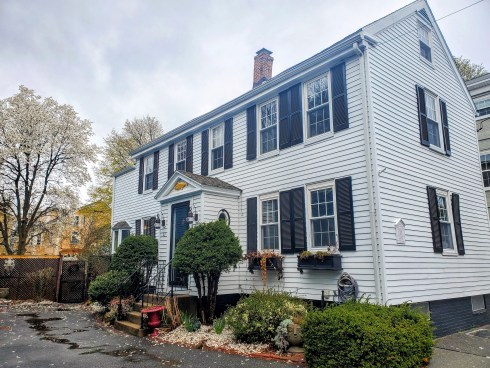
The Monmouth Battlefield and nearby Cranbury; the last cute house is home to the Cranbury Historical & Preservation Society–everywhere I go there are city historical museums or societies and Salem is very conspicuous in its lack of one!
The encampment focus is one which highlights civilian as well as combatant experiences and sacrifices. At the Georgian Ford Mansion in Morristown, you cannot help but think about Theodosia Ford, who offered her gracious home to General Washington to serve as his headquarters in 1779, two years after her husband died during another winter quartering, with 35 soldiers in the house. During Washington’s occupancy, which included his wife Martha, five aides-de-camp, 18 servants (the NPS is not forthcoming on how many were enslaved), assorted guides and occasional dignitaries also in residence, Mrs. Ford and her four children were restricted to two rooms. At Jockey Hollow several miles away, the surviving Wick house, a very New Englandish structure built about 1750, would have been surrounded by small soldiers’ cabins built from 600 acres of the farm’s timber, while Major Arthur St. Clair of the Pennsylvania brigade quartered in the family home. They all endured through the “Hard Winter” together. Numerous monuments and plaques testify to the sacrifices of the Revolutionary soldiers who occupied Morristown at one time or another; I think the contributions of the Revolutionary citizens of Morristown should be marked as well. But perhaps they already are, by the witness houses still standing almost 250 years later.


The National Historic Park at Morristown, encompassing the Ford Mansion and Washington’s Headquarters Museum (one of the first NPS museums, designed by John Russell Pope and completed in 1937), as well as Jockey Hollow. Some exhibits inside the Museum, including an altar-esque presentation of an Edward Savage portrait of George Washington. The park does not include the Jabez Campfield House, c. 1760, but it’s just down the road from the Ford Mansion: this is the scene of the courtship of Alexander Hamilton and Betsy Schuyler in 1780, so it’s now referred to as the Hamilon-Schuyler house! The Wick house and its grounds, which are beautiful, including reproduction soldiers’ cabins and a wonderful herb garden maintained by the Herb Society of America. Like New England, New Jersey is very green this summer.


 Just a few monographs and primary sources for the further study of Salem’s Loyalists; Congratulations to General Gage.


 Tory Houses: several survive but most are long gone. The Ropes Mansion in its original location, right on Essex Street (Old-Time New England, 1902); The Salem Chamber of Commerce is located in Dr. John Prince’s much-altered house on Essex Street, and Historic Salem, Inc. is located in the much-altered Curwen House, which used to be situated on Essex Street.
 Essex Gazette, June, 1774; Salem Mercury, June 20, 1788.




 Tearing Down the Leaden Statue of George III on Bowling Green, NY to Celebrate the Signing of the Declaration of Independence, July 9, 1776 (Book plate + painting), Frederick Coffay Yohn.


 A bit of red in Yohn’s Concord Bridge painting, and four more Story paintings by Yohn: The Defense of Fort Sullivan, The Repulse of the Hessians Under Count Donop at Fort Mercer, Winter at Valley Forge, and The Battle of Bennington.

 Hugh W. Ditzler, Washington Taking Command of the Army at Cambridge, Edward H. Potthast, Bayonette Charge at the Battle of Camden; and F. C. Yohn (again; I guess I’m a fan and clearly Cabot was too), The Siege of Yorktown.


 Gloves with Lafayette’s image from the collections of the Metropolitan Museum of Art and the Museum of Fine Arts, Boston; a silk bag from the Smithsonian’s Cooper Hewitt Museum, and a ribbon from the collection at Lafayette College.


 Mrs. Daniel Sargent (Mary Turner), Fine Arts Museums of San Francisco; and Mrs. Benjamin Pickman (Mary Toppan), Yale University Art Gallery + plus a crop of the serpentine trim on their dress.
 John Singleton Copley, The Copley Family, 1776-77, National Gallery + a crop of Susanna’s
 Lydia Lynde Walter,Virginia Museum of History and Culture; Abigail Pickman Eppes Gardiner, Brooklyn Museum.






