Tag Archives: advertising

Colonial Chocolate

Salem can lay claim to at least one candy title–Ye Olde Pepper Candy Companie, established in 1806, claims to be “America’s oldest candy company” and is still manufacturing the gibralters and black jacks that established its reputation. But the other day I came across a trade card in a digital archive which I thought could lead to another title for our fair city:  oldest commercial chocolate manufacturer.  The card (which gets no bigger, sorry) advertises the business of Gideon Foster, Chocolate Manufacturer, and dates from 1780–the same year that the famous Walter Baker & Co., Ltd. chocolate company was founded in Dorchester Lower Mills.  Perhaps Foster beat out Baker by a few months!

Chocolate 1780

Chocolate Bakers factor

Chocolate Baker 1929

Bakers Christmas

Advertising Chocolate, 1780-1829. Baker images courtesy The Dorchester Atheneum.

Alas, I don’t think Salem can claim the chocolate title, for two reasons.  The Baker Company can be dated even earlier than 1780, to when Walter Baker, a Boston physician, established a partnership in 1765 with English chocolatier John Hannon. When Hannon departed for Europe in 1780, never to return, Baker continued to run the company under his sole ownership, and it expanded dramatically through the nineteenth century under his heirs and the twentieth century under the successive ownership of  General and Kraft Foods (leaving Foster’s little company in the dust!)  The other reason is that while Gideon Foster is associating himself with the commercial mecca of Salem,on his trade card, his chocolate mill was actually located in the nearby village of South Danvers, now Peabody; in fact, Foster’s well-preserved Federal house serves as the headquarters of the Peabody Historical Society.

That matter settled, I still have my questions. Why were these two prominent men so focused on the production of chocolate during the Revolutionary War?  Wasn’t chocolate a rather trivial pursuit at this particular time? Foster was General Gideon Foster, hero of the Battles of Lexington and Concord, later at Bunker Hill and the siege of Boston, but back in Peabody making chocolate by 1780:  was chocolate manufacture a matter of national necessity?  Probably not, but it was definitely a substantive commodity in the eighteenth century, viewed as nutritional, medicinal, and sustaining–almost like food. But it was also a beverage (we are generally talking about drinking chocolate at this time; candy bars come later) that some thought had the potential to replace the almighty tea. Thomas Jefferson certainly thought so; in a 1785 letter to John Adams he predicted that “Chocolate. … By getting it good in quality, and cheap in price, the superiority of the article both for health and nourishment will soon give it the same preference over tea and coffee in America…”

Here in Salem, and in the present, my favorite source for chocolate is the decades-old Harbor Sweets, where I started my Christmas shopping today (with less than two weeks to go–classes complete, papers and final exams to grade!)  Even if you don’t have chocolate on your list, this is a great place to go for its Santa’s workshop ambiance, as well as the free samples.

Chocolate Harbor Sweets


Pilgrim Pants

Eat, drink and shop: the association of Thanksgiving and commerce is nothing new.  Pilgrims were used to pitch almost everything in the later nineteenth and twentieth centuries:  not so much now.  I’ve seen pilgrim advertisements for all sorts of food and drink, which is understandable, but there were also lots of ads for various types of clothing, which is not really that logical an association; after all, one does not think of the Pilgrims as fashionable. That was not the pitch, however, for the famous “Plymouth Rock $3 pants”, which all New England men apparently wore in the later nineteenth century. Rather, the appeal was affordability and durability; these pants were stalwart and persevering, just like Pilgrims. The very collectible lithograph below, from the archives of both the American Antiquarian Society and the Boston Athenaeum, is a play on the classic Landing of the Pilgrim Fathers painting by Charles Lucy. This painting was turned into multiple prints and postcards before World War I, so it’s only natural that it became the basis of a very anachronistic advertisement.

Plymouth Rock $3 Pants lithographic advertisement by G.H. Buek & Co., 1885, American Antiquarian Society; 1915 postcard print of Charles Lucy’s Landing of the Pilgrim Fathers, New York Public Library Digital Gallery.

The other article of clothing commonly associated with Pilgrims, primarily before World War II, were socks, which don’t have to be very fashionable. The Pilgrim brand of clothing, one of Sears’ most long-running (1905-1964), started with socks, and took off from there. While Pilgrims didn’t always appear in ads for this line, they definitely established the brand in the first decades of the twentieth century. Women’s “Pilgrim Positive Wear”, guaranteed to last for six months, were advertised everywhere. Other companies followed suit with ads that featured Pilgrims wearing durable, seldom-in-need-of darning socks. Just one more thing to be thankful for, according to the Norman Rockwell-illustrated ad in the Thanksgiving 1922 edition of the Saturday Evening Post.


The Power of the Printed Image

Most of the courses that I teach focus on the period in which printing technology first emerges, so I am constantly assessing the influence of print on the Renaissance, the Reformation, and nearly every aspect of early modern society and culture. Consequently I have a particular and professional appreciation for the Smithsonian Institution Libraries’ digital exhibition Picturing Words:  the Power of Book Illustration, which began its life as a “real”exhibition at the Smithsonian and on the road and then evolved into a virtual one. Ironically, I think most exhibitions that feature texts work better online than in rooms, and I bet this one does too:  you can get closer to the images, for longer, and come to appreciate the influence they must have had in their own time, and their continuing power in ours. The images in the exhibition are organized into three categories, inspiration, information, and influence, with an additional section of pictures which illustrate the process of printing illustrations from Gutenberg’s time to ours. I think that all the images are well-chosen, but for the purposes of this post I am limiting myself to just five illustrations, with a few more for context.

First up, from the Information column, a work I refer to often in all of my classes: the pioneering anatomical treatise by the Flemish physician Andreas Vesalius, De humani corporis fabrica libri septem, or “The Seven Books on the Structure of the Human Body” (1543).  In the Fabrica, Vesalius took on authoritative Galenism with the help of draftsmen from Titian’s workshop:  the result was a triumph for empiricism and a great example of the often-close relationship between art and science in the Renaissance. Several images are in the Picturing Words exhibition, but you can “turn the pages” of the entire text at the National Library of Medicine.  I love the title page, with Vesalius conducting a theatrical dissection, his face turned to us, the audience and readers, as well as the artfully placed skeletons and body parts.

As I am essentially materialistic at heart, the images from the exhibition that appeal to me the most are from the Influence category, as in influencing design and attracting consumers.  Asher Benjamin’s Practical House Carpenter has always been a favorite source for architectural images, and even though I’m about a century late for these particular products, I am quite drawn to these stoves and shoes. It’s important to remember in this digital age that print was at least as important to the Consumer Revolution as it was to the Scientific Revolution.

Columns, stoves and shoes:  images from Asher Benjamin’s The Architect; or, Practical House Carpenter, Boston: B.B. Mussey, 1853; Oriental and American Stove Works, Perry & Co., New York: The Van Benthuysen Printing House, 1874; Queen Quality Smart Shoes, Thomas Plant Co., Boston, 1910.

My last image is from the Inspiration section, but I have bypassed the medieval religious texts in favor of a page from David Pelletier’s The Graphic Alphabet (1996).  The link between the two is through the use of letterforms as illustration, an interesting feature of the exhibition:  ornamented capitals in the past, letters as ornaments in the present.

David Pelletier, The Graphic Alphabet.  New York: Orchard, c. 1996.


Which Witch House?

One reason that I’ve been an ardent preservationist for most of my life is my belief that buildings hold extraordinary power–even more power, I think, than unbuilt spaces, no matter how beautiful. I can’t imagine a better example than Salem’s “Witch House” (more formally and accurately known as the Jonathan Corwin House), a structure that represents both the most tangible connection to the Witch Trials of 1692 as well as a symbol (and vessel) of Salem’s modern transformation into the “Witch City”. The Witch House seems to reflect the evolving aspirations and perceptions of the city that surrounds it:  for much of the nineteenth century, it was referred to as the “Roger Williams House”, a designation that tied it to the seventeenth-century minister who left intolerant Salem for free Rhode Island rather than the witch-trial Judge Corwin from a generation later. Freedom of conscience versus irrational jurisprudence.

The Witch House today and in an 1886 card by Edwin Whitefield, author/illustrator of Homes of our Forefathers.  Whitefield’s images seems to be based on that of Samuel Bartoll’s 1819 painting, in the collection of the Peabody Essex Museum.

The early architectural history of the Witch House is a bit mysterious (a study has been commissioned by the city, but I haven’t seen the results yet), but most experts believe that it dates from much later in the seventeenth century than Roger Williams’ time in Salem. All of the above images, those from the nineteenth century and just yesterday, might be idealized images of this fabled house. We do know that Jonathan Corwin acquired a structure in this location in 1675, and that he served on the Court of Oyer and Terminer which tried the accused “witches” of 1692. That fact alone seems sufficient for the house’s transformation into the “Witch House” much later, after it left the possession of the Corwin family in the mid-nineteenth century. More than anyone, the person responsible for this identification was George Farrington, an entrepreneurial Salem apothecary who definitely emphasized the witchcraft (rather than Williams) associations of his new place of business:  Farrington grafted a box-like shop onto the house and sold medicines in bottles with a flying witch insignia, anticipating the marketing strategies of Daniel Low decades later and many Salem businesses today. He also published images of  the “old witch house”, effectively establishing that identity.

The Witch House in the mid-nineteenth century:  very influential photographs by Frank Cousins of the front and rear of the house just prior to Farrington’s purchase in 1856 (the house had acquired a gambrel roof in the mid-eighteenth century), a Deloss Barnum photograph from the 1860s, after Farrington’s pharmacy had been attached to the house, an “Old Witch House” stereoview published by Farrington, and a Farrington medicine bottle from the 1880s as pictured in a recent ebay auction.  All photographs from the Robert Dennis Collection, New York Public Library.

For nearly a century, the Witch House was configured as a strange (maybe not for Salem) combination of business and tourist attraction and thousands (maybe more) of postcards were issued, fixing and broadcasting its identity. In the decades before and after World War I, when Daniel Low was marketing its witch spoon and other witch wares nationally, there seems to have been a marked increase in the number and variety of Witch House cards. There are also some interesting private photographs of the house from this era, confirming its conspicuous place in Salem’s urban streetscape.

Two photographs of the Witch House in the 1890s from the Schlesinger Library at Harvard, and postcards from 1900, 1901, 1906, 1908, 1911 & 1922.  Just a random sampling of many on the market!

The 1940s was a decade of transformation for the Witch House, when it came to represent preservation–but also profits: change and continuity. With the planned widening of North Street, a main thoroughfare in and out of Salem, the house was threatened, and its survival (along with that of the adjacent Bowditch House) became the rallying cry for the formation of  Historic Salem, Incorporated and its subsequent restoration under the direction of Boston architect Gordon Robb (who had worked on Colonial Williamsburg as well as another famous Salem seventeenth-century structure, the Pickering House). Moved to a more secure northwestern position on its lot, its shop detached and gables rebuilt, the Witch House was opened to the public in 1948 by the City of Salem, and it has been doing steady business ever since.

The Witch House in 1940 (HABS photograph by Frank Branzetti, Library of Congress), 1945 & 1948.

For more on the evolving perception, and structural history of the Witch House, see Salem’s Witch House:  a Touchstone to Antiquity (The History Press, 2012) by Salem architectural historian John Goff.


October Century

To set the tone for October, always a month of highs (my birthday, beautiful weather and scenery, baseball) and lows (Salem’s transformation into full-blown Witch City, baseball) for me, I am starting off with some lovely images from Century Magazine, the popular successor to Scribner’s which was distinguished by the quality of its illustrations and its emphasis on popular history (lots of Civil War memoirs, and Napoleon) and serialized fiction by the most renown authors of the day. It was published from 1881 to 1930, an era which was clearly a golden age of graphic design. Collaborations between notable authors and artists distinguished Century prior to World War I; one of my favorites was that of Julian Hawthorne, son of Nathaniel, and Harry Fenn on an article from 1884 entitled “The Salem of Hawthorne”. Fenn’s Custom House is below.

Another eminent Century author was Theodore Roosevelt, who penned several articles on the West in the later 1880s (with illustrations by Frederic Remington) and one on the heroism of the New York City Police Department after he had become its commissioner!

Most of Century covers are pretty sedate: more money, and emphasis, was invested in what was between the covers, and on advertising posters to sell each issue:  “coming attractions” for the literary world, a century ago.

Century cover and posters from the 1890s and 1910s, New York Public Library Digital Gallery.


Salem Sketches

It’s been difficult to focus on Salem these past few weeks with so much going on in the historical world:  the potential discovery of King Richard’s skeleton, the raising of a plague ship, a wife for Jesus (or maybe not)!  Then again, I’m not a fan of a parochial perspective; I’ve always felt that the present and the past and places are best viewed in the broadest context possible, so Salem is the world.  That said, occasionally I just want to act like a Victorian antiquarian and stay local. Today, I’ve got some very random sketches of Salem gathered from a variety of sources:  guide books, auction archives, historical societies, old books. Most are very vernacular and commercial, though a few are the works of well-know artists. They’ve been gathering virtual dust in my digital files for a while, so it is time to get them out there.

The sketches appear in chronological order, beginning with two charming drawings by the early nineteenth-century artist Michele Felice Cornè  (1752–1845), a Neapolitan who emigrated to the United States in 1800 and lived in Boston, Salem, and Newport. These drawings date from around 1810, when Cornè was living in Salem, enjoying the patronage of the Derby family. It takes a sketch to reveal little details like the toddler’s bassinet (cage?) below, details that would never appear in one of Cornè’s formal paintings of ships or houses. That’s what I like about sketches, as opposed to more formal compositions:  they give forth a seemingly-casual, and often more intimate, impression of daily life.

Cornè sketches, c. 1810, courtesy Newport Historical Society.

Lots of later nineteenth-century drawings of Salem exist, when both the city and its residents began to market “olde Salem”, first featuring architecture, and then (unfortunately) witchcraft. The sketches in Historical Sketches of the Old Houses of Salem (1870) display a bit of  (sometimes black) humor, as in Six Witches Will be Hung To-Day.  Come One! Come All! and our “Four Fathers”.  The decision to back the Witch City brand had not been made yet, in fact; this early guidebook looks like it is trying to offer up all of Salem’s attractions (including very big chimneys) at the same time.

The accomplished artist Eliza Pratt Greatorex (1819-1897), who was renown for her pen-and-ink sketches of American and European streetscapes, came to Salem to sketch (of course) the “Witch House” (more formally and correctly known as the Jonathan Corwin House) which she portrays as The Last of the Old Witch House.  Little did she know that it would endure as one of the centerpieces of the Witch City.

Eliza Pratt Greatorex, The Last of the Old Witch House, Salem, Massachusetts.  New York Public Library Digital Gallery.

More simplistic (and cheerful) sketches of Salem are in Lydia Louise Very’s Old Fashioned-Garden (1900) and What to See in Salem (1915), both published by the Salem Press Company. Very was part of the very interesting Very family of Salem, and sister of the transcendental poet Jones Very, for whom she cared during his long struggle with mental illness. Moving forward into the twentieth century, there is a pen-and-ink sketch of Chestnut Street that was published in several national newspapers in 1930.

No witches:  sketched views of Salem in 1900, 1915 & 1930.

Sketching continues, it just takes different forms in the present, like these characters from the new Salem video game by Ten Ton Hammer, featuring : Puritans, Permadeath, and Open PvP in a Fantastical New England. These guys remind me a bit of the “four fathers” of past sketches.


Another Cartophilic Collection

I’ve posted on trade cards several times, and they remain a form of ephemera that I casually collect. It seems to me that these early business cards are among the least ephemeral of ephemera–so many survive.  And most of them are the standardized children/animals/flowers variety.  So I’m pretty picky:  my collection is full of Salem items, cards with unusual shapes, cards that advertise Sarsaparilla (for some reason, a new interest of mine; when sold as a medicinal tonic at the end of the nineteenth century it contained something like 18% alcohol) and apothecaries in general, and those put out by the home furnishings trades. Occasionally odd images catch my fancy, and I don’t care what they are selling. I really prefer the earliest trade cards, issued in western Europe in the seventeenth and eighteenth centuries, but I could never afford them and most of them are in rare book libraries anyway. It’s been a while since I featured any trade cards, so I thought that I’d showcase my most recent finds.

First, some Salem cards. Frank Cousins was an amazing photographer/entrepreneur who did much to capture and sell Salem a century ago:  the cards for his Essex Street shop, the Bee-Hive, were often issued in interesting shapes.  I always go for any view of the wharves and great examples of typography, and I love the font on Mr. Goodwillie’s card. The last card, presenting a western image of Chinese workers, is extremely interesting:  “others”, particularly Chinese, often appear on late nineteenth-century trade cards, and almost always in a stereotypical, racist and/or jingoistic way.  I’m not sure what’s going on with this card, issued by a Salem pharmacist; most likely it is part of a series.

As you can see, A.A. Smith is offering “petroleum remedies”:  even more unusual is the”magnetized food” on sale at a Brooklyn pharmacy.  I’ve included the back of the card so you can see the pitch:  using children to appeal to their mothers, obviously an age-old practice.  And then there are two cards issued by the Charles I. Hood Company of Lowell, Massachusetts, the leading manufacturer of the equally healthy Sarsaparilla.

Magnetized Food” trade card from the Library Company of Philadelphia Digital Exhibit: Nineteenth-Century Pharmacists’ Trade Cards from the William H. Helfand Collection.

I thought I was familiar with all the digital databases of works on paper but just recently I found the online collection of the Rothschild family’s Waddesdon Manor, which includes over 700 trade cards from the seventeenth and eighteenth centuries. This is an amazing resource for all sorts of things. The Rothschilds were probably the greatest collectors of the nineteenth century, and I was surprised to see so many humble trade cards among their more luxurious acquisitions, but apparently Ferdinand von Rothschild, the builder of Waddesdon, was interested in every aspect of French life and culture in the eighteenth century. Here are three late-seventeenth-century cards from his collection, with which urban outfitters offered their services and wares:  the first one is from a hat-maker, the second from a vestment-maker, and the last one from a furrier. Mere slips of paper that survived all these many years.


The Queen Pitches

I must admit to indulging in a bit too much anniversaic history of late but the Anglophile in me cannot resist today’s anniversary of Queen Victoria’s accession (in 1837) especially as her successor just had such a big show. I’ve just discovered the most interesting Salem connection as well:  the Queen’s third cousin, Dr. Ernst Bruno de Gersdorff, left his native Germany shortly after his graduation from medical school and in the midst of the revolutions of 1848, and wound up here, where he began what looks like a very successful homeopathic medical practice and married the sister of one of the wealthiest and most prominent men in town, Judge Joseph Choate, who would later be appointed American ambassador to Great Britain!  A small world of connected people in the transatlantic Victorian Age.

It’s the Queen’s day, not the doctor’s, so I want to pull up some images from my teaching files, featuring the very commercial Victoria as pitchman to the world, at the very peak of the British Empire.  Here is the Queen/Empress of India/safeguard of the Constitution selling oats, soap, stoves, cloth, and cigarettes (produced by both British and American manufacturers) in the 1880s and 1890s.

Victorian advertising ephemera from the John Johnson Collection at the Bodleian Library, Oxford University, the British Library, the British Museum, Duke University’s Digital “Emergence of Advertising in America” Collection, and the New York Public Library Digital Collection.


Our Ship Comes In

Yesterday the Friendship of Salem, a reproduction 1797 three-masted East Indiaman, returned after an absence of many months. It was a beautiful, breezy day, so I went down to Derby Wharf to wait for it, and promptly fell asleep (right in the midst a crowd of people, pretty embarrassing).  When I woke up, the ship was almost upon the wharf (a startling sight to wake up to, actually), so I missed its approach. It rounded the wharf and glided to its berth, negotiating a graceful turnaround along the way so it could back in–its accompanying little pilot boats doing much of the work.  And then The Friendship was home.

For a geographical overview and some historical context, here are two bird’s-eye views of the Salem Maritime National Historic Site by National Park Service illustrator Fred Freeman:  where once there were many busy wharves, now there is only the long Derby and the much shorter Hatch’s and Central wharves. Imagine not one Friendship, but many.

More harbor views, both romantic and realistic:  the scene from Nathaniel Hawthorne’s Custom House office, from an interesting article entitled “The Salem of Hawthorne” by Julian Hawthorne in The Century Magazine (1884) , an illustration from an article on post-fire Salem in The New England Magazine (1914), and an undated advertisement for coal, which I found among other papers in the third-floor eaves of my house last week. Mr. Phillips lived in the house in the second half of the nineteenth century, a time when Salem’s wharves were housing less glorious goods than those brought in by The Friendship many years before.


Corset Culture

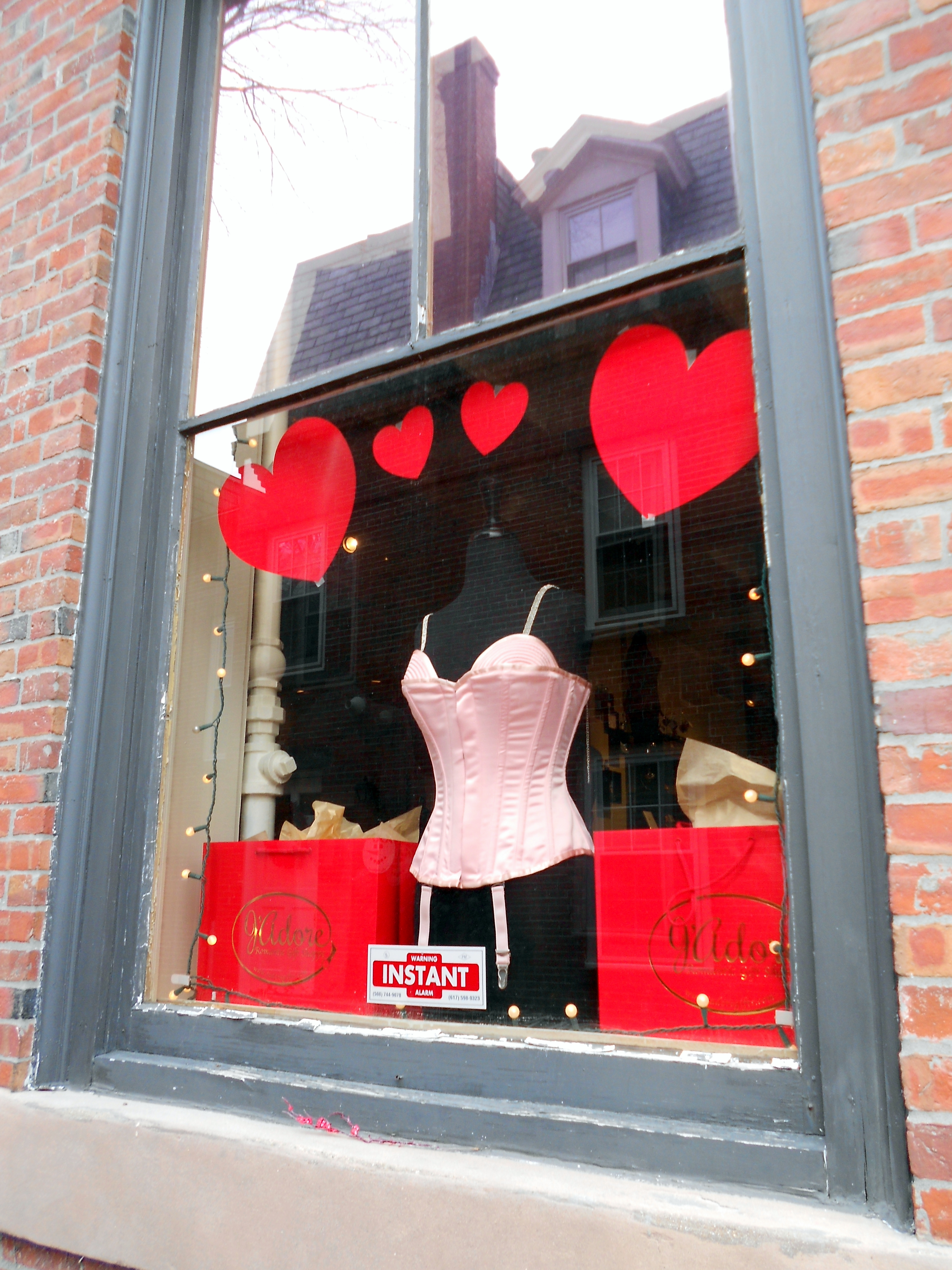
From my vantage point here in Salem, it appears that we’re in the midst of a corset comeback:  not only do we have our own corsetmaker who sells her creations online, but also a new bricks-and-mortar corset shop in Derby Square, right across from Old Town Hall.  A Beautiful Corset (10 Derby Street, Salem) offers made-to-order corsets by the British corset manufacturer Vollers, for which it is one of the few distributors in the United States. The owner explained to me that she has operated an online business for several years, but opening a real shop was a necessity, because with corsets, it’s all about the fit (and the fitting!)  Her expansive store is filled with “models” named after years, as Vollers still cuts their corsets from patterns made in 1899, and 1903, and so on, as well as a gift shop-within-a-shop called J’adore. 

The shop window at A Beautiful Corset/J’Adore, fabric choices for the corsets, a finished product in Chinese silk–with Salem’s Old Town Hall as backdrop.

My interest in corsets doesn’t come from a love of constraint, but rather of craftsmanship, and I always like to see a new shop open up in Salem, particularly one that doesn’t offer the same old (kitschy, witchy) things.  Corsets are both very old and very new, given that they morphed into girdles several generations ago, coincidentally with the invention of all sorts of synthetic and stretchable textiles, and essentially disappeared.  The reappearance of the hand-made corset is something to celebrate, just like letterpress printing.

The commercial revival of corsetry seems to be coincidental with a cultural one.  Several exhibitions featuring the corset have been mounted in the last few years, including the Victoria & Albert Museum’s touring exhibition Undressed:  350 Years of Underwear in Fashion and the Worcester Art Museum’s Bound by Fashionthe Corset in European Art.  It seems absolutely fitting that Worcester should have a big corset exhibition, as that city was the absolute center of corset manufacturing here in Massachusetts (with claims of being the largest corset manufacturer in the world) in the later nineteenth and twentieth centuries, when the Royal Worcester Corset Company (1861-1950) employed over 2000 workers (mostly women) at its state-of-the-art factory.

Pink silk corset, circa 1885-95, from the Collection of the Victoria & Albert Museum, London; Portrait of a Woman, 1556, by an anonymous painter of the Flemish school, Worcester Art Museum, Worcester, Massachusetts, and interior view of the Royal Worcester Corset Factory main stitching room, from Digital Treasures:  a Central and Western Massachusetts Library Project.

Worcester might have had claims to worldwide corset domination, but in terms of advertising claims, the company that seems to have led the industry in innovations was Warner Brothers, the founding corporation of the present-day Warnaco.  The company was founded by a pair of physician brothers, Lucien and Ira Van Der Warner, who founded their “reformed” corset company in Bridgeport , Connecticut in 1874 after several years of lecturing on the considerable dangers of whalebone- and steel-boned corsets.  Their new “healthy” corset was boned with more flexible coraline, an organic product made from the agave americana plant, and they must have spent a fortune on colorful chromolithographic advertising to showcase its natural benefits.  Two decades later, they had both retired as millionaires.

Warner Brothers Coraline Corset advertisement and trade cards, from Duke University Digital Collections and the Library of Congress.

The history of the corset is really essentially the history of women–women’s fashions, women’s health, women’s work–so obviously a short blog post can only scratch the surface.  Another major reason why corsets have been having a “moment” in the past few years is an amazing book:  Valerie Steel’s The Corset:  A Cultural History (2001), a work of intensive scholarship and immediate accessibility.  If you want the whole story of the corset, pick it up.

A 15-year-old corset worker in 1917:  Library of Congress.