When Salem was Pretty

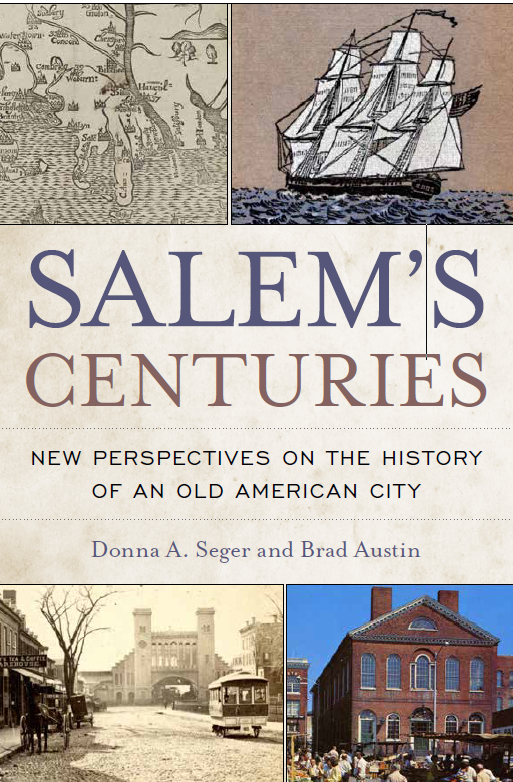
The Salem visual vibe is darker now, and focused firmly on “Gothic” rather than Federal or Colonial, but the Witch City used to be pretty. I wrote the chapter on the Colonial Revival in our forthcoming book Salem’s Centuries. New Perspectives on the History of an Old American City (for which we have our cover, and a production schedule, and a publication date coming soon!), spotlighting four Salem “influencers” who emphasized the city’s beauty and craftsmanship through various cultural initiatives: Mary Harrod Northend, Frank Cousins, George Francis Dow and Caroline Emmerton.  They were so successful that Salem coasted into a period of being known primarily for its architectural and aesthetic heritage that lasted well into the 1960s, an image that was sustained by the Essex Institute’s house museums and the very public battle over urban renewal. A succession of commercial and graphic artists celebrated Salem through their accessible imagery, and we see Salem grouped with Colonial Williamsburg, Historic Deerfield, Sturbridge Village, Mystic Seaport, and other traditional heritage destinations. In today’s competitive tourism realm Salem has pulled ahead of (or moved behind?) that pack by emphasizing horror over beauty, Gothic over Federal, and darkness over light. At least that’s the projection I see in so many shop windows and on so many websites, but I think I better do some more searching in the real world. There are also many AI images of a Salem that doesn’t even exist, a concocted Victorian-Gothic world with black cats and cute witches, but also church spires! Fantasy Salem is even more idealistic than what came before, depictions in color and black and white of well-manicured car-free streets and stately houses, a “city of treasures” according to Katharine Butler Hathaway.

Some of my favorite images of Salem from the 1920s to the 1960s: Felicie Waldo Howell’s “Spring on Chestnut Street” + various houses; shelter magazines LOVED Salem in the 1920s; Rudolph Ruzicka made several Salem prints; interior vignettes from House & Garden, June 1939;Chestnut Street scenes from Philip Kappel and Samuel Chamberlain; LOVE these notecards from Nantucket artist Ruth Haviland Sutton; the “Silent Traveler,” Chiang Yee’s view of the Custom House.


Saints & Sinners & a Bad Professor

So you would think that I would be happy when an exhibition of paintings, texts and objects right in my teaching sweet spot of late Medieval/Renaissance/Reformation/Early Modern Europe comes to my very own city, and yes, I am. Have I taken advantage of said exhibition and brought my students to see things which I regularly refer to? No I have not. The “Saints & Sinners” in my post title refers to the current exhibition at the Peabody Essex Museum, Saints, Sinners, Lovers, and Fools: 300 Years of Flemish Masterworks, and the “Bad Professor” is me. This has happened before: the PEM has a global purview, and several exhibits which have complemented my courses have been up, but this one is really spot on. So when I finally went yesterday afternoon (it opened in December and is up until May), I really enjoyed it, but also felt bad. I am really not good at out-of-the-classroom activities with my students: I never have been and I never had to be. All my colleagues are a lot better. I always used to think, oh well, they’re Americanists, it’s easy for them, but that’s not going to work in this case is it? And I’ve always blamed it on Salem State’s location—about a mile out of downtown Salem. It’s not very far, but it feels far, when you’re trying to cover so much in the limited time of a semester. I walk it often, but to and from is going to eat up an entire class with not much time for viewing in between. The original Salem State (Salem Normal School) was located just behind my house on Broad Street, but in the 1890s there was a big move to a more expansive—now residential—area south. The move made sense at that time, but now I think our university would benefit from a downtown location, or maybe I’m just making excuses! I have occasionally invited my students to join me at exhibitions, and a few have, but never the entire class: my students seem very busy, taking six classes and working two jobs—oops, more excuses. In any case, I’m certainly going to extend that offer to them for this exhibition, because they will in fact see many things which they have heard about before.

Detail  from Jan Wildens, Panoramic View of the City of Antwerp across the River Scheldt, 1630.

Saints and Sinners is a traveling exhibition co-organized by the Denver Art Museum and the Phoebus Foundation in Antwerp, and it is very Antwerp-centric. Once certainly gets a sense of the somewhat wider world that was late medieval and Renaissance Flanders, but Antwerp is the star of the show. But that’s ok, because Antwerp was a very dynamic city in this era–the first non-Italian European entrepot. [a great read for the non-specialist is Michael Pie’s Europe’s Babylon: the Rise and Fall of Antwerp’s Golden Age] The exhibition opens with two galleries exploring intense late medieval piety and the rise of Christian humanism in northern Europe: there wasn’t much discussion in the exhibition text about the latter (or humanism in general, really) but I saw it all around me in both the Christocentric devotion and the subtle critique of the Church, most evident in Anthony Rebukes Archbishop Simon de Sully in Bourges, (c. 1475, by Master of the Prado Adoration). There is a lovely little triptych with a nice interpretive feature.

Circle of Dirk Bouts, The Virgin and Child in an Enclosed Garden , about 1468; Master of the Prado Adoration, Anthony Rebukes Archbishop Simon de Sully in Bourges, about 1475; Artist in the Southern Netherlands, Triptych with Saint Luke Painting the Virgin Mary and Jesus, 1520-30.

Then we were on to more worldly things: shockingly fresh portraits of people who were not saints, still-lives of stuff, a few landscapes, battle scenes, scenes of daily life and satire, cabinets of curiosities. The segue between the spiritual and material worlds was a succession of Adoration of the Magi paintings, focusing on stuff. You can never underestimate the impact of the Renaissance portrait, and I was particularly wowed by the portrait of Joost Aemsz. van der Burch by Jan van Scorel. He looks very (Thomas) Cromwellian to me, and yes, he was a contemporary and also a legal advisor, to Holy Roman Emperor Charles V. I love portraits of the new nobility of merit or robe (rather than the sword) and also of merchants, the other new men of the era. One of the most captivating (double) portraits of this exhibition is the rather pointed portrait of two “tax collectors,” a copy of the famous Quentin Massys painting of the same title. This image is a great teaching tool: I suspect the men were in fact “tax farmers,” collecting taxes for the government for a certain percentage, a practice which emerged before the expansion of professional state fiscal agencies, and their depiction conveys a lot about attitudes towards money, class, occupation, society, and even color. Another double portrait of a married couple was also interesting: they are obviously well-heeled and playing “triktrak,” an early form of backgammon.

Quinten Massys, Tax Collectors, late 1520s, oil on panel, 86 x 71 cm. Liechtenstein Collection, Vaduz/ Vienna.

LOVE this first portrait above: Jan van Sorel, Portrait of Joost Aemsz. van der Burch1530-1; Marinus von Reymerswaele, After Quinten Metskis, Tax Collections, about 1530; Jan Sanders van Hemessen (Hemessen c. 1504-1556 Antwerp), Double Portrait of a Couple Playing Triktrak, 1532.

I was familiar with most of the printed texts in the exhibitions but the key reference works were there: the very important and popular Cosmographia of Petrus Apianus, the pioneering On the Fabric of the Human Body by Andreas Vesalius, and the Nova Reperta engravings by Flemish artist Johannes Stradanus published by Philips Galle. The Nova Reperta (New Intentions of Modern Times) is a portfolio of 19 European “inventions” (many of which are not inventions and certainly not European inventions) is such a testament to European pride (and invention!) at the end of the very dynamic sixteenth century. The frontispiece alone is revealing [I use this great digital site at the Newberry Library in class]: highlighted are 1) the western hemisphere (ok Europe gets credit for that discovery), the printing press (Chinese origin–I don’t see the type here!), distillation (I would call this a Eurasian collaboration), wood from the guiacum tree in Brazil (then thought of as the cure to another American import, syphillis, but soon to be abandoned for mercury), a cannon (ok the Europeans encased Chinese gunpowder), a saddle with stirrups (ancient!), a clock (clock history is complicated but if we’re talking mechanical I think I will give it to Europe).  As the exhibit moved into a surreal and satirical gallery, with a Bosch-esque Hell, and lots of foolery, I was with it, but I walked right through the boring Classical Impact section (not what I’m looking for in Antwerp) into the galleries of wonder and cabinets of curiosity. It was fun to see actual Wunderkammer as well as paintings of wealthy Flemish men and women with their collections of exotic objects and paintings; one can easily grasp how connoisseurship expanded into collecting and it was almost as if these galleries were a mirror of the entire exhibition.

Andreas Vesalius, On the Fabric of the Human Body in Seven Books, 1543; Follower of Hieronymus Bosch, detail from Hell, 1540-5-; Daniel Teniers, Festival of Monkeys, 1633;  Gillis van Tilborgh II, Twelve Gentlemen in an Elegant Interior, about 1661; The Famous Pocupine in London, 1672 @Trustees of the British Museum. After I saw him in the bottom right corner of the Cabinet in the exhibition, I had to put in him here as he is my favorite early modern porcupine.

Virginia Green

Sorry for the delay in posting part II of my spring break road trip: I came back with a nasty flu so re-entry and re-engagement have been stalled. I’m feeling a bit better today and I thought it would make me feel better yet by looking at my photos. From the Eastern Shore, we traveled over the scary Chesapeake Bay bridge/tunnel up to Williamsburg for a few days, then we visited my sisters-in-law in Richmond. It was a real treat to stay in the Williamsburg Inn, and I do like Williamsburg in general even if it has its “history disneyland” qualities, but its highlights on this particular trip were definitely the George Wythe House and the museums. On the way up to Richmond, we stopped at the Berkeley Plantation on the James River, a beautiful and very history-rich site. I always love the capital, and we also visited Monticello up in Charlottesville, which I haven’t been to since I was in college. On the long drive back myself this past Saturday, I stopped on Virginia’s northern neck to visit Menokin, a plantation ruin in the midst of an interpretive restoration. As I drove north from there, I started feeling a bit gray but was thinking mostly of green: as we drove down we saw increasing green and on my ride home I was seeing less. That’s one of the things I like most about my March break trips down south: we won’t see that green in Salem for a while.

Four plantations: Eyre Hall on Virginia’s Eastern Shore, Berkeley and one of its “dependencies,”, Monticello & Menokin.

Eyre Hall, overlooking the Chesapeake on Virginia’s Eastern Shore, is a well-preserved, privately-owned 18th-century plantation whose owners open up its gardens to visitors, so we drove right in and I snuck a photograph of the house. The gardens are supposedly beautiful, but it was a a bit early for blooms. Berkeley has direct connections to the Harrison presidential family and to the Civil War, and is also a site rich in the history and documentation of slavery. There is also a claim to America’s “First Thanksgiving” in 1619, which I’m not going to explore because I’m from Massachusetts. Monticello was of course Thomas Jefferson’s beloved home, and he also has a tie to Berkeley and to the George Wythe house in Williamsburg. The Hemings family is also showcased at Monticello, which was the busiest site we visited by far: it was kind of difficult to take in the house on our packed tour. Menokin, as you can see, is currently a ruin, but its restorers have big plans. I took a lot of notes on interpretation over the week, but I haven’t really sorted them out and I’m not quite up to it, so I’m going to reserve my thoughts on inclusion/exclusion (and Thomas Jefferson!) for later.

Colonial Williamsburg: including the George Whythe (rhymes wth Smith) house, the Capitol and Governor’s Palace, and the museums.

And a view of the University of Virginia’s Lawn from the Rotunda (which I never knew you could spot from Monticello before last week).


Greetings from the Eastern Shore

I’m at the beginning of my traditional spring break trip down south, and currently on Maryland’s Eastern Shore headed for Virginia tomorrow. I don’t know why, but usually when I’m headed south I go the “western” way, and this year I wanted to spend some time on the other side of the Chesapeake Bay. It’s really nice; I’ve missed it! I have my husband with me so I’m a bit constrained: generally I would drive like a mad woman to see every 17th century house in the entire region but husbands need care and feeding so I have to stop at more taverns and coffee shops than I would on my own. Everything slows down with him, which can be a good thing. We stayed in Easton for two nights, after stops in New Castle, Delaware and Chestertown, Maryland on our way down Saturday. Yesterday we were in Oxford and Cambridge and St. Michaels, where we spent a LONG time at the amazing Chesapeake Bay Maritime Museum. I feel like I’ve been in the midst of Frederick Douglass/Harriet Tubman territory, because I HAVE: somehow I never realized how important the Chesapeake Bay was to the Underground Railroad before, but everywhere I went emphasized that importance. And in addition to that life lesson, there was just so much beautiful mid-Atlantic architecture! Here’s a brief tour:

Brief stop in New Castle, DE. Such a great town.

Chestertown, MD. So gorgeous!

Further south, Easton has several connections to Frederick Douglass as its the closest larger town to the site of his birth on Tuckahoe Creek and the county seat of Talbot County. One of the reasons I wanted to visit the Eastern Shore was to see the Harriet Tubman “Take my Hand” mural further down in Cambridge, but its artist Michael Rosato had more recently completed a Douglass mural in Easton, so that was our first stop on Sunday morning. Harriet’s mural is personal and compelling, Frederick’s more sweeping, both extremely effective. There’s another Douglass mural in Easton, much more controversial and appearing much more ephemeral, about which people in town seem to have mixed opinions. There’s also a very lively downtown and a bit further out, the oldest Quaker meeting house in the United States, the Third Haven Meeting House.

So much to see in Easton.

On to Oxford and Cambridge, in that order.Very different towns: Oxford is a picture-perfect town of pristine historic houses; Cambridge is a much larger town with obvious economic and preservation challenges but also a lot of pride and energy. Oxford is just so pretty; Cambridge seems very much a center of an Underground Railroad perspective on the Eastern Shore.

a big transition down to Cambridge, but there was Harriet!

The “Take my Hand” mural really has presence! It’s not just her figure—it’s the background. When you’re darting around all these towns bordered by rivers, creeks, or the Bay, you can feel the challenges and the opportunities that all this water represented. Next time, I’m just going to follow the Byway–you can download the app. But this time, we had other places to go: my husband was really looking forward to visiting the Chesapeake Bay Maritime Museum in St. Michaels, so off we went. I’m pretty familiar with St. Michaels, but had never been to the museum before: it did not disappoint! We had to split up though as he’s a real waterman (A GREAT WORD WHICH THEY USE DOWN HERE WHICH WE SHOULD ADOPT IN NEW ENGLAND) himself, and I just can’t spend hours exploring the minutiae of oystering and crabbing. But there was also an entire exhibit on the Bay and the Underground Railroad (as well as the rescued and relocated house of Frederick Douglass’s sister) which was a perfect capstone to our day.

St. Michaels: cute houses and the Chesapeake Bay Maritime Museum.


A Salem Women’s History Tour

For International Women’s Day today, I thought I would put together a walking tour of Salem women’s history. Of course, every street and every building in Salem has traces of women’s history, most of it hidden from us. I would like to include more than “notable” women on my tour, and I think I’ve busted out that category a bit, but there’s still a lot of work to do and a lot more to learn. I decided to limit the tour to existing buildings, so it definitely skews towards the nineteenth and twentieth centuries. I read revews of Salem walking tours occasionally, mostly because I want some sign of hope that Salem tourists are interested in topics other than the Salem Witch Trials, and that’s the number one complaint: we stood on the sidewalk looking at a parking lot. If they were interested in something other than the Salem Witch Trials, they would no doubt see more buildings and places than parking lots. So my tour is all about buildings, and the women who lived in them. Beware if you want to do it yourself: it’s a long tour—I easily got in my 10,000 steps!

We’re starting on Derby Street, right next to the Custom House, at 1) The Brookhouse Home for Aged Women. Not only is this a McIntire building and an early (1861) example of a privately-established residential home for senior women, but it was also the home of Massachusetts congressman and Secretary of the Navy Benjamin W. Crowninshield, whose wife Mary was quite the Washington socialite: her letters are very revealing about the social scene during the administrations of Presidents Madison and Monroe in general and Dolley Madison in particular. Mary Crowninshield spared no detail, either of drapery or dress trimmings.

Then it’s on to another impressive brick Federal house turned social institution, 2) the Woman’s Friends Society on Hawthorne Boulevard. Founded in 1876 as a residence and employment “bureau” for younger women, the Society acquired its impressive brick double house from Salem’s famed philanthropist Captain John Bertram and his daughter Jennie (Bertram) Emmerton, the mother of Caroline Emmerton of House of the Seven Gables fame. So it is the Emmerton House, and it continues in its original mission. Lots of women’s stories to tell here, as it also became a center for social work, craft eduction, and public health initiatives.

We walk westerly on Charter Street until we come to the so-called 3) Grimshawe House where the famous Peabody sisters lived and where Nathaniel Hawthorne courted his future wife, Sophia. This house was built around 177o and educators Elizabeth and Mary lived here between 1835-1841 with said Sophia, their parents and brother. It has been in decline for most of the second half of the twentieth century, serving as a eerie gray neighbor of the Charter Street cemetery, but last year signs of restoration (and color) appeared.

Now we’re walking towards the McIntire Historic District along Front and Norman Streets and then we’re on Chestnut. There are quite few houses on this street worth noting in relation to women’s history, but I limited myself to 4) Mrs. Parker’s house at #8, 5) Hamilton Hall; 6) the Phillips House, and 7) a Caroline Emmerton-commisioned house. My neighbors just across the street live in the beautiful house occupied by Mary Saltonstall Parker, an author and artist at the turn of the last center. Mrs. Parker loved traditional crafts and antiques and wrote about both in a succession of small books which reflect the Colonial Revival movement, but she was also a “maker” herself and one of her embroidered samplers was on the cover of House Beautiful in 1915. Hamilton Hall is a veritable monument to women’s history, including the work of the Remond family, all those festive fundraising fairs in the nineteenth century, debutante assemblies and the lecture series sponsored by the Ladies Committee in the twentieth. And schools! Dancing schools and “dame schools,” including that of Lucy Stone in the 1880s below. I certainly learned a lot about a variety of women working at the Phillips House this past summer, including ladies of the Phillips family and their staff, but I wanted to spotlight this house at was also the home of Caroline Howard King, the author of one of the most popular (and literary) Salem memoirs, When I lived in Salem. Before the house was the Phillips House, it was actually a genteel boarding house, and Caroline lived there from the 1890s until her death in 1907, I believe. The last house below is Caroline Emmerton’s commissioned copy of the Derby House by architect William Rantoul: it completes the street.

Over on Essex Street, we stop at the venerable 8) David Mason House⁠. Notable for its namesake occupant’s role in Leslie’s Retreat in 1775, more than a century later it was purchased and restored by the prolific author and suffragist Grace Atkinson Oliver, who also served as a member of Salem’s School Board. Across the street is the 9) Quaker Cemetery, where one can reflect on the persecution of Salem’s Quakers in the seventeenth century, including Cassandra Southwick and her daughter Provided. Further down the street towards downtown are 10) the Cabot-Endicott-Low House, childhood home of Salem’s only “dollar princess,” Mary Endicott Chamberlain Carnegie, pictured below just before she presented her stepdaughters to Queen Victoria, of whom she was reportedly a favorite, 11) Caroline Emmerton’s stately house and 12) that of Susan Osgood, another preservationist of sorts, who was the niece of Salem’s first, Joseph Barlow Felt, who was married to Abigail Adams’ niece, also named Abigail. Because the Felts had no children, a lot of her aunt’s things ended up with Susan, including items that Abigail Felt inherited from HER aunt Abigail Adams. Susan donated Abigail’s Inauguration dress (+ slippers!!!) to the Smithsonian Institution, where they reside in the First Ladies exhibit.

Through the Ropes Garden and over to Federal Street and the 13) home of Salem’s first female physician, Dr. Sarah Sherman. She was an amazing woman, who was also elected to the School Board in 1879, the first “school suffrage” election in Salem. Then we will walk towards downtown, cross North Street, and visit two Lynde Street houses, home to two accomplished Marys. First up is the 14) house of Mary Bradford Hagar, who served as the chair of the Salem Ladies Centennial Committee in the 1870s, which organized Salem”s exhibits for the Centennial Exhibition of 1876. Her committee did such a great job that it won national acclaim, and 100 years later in 1975, the Essex Institute mounted a re-exhibition. Next is the 15) house of Mary Harrod Northend, the prolific author of everything “Old Salem” in the early twentieth century. A very Colonial Revival street!

Salem walking tours always stop at the 16) Lyceum Building, now Turner’s Seafood Restaurant, on Church Street as it was supposedly the site of the first Witch Trial victim Bridget Bishop’s orchards, but I would include it on my tour because it was the site of so many meetings of Salem’s Suffrage Society from the 1870s on. I’m cheating a bit here as the present Lyceum building was not the one in which Salem’s Suffragists met: there was an earlier wooden structure on the same site. Like so many sites in central Salem, it is historic in more ways than one. Walking towards the Common, I think I would stop at the Peabody Essex Museum’s 17) Bray House, because it is so cute and also because Salem’s most successful commercial artist, Sarah Symonds, had a workship and retail space there.

I want to include at least one house on Washington Square on my tour, so I think I’m going with the present-day 18) Bertram House. What does this former home for aged men and current assisted living facility for both genders have to do with women’s history? My link is another Endicott and preservationist, Clara Endicott Sears (contemporary and cousin of Mary Endicott), who wrote a charming childhood memoir of life in this house with her grandparents entitled Early personal reminiscences in the old George Peabody mansion in Salem, Massachusetts (1956). The Bertram House overlooks the Common, where a grand historical pageant was present for the Salem Tercentenary in July of 1926: its author was Nellie Stearns Messer, who lived at 19) 15 Oliver Street, pictured just below. By all accounts that I have read and heard, she seems to have been a very active mid-century public historian, before that term was used. In addition to the Tercentenary pageant, she also wrote very substantive histories of the Tabernacle Church and Ropes House. We then walk northward towards Pleasant Street, and the 20) home of one of Salem’s most notable entrepreneurs, Charlotte Fairfield. Charlotte ran a coal company that undercut Salem’s coal cartel in the first decade of the twentieth century, and received lots of attention in the Boston papers for doing so. Independent indeed.

For the last leg of the tour we’re going to swing over to Pickman Street to see the building which houses the 21) Esther C. Mack Industrial School for Girls from the 1890s through the 1920s. Established by a large bequest in the will of its namesake, the school taught what we would call domestic rather than “industrial” skills, mostly sewing and cooking, to young girls and had quite a few collaborations with the Woman’s Friend Society. The photograph below, by Mary Harrod Northend, is of a sewing class. So many progressive women in Salem at this time: I haven’t even touched on the House of the Seven Gables except for showcasing several properties associated with its founder, Caroline Emmerton, or any of the public health and cultural initiatives of this era. This is why I get more than a little frustrated with the continuing almost-exclusive focus on 1692 in this city: it excludes so much history in general, and so much women’s history in particular. But we’ve walked enough for one tour, so I propose crossing the Common, perhaps taking a peak and the 22) birthplace of prominent Salem artist Fidelia Bridges, and then popping into the tavern at the Hawthorne Hotel for a drink, and a toast to the ladies.

Map made by John Northey for the Bicentennial in 1976: as you can see, there’s a lot more land to cover.


What I’m Reading, Spring 2025

I’ve working my way through a stack of books this semester and looking forward to some notable new publications so I thought I’d put together a post to relieve everyone (including myself!) from the Revolutionary focus. As is generally the case with my reading lists, there’s no fiction here. I really, really wish I could read fiction, but I am for the most part an “information reader”: I’m looking for something or want to learn something. I aspire to read for pleasure but I’m not there yet. I’m always teaching and writing about history, so most of what I read is history too, but I have various sideline subjects: architecture, urban planning, folklore, art. I will often have a stack of books by my bed or desk which I will dip into for an hour or two, but for the past year I’ve been trying to break that habit and read through every book I pick up. I’ve been moderately but not completely successful in this aim. I’m also trying to kick my Amazon habit, but have been less successful in that goal! So here’s the list, in no particular order.

Big, sweeping cultural histories of monsters and fairy tales! I’ve been eagerly awaiting Humans. A Monstrous History, which was published just last month. I ordered a desk copy from the publisher, because if it’s as good as I think it will be, I will definitely use it in class. I think I know where Surekha Davies is coming from, because I read her first book on Renaissance ethnography, but she is really stretching it our here—“monsters” are a bit different in the medieval and early modern era. But every civilization has its monsters, and their creation tells us a lot about every civilization. I’ve had Warner’s Once Upon a Time for a while, but finally finished it, as I thought it would be a good companion book for the monsters.

American history always seems much more….tangible! I love books that can explain how just one thing—whether tangible or not, can be “revolutionary” so this book on the Franklin stove is right up my alley: I have a Franklin stove and have written about its companion technology, Rumford roasters! I have not received this book yet (I couldn’t order a desk copy as I don’t teach American history) but I am really looking forward to reading it. I have read No Right to an Honest Living and while it was a bit slow-going for me, I really learned a lot. I wanted to read it as I have thought and written about the Remond family here in Salem so much and I thought this book on Boston African Americans who lived at the same time might give me some insights into their lives, and it has.

Some women’s history (and literature) for Women’s History Month. These are two very accessible, informative, and complementary books: I read straight through them in a weekend. I am a fast reader but I also tend to “gut” books as they taught us in graduate school: you really can’t do that with either of these books. This is the anniversary year of Jane Austen’s birth so I expect we will get more Austen books but I suspect Jane Austen’s Bookshelf will do it for me: I liked this very personal window into her reading world.

A wide range of architecture. I guess I’m going for complementary reads here; I hadn’t planned on that, a pattern is emerging! Now that I think about it, I guess this is how I read. If I read an engaging book, I want more, or I want some kind of response. I’m not sure these that Inessential Colors and A Paradise of Houses will be complementary: I’ve only read the former and the latter is going to be published at the end of this month, I think. I pre-ordered it because its title gave me hope: Salem is just getting uglier and uglier with its new construction and I yearn for a reversal and “rebirth” back to urban integration and intention: do we even have a city planner anymore? Maybe this is not what Podemski is offering, but I’ll see. Works on pre-modern architecture that are not theory seem rare so I snapped Inessential Colors right up: it’s an academic book which explores the beginnings of the use of color in architectural renderings. I’ve been reading a lot of color theory for the next book I’m researching, on saffron, so it hit the sweet spot of architecture + color for me but it might be a bit specialized for most.

Different Forms of Memory. Here are another pair of books of which one (I’m showing two covers here because mine is on the left but I much prefer the right) I’ve read and the other I’m waiting for: I should have subtitled this post “books I planned to read.” I’m really interested in statues and other forms of public commemoration: Fallen Idols was an ok overview but it didn’t quite do it for me. I think I’ll read Erin Thompson’s Smashing Statues: The Rise and Fall of America’s Public Monuments next. I’ve really become interested in Revolutionary remembrance because of my deep dive into the Revolution last year and this year’s commemorations. The Memory of ’76 looks like it’s going to answer a lot of questions I have about this topic, so I wanted to include it here as a reminder—it’s coming out in July.

Lightening (Liquoring) up. I have the occasional habit of posting my Friday cocktail creations to Instagram, and was rewarded with several books on alcohol this past Christmas! Kind of embarassing, but both of these gin books have some great recipes and Austen + alcohol—what could be better? I write quite a bit about the cordial consequences of early modern distillation in my book The Practical Renaissance, but Camper English has a much more accessible and expansive take on this trend: Doctors and Distillers is a really enjoyable book.

Would love some suggestions for engrossing historical fiction and public art marking history!


Leslie’s Retreat 250

More local Revolutionary history! I know I have not been straying far from this focus lately, but this past weekend (well, really February 26) marked the 250th anniversary of Leslie’s Retreat here in Salem with several colorful events which definitely deserve a post. And fair warning, there will be more 1775 over the next few months: I’m giving a talk on Salem’s “pre-Revolutionary Revolution” for Historic New England in April and then there will be the big commemoration of Bunker Hill and then……….we’ll see. I promise to sneak some other topics in here, but for Massachusetts in the American Revolution, it’s really all about 1775, so there’s a lot going on. Saturday’s commemoration kicked off with a presentation at St. Peter’s Church which echoed the sequence of events in 1775 when the Sabbath was disturbed by the arrival of British soldiers in Salem in search of contraband cannon. I arrived a bit late for this event, as it was advertised as featuring “stakeholders” and I knew that meant politicians: that is the term that our previous mayor and present Lieutenant Governor, Kim Driscoll, used all the time during her tenure to distinguish VIPs from mere residents. It’s still used all the time in Salem, and I always bristle when I hear it, so my little rebellion was to stomp over to St. Peter’s late. By the time I arrived, there was a full church listening intently to the last of the stakeholders, our present Mayor Dominick Pangallo. Then we heard from Lt. Colonel Leslie himself, sang a hymn and listened to a timely sermon, and watched as the news of the marching soldiers (some of whom were apparently right next door) interrupted the everyday life a few colonial Salemites. And then we were off to the North Bridge!

The “congregation” walked over to the site, now pretty unrecognizable or unimaginable if you know the historic terrain, where the parley which brought about, and constituted, Leslie’s Retreat, happened nearly 250 years ago. The major difference between this special commemoration and those of previous years was the presence of many more reenacting regiments, so the crowd and the soldiers were separated on two lanes of the bridge, with traffic blocked off (which was quite something, as route 114 is a major artery). In past years civilians and soldiers were mixed in together, and there was less of each. I couldn’t really see or hear the negotiations between Lt. Col. Leslie and the Salem men, but everything that transpired seemed to happen much quicker than was the case in 1775. Leslie retreated very quickly, followed by a few regiments of Colonials which had formed on the other side of the river. All I could really capture was the marching, to and from. A lot of players—I’m sure this took a lot of coordination. After witnessing this, I cannot imagine the complexities of the “curation” of the Battle of Bunker Hill in June.

There were trolley tours and a great exhibit at the Salem Armory Visitor’s Center, but I was focused on a fashionable event in the afternoon: “Fashion in the Season of Revolution: a Panel Discussion and Reenactor Promenade” at the Peabody Essex Museum. This was so interesting: I’m still kind of thinking about it. There were scholarly talks about Abigail Adams’ quilted petticoat and Eldridge Gerry’s sister’s wedding ensemble and the revolutionary preference for homespun as it related to shoes, and then there were questions for an ensemble of reenactors in the audience and on stage. Their answers were really thoughtful and fascinating, including those of a 14-year-old girl who had come up to Salem with her regiment for the day (I’m only 14 so I can’t carry a musket but I have a bugle. Who knew that musiciansuniforms had variant stripes?) I have to tell you that most academic historians have a bit of a snobby attitude towards reenectors: I would include myself in this company until the last few years. It’s the dominance of archival research in our profession, and an assumed exclusive association with military history, I think. Speaking for myself, I had always associated reenacting and “pageantry” with the Victorian romanticization of the pre-modern past, something I’ve always had to counter throughout my teaching career. But my perspective on this has changed over the years, especially as I’ve met local history enthusiasts in this region. I still really can’t handle a Renaissance Fair, but it’s clear to me that for many reenactors, who engage in the pursuit for decades, both their “kit” and their engagement in commemoration are ways to study and venerate the past at the same time. I clearly am craving a material connection to the past as well, as all I really want to do on most days is drive around and look at seventeenth-century houses: and I envy their comaraderie!

After all that, it was off to the Revolution Ball next door at Hamilton Hall. It took me a while to get dressed, as I had my own little reenactor “Caraco” jacket which laces up the front and a really nice dark red silk “petticoat” (skirt) which also took me a while to figure out. The ball was really magical: the Hall looked gorgeous, I hope you can get some sense of it in the photographs below. It was period dress/black tie, and it seemed liked it was about half and half. Dancing with a caller, cocktails, I even ate, which I never do at parties for some reason. There were quite a few people there that had participated in the events of the day, and who were part of other commemoration activities, so there quite a bit of festive camaraderie, so much so that I can justify using that word twice in one post.

N.B. Saturday was a fun celebration, but I woke up on Sunday to a flag hanging upside down at Yosemite National Park (where a former student works, still, I think), a distress signal from its rangers/stewards. So I have to add my hope that the revolutionary commemorations of 2025, 2026, and beyond can communicate to the American public the extreme sacrifices that the Revolutionary generation made for real freedom, not just lower consumer prices. Moreover, this long commemoration is itself threatened by this administration’s attack on federal employees in general and those of the National Park Service in particular: Salem Maritime National Historic Site historian Emily Murphy curated and presented the exhibit on Leslie’s Retreat which will be on view all spring, and obviously Minute Man National Historic Park will be center stage for the commemorations of Lexington and Concord in April. A comprehensive list of the Revolution 250 inititatives and events planned by Massachusetts National Historic sites and parks is here: please support their efforts and their personnel.


Leslie’s Retreat: How an Incident became an Event

Next weekend here in Salem a whirlwind of events will commemorate the 250th anniversary of Leslie’s Retreat, including reenactments of the Redcoats’ march towards the North Bridge and the negotiations/resistance that followed, a variety of tours, an exhibit, a concert, a play at Old Town Hall, a presentation on revolutionary and reenactment clothing at the Peabody Essex Museum, and a ball at Hamilton Hall! A group of stalwart history enthusiasts and educators organized a Retreat reenactment nearly a decade ago and the event has been growing in popularity every since, but this year is BIG because of the 250th anniversary, and the city has jumped on the bandwagon. I’m grateful to those “First Reenactors” as February 26th (or thereabouts) has become a conspicuous non-witchy event on the Salem calendar, so I feel like commemorating them, but their efforts are part of a long tradition: Salem has long celebrated its brief, shining moment of Revolutionary resistance. I’ve posted quite about what the event called “Leslie’s Retreat” was so this year I thought I’d write in response to a slightly different prompt: how did this “incident at the North Bridge in Salem” became the event we call “Leslie’s Retreat?” I’m also interested in how it became known as “the first armed resistance to British troops” when it clearly wasn’t, but I suspect the answer to that question is because they just kept saying it was so I don’t want to waste too much time on that.

Wonderful etching of Salem’s North Bridge in the 1880s by George Merwanjee White, Phillips Library (the shores looks so close!); various mid-century pictorial maps with the “first” claim.

So before I go into all the factors which made Leslie’s Retreat LESLIE’S RETREAT, here’s a very brief summary of what happened on February 26, 1775. VERY BRIEF. You can search for my other Leslie’s Retreat posts or, if you want all the details and the most probing analysis, go to J.L. Bell’s amazing blog Boston 1775which imho and that of many others is the absolutely best source for pre-revolutionary Boston and its environs. Bell is giving a talk for the Marblehead Museum on February 27 which I am very much looking forward to as I have managed to miss all his other presentations on Leslie’s Retreat. Until I am enlightened further by him, here is my summary:

“Leslie’s Retreat” represents the unsuccessful attempt of the 64th Regiment of Foot under the command of Lieutenant Colonel Alexander Leslie to commandeer cannon in Salem. Said cannon were likely 17 twelve-pounders secured by Colonel David Mason, who had commissioned blacksmith Robert Forster to mount them to carriages. Royal Governor Thomas Gage, who had essentially been kicked out of Salem the previous August as the town was serving as the provincial capital (but who clearly still had his contacts) caught wind of this clandestine cannon and ordered Lt. Col. Leslie and his troops to sail from Fort William in Boston Harbor to Marblehead, and from there march to Salem and “take possession of the rebel cannon in the name of His Majesty.” The operation was planned for a sleepy Sabbath Sunday, but as soon as the Regulars landed in Marblehead word got out, and the alarm was sounded not only in Salem but in other Essex County towns. Leslie marched to what was then called the North Field Bridge, which was a drawbridge firmly fixed in the up position which prevented him from crossing the North River to Forster’s forge and foundry. A crowd formed and negotiations began between a frustrated Leslie, several Salem residents and militiamen, and a local pastor, Thomas Barnard. With darkness (and militiamen throughout Essex County) advancing, a compromise was reached: the bridge was lowered and Leslie and his men were able to cross and inspect, but the cannon were long gone. So they retreated back to Marblehead and Boston. 

[Interuption/disruption: in longer narratives of Leslie’s Retreat, a woman named Sarah Tarrant is generally referenced, as she taunted Leslie and his soldiers from her open window. That’s fine, I’m sure Sarah was very brave, but Colonel Mason’s wife Hannah and her two daughters made 5000 FLANNEL CARTRIDGES for the cannon in the preceding month. So I think Hannah Symmes Mason and her daughters Hannah and Susan deserve some glory too.]

John Muller’s authoritative Treatise on Artillery, which Mason no doubt possessed, contains detailed instructions for making cannon cartridges as well as all types of carriages. 

So here are the major factors and forces which transformed Leslie’s Retreat from mere incident to major event: it was a chronological process, of course!

1820s Patriotism. Here in the Boston area, there was clearly some intensifying patriotism focused on the Revolution in the 1820s, the result of a combination of forces, including the upcoming fiftieth aniversary, the visit of General Lafayette, and above all, the movement to commemorate the Battle of Bunker Hill. I was not surprised to see the first public reference to “Col. Leslie’s Retreat” in this decade, though I bet it was a term in use before then. It seems that the loyal citizens of North Salem took matters into their own hands in 1823, and I really would like to see this elaborate staff with an eagle and a bust of George Washington. The Bunker Hill Monument Association was established that same summer, and Lafayette laid the cornerstone for the monument in 1825. It was not completed until 1843, but at the Whig Bunker Hill Convention of 1840, a grand historical parade around the monument-in-progress featured 1200 marchers from Salem bearing a Leslie’s Retreat banner asserting we were the first to defeat our oppression in 1775—we shall be the last to yield to them in 1840.

The Essex Institute. Founded in 1848 and serving as Salem’s de facto historical society until its assimilation into the Peabody Essex Museum in 1992, the Essex Institute commissioned TWO items which are essential to the history, interpretation, and identification of Leslie’s Retreat, Samuel Morse Endicott’s Account of Leslie’s Retreat at the North Bridge in Salem on Sunday Feby’y 26, 1775 (1856) and Lewis Jesse Bridgman’s watercolor of Repulse of Leslie at the  North Bridge (1901). Endicott’s Account became an instant classic and as it was issued in a very nice edition after its first publication in the Collections of the Essex Institute it became even more valuable with age: a brief survey of book auction catalogs from the early twentieth century indicates it was in every gentleman’s library. And as I have written here many times before: it’s difficult to “imprint” anything or anybody in people’s minds without an image, so the Bridgman painting has been equally valuable. It was reproduced everywhere, including as a hugh wall mural donated to Salem High School by the Daughters of the American Revolution, North Bridge Branch, in 1910.

The Civil War. There are numerous “memory” connections between the Revolution and the Civil War, but I think the most important one in Salem’s history is Governor Andrew’s identification of the North Bridge as one of the key places in Massachusetts to fire off a salute in celebration of the ratification of the thirteenth amendment. The bridge had received a new “Liberty Pole” in 1862, so its identification with liberty was pretty established by that time. There’s no question that the North Bridge was a much more hallowed place than it is now: overpasses just don’t conjure up heritage like bridges.

The Big Anniversaries. The years 1875-1876 were similiar to 1975-1976 and 2025-2026, with the convergence of the 100th, 200th and 250th anniversaries of Leslie’s Retreat and the beginning of the American Revolution. “Triumphal arches” were erected on the North Bridge in 1876 and again in 1926, for Salem’s Tercentenary. There were just so many occasions to mark and remember Leslie’s Retreat, and when there wasn’t an occasion, one was made up! The Leslie’s Retreat monument, now under the bridge rather than on it, was erected in 1887, and a quarter of a century later the “Pageant of Salem” dramatized the narrative (as if it wasn’t dramatic enough). I must say, the 1975 reenactment looks like it was really fun.

The 1926 Salem Tercentenary Leslie’s Retreat Float was sponsored by the DAR, North River Branch. Salem State University Archives and Special Collections; Col. Leslie by Racket Shreve in Salem’s wonderful Bicentennial Illustrated Guide Book.

These big anniversaries were important, but they were only highlights in a long history of commemoration: from at least the 1850s, there was some kind of speech or moment recognizing Leslie’s Retreat every year, all through the 1860s, 1870s, 1880s, 1890s, 1900s, 1910s and 1920s. After that, it’s a bit more occasional, but you can still find references. The longest period where there are the fewest mentions in the press was from the Bicentennial to 2017, when the “First Reenactors” reengaged with the event and its impact. I wonder (not really) how Salem changed during these thirty years? We are certainly not in the period where, as one of the commenters on a previous post asserted, “every 8th grader in Salem had to write a paper on Leslie’s Retreat” for better or for worse. But thanks to those First Reenactors of 2017 (or 2016??? I can’t seem to remember) we are in a much better place for commemorating 1775 than we would be without their efforts, so hat’s off and huzzah to them!

Charlie Newhall, Jonathan Streff & Jeffrey Barz Snell and a BIG crowd in 2017.


The First Loyalist of Salem

I’ve been researching Salem’s Tories for a while, and I think it’s time to name the top guy. Gilbert Streeter, whose “Salem before the Revolution” essay is full of gossipy details and strident assertions (I don’t know if I would call it “history” but it sure is fun to read), refers to William Browne as “easily the First Citizen of Salem” in the early 1770s, but he lost that status over the course of 1774, and became the First Loyalist of Salem in my humble opinion. His classmate at Harvard, John Adams, later referred to Browne as “a solid, judicious character…They made him a judge of the superior court and that society made of him a refugee. A Tory I verily believe he never was.” I can’t really understand why Adams made that last assessment: Browne seems like the ultimate Tory to me, by his own words, and by his sacrifices, which included Salem’s grandest “mansion house,” a farmhouse in South Salem which later became the home of Revolutionary hero John Glover, and thousands of acres in Connecticut which he had inherited from his grandfather. He left all of that behind when he departed for England in the Spring of 1776, and it was formally confiscated by the Provincial Congress of Massachusetts several years later. This was not devestating to Browne: he moved on, taking on the not-uncommon role for Loyalists newly-arrived in Britain, that of tourist, for a few years before his appointment as the royal Governor of Bermuda.In his will, he left thousands of pounds to his daughters, but no property, He also refers to himself as “late of Salem.”

A Joseph Blackburn portrait of a young William Browne, donated to the Bermuda Historical Museum late in 2023 by Judith Herdeg of Chadds Ford, PA.

Browne’s commitment to the King is clear; he never faltered. His loyalism was manifest. He was one of the 17 rescinders of 1768, described by Adams as Wretches, without Sense or Sentiment, after they voted to rescind the Massachusetts Circular Letter which had been drafted by the House of Representatives (well, really Samuel Adams I believe) in opposition to the Townshend Acts.  The Letter, which was disseminated among the colonies, called for resistance, and Massachusetts Governor Francis Barnard ordered the House to rescind it or be dissolved. A vote was held in the assembly, which resulted in 92 nays and 17 yeas in favor of rescission, with Salem’s representatives Browne and Peter Frye (to whom I would give the title Second Loyalist) voting YEA. The non-rescinders were lionized in Massachusetts, and the rescinders demonized, quite literally by Paul Revere, who cast them into hell. But it was not so easy to dismiss the well-connected (and well-liked, by most accounts) Browne and Frye in Salem.

Paul Revere (1735-1818) & Benjamin Church (1734-1778), A Warm Place — Hell…. While gasping Freedom wails her future fate, and Commerce sickens with the sick’ning State… [Boston: Edes & Gill, 1768].87. A rare copy of this broadside sold last month at Christie’s for over $63,000.

On July 18, 1768, one of the most extraordinary meetings in Salem’s history occurred, a gathering that exposed the division of the town’s leaders over royal policy. It was a response to a petition of 58 men who wanted a public denouncement of Brown and Frye, expressed in more civil language, of course–or maybe not. And so the body voted to approve the action of the House of Representatives in not rescinding the Circular Letter and to thank the House for its defense of American liberties. After these votes, the moderator of the meeting, Benjamin Pickman (I think he would be my Third Tory), expressed a minority view, bolstered by other “placemen,” that what is proposed to be done (whether design’d or not) may tend to injure the Gentlemen who represented this town in the last General Assembly of this Province, and especially if so design’d, may discourage every suitable Person from serving the Town in any capacity whatsoever. About 30 men, Browne and Frye included, signed on to this addendum, but the majority judgement stood. The Boston Gazette and Country Journal followed up with an article identifying the connections (family, marriage, business) between the protesters and Browne, and anonymous letters to the editor of both Boston and Salem papers heaped scorn upon the Salem Rescinders for the next few months.

The division exposed by the town meeting in the summer of 1768 continued to harden, all the way up to the beginning of the Revolution. Browne was clearly respected and even liked, but he would not be able to survive the coming of General Thomas Gage in the early summer of 1774. As a customs official, Colonel of the militia, and one of the richest men in town with the grandest house, he was probably expected to welcome the new royal governor to the new provincial capital, but by all accounts he went above and beyond. Browne was too much in Gage’s company, and the contemporary accounts—and even the histories well into the nineteenth century—report that he “took offices from Gage” as the latter consolidated royal power over the Massachusetts government. The two offices in question were a permanent judgeship on the Superior Court as well as a seat on the new mandamus council, for which Browne took the oath of office from Gage in Salem in early August. The Patriots called for county conventions that same month, and the Ipswich Convention met on September 6 with 67 delegates representing each Essex County town in attendance. It called for the resignation of royal officeholders, and a delegation of Salem men delivered this demand to Browne in Boston shortly thereafter. He refused.  Salem’s (or the county’s) response was the resignation of the entire contingent of officers of the First Essex Regiment, rendering it impossible for Browne to continue as their colonel. There was further commentary: Browne was now “politically deceased of a pestilent and mortal disorder, and now buried in the ignominious ruins at Boston.” Clearly there was no going back for Browne: he was dead to Salem where his family had lived for five centuries. But I don’t think he wanted to go back: for him, service to his “country” meant service to his King.

P.S.William Browne has been dancing around several of my posts and I really wanted to be done with him, but I am not. There’s more to learn and write. The confiscation of his properties in 1779 has shed some light on his slaveholding in the Salem, Connecticut region, but several enslaved persons lived in his Salem, Massachusetts house as well. How did his New England past, especially this part of his past, affect his policies as the Governor of Bermuda, for which he generally receives high marks? That’s just one (more) question I have about William Browne.


Salem’s Abandoned Revolutionary Forts: a Bicentennial View

Every time I go up to the treasure trove that is the Phillips Library it’s a significant commitment of time so I try to order up a variety of items so I can accomplish whatever mission I’m on but also treat myself. Its collections are so diverse that you can always find something new and exciting but you have to spend some time in the catalog before you even get there. Fortunately, there are very good finding aids, for which I will always be grateful to the librarians who craft them. Last week I was after materials relating to Salem’s Tercentenary in 1926 but I also wanted to look at sources for the Revolution: I’m giving a talk on Salem’s early revolutionary role later this semester so am on the hunt for anything that can add a few anecdotes. It was actually thrilling to look at one small paper-bound journal constituting the records of Salem’s Committee of Correspondence for 1775-1776 and quite another experience to look at some photos of our city’s long-abandoned forts, Fort Pickering and Fort Lee, taken during the Bicentennial 200 years later. I have never been able to figure out what the City’s policy is towards these installations beyond benign neglect: Fort Lee is all grown over and Fort Pickering has these strange plaques dedicated to the US Army’s Special Forces which have nothing to do with its history or that of Salem. There have been myriad studies and reports: with funding from the Massachusetts Historical Commission, the City commissioned an excellent study in 2003 that used to be online but now I can’t find it, and Essex Heritage sponsored another comprehensive study which was published in 2023. Maybe this recent report will inspire some action! The photographs below were all taken by a man named Alfred K. Shroeder for the Council on Abandoned Military Posts, New England Chapter, and he captures both the sites and the ceremony, nearly fifty years ago.

Apparently The Council on Abandoned Military Posts is now CAMP: the Council on America’s Military Past. Below: Several perspectives on the Bicentennial commemorations at Fort Pickering:

Winter Island has a long military history and was home not only to Fort Pickering but also Coast Guard Air Station Salem from 1935 to 1970, which became an air-rescue station in the last year of World War II. The property then passed to the City of Salem. The first picture below shows the doors of the station’s hangar and the barracks—in much better condition in 1976 than now—and then aerial views of Fort Pickering and the adjacent Winter Island structures from different perspectives. Finally, there are some steps to Fort Lee, just off the island on Salem Neck, and an aerial view of its groundworks.

Phillips Library PHA 107: Photographs of abandoned military posts in Salem, Mass., 1976.

Putting in another plug/link for the recent historical narrative & resource study on Forts Pickering and Lee by Frederick C. Detwiller as it should be your first stop if you want to learn more about these forts!