Category Archives: Women’s History

We Need Louise!

If you haven’t noticed, I’ve become a bit obsessed with the prospect of an exiled and extracted Phillips Library; even though I’m living through it, it’s still difficult for me to grasp how this could happen to a city with as rich a heritage as Salem—-to any community really. I just don’t understand how or why the Trustees of the Peabody Essex Museum could acquiesce to such a radical policy, but then again, I don’t have many insights into the role(s) of contemporary trustees: I am governed more by characterizations from the past than present examples. I can suppress thoughts of Salem losing nearly all of its material history for a day or two, but then they come raging back: in dreams (or nightmares), first thoughts upon waking, and last thoughts at the end of the day. Lately I’ve found myself conjuring up people from the past and asking (myself–not them!) what they would think or do in this situation: Dr. Henry Wheatland, who devoted his life to the Essex Institute by all accounts, or James Duncan Phillips, the great Salem historian after which the Library is named. These men would not be happy, and they would make their unhappiness known, no doubt. But I think this particular crisis calls for another Essex Institute trustee from the more recent past: the pioneering preservationist Louise du Pont Crowninshield (1877-1958). I just know she would never let this happen.

Louise 1900 wedding

Francis & Louise du Pont Crowninshield and bridesmaids (+dog) on their wedding day, 1900 (Hagley Museum & Library)

Louise was a Gilded-Age princess: the heiress to the du Pont industrial fortune, raised at Winterthur, and married to Boston Brahmin (with Salem roots) Francis Boardman Crowninshield in 1900. She mixed in all the right circles but was obviously not content to just play and party: like her brother Henry, she was an energetic student and collector of early American material culture, and this passion brought her into the early preservationist movement. After restoring her family’s original homestead, Eleutherian Mills, she became involved with the rebuilding and restoration of two historic Virginia properties related to George Washington: Wakefield, his birthplace, and Kenmore, the Fredericksburg plantation that was home to his sister and her family. Crowninshield then worked her way up the east coast, participating in a succession of preservation initiatives, including Independence Hall in Philadelphia and several Massachusetts properties: Gore Place in Waltham, the Lee Mansion in Marblehead (where she and her husband summered at a beautiful estate on Peaches Point), the Wayside Inn in Sudbury, the Mission House in Stockbridge, and two Essex Institute houses: Peirce-Nichols and Gardner-Pingree. Her interest and investment in another Salem house, the Derby House, was integral to the establishment of the Salem National Historic Site as the first national historic site in the NPS. She was one of the founding trustees of the National Trust for Historic Preservation in 1949 and is the namesake of its most prestigious award.

louise-du-pont-crowninshield1

Louise du Pont Crowninshield in the center of the “Kenmore Ladies”, 1930s.

Louise du Pont Crowninshield was a powerful woman: so powerful that the substantial contributions she made towards the restoration of the Gardner-Pingree house in the 1930s entitled her to dictate (apparently–I’m relying on written hearsay here) that no mention be made of her relative-by-marriage’s key role in the savage murder of Captain Thomas White in the house in 1830 when it was opened for tours a century later, and to place furniture in the Derby House that was perhaps a bit “old” for its period. But her capital and connections were utilized overwhelmingly for the public good rather than vanity or recognition. She was committed: to her belief that Americans will be better for having around them some visible remains of their past, as well as to the importance of place in general and Salem in particular. She served on the boards of both the Essex Institute and Peabody Museum, and as President of the Salem Maritime Trust as well. If Mrs. Crowninshield was alive today I have no doubt that she would spare no expense of her cultural capital (telling her Marblehead neighbors and fellow trustees: we are not going to do this to Salem), and perhaps also her capital, to ensure that the Phillips Library was returned to Salem, adjacent to the buildings in which she invested so much of herself, and which bear her name. We need her now.

Louise Collage

CB

CB2

Helen Comstock’s influential 1958 coffee-table book 100 Most Beautiful Rooms in America was a veritable memorial to Louise du Pont Crowninshield in the year of her death, with pictures of Winterthur, Kenmore, and (above), a Peirce-Nichols bedroom, the Crowninshield Memorial bedroom in the Gardner-Pingree House, and the Lee Mansion parlor. A true memorial is the Crowninshield-Bentley house, which was removed to the Essex Institute campus from its original location further along Essex Street and restored by subscription in 1959-60 in tribute to Mrs. Crowninshield. (Love these historic house pamphlets published by the Essex Institute in 1976-78—scoop them up if you can find them).

P.S. And of course there are Crowninshield papers in the Phillips Library deposited by Mrs. Crowninshield, as well as other purchased and donated in her memory.


The Ladies’ Miscellany, 1828-31

To end Women’s History Month on a more pleasant note, I leafed through the digital pages of a short-lived Salem newspaper published for women by John Chapman from 1828 to 1831: the LadiesMiscellany.  I started with the question what did women want to read?  but quickly determined that this was a query that I would not be able to answer, as most of the material in each edition seemed to be of a prescriptive nature: what women should read and do rather than what they might like to. There are long romantic/dramatic or edifying stories in every issue, along with poetry (a lot of odes to the seasons), little editorials about “women’s issues” culled from other American and English periodicals, and (the best part): events:  strictly marriages and deaths, with the occasional ordination. No births, for some reason, although you would think this would be a popular topic. Reading the lines very randomly (which suits the nature of this publication: “miscellany” is an apt title), and reading between the lines, these are my main takeaways:

  1. It is possible to be the perfect wife.
  2. Mustard is an antidote for poison!
  3. Success in life (or marriage) generally consists of finding the right regimen–and sticking to it.
  4. Many young Salem men drowned by falling overboard ships in exotic places, or in Salem Harbor.
  5. It is possible to illustrate the concept of division of labor many different ways using domestic items and tasks.
  6. Corset mania was a major concern–but for whom? Certainly not for Mrs. Sally Bott, who was the Miscellany’s most consistent advertiser.
  7.  It’s nice to see this notice of the Salem Female Charitable Society, which was founded in 1801, incorporated in 1804, and is still in existence today!

Ladies Miscellany2

Ladies Miscellany Collage 1

LM Collage

LM Collage 2

LM collage 3

Corset collage

-SFCS collage


A Scalping in Salem

As today is “Salem Women’s History Day” as proclaimed by our mayor, I thought I should write about a “notable” Salem woman. I’ve certainly featured lots of Salem women here, including accomplished authors, artists, and activists, some prominent socialites, a few domestic heroines, and even an accused murderess, but there are lots more stories to tell. When considering my options, one particular woman kept popping up in my mind, or rather I couldn’t get her out of my mind: Hannah E. Leary of Cross Street, a carding machine operator at the Naumkeag Steam Cotton Company in the late nineteenth century. To my knowledge, Hannah did not write anything, or paint anything, or organize anything of note, but she did suffer a tragic, terrible accident in the summer of 1894 which is perhaps representative of the challenges of daily working life for many Salem women at this time. And that makes her notable. On a hot day in late July, Miss Leary’s hair was caught in a carding machine, effectively “scalping” her: the suffering that she experienced on that day and over the next week was chronicled daily in the pages of the Boston Post, giving her a notability that her fellow workers, both male and female but all un-maimed, lacked.

Leary Collage

Naumkeag Steam Cotton Co 1890s Cousins First reports on the scalping of Hannah Leary, Boston Post, July 27, 1894; the Naumkeag Steam Cotton Company, popularly known as Pequot Mills, in the 1890s, Frank Cousins.

The reporting is very detailed, and thus hard to forget. Hannah never lost consciousness although many around her fainted. Her bloodied scalp was retrieved from the machinery and she was conveyed to the Salem Hospital on Charter Street (after a considerable time, as the hospital’s one and only ambulance was in Swampscott). There the doctors began the delicate task of re-attaching her scalp to her head with the hopes that it would “knit”. We are informed that Hannah is one of the oldest women workers at the Mill, at age 43, and that her employment began when she was 15. We are also informed that she normally wore her long hair braided and pinned, but that on this particular day she did not. Reaching down to pick up something under the machine, she was caught in its mechanical death grip, an occurrence that has happened many times before, the paper tells us. Every day over the next week the Post checked in on her condition: things look bleak as we read one lurid headline after the next, and then we read that “she may live”, and no more—I guess she ceased being news.

Leary Collage 2 Daily Reports on Hannah’s condition in the Boston Post, August 1-5, 1894.

Some context: these industrial accidents happened all the time. I went through all the regional newspapers trying to determine Hannah’s fate and read about worker after worker falling, losing fingers, being scalded or burned or blown up. The “scalping” reports definitely receive the biggest headlines. Hannah’s doctors are almost blasé about her injury (it happened to a girl last year), and she had suffered another mangling earlier in her career. Everyone knows about the big industrial tragedies, like the Pemberton Mill collapse of 1860 or the Triangle Shirtwaist Factory Fire of 1911 or the Great Molasses Flood of 1919, but the daily toll on individual workers seems relentless. I am also struck by how neglected Salem’s industrial and labor history is: it’s as if we’re caught in a colonial Groundhog Day where we have to repeat the same stories again and again and again. My colleague at SSU, Avi Chomsky, has focused on industrial relations in this era for both a book chapter (in Salem: Myth, Place and Memory by my other colleagues, Dane Morrison and Nancy Lusignan Schultz) and an exhibition  on the Pequot Mills Strike of 1933, and more recently, Jacob Remes has examined workers’ organization in the aftermath of the Great Salem Fire of 1914 in Disaster Citizenship: Survivors, Solidarity, and Power in the Progressive Era. There is a lot more work to be done, however, to put Hannah’s story in a more comprehensive context: the “mill girls” of Salem stare out at us in the photographs of Lewis Wickes Hine but we don’t know much more about them than their names.

Scalping collage

Factory Women Lawrence More:  reports in the North Adams Transcript and  Fitchburg Sentinel, 1899, 1903 & 1913; Factory women photographed in the Workforce Washington Factory in Lawrence, MA, March 27, 1903, Lawrence History Center.

And what of Hannah? Because of her tragic accident she does emerge from the pack of “typical old-maid workers” in the words of pioneering photographer Frances Benjamin Johnson, but only in bare outline. The newspapers abandoned her as soon as it appeared that she would recover. She returned to her sister’s house on Cross Street, but not to work. She died four months later of a “tumor in the uterus”, still only forty-three years old.


Puritan Princess

Today I have the story of the Salem girl who probably came closest to the Gilded Age “dollar princess” stereotype and scenario, whereby American money was wedded to English aristocracy. Yet Mary Crowninshield Endicott (1864-1957) did not really come that close at all: she was in fact quite wealthy but did not need to bail out either of her English non-aristocratic English husbands. Nonetheless, there was definitely something regal, if not royal, about her: of ancestry, of marriage, and definitely of bearing. I must admit that I’ve developed quite a girl-crush on her, and she obviously had scores of admirers in her own time, among them John Everett Millais, John Singer Sargent, and even Queen Victoria. I think she might be the ultimate Anglo-American, or at least Salem Anglo-American.

puritan-princess-millais

NPG Ax36327; Mary Chamberlain (nÈe Endicott) by Eveleen Myers (nÈe Tennant)

john-singer-sargent-mary-crowninshield-endicott-chamberlain-mrs-joseph-chamberlain-1902

The Millais portrait (1890-91,© Birmingham Museums and Art Gallery); photograph by Eveleen Myers (née Tennant, 1890s, © National Portrait Gallery); and Sargent portrait (1902, National Gallery of Art) of Salem-born and -bred Mary Crowninshield Endicott Chamberlain.

Mary was born in the Tontine block on Warren Street in Salem to William Crowninshield Endicott, a direct descendant of John Endecott, the first governor of Massachusetts Bay Colony, and Ellen Peabody Endicott, granddaughter of one of the richest men in the United States, Captain Joseph Peabody. She was as close to “American aristocracy” as you could get at the time; in fact when she married the prominent British politician and statesman Joseph Chamberlain in 1888, her brother remarked that he was a bit too middle class. She was raised in Salem and Danvers: living in the Georgian Cabot-Endicott-Low house on Essex Street “in town” during most of the year and at the Peabody family’s Danvers estate, Glen Magna, during the summers.While her father served as Secretary of War during Grover Cleveland’s first administration in the later 1880s, the entire family moved to Washington, D.C., where she met Chamberlain, who was twice-widowed, more than twice her age and in the midst of a spectacular political career exemplified by parliamentary leadership and intense advocacy for progressive reform of both British social welfare policy and the British Empire. Clearly they were in the midst of an intense courtship over most of 1888, but come summer their engagement was vehemently denied in the press by “Miss Endicott’s family”: apparently her political father thought Mr. Chamberlain’s opposition to Irish Home Rule would be unpopular in America, but later, once the engagement was confirmed, the reasons for the denials were attributed to Miss Endicott’s “tact”, “reserve”, and desire for a quiet wedding. She would not get her wish: that fall, with the nuptials approaching in November, there was feverish anticipation on both sides of the Atlantic and a succession of newspaper articles offering up every little detail. My favorite piece is from the Boston Weekly Globe, dated November 14, 1888: it emphasizes the bride’s pedigree, the bridegoom’s wealth (an annual income of £150,000! Lavish estates in Birmingham and London!), her trousseau (7 “very costly” Worth dresses!), their wedding gifts (including a very big check from her maternal grandparents), and the fact that President and Mrs. Cleveland will be attending the wedding, to be held at St. John’s Episcopal Church in Lafayette Square, across from the White House.

puritan-princess-collage

In this article, and all the others, there is as much fascination with Miss Endicott’s “lineage” as with the material details of the upcoming wedding. A characteristic observation: Miss Endicott is truly of a sufficiently high lineage for peerage [insert catty remark that her future husband is not, in fact, a peer]. She comes of Puritan stock that cannot be excelled. Her father, Hon. William E. Endicott, the present Secretary of War, is a lineal descendant of John Endicott, the first colonial governor of Massachusetts, and he has in his possession the famous sword with which Governor Endicott cut the cross from the king’s colors on March 4, 1635. Her great-grandfather, Jacob Crowninshield, was Secretary of the Navy during President Jefferson’s administration. Her mother is the daughter of George Peabody, the well-known merchant, philanthropist and poet. Through both her paternal and maternal ancestry Miss Endicott is descended from the same Puritan families from which came the illustrious hero of the Revolution, General Israel Putnam…….and on and on her ancestry goes. Another theme is Miss Endicott’s (again, “Puritan”–“Yankee” is never used; it’s too early for “Brahmin” and far too early for  “WASP”) reserve and discretion: after the wedding it is pointed out by EVERYONE that she wore a simple gray silk “traveling” dress for the ceremony rather than an elaborate gown. Still, there were all those Worth dresses: I could not find any pieces from the 1888 trousseau, but I did find the gray dress Mrs. Chamberlain wore in her Millais portrait a few years later, as well as a 1902 afternoon dress from her wardrobe, which was featured in the National Gallery of Australia’s 2004 exhibitionThe Edwardians: Secrets and Desires.

puritan-princess-worth-dress-2

puritan-princess-dress

Mrs. Endicott’s Worth gowns from 1890 and 1902, Fashion Museum, Bath and National Gallery of Australia.

After a brief honeymoon on the French Riviera, Mr.and Mrs. Chamberlain took up residence in England, both in London and at Highbury Hall, his stately home in Birmingham. Mary assumed social duties but seems also to have shared her new husband’s political ones, especially after he became Colonial Secretary in 1895. Secretary Chamberlain’s desire to reform the commercial structure of the British Empire has revived his reputation recently, as the free-trading block he envisioned seems to provide somewhat of a model for post-Brexit Britain. Mary traveled with him extensively over much of the next decade, and was often referred to as the Chamberlain’s “best and truest counsellor”. At home in England, Mary seems also to have become a favorite of the Queen. The American papers attest her royal approval to be tied, once again, to her “discretion”, of both dress and decorum: she disavowed the low-cut “decollete” gowns in favor of more modest apparel and stayed away from the Prince of Wales’s racy set. The British papers are not as forthcoming, but she did receive a rare gold (not silver) Diamond Jubilee medal from the Queen in 1897. Contrary to the 1904 Washington Times article below, however, Mary did not become the Countess of Highbury and the “first American peeress”: I’m not sure where this story came from, but it does illustrate the continuing interest in Mary Endicott Chamberlain. In the articles about Joseph Chamberlain’s death in 1914 (he had suffered a debilitating stroke in 1906), Mary, the “Puritan Aristocrat” remained the main focus of the American newspapers.

puritan-princess-family

puritan-princess-birmingham

puritan-princess-chamberlainjoseph

puritan-princess-1903-npg

puritan-princess-washington-times-1904

puritan-princess-bg-1914-july-5

The bride and bridegroom with Mr. Chamberlain’s children at Highbury in 1889: Back row, left to right: Neville Chamberlain (1869-1940), Austen Chamberlain (1863-1937) and Joseph Chamberlain (1836-1914). Front row, left to right: Miss H. Chamberlain and Mrs Mary Chamberlain (nee Endicott); “The Reception of the Right Honourable Joseph Chamberlain, MP, and his American Bride, at the Town Hall, Birmingham”, The Graphic, January, 1989; The dashing Colonial Secretary in 1895; Mr. and Mrs. Chamberlain in 1903; the Washington Times, 1904, and Boston Globe, 1914.

In late spring of 1916, Mrs. Chamberlain became engaged to another older, widowed, English gentleman: the Reverend William Hartley Carnegie, a Canon and Sub-Dean of Westminster Cathedral. They were married in August in the Henry VII Chapel at the Cathedral, with her stepsons Austen, future Cabinet Minister and Nobel Laureate, walking her down the aisle and Neville, future Prime Minister, in attendance. The announcements in the Boston papers read: Salem Woman, Widow of Chamberlain, marries Canon of Westminster Abbey. This was the beginning of a much more private life for Mary Endicott, and after the Reverend Canon’s death in 1936, it became even more “quiet”, at least from the perspective of newspaper coverage. She would live for another twenty years, during which she did not make much news. There is extensive documentary evidence of her correspondence and close relationships with her two Chamberlain stepsons, but she survived them both. She is interred alongside her second husband in Westminster Abbey, with a simple inscription of “Mary Endicott” and a memorial bust of her first husband nearby.

puritan-princess-study

John Singer Sargent’s pencil study of Mrs. Joseph Chamberlain, 1902, Harvard Art Museums/Fogg Museum.


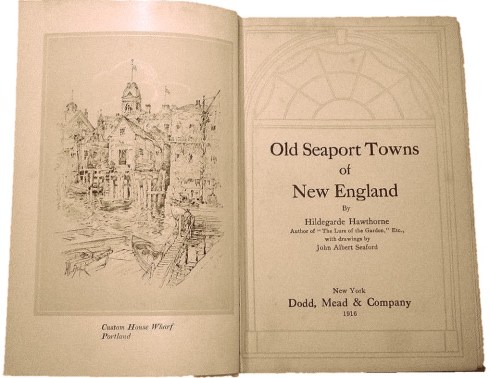
Hildegarde Hawthorne Hits Salem

Nathaniel Hawthorne’s granddaughter Hildegarde (1871-1952), a prolific author of ghost stories, garden books, biographies and travel narratives as well as an ardent feminist and suffragist, returned to her ancestral city the year after its great fire (which she mistakenly dates to 1913 rather than 1914) so that she might gather material for her forthcoming book, Old Seaport Towns of New England. With “Sister” in tow, she disembarks into a bustling city which she clearly does not find as charming as Newburyport to the north or Newport to the south. The “insistent present” is bothersome in Salem, and she feels much closer to the spirit of her illustrious grandfather when she looks at the “tenements” of Union Street than the new House of the Seven Gables, “which used to belong to some relatives of ours”. She does, of course, love Chestnut Street.

hh-old-seaport-towns-of-ne

hh-chestnut-street

hh-old-seaport-towns-beverly-bridge-salem-side

Chestnut Street and the Beverly Bridge, Salem Side, by John Albert Seaford, from Old Seaport Towns of New England (1916)

And there’s lots more to see obviously, BUT (it seems like there is a but hanging over every sentence) new Salem or invented Salem seems to be intruding on old Salem too much:  You can easily spend a couple of days looking up the houses where famous men were born in this solid old city (for a feminist, she doesn’t seem to care about the house of famous Salem women). They seem to have had had an extraordinary hankering for the place. Not but what Salem must have been a particularly beautiful place in the days when these notable births were most common. It is now, in many spots, though it has lost much of its looks with advancing age.  For, oddly enough,as it becomes older it becomes younger, and the youth is not an improvement. After two days in town, Hildegarde left Salem at sunset, over the Beverly Bridge, vaguely disturbed by the conflicting impressions of her noisy, commercial present, that will not let you be, and the obstinate power of her past, equally insistent. It seems to me as if these last lines could have been written in 2016 as easily as 1916.

hh-collage

hh-1916

Two of Hildegarde’s other titles; Hildegarde, second from left, at the New York Womens’ Suffrage Parade, 1913, ©Paul Thompson, Getty Images.


Clarissa Lawrence of Salem

The intertwined histories of Salem’s African-American community and Abolitionist movement in the mid-nineteenth century are often referenced and represented by the work of two strong women, Charlotte Forten Grimké (1837-1914) and Sarah Parker Remond (1824-1894), both born into families that were free, prosperous, and ardent advocates of abolition. Charlotte was a Philadelphia girl who came north to receive an integrated education in Salem: she graduated from the Higginson and Salem Normal Schools and became the first African-American to be hired to teach white students in a Salem public school when she accepted an appointment at the Epes School on Aborn Street. While in Salem she lived with the Remonds and became an active member of the Salem Female Anti-Slavery Society, and thereafter her continued advocacy for abolition was expressed primarily through her writing and her teaching, especially during her experience as a teacher of formerly enslaved children on the Union-occupied Sea Islands of South Carolina during the Civil War. Sarah Remond was a Salem native who followed in her parents’ and brother Charles’ footsteps in her dedication to the cause of abolition: she gave her first public speech for the cause when she was a teenager and was appointed a traveling lecturer for the American Anti-Slavery Society when she was twenty. In late 1858 she sailed for Britain to expose the horrors of slavery to a country which had close economic ties to the South, and delivered 45 lectures in the next few years, all of which attracted considerable crowds and press coverage–both abroad in the United States. Sarah never returned to Salem: after her citizenship status was questioned by the United States government upon her departure for Paris, she decided, in effect, to renounce it: she remained in Britain for several years, lecturing and taking classes at the Bedford College for Women, and then left for Italy after the Civil War.There she remained for the rest of her life, completing her medical degree, marrying, and entertaining family and friends from home.

There’s a lot more to say, and a lot more has been said, about both Charlette Forten Grimké and Sarah Parker Remond, but I’m interested in another African-American woman from Salem today: older, much lesser-known, but also an educator and an abolitionist: Clarissa Lawrence, also known as Chloe Minns, or “Mrs. Minns”. Her origins are obscure: we hear of her only in the Reverend William Bentley’s chatty diary when she is hired to run Salem’s first black public school in 1807. A “mulattoe” woman who could read but not write at the time of her appointment, Bentley is increasingly impressed with her as time goes by: every time he visits the “African School” on “Roast Meat Hill” he notes its “good order”. After he and Salem’s treasurer conducted a tour of all of Salem’s public schools in 1809 he observed that “In south Salem we found 40 children not provided with the best instruction. The African School by Mrs. Minns, 30 blacks, was better kept & several blacks repeated their hymns with great ease and propriety.” After the Reverend officiated at Mrs. Minns’ marriage to Schuyler Lawrence (her third, his second) in 1817 he commented that she “has acquitted herself with great honour, as to her manners & as to her instructions” and opined that the Lawrences were “the first grade of Africans in all our New England towns”. They settled on High Street, 8 High Street to be precise, where his seemingly-successful chimney-sweeping business was also located. She continued to teach (until 1823) and also held leadership positions in both the Salem Female Anti-Slavery Society and the Colored Female Religious and Moral Society of Salem. She cast off “Chloe Minns” (a name given to her in slavery?) and became Clarissa Lawrence, or Mrs. Lawrence. Like Charlotte Forten, she combined the causes of free education for blacks and abolition into an engaging appeal, and (two years after Forten was born in Philadelphia) traveled to that city to address the third national convention of the Women’s Anti-Slavery Society, asking her mostly white audience to “place yourselves, dear friends, in our stead”, and observing that “We meet the monster prejudice everywhere….We cannot elevate ourselves….We want light; we ask it, and it is denied us, Why are we thus treated? Prejudice is the cause.”

And that’s all I know about Clarissa Lawrence, which is just not enough. Compared to the well-charted lives of Forten and Remond, hers is relatively marker-less, especially her early life. The divergent circumstances of birth, wealth, and family created different paths for these three women, but the existence of slavery led them to a common place. I am writing about Clarissa today because I unexpectedly came upon a fruit of her labors yesterday, a beautiful sampler produced by one of her students in the collection of Colonial Williamsburg. Sarrah Ann Pollard’s sampler, produced at the “Clarrisa Lawrence School” in 1818, bears the inscription: virtue the [the] chief beauty of the ornament mind the nob/lest virtue of the female kind beauty without virtu[e] is [no value]. And now I’m wondering if I’ve even spelled “Clarissa” Lawrence’s name correctly, the way she would have wanted it.

Clarissa Lawrence School Sampler CWC

Clarrisa Lawrence School Sampler detail CWC

High StreetFramed Sampler by Sarrah [Sarah] Ann Pollard, 1818, Salem, Massachusetts. Collections of Colonial Williamsburg. 8 High Street, Salem: the former home of Mr. and Mrs. Schuyler Lawrence.


The Little Locksmith

Several years ago, one of my favorite readers, and bloggers, told me about a book written by a Salem author called The Little Locksmith, but for some reason I didn’t pick up a copy until just this past week–and I spent the cold and windy weekend reading it. This was quite an experience, as this is a memoir that puts our indulgent modern memoirs to shame in its ability to present an engulfing narrative of suffering (or perhaps I should say not suffering) and survival. The Little Locksmith was published in 1943, several months after the death of its author, Katharine Butler Hathaway, who was diagnosed with spinal tuberculosis right here in Salem in 1895, when she was five years old. For the next ten years, she was confined to her bedroom and strapped to a board “like a specimen butterfly” in the hope that her spine would grow straight. She emerged not only hunchbacked, like the little locksmith that used to come to her Salem home (on Lafayette Street, sadly swept away by the Great Salem Fire of 1914), but also severely stunted, a very wise young woman in a child’s body. One would imagine that she would look back on this childhood with horror, regret, and even anger, but she does not, instead we read of “joyous” days:  Though my back was imprisoned, my hands and arms and mind were free. I held my pencil and pad of paper up in the air above my face, and I wrote microscopic letters and poems, and made little books of stories, and very tiny pictures, I sewed the smallest doll clothes anybody had every seen, with the narrowest of hems and most delicious little ruffles. I painted with watercolors and made paper dolls and dollhouse furniture out of paper. Paper was the nearest thing to nothing in the way of material, and yet it was possible to make it into something that people would exclaim over and fall in love with. It was something precious made of nothing.” 


Little Locksmith Katharine Butler Hathaway

Little Locksmith cover

Little Locksmith House Pen

Katharine Butler Hathaway (1900-42): from the Schlesinger Library at Radcliffe, where her papers are located; a first edition of The Little Locksmith (1943); the Mark Hatch House in Castine, where she lived from 1921-1931, Penobscot Marine Museum.

This ability to discern, appreciate, and make things that are precious stayed with her for the rest of her life. After she emerged from her Salem bedroom at aged 15, her “horizontal life” leaving her misshapen yet somehow also enchanted, she was off to Radcliffe, New York City, Paris, and Castine, Maine, where she found a neglected old house which she crafted into a precious touchstone. The Little Locksmith is really about this house and what it means to her more than anything else, which makes it even more fascinating for materialistic me. Her ability to describe places and what they mean to her is captivating: the chapter where she describes her family’s return to a sultry September Salem from their summer residence in Vermont is probably my favorite, as the sounds of crickets and steps on the brick sidewalks of Salem are the sounds that I always notice when I return home from up north. Upon her marriage to Daniel Hathaway of Marblehead, she is forced to sell her beloved Castine house, but they move on to settle in an old brick house in Blue Hill, Maine, which becomes yet another charmed setting for her, unfortunately her last.


A Daring Woman

I’ve been working on a longer project on Lady Deborah Moody (1586-1659?), another one of the transatlantic travelers of the seventeenth century who fascinate me perpetually. She was in Salem for only a few years but made her mark, characterized as a “dangerous woman” by John Endecott but looking decidedly more daring to me. Lady Deborah was born Deborah Dunch in 1586, to Walter Dunch of Avebury, Wiltshire (1552-1594) and Deborah Pilkington (1564-1594+), the daughter of James Pilkington, the Bishop of Durham and perhaps the most Puritan-leaning member of the Elizabethan episcopal hierarchy (who was himself exiled during the Marian regime). In 1606 Deborah married Henry Moody of Garsdon Manor, Wilthire, with whom she had two children and acquired her “Lady” status after her husband was granted a knighthood and a Baronet title by King James I. She remained in London for a decade after his death in 1629, and then left for the New World: acquiring a small house near that of Reverend Hugh Peters in Salem and then working farms in nearby Lynn and Swampscott. But her time in the Massachusetts Bay Colony was to be short-lived because of her avowed religious beliefs, particularly her public disavowal of infant baptism. Anabaptists were definitely not welcome in Puritan New England, and Lady Moody was fined, excommunicated from the First Church of Salem and eventually evicted from the colony altogether. Dutch New Netherland, famously tolerant in matters of religion, beckoned, and in 1645 she became the first female founder of a settlement in the Americas, receiving over 7000 acres encompassing present-day Gravesend in Brooklyn and Coney Island.

I haven’t been able to find an image of Lady Deborah, but here are several associated with her life:  I’m all about visual context! The first is one of the marble memorials to her parents, Walter and Deborah, in Little Wittenham Church near Dorchester (courtesy The Early Modern Whale); the second has nothing at all to do with her, but is a stunning (probably memorial as well) double portrait of near contemporaries, one of whom was possibly named Dunch (e): Anonymous English Artist, A Child and his Nurse (possible John Dunch), c. 1589, Private Collection (part of last year’s exhibition at the National Portrait Gallery, Elizabeth I and her People); Anti-Anabaptist (and-Presbyterian) Broadside back in old England, 1647; J & J Graphics notecard of the Lilac Garden in Swampscott, the present-day location of Lady Deborah’s “Swampscott” Farm, 1640-42; The Moody Coat of Arms, utilized by Lady Deborah’s son Henry, an American Baronet; Still-standing Gravesend house at 27 Gravesend Neck Road long-associated with Lady Moody, although it doesn’t appear that she ever lived there (courtesy Ephemeral New York and Brooklyn Historical Society; you can read more about the house here).

Dunche Memorial Little Wittenham

achildandhisnurse

Anti Anabaptist Propaganda 1647

Lilac Garden Swampscott J and J Graphics

Moody Coat of Arms Collage

ladymoodyhouse Gravesend

lady-moodys-house-BHS


Mary Harrod Northend

I’m not bound to such designations, but as we’re almost running out of Women’s History Month and our mayor has declared March 29 Salem Women’s History Day I’ve decided to feature a notable Salem woman on this last weekend in March. After much deliberation–as there are many notable women in Salem’s history–I’ve settled on the author and entrepreneur Mary Harrod Northend (1850-1926). She has interested me for some time, and she’s popped up in several posts in the past, but she deserves her own. Northend was from old, old Massachusetts families on both sides, and this heritage is key to her life and work. Both parents were actually from northern Essex County, but moved south after their marriage: her father, William Dummer Northend, became a prominent attorney and a state senator for Salem. Mary was born at 17 Beckford Street, a side-to-street late Federal house, but the family moved over to Lynde Street, in the shadow of the Federal Street courthouses, in the later 1850s. Their grand Italianate double house, photographed for Mary’s books later, is now sadly chopped into 12 apartments by my count. The few biographical details I could gather refer to a childhood sickness; in fact by all accounts (or by no accounts) Mary led a quiet life in her childhood and adulthood, until she burst out in her 50s and started writing all about colonial Salem and colonial New England, necessitating regional travel, which she clearly embraced. Eleven books were published between 1904 and 1926, when she died in Salem from complications sustained from a car accident, and many, many articles for magazines such as Good Housekeeping, The Century and The House Beautiful: I haven’t had time to compile a proper bibliography. But she was an incredibly prolific woman: an acknowledged expert on New England architecture and antiquities, with a touch of Martha Stewart-esque domestic stature as well, forged by her publications on decorating and party-planning. Let us, she writes in a very Martha tone in The Art of Home Decoration: link the old and the new, working out entrancing combinations that are ideal, making our home joyous and bright through the right utilizing of great grandmother’s hoard.

Northend Birthplace Beckford Street Salem

Northend 1862 Portrait

Mary Harrod Northend’s birthplace at 17 Beckford Street, Salem; her father William Dummer Northend, newly-elected State Senator from Salem, 1862, State Library of Massachusetts.

Her books and articles reveal Mary to be a fierce advocate for “Old-time” New England; she is at the forefront of that (second?) generation of strident Colonial Revivalists, fearful that the (changing) world around them hasn’t developed proper appreciation for colonial architecture and material culture. She is evangelical in her love of clapboards, mantles, arches, doorways, garden ornaments, pewter and seamless glass. The phrase “detail-oriented” doesn’t even come close to capturing Mary’s appreciation of the things that were built and made in the colonial past: these things are her life and her world. And like any good educator–which she was–Mary wanted her (growing) audience to see her world and so she spared no expense when it came to photography, first taking her own photographs and then “directing” commercial photographers in the manner of a cinematographer, according to Mary N. Woods’ Beyond the Architect’s Eye: Photographs and the American Built Environment (2011). The end result was a vast collection of still images (there are 6000 glass plate negatives in the collection of Historic New England alone, though the entry in the biographical dictionary Who’s Who in New England for 1915 indicates that Mary has “20,000 negatives and prints of American homes”) which she used to illustrate her own books, sold to other architectural writers, and colorized in the style of  Wallace Nutting to sell directly to the public.

Northend Historic Homes 1914

Northend Doorways 1926

Northend Cook Oliver

Northend Framed Photo Cook Oliver

Two of Northend’s most popular titles, Historic Homes of New England (1914) and Historic Doorways of Old Salem (1926); the Cook-Oliver House on Federal Street in Salem, featured in Historic Homes and sold as an individual colorized print, “The Half Open Door”.

It’s relatively easy to research the work of Mary Harrod Northend: her books are still readily available in both print and digital form and prints from her photographic collection are at Historic New England and the Winterthur Library. But I wish I knew more about her business, the business of publishing books and photographs, writing, lecturing, collecting. I’m also curious about money: there’s definitely a bit of voyeurism in Northend’s books and I can’t discern why she remained in the family home on busy Lynde Street rather than move to the McIntire District just a few blocks away. In one of her most personal, yet still fictionalized, books, Memories of Old Salem: Drawn from the Letters of a Great-Grandmother (1917), the great-grandmother in the title lives on Chestnut Street, but Mary never did. This might have been a family matter: her widowed mother and sister lived right next door in the Italianate double house, which was also an appropriate “stage” for some of her photographs. I also think it was quite likely that Miss Northend was seldom at her own home, as she was so busy documenting those of others!

A very random sampling of Mary Harrod Northend photographs, mostly from Historic Homes and Colonial Homes and their Furnishing (1912), all from the Winterthur Digital Collections:

northend-gables-door1

Northend 10 Chestnut Door

Northend Robinson House Summer Street

Three very different Salem houses:  doorway at the House of the Seven Gables, entrance of 10 Chestnut, side view of the Robinson House on Summer Street.

Northend Pewter Mantle

Northend Waters House Mantle

Northend Mantles

Salem mantles: a pewter display, McIntire mantle at the Waters House (LOVE this louvred fire screen), Whipple and Pickman mantles.

Northend 29 Washington Square Hallway

Northend Ropes Windowseat

Northend Saltonstall House Haverhill Hall

Northend Kittredge House Yarmouth Remodeled Farmhouses Cape

Northend Bright House Beds

Details & decor I love:  hallway of 29 Washington Square, Salem, Ropes Mansion windowseat, entry hall at Saltonstall House, Haverhill, Attic and twin canopy beds on the Cape (from Remodeled Farmhouses, 1915–but all of Miss Northend’s books feature canopied beds! I would place them headboard to headboard.)

Northend Kate Sanborn House Spinning Wheel

Northend House Winterthur

Flagrant displays of Colonial Revivalism: Spinning wheel and fire buckets at the Kate Sanborn House, and Miss Northend’s own house on Lynde Street, all dressed up for Spring.


The Woman Who Lived in My House

I knew that a woman named “Mrs. Rose” lived in my house in the middle of the nineteenth century, but nothing more about her: when I saw the name on the 1851 map that I featured on my last post my curiosity was piqued. So I took advantage of a free snow day yesterday and searched for some biographical details, which were not too difficult to find. I have a general disdain for genealogical work, but Mrs. Rose was so well-connected that at least an outline of her life came together pretty easily.

She was Harriet Paine Rose, born in 1779 to parents from two prominent Massachusetts families: the Paines of Worcester and the Ornes of Salem. Imagine being of her generation: she was born in the midst of the Revolutionary War and died on the eve of the Civil War, in 1860, right here in Salem (though not right here in my house, but that of her daughter’s, down Chestnut Street at #14).  Her father, William Paine, had come to Salem from Worcester to study medicine with the renown physician Dr. Edward Holyoke and presumably met Lois Orne, the youngest daughter of wealthy Salem merchant Timothy Orne, at some social occasion. There are two charming portraits of Harriet’s mother and aunt by Joseph Badger in the Worcester Museum of Art, and I can’t resist showing them here.

House Harriet's Mother

House Rebecca Orne Worcester Art

Lois Orne (Harriet’s mother), at 21 months and Rebecca Orne (Harriet’s aunt) at age nine by Joseph Badger, 1757, Collection of the Worcester Museum of Art.

Lois and William were married in Salem in 1773, with Miss Orne’s dowry receiving considerable attention: an extravagant silver tea service made by Paul Revere, his largest private commission. This was a service that “attested alike to the solidarity of her fortune and lustre of her descent”. Quite ironic, as a year after their wedding the Paines decamped to Britain, as William was a Loyalist!  There he completed his medical education and was successively appointed an apothecary and surgeon to the British army. The family was stationed first at Newport, Rhode Island (where Harriet was born in 1779) and later at Halifax, Nova Scotia, where they remained, as exiles, after the Revolutionary War.

Paine Silver

Paul Revere’s “Paine Service”, Collection of the Worcester Museum of Art.

Family drew them back, apparently, first to Salem in 1787 and then to Worcester, where they took up residence at “The Oaks”, the Paine family estate, now (again, rather ironically) owned by the Daughters of the American Revolution. I don’t know how the Paines were received at that time, but Dr. Paine eventually became a naturalized citizen in 1812. So Harriet spent her adolescence and teenage years in Worcester, but that’s about all I know: I’m not sure if or where she went to school, or when or how she met her eventual husband, Joseph Warner Rose, whom she married in 1802.

cousins-timothy-orne-house-266-essex

Timothy_Paine_house-Worcester

The Ancestral Homes of Harriet’s Grandparents:  The Timothy Orne House in Salem, Frank Cousins photograph, c. 1890 (the house is still standing on Essex Street, though much changed), and the Timothy Paine House in Worcester (“The Oaks”).

I really do wonder how Harriet met her husband because he was quite exotic:  Joseph Warner Rose was an Englishman who, at that point, had never been to England:  he was the son and heir of the owner of a large sugar plantation owner in Antigua, where he had been born. The Rose plantation, called “The Valley”, was located six miles outside of St. Johns, in an area which is still called “The Roses Estates”. By 1803 the newlyweds were on the island, and Harriet was in an altogether different world than her native New England:  a world of sun and heat and bright colors and slavery. I have no idea how she felt about this; I don’t think I could find out, unless there is some diary somewhere. What I do know about her life on Antigua over the next 15 years or so is revealed by parish records of births and deaths: Harriet bore nine children, seven of which died in infancy. Perhaps because of these successive tragedies and their impact on his wife, Mr. Rose brought Harriet back to Massachusetts with their two surviving daughters and remained there himself for a while. There are references to health problems (blindness?) on his part, which drove him to London for treatment, and then back to the island, to settle his affairs. While there, he died unexpectedly, and Harriet was left a widow in her early forties. She never returned to Antigua, and I have no idea what happened to the Rose Plantation or its inhabitants other than the fact that slavery was abolished throughout the British Caribbean in 1834.

Antigua 1623

William Clark, “Digging or Rather Hoeing the Cane Holes in Antigua”, from Ten Views in the Island of Antigua, aquatint (London, 1823).

The very same year that her husband died, Harriet’s eldest daughter, also named Harriet, married John Clarke Lee of Salem, an aspiring businessman from the same interconnected social circle in which all of her cousins seemed to dwell. This union would produce ten surviving children and the Lees would build the grand Greek Revival at 14 Chestnut Street which would later become the home of the renown Salem artist Frank Benson. The senior Harriet, my Mrs. Rose, remained in Worcester until the death of her father in the 1830s (Lois had died a decade before) and then moved to the city of her maternal ancestors, and my house. The 1850 census lists her in residence, aged 70, with one Jane McCracken, 29, from Ireland, whom I assume was a servant: 10 years later she died at the Lee house just down the street.

In the last few years of the nineteenth century, several of Harriet’s direct and more distant descendants wrote genealogical histories which reference her, and even attempt brief characterizations. Her niece’s account, A Sketch of the Children of Dr. William Paine, 1774-1869, emphasizes her virtue (in her pew at St. Peter’s she prayed every Sunday for the President and all others in authority) as well as her great beauty, an attribute that is also noted in the slightly-more detached Pickering Genealogy by Harrison Ellery. Ellery also notes that Mrs. Rose was “the last person in Salem to wear a turban” and includes a heliotype image of a portrait miniature (below) in the possession of her grandson which is, he assures us, a very unsatisfactory likeness, and is said to give one no idea of her beauty.

Harriet Paine Rose