
I’ve been searching high and low for Salem suffragists, and I have found some, but it’s been a difficult search as there are no extant papers of the “Woman Suffrage Club” of Salem that I can find: newspaper articles, a few flyers, references in diaries and other texts, that’s about it. There are records of many other women’s organizations—charitable groups, religious groups, fellowship groups—which met over different decades of the nineteenth and early twentieth centuries, and among them are the minutes and correspondence of the Salem Female Anti-Slavery Society (SFASS), one of the country’s earliest female abolition societies. Looking at all these records, I see familiar names turning up again and again, and as I suspect there were concentric circles of female activism in nineteenth-century Salem, most especially among those women advocating for abolition and suffrage, I am especially grateful that the SFASS archives have been digitized through a partnership of the Congregational and Phillips Libraries. I had a student who worked with these records a year ago for her capstone research and she deemed them “boring”, but I find them fascinating in terms of both content and tone: expressions of a sisterhood of mutual aid and activism pervade even the most administrative of notations.


Records of the Salem Female Anti-Slavery Society, 1834-66, Phillips Library MSS 34: available at the Congregational Library. Meeting minutes & Correspondence from William Lloyd Garrison.
Before I get into the activities of the Salem Female Anti-Slavery Society, I need to write about Clarissa Lawrence, again. An African-American schoolteacher who lived on High Street in a house that still stands, Lawrence was committed to what was obviously for her an intertwined mission of aid and abolition: she established the first female Anti-Slavery Society in 1832, the Female Anti-Slavery Society of Salem, which consisted solely of free women of color. This organization was folded into the integrated Salem Female Anti-Slavery Society in 1834, but in the interim year, Lawrence also revived and reformed the dormant Colored Female Religious and Moral Society of Salem. This woman was tireless, and relentless, and on fire. She served in the leadership of the SFASS, and was a delegate to the third Anti-Slavery Convention of American Women in Philadelphia in May of 1839. On the last day of the convention, Lawrence rose to make a memorable speech, recorded in its proceedings and frequently referenced and reprinted. Yet despite her renown among her peers and historians, she is largely forgotten in the Witch City.

I hope that Mrs. Lawrence felt supported in all of her efforts by her sisters in the newly-formed Salem Female Anti-Slavery Society, all 130 of them, including officers, managers and members. I assume that her election as Vice-President means that she was. The women were very serious about their organization, their meetings, and their minutes. Their first task was to draw up and ratify a constitution, after which they held regular meetings at Mechanic Hall, Creamer Hall, the Masonic Hall, and the Howard Street Church: sub-committee meetings were held at members’ homes. There is one reference to the expenditure of ten dollars for the “privilege of holding our meetings for the enduring year (1837) in the Anti-Slavery Room–occupied by the anti-slavery gentlemen of this city as a reading and debating room”: I have no idea where this might have been, but it conjures up an image of gentlemen reading and debating while the women are doing. Every meeting started with prayers, and decorum was always observed: one young lady who shall remain nameless was asked to resign for her use of “profane” language and she complied. Most of the work of the Society consisted of fundraising in order to support several missions: the purchase of memberships in the Massachusetts Anti-Slavery Society for those that could not afford them, sending representatives such as Clarissa Lawrence to conventions, supporting “refugees from slavery”, and underwriting William Lloyd Garrison and The Liberator. There were occasional requests for support of vulnerable members of Salem’s free black population—which were answered—but you can tell that the ladies’ primary focus was on those who had escaped from the South. Fundraising primarily took the form of holding fairs, in which the other female anti-slavery societies in the area—in Boston, Marblehead, and Danvers—would contribute, with reciprocation from Salem: the bonds of sisterhood definitely crossed municipal boundaries as well as state lines.
 Salem Register, 1841
Recording Secretary Eliza J. Kenny (sometimes spelled Kenney) was a fascinating woman in several ways, and she will get her own Salem Suffrage Saturday post in the near future: her influence, as well as long-serving President Lucy G. Ives, seems to be behind the lecture series sponsored by the SFASS from 1844-1860, which brought many famous abolitionist advocates to Salem: William Lloyd Garrison seems always ready to speak in Salem, but Wendell Phillips, O.B. Frothingham, William H. Channing and others also came to speak at the Lyceum. The lecture that received the most attention in the press by far was that of “fugitive slave” William Wells Brown, who came to Salem on his first tour as an agent of the Massachusetts Anti-Slavery Society, at the beginning of a brilliant career. When asked if he could “represent the real condition of the Slave” Brown replied that he could not: your fastidiousness would not allow me to do it; and if it would, I, for one, should not be willing to do it;—–at least to an audience. Were I to tell you the evils of Slavery, to represent to you the Slave in his lowest degradation, I should wish to take you, one at a time, and whisper it to you. Slavery has never been represented; Slavery never can be represented. What is a Slave? A Slave is one that is in the power of the owner. He is chattel; he is a thing; he is a piece of property. A master can dispose of him, can dispose of his labor, can dispose of his wife, can dispose of his offspring, can dispose of everything that belongs to the Slave, and the Slave shall have no right to speak; he shall have nothing to say. The Slave cannot speak for himself, he cannot speak for his wife, or his children. He is a thing. Brown’s words were by all accounts riveting, so much so that his Salem talk was issued in print, with the Salem Female Anti-Slavery Society right there in the title, on the cover, a great example of the Society’s increasing focus on communication in its second and third decades.


 Salem Observer, 1847-48; Henry M. Parkhurst’s “phonographic report” of Mr. Brown’s Lyceum Speech.
Eliza Kenny led me to the intersection of abolitionism and suffrage: she was the first Salem woman to sponsor a petition, “that the right of suffrage may be extended to women” to the Massachusetts legislature in 1850, right after she attended the first National Women’s Rights Convention in Worcester. I saw lots of familiar names among the 25 women who signed the petition: her anti-slavery sisters. Eliza went down a spiritualist route that made her a less effective (and committed) advocate for either abolition or suffrage later, but her decades of activism are commendable, as are those of the Salem Female Anti-Slavery, which disbanded in 1866, their objective realized at long last. But there were still battles to be waged.

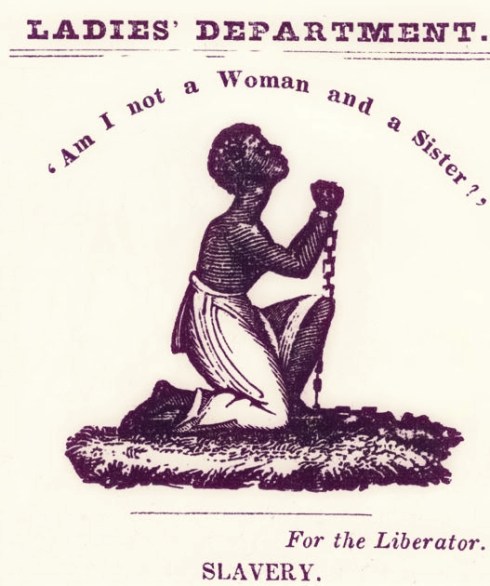
Kenny petition for the Harvard Anti-Slavery Petitions of Massachusetts Dataverse; The Female version of Am I Not A………., first used in George Bourne’s Slavery Illustrated in Its Effects upon Women (1837).


 A Half Century in Salem, and two photographs of Marianne Cabot Devereux Silsbee from her 1861 photographic album at the Phillips Library in Rowley (PHA 58): the first dated 1851 and the second 1861.


 The Silsbee Mansion on Salem Common in 1884, George H. Walker; Memory and Hope (1851); Title page of My Grandmother’s Mirror (Essex County Collection, Phillips Library,


![Hathorne Salem_Gazette_1799-03-12_[1]](https://i0.wp.com/streetsofsalem.com/wp-content/uploads/2020/01/hathorne-salem_gazette_1799-03-12_1.jpg?resize=490%2C410&ssl=1)


 2020 Suffragists in the Rose Bowl Parade, Getty Images.

 Helen Hagar in 1915, courtesy the Local History Resource Center at the Peabody Institute Library. After her graduation from Peabody High School that year, Miss Hagar moved to Salem and lived there until her death in 1984, working for the Society of the Preservation of New England Antiquities and then the National Park Service to live in and conduct tours of the Derby House. She became an expert on traditional stenciling, and lectured and taught on its history, as well as producing some of her own stenciling work on tole and wooden objects and partnering with various antique dealers like Ethelwyn Shepard (flyer courtesy Historic New England). A cross stitch pattern by the Jenny Brooks Company, located at One Cambridge Street, Hagley Museum & Library.

 Goldthwaite & Shapley, Dressmakers, 269 Essex Street, Salem. Andrew Dickson White Architectural Collection, Cornell University Library.
 Needlework Sampler by Naby Dane (b. 1777), Sarah Fiske Stivours School, Salem, Massachusetts, Dated 1789, Sotheby’s; 6 Forest Avenue, Salem.
 Waters-Sigourney Dress and Southworth Hawes Daguerreotype, Museum of Fine Arts, Boston.


 Ace of Spades card (verso and recto) from a c. 1915 deck published by the National Woman Suffrage Publishing Co., Boston Athenaeum.
 The Mayflower II seemed to be more of a national story in 1957; on the stop in

 The official British program and interactive maps on the Mayflower400 website, which also includes artwork that has been seldom seen (over here, at least), like Anthony Thompson’s 1938 painting The ‘Mayflower’ Leaving Plymouth, 1620 @Essex County Council.

 Indian Muslin and silver wedding reception dress of Sarah Ellen Derby Rogers, 1827, Peabody Essex Museum (Gift of Miss Jeannie Dupee, 1979).


 A Treasure Trove of Silver in an old Salem house, from Walter Dyer’s Lure of the Antique (1910).
 Amazing photo of a lady (perhaps Mary Harrod Northend?) at the original location of the Hooper-Hathaway House (now on the House of the Seven Gables campus) inspecting some Old Salem wares in Dyer’s Lure of the Antique. The caption reads: “Don’t expect to buy these old treasures for a song. You are lucky to get them at all.” Once the Ward House was relocated and opened, it became the workshop of Sarah Symonds, who “perpetuated antiques” in the form of plaster-cast doorstops and mementos of famous Salem structures (Boston Herald, January 17, 1918). I think the days of buying antiques from guileless Salem homeowners were gone even by 1910, and in the next few decades the number of shops advertising in periodicals exploded.

 Salem Antique advertisement from the 1922 volume of the magazine Antiques, and from the collections of Historic New England.


 Atkinson’s Advertising, and her shop on the left-hand side of the Witch House, in photographs from the New Bedford and Cambridge Historical Societies, via Digital Commonwealth; Some items from the “Atkinson Collection” in Dyer: she was particularly known for her selection of Lowestoft.


 Historical artist Peter Waddell’s
 Peter Waddell’s recreation of one of Dolley Madison’s “Wednesday Squeezes” with many turbans and feathers in evidence, White House Historical Association; the capture and burning of Washington in 1814, New York Historical Society. Mrs. Madison continued to be an active hostess in her temporary quarters, which Mrs. Crowninshield tells us all about, but she does not have much to say about the post-war state of Washington.


 The lovely Catherine Johnson Pierce, who we do get to
 A published sermon for the Salem Female Charitable Society, 1815; and records of the Salem Female Anti-Slavery Society as


 Two-year-old Parker Curry facing Michelle Obama’s portrait by Amy Sherald: a photograph taken by museum visitor Ben Hines which went viral last week,






