Category Archives: Women’s History

An Inventory of Salem Women Artists

Today’s #SalemSuffrageSaturday post is really more of a list than a composition, and a working list at that: I want to take a stab at identifying as many female Salem artists as I can, although I know it’s an impossible task. It’s impossible because there were so many, and I’m pretty certain I haven’t tracked them all down, but it’s also a difficult task because of the historical impact of gender. In the seventeenth, eighteenth, and nineteenth centuries, women were taught artistic and creative skills as part of their informal and formal education: some excelled and were clearly artists, even though they—or anyone else—did not identify themselves as such. I think this especially applies to women who worked in the textile arts but to other women as well. In the nineteenth century we see the emergence of (a few) women who can make their living through their artistic talent and skill; this is rarely possible before.

Artists Fidelia Bridges by Oliver Ingraham Lay 1872 SmithsonianFidelia Bridges (1834-1923) by Oliver Ingraham Lay, 1872, Smithsonian: Bridges is probably the first and most successful Salem woman artist, though she traveled widely and lived in Connecticut for most of her professional life.

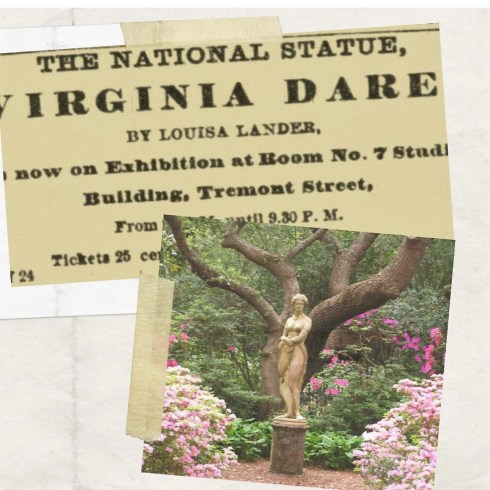
Daughters of old Salem families, Fidelia Bridges, who worked in several mediums and as both an artist and an illustrator, the Williams sisters, Abigail and Mary, who were both artists as well as art dealers, and sculptress Louise Lander, all found themselves in Rome in the mid-19th century for varying periods of time, drawing inspiration and establishing connections. The Misses Williams returned to the family home on Lafayette Street where they created a studio and loaned their works out to several prominent institutions, including the Essex Institute, which featured its very first art exhibition in 1875 featuring many Williams works. Louise Lander (1826-1923) also returned, reluctantly and eventually, to Salem and the family home at 5 Summer Street when she was shunned by the Anglo-American (and quite Salem-dominant) circle in Rome upon charges of some sort of scandalous behavior which she never deigned to answer. She exhibited her “national statue” of Virginia Dare, the first English child to be born in the New World, to raise money for war relief and moved to Washington, D.C. upon the death of her last Salem sister in 1893.

artist williams 4 (2)

Artists Williams Sisters Bulletin of Essex Institue 1875 (2)

Artist Virginia DareMary E. Williams, illustrations from The Hours of Raphael in Outline – Together with the Ceiling of the Hall Where They Were Originally Painted (Little, Brown, 1891); Just some of Mary and Abigail Williams’ works shown in the 1875 Essex Institute Exhibition; Virginia Dare in the Elizabethan Gardens & notice in the Boston Post, January 24, 1865.

To these nineteenth-century artists who seem to be awarded “professional” status I would add Mary Jane Derby (Peabody, 1807-1892) and Mary Mason Brooks (1860-1915) from the generation before and after the “Roman” circle. I’ve written about Derby many times before (see here and here) because I am the fortunate recipient of a journal she composed for her grandchildren, and Brooks more briefly here. Before her marriage, Mary Jane (a cousin of Louisa Lander) was definitely pursuing an artistic career, and she created several lithographs for the Boston firm Pendleton’s Lithography in the 1820s, including a view of her childhood home on Washington Street. Brooks, who worked exclusively in watercolors I believe, was one of the Salem artists who worked out of the famous “studio” at 2 Chestnut Street briefly, and her works were exhibited in Boston and New York. Among Mary Jane’s generation (almost) were two lesser-known artists, Sarah Lockhart Allen (1793-1877), who produced portraits in miniature and pastel, and Hannah Crowninshield( 1789-1834), both of whom were recognized as working artists by their contemporaries. Sophia Peabody Hawthorne (1809-71) is representative of the score of score of female artists who exhibited and sold their works at charitable fairs and bazaars in mid nineteenth-century Salem: always as “misses”.

brm2033-derby-nahant-ca-1827-749x1024 (2)

Artists Mary Mason Brooks

Artists reportsoffirstex01sale_0027 (2)

View of the Nahant House by “MJD” (Mary Jane Derby), Boston Rare Maps; Mary Mason Brooks, The Lumber Schooner, Grogan & Company Auctions. Just a few of the “Fine Arts” exhibitors from Reports of the First Exhibition of the Salem Charitable Mechanic Association : at the Mechanic Hall, in the city of Salem, September, 1849

And then there were all those Salem needlewomen! In her definitive work Girlhood Embroidery: American Samplers and Pictorial Needlework, 1650-1850 (1993), collector and scholar Betty Ring devotes an entire chapter to Salem, focusing on the influential school of Sarah Fiske Stivours (1742-1819) and showcasing the work of Antiss Crowninshield (1726-1768), Love Rawlins Pickman (Frye, 1732-1809), Susannah Saunders (Hopkins, 1754-1838), Betsey Gill (Brooks, 1770-1814), and Mary Richardson (Townsend, 1772-1824) among others. This was a very important Salem art form that was revived in the late nineteenth and early twentieth century by Jenny Brooks, Mary Saltonstall Parker (1856-1920) and other entrepreneurial artists.

Artists_Girlhood_Embroidery__2_-removebg-preview

artists Saunders Sotheby's (2)

Screenshot_20200618-064954_Chrome

Brooks Collage

mary-saltonstall-parker-house-beautiful-1916 (1)Betty Ring’s two-volume Girlhood Embroidery; Salem samplers by Susannah Saunders (Sothebys) and Elizabeth Crowinshield (Doyles); Jenny Brooks Co. advertisements from 1913, and Mary Saltonstall Parker’s cover embroidery for House Beautiful, October 1916.

So that brings me to the most entrepreneurial of Salem women artists, or maybe all Salem artists: Sarah Symonds, an artist-craftswoman descended from a long line of Salem craftsmen. I’ve written about Symonds (1870-1965) very recently, so I’m not going to go and on here, but she operated a very successful business selling her cast plaques of historic Salem symbols and structures in the first half of the twentieth century. Following her death in 1965 the Essex Institute, which operated as Salem’s historical society until its amalgamation into the Peabody Essex Museum in 1992, started collecting her works, as they “have enriched our local picture of the past”.

20200121_133721Sarah Symonds in her studio, Phillips MSS 0.202, Papers of Sarah Symonds, 1912-21.

How the past informs the present, and how the present acknowledges, interprets, and builds upon the past are central preoccupations of mine, and artistic perspectives on these processes can be just as illuminating as texts. I’d like to conclude this (again, working) list of women artists from Salem with a contemporary artist whose work is a great example of this illumination: book artist Julie Shaw Lutts. Julie’s a great friend of mine and I’ve featured her work before here, but she has just completed a very timely project which I love, so I wanted to showcase her talents again. The Vote is a mixed media artist’s book which commemorates the achievement of women’s suffrage in ways that are both personal and memorial, material and textual, and touching: all the best ways.

the-vote-9-julieshawlutts (2)

the-vote-8-julieshawlutts

JS Lutts 2©Julie Shaw Lutts, The Vote.


Women on a Pedestal

Obviously statues have been in the news of late, so I thought I would tap into the national (and international) focus by looking at some of our country’s more notable monuments to women, either striving for the franchise or striving in general, for this week’s #salemsuffragesaturday post. It doesn’t matter what your political inclination is, everyone seems to agree that there are not enough statues of women anywhere and everywhere, and corrective measures are being taken, along with initiatives associated with this Suffrage Centennial year. The husband and wife team who constitute Statues for Equality have established that statues of women represent less than 10% of public monuments in several American cities, and far less in most. In Salem we have only one statue to a woman: Samantha Stevens from Bewitched, situated in our city’s most historic square. She never accomplished anything (because she never actually existed) and her prominent situation and whimsical depiction mocks the real victims of the 1692 trials who were falsely branded “witches”, but nonetheless she is deemed worthy of monumental representation in Witch City. There are so many more women (real women) that deserve to be put a pedestal in Salem—that’s what this year has been all about for me.

pixlrSamantha is currently wearing an ensemble by local artist Jacob Belair, which I think is lovely on its own but also because it covers part of her up! I wish it extended to her unfortunate pedestal. I’m not in Salem now, so I asked my stepson ©Allen Seger to take the photos of Samantha in crochet.

Let’s turn to some more serious representations. Ever since it’s installation 15 years or so ago, the Boston Women’s Memorial has been one of my favorite monuments: not only is it aesthetically pleasing and immediately engaging, but it represents a spectrum of women who shaped Boston’s history (as well as that of Massachusetts and the nation): Abigail Adams, Phillis Wheatley, and Lucy Stone. These women are not just on pedestals (actually they have come off their pedestals) but depicted by sculptor Meredith Bergmann in the process of thought and activity, with their words accompanying them. Monumental women are in large part, active women, the feminine counterpart of all those masculine equestrian statues.

Screenshot_20200612-082211_Chrome

Screenshot_20200612-082224_Chrome

Screenshot_20200612-082234_ChromeThe Boston Women’s Memorial by Meredith Bergmann; photographs from her website.

Meredith Bergmann was also commissioned to create the most anticipated installation of this Suffrage Centennial Year: the Women’s Rights Pioneers Statue in Central Park in New York City, which will be unveiled on August 26, the date on which the ratification of the 19th Amendment was certified in 1920. This will be the park’s first statue honoring real women, and it also focuses on their activity: Sojourner Truth, Susan B. Anthony, and Elizabeth Cady Stanton are gathered around a table, intently focused on drafting a document. The statue had a controversial conception in that Truth was originally excluded, but public discussion and debate resulted in a more inclusive—and representative—monument.

Screenshot_20200612-082723_Chrome

Screenshot_20200612-082623_ChromeModel and Mock-up of the first and final monument to the Women’s Rights Pioneers by Sculptor Meredith Bergmann, to be unveiled in Central Park on August 26, 2020.

As the state which ultimately ratified the 19th Amendment in August of 1920, Tennessee takes its suffragist history very seriously and has produced two notable monuments to the women who worked so hard to make it happen (because it’s really not all about a wavering state senator is it?) There is the Tennessee Woman’s Suffrage Memorial (2006) in Knoxville, depicting Lizzie Crozier French, Anne Dallas Dudley, and Elizabeth Avery Meriwether, and the Tennessee Woman Suffrage Monument (2016) in Nashville’s Centennial Park, featuring Dudley along with Abby Crawford Milton, J. Frankie Pierce, Sue Shelton White and Carrie Chapman Catt. Even more recently, the Commonwealth of Virginia—always the site of so much statue furor—dramatically increased its commemorative depictions of accomplished women with its Virginia Women’s Monument: Voices from the Garden initiative, honoring the “full scope” of women’s achievements with twelve representative statues.

Screenshot_20200612-075354_Chrome

Screenshot_20200613-080549_Chrome

Screenshot_20200612-072439_Chrome

Screenshot_20200612-072336_ChromeThe Knoxville and Nashville Suffrage statues—both by Tennessee sculptor Alan LeQuire—and the unveiling of seven statues of prominent Virginia women last fall: former Virginia First Lady Susan Allen points to a statue of Elizabeth Keckley, dressmaker for Mary Todd Lincoln, and suffragist Adele Clark among the crowds (Bob Brown/ Richmond Times-Dispatch).

I like the fact that so many of these monuments are collective, featuring women engaged with each other. Sometimes they are working, sometimes they are simply “conversing”—or meeting for the first time like one of the most famous Suffragist monuments, the “When (Susan B.) Anthony met (Elizabeth Cady) Stanton” statue in Seneca Falls, New York, portraying the moment when these two icons were introduced by Amelia Jenks Bloomer in 1851. My very favorite “conversation piece” is the lovely statue of two prominent Rochester, New York suffragists, Anthony and Frederick Douglass, having a cup of tea: I would love to have been a fly on the wall (or the bench) for that conversation!

Screenshot_20200613-075828_Google

Screenshot_20200613-080112_ChromeThe Anthony-Stanton-Bloomer statue (1998) by Ted Aub in Seneca Falls; Ira Srole’s “Let’s Have Tea” (2009) in Rochester.

The most official Suffrage statue of all, Adelaide Johnson’s “Portrait” monument to Anthony, Stanton, and Lucretia Mott completed (and dedicated) in 1921, is also a collective representation but the women don’t seem particularly engaged with each other: it’s not my favorite statue but that doesn’t mean I think it should have been hidden away for most of the twentieth century! The “unfinished” appearance of the work also engulfs the women in their “pedestal” rather than placing them on it, but rumor has it that Johnson was making room for at least one more prominent woman—perhaps the first female president—to be carved out of that raw marble in the back at some point in time. Clearly not 2020.

Capitol StatueOffice of the Architect of the Capitol.


Feeding Suffrage

Sorry I’m a bit late today with my #SalemSuffrageSaturday post: I’ve migrated up to Maine for several weeks and the wifi situation is a bit challenging! But I think I have it together now. I’m going to move into some national suffrage history for a few weeks and then go back to the parochial, because the long-term suffrage movement was successful ultimately because it operated at several levels: the national and the local, the exterior and the interior. I have been continually impressed, as I studied this movement this year, at how adept the marketing was, with every concern taken into consideration: messaging, branding. graphics, audience. Lately I’ve been reading some wonderful suffrage cookbooks, which in many ways were the perfect venue for the Suffrage message: not too radical, traditional really, but also containing themes of practicality, self-sufficiency, and above all, femininity. The first Suffragist cookbook, the Woman Suffrage Cookery Books, was edited and published by Mrs. Hattie Burr of Boston in 1886 with exactly that message in its forward:  Alarmists of both sexes will shrink back abashed before this cook-book, for at least two recipes, which she has tested with success, will be given over the signature of each fair suffragist who contributes to its pages. It will be a confession book, a proof that, even if they wish to vote, the suffragists cherish a feminine interest in culinary matters.

Suffrage 1886 2 (2)

Suffrage-Cookbook-1890-2nd-ed-2

First and Second Editions of Mrs. Hattie Burr’s Woman Suffrage Cookbook, 1886 & 1890: you can read the text here.

Indeed there was nothing at all alarming about this cookbook: no radical recipes! In addition to recipes for everything from soup to nuts, there are sections on the care and feeding of invalids and helpful household hints, followed by “Eminent Opinions on Woman Suffrage” (starting with Plato!) only at the very end: an appendix. I think the relative banality of this book must have helped the cause considerably, and it certainly inspired regional editions as well as the first British Suffrage cookbook in 1912. I also think it inspired valuable support, in the form of advertising, from commercial food producers, such as Fleishmann’s Yeast (referenced in several of the recipes) and Kellogg’s Cereals. All in all, it seems like the cookbook was a very nourishing genre for the Suffrage movement.

Screenshot_20200605-093743_Chrome

Suffrage Pittsburg 1915

Suffrage British Cookbook 1912 (2)

Suffrage Ad Collage

suffrage all-stirred-up-9781643134529_lg

Suffrage cookbooks from Washington State (1908), western Pennsylvania (1915) and the UK (1912), from the Ann Lewis Women’s Suffrage Collection. Fleischmann’s Yeast and Kellogg’s advertisements from the 1890s and 1914. I bet that Laura Kumin’s All Stirred Up, which will be published in August, will have lots more details about the publication and impact of these cookbooks. 


If We Can’t Picture Them, Were They There?

We don’t have any portraits of Salem women before the eighteenth century: the (European) women of Salem’s (European) founding century are therefore difficult to picture. We are left with nineteenth- and early twentieth-century romanticized and idealized images of dramatic women: persecuted Quakers, the two Annes, Hutchinson and Bradstreet (who never lived in Salem), and above all, the women who were accused of witchcraft. The latter are always represented by illustrations from long after their deaths, or by images of English or continental witch trials, utilized even on the covers of scholarly books on the 1692 trials. Why am I always seeing the Pendle “witches” from 1612 depicted as the Salem “witches” from 80 years later and across the Atlantic?

Picturing Pendle Collage

Because “public-facing” history, presented in digital formats and disseminated through social media, needs pictures: texts just won’t do! And book covers need to draw the reader in. I’m as guilty as the next blogger of using the later nineteenth-century images (of which there are so many!) to illustrate some of my posts, although I never substitute depictions of one event for another. I’d love to have some contemporary illustrations of Salem women in the seventeenth century doing all the things I know they did: parent, cook, sew, garden, make all sorts of stuff, keep taverns, worship, wonder. But there aren’t any. I’d love to have a portrait of Lady Deborah Moody, who settled briefly in Salem before she moved on to New York and was labeled a “dangerous woman” by John Winthrop for her heretical Anabaptist views (and I think her independence), but there aren’t any—I’ve checked through all the English sources as well. I’d love to have an image of the adversaries Martha Rowlandson, who divorced her husband for impotence in 1651, and Eleanor Hollingsworth (mother of Mary English, who I’d also like to see), who operated her own tavern, brewed her own beer, and cleared her husband’s considerable debts. But nothing. There are several portraits of seventeenth-century Massachusetts women, so I guess they need to stand in for their Salem sisters: anything to avoid disseminating those simplistic “Puritan” images!

Women Pictured

Puritan WomanReal 17th Century Massachusetts Women and a “Puritan Woman, 17th Century” from Cassel’s Historical Scrap Book, c. 1880.

As an English historian, I have a wide range of texts and images available to me with which to explore seventeenth-century women: many portraits of wealthy ladies, prescriptive writing, prints and broadsides, recipe books and diaries, theatrical performances as social comment and criticism (with women as the focus quite a bit in the earlier seventeenth century). So English women seem more diverse, more interesting, more active, more layered, while their sisters across the Atlantic seem a bit…..one-dimensional in comparison. I guess that’s why the authors of books on the Salem Witch Trials pinch English images so often. Of course if we move away from the reliance on the visual we can learn a lot more, but I worry that the exclusive reliance on “picture history” in the public sphere erases those who do not leave an image behind.

Virtuous Women

I think I can illustrate my concern a bit better by examining some women from the nineteenth century, certainly a much more visual age, but not universally so. There’s been a lot of interest in Salem’s African-American history over the past few years, which is of course great. Two women in particular, have claimed the spotlight: Charlotte Forten Grimké (1837– 1914)  and Sarah Parker Remond (1824-1894). Both were incredible women: Charlotte came north from Philadelphia to live among the always-hospitable Remond family to attend Salem’s desegregated schools in the 1850s, and went on to graduate from Salem Normal School (now Salem State University, where I teach) and become Salem’s first African-American teacher in the public schools, while Sarah grew up in Salem in the midst of a very activist Abolitionist family and became a much- heralded advocate herself, before emigrating to first England and then Italy for her undergraduate and medical degrees. Charlotte remained in her teaching position for only a couple of years before returning to her native Philadelphia and then launching an amazing career of advocacy herself, in the forms of teaching, writing, and public speaking. Both women were illustrious, and completely deserving of the two Salem parks which now bear their name. But I can’t help thinking about another African-American woman, Clarissa Lawrence, who spent her entire life in Salem, running her own school for girls, founding the country’s first anti-slavery society for African-American women as well as a benevolent society, with only a brief trip to Philadelphia for a national Abolitionist convention in which she gave the riveting “We Meet the Monster Prejudice” speech. Where is Clarissa’s park or statue in Salem? Why is Charlotte, whose family is from Philadelphia, the feature of Destination Salem’s Ancestry Days, which seeks to serve as “a gathering point for descendants of Salem’s families as well as a research opportunity for people who want to learn more about their family history”? Her family history is not here! (well actually, none of Salem’s history is here). I suspect the answer to these questions is in good part based on the fact that we have no picture of Clarissa Lawrence, so it’s almost as if she didn’t exist.

Clarissa (2)

Clarissa 2

Ancestry-DaysCharlotte Forten between the two Salem Nathaniels, Hawthorne and Bowditch on the Ancestry Days poster. This sounds like a great genealogy event, but none of Charlotte’s family records are held by the participating institutions: why not feature Sarah Parker Remond, whose are? We even have several photographs of Sarah!


Seven Women of Salem: the Preservationists

I’ve been rather depressed about the state of historic preservation in Salem: after a strong commitment in response to full scale urban renewal in the 1960s and early 1970s we seem to be awash in a sea of vinyl siding and shed dormers. I’m not sure what happened exactly, although rising property values and the corresponding desire of developers to cram as many units as possible into old structures, thereby transforming their architectural profile beyond all recognition, likely has something to do with it. But history always brings perspective, and in recognition of both this Centennial anniversary of women’s suffrage, my own #SalemSuffrageSaturday series, and the Preservation Month of May, I am focusing on seven women who really made an impact on the recognition, and preservation, of Salem’s material heritage. These women faced far greater obstacles than I am seeing now, and they should be celebrated. This post is partly repetitive, as I’ve featured several of these women before, but there are some new heroines as well, at least new to me.

In chronological order:

Caroline Emmerton (1866-1942): the founder of the House of the Seven Gables Settlement Association, and a founding member of the Society for the Preservation of New England Antiquities (now Historic New England). Much has been written about Caroline Emmerton (especially as she was a rather mysterious woman), so I don’t have too much to add here, but she deserves recognition not only for reconstructing and creating the House of the Seven Gables and its campus, but also reorienting Salem’s—and the nation’s—appreciation of its first-period past. The House of the Seven Gables, and Emmerton’s vision of her native city, remains a strong counterweight to the commercial cacophony of Witch City. Emmerton seems like a rather “creative” preservationist to me, but certainly an influential one!

Emmerton Collage (2)Caroline O. Emmerton, The Chronicles of Three Old Houses, 1935

Louise du Pont Crowninshield (1877-1958): As a du Pont, Mrs. Crowninshield was not from Salem, nor did she ever live here (although she summered in Marblehead), but she has to be included on any list of preservationists for her key efforts towards the preservation and interpretation of several Salem sites, including the Derby House of the Salem Maritime National Historic Site and the Peabody Essex Museum’s Crowninshield-Bentley and Peirce-Nichols houses. She was also a board member of SPNEA, as well as of the Essex Institute and Peabody Museum in Salem, and a founding trustee of the National Trust for Historic Preservation. You can read more about Louise in this post, in which I appeal to a potential successor to to emerge in contemporary Salem!

louise-du-pont-crowninshield1Louise duPont Crowninshield (center) surrounded by the ladies of the Kenmore Association in Virginia, one of her first preservation projects, Hagley Museum & Library.
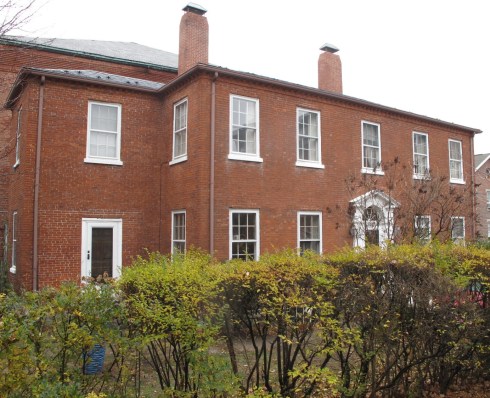
Bessie E. Munroe (?-1975): Mrs. Munroe waited out urban renewal in Salem in her lovely Federal home on Ash Street, with demolition ongoing all around her. She was a widow in her 80s when the Salem Development Authority began implementing its 1965 urban renewal plan, which called for the demolition of 145 out of 177 buildings downtown, including her house! She was compelled to sell to the SRA in 1970, but fortunately the agency agreed to her life tenancy because of her age and health. And then a new Salem Redevelopment Authority emerged, more intent on preservation than demolition: at the time of Bessie’s death in 1975, her house—the last historic residence standing, facing a parking lot—was saved and sold to a preservation architect. It is now on the National Register.

IMG_20200518_091858_799

SAL_2431 (2)Seeing red (demolition) in 1965; 7 Ash Street, the Bessie Munroe House, today.

Ada Louise Huxtable (1921-2013): Another woman who never lived in Salem (but long summered in nearby Marblehead like Louise duPont Crowninshield) yet had a tremendous effect on the city’s material heritage largely through her passionate indictments of the 1965 urban renewal plan (see above) published in the New York Times from 1965. Sometimes I think crediting her exclusively for the demise of this plan minimized all the efforts towards that aim by preservationists here in Salem, but still, there’s no denying her powerful impact, as she occupied a strong position of power as the architectural critic for the Times. Ms. Huxtable was not a strict preservationist, but she believed that it could be a useful tool against generic, thoughtless development with no historical or aesthetic merit: sterilized nonplaces. She kept watch on Salem through its new redevelopment and credited its mix of old and new in later articles and her 1986 anthology Goodbye History, Hello Hamburger. In praising Salem for “renewing it right” she also asserted that “Salem’s results promise to be a stunning rebuke to every community that has ever thought the only way to revitalization lay through….mutilation of what was often a unique identity for shoddy-slick, newly jerrybuilt anonymity.” Every day I wonder what Ms. Huxtable would think of Salem’s newest buildings.

Ada 1965 NYTAda Louise Huxtable’s condemnation of Salem’s 1965 Urban Renewal Plan in October of that year, the first of several pieces published in the New York Times.

Elizabeth K. Reardon Frothingham (1923-1983): A Salem native descended from several notable Salem families, “Libby” Reardon was a passionate afficionado and student of early American architecture who went on to become a professional preservationist, shepherding Historic Salem Inc. though its most turbulent era and writing several detailed inventories for the City of Salem. All of her records, unfortunately, were donated to the PEM’s Phillips Library and therefore moved from the city to which she was so dedicated: you can read more about that here. Given the pandemic, I haven’t been able to access her records or reports up there, but newspaper accounts testify both to her discovery (as a mere “housewife”) of two camouflaged Salem first-period houses, the Gedney and Samuel Pickman (pictured in the Huxtable article above, as well as below) Houses, as well as to her steadfast defense of Salem’s material heritage in the 1960s and 1970s. She was a real preservation heroine, gone too soon: I can only imagine what she might have achieved in the 1980s or 1990s—or now!

Reardon Collage1965! What a year that must have been—-Salem’s preservationists had to have been functioning 24/7.

And speaking of gone too soon, I wanted to take this opportunity to recognize two women who were clearly effective administrators of their respective institutions as well as contributors to the preservation of Salem’s material heritage: Anne Farnam (1940-91) of the Essex Institute and Cynthia Pollack (1932-1992) of the Salem Maritime National Historic Site. Ms. Farnam served as Curator at the Institute from 1975 to 1983 and as its President from 1984 until 1991, while Ms. Pollack served as Superintendent of SMNHS from 1983 to 1992. I have no idea what their personal relationship was like, but they were clearly colleagues not only in advancing the missions of their institutions but also the stature of Salem as a heritage destination. Both were active in the Salem Project, the forerunner of the Essex National Heritage Area, and both worked towards a more layered and contextual interpretation of Salem’s history. When you study their careers, you can see how interpretation and preservation are integrated and complementary: as the chief administrator of an institution charged with the stewardship of eight historic houses, Ms. Farnam was by necessity a preservationist, but she also initiated the 1977 exhibition on “Dr. Bentley’s Salem: Diary of a Town” which seemed to have seamlessly merged textual and material history (I never saw it, but I do have the companion volume of the Essex Institute Historical Collections). Likewise, Ms. Pollack deserves high praise for her dedication to the restoration of Salem’s historic wharves, but at the same time worked to enhance Salem Maritime’s interpretive reach: as the tribute sign at the Visitors Center’s Cynthia Pollack Theater reads: There were stories to be told, and she wanted visitors to see, touch, smell, and feel the maritime spirit that the site embodies. We all have a lot to live up to, I think.

Women Preservationists CollageA Boston Globe (glowing) review for Ms. Farnam’s exhibition, Dr. Bentley’s Salem. Diary of a Town in 1977 and 1992 photograph of Ms. Pollack.


The Unveiling of Salem Women

A big transition here from New Deal Salem to Governor Endicott’s Salem but I am joyfully skittering back to the early modern era for #SalemSuffrageSaturday after spending too much time in the twentieth century for the #Salemtogether project of the last month or so! It’s dificult to uncover seventeenth-century women—both in Europe and in the New World: you generally need a flashpoint. Obviously the Salem Witch Trials was a HUGE flashpoint which created a window through which we can see several women closer up at the close of the seventeenth century, but earlier on, there’s not a lot to go on. So a debate about the veiling of women in the 1630s is an opportunity to examine perceptions of women—in a very general sense. Likely at the instigation (or at the very least the encouragement) of Governor John Endicott, often characterized as a “hot-headed” Puritan and certainly a strident separatist, the Reverend Samuel Skelton, the first minister of Salem’s First Church, ordered women to wear veils to church in 1630, “under penalty of non-communion, urging the same as a matter of duty and absolute necessity”. Under the remainder of Skelton’s tenure, and through the short term of his successor Roger Williams, this was the policy, and it was a controversial one, drawing the very public disagreement of the prominent Reverend John Cotton of Boston, who saw veils as more ceremonial than scriptural and demeaning to women in a more representative Reformed perspective.

pixlrThe MEN: pro-veil John Endicott and anti-veil John Cotton.

I have to back up a bit chronologically and go back to England to put this issue in its proper context: Endicott’s point of view is confusing to me as it is actually CONTRARY to that of the Puritans back home, who identified veils with the traditional “churching” ceremony in which new mothers were “purified” through a ritualistic return to the Church. There was no scriptural reference to this ceremony, so Puritans rejected it. But on the other hand, there WAS a very key scriptural justification for women wearing veils in church, from the Apostle himself, St. Paul: “For a man ought not to cover his head, since he is the image and glory of God; but woman is the glory of man. For man was not made from woman, but woman from man. Neither was man created for woman, but woman for man. That is why a woman ought to wear a veil on her head, for the sake of the angels” (1 Cor. 11:710). So this was a paradox, between tradition, custom, and the Bible—which of course can be interpreted in alternative ways—leading to debate along the spectrum of English Protestantism from the Elizabethan era to the onset of the English Civil War. In the earlier period, Puritan Thomas Cartwright alleged that the customary wearing of a veil was a Judeo-Catholic invention which should be abolished, while Archbishop of Canterbury John Whitgift responded that this was a trifling matter, which women could decide for themselves: “let the women themselves answer these matters”. He asserted further that the wearing of veils was a civil matter, a custom, rather than a ceremony of the Church. Whitgift’s voice of moderation was echoed later by the Reverend Cotton, who not only engaged in a fierce public debate in Boston over the veiling of women, a debate that was so “enthusiastic” that John Winthrop had to “brake [it] off”, but also traveled to Salem to encourage the unveiling of its women in a sermon which was characterized as both enlightening and immediately effective by William Hubbard in his General History of New England (1680): Taking an occasion to spend a Lordsday at Salem, in his exercise in the forenoon, he by his doctrine so enlightened most of the women in the place, that it unveiled them, so as they appeared in the afternoon without their veils, being convinced that they need not put on veils on any such account as the use of that covering is mentioned in scripture…….[He] let in so much light into their understandings, that they who before thought it a shame to be seen in the public without a veil, were ashamed ever after to be covered with them”. Well, this was quite a moment, especially as Endicott seemed to be advocating for a policy in which women should wear veils “abroad”, meaning in public, rather than just in Church, and another reminder (there are so many!) that you can’t paint “Puritans” with a very broad brush, as is definitely the practice in Salem today.

Screenshot_20200515-205634_Chrome

Screenshot_20200515-210231_ChromeThe WOMEN: what were they wearing? Well, these are English women rather than Salem women but they are contemporary and this first portrait is one of my very FAVORITES: an anonymous painter and subject, it it titled “A Puritan Lady”, 1638, Berwick Museum & Art Gallery. I think it was back to the “steeple-crowned hat”, if they ever took them off! You tend to see veils for particular occasions and times of life: the second portrait is of Jane Trevor, Lady Myddleton as a WIDOW, so she is wearing a mourning veil. National Trust, Chirk Castle, c. 1670.


Molly Saunders

Though Salem is very much a foodie town today, I don’t think it has a historical culinary reputation, but there are four foodstuffs that do stand out in its long history: a daunting sour beer beverage called whistlebelly vengeancea “Salem” suet pudding, Gibralters, a hard candy invented and marketed by Mrs. Spencer–atop–her carriage, and Molly Saunders’ gingerbread, which came in two varieties: top-shelf and lower-shelf. The latter received acclaim even in mid-nineteenth-century Boston, which liked to lord over fading Salem at every opportunity. In her reminiscences of A Half Century in Salem, Mariane Silsbee gives us perhaps the best description of this storied item: Anybody who has never tasted “Molly Saunders’ gingerbread” has missed a pleasure. In a small shop on Central Street was a door, half wood, half glass, such as formerly were so universal, and the children could peep at the destined feast before lifting the latch, thereby tinkling a bell to give notice of a customer. The common name of this gingerbread was “upper shelf” and “lower shelf”. Upper shelf had butter in it, lower shelf had none; “upper shelf” was three cents a cake, “lower shelf” was two; and both were so delicious that whoever chose the one longed also for the other, but youthful funds were limited. It appeared and disappeared with the maker. Whether she was a Mrs. or a Miss is not now known; if she retired from business during life, or left it in dying, is a doubt not to be settled. The Bedneys were the next occupants of the shop; their election cake was good, but they were merely successors, not rivals, to the immortal Molly Saunders. There was a reappearance of Molly Saunders’ gingerbread in the twentieth century in the form of recipes in What Salem Dames Cooked (1910) and my favorite Hamilton Hall Cookbook (1947), but who knows which of these (variant) recipes are authentic—if either? (The Dames top shelf recipe doesn’t even have ginger in it, and contrary to what Mrs. Silsbee asserted, both varieties have butter as an ingredient). How were they passed down from the “immortal” though rather mysterious Molly Saunders?

Gingerbread collage

Gingerbread HH collage

Gingerbread 2 (3)Recipes & stories of Molly Saunders’ famous gingerbread were passed down in a variety of publications over the later nineteenth and early twentieth centuries…..

I am no culinary detective but I don’t really trust any of those twentieth-century recipes. Instead, I decided to refer to a publication closer to Molly Saunders’ own time: Mrs. Putnam’s Receipt Book, and Housekeeper’s Assistant, first published in Boston in 1849. This is such a great book: it has such an air of confidence about it and also of tradition: Mrs. Putnam and Mrs/Miss Saunders were coming from the same place and time and so I think their gingerbread recipes would be similar. New England cooks in the later eighteenth and early nineteenth centuries discerned between hard and soft sugar and molasses gingerbreads, and I think this might also be the distinction between Molly Saunders’ top- and lower-shelf varieties, but whether it’s the hard or the soft or the molasses or the sugar I do not know! In any case, here are Mrs. Putnam’s receipts, and it is perfectly clear that we are talking about cake gingerbread here, and not the snaps or cookies that were sold more on the fly, at musters and fairs. And in addition to all of these recipes, I’m also offering up a book recommendation in this post (or two, as I think I have recommended Mrs. Putnam as well): Helen Oyeyemi’s Gingerbread, which also references a mysterious gingerbread recipe and started me on my little quest.

Gingerbread Putnam Collage

Screenshot_20200507-144659_Google


Mrs. Gibney did not have to rise to the Occasion

In the first few months of 1918, the Boston-area newspapers all carried a story about a local Salem family, the Gibneys of Oak Street, who had received a letter from President Woodrow Wilson thanking them for the service of their four eldest sons. All the stories printed the President’s letter verbatim, and detailed the service of the young Gibney soldiers, but they also directed a spotlight on their mother, Mrs. John (Alice) Gibney, who clearly represented the perfect wartime mother: an expert war gardener, frugal cook, and Red Cross volunteer. There are lots of stories about women rising to the challenges (and opportunities) of the home front during World War One, but I think Alice Gibney’s service was quite simply her life (and vice-versa).

Gibney-1-Boston-Sunday-Post-2

Gibney-2-3Boston Sunday Post, February 3, 1918 & Boston Sunday Globe, April 7, 1918.

So let’s look at the life of Alice Marion O’Brien Gibney (1869-1945) in the Spring of 1918. She was a Lynn girl who married a Salem boy in 1890: they had fourteen children, three of whom died in infancy. The family home on Oak Street looks like it might have acquired some additions over the years, but even in its expanded state it’s a bit difficult to envision it containing a family of thirteen although obviously there was more room with the four oldest boys in the service. At around the same time that Alice and John Gibney received their letter from President Wilson, he was laid off from his job at a Lynn shoe factory, so he fell back on what seems to have been a secondary line of work, ferret-breeding (and later, extermination). So Alice not only had a houseful of children but also ferrets out back. Nothing phased her: she told the Boston Post reporter that “surely we haven’t the right to grumble over a little personal discomfort” when boys such as hers “have taken their lives in their hands for the sake of their country.” In addition to her work as one of the founding members of the Bowditch (School) Parent-Teacher Association, she established the Company H Woman’s Auxiliary, which “carefully looked after 150 boys….even if they are far away in France (with her son Alfred): for Christmas of 1917 she personally packed 150 Christmas parcels for these soldiers. Along with the ferrets, there were several gardens out back: a vegetable garden which enabled Mrs. Gibney to can 150 quarts of tomatoes and 32 quarts of beans and “put down” bushels of carrots, parsnips, and celery in her cellar, and a flower garden “which brought forth 10,000 blossoms” in 1917, which were sold in the market. She made jars of pear preserves and grape “catchup”, all the while also supervising the war gardens of her younger children, who took top prize in the Salem Chamber of Commerce garden contest several years in a row.

20200430_114240

Grape Catchup CollageThe standard war-time recipe for grape “catchup”, sometimes called catsup and later ketchup: it evolves into a relish over the twentieth century, but earlier in the century there were many different types of catchups: cranberry, mushroom, any fruit or vegetable really, and it was recommended that such sauces be served with roasts. I bet Mrs. Gibney had a more economical recipe for her grape catchup as 2 pounds of sugar would have been very dear in 1918.

Every day, in her free time, Alice Gibney went to the Red Cross headquarters in Salem to work on surgical dressings, baby layettes, or knitting projects, “wherever the need is greatest”. She also turned her practical experience at provisioning and feeding her large family to account in the service of Salem’s food conservation campaign. All four Gibney soldiers came home at the end of the Great War, several had families, and Mrs. Gibney lived to see her grandsons go off to war as well. She died at the close of World War II and is buried in Harmony Grove cemetery, not very far from her lifetime home.

Picture_20200430_182434877We just discovered that Hamilton Hall served as a Surgical Dressings center for the Salem Red Cross in the summer of 1918, so Mrs. Gibney might have worked there—my attempt at a ghost sign for the Hall!


Sarah’s Spectacles

In my mission to ferret out lesser-known Salem women for my #salemsuffragesaturday posts I seem to be focusing on quite a few unmarried women, but they are not your typical “maiden aunts” known only to their families: some public activity has to have been documented or they would leave no mark other than personal memories. Today I am featuring the older sister of a very famous Salem family, described by none other than the New York Times as “eminent for genius and enterprise”: Sarah West Lander (1819-72). Sarah’s siblings included Civil War General Frederick W. Lander and sculptress Louisa Lander; they were the great-grandchildren of Elias Hasket Derby and the grandchildren of Elizabeth Derby and Captain Nathaniel West, whose spectacular divorce rocked Salem in 1806. I wanted to write about Sarah mostly because I’m envious of the amazing houses in which she lived throughout her life, no doubt in the midst of all that famous Derby furniture: a charming and long-gone Barton Square house, the famous McIntire creation Oak Hill in nearby Peabody (also long gone, but with interiors preserved at the Museum of Fine Arts, Boston), and the brick townhouse that now houses the Salem Inn. But in her own time, I think she found considerable fame as the author of a series of juvenile travelogues titled Spectacles for Young Eyes: eight volumes were published in all during the 1860s, encompassing cities from Boston to New York to Berlin and St. Petersburg. It is through these spectacles that we come to see Sarah.

Lander Barton Square 1904 (2)

Lander Oak_Hill (2)

Oak Hill Parlor MFA

Lander Cousins (2)Five Barton Square, Sarah’s birthplace, in 1904 by Frank Cousins from his Colonial Architecture in Salem (1919); Oak Hill in the early twentieth century, Peabody Institute Library; Five Summer Street (left), Sarah’s home after 1850, in a 1890s photograph by Frank Cousins, Phillips Library, Peabody Essex Museum via Digital Commonwealth.

Sarah didn’t begin writing her children’s books until the onset of the Civil War: the first one, originally titled Spectacles for Little Eyes and focused on nearby Boston, was published in 1862, the same year that her brother died from injuries sustained in battle and the onset of pneumonia. His Washington funeral was attended by President Lincoln and members of the Cabinet; crowds lined the streets of both the capital and Salem after his body was returned home for burial in the Broad Street Cemetery on March 8. It is impossible to know how Sarah processed all this: it is tempting to offer up escapism through travel writing but certainly that’s taking too many liberties!

Lander Funeral FOUR

Lander Funeral March New York Times, March 9, 1862; C. Mathias, “General Lander’s Funeral March”, Library of Congress

Seven more books followed Spectacle for Little Eyes, all issued in multiple illustrated editions with the revised series title Spectacles for Young Eyes. Contemporary trade journals refer to Miss Lander’s success at selling 50,000 plus copies per title: while the rest of the country was occupied with war and reconstruction, she was clearly focused on her writing, publishing poetry and translations from French and German as well as the Spectacles books. Obviously Sarah knew Boston, but I can’t find any evidence that she visited any of the other cities she wrote about, using the experiences of the wandering Hamilton family as her “spectacles”. Her younger sister Louisa was well-traveled, but Sarah was an armchair traveler, settled in a Salem which she describes as very pleasant, quiet, staid, [and] neat-looking—as if it were Sunday all the time. The spirit of the Puritans seems hanging over it still [very Hawthornesque!]. Hers was a quiet Salem, not a busy (though declining) port, a burgeoning industrial center or a cauldron of reformist activism.

Lander Collage

Spectacle2 (2)

Lander zurich 2 (2)

Lander Spectacles 3 (3) Spectacles: Boston, St. Petersburg, Zurich, “Pekin”.

Indeed, in her 1872 obituary, the Salem Gazette is pretty much in the same position to view Miss Lander as I am: it belongs to those who were favored with her intimate acquaintance, to speak of the attractions and virtues of her private character. But we may be permitted to refer to those productions through which she has become known to the public, i.e. the Spectacles, much praised for their great research, their moral tone, beauty of style, and great fidelity of description.


It was Her Shop

Looking through classified advertisements in eighteenth-century Salem newspapers is one of my favorite pastimes: I can’t think of a better way to gain insights into the public lives of people at that time, though their private lives are, of course, another story. The other day I was wandering around in 1769 and a particularly enticing notice caught my attention: with its large letters and array of goods it could not fail to do so. Priscilla Manning, in big bold letters, listed her worldly goods, encompassing all manner and colors of cloth, caps, hose, shoes and tea, of course, all available at “her shop in Salem, a little above Capt. West’s Corner, at the lowest prices for Cash.” First I had to figure out what all of these eighteenth-century fabrics were: taffeta, satin, lawn, cambric, and linen were familiar to me, but somehow I have made it to this advanced age without knowing what “calamanco” was. I assumed it was an alternative spelling for calico, but no—a very different, thicker, embossed woolen cloth, which has its own (tortoiseshell) cat association in some parts of this world. Not only was I ignorant about calamanco: I had no idea that our neighboring city to the South, Lynn, was a major producer of calamanco shoes in the eighteenth century, well before it became known as an industrial Shoe City. But there’s the reference right in Priscilla’s inventory: best Lynn-made calamanco and silk shoes. My friend and former colleague Kimberly Alexander, author of Treasures Afoot: Shoe Stories of the Georgian Era, set me straight: calamanco shoes were the “everyday footwear of American life” and Lynn-made shoes had such a good reputation in the Boston area that merchants such as Priscilla “proudly trumpeted their origin”. Yes, that’s right: Priscilla Manning was a merchant; why is that occupational term reserved only for men?

Priscilla-Mannings-Shop-Essex_Gazette_1769-12-19

IMG_20200416_145733_213

Calamanco Shoes Deerfield

My calico cat Trinity and some anonymous tortoiseshell I stole from the web, as apparently some parts of the word call torties “calamanco cats”; calamanco wedding shoes from c. 1765, collection of Historic Deerfield (object #HD 2004.26, photo by Penny Leveritt).

Priscilla continued to carry on her business until 1772 when she married a widower from Andover named George Abbot: he brought his two young girls to Salem, and if advertisements are any indication, took over her shop. Suddenly it is George Abbot who is offering all of theses splendid goods, from the same shop, with only a few slight changes, including cash given for empty snuff bottles. Priscilla disappears!  Certainly the commercial contacts necessary to conduct such a cosmopolitan provisioning business were hers, and I bet she continued to work them, but she is no longer the public face of her business. Actually the newspapers give us few insights into the Abbots during the Revolution: George appears in a 1774 letter addressed to General Gage protesting the closing of the port of Boston, and then we don’t see another advertisement until 1783, when the shop has moved to “Main Street”. In the following year, he died at age 37, leaving Priscilla as the guardian of her two stepdaughters and their daughter, also named Priscilla.

Priscilla-Manning-Essex-Gazette-March-17-1772

Priscilla-Manning-Essex_Gazette_1773-04-27_155

So what does Priscilla do? She re-opened her shop, “just above the town pump”, and built a big new house—both in her name. I do wonder if she had more freedom of operation as a widow than a miss, but that conspicuous advertisement from 1769 indicates she was under no commercial constraints before her marriage. The papers carry notices of the marriages of her stepdaughters and, sadly, the death of her own daughter at the tender age of 16, but they can offer no other insights into the life of Priscilla Manning Abbot, until her own death in 1804. What she left behind, to be disposed of by her executrix Elizabeth Cogswell: her mansion house and barn, one-half of wall pew #6 in the “Rev. Dr. Barnard’s meeting-house” and of course, her stock in trade.

Priscilla-Manning-Salem_Mercury_1788-02-19_2

Priscilla-Manning-Salem_Mercury_1789-02-24_3

Priscilla-Manning-Salem_Gazette_1804-04-03_3

Priscilla-Manning-Salem_Gazette_1805-01-18_3

20200416_133113

20200416_133028

I think this plaque should read Priscilla Manning Abbot, Merchant.

Appendix: Priscilla Manning’s ad caught the attention of an expert in the field as well as wandering me: check out Carl Robert Keyes’ analysis at the Adverts 250 Project.