Category Archives: Travel

Hudson Picturesque

I drove into one of the most distressed small cities in America this past Monday, and was both assaulted and astonished by: rows and rows of brick townhouses from the nineteenth century and before, many gone to rot, manifest poverty, amazing elevated Hudson River views, a historic district of restored Gilded Age mansions saved from a sweeping program of urban renewal and by their courageous owners, and a fisher cat. Perhaps I would not have ventured into Newburgh if I had known that it was “The Murder Capital of New York“, but then I would not have seen the deterioration or the restoration (or the fisher cat, which is not a cat at all but a rare weasel-like creature–it fled into an abandoned wooded lot before I could turn on my camera, but I knew immediately that that’s what it was). I went to Newburgh to see Washington’s Headquarters, but came away seeing a whole lot more. I’m going to refrain from including images of Newburgh’s distress–but let me assure you that its surviving restored structures are all the more picturesque because of the contrast.

Hudson 7

Hudson 6

Hudson 5

Hudson 4

Hudson 2

Hudson Vaux

Hudson 3

Along Montgomery Street in Newburgh, New York; villas and a foundation garden. The influence of Calvert Vaux (1824-95) and Andrew Jackson Downing is very apparent. There is a park named after Downing in Newburgh, and this last house is clearly based on “Design no. 14” in Vaux’s Villas and cottages. A series of designs prepared for execution in the United States.

The Hudson River Valley is, of course, picturesque in both natural and man-made ways: and when they come together they really grab hold of you! The whole region is dotted with romantic structures, large and small, alone and in assemblages like Montgomery Street. On the other side of the river, I captured a few more romantic structures, and, for contrast, the USS Slater (the last World War II destroyer afloat) on its way up the river to Albany.

Hudson 1

Road Trip 097

Hudson 8

Hudson 10

On the other side of the river: houses (actually I don’t think this first structure is a house–some sort of chapel?) in Cold Spring and Rhinecliff; the USS Slater on the Hudson.


In Asbury

As my husband’s family had a long association with Asbury Park–operating a sporting goods store downtown at the turn of the last century and amusement concessions on the boardwalk for most of the twentieth–we always visit there when we are on the Jersey Shore. In the past this has not been a particularly pleasant experience: brown concrete towers loom over rather tired remnants of the city’s prosperous past, downtown buildings are boarded up, and one of the “anchors” of the boardwalk, the Casino (where my husband’s grandfather installed a carousel in the 1930s), appears to be on its last legs. And while this is all still true to a certain extent, things were looking up last weekend: there was more activity and fewer boards in the very clean downtown, and the boardwalk and beach appeared to be almost as busy as they would have been a century ago. The rise, decline, fall, and resurgence of Asbury Park are much bigger topics than I can pursue here, but this was the first time, as an occasional outside observer, that I sensed energy in the city–and Ocean Grove next door seems to be positively booming!

Asbury 3

Asbury

Asbury 7

Asbury Park this past weekend: the past-and-present images are a family picture of my husband’s great-grandfather in front of the Cookman Avenue sporting goods store with his customers (he’s in the center with arm akimbo) and the current storefront.

Asbury 8

Asbury Carousel 2p

Asbury 9

Asbury 5

On the boardwalk: semi-motion picture of the Casino, the Carousel, brought to Asbury by my husband’s grandfather in 1932 and removed in the 1980s–it showed up on ebay a couple of months ago (photograph from Helen Chantal-Pike’s Asbury Park’s Glory Days: the Story of an American Resort); the view from the Casino, a container concession.

APPENDIX: apparently the other Asbury carousel–housed in the adjacent Palace rather than the Casino –is the ebay listing (see comments below); the Seger/Casino carousel is in Myrtle Beach, but you can now download an app to recreate its ride!


New York Minutes

Just back from a quick trip to New York City, which overwhelmed me, as usual. It’s not just the size of the city and the buildings, it’s the details that overwhelm, on the (pre-World War II) buildings, and everywhere:  the textures of the city.  I need a week or so just to absorb a neighborhood, so the pictures below are just instant impressions of Brooklyn Heights and lower Manhattan, where I attended a very special wedding and a very indulgent (seven-course? I lost count) lunch. On the way out of town I did stop at the Met’s Interwoven Globe exhibit, which also overwhelmed me with its details and textures. Part of my return trip was quite leisurely as I took the Taconic Parkway and Route 23 into Massachusetts, but then I flew back to a very busy Salem on the Mass Pike. It’s really Witch City here now, which is overwhelming as well.

New York 049

???????????????????????????????

???????????????????????????????

New York 117

???????????????????????????????

New York Minutes

???????????????????????????????

???????????????????????????????

New York Minutes 8

New York Minutes 11

Bed carpet

Brooklyn Heights and Lower Manhattan:  the view from my brother’s apartment window, streets and windows in Brooklyn Heights, “Historia testis temporum” (History is witness to the Times) at the Brooklyn Historical Society, lower Manhattan, apples in the foyer of Bouley, where we ate lunch, a palampore (bed cover) and table carpet from Interwoven Globe.


Sunrise, Sunset

Before the park and the rusticators, there were the painters, most notably those identified as belonging to the Hudson River School who seem to have been similarly inspired by Mount Desert Island. I’m leafing through this lovely book by John Wilmerding, The Artist’s Mount Desert. American Painters on the Maine Coast (1995), and am particularly drawn to the paintings of Frederic Edwin Church, who came to the island in the 1850s after Alvan Fisher and Thomas Cole “discovered” it for the artistic community in the 1830s and 1840s. Church captures the drama and the contrast of the island’s terrain, and its weather. On Mount Desert, it’s not “wait a minute” for the weather to change as in the rest of New England, but “wait a second” for the fog to roll in (on little cat feet).

Fog_off_Mount_Desert_Frederic_Edwin_Church

Sunrise off Maine Coast Church

Frederic Edwin Church, Fog off Mount Desert (Collection of John Wilmerding), 1850, and Coast Scene,Mount Desert (Sunrise off the Maine Coast) Wadsworth Athenaeum, 1863.

We had great weather during our trip but it was foggy most mornings and evenings. One day I traveled from a very sunny, almost hot Southwest Harbor to a very foggy (northeast) Bar Harbor in the space of a half-hour. The fog does amazing things to the island’s mountains, coast, and offshore islands, which you can see by the sequence of photographs below, particularly those taken from the deck of the Margaret Todd, a replica cargo schooner moored in Bar Harbor, on which we took a sunset cruise. There’s also a few buildings below, but not many; I’ve got to go back to Mount Desert for houses and gardens without (most of) my camping companions. I would not presume to characterize the (remaining) architectural landscape of  Bar Harbor, for three reasons: 1) there was a devastating fire in 1947 which leveled much of downtown (67 summer cottages, five hotels, 170 year-round homes); 2) I didn’t really have enough time for an assessment, due to the demands of camping; and 3) this is the territory of the Downeast DilettanteHowever, I will say that it’s a little sad to walk along the Shore Path and see only one Gilded Era “cottage”, the Breakwater or Atlantique estate of John Innes Kane, great-grandson of John Jacob Astor. I grew up along a similar path far to the south but still in Maine, lined with many similar contemporary cottages.

Breakwater from the Shore Path and the deck of the Margaret Todd, a Seal Harbor chapel and cottage, houses and bridge in Somesville:

Acadia 057

Acadia 170

Acadia 103

Acadia 108

Acadia 110

Acadia 112

And now for the fog:  rolling into various Mount Desert harbors, and engulfing one of the Porcupine (I think it’s Bald Porcupine) islands in Bar Harbor in a matter of moments. And then it dissipated just as quickly.

Acadia 124

Acadia 132

Acadia 144

Acadia 161

Acadia 163

Acadia 164

And then sunset, a few more moments later.

Acadia 184


Rockefeller’s Teeth

I’ve returned from our camping trip to Mount Desert Island off Maine, home to America’s oldest, and most eastern, federal park:  Acadia National Park. Mount Desert is more than the park: its dramatic landscape, characterized by the close encounter of sloping coastal mountains and sea, also includes several pretty towns and villages (Bar Harbor, Northeast Harbor, Southwest Harbor, Somesville, Tremont) but this was a camping trip dictated by nature. Nevertheless, Acadia, like all national parks, is a product of both private and public initiatives, and few people in the former sector contributed more than John D. Rockefeller, Jr., son of the founder of Standard Oil, who donated more than 11,000 acres to the park and financed and oversaw the construction of one of its most notable features, the network of crushed-stone carriage roads topped by quaint cobblestone and granite bridges and lined with broken boulders, occasionally referred to as “Mr. Rockefeller’s teeth”. To me, these roads are the perfect blend of human achievement in harmony with nature–and they also afforded a welcome escape from camping.

Acadia 012

Acadia 027

Acadia 046

Mount Desert Island:  harbor, coastline, and the view from Mt. Cadillac.

Mr. Rockefeller designed, financed, and oversaw the construction of 57 miles of carriage roads between 1913 and 1940, using local labor, local materials, and the island’s landscape as his guideposts. The roads run through fir forests, around glacier lakes and mountains, and over streams and chasms, offering perfect vistas at every opportunity. To stand on one of his 16 bridges, several of which have built-in viewing spaces, is literally to be served up nature: they represent multidimensional access. No cars (which Mr. Rockefeller apparently detested): only feet, horses and bicycles. I remember walking down one of these roads a few decades ago when they were not in such superlative condition; now they are pristine.

Acadia 033

Acadia 037

Acadia 067

Acadia 074

Acadia 073

Acadia 078

Acadia 079

Acadia 080

Acadia 083

Acadia 090

Acadia 091

Acadia 093

Acadia 099

Mr. Rockefeller's Teeth

The Jordan Pond Gate Lodge, commissioned by Mr.Rockefeller and designed by Grosvenor Atterbury, and several bridges of Acadia; Mr. Rockefeller’s teeth along the road.

More tomorrow:  fog and sun.


Gone Camping

I’m off camping in the Maine woods for the next week, so no posts for a while. IF I survive, I should have some nice pictures next weekend………..

Camping 1909


Waiting & Walking in Old Boston

I spent all of yesterday in Boston, in the realms of two of the city’s more venerable–and very different–institutions. At Massachusetts General Hospital, I kept my father company while we waited for news of my stepmother’s condition after surgery (she is fine, thank you). This particular institution has such a strong historic identity that you can’t escape it: sepia-toned photographs of firsts line the halls, a flyer for the “MGH History Trail” greets you in the waiting room, the original 1821 Bulfinch-designed building still sits in the center of its expansive campus, and a new Russell Museum of Medical History and Innovation opened its doors just last year. While waiting, I made my way to the Bulfinch Building, and ascended stone steps to the 4th floor surgical theater called the “Ether Dome”, the site of the first public surgery with anesthesia, performed in 1846 (there is a mummy up there too).

Boston 053

Boston 110

Boston 121

Boston 113

Boston 122

In the afternoon, I found myself in another venerable Boston institution: an “Old Boy’s Club”, except it wasn’t! Surviving bastions of the Brahmin past, Boston’s social clubs–most of which are located in the Back Bay–continue to function as social centers for their members but also offer rooms for short-term stays “in town”. My father’s club was closed for renovations, so they had placed him at the nearby Chilton Club, the only women’s club (clearly I cannot say “Old Women’s Club) among its brethren. Named for Mary Chilton, the first Mayflower passenger to leave Plymouth for Boston, the club occupies two adjacent brownstones on Commonwealth Avenue. Compared to the other Boston clubs I have seen, the decor of Chilton was indeed decidedly feminine, with needlepoint, lots of toile, a damask fabric-lined dining room, delicate fancy chairs scattered about, a pale yellow ballroom with mirrored “windows”, and a beautiful front-facing parlor called the “Dexter Room”. I asked the man at the reception desk if it was safe for my father to stay there, and he said they had admitted men a while ago (but they asked him to use the side entrance when he returned later that night).

Boston 098

Boston 081

Boston 076

Boston 089

Boston 097

Appendix:  in the Public Garden, a swan laid on her newly-lain eggs, in the biggest nest I have ever seen!

Boston 062


Most Endangered 2013

My affection for history was fostered by places and buildings; it’s very material. And while I appreciate and am often awed by nature, I find the built landscape more accessible–and instructive. I’ve been an ardent preservationist since my teens, and am just passionate (geeky) enough to actually anticipate the release of the National Trust for Historic Preservation’s annual Most Endangered Places list every year. Yesterday brought the big announcement of this year’s list, which includes two New England properties with which I am familiar and nine more which I’m eager to see (most of them anyway, before they disappear). I have helped to create similar lists for our local preservation organization, Historic Salem, Inc., and if our deliberations are any indication, this list is the result of an intensive process:  you have to choose places that are threatened but are not too far gone, that possess the potential for recovery, there are always political factors involved, and historical and/or cultural significance has to be readily apparent. I’m sure the National Trust also has to take into account regional representation, as their Most Endangered Places are generally spread all over the U.S. map.

New England Most Endangered Places: Gay Head Lighthouse, Martha’s Vineyard, Massachusetts, and the Abyssinian Meeting House, Portland Maine.

Most Endangered

The Gay Head Light, Aquinnah, Martha’s Vineyard, Massachusetts, is threatened by erosion: it’s about 10 feet away from falling over the cliff. It’s wooden predecessor was faced with the same threat in 1844, and this brick structure, outfitted with a first-order Fresnel lens, dates from the 1850s.

OLYMPUS DIGITAL CAMERA

The Abyssinian Meeting House in Portland, Maine was built in 1828 to serve as a school and assembly house for Portland’s African-American community, and it also served as a stop on the Underground Railroad. It is the third oldest African-American meeting house in the country, which is amazing to me given its northern location. If you visit the Abyssinian Restoration Project website, you will see that an intensive preservation effort is ongoing; all they lack is resources.

Properties threatened by Development: The Village of Mariemont, Ohio, and the James River, Virginia.

Mariemont_619x350

The Village of Mariemont  in Ohio, a Tudor Revival planned community built in the 1920s, is threatened by highway construction. Of all the threats to historic structures, infrastructure development bothers me the most, because it is often short-sighted. Salem was faced with the threat of a road running down its historic center in the 1960s which was fortunately averted; I thought Urban Renewal had ended.

Most Endangered

The historic places that line its shores–Jamestown, Williamsburg, and a host of plantations–have given the James River the name “America’s Founding River”. Apparently “inappropriate development” threatens this region now. I’ll take the National Trust’s word on this, but I wish they were a bit more specific about the threat.

Most of the places on the list are quite modern, including Houston’s Astrodome, the Worldport at JFK Airport in New York, and several mid-twentieth-century buildings–all of which face demolition. By contrast, the oldest building on the list and one of the oldest buildings in North America, the San José Church (1523) in Old San Juan, Puerto Rico, is threatened by the deterioration that comes with time. The notes on its Historic American Buildings Survey record indicate that it was “in need of extensive repairs” in 1935, so you can imagine its condition now.

Endangered Historic P1341341

Church

Church 2

The Church of San José in Old San Juan, Puerto Rico, built by the Dominican Order in 1523. Black and white photographs from the Historic American Buildings Survey (1935), Library of Congress.


Old Wethersfield

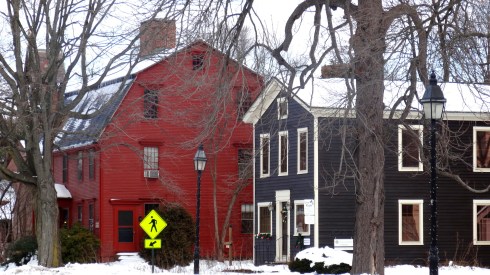
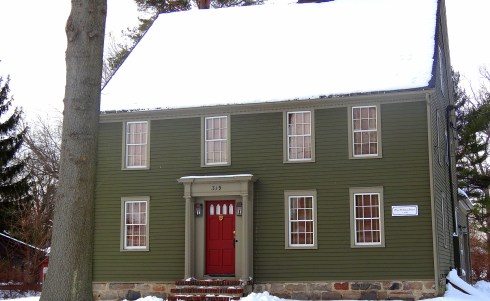
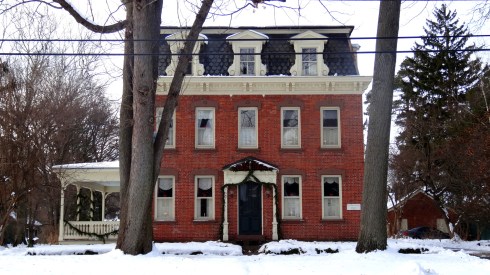
Whenever I’m heading home from New Jersey or New York or points south, I always like to stop in at Old Wethersfield, Connecticut:  it’s a beautiful village just off the highway and just outside Hartford:  a convenient respite for a weary traveler. Old Wethersfield is a National Register Historic District, comprising 100+ houses from the seventeenth, eighteenth and nineteenth centuries situated along a main thoroughfare and a slender rectangular green, which is part of the larger town of Wethersfield. I had two restless guys with me yesterday but they still let me stop for a bit, to take pictures of some of my favorite houses and briefly run into Comstock, Ferre & Company, which has been selling heirloom seeds for two centuries. Wethersfield is known not only for its colonial architecture, but also for its venerable seed companies, including Comstock and the Charles C. Hart Seed Co. in the present and a whole host of provisioners in the past. The most profitable product of these companies, a red “Wethersfield Onion”, even gave the old town the nickname “Oniontown” for a while. I am also compelled to mention Wethersfield’s fascinating/notorious founder, John Oldham, who was exiled from the Plymouth Colony for “plotting against pilgrim rule” and went on to establish settlements in Hull, Gloucester, and Watertown, Massachusetts, and eventually Wethersfield, the first English settlement in Connecticut. (Oldham seems to have rubbed shoulders with Salem’s founder, Roger Conant, on more than one occasion). Travel and Leisure magazine just designated Old Wethersfield one of America’s “prettiest winter towns”, and it certainly appeared so yesterday afternoon with snow lining the brick sidewalks and artfully draped on the colorful colonial houses.

Just a small sampling of Old Wethersfield, New Year’s Day 2013:

Wethersfield 052

Wethersfield 046

Wethersfield 044

Wethersfield 045

The plaques and signs refer to the house above, as in the case of one of Old Wethersfield’s most famous houses, the Webb House, pictured below with its neighbors.

Wethersfield 080

Wethersfield Webb House 083

Wethersfield 084

Wethersfield 074

Wethersfield 077

Wethersfield 076

Wethersfield 086

More!!! And as you can see, there are “newer” houses in Old Wethersfield too.

Wethersfield 091

Wethersfield 092

Wethersfield 056

Wethersfield 053

Wethersfield 060

Wethersfield 090

The Comstock building, obviously a livelier place in the summer but still very much open, and an 1899 seed catalog cover featuring the Wethersfield Onion, the “greatest onion on earth”,  from the Smithsonian Institution Libraries’ Collection.

Wethersfield 049

Wethersfield Onion Smithsonian


Iron Animals

It seemed like everywhere I went this (past) summer there were animals made of iron or some other metal.  Large or small, inside or out, they were in shops, parks, and museums.  So I snapped away, and here are some of my favorites, in chronological order of sighting.

All Summer long: horse sculpture by Deborah Butterfield in the atrium at the Peabody Essex Museum; in the midst of what used to be a Salem street.

Early July:  a stag and yet another noble horse at Smith-Zukas Antiques @ Wells Union Antique Center, Route One, Wells, Maine.

Late July:  a climbing tree frog by North Shore artist Chris Williams in Ipswich. 

Late August:  Big cats by Wendy Klemperer face off each other in Lenox.

Late August, again:  a tortoise and a hare in Copley Square, Boston.