Category Archives: Tourism

Hooked on Kinderhook

I made a very quick trip out to the Hudson River Valley at the beginning of last week to visit my brother and brother-in-law, and despite its brevity I still made some discoveries, including the delightful Columbia County town of Kinderhook. I always try to find new places when I’m out there, so on the way home I headed north from Rhinebeck, where they live, before turning east towards Massachusetts. It was supposed to be an hour-long diversion to see the Martin Van Buren National Historic Site before I headed home, but there was so much to see in Kinderhook I lingered, and did not get to Salem until well after dark. The President’s house did not disappoint, but downtown Kinderhook blew me away: beautiful houses and gardens, so much history, a stunning art gallery. The picture-perfect historytown: well worth a weekend trip if you’re within driving distance (or a longer one if you’re not). For some reason, I expected Lindenwald, which Martin Van Buren purchased after his presidential term was over, to be a bit dull and dowdy but it was on my list: when I got there I found it neither. I’ve been on a Gothic Revival kick all summer long, but this house is more than that: it’s a late Georgian mansion house transformed into a Gothic Revival mansion with an Italianate tower! Quite a melange: and Zuber & Cie wallpaper inside. The house was built by Judge Peter Van Ness in 1797, and inherited by his son William, who was Aaron Burr’s second in the 1804 duel which fatally wounded Alexander Hamilton. After Van Buren was defeated (on a Whig ticket) in the 1840 presidential election he retreated to Lindenwald, but following another defeat in the election of 1848 (on the Free Soil Party ticket) he was ensconced there for the remainder of his life. In 1849 he hired architect Richard Upjohn (who must have been THE Gothic Revival architect as he designed my two favorite houses in that style: the Rotch House in New Bedford and Kingscote in Newport) to expand and transform it.

Exterior and interior views of Lindenwald, including the tower stairwell and first-floor parlors. The entire center of the house is one big dining hall with the restored Zuber paper: for some reason it was difficult for me to photograph so refer to the site’s website! Not sure what this little house was for but it is cute.

This was the last day of a week-long heat wave so I really wanted to stay in my car, but once I got into downtown Kinderhook I had to get out of it. There were so many beautifuly houses, I would just stop, run out and take a photograph, and run right back into the air conditioning. But this was happening so often and the houses were in such close proximity to one another that it was getting a bit comical, so I finally stopped and took a walk. There was a strong presence of history: I had the image in my mind of the Continental Army marching down the main street victoriously after the (Second) Battle of Saratoga in the fall of 1777, especially as I passed the house where the captive General Burgoyne was entertained which was very close to the house where the wounded Benedict Arnold was taken. Earlier in the war, General Henry Knox passed through Kinderhook on his heroic quest to deliver cannon from Ticonderoga to General Washington in Boston. There are all these beautiful brick houses—both Dutch and English. There were details on the wooden houses I had never seen before. I was a puddle after my walk through Kinderhook but it was worth it!

The Luykas Van Alen House, 1747, which is owned and operated by the Columbia County Historical Society, as is the James Vanderpoel “House of History,” built in 1810. (The Van Alen house had several front porches with these built-in benches you see on Dutch Colonial houses built in the 20th century). Some houses which caught my eye in Kinderhook Village–I could have included many more. House where General Burgoyne was entertained and Major General (Turncoat) Arnold was attended to.

It was so hot in the Van Buren house that our guide passed out these cool fans! Perfect keepsake and advertisement for all this region has to offer. New York State takes its history very seriously: there are markers everywhere (maybe even TOO many–a big statement from marker afficionado me), every town has an official historian, and no opportunity goes unutilized to showcase it.


The Golden Goose

Last week Salem’s new Heritage Trail, or at least the foundation thereof, was revealed with a report to the Salem Redevelopment Authority (SRA) and the launch of a new website. The outgoing “Red Line” has long been the object of derision, as it was a play-to-play route which made no meaningful distinction between the Salem Maritime National Historical Site and the Salem Witch Dungeon Museum. Concerns about the sign pollution which plagues downtown Salem and the now-common understanding that “redlining” refers to housing segregation apparently inspired the city’s tourism agency, Destination Salem, to put together a working group comprised of “stakeholders” representing Salem’s organizations, institutions, businesses and local government (but not, notably, neighborhood groups) to reconfigure the existing trail as something “new.” The end result will be a gold line running through downtown Salem, and very nice signs which will mark the stops along the way, including……………….the Salem Maritime National Historic Site and the Salem Witch Dungeon Museum.

Believe me, I’m pretty tired of screaming into the void about how Salem values (or doesn’t) its long and notable history. I also realize that the people who have transformed a small subsection of this history into a valuable commodity have clearly won the day, as many of Salem’s heritage organizations, including Historic Salem, Inc., the Salem Historical Society, the Essex Heritage National Commission, and even the Salem Maritime National Historic Site had representative members in this working group, so are clearly supportive of this new trail. But this is a really important time for Salem, with its 400th anniversary only a few years away and so many of its historic houses shuttered, including the entire Essex Street Block campus of the Peabody Essex Museum. So I have a few things to say, of course! I’ll try to be as succinct and straightforward as possible: after some consternation I have limited and organized my thoughts (which might take the form of pleas) into three main points:

      1. Forprofit sites cannot be heritage. Salem’s heritage is a public good, not a private commodity. Packaging an historical event into a dramatic presentation creates an “attraction,” not a museum. Packaging a tragic historical event into an attraction is troubling if not enacted with great care, and the dated figures employed by the The Salem Witch Dungeon Museum and the Salem Witch Museum evoke more mockery than empathy. These attractions have no place on an officially-sanctioned “Heritage Trail”; I don’t think any for-profit site does. Call the trail something else: my friend Joe suggested the “Tourism Trail.” I would have no problem with that: it’s the equivalency of an actual historic site like the House of the Seven Gables or the Charter Street Cemetery or the East India Marine Hall (all sites on the trail) with a manufactured attraction that troubles me, especially as the latter are so obviously exploitative. The creators and consultants of the new Heritage Trail realize that there is an issue here, so they have come up with criteria that Salem sites which hope to be listed on the trail as it expands must meet. Here they are, included as Appendix B in the “Salem Heritage Trail Recommendation and Project Recap” report prepared by the consultant company MuseumTastic for Destination Salem and presented to the SRA:So, much of this seems fine, certainly the themes are great (more on them below), and the criteria professional. I’m having some difficulty envisioning the logistics of the vetting process, but will leave that to the experts. What does concern me, however, is the disassociation of “site” and “building” as referenced in #3 on. As you see in my graphic above, the Salem Witch Museum, the most profitable of the for-profits, is referred to as the former East Church, which is presumably how it made the cut. Why the East Church is deemed “historic” is beyond me, aside from its imposing Gothic Revival style: certainly it is no more historic than the nearby houses of ultra-philanthropist George Peabody and Supreme Court Justice Joseph Story, or the birthplace of the illustrious Benson brothers across the Common. When I asked why and how the Salem Witch Dungeon Museum, also located in a former church (built by the Christian Scientists and not the East Church parishioners), was included on the trail, I got this response from the Executive Director of Destination Salem: The Witch Dungeon Museum and Lynde Street are the site of early fortifications. English settlers knew that their presence in Salem immersed them in a web of global conflicts. Fearing reprisals from the indigenous people they were displacing and attacks from other colonial powers, the colony of Massachusetts erected a fort near this spot in 1629. Samuel Sharpe came from London with cannons to assume command of the militia. The first fort was probably made of tall wooden palisades, with extensions jutting out to prevent flanking. In the following decades, further fortifications were built along the Salem coast and a palisade was built along the western end of town. The early, feared attacks never happened. The East Church built a chapel on Lynde Street in 1897 and The Witch Dungeon Museum opened in the building in 1979. Visitors can watch a live-action reenactment of a witch trial and tour a recreation of the grim prison where the accused were kept. So basically: because a long-gone fort was once on the site of the Salem Witch Dungeon Museum, it qualifies for the trail? I don’t think I need to spend too long discussing the implications of this “standard.” In a city as old as Salem, every structure downtown was built on the site of something else: there are layers and layers and layers. The Witch Dungeon Museum’s storefront sister “museum” on venerable Essex Street, the Salem Witch History Museum, could claim that it sits on the site of Salem’s first printing house or any number of historic structures and thus qualify for the new Heritage Trail. Perhaps the cumulative criteria above could mitigate against this, but it does not appear to have done so with the Salem Witch Dungeon Museum: I think we need to be honest about where we are leading people—and why.

        Mannequin City: mid-20th century interpretive “technology” reigns in Salem’s for-profit witch “museums” which have no incentive to innovate, as the City delivers visitors right to their doors; Witch Dungeon Museum hanging mannequins.

      2. The Trail is too restricted geographically. Salem has been a tourist destination for over a century, and there are previous incarnations of the Red Line, which was stamped on the City in the 1980s. (People seem to think that the big turning point in Salem’s tourism history is the filming of the television show Bewitched in 1970s, or at least that’s the story the rationalizes the placement of the Samantha statue in Salem’s most historic town square. But that’s clearly not true: it was the Haunted Happenings festival, initiated by the Salem Witch Museum in the early 1980s, that created our modern Witch City). All the pre-1980 trails were much longer, and included more Salem neighborhods and sites, including the entire McIntire District showcasing architecture, South Salem showcasing Pioneer Village and many more sites in the Downtown and Derby Street districts. If it really is going to tell Salem’s story in a comprehensive and authentic way (and accomodate all those themes!) the Trail has to branch out considerably. One of the reasons I find it so objectionable to direct people to a witch business on the basis of a seventeenth-century fort that is no longer there is the fact that Salem has a seventeenth-century fort that has been left to rot on Winter Island.
      3.  Salem tourism brochures from the 1950s through the 1980s: not until the last decade was the Heritage Trail restricted to downtown and the “story” increasingly restricted to witches. Love the sentiment of “traveling through history in Salem.”
      1. 3. A Plea for Authenticity & Creativity: I don’t really have enough to go on to speak to technology or  interpretive issues, but from what I can read I am struck by the relative conservatism in terms of the conceptualization of the entire trail: I expect more from a process of “strategic revisioning;” I don’t see any revisioning at all actually. Maybe that’s coming? This trail could have been recast as a “walking museum” as some cities have done (Memphis!), and thus accomodate both heritage and for-profit sites (in a pop culture category: the history of witchcraft tourism in Salem IS part of our heritage unfortunately) as well as the Peabody Essex Museum’s shuttered sites which are outfitted with “PEM Walks” interpretive audio “postcards“: why not integrate this ready-made interpretation into the Trail? Salem doesn’t have a history museum so a thoughtfully-constructed walking museum could really compensate for this deficiency: this approach could also add some chonological development to the trail, which is completely missing. Authenticity is everything in this digital, virtual age, which is why it is imperative to emphasize the unique geography and history of Salem with real places rather than artifical ones: besides the for-profit sites, I am also troubled by the selection of the new Charlotte Forten Park on Derby Street as a location to highlight Salem’s African-American history: African-Americans (including Charlotte Forten) did not live or work anywhere near it! And as I’ve written about before, the park has been “colonized” effectively by the Real Pirates Museum, which tells the story of pirates (some real, some not) from Cape Cod. More appropriate places to tell the stories of Salem’s African-Americans are Derby Square (which is on the Trail) where a variety of vibrant black businesses were located, and Hamilton Hall, where Salem’s Remond family lived and worked. Actually, a wonderful interpretive location for interpreting African-American history would be Higginson Square, which runs parallel to Derby Square: to tell the truth, the Remonds spent at least as much time at 5 Higginson Square as Hamilton Hall, and Charlotte spent considerable time there too. There could be some kind of creative installation there, which brings to my last point/question: why is Salem’s very dynamic creative community so absent from this revisioning project? My very favorite urban heritage trail is actually that of Asheville, NC, in which stories of the city’s past residents, both well-noted and not-so well-known, are woven together through public art, including commissioned sculptures and pre-existing artifacts. Lke all the best heritage trails, Asheville’s was a process of considerable community engagement: it is a work in process that is still engaging the community. That could happen here too, but only with the realization that all of Salem’s residents are “stakeholders” in our city’s Heritage Trail.
      2.  Higginson Square, 1893, Nelson Dionne History Collection, Salem State Archives and Special Collections. A big flatiron to highlight Asheville’s Flatiron building. It begs the question: no Parker Brothers site for Salem’s new Heritage Trail?

So those are my three main points but I do want to say a bit about the “future” of Salem’s heritage, which is kind of a funny phrase: isn’t heritage about the past and how can it have a future? Well, heritage has a past, a present and a future: we’re dealing with the present now. After the Executive Director of Destination Salem gave her presentation to the SRA last week, there were a few questions from the board (which only has authority over signage downtown, not content, so I was suprised to see this engagement), including, “why so much witch stuff?” (I am paraphrasing). She answered: (I’m still paraphrasing but this is very close) “well, 85% or our visitors come for the witch trials so we have to give them what they want.” I have no doubt that this is true, because we don’t have a heritage trail that showcases our Samuel McIntire mansions or our Revolutionary resistance or our 445 Revolutionary privateers or our industrious inventors or our treasure- (and history-) hunting Mormons or our dashing Civil War officers or our zealous abolitionists and suffragists or our amazing artists and craftsmen or our brave warriors on both the battle and home fronts or any of our immigrant communities as far as I can see. Maybe all that is coming, but it is clear to me that witchcraft-based tourism is only going to become even more pervasive in Salem if some sort of structural change does not occur because it is self-perpetuating. Destination Salem has always been a thoroughly professional, accessible and effective tourism office, but I’ve never understood how it came to be in charge of heritage, because for me, tourism and heritage are not necessarily the same thing. But in Salem, I guess they are. I suspect that the same old scenario which governed the creation of the first Heritage Trail was present here: the City did not invest enough effort or money, and so left it to the business owners, who quite logically advanced their own interests. So let’s just call it the Tourist Trail, or take advantage of this (golden) opportunity to do something more—and better.


Roseland Cottage

In the last week of June I drove down to the “quiet” northeastern corner of Connecticut to see a house that was a major presidential July 4th destination in the later nineteenth century, Roseland Cottage, Historic New England’s sole property in the Nutmeg State. Home to several generations of the prosperous Bowen family from its construction in 1846 until its acquisition, fully furnished, by Historic New England in 1970, Roseland Cottage is a perfect Gothic Revival summer cottage located on one of the most picturesque roads in New England, Route 169 (the old Norwich-Worcester Turnpike), across from the Woodstock common which could accomodate the crowds that accompanied the first presidential visit of Ulysses S. Grant in 1870. Successive July 4 celebrations grew in size mandating their relocation to nearby Roseland Park, but three more presidents, Rutherford B. Hayes, Benjamin Harrison, and William McKinley, still stayed at the “cottage” and its outbuildings include both a presidential “two-seater” outhouse and a bowling alley built for Grant. When you read the accounts of these post-1870 Independence Day celebations you kind of get the feeling that this was a “July 4th is back” moment after the turmoil and division of the Civil War and its aftermath. I’d like to think that we are in a similar moment now, post-Covid, but I don’t think we are quite there (though it was nice to see the Pops last night). Roseland, however, is much more than a presidential pink palace: it feels very much like a family home, centered, but at the same time, out of time, as if it sprung from a fairy tale.

Roseland Cottage, built in 1846 for Mr. and Mrs. Henry C. Bowen: downstairs parlor, presidential bedroom, and outbuildings (including a carriage house bowling alley built for President Grant’s visit).

Because of its distinct style (even the furniture was custom-built for the house in Carpenter Gothic style, which foreshadowed Frank Lloyd Wright according to our guide), the house feels like a stage set in some ways, but also like we’ve just stepped in to a family home moments after its inhabitants have left as there are so many personal items remaining: Mr. Bowen’s commendations and commissions (he was a stalwart progressive Rebublican, which meant pro-abolition and suffrage in addition to pro-temperance, and also the founder and publisher of The Independent newspaper), Mrs. Bowen’s wedding dress and the Gothic Revival crib in which she rocked nine of their children (she died giving birth to their tenth and Mr. Bowen remarried a local girl), family photographs, books, prints, games, and decorative objects. I like to think that the pink china below was her preferred shade of her favorite color: Roseland has apparently been 13 shades of pink over its history and is now quite salmony-pink.

The other contradictory feeling is formality and SUMMER: Roseland Cottage is bordered by lush box-bordered gardens (which used to enclose roses but now mostly annuals, I believe), lawn, and Woodstock green so vivid green surrounds you inside, along with the bright colors of the stained-glass diamond-paned windows and the flowers outside. There are some fancy woolen carpets, but also thin matting under foot, and all of the soft furnishings are cotton florals and lace. Such a contradition, this house: dark and light, formal and fairytale-ish, solid and airy, sunshine and shadow.

My “HNE booties” and the grounds, displaying another contradiction: I wonder why there is a Greek Revival folly among all this GOTHIC Revival?


Landmark Lineage

I’ve been obsessed with the work “landmark” ever since the Samantha statue incident of last week: a succession of news stories in the days following reported the vandalism inflicted on this famous Salem “landmark” and each time I heard or read that term applied to this horror installation I screamed “she is not a landmark!” in my head. Isn’t a landmark something notable, of value, an attribute of place or a place itself, but nevertheless something we admire and want to preserve? Several people pointed out that the word doesn’t have to connote subjective judgements: it is merely  something recognizable. I’ve just written a book which has chapters on both surveying and navigation, so you’d think I’d be a bit more confident in my understanding of this term. Its original use in navigation refers to a physical feature of the land with which you can find, or mark, your way, but I thought its meaning evolved in the past centuries with respect to architecture, historic preservation, and the recognition and  designation of built landmarks. My understanding of the term is coming more from those fields, so using the same term to apply to Samantha and say, the Ropes Mansion just seems wrong! Clearly it is time to look this word up, so I went straight to the Oxford English Dictionary (I am fortunate to have an institutional subscription but I go there only when I really need to, as it is a rabbit hole for me. But needs must.)

LANDMARK: object marking a boundary line; district;

 2. An object in the landscape, which, by its conspicuousness, serves as a guide in the direction of one’s course (originally and esp. as a guide to sailors in navigation); hence, any conspicuous object which characterizes a neighbourhood or district.

 3. (In modern use.) An object which marks or is associated with some event or stage in a process; esp. a characteristic, a modification, etc., or an event, which marks a period or turning-point in the history of a thing.

Ok, I’m going with the second part of #2 “any conspicuous object which characterizes a neighborhood or a district.” The key word for me here is characterizes. I’m just not comfortable with Samantha characterizing Salem: I want Samuel McIntire to characterize Salem. But obviously there has to be some sort of standard for designating a landmark, or is it all subjective? To try to answer this last questions, I decided to do a search for “Salem Landmark” in all of my newspaper databases. This query produced hundreds of hits, but I quickly determined that many of these references were to the Salem Landmark newspaper of 1835-36 which first published the wildly popular “Enquire at Amos Giles’ Distillery” temperance parable, which was reprinted all over the country. So I eliminated those entries, and came up with a clear succession of Salem landmarks.

For the most part, the word landmark was used in referenced to historic buildings in Salem, but there were some exceptions. Beginning in the 1870s, there seems to be an emerging concern that Salem is losing its historic structures because there is a succession of titles to the tune of “another Salem landmark gone.” Clearly the word could be used to ascertain an increasing interest in historic preservation, but it’s not just about loss: landmark appears when particularly old or otherwise notable buildings are sold or “substantially altered,” when there’s a fire, or some event happens in a well-know location. Here’s a few examples, starting with the “old Putnam Estate on Essex Street,” a house with which I’m not immediately familiar—I’m not quite sure about this Bridge/Osgood Street house either, but it has an interesting story! Sounds like part of it might still be around?

It’s easy to get caught up in the stories attached to these old buildings: I did so several times and forgot all about Samantha (which is good)! The two above are a bit more obscure landmarks, but anything to do with Nathaniel Hawthorne, Samuel McIntire, the Witch Trials, the Revolutionary War, and political leaders or wealthy Salem merchants were designated as such. Sometimes I think the word was used a little loosely: a sailcloth factory? Well, it was a sailcloth factory that belonged to the legendary Billy Gray and was the studio of Ross Turner: I hope he didn’t lose any paintings! I had heard about the threat to the Pickering House before, which is why I am not expressing shock and awe now. Everything else below is pretty self-explanatory, but I should report the the Silsbee/Knights of Columbus mansion has just been completely restored and expanded and it looks great.

Besides Derby Wharf (above), the only designated landmarks I could find which were not buildings were a landmark store which closed after 114 years in business, and the famed “Brown’s Flying Horses” of Salem Willows. This carousel had been a major attraction of Salem Willows since the 1870s, and its sale to Macy’s Department Store in 1945 was big news and a big loss. By all accounts, it was a beautiful example of craftsmanship by a Bavarian woodworker, so comparing it to Samantha is a stretch, but both were/are popular “attractions,” so I guess that’s the landmark connection. I think I’ve worked myself out of my landmark labyrinth, but I’m still troubled by placement: certainly nothing could be more evocative and appropriate in a seaside amusement park than a carousel, but I still don’t think Samantha belongs in Town House Square.

Apparently this business had started in 1794 by the Driver Family and was run by relatives or in-laws until 1908, Boston Sunday Globe, September 20, 1908. Brown’s Flying Horses at Salem Willows, photographs from the “Essex Institute”/Phillips Library via Painted Ponies: American Carousel Art by William Manns et. al.


Skirting Witches and Pirates in Salem

Walking is my preferred form of transportation in Salem, but I tread carefully: I want my path to be lined with beautiful old houses, colorful shops and lovely green (or white) spaces. Attractions exploiting the terrible tragedy of 1692 and out-of-town-yet-territorial pirates cloud my view and dampen my day. I’m happy to meet real witches and pirates on my walkabouts, but kitschy parodies annoy me. If you are of like mind, there are many routes you can take in Salem on which you will not cross paths with anything remotely touristy, but if you are venturing downtown you must tread carefully too. Avoid the red line at all costs and follow my route below, which I have superimposed on an old map of the so-called “Heritage Trail”: I’m starting at my house on lower Chestnut Street and making a witch-less circle.

Across from my house is Chestnut Street Park: this is not a public park but a private space, owned by all the homeowners of Chestnut Street. It was once the site of two churches in succession: a majestic Samuel McIntire creation which lasted for almost exactly a century and was destroyed by fire in 1903 and a stone replacement which was rather less majestic and lasted about half as long. The gate is usually open to everyone, but not for reseeding time as you can see by the sign. I walk down Cambridge Street by the park and across Essex into the Ropes Mansion Garden, not looking great now but an amazing high summer garden. Then I walk down Federal Court and across Federal Street to the Peirce-Nichols House which is owned, like the Ropes Mansion, by the Peabody Essex Museum. Unlike the Ropes, I can’t remember when the Peirce-Nichols was last opened to the public: it’s been decades. It has a lovely garden in back which was always open, and my favorite place to go at this time of year because of its preponderance of Bleeding Hearts. The gate to the back of the house has been closed for a couple of years now, but it is latched and not locked, so I entered and went into the rear courtyard, passing the memorial stone dedicated to the memory of Anne Farnam, the last director of the Essex Institute before it was absorbed into the Peabody Essex Museum on my right. I never knew Anne but I’ve learned a lot from her articles in the Essex Institute Historical Collections so I always pay tribute. The gate to the garden in back was latched and locked, so I presume the museum does not want us to venture in there. I hope it was ok to go that far! While I am grateful for these pem.org/walks recordings I’m always wondering why these houses are never open.

Continue down Federal Street past the courthouses: you must avoid Lynde Street and Essex Street where witch “attractions” abound. I take a left after Washington street onto a street that no longer exists: Rust Street. I like the juxtaposition of the newish condominiums and the old Church and Bessie Monroe’s brick house on Ash Street on the right: a symbol of the opposition to urban renewal in Salem. Then it’s on to St. Peter Street, past the Old Jail and the Jailkeepers’s House (below), right on Bridge, and then right again, onto Winter Street.

Winter Street

As you approach Salem Common, you must bear left and head for the east side, as the west side is the territory of the Salem Witch “Museum.” There are some side streets with wonderful houses between the Common and Bridge Street which might be a bit more pleasant to traverse than the latter but you will be cutting close to the “Museum”: that’s why I always go with Winter. Once there, go straight by the Common on Washington Square East : you will pass the newly-renovated Silsbee Mansion, which long served as the party palace Knights of Columbus and has been converted into residential units with a substantive addtion and exterior restoration, and one of my favorite houses on the Common, the Baldwin Lyman House.

On Washington Square East.

Washington Square East will take you right to Essex Street: cross and go down the walkway adjacent to the first-period Narbonne House into the Salem Maritime National Historic Site. No witches or pirates here: you’re safe! I love the garden behind the Derby House: I think it is probably at its best in June when the peonies are popping but it’s a great place to go all spring and summer and even in the fall. On Derby Street, you can turn left and go down to the House of the Seven Gables or go straight down Derby Wharf: I went to the end of the wharf on this particular walk. The Salem Arts Association is right here too, but beware: there is a particularly ugly witch on its right so shade your view lest your zen walk be disturbed.

Salem Maritime National Historic Site and the Salem Arts Association.

Back on Derby. Adjacent to the Custom House is a wonderful institution: the Brookhouse Home for Women, established in 1861! The Home is located in the former Benjamin Crowninshield Mansion, and it is very generous with its lovely grounds, which provide my favorite view of Derby Wharf. I always stop in here, and then I work my way back up to Essex Street on one side street or another. Essex Street east and west are wonderful places to walk, but the pedestrian-mall center is witch-central: a particularly dangerous corner is Essex and Hawthorne Boulevard, where the Peabody Essex’s historic houses face some of the ugliest signs in town. It’s a real aesthetic clash: gaze at the beautiful Gardner-Pingree House, but don’t turn around! If you want to go to the main PEM buildings or the Visitors’ Center further down Essex, approach from Charter Street north on another “street” that no longer exists: Liberty Street.

From the Brookhouse Home to the PEM’s row of historic houses on Essex Street. Memorial stone in the Brookwood garden: Miss Amy Nurse, RN, an Army Nurse (1916-2013).

Charter Street is the location of Salem’s oldest cemetery, the Old Burying Point, recently restored and equipped with an orientation center located in the first-period Pickman House, which overlooks the Witch Trials Memorial. So this is a wonderful, meaningful place to visit, but beware: just beyond is the “Haunted Neighborhood” or “Haunted Witch Village” (whatever it is called)  situated on the southern end of the former Liberty Street, abutting the cemetery. This is a cruel juxtaposition during Haunted Happenings, when you literally have a party right next to sacred places, but not too noticeable during the rest of the year, because for the most part witchcraft “attractions” create dead zones. But the tacky signage can still spoil your walk so avert your gaze as much as possible. Charter Street feeds into Front Street, Salem’s main shopping street, and from there you can find the path of least (traffic) resistance back to the McIntire Historic District, which is very safe territory. Broad, Chestnut, upper Essex and Federal Streets are lined with beautiful buildings, as are their connecting side streets, so take your pick. I usually just walk around until I get in my 10,000 steps: on this particular walk I ended up on Essex.

Charter, Front & upper Essex Streets.


Salem as Historyland

For the most part, this blog has been an academic release for me rather than academic engagement: I consider most of the history I’ve offered up here more pop-up than professional. But there is one academic field with which I have been engaging (mostly in the form of learning) continuously: the history of tourism. This is a relatively new field, emerging in the 1990s, but also a very interdisciplinary and important one, involving social, cultural, and economic factors interacting at local, regional, and global levels. There’s a Journal of Tourism History, several academic book series, and an emerging taxonomy: the general category of Heritage Tourism, for example, can be broken down into more specialized endeavors: literary tourism, thanatourism (also called Dark Tourism, focused on visitation to sites of death and suffering), legacy (genealogical) tourism. Salem became a tourist designation in the later nineteenth century, and from that time its projections have included all of these pursuits. With the bicentennial of the Salem Witch Trials in 1892, witches started appearing everywhere, but Nathaniel Hawthorne represented stiff competition in the opening decades of the twentieth century, particularly after the centennial commemoration of his birth in 1904 and the opening of the House of the Seven Gables in 1910. Over the twentieth century Hawthorne waned and the witches ultimately triumphed, but at mid-century there was a relatively brief span when Salem and its history were both perceived and presented more broadly, as an essential “historyland” which one must visit in order to understand the foundations of American civilization. The major periodicals of the 1940s and 1950s, including Time, Life, American Heritage and National Geographic, presented Salem not only as a Puritan settlement, but also as an “incubator” of both democracy and capitalism with the events of 1692 subsumed by those larger themes.

I think I need to explain and qualify my use of the term “historyland” before I continue, as I’m not using it in the perjorative way that it has come to be used in recent decades: idealized history theme park where one can escape the present and have fun! The “American Way of History” in the words of David Lowenthal. Its meaning evolves, but I am using it first (more later) as it was initially applied: to a region in which much happened and much remained as material legacy to what happened. It emerges in the 1930s as a very specific reference to the area encompassing Jamestown and Colonial Williamsburg in Virginia: I believe a section of Virginia’s Route 3 is still called the “Historyland Highway.” Virginia was so great at marketing itself as Historyland (an example is upper left in the above graphic—some chutzpah to claim that the “nation was preserved” in Virginia!) that other states, like nearby Maryland and North Carolina, started using the term as well. I’m sure that every state on the eastern seaboard was jealous, and the term was extended geographically, chronologically, and conceptually when a Historyland living history park focused on the logging industry opened in Wisconsin in 1954. In the next decade, National Geographic started using the term more generally in reference to national landmarks, in the succession volumes to its popular Wonderlands guides. I don’t want to romanticize the word or its meaning too much: the history that characterized these historylands was overwhelmingly European, narrative, and a bit too focused on colonial costumes for my taste, but at least it was place-based. I can imagine that the civic authorities would have been just a bit wary about the impact of for-profit attractions peddling a story that was not Salem’s in the 1950s and 1960s, especially with the presence of so many non-profit local history museums like the Essex Institute, the Peabody Museum, Pioneer Village, and the Salem Maritime National Historic Site. Clearly that is not a concern now. In characteristic fashion, National Geographic focused on the site-specific aspects of Salem’s past and present in its September 1945 issue, focused on the Northeast. Its industrial base has created some “drabness,” but “this prosaic, utilitarian present is more than matched by an extraordinarily insistent and romantic past. Salem is literally a treasure house of early American landmarks, relics, articles, and documents of historic interest, all easily accessible and within a small area. The little city is fairly haunted by these still-visible evidences of its illustrious position, first as progenitor of the great Massachusetts Bay Colony, and later as a mistress of the seas. Unlike some larger cities of venerable age, in which population grew apace, it was unnecessary for Salem to tear down and rebuild: thus a larger proportion of memorable objects remains undisturbed.” Wow: a city which retains its treasures, was focused on preservation, and haunted by its still visible-past rather than made-up ghosts! What we have lost.

Photographs of Salem from the September 1945 issue of National Geographic, obove, and from America’s Historylands: Landmarks of Liberty (1962) below: the Witch House, secret staircase at the House of the Seven Gables, and Pioneer Village.

This total package, “treasure house” characterization continued to define Salem’s representation in national periodicals over the next two decades, during which Life, Time, and even Ladies Home Journal came to the city to take it all in: the Custom House and Derby Wharf, the House of the Seven Gables, Pioneer Village, the Essex Institute and the Peabody Museum, the Court House with its pins, the YMCA with its small Alexander Graham Bell display (see above), the recently-restored Witch House, and Chestnut Street. (And everything was open all the time! Peirce-Nichols, Derby, all those houses we can seldom enter today).  But change was coming, to they ways and means by which we interpreted the past as well as to Salem. From the late 1960s, the meaning of “historyland” took on a more negative meaning and associated “living history” attractions began to fall out of fashion, a trend that culminated with Disney’s disastrous Virginia pitch in the early 1990s. And then Samantha and her Bewitched crew came to Salem, allegedly showing it the way forward: tell one story rather than many and focus on private profits rather than civic pride. The Salem Witch Museum demonstrated that that path could be very successful, and so everybody else jumped on board: the public sanction of “Haunted Happenings” eventually transformed Salem into a full-time Witch City and undermined those institutions which were trying to tell other, or more complicated stories. Many of Salem’s textual treasures have been transferred to Rowley, but I guess we are compensated by the real pirate’s treasure from the Whydah? In recent years, the city’s tourism agency, Destination Salem, has attempted to broaden its appeal by taking advantage of the popularity of genealogical research/travel with its Ancestry Days (next week: see schedule of events here) but I wonder how far that initiative can go when most of Salem’s genealogical assets are in Rowley. Perhaps no structure represents Salem’s transition into a modern historyland, with all of its current connotations, better than the Peabody Essex Museum’s Ropes Mansion, once merely an “early home on an old street” and now the Hocus Pocus house. If I were a true historian of tourism, I could explain this transition in social, cultural, and economic terms, but I’m not there yet. Nevertheless, Salem is the perfect subject for this dynamic field: we’ve already seen some great studies, and I’m sure we’ll see more.

The Ropes Mansion in the May 16, 1958 issue of Life Magazine, and October 2021.


Pirates were Pirates

So I’ve been preoccupied with pirates for about a week, ever since the new Real Pirates Museum opened up in Salem adjacent to Charlotte Forten Park on Derby Street. My preoccupation was fostered by initial outrage at the apparent pirate takeover of this relatively new park dedicated to a prominent abolitionist and educator: colorful murals of the pirates within rise about the very minimalist park in a manner which I found dissonant and even offensive. I saw red: this was another Samantha statue moment for me. It wasn’t just the murals: the Real Pirates sign and entryway is centered on the park and there is obvious intent to integrate the attraction with the park. What could be the rationale? I looked through the meeting minutes of the two boards which were charged with approving the walkway, signage, and murals, the Salem Redevelopment Authority and the Public Art Commission, and found some interesting statements from the project manager for Real Pirates to the latter. He connected piracy and abolitionism (and past and present) through an effusive focus on piratical egalitarianism: “the concept of the murals is to portray the values of maritime history honored in Salem today as represented by the jolly roger, a symbol once condemned by nations that enslaved and exploited human beings and now seen as a symbol of what may have been the most democratic and egalitarian society of its time and by five portraits of historic individuals who sought freedom from the oppression and intolerance of their time.” The Commission approved the murals with one condition: that the pirates be disarmed.

Pirate values? That’s the connection? Motley crews in the Golden Age of Piracy shared the same values as Charlotte Forten in the nineteenth century and even Salem today? This seemed a little over the top and brought me into the realm of the Real Pirates Museum, a place I didn’t really want to go: it’s a private business and who am I to tell them what they should or should not be doing? But still, this is a lot of public projection, literally and metaphorically. I’m very familiar (especially after doing a deep dive over this past week) with the historiography of Atlantic piracy in the later seventeenth and eighteenth centuries, in which historians like Marcus Rediker, Peter Linebaugh, and others have emphasized the socio-economic structures which churned up so much piracy and cast pirates themselves as working-class heroes challenging the various hierarchies of the British Empire during its most craven period, when it was armed with the asiento granting monopoly privileges to supply the Spanish Empire with enslaved labor. Pirates were clearly challenging this evil empire, and doing so with diverse and meritorious crews, but pirates were also pirates: practical, opportunistic, violent. Pirates were not roving abolitionists. While it is true that the large crews of Edward Thatch or Thache, the notorious Blackbeard, might have been as much as thirty percent African at one time, it is also true that when he captured the French slaver La Concorde in November of 1717 with 455 enslaved Africans in its hold he returned the vast majority to its deposed captain for transport back to the slave market in Martinque. La Concorde became his flagship briefly, renamed The Queen Anne’s Revenge: slave ships were popular among pirates as their architecture suited piratical purposes perfectly, but liberating human cargoes was not their business. In the words of David Cordingly, “pirates shared the same prejudices as other white men in the Western world. They regarded black slaves as commodities to be bought and sold, and they used them as slaves onboard their ships for the hard and menial jobs: working pumps, going ashore for food and water, washing and cleaning…” (Under the Black Flag: The Romance and Reality of Life Among the Pirates, 34). They were also disarmed, just like the Real Pirates mural figures.

Anchor from the Queen Anne’s Revenge, whose wreck was discovered in 1996. The Queen Anne’s Revenge Project is an absolutely wonderful site, where discoveries, treasures, and topics are discussed regularly relative to the ship in particular and piracy in general.

So that brings us, and me, to the Real Pirates Museum in Salem. Real Pirates is the sister museum of the Whydah Pirate Museum on Cape Cod: both are based on the sensational underwater archeological discovery of the wreck of the Whydah, another slaver turned pirate flagship, off the eastern coast of the Cape in 1984 by Barry Clifford. I’ve always heard that the Whydah is the only authenticated pirate shipwreck, but I believe that the Queen Anne’s Revenge has since been authenticated as well? In any case, the Whydah Gally was captured in the Caribbean by Samuel “Black Sam” Bellamy and his crew on her maiden voyage in 1716 and utilized to capture a succession of prizes until she ran aground off Wellfleet in the following year. Bellamy perished along with most of his crew, a young, dashing, democratic Robin Hood who seems to have acquired the most romantic reputation of any Golden Age pirate because of his storied relationship with a Cape girl, Maria/Mary/Mehitable Hallett, who may or may not have existed (If she did exist, she was certainly not named Maria, a very Catholic name in very Protestant Massachusetts). Here is how the project manager of Real Pirates described these two in his submissions to the Salem Public Art Commission, as their murals were going to be, and are, very prominent:

Sam Bellamy, known as the “Robin Hood” of pirates, who had suffered as a common sailor, and was determined to assert his inherent human right to organize with others of similar conviction to form his own nation that would oppose by force other nations that had derived their wealth from the sale of human beings and from the murder and exploitation of the common person.

Maria Hallett, who as a single mother was thrown out of her home, banished from civilization and then accused of being a witch and yet never gave up her dignity or her dream of true love and salvation.

Much of these characterizations seem to be made up of whole cloth, and when I read them, I really didn’t want to visit a museum pushing romance over reality: even if “Maria Hallett” existed, or is a composite of several women who existed, how in the world can one know that she never gave up her dignity or her dream of true love and salvation (salvation?)? But I’m really upset about the park, so I knew I was going to write more, and if I was going to write more I knew I might end up criticizing the museum because of these over-the-top, thoroughly anachronistic statements of egalitarianism, dignity and love rather than its own exhibits, which is not fair. So off I went to see the Real Pirates. Before I left, I wanted to check the photography policy, so I went to the website, and there I saw something very interesting: I was not headed for merely a pirate experience, but a pirate and witch experience!

This is not the pitch on Cape Cod, I can assure you: this is a special Salem pitch. And obviously this is why there’s so much emphasis on Maria Hallett, who became known as the “Witch of Eastham” over her long legendary career. I quickly became more fixated on this than the “Pirates as Social Justice Warriors” claim, especially as I did not see over-reach in that area in the exhibit’s interpretation. It was disappointing, because my experience there was primarily positive: the staff was friendly and informative, it’s a very well-designed space, there’s a good introduction to the trans-Atlantic Slave Trade, and there are authentic artifacts from the Whydah. When you have Real Pirates and real treasure why feature a fake witch? I think this focus is a mistake, although to its credit, the exhibition does present all the Maria theories rather than the “fact” of her existence. I shook that fictional witch off, because I was enjoying my conversation with one of Real Pirates’ managers, who is a graduate of our MA program at Salem State where she wrote her thesis on pirates! She was full of plans and ideas, for both interpretation within the museum and engagement outside: she seemed to have put more substantive thought into how to feature and honor Charlotte Forten than most people associated with the City of Salem, even though that is not her job. (I still think it’s a stretch, and an uncomfortable one at that, but go for it) And then I got distracted by the nautical instruments displayed, as there’s a whole chapter on them in my book: I thought they were rather boring to write about actually but now I don’t seem to be able to get enough navigational dividers! That’s the key: the authentic objects. Historical authenticity is sadly at a premium in touristy Salem, and the Real Pirates Museum can distinguish itself by keeping it real.

A REAL Anchor.


The South Coast of Massachusetts

One thing that I’ve always loved about Massachusetts is its regional topographical diversity. I’m not sure that this is the correct phrase: topographical generally refers to the natural landscape but I’m referring to the built environment. In nearly every region of Massachusetts, you can explore urban and rural environments adjacent to each other, within the time span of an hour or so. It’s a bit more difficult to get the urban/rural contrast within the general vicinity of Boston, where suburban streetscapes reign, but elsewhere you can explore the architecture of a densely-settled old city by foot in one hour and then find yourself driving amidst farmland in the next. This was my experience over the past few days as I explored the South Coast of Massachusetts, which extends from Cape Cod to Rhode Island along Buzzards Bay. It was my Spring Break breakaway, as I decided to stay relatively close to home rather than taking a big trip. This is beautiful coastline, but if you’re familiar with this blog you know that I’m more interested in human history than the natural world so I tend to explore territory through buildings and this region contains quite an array of architecture. It’s an easy day trip, basically just following Route 6 from Fall River to Wareham or the other way around, but I spent a lot more time in rural New Bedford and rural Dartmouth than I expected to, so I stretched it out to two days. You could do a wonderful Industrial Revolution tour of these region, starting with the Old Slater Mill National Historical Park in nearby Pawtucket, Rhode Island and then proceeding to the powerhouse cities of Fall River and New Bedford where factories remain in various states of redevelopment or decline, but I was a bit more interested in domestic architecture on this trip.

Beginning with the cities, where you can see the impact of all that wealth from whaling (New Bedford) and manufacturing (Fall River AND New Bedford) very clearly, as well as the impact of the DECLINE of these industries. But I was focused on the former! Very impressive mid-nineteenth century houses in both cities: Fall River experienced a fire in 1843 which was followed apparently by a building boom, but both cities have impressive revival buildings: Greek, Gothic, even Renaissance. I stayed away from everything relating to the notorious Lizzie Borden in Fall River for the same reason I don’t dwell on anything related to 1692 here: I’m not interested in the commercial exploitation of tragedy. In New Bedford, I breezed through the Whaling Museum too quickly: that definitely deserves its own post and both cities (of course) have active historical societies that document and exhibit their economic and social histories.

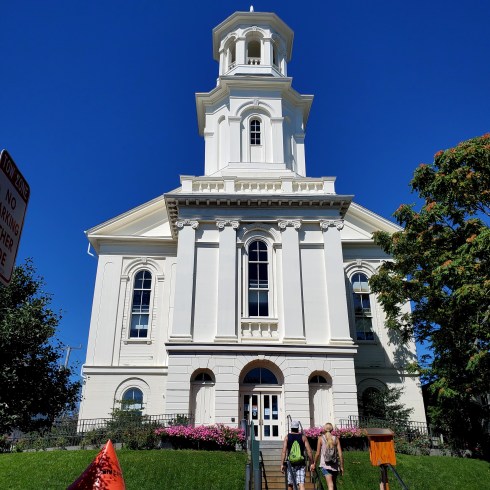
Great Gothic Revivals! This regional ramble was prompted by my desire to see just one house, the William J. Rotch cottage in New Bedford (first up below), and it has some impressive neighbors.

This last red house is in Fall River; all the rest are in New Bedford, in the immediate vicinity of the Rotch Cottage.


Great Greek Revivals!

In both cities—-more institutional than residential I think, although some larger buildings began as residences and then became offices or institutions. The first house below is another Rotch house in New Bedford with a lovely adjacent garden, now a museum, and the following houses are also in New Bedford except for the last two, which are in nearby Mattapoisett: rural variations on a theme.


I didn’t expect Fall River to remind me of…….San Francisco? The Highlands Historic District looks WAY down on the Taunton River and Mount Hope Bay. I couldn’t really capture this in pictures, but here are a few houses in the district.


Idiosyncratic Buildings: The former Durfee High School/current Probate Court building in Fall River & the Seamen’s Bethel in New Bedford.


Cape-Townsthe South Coast is very close to Cape Cod and thus very Cape-like, although less commercial. And all manner of Capes can be found all along Buzzards Bay, particularly east of New Bedford. I think this first one is in Westport (although I can’t quite remember, was in a bit of a daze at the time), and the following photographs are of Mattapoisett (2) and Marion (2).


Shingles: South of Boston you tend to see more shingles than clapboards on older houses, but there were some interesting shingle-clapboard combinations on the South Coast as well. Below: Westport (2), the lovely Dartmouth village of Padanaram (2), Marion (2), and the sign on the Rochester Women’s Club.


A working Coast, past and present: Outside of the cities, you can see evidence of work past and present: in the harbors, of course, but also on the land. The Russells Mills section of Dartmouth (which is one of the largest Massachusetts towns in terms of acreage) is preserved as an early center of rural industry, as is the Tremont Nail Factory District in Wareham, and there are “Right to Farm” signs in nearly all the towns I visited, and of course, cranberry bogs! Below: Russells Mills (2), Padanaram Harbor, and Wareham (2).


Some Orientation: Crop of the South Coast from Ernest Dudley Chase’s 1964 tourism map of Massachusetts, Boston Public Library; an old sign in Rochester.


A Peaceful Thanksgiving from Plymouth

In full disclosure, as I write this, I am not in Plymouth: I’m actually in New Jersey, soon to go back to Massachusetts for a spell and then to Vermont for Thanksgiving. But last weekend I was in Plymouth, which was getting everything ready for the 400th anniversary of the very first Thanksgiving, in 1621. The weather was beautiful and my husband and I visited all the spots: the newly-renamed Plimoth Patuxet Museums, the Plimoth Grist Mill, and the Mayflower of course. We walked by Plymouth Rock with a passing glance which is pretty much all it deserves, but there was a small crowd gathered round, as usual. Even though Plymouth was getting ready, it was still calm and peaceful, and a welcome refuge from Salem which has been anything but for months. When we took a break for lunch we first tried a relatively new and seemingly hip place down on the water, but it was so noisy and crowded we walked right back out; I said to myself (or maybe out loud, I can’t remember): that’s like a Salem restaurant. We ended up in local sports bar, perfectly happy. Everything was just so easy in Plymouth. There were fewer reenactors at Plimoth Patuxet than I had ever seen before, but for me, this just heightened the starkness and impression of the landscape, a reproduced one for sure, but still quite effective in transporting one back.

In downtown Plymouth, the reproductions (the Grist Mill, the Mayflower) are merely small parts of an authentic, living town with old and new structures, going about its business, a town where you can actually buy basic necessities like socks and shoes (along with violins!) from shops that are open all year round. There’s a real history museum and a historical society. As you can tell, I just can’t help but compare Salem and Plymouth: I’ve done it before and I’m doing it now. They are both old Massachusetts settlements which have become tourist towns with claims to fame based on holidays: but Plymouth clearly seeks to set its holiday in a comprehensive historical context while also preserving daily livability for its residents, while Salem, after reducing and contorting its own history to fit its chosen holiday, seems focused only on throwing an escalating party. And as we all know, parties are more fun for the guests than the hosts (or at least that’s my experience).

Happy Thanksgiving from Plymouth!

Update: Heather Wilkinson Rojo is your source for all things Mayflower in general and Mayflower 400th commemoration in particular: see all of her lovely links here: https://nutfieldgenealogy.blogspot.com/p/mayflower-400th.html?spref=tw


A Cape Full of Color

So every year in early September we journey to Cape Cod on the weekend after Labor Day for my husband’s birthday. It is an odd time, just after “summer” is over and we have established our fall routines, and I always complain, but off to the Cape we go because he has wonderful memories of fishing in Provincetown and that’s what he always wants to do for his birthday. As is generally the case with us, he will fish and I will walk or drive around looking for old houses, but this time we spent most of the weekend together. Provincetown is one of those towns that I don’t think I want to go to before I go but once I’m there I’m happy: actually everyone seems happy in Provincetown! It’s not that it isn’t a wonderful, dynamic and scenic town, it’s that I always feel that it is overbuilt and too crowded, with both houses and people. And it is, but if you stop and look at individual houses you’ll see some wonderful details and landscaping. I had not seen the Public Library before, and that was a special treat, and of course I had to make my yearly pilgrimage to John Derian’s summer house with its shop in back. Another highlight: the recently-restored eighteenth-century Mary Heaton Vorse House, on which interior designer Ken Fulk seems to have spared no expense.

Saturday in Provincetown: the Pilgrim monument, Public Library in the former Center Methodist Church, featuring a half-scale model of the Rose Dorothea schooner on its upper floors, John Derian & Mary Heaton Vorse Houses, and, of course, the beach.

I posted a few pictures and an Instagram friend informed me that there was an “All around the Common” event on Sunday way back in Yarmouth Port, during which several historic houses would be open, including Historic New England’s Winslow Crocker House, which I had never visited. So that was all I needed to hear: I had no problem driving back to get into that house. It was a very blustery day, so my husband decided to join me in lieu of fishing: a big surprise. We then commenced a long drive back to Salem via nearly every Cape town on Sunday, with stops in Harwich and Yarmouth. We both really wanted to visit the Atwood-Higgins House in Wellfleet, which is part of the Cape Cod National Seashore, but as soon as we got to the gates of the property a rather frantic park ranger drove up to us in his SUV and told us to proceed with extreme caution as there was a major mosquito infestation. We were still pretty gung-ho, but about ten steps in we were covered with mosquitos and ran back to our car: one Wellfleet mosquito rode all the way back to Salem with us! And then it was on to Yarmouth.

All we saw of the Atwood-Higgins property in Wellfleet.

I dashed through the Edward Gorey House and the Bangs Hallet across the Common, and then spent quite some time in the Winslow Crocker House: too much time for my husband. The house was built during the Revolution by privateer Crocker in West Barnstable, and moved by collector and descendant of an original land grant Cape family, Mary Thatcher, to Yarmouth Port in 1935-36. She had a new foundation laid, and removed all evidence of the division made by earlier owners. Miss Thatcher lived in the house all year long and filled it with antiques, all of which she donated to Historic New England. It’s a gorgeous Georgian house with warm wooden paneling throughout, lots of light, and some great William & Mary and Hepplewhite furnishings. I have added Miss Thatcher to my list of heroic female preservationists.

The Edward Gorey and Captain Bangs Hallet houses on Yarmouth Port Common and the Winslow Crocker House, built c. 1780. Miss Thatcher.

Our last visit was to the 1790s house of an old friend of my husband’s, also on architect, on the Herring River in West Harwich. Amazing setting and decoration, and some very striking mantles in particular (I hope you can pick up the detail in the pictures). A perfect end to our Cape dash, and then we dashed for home, with (miraculously) no traffic!

A beautiful end of our weekend in West Harwich.