Category Archives: Salem

Rose Reverie

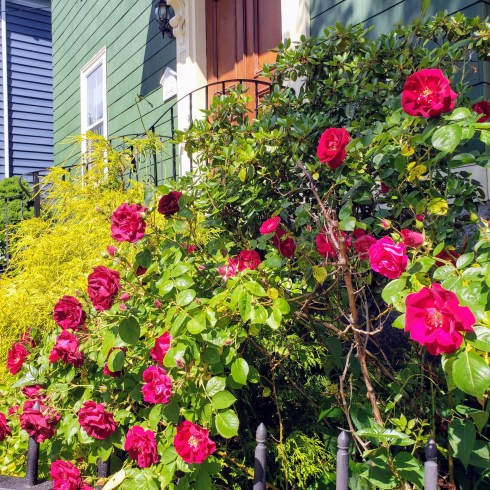
These are the rose weeks of the summer in central New England: while newer varieties of roses are bred to be repeat- or ever-blooming the older varieties bloom now, so if you walk the streets of an older city or town you’re going to see bursting bushes behind and over fences and along porches and foundations. Often red or a very very dark pink. I’m not certain what cultivar these roses are: at first glance they appear to be of the gallica variety, the oldest type of rose to be cultivated in Europe which was brought to North America in the seventeenth century. Certainly several of the rose bushes in the “Colonial” garden behind the Derby House are gallica, cultivated for their medicinal and household uses as much as for their beauty. When I’m walking down the street taking photographs of rose bushes at this time of year and happen to spot a homeowner in close proximity, I always ask about their roses, and I nearly always get the answer: oh they’ve been there forever.

20190617_100203

20190617_100010

20190617_100321-1

20190617_095006

20190617_094656

Salem was a horticultural haven in the nineteenth century, so it’s fairly easy to find out what people were growing and showing. When I look through periodicals like the New England Farmer, and Horticultural Register or the Transactions of the Essex Horticultural Society it is pretty clear that most people were more excited about dahlias than roses at mid-century, though Francis Putnam did have quite a collection of showy roses on hand, including La Reine, Duchess of Sutherland, Aubernon, Baron Prevost, Madame Laffey, Madame Damame, Mrs. Eliot, Devoniensis, Bon Silene, Bossuet, and Anne Boleyn, though he was a florist by trade. I have a pink David Austin Anne Boleyn rosebush in my garden, though I doubt it’s the same cultivar as Mr. Putnam’s nineteenth-century varietal. According to Alice Morse Earle’s Old Time Gardens, Newly Set Forth (1901), an even more storied English rose, the “York and Lancaster” striped gallica, could once be found on the grounds of Nathaniel Hawthorne’s birthplace in its original location on Union Street. Interest in the “old-time” roses was clearly reviving in the latter part of the nineteenth century, as was the lore attached to all sorts of flowers according to the “language” attributed to them, but serious garden writers always cautioned against mixing up the York and Lancaster with its similarly-striped cousin, the “Rosa Mundi” rose, which had even earlier “historical” origins.

Roses Collage 2

Roses Collage

Rosa Mundi Cutis Botanical MagazineJohn Ramsbottom’s “King Penguin” book, 1939, with its York and Lancaster illustration; Mrs. L. Burke’s The Language of Flowers, 1865; Rosa Mundi from Curtis’s Botanical Magazine, 1790s.

Enough of history and let’s see some more roses about town, including my own (first up) which are modern David Austin varieties: my house was a working (rooming) house for much of its life and I doubt there was space (or time) for a flower garden, so I don’t have any old rosebushes. I don’t like any red in the garden for some reason (though I love it indoors), so it’s pink and yellow and ivory for me. Then we have: one of my favorite pocket gardens on Botts Court, two very dependable displays nearby, and the particularly lush roses behind (not in) the Ropes Mansion Garden—just love these. It’s summer now.

pixlr-3

20190622_121043

20190618_175920

20190617_090215

20190618_172836


Mid-Century Maritime

The Peabody Essex Museum’s new building, or at least its exterior, is now completed, creating a sweep of contrasting structures along Essex Street, with the East India Marine Hall centered between two more modern monolithic structures. During the long construction process, and after we learned that the PEM would be removing Salem’s archival heritage to a new Collection Center in Rowley, it was revealed (not in a press release, of course) that the large anchor which was placed in front of the Marine Hall over a century ago would also not return. I believe it’s up in Rowley too. I don’t know the rationale for this decision with absolute certainty, but I did hear a rumor that the leadership of the museum believed that the anchor reeked of “maritime kitsch”, which is obviously incompatible with its new profile and identity. If that is indeed the case, it’s amusing to see several “Ladies of Salem” figureheads hanging prominently in front of the PEM’s sleek facades.

20190617_091632

20190617_091657

20190617_091739

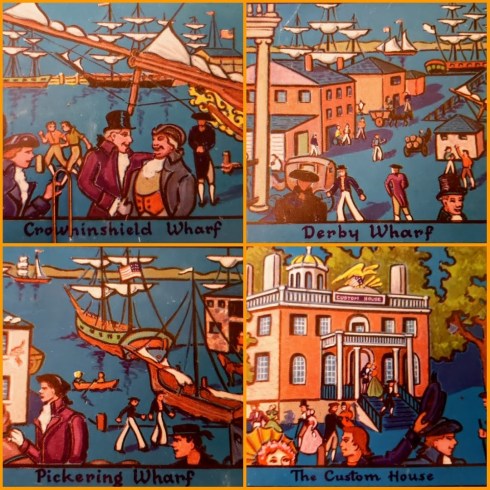
Salem is awash in witch kitsch; I think a little maritime kitsch would balance things out. But the anchor is hardly kitschy when you compare it with some nautical designs from half a century ago, when Salem was embracing its maritime identity a bit more than its witch-trial one: before Bewitched white-washed the latter and paved the way for full-scale exploitation. The sleek nautical images of the 1920s and 1930s gave way to more idealistic and pictorial depictions in the 1940s and 1950s, and I don’t think you could find any better representative of this mid-century aesthetic than the marketing materials of the Hawthorne Hotel. I have a menu and a flyer which present a very colorful past, enabling the hotel to offer “the charm of Old Salem in a modern manner.”

20190618_203026

20190618_203119

20190618_203139

20190618_203051

pixlr-1

I don’t really see how the Hawthorne’s 1950s lobby “captured the spirit of Old Salem”, but its Main Brace cocktail lounge was indeed very “salty”. It featured murals by the Rockport maritime artist Larry O’Toole, who also produced a famous pictorial map, “A Salty Map of Cape Ann”, in 1947-48, as well as maritime murals and paintings commissioned by institutional and individual patrons. The netting, the captain’s chairs, the mural: not a nautical detail was overlooked in the Main Brace.

20190618_204044

20190618_204349

Mid Century Maritime HH Main Brace 1942

Mid-Century MapThe Hawthorne Hotel’s lobby and Main Brace cocktail lounge; Jonathan Butler, Harriet Shreve & John Pickering X in the Main Brace c. 1942 from Kenneth Turino’s and Stephen Schier’s Salem, Volume 2 (Arcadia Publishing, 1996); Larry O’Toole’s Salty Map of Cape Ann from Geographicus.

The idealized maritime aesthetic was not just a presentation or projection: it was also a perspective, as illustrated in the many “great men in their great ships” books which were published in the 1950s and 1960s portraying American history as the history of expansion by land and sea—-and Salem playing an absolutely central role in the latter. Consequently when tourists came to Salem they wanted to see the remnants of this glorious past. Arthur Griffin’s photographs of Salem in the 1940s and 1950s (at the Digital Commonwealth) depict well-dressed tourists looking at all manner of maritime relics in the old Peabody Museum of Salem: how far we’ve come from that innocent age.

Mid-century Collage

mid century collage 2

Mid Century Griffin 3


A Monumental Divide

At the center of Raleigh is the North Carolina Capitol building, in the midst of Capitol Square, surrounded by more than a dozen monuments to the memory of statesmen and soldiers. The most recent installation (1990) is the North Carolina Veterans Monument, while the tallest memorial is the monument erected “to our Confederate dead” in 1892, and the only monument referencing women is the 1914 statue honoring the North Carolina Women of the Confederacy. The Raleigh-Durham area has seen several intense protests against Confederate monuments over the past several years, resulting in the toppling of the Robert E. Lee and “Silent Sam” statues in Durham and Chapel Hill, but this past August the special “Confederate Monuments Study Committee” of the North Carolina Historical Commission voted that the Capitol monuments should stay in place, despite the request for removal from North Carolina governor Roy Cooper and the Committee’s own opinion that the statues are “an over-representation and over-memorialization of a difficult era in NC history.”

Mon 5

Mon 2

Mon 1

Mon 3

I would have to agree with that characterization, particularly of the Women of the Confederacy statue, which depicts a woman as a mother-historian, reading the heroic tales (I presume) of war to her sword-bearing son. The towering Confederate Dead statue nearby (which was very difficult to photograph) features anonymous soldiers and a rather simple message of honoring the dead, and so is perhaps not as confrontational as a statue of an individual and identified Civil War soldier, though there is also a monument to Henry Lawson Wyatt, purported to be the first Confederate soldier killed in action, on the Capitol grounds. In announcing its decision to let these statues stand, the state Commission called for additional interpretation, “to provide a balanced context and accounting of the monuments’ erection in their time in political history” as well as the erection of additional monuments honoring the contributions of North Carolina’s African-American citizens. I did not see such context, nor equal monumental representation, but we are less than a year out from this ruling and a long-term effort to establish an adjacent “Freedom Park,” designed by architect Phil Freelon, the leader of the design team for the Smithsonian Institution National Museum of African American History and Culture, appears to have accelerated over the past year.

Freedom Park

Plan for the proposed “Freedom Park” and monument in Raleigh.

As I wandered around Capitol Square this past weekend looking at all of its installations with my historical and decidedly northern (even more decidedly Massachusetts) perspective, I had the most visceral reaction to a monument which wasn’t even mentioned in the recent debate over Confederate memorials in North Carolina: that dedicated to Samuel A’Court Ashe in 1940. Ashe obviously lived a full life and was revered by many in his native state, but all I could see when I read this plaque was heroic defender of Fort Wagner. Just a few weeks before I was wandering another hallowed ground, Salem’s Harmony Grove Cemetery, where I saw the graves of several men who served with the 54th Massachusetts Volunteer Infantry Regiment, the first Civil War military unit comprised of African-American soldiers to be raised in the North. The soldiers of the Massachusetts 54th distinguished themselves during the assault on strategic Fort Wagner, which guarded the entrance to Charleston Harbor, at great cost, losing 281 men on July 18, 1863: 54 confirmed casualties (including commanding officer Robert Gould Shaw), 179 wounded, 48 simply lost, while the Confederate troops inside were reportedly “maddened and infuriated at the sight of Negro troops.” Their sacrifice confirmed their promise of hope and glory, in the words of Massachusetts Governor John Andrew, and was memorialized later by the Augustus Saint-Gaudens monument on Boston Common (1897), Robert Lowell’s poem “For the Union Dead”, and the 1989 film Glory. Ashe, the defender of Fort Wagner, has much to say about the war and its commemoration, as his long post-war career was characterized by prolific writing (and Confederate commemoration advocacy) both as a newspaper editor and historian. In his History of North Carolina, he makes no mention of the Massachusetts 54th at Fort Wagner, but only of “the splendid heroism and devotion of the North Carolina troops”, and his “historical” analysis of the causes of the Civil War focuses almost exclusively on the policies of an “unpatriotic” Abraham Lincoln, whom he never refers to as President: it is not true, as Lincoln said, that without slavery there would have been no secession. It was the absence of the spirit of compromise on the part of Lincoln and his party that brought about secession in 1861….Secession would have been averted if Lincoln had copied the example of his patriotic predecessors. But he made his anti-slavery feeling his ‘paramount object’ instead of his desire to save the Union. He was revered as “that stainless leader of the Lost Cause” in the 1940 address given at the dedication of his monument. Frankly, I don’t want to read anything more about or by Mr. Ashe, and the next time I am in Raleigh I will give his memorial a very wide berth.

Mon 7

Monument title 1933

Shaw Memorial

20190612_114421

The monument dedicated to Samuel A’Court Ashe in Raleigh’s Capitol Square and one of his telling titles; the Boston Common monument to Robert Gould Shaw and the Massachusetts 54th by Augustus Saint-Gaudens: two memorials which reference Fort Wagner, and the Civil War, in very different ways. The grave of  Salem native of Luis Fenollosa Emilio, a Captain of the Mass. 54th who survived Fort Wagner and lived to tell their tale in A Brave Black Regiment (1894).


We just Beauties See

I’ve always loved the seventeenth-century poem by Ben Jonson It is not Growing like a Tree with its closing lines In small proportions we just beauties see; And in short measures, life may perfect be. It evokes the ephemeral perfection of late May and early June, when the bleak New England “Spring” finally ceases and we are rewarded with a burst of flowering amidst all that new, lush green. As I write this, at night, I’m still kind of cold, but it certainly is beautiful out. I got my garden under control last week: I lost some things but most of my very favorite plants are doing just fine, including the “ladies”, slippers and mantle. I take long walks on these long days, and pictures of everything beautiful, even plants I don’t really like. I’ve never been a rhododendron fan, and as those are peaking right now, it is difficult to avoid them: consequently I have included an unusual yellow variety. Peonies are also just too much for me, but who can resist capturing those show-offs now? I actually find irises creepy, but they are so colorful and fleetingly stalwart I snapped them too. So here is a portfolio of late spring/early summer flowers, primarily from my own garden, the Ropes Mansion garden, the Peirce-Nichols garden which is the place to go for Bleeding Heart at this time of year, and the Derby Garden at the Salem Maritime National Historic Site, where the first of the peonies are just starting to pop. But you can spot flowers just walking down the streets of Salem at this time of year, along or through the cracks of an old fence.

20190530_145027

20190530_145212

20190603_184351

20190530_145642

20190530_145955

20190530_145931
20190530_151426
20190530_150458
20190530_155806
20190530_155433
20190603_132801
20190603_140422
20190603_140008
20190601_173628
20190601_163637
What’s blooming now in Salem: Lady’s Slippers, Sweet Cicely, Jacob’s Ladder, Wisteria, Irises, Mock Orange, Rhododendron, Bleeding Hearts, (flowering) Wisteria, Dame’s Rocket, Clematis, Columbine, Peonies, Comfrey.

Salem as America’s Attic

I might be pushing it a bit with my title, but since I’ve returned from Winterthur earlier this Spring, I’ve been obsessed with exploring “Salem as source” for antiques and collectibles in the later nineteenth and early twentieth century, when the passion for antiquing emerged. This is another avenue into Salem’s influence on the burgeoning Colonial Revival; I think its architectural influence has been established, by a succession of architects coming to town to sketch starting as early as the 1870s. It was during that Centennial decade that a group of Salem ladies put together a collection of regional “relics” for display both at the Essex Institute and the Centennial Exposition in Philadelphia in 1876, a visual representation and projection of “Old Salem” that was also published for a national readership in Frank Leslie’s Illustrated Newspaper (for January 22, 1876) .I just don’t see how items such as the baby-clothes worn by Judge Curwen who tried the Salem Witches, chalice made of the woodwork of a house still standing, which was built by Roger Williams in 1635 and is known at the Witch House, wine glass used by General Washington while in Salem, and an Elizabethan wainscot cupboard which has been stored away for the past fifty years in a barn could have failed to capture the American imagination!

Antiques Frank_Leslie's_Illustrated_Newspaper_1876-01-22_12

I pursued a variety of texts to support my thesis of Salem’s central role as antiques destination/influencer, including secondary texts such as Elizabeth Stillinger’s The Antiquers (1980) and Brian G. Greenfield’s Out of the Attic (2010) and texts from the first era of antiquing such as the Shackletons’ Quest of the Colonial (1907) and Walter Dyer’s Lure of the Antique (1910). I was not disappointed by either the historical or the contemporary view, and I love the older texts. Robert and Elizabeth Shackleton remark that Salem is “dear to memory, not only from its treasures of the past but from being the place where, Westerners that we at that time were, we first saw a grandfather’s clock ticking away, in a private house, in the very corner in which it had ticked through the Revolution,” and Walter Dyer’s book is filled with Salem treasures, captured by the camera of Salem’s very own Mary Harrod Northend.

Antiques Collage 2

20190529_105322

20190602_151257_20190602152523730A Treasure Trove of Silver in an old Salem house, from Walter Dyer’s Lure of the Antique (1910).

All of these texts, and others, point to several key factors which made Salem a collector’s paradise: the famous collections of individuals like Henry Fitzgilbert Waters and George Rea Curwen and the Essex Institute, with its period rooms assembled by George Francis Dow, the photographs and texts of Frank Cousins and Miss Northend, and the perception of the sheer antiquity of the city, whether shaped by Nathaniel Hawthorne or the witch entrepreneurs, or both. In assembling his influential period rooms (largely drawn from Curwen’s bequest, and which have become historic “objects” themselves—I believe they are going to be reassembled in Plummer Hall by the PEM), Dow followed the lead of the Centennial ladies and focused on the humanity or “everyday life” of colonial dwellers, in order to enhance their accessibility. Dow clearly felt that he was in competition with more entrepreneurial purveyors of “old Salem” when he remarked in 1916 that Salem used to be viewed and “visited as a monument, a shrine—-something to be studied. Now the visitor lightly pauses, here are there, butterfly-like, or is whirled through the streets in an automobile, while on the running board a small boy “guide” delivers an extraordinary distortion of fact plentifully soused with fiction.” (Essex Institute Annual Report 1916: OMG what would he think NOW!!!). But, more visitors to Salem meant more visitors to Dow’s period rooms and historic houses at the Essex Institute, and eventually to his Pioneer Village, and to Caroline Emmerton’s House of the Seven Gables, and to Salem’s growing number of antique shops: tourism, then as now, is a double-edged sword. Periodical and ephemeral evidence points to a healthy number of antique shops in Salem in the first half of the twentieth century, particularly in the 1920s and 1930s.

20190602_142305

Boston_Herald_1918-01-27_27Amazing photo of a lady (perhaps Mary Harrod Northend?) at the original location of the Hooper-Hathaway House (now on the House of the Seven Gables campus) inspecting some Old Salem wares in Dyer’s Lure of the Antique. The caption reads: “Don’t expect to buy these old treasures for a song. You are lucky to get them at all.” Once the Ward House was relocated and opened, it became the workshop of Sarah Symonds, who “perpetuated antiques” in the form of plaster-cast doorstops and mementos of famous Salem structures (Boston Herald, January 17, 1918). I think the days of buying antiques from guileless Salem homeowners were gone even by 1910, and in the next few decades the number of shops advertising in periodicals exploded.

Antiques Collage 3

Antiques Hardy HNE

Antiques 1930s HNESalem Antique advertisement from the 1922 volume of the magazine Antiques, and from the collections of Historic New England.

There is one antique dealer from this era who really stands out, at least to me, but I think also in general: Miss A. Grace Atkinson, who kept a “shabby” shop at the “Old Witch House” on Essex Street right up until its conversion into the Witch House of today. Not only is Dyer’s book filled with items from the “Atkinson Collection”, but according to the long correspondence between her and Henry Francis du Pont, she was also a source for Winterthur. I think Miss Atkinson might have been the sister of James Almy’s second wife Emma, because of her residence at 395 Lafayette Street, the Colonial Revival mansion built by Mrs. Almy after the dearth of her prominent storeowner husband, but I can’t confirm that. She was by all accounts a shrewd collector and dealer, however, and did not hesitate use the witch connection to advance her business.

Antiques Collage

Antiques Witch House New Bedford

Antiques Witch House 1918 Cambridge Historical Society

wp-1559507355444.jpgAtkinson’s Advertising, and her shop on the left-hand side of the Witch House, in photographs from the New Bedford and Cambridge Historical Societies, via Digital Commonwealth; Some items from the “Atkinson Collection” in Dyer: she was particularly known for her selection of Lowestoft.


The War on Paper

I spend a lot of time in cemeteries all year long (well perhaps not in the depths of winter) but in the weeks leading up to Memorial Day that time intensifies: late May is characterized by that heady mix of beautiful blooms and remembrance. Salem’s two larger cemeteries, Greenlawn and Harmony Grove, are nineteenth-century “garden cemeteries” which are beautiful places to wander and to remember, as they contain graves of soldiers who fought and died in the Civil War, the Spanish-American War, World Wars One and Two, Korea and Vietnam. The two Salem men who were killed in Afghanistan, James Ayube and Benjamin Mejia, are buried in these cemeteries as well: the former at Harmony Grove and the latter at Greenlawn. In the center of town, Salem’s older cemeteries, at Charter, Broad and Howard Streets, contain the graves of Revolutionary War veterans, as well as those who fought in earlier colonial conflicts, and the Civil War. This is one of the more important aspects of living in an old settlement: you can feel the weight of history.

20190524_124718

Harmony Grove is the cemetery where you feel the weight of the Civil War the most, or the “War to Preserve the Union” as its northern combatants called it (because that is what it was). Greenlawn has a G.A.R monument and many graves of Civil War soldiers, but there is something about Harmony Grove that feels more connected to that era. There is a central circle commemorating the young Salem men that died during the war, and survivors’ graves are interspersed throughout the cemetery: the grave of Luis Emilio, the Captain of the Mass. 54th is there. He survived the assault on Fort Wagner in South Carolina in 1863 and lived to tell the tale, but the grave of William P. Fabens, who died there the following year, is also at Harmony Grove.

20190524_124907

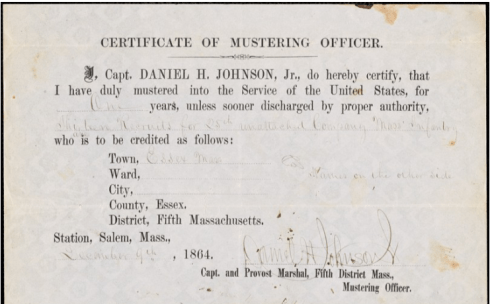
Stones can only tell you so much: if you want to want to know more, you need paper: the sources of the Civil War are plentiful and accessible in general but for Salem in particular, sparse, because of the removal of the Phillips Library.  With its present pledge to digitize more of its collections, this situation might change, but for now we are dependent on other repositories for glimpses of Salem’s Civil War history. Given Salem’s role as a regional center in northeastern Massachusetts, I was able to piece together a paper trail through two state digital databases, the New York Heritage and Digital Commonwealth, and a few other sources: this trail does lead us to the battlefield (or camp nearby) but is more evocative of the war at home. Salem emerges as a busy place of mobilization and recruitment, where young men from all over Essex County were mustered into service and dispatched to the major regional training camp in Lynnfield. At the beginning of the war, this is a process of enthusiastic volunteerism, but as it wears on it’s all about bounties and quotas. Massachusetts Adjutant-General William Schouler cited his own correspondence in his two-volume History of Massachusetts in the Civil War (1868) including this representative instruction to an official in Newburyport: Recruit every man you can; take him to the mustering officer in Salem and take a receipt for him. After he is mustered into United States service, you shall receive two dollars for each man. The officer will furnish transportation to Lynnfield. Work, work: for we want men badly. The correspondence between Daniel Johnson, the mustering officer and Provost Marshal in Salem who was responsible for recruiting men from Essex County in the last 18 months of the war and officials in the small town of Essex illustrates the intensifying local effort to meet quotas established by the state and federal governments.

MD Poster

MD Poster 2

MD POster 3

Civil War logistics 2

Civil War logistics 5

Civil War logistics DCRecruiting posters from 1861-1863, New York Historical Society via New York Heritage; Town of Essex Civil War records, 1864 via Digital Commonwealth.

Official records are illuminating yet necessarily focused on logistics; more intimate perspectives, bringing us closer to the camp or battlefield, can be found in diaries and journals. Two Salem soldiers recorded and projected their personal perspectives during and after the war: John Perkins Reynolds and Herbert Valentine. Reynolds (a grandson of Elijah Sanderson who was briefly detained by the British on the even of the battles of Lexington and Concord!) kept a diary of his service in the opening months of the war with the Salem Zouaves (at the Clements Library at the University of Michigan, and available here in print),  and also documented  his reminiscences of his time with the Massachusetts 19th (at the Massachusetts Historical Society). Valentine’s journals, scrapbooks, and visual impressions of the war are also in several repositories, including the Wilson Library at the University of North Carolina at Chapel Hill, the Z. Smith Reynolds Library at Wake Forest University, the Phillips Library, and the National Archives, which has digitized his watercolors of wartime scenes.
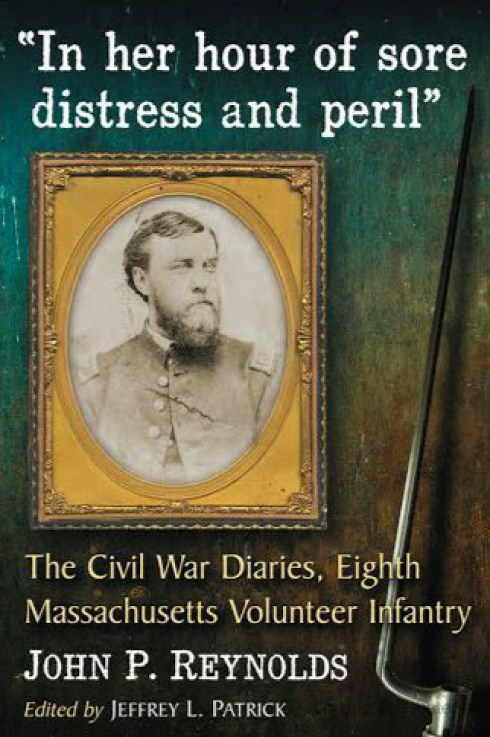
CIvil War Diary

Civil War Valentine 1

Civil War Valentine 2Valentine’s Virginia vignettes, 1863-64, National Archives.

These are not impressions that would have been available to contemporaries, but I think people who lived during the war would have have been exposed to its images and texts every day: posters, newspapers, the daily mail. A sea of Civil War envelopes survives, emblazoned with all sorts of colorful messages: surely this must be a fraction of what was produced and disseminated. According to its finding aid (which is online), the Phillips Library has 17 boxes of Civil War envelopes! Wow—-those will make quite a splash when they come online. My very favorite example (about which I wrote a whole blog post) depicting President Lincoln as the “Union Alchemist” was printed by Salem printers G.M. Whipple and A.A. Smith: I hope that there are more examples of their clever imagery in that Rowley vault.

Civil War Envelope - C-O-53 Library Co of Philadelphia Union Alchemist

Civil War Envelope 2

Civil War Envelope 3Library Company of Philadelphia and Richard Frajola.

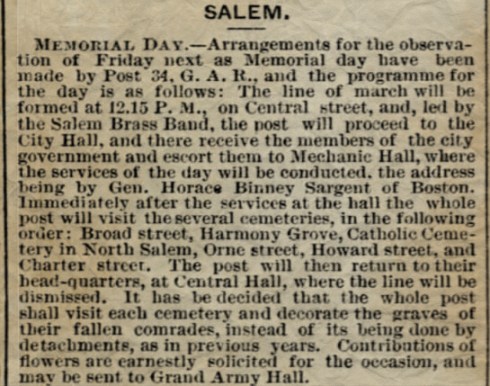
Newspaper accounts constituted a daily drumbeat and are thus too plenteous to consider here, but I did want to chart the beginnings of remembrance for this Memorial Day, so I looked at newspapers from the later 1860s and early 1870s—or so was my goal; I dug in and went quite a bit later. For the most part, the Salem story follows the national (or at least northeastern) pattern: in 1868 the first Commander-in-Chief of the Grand Army of the Republic declared May 30 to be Memorial Day and the Salem G.A.R obeyed his orders to the letter. I saw very few references to “Decoration Day”; Memorial Day seems to be have been the preferred designation right from the start. While local officials were invited to participate in the proceedings, the entire commemoration was a G.A.R affair until the early decades of the twentieth century. The only concerns expressed about the increasingly-ingrained “holiday” came right at its beginning and much later: an anonymous daughter of Civil War casualty expressed her concerns in 1870 that the proceedings were too commercialized, and certain members of the G.A.R leadership were profiting from supplying (see the C.H. Weber advertisement below), and much later the G.A.R itself expressed its concerns that a city-licensed circus was being allowed to operate on Memorial Day (see? protesting city-sanctioned circuses is a time-honored Salem tradition).

Memorial Day Salem_Register_1870-05-30_2

Memorial Day BG Mary 26 1873

Memorial day 1923 BG May 12

Memorial Day 30 May 1944 BGThe evolution of Memorial Day: C.H. Webber outfits participants for the occasion, Salem Register, May 19, 1870; Boston Globe May 1873, 1923, and 1944: the last GAR members in Massachusetts, including Thomas A. Corson of Salem, who died later that year at age 103.


Looking for Daniel Bancroft

If you walk down the streets of Salem looking at house plaques bearing the date of construction and first owner, you will quickly notice that a fair number of them will read “housewright”. There seem to have been so many housewrights in Golden-Age Salem around the turn of the nineteenth century, but only one architect of note: Samuel McIntire, of course. “Architect” is a rather fluid term until the later nineteenth century when the occupation was professionalized, but I’m wondering if there were any other designers, rather than merely builders, of structures in Salem before that time. One candidate is a colleague of McIntire’s, often described as his “chief assistant” or builder, a man named Daniel Bancroft (1746-1818). We have an absolutely glowing epitaph for Bancroft from the Reverend William Bentley, following his death from typhus in 1818 at the age of 72: “the most able Architect we had. We gave more to the genius of Macintire, as a Carver, but as a practical man in every part of Carpentry in house building, I have never known Mr. B’s superior.” [Diary, IV, 6] High praise indeed, although Bentley seems to be citing Bancroft’s craftsmanship rather than his design skills, and praising McIntire for the very same reason. In any case, Bancroft is a bit elusive: not only do you have to go through McIntire to get to him, but there is also considerable confusion between Daniel Bancroft the Elder (McIntire’s Daniel) and his son, Daniel Bancroft Jr., who was also a housewright. The “Daniel Bancroft House” on River Street, for example, was the home (and presumably the work) of the younger Bancroft. Around the corner on Lynn Street—perhaps #3—was his father’s house and workshop.

20190521_102707

20190521_102652

Bancroft July 1796Salem Gazette, July 1796.

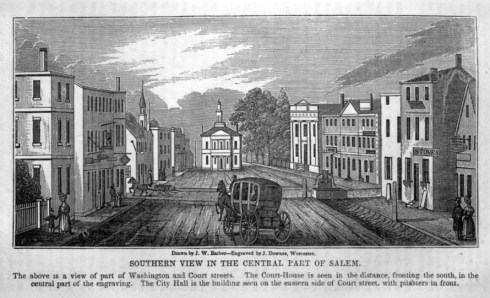
The earliest “commission” I could find for Bancroft is for the construction of a new church or meeting house in 1776-77 for the Third Congregational Church, later (and now) called the Tabernacle Church, as the church which replaced the colonial construction was inspired by London’s Metropolitan Tabernacle. The Tabernacle’s records have been digitized by the Congregational Library, and among them are payments to Bancroft, specifically in terms of days of labor. Bancroft exceeds mere workman status thirteen years later in an article in the March 1790 issue of Massachusetts Magazine about the Salem meeting/courthouse at the head of Washington Street, which states that its plan “was designed by the ingenious Mr. Samuel McIntire and executed by that able architect, Mr. Daniel Bancroft.” Clearly the word is used to refer to the builder, or executor, of McIntire’s vision, and I guess we can conclude that Bancroft was just that. But he built the most elaborate buildings in the Salem of his day: not just the Tabernacle and the courthouse, but also the Assembly House and the short-lived mansion of Elias Hasket Derby, which stood on the present site of Old Town Hall for only fifteen years. And likely much more.

Bancrofts Tabernacle Church.

Bancroft Tabernacle

Bancroft Court House

Bancroft Felt Courthouse

Bancroft salem-barber

20190521_103252

lost-mansion-old-shipmasters-of-salemThe Tabernacle Church of 1777-1854, from Samuel Worcester’s Memorial of the Old and New Tabernacle (1855); payments to Daniel Bancroft in the Tabernacle Church administrative records at the Congregational Library; Images of the McIntire courthouse from Massachusetts Magazine, George Washington Felt @ Peabody Essex Museum, and J.W. Barber. Drawing of the Derby Mansion from Charles E. Trow, Old Shipmasters of Salem (1905).

I’m sure that there is more evidence, material and textual, of Bancroft’s work and life; I can feel that there is a lot more to his story. If I had the time, I would: consult the McIntire papers at the Phillips Library in Rowley, explore Bancroft in records of the Symonds family of Salem, into which he married, and ascertain his possible connection (through McIntire, or alone) to the very Salemesque Thomas Symonds House in his native Reading. There is also his service in the 6th Massachusetts Regiment during the Revolutionary War to consider. For now, though, he remains an elusive figure: I couldn’t even find his gravestone in the Broad Street Cemetery where it is purported to be! There is a stone with a similar shape, but its inscription is illegible, as if symbolizing Bancroft’s ghostly presence in Salem.

20190521_124030


Cracking Open the Treasure Chest

There are two notable developments regarding the Phillips Library of the Peabody Essex Museum (PEM), the major archival source of Salem’s history, so (fair warning) I am returning to that troublesome topic. I don’t think I’ve written about the Library and its collections since the very beginning of the semester, when I made my first trip up to Rowley: out of sight, out of mind has been one of my major concerns about the relocation of this venerable collection to this rather detached location, and that’s pretty much been the case for me. The Library has regular open hours up there, the staff is very helpful, there are many discoveries to be made, but while I’m sure it is an invaluable repository for the curators of the Museum and specialized researchers, it’s hard to see how it could develop into any sort of a community resource, despite the nature of many of its collections. The PEM (or I should say its leadership to date) has never acknowledged the historical-society-origins of its amalgamated Library, so I’m sure that’s fine with them, but they have taken several strident steps towards open access in recent weeks with the hiring of a new Head Librarian and the announcement of a digitization initiative which will roll out in several stages. Following up on their partnership with the Congregational Library, which has made some important manuscript collections accessible, there are now some very interesting printed materials available in the Internet Archive, with lots more to come, apparently.

PEM atlasmaritime1700mort_0060There is a facsimile edition, but how amazing to see the original 1693 maritime atlas of Pierre Mortier, the “most expensive sea-atlas ever published in Amsterdam in the seventeenth century” according to the eminent Dutch cartographical historian Cornelis Koeman. Stunning plates of beautiful European ships: here is a “Tartane de Pesche”.

This is wonderful: certainly the PEM should be commended for cracking open the treasure chest that is the Phillips Library but I do want to emphasize that this “opening” has been a long time coming and is as much due to outside pressures as inside initiatives. Thanks to all the people who are keeping track of these things in Salem (and to digitization), I have in my (FAT) Phillips Library file a collection of published articles in which a succession of PEM representatives made confusing claims about the museum’s progress towards making its holdings more accessible. In response to a major push-back by scholars and librarians in 2004 after Library hours and staff were reduced dramatically, the PEM indicated that increased internet offerings would compensate for the restricted access. Then-acting “Library Administrator” John R. Grimes made the egalitarian argument that “many of the people interested—or potentially interested—in historical documents are not professional researchers, but students and laypeople with regular jobs, for whom the new digitization technology and the Internet proved access to knowledge they would otherwise never see” (Northeast Regional Library Newsletter, June 2004). A decade later, Phillips Library Librarian Emeritus Sidney Berger published an update on the progress of digitization in the Winter 2014 issue of Antiques & Fine Art magazinestating that in an effort to bring the PEM’s material to a worldwide audience, during the last two years, PEM’s Phillips Library, with the assistance of a team of cataloguers, has gone from having 9 percent of its holdings to more than 90 percent digitally accessible; financial gifts from donors have made this possible. The team has undertaken a retrospective conversion of 175,000 old cataloging records into the preferred Library of Congress system and catalogued another 75,000 previously unprocessed materials. The retrospective conversion connects PEM’s vast library holdings to researchers near and far. One of the particularly gratifying aspects of this project has been to make 50,000 singular, one-of-a-kind documents that only exist in PEM’s Phillips Library Collection available online. We could all see the online catalog, a momentous achievement certainly, but where were the “50,000 singular, one-of-a-kind documents”? No one could find them, and there was also confusion among the general public about the distinction between “records” and “holdings”: both can refer to catalog entries as well as the documents themselves. I think the long-term claims and confusion left PEM in a bit of a vulnerable position when they finally announced that the Phillips Library would not be returning to Salem, because it was apparent that there was no compensatory commitment to digitization. When pressed at the dramatic public forum on January 11, 2018, CEO Dan Monroe would only say that digitization was “expensive”.

PEM DMMr. Monroe at the 1/11/18 public forum at PEM.

So that is why the recent announcements are so welcome. Digitization goals are clearly stated. Mr. Monroe is departing, to be succeeded by Brian Kennedy, the director of the Toledo Art Museum, an institution that seems to have all of its collections online. The newly-hired head librarian, Dan Lipcan, has a great track record of digitization at the Watson Library at the Met (and, if this blog post about the devastating losses at Brazil’s Museu Nacional is any indication, a higher degree of sensitivity about the importance of material heritage to a locale than I have discerned from most representatives of the PEM). The chief of collections, John Childs, has been a pretty steady advocate for more digitization throughout, so I’m assuming that he is behind the initiatives that have already been put into place. The materials “deposited” in the Internet Archive seem very well-curated and seemingly representative of the Phillips Library’s diverse collection: local history, maritime history, natural history, fashion (not a strength of past collecting, but definitely a present and future emphasis), all about China, and more.

PEM Pickering

PEM journaloftravels1794saun_0005

PEM hamiltonhallerec0000fabe_0001

Essex Institute Annual Report 1988

PEM derbywharfsalemm1973dobr_0001

PEM Hats

PEM lebontondapresgu1192barb_0025

PEM horticulturalreg1112unse_0009

PEM Chinese Junks 1920

It’s very interesting to see the expansion vision that never happened on the front and back covers of the Essex Institute’s Annual Report from 1988, and I really want to dive into the Historic Structure Report for Derby Wharf from 1973, but I’ve also got to admit that I love George Barbier’s beautiful illustrations in Le bon ton d’aprèsguerre (the lady in the Poiret dress avec arrow above) and who can resist a book titled The Romance of Men’s Hats? But what I’m really looking forward to, along with many people, is the promised digitization of photographer Frank Cousins’ large body of work, encompassing images of Salem from c. 1890-1920. Apparently these are coming soon, and after that could we please see some scans from all those papers of Salem families? Almy, Butler & Robson, Crowinshield, Fabens, Lee, Loring, Peabody, Peirce-Nichols, Saltonstall, Waters……..my colleagues and I made a list if anyone’s interested.


Etching Salem

This is generally a beautiful time of year to take photographs around Salem but it’s been rather cold and dreary for the past few weeks, with the exception of a few isolated days. I’m sure that when everything dries out we will be living in a lush and green world, but for right now I’m more predisposed to take out a book than go outside. So after I finished my grading (always a celebratory moment), I curled up with some old architecture and photography books and soon realized that one “Salem artist” whom I have never featured is Philip Kappel (1901-1981), an etcher and book illustrator who spent several years working with Philip Little and in his waterfront studio off Derby Street. Kappel was not really a Salem artist: he was born in Connecticut, educated in New York City, and as he was employed by several steamship lines over his career, he traveled the world six times over, gathering materials for his etchings everywhere he went. But he did publish a lovely book in 1966 titled New England Gallery with several Salem images inside, as well as some interesting commentary on his time here.

20190514_161149

20190514_161436

20190514_161415

20190514_142244 See what I mean about the weather? But Kappel’s Ropes Mansion and Witch House hint at brighter and warmer days, even with no color!

20190514_161404

20190514_151427

20190514_161301

20190514_150116

Little Studio

20190514_161348The Custom House (which is celebrating its 200th anniversary this year) Derby Wharf Lighthouse, The Little Studio (just above the compass star)–where both Philip Little and Philip Kappel worked, in different seasons—and the House of the Seven Gables.

Kappel relates the standard histories of most of the Salem structures presented in New England Gallery but is more effusive about Chestnut Street because that is where his friend and mentor, Philip Little, lived. Little summered on MacMahan Island off Boothbay Harbor every year, and during a visit to the mainland he chanced upon a small exhibition of Kappel’s drawings and sought the young artist out. Kappel was teaching art in Boothbay, but Little thought he should and could do better, and offered him his Salem studio on Daniels Street Court, “hard by Salem Harbor, in the heart of the area which made Salem a great seaport in its heyday.” There, Kappel reveals, “inspired by its moods and reveling in its historic past, I never worked harder or produced more work. Every summer passed too quickly.” Kappel’s depiction of the Little house at 10 Chestnut Street includes the entrance pillars of Hamilton Hall, which gives him an opportunity to pass along a charming little anecdote:  Many years ago Philip Little took me on a tour through Hamilton Hall. As we were descending the long flight of stairs that led to the second floor from the first, I notices a series of large white circles painted on the top step, and a similar treatment accorded the last step. (I have since learned that the circles have been removed.) When I asked the purpose of this unusual feature, Philip Little forthrightly informed me that the circles served as warning signals for those who might have “sipped too long and too much at the punchbowl,” alerting them to the impending dangers of a fall when taking the first step into the space, the circles on the last step indicating that all was well; a successful landing had been effected. There is carpet on those stairs now, but having been to one or two enthusiastic events at Hamilton Hall over the years, I’m wondering if we should put those circles back!

20190514_161320

20190514_161311Chestnut Street


Step it up, Salem

Nothing helps to define the distinguishing characteristics of where you live better than travel. I’ve been traveling quite a bit over the past year, near and far, in the US and abroad, but generally to places which are identified as tourist destinations, like Salem. I’m always happy to return home, where I am more appreciative of Salem’s many advantages and resources, but also its lost opportunities, for lack of a better phrase. There are quite a few places that make do with with a lot less than Salem has: they might or might not have streets of historic architecture (though most of the places I visit do), they might not have a “marketable historic event,” they might not have a harbor, they might not have 100 restaurants, but they do have: 1) historical societies and/or museums that provide free exhibits and walking tours for the public; 2) museums that are actually museums–nonprofit institutions with collections and curators; 3) attractive and informative signage; and 4) a sense of pride expressed by effective stewardship of public properties—historical and otherwise. I think Salem could do a lot better; I think we need to step it up in these four areas in particular. I’m not sure how to do that, however, as I’m not really sure who is in charge of Salem’s tourism planning and administration. Free enterprise seems to reign over the city’s tourism, with private institutions taking primary responsibility for selling our city’s heritage, with a few very notable exceptions like the Salem Maritime National Historic Site and the House of the Seven Gables. There should be some role for our city government, but I’m not sure if that role has been defined or exists, so I’m going to make my key points in the form of questions and just cast them out there into the unknown.

Why can’t we ditch the Red Line? I’ve written a whole post about this and my feelings have not changed, so I’m not going to belabor the point, but the Red Line–as one of the few truly public history initiatives visible in the city—makes Salem look regressive (I’m sure it must be based on Boston’s Freedom Trail, which dates to 1951! Come on, times have changed in historical interpretation! Where is our app?) exclusive (there is no African-American history on the Red Line; at least Boston’s Freedom Trail intersects with its Black Heritage Trail. Salem has no Black Heritage Trail and no markers on black heritage sites), and exploitative (because it’s really all about shops and witch “museums” obviously). Plus it just looks bad. We can and should do a lot better: the foundation is already laid with some great tours produced by Salem Maritime and Essex Heritage  (here and here), among others. We just need to consolidate, repackage and go digital.

20190506_143128

20190506_142906Is the Red Line going to take us across North Street to the beautiful Peirce-Nichols House? Of course not, sharp left to the Witch House, after we’ve just been to the Witch Dungeon Museum.

Why can’t we transform this beautiful Greek Revival courthouse which is currently empty into the Salem History Museum and Visitor Center?  There is a nice display of placards providing an overview of Salem’s history called the Salem Museum at Old Town Hall and a Visitors Center with much more regular hours run by Salem Maritime in the drill shed of the former Salem Armory, but I think we need to consolidate these two services into one building and this former courthouse happens to be empty and in the possession of the Salem Redevelopment Authority (SRA). I’m sure the SRA wants to develop it–and its adjacent courthouse next door–but this would be a great spot for Salem to really own its history. It’s right across from the train station and its parking lot. Salem needs permanent and professional exhibitions of its entire history, including the Witch Trials, which has always been its biggest draw. Doesn’t Salem Maritime have its own story to tell? Why does it bear the primary responsibility for visitor orientation in Salem? We know that the Peabody Essex Museum is not interested in historical interpretation, but they might be persuaded to loan some things, as would the Salem State Archives (I think!) which has been collecting quite a bit of local history over the past few years. 

20190511_124916Two empty courthouses downtown: can’t ONE play a key public role?

Why can the city of Salem regulate tour guides but not “museums”? Most historical interpretation in Salem is offered by private tour companies and private “museums” which are really not museums at all: they offer presentations and dioramas rather than collections and context. (This is not just my opinion! Check out reviews for the Salem Witch Dungeon Museum, the Witch History Museum, and the Salem Witch Museum on Yelp or TripAdvisor: even the people that like these places say “this is not what you would think of as a museum.”) The City of Salem licenses tour guides, but anyone and everyone can open a museum. This seems like an inconsistent public policy regarding historical interpretation to me. The other issue with the “museums” and haunted houses is their seasonality: they can be absolutely deadening if situated in a central location, as is the case with the juxtaposition of the Witch History Museum, Count Orlock’s Nightmare Gallery and the delightful Witch Mansion or whatever it is called along central Essex Street. This is Salem’s main street and you can hear a pin drop on a Friday night as these places are shut up tight; I think the last two were open only in October even during the day–but as you will notice, the Red Line runs right by.

pixlr-2

20190508_153716Thank goodness for Wicked Good Books and the Hotel Salem, otherwise there’s not a lot going on on the Essex Street pedestrian mall, day or night. 

Why can’t we have consistent, attractive, and informative signage? And why do these private “museums” get to stick their signs on all over town on public utility poles?

20190511_140534

20190506_143549

20190506_143528

20190506_143339

Look at these signs! Clearly the owners of the Salem Witch Museum and Witch Dungeon Museum can just place signs wherever they like. I’m assuming the numbers on this last sign refer to the Red Line and (obviously) the Salem Trolley tour, another private purveyor of history in Salem. I think we need some contrast here, so here’s just one of a succession of well-designed signs I spotted around North Adams last weekend.

20190504_081421

While I’m on the subject of signs, I would be remiss if I didn’t commend the City of Salem for putting up some lovely neighborhood and park signs—which they have—but the information presented on these signs has to be correct. I’m particularly concerned about the sign for the relatively new Remond Park adjacent to the Beverly Bridge. This is a memorial to the Remond family, a very successful free black family in mid-nineteenth-century Salem whose members advocated for school desegregation, abolition and myriad other social justice issues while operating several successful businesses. It’s great that they have a park! It’s great that this park is one of only two Salem sites on Tufts University’s acclaimed African American trail project. But the sign has the wrong information: Salem had a vibrant African-American population in the nineteenth century downtown; there was not “a large population of African Americans” who lived in this rather remote section of Bridge Street Neck. As if the location of this park wasn’t off the beaten path (Red Line) enough, Salem’s African-American population is marginalized geographically by this sign, just as they are marginalized (or omitted) from Salem’s history.

20190511_132408

20190511_132347Bridge Street Neck was not “home to a large population of African Americans” in the 19th century: just check the city directories!

Why can’t we protect Salem’s sacred sites? Salem’s downtown cemeteries, especially the Old Burying Point or Charter Street Cemetery, are besieged during October: why can’t the gates simply be shut? I have seen terrible things in Charter Street: many tourists don’t seem to realize that it is a real cemetery rather than some sort of stage set. The City of Salem has an obligation to protect this sacred site, and it could do so by simply locking its gates. Salem’s Quaker Cemetery on Essex Street is always locked up; why can’t Charter Street be locked up for the month of October? This is a question that people have been asking for years and there is never any answer.

20190506_160646

20190508_152704