Category Archives: Salem

Sidney Perley’s Houses

Sidney Perley (1858-1928) exemplified that exhausting mix of endeavors—historical, genealogical, archaeological, architectural, legal, literary—which in his time was represented by the occupational identity of an “antiquarian.” It was a title he proudly bore, and one which had primarily positive associations a century ago. Now it is itself an antiquated term and I don’t know any historian who would refer to themselves as such. I’ve read pretty much everything Perley wrote about Salem, including the multi-volume History of Salem he published just before he died, and while I wish his work had a bit more context and interpretation, I still value it and think of him as a historian, primarily because he was so very focused on making early public documents public. His meticulous research and publication of probate records, deeds, and town documents was service-oriented; he was very much a public historian in his own time. And more than that: there is a famous dual characterization/division of historians by the French historian Emmanuel Le Roy Ladurie, who observed that they fell into one of two camps, either that of truffle hunters, “their noses buried in the details,” or of “parachutists, hanging high in the air and looking for general patterns in the countryside far below them.” Perley was the ultimate truffle hunter, and I’m grateful for all of the detailed information he dug out for me. Because he was trained as a lawyer, Perley’s publications on local history are overwhelmingly based on deed research, and this focus made him somewhat of an architectural historian as well: he sought to portray the built environment, not just land grants and transfers. His wonderful little series of “Parts of Salem in 1700” (and other Essex County towns too), first published in the periodical Essex Antiquarian and/or the Historical Collections of the Essex Institute and later incorporated in the the History of Salem, always included charming illustrations of houses, both on his hand-drawn maps and in the text. Now while I trust Sidney Perley completely in his dates for the construction, transfer, and demolition of these houses, sometimes I think he displays a little artistic license in their depiction. But maybe not: I’m just not sure.

The Essex Antiquarian Volume III (1899).

I’m not sure because sometimes he is a bit vague about the sources for his house illustrations. I would say that I have complete confidence in the depictions of about three-quarters of his illustrations: they were still standing in his time, or had been recently demolished, or had been sketched or photographed before demolition. But with some houses, he is relying on the memory of an anonymous elderly gentleman who gazed at the house early in his life, or on an undated sketch by an anonymous artist found in the depths of the Essex Institute. I’m always interested in the early days of historic preservation, or the first stirrings of some kind of preservation consciousness, so the depictions of these first period houses by Perley and his fellow antiquarians are just fascinating to me: their visions created houses that are still showcased in Salem, most notably the House of the Seven Gables and the Witch (Jonathan Corwin) House. Their visions shaped our visions of the seventeenth century. I like to imagine Perley’s houses still standing, and the best way to do that is to map them: my progress in the acquisition of digital mapping skills stopped as soon as I got my book contract in the summer of 2020, and as I am now working on another book it will stay stalled for a while, but I can cut and paste with the best of them! I am using Jonathan Saunder’s 1820 map of Salem from the Boston Public Library as the background for an evolving Perley map here, but later maps, with more crowded streets, really make these structures stand out too: they must have been so very conspicuous in Perley’s time. I find it interesting that in Europe, very old and very modern structures can coexist, side by side, but we seldom see that in America.

Jonathan P[eele?] Saunders / Engraved by Annin & Smith, Plan of the TOWN OF SALEM IN THE Commonwealth of Massachusetts from actual Surveys made in the years 1796 & 1804; with the improvements and alterations since that period as Surveyed by Jonathan P. Saunders. Boston, 1820. Proceeding clockwise rather haphazardly from the Epes House, on the corner of the present-day Church and Washington Streets, to the Lewis Hunt House, which was photographed before its demolition.


The MacCarter and Bishop Houses: the latter burned down in the 1860s but was fortunately sketched a few years before.


Some survivors in this bunch! The John Day House survived until Frank Cousins could photograph it in the 1890s (Phillips Library, Peabody Essex Museum), I’m not sure if Perley’s “John Beckett” house on Becket Court is the “Retire Becket” House on the House of the Seven Gables’ campus? Half of the Christopher Babbidge house survives to this day, though it moved to the parking lot of the 20th century building which replaced it.


The Era of Excessive Mourning

I’m giving a talk at the end of the month on the impact of the Reformation on the theology of death and practice of mourning, on both sides of the Atlantic in the seventeenth and eighteenth centuries. I’ve got the former down, but I’m a bit confused by the latter, and particularly by the rise of large, elaborate funerals from the later seventeenth century. Puritans in both old and New England modeled their mourning on the Calvinist disdain for the Catholic culture of death, with its emphasis on transcendent saints, purgatory, prayers, rituals, and material remembrance. As there was nothing that the living could do to facilitate the passage of the deceased into heaven, funerals should be short and simple, and excessive monuments could easily trespass into the territory of idolatry. That’s the ideal, but was it the reality? The most straightforward directive for funerals, the Directory of Publick Worship (1647) of the Westminster Assembly charged with reforming the Church in the midst of the English Revolution, asserted that because the custom of kneeling down, and praying by or towards the dead corpse, and other such usages, in the place where it lies before it be carried to burial, are superstitious; and for that praying, reading, and singing, both in going to and at the grave, have been grossly abused, are no way beneficial to the dead, and have proved many ways hurtful to the living; therefore let all such things be laid aside on the one hand, and on the other that the Christian friends, which accompany the dead body to the place appointed for publick burial, do apply themselves to meditations and conferences suitable to the occasion and that the minister, as upon other occasions, so at this time, if he be present, may put them in remembrance of their duty. Meditations? I get that, but conferences could clearly be held in the pub after the burial. The Directory’s final say on funerals, that this shall not extend to deny any civil respects or deferences at the burial, suitable to the rank and condition of the party deceased, while he was living relays what happened: as the religious significance of the funeral was lessened, their social roles increased, as an expression of the deceased (and their families) status in society. Monument comes to mean something a little more…..mobile.

Every little detail of the funeral of Robert Devereux, the 3rd Earl of Essex and first General and Commander of the Parliamentarian Army, is included in this 1646 broadside.

Essentially what happened is that funerals became more for the living than for the dead. Perhaps they always were, to some extent, but the Reformation extended that extent considerably. Over the course of the seventeenth century, we can see this consequence in print, in broadsides publishing funeral sermons and elegies, as well as the new funeral custom: the issuing of funeral “tickets”.

A Selection of Funeral Tickets from the British Museum.

Across the pond in British America, there weren’t many funeral tickets, but there were lots of printed elegies, and lots of gifts dispersed to the (presumably invited) mourners by the family of the deceased: the traditional ring, the occasional “scarf”, and gloves, so many gloves. The custom of gifting the minister and pallbearers with white gloves seems to have been extended to include everyone who attended the funerals of former members of wealthy New England families in the first half of the eighteenth century: the family of Andrew Faneuil dispensed 4000 pairs of gloves to mourners in 1738! This custom was burdensome to many families, obviously, and the Massachusetts General Court passed “An Act to Retrench the Extraordinary Expence in Funerals” in 1742, ordering that “no scarves, gloves (except six pair to the Bearers, and one pair to each Minister of the Church or Congregation where any deceased person belongs), wine, rum, rings shall be allowed at any Funeral, upon the Penalty of Fifty Pounds,” an extravagant fine for extravagant funerals! As you can see below, Charles Apthorp’s Boston funeral reverted to past practice in 1758 after the act ran out, as his family distributed 95 pairs of gloves to attendant mourners. The attempts of local and provincial governments to regulate “excessive mourning” in the eighteenth century illustrate another consequence of the Reformation: the so-called “secularization of the parish”:  it was the state, or the assembly, or the town, which regulated funeral practices, not the Church. In his multi-volume History of Salem, Massachusetts (1924), Sidney Perley reports that in 1697, the town’s selectmen established rules about both the ringing of bells and the order of processions for funerals: ministers had no say.

Major Thomas Leonard’s funeral elegy, Library of Congress; a mourning ring for Edward Kitchen of Salem, Yale University Art Gallery; Announcement of the 1742 Act; Charles Apthorp portrait by Robert Feke (Cleveland Museum of Art) and a list of the 95 gloves dispensed by his family on the occasion of his 1737 funeral, King’s Chapel.

I had no idea that “excessive mourning” was such a conspicuous issue in colonial British America, so was particularly surprised to see the First Continental Congress address it by including elaborate funerals with other forms of “expensive” diversions” which were prohibited: just a black ribbon or crepe armband or necklace, and no funeral gifts of scarfs and gloves. After the Revolution, elaborate funerals must have returned, and so did the penalty system: the selectmen of Boston and Salem issued very detailed and stern warnings against excessive funeral gifts and dress in 1788 in an attempt to encourage an “economical plan of mourning.” By this time, I think the era of elaborate funerals was coming to an end, only to be revived and extended by the Victorians, of course. When Mary Ball Washington died in the following year, newspapers across the new country lauded the first President’s restrained mourning for his mother, as “the heart that mourns need no external sign to speak the agony that preys within.”

The size and customs of funerals are just one avenue into this big topic, but I’m wondering if these showy funerals represent the triumph of a a transatlantic Anglicanism over Puritanism, among other themes and trends. On a more material level, I’m also wondering if coffins became more common in North America, land of a million forests, than still-shrouding Britain in this period! Fortunately I’m giving this talk with my colleague Tad Baker, an expert on colonial material culture (as well as the Witch Trials and myriad other topics), so he can speak to the issue and other details of the built landscape of the Old Burying Point on Charter Street in Salem, the sponsor of our event. I’ve got some things to say about early modern European cemeteries, but he has a lot more expertise in this realm.

Here’s the link to our talk, “The Protestant and Puritan Way of Death,” for the Charter Street Welcome Center: https://www.facebook.com/events/1275084503014361/

And here are some great resources—I’ve got to continue brushing up on this topic myself so I welcome more suggestions!

Craig M. Koslofsky, The Reformation of the Dead: Death and Ritual in early modern Germany, 1450-1700.

Thomas W. Laqueur, The Work of the Dead. A Cultural History of Mortal Remains. 

Peter Marshall, Beliefs and the Dead in Reformation England 

Steven C. Bullock, “Often Concerned in Funerals:” Ritual, Material Culture, and the Large Funeral in the Age of Samuel Sewall” New Views of New England: Studies in Material and Visual Culture, 1680-1830, eds. Martha J. McNamara and Georgia Barnhill (2012: available here).

Steven C. Bullock and Sheila McIntyre, “The Handsome Tokens of a Funeral: Glove-Giving and the Large Funeral in Eighteenth-Century New England,” William and Mary Quarterly 69 (April 2012).


What About Fort Pickering?

I love commemorations: I have posted about them often here, particularly at the beginning of a new year like 2020, during which the long-planned commemorations (of the achievement of women’s suffrage, the Mayflower voyage, and the bicentennial of the state of Maine) didn’t quite go off as planned, obviously. As I spend much of my time thinking about the past, I relish any moment in which a more collective present is so engaged. In four years’ time, Salem is going to be thrust into a big commemorative year, even bigger than 2020 and hopefully more celebratory and reflective: 2026 will mark the 250th Anniversary of the beginning of the American Revolution and the 400th anniversary of the first European settlement in Salem. Revolution 250 has been planning the regional observance of the Revolutionary anniversary for quite some time in a collaborative and dynamic manner, because “commemorations bring people together.” I think there is some Salem participation in this effort, but I’m really not sure. I’m even less sure about what is being planned for Salem’s 400th anniversary: when I look at the organizing that has been going on in two other cities facing big anniversaries, Portsmouth and Gloucester, I see much more organization than is in evidence here in Salem, but then again these cities’ 400th anniversaries are next year so they better have their acts together! Salem certainly has time, but from what foundation and inspiration will it proceed? Who is in charge and who is involved? What will “Salem 400” entail and hope to achieve? I google that term from time to time but all I get is this. Without a professional historical society or heritage commission to shepherd such an initiative, there is no doubt that the 400th anniversary of Salem’s founding will be a much more “top-down” initiative than that of its sister cities, or even its own Tercentenary, which inspired a multi-layered calendar of commemorative events and expressions, including a parade of 10,000 participants, pageants and performances, musters and medals, open houses, bonfires, and headlines in national newspapers.

Official Tercentenary Program, 1926: you can see some great photographs of the events here.

I can’t imagine 10,000 people turning out for a Quadricentennial parade in 2026! The past century has transformed history into a product in Salem, something to be exploited rather than contemplated or celebrated. A singular focus on 1692 seems to have deadened the city’s interest in nearly everything else, save for the occasional nod to the military or the marginalized. I’m not sure how anyone can engage in history in Salem, save for nostalgic facebook postings. The few references to plans and goals for 2026 seem to acknowledge this by emphasizing places over people, and the present over the past: foremost among them is Mayor Kimberley Driscoll’s “Signature Parks Initiative,” which is “focused on planning and carrying out improvements and preservation work in six of Salem’s busiest and most beloved public parks and open spaces, ensuring that they will remain available and enjoyable for future generations to come: Forest River Park, Palmer Cover Park, Pioneer Village, Salem Common, Salem Willows and Winter Island.” Certainly this initiative is welcome, and will be beneficial to Salem’s residents (as will more trees, also a part of “quadricentennial planning”) but is it commemorative? Is it engaging, inspiring, and challenging the public, as opposed to simply providing for them? Maybe it is for some, or even many, but not for me: I want more history—and more humanity—in my quadricentenary. Compare Mayor Driscoll’s Signature Parks Initiative with the centerpiece of the Gloucester 400 commemoration: the 400 Stories Project, “a citywide undertaking whose goal is to collect, preserve, and share 400 stories of Gloucester and its people” from 1623 until 2023. The Project’s administrators invite Gloucester residents to “help us make history” by sharing their stories. This is a pretty sharp commemorative contrast between these two old Essex County settlements.

“Our People, Our Stories”: I wonder what the tagline of Salem’s Quadricentenary will be?

So far the most conspicuous work of the Signature Park Initiative in Salem has been in evidence at Forest River Park in South Salem: one end of the park now features new public pools and trails along with an enlarged and renovated bathhouse while the other is slated for a dramatic alteration revolving around the exchange of the Colonial Revival reproduction “Pioneer Village” currently situated there with the YMCA camp formerly located at Camp Naumkeag in Salem Willows. The writing has been on the wall for Pioneer Village, built for the Massachusetts Tercentenary of 1630, for quite some time as the City has neglected its buildings and landscape for decades and expanded the adjacent baseball field more recently. However, the exchange plan has hit a snag recently, as the City had to apply for a waiver of its own demolition delay ordinance before its own Historical Commission in order to remove the buildings at Camp Naumkeag, which was first established as a tuberculosis camp over a century ago. So far this waiver has not been granted, and a notable resistance to both the destruction of Camp Naumkeag and the relocation of Pioneer Village has emerged. I wrote about Pioneer Village at length last summer, and I have been rather ambivalent up until last month, when several admissions shifted me into the wary and possibly-even-opposed zone: I’m still thinking about it as I find it a particularly vexing public history problem! This is an ambitious plan: Pioneer Village is not simply going to be relocated but rebuilt and re-interpreted with the addition of a visitors’ center and a new focus on the relationship between the European settlers and the indigenous population of pre-Salem Naumkeag. This is an admirable goal for sure, but to my ears, the new interpretive plans sound vague, simplistic and ever-shifting, and above all, lacking in context. They are supposedly the work of the numerous consultants who have worked on the project, paid and unpaid and including several people whom I admire, so it might just be a matter of presentation, but there are several statements that I find concerning. In the first Historical Commission hearing, one consultant responded to the argument that Camp Naumkeag was itself an important historical site because of its role in public health history with an assertion that that role would enhance the new Pioneer Village’s focus on the virgin soil epidemic which devastated the indigenous population even before settlement, as if infectious diseases were interchangeable and detached from time and place! [“Pioneer Village Complicated by History,” Salem News, September 16, 2021] Several months later, the City posted its plans on its website, with this all-encompassing but yet incomprehensible statement of goals: increased access and visibility to the breadth of Salem’s history as represented by the breadth of the site’s history, including Salem Sound’s natural history, the original inhabitants, Fort Lee and the Revolutionary War, the Willows, Camp Naumkeag, and the Pioneer Village. So now it seems as if the newly-situated Pioneer Village will be utilized to interpret almost the entirety, or breadth, of Salem’s history, and in a space which the accompanying plan revealed will have parking for only ten cars. In terms of both interpretation and logistics, this is a flawed plan as presented: its reliance on the seasonal trolley for access is confirmation of its orientation to tourists over residents as well as its seasonal status, in contradiction to the breadth of its stated goals and costs.

The current Plan for the new Pioneer Village on Fort Avenue, on the site of the present-day Camp Naumkeag.

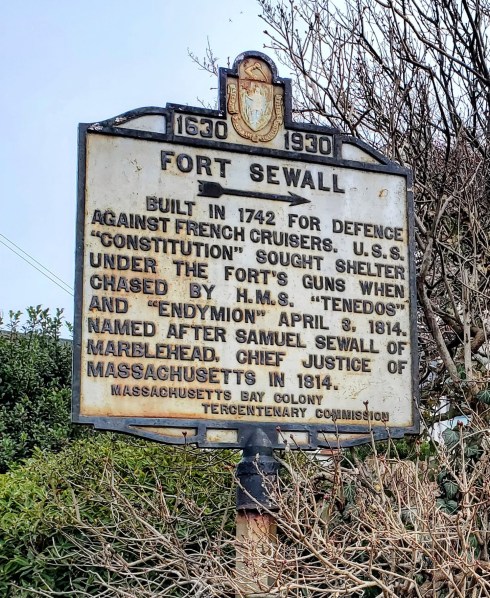
While at face value the inclusion of yet another long-neglected Salem historical resource, Fort Lee, looks like a good thing, I find it concerning. Why should Fort Lee be included in the interpretation of the faux Pioneer Village and not its very authentic (and far more important) neighboring fort on Winter Island, Fort Pickering? This is the guiding principle of the the 2003 study commissioned by the City and the Massachusetts Historic Commission, the Fort Lee and Fort Pickering Conditions Assessment, Cultural Resources Survey, and Maintenance and Restoration Plan: that the forts should be “restored, maintained and interpreted together [emphasis mine] as part of the Salem Neck and Winter Island landscape for enhanced public access.” To its credit, the City has begun a phased rehabilitation of Fort Pickering, but I see much less energy and far fewer resources committed to it than to the Pioneer Village project, which is perplexing given its authenticity and historical importance. Winter Island has served successively as a fishing village, a shipbuilding site, and in continuous military capacities from the very beginning of Salem’s settlement by Europeans to the mid-twentieth century.  The storied fortification which became known as Fort Pickering in 1799 was built on the foundation of the British Fort William, part of a massive effort by the new American government to fortify its eastern coastline beginning in 1794 under the direction of French emigré engineer Stephen Rochefontaine. Fort Pickering was manned, and rebuilt, on the occasions of every nineteenth-century conflict, and was especially busy during the Civil War. Another regional Rochefontaine fort, Fort Sewall in Marblehead, shines under the respectful stewardship of that town. Salem is so fortunate to have so much built history:  why can’t we focus our energies and resources on preserving and re-engaging with authentic sites, rather than creating new ones? (And could someone please find our SIX Massachusetts Tercentenary markers? Every other town in Massachusetts seems to have held on to theirs).

Talk about a site that can illustrate the BREADTH of Salem history: Winter Island was an early site for fishing and fish flakes (and even more substantial “warehouse” structures) as well as the location of Salem’s first fort William/Pickering. The Salem Frigate Essex (depicted by Joseph Howard) was built adjacent to the Fort in 1799, and Winter Island also served as the site of Salem’s “Execution Hill” in the later eighteenth and nineteenth century and of a Coast Guard air station from 1935-70. Members of the US Coast Guard Women’s Reserve, or SPARS, were stationed on the island during World War II. Rochefontaine’s 1794 plan and block house sketches and Frank Cousins’ photographs of the island and fort in the 1890s, Phillips Library of the Peabody Essex Museum. Marblehead’s Fort Sewall on the last day of December, 2021.


Salem Sustainability; or the Most Charming Memoir Ever

I came across a delightful short memoir quite by accident yesterday; it was so well-written and charming that I couldn’t stop thinking about it so I decided to write about it today to get it out of my head! It’s not about any BIG thing or event; in fact, it’s about a very little thing, what we might call an accessory today, and something we might not have thought much about at all before the pandemic: handkerchiefs in general, and “bundle handkerchiefs” in particular. “The Bundle Handkerchief ” was published in The New England Magazine in 1896 by Elisabeth Merritt Gosse, a Salem native and emerging newspaperwoman, who would go on to have a very successful career writing principally for the Boston Herald. It must have proved popular as it was issued as an illustrated pamphlet a few years later: I would love to get my hands on this! It’s such a simple story of how people wrapped up their purchases or possessions in the nineteenth-century, in handkerchief bundles of all cloths: gingham and calico sold at Mrs. Batchelder’s or Miss Ann Bray’s shops, the ‘finest white India silk” for ladies’ hats, lawn, linen or muslin for more intimate garments, Madras for new gowns as they made their way home from the dressmakers’, and “pale pink and blue gingham plaids” for shirts and spencers. Yet it is also revealing: of what people are doing and buying and wearing in very specific detail. l learned about all sorts of shops and customs of which I was previously completely unaware in its jam-packed three pages.

The bundle handkerchief as art: Alfred Denghausen, 1936, National Gallery of Art.

Apparently one could not even enter this world properly (or be introduced to it) without a bundle handkerchief! Is this where the stork with the bundled baby comes from? According to Elisabeth, No Salem infant, even without the requisite number of great-grandfathers and grandmothers, could be considered to have been properly introduced to society until it had dangled in a bundle handkerchief from a pair of steelyards, while its weight was recorded in the family Bible at the end of the family pedigree. She also included her own childhood memory of accompanying the family servants, armed with “two great bundle handkerchiefs of coarse blue and white checked gingham” to Mr. Hathaway’s bakery on Sunday mornings after church to retrieve the baked beans and brown bread which had been placed in his cavernous oven the day before. Salem women packed their soldiers’ trunks with prayer books from Mr. Wilde and medicine chests from Mr. (not Mrs.?) Pinkham, as well a selection of fine new bundle handkerchiefs, and three of these, of dark red silk, with the name embroidered in one corner, came home in one soldier’s trunk, brought by a guard of honor; for Salem gave the first of the Essex County heroes who laid down their lives for their country in the war of the Rebellion, as she did in the war of the Revolution. I wonder if she is referring to her own father here, Lt. Colonel Henry Merritt, who was killed at the Battle of New Bern in March of 1862.

Not blue and white, but the best I could do: a recipe card from the 1950s; Mr. Hathaway’s Bakery or the “Old Bakery” (now the Hooper Hathaway House on the campus of the House of the Seven Gables) in its original location at 21 Washington Street, Historic New England; Elisabeth Merritt Gosse in 1905, upon the occasion of the dedication of a boulder commemorating her father’s regiment near Salem Common.

Elisabeth Merritt Gosse recounts her last memory of a bundle handkerchief on the streets of Salem, wrapped around a book and carried by Mr. John Andrews in and out of the Salem Athenaeum, and observes that her title topic is as vivid a bit of color in Salem’s history as is Alice Flint’s silk hood, the frigate Essex, the North Bridge or even the House of the Seven Gables; and to speak of it calls up a long line of Salem’s sires and dames who took pride and pleasure and comfort in its use. [Another Salem memoirist, Harriet Bates or “Eleanor Putnam,” went even further: “The bundle handkerchief is as essential a figure in Salem history as the witches themselves.”] The bundle handkerchief’s time had passed in 1896, however, replaced by paper and string, prosaic, rustling, tearable, and to be quickly thrown aside and thrown away. This is not a good development in Elisabeth Merritt Gosse’s estimation, but as she died at the venerable age of 86 in 1936, we can at least be glad that she didn’t live long enough to see plastic.

Elisabeth Merritt Gosse was referencing the OLD Salem Athenaeum, now one of the Peabody Essex Museum’s empty buildings further up on Essex Street, but as I happened to be walking by the present one today, I snapped this photograph.


A Mysterious Matron and other Salem Cookbooks

Salem has a brand new cookbook out just in time for the holiday season: Salem’s Cookin‘, the Official Chamber of Commerce Cookbook. I kind of wish it had more historical recipes, as Salem has quite a few culinary claims to fame, but I’m sure I’m the only person with this wish as it features a range of recipes for dishes served at the city’s most popular restaurants and offerings from other establishments and individuals which seem surprisingly doable. It’s a very practical cookbook as well a showcase of Salem’s culinary landscape. Still, I’d rather read about food than attempt to make it so I thought I would mark the occasion with a survey of Salem cookbooks, beginning with the serious and mysterious The American Matron; or Practical and Scientific Cookery published in 1851 by an anonymous “housekeeper” who lived in Salem. This housekeeper was quite the cook, quite the chemist really, and quite the writer, and I’ve been trying to find out who she was for quite some time, with no success.

As its title implies, The American Matron is a very practical cookbook as well, so practical that it often seems as concerned with preventing food spoilage and consequential poisoning as offering up recipes that are easy to make and pleasant to eat. The instructions for pickle storage below are very representative of its author’s tone throughout: warning her readers not to keep their pickles in pottery or metal containers due to arsenic and acid, she concludes that One may not be instantly poisoned after eating pickles prepared or kept in such vessels; but if constantly used, a deleterious influence must be operated on the health from this cause, even when lest suspected. This is a text which begins with the proper storage of water and reads more like a public health manual than a cookbook in places, but it also includes scores of recipes for both traditional New England dishes as well as more exotic concoctions featuring ingredients from around the globe, highlighting Salem’s continuous seaport status. There are a lot of interesting seafood recipes in particular, all stressing the necessity of using just-off-the-boat ingredients. It is also a manual for housekeeping, containing instructions for dyes, cleaning agents, and pest control that one might see in the more random printed recipe collections of the early modern era: my favorite is her very nineteenth-century prescription for  how to remove the black Dye left on the skin from wearing mourning in hot weather. That’s a predicament I never considered before reading this book!

I can’t find any Salem cookbooks from the later nineteenth century, so I guess that brings us to a collection of historical recipes gathered together under the title What Salem Dames Cooked and published as a fundraiser for the Esther Mack Industrial School in 1910. Like many Salem creations of this particular time, this little volume expresses a Colonial Revival view of the past with its ye olde type and terms, and it was reissued about a decade ago in a glossy reprint so it is widely available. Moving forward another half century, the Hamilton Hall Cook Book was published by the Chestnut Street Associates as a fundraiser for Hamilton Hall just after World War II. Its recipes are quite minimalist, but as it contains both the iconic 1907 photo of Hall caterer Edward Cassell and a lovely illustration of the Hall’s Rumford Roaster I think it must be my favorite Salem cookbook. Old copies turn up on ebay rather regularly but I think Hamilton Hall should reprint it!

A Mary Harrod Northend photograph of the students at the Esther C. Mack School, Historic New England; Mr. Cassell making his deliveries in front of the Peirce-Nichols House.

I am sure there must be more later twentieth-century Salem cookbooks: perhaps issued by ladies’ committees of a church or the Hospital? But the only one I have in my possession is Served in Salem, published in 1981 by the Ladies Committee of the Essex Institute. Both the Hamilton Hall Cook Book and Served in Salem feature lots of recipes with ready-made, canned and frozen ingredients, in stark contrast to The American Matron: twentieth-century cooks didn’t have to worry about preservation and were apparently interested in as many shortcuts as possible. Served in Salem emphasizes entertaining: there are many “party” dishes and featured table settings which showcase the Essex Institute’s collections. Like its Chestnut Street predecessor, however, Served in Salem also features several nods to the past, including a letter from Sally Ropes Orne to her brother Nathaniel which reveals in great detail the Christmas dinner she served to her guests in the family mansion in 1848. It’s so great, and brings us back to the time of of The American Matron, though Sally writes from the perspective of a gracious hostess rather than a practical housekeeper. The dinner began with a toast with sherry, Maderia and hock (which she disdains as too expensive for the taste), then came in the oyster soup, followed by boiled chickens and a ham with caper sauce, mashed potatoes and squash. The next course featured a “noble turkey” accompanied by gravy and liver sauce and more mashed potatoes, this time “browned on top and marked off in diamonds,” which was followed by deserts: plum pudding with hard sauce, mince pies, and cream pudding. Everything was then removed, including the white tablecloth, and the meal was completed with Baldwin apples, grapes, nuts and raisins, along with more sherry. She concludes that “every article was charmingly cooked” and assures her brother that the day went off finely.

Christmas Dinner Service in the Ropes Mansion, from Served in Salem (1981).


In Which I Try to Understand the Peabody Essex Museum’s Current Exhibition on the Salem Witch Trials

The Peabody Essex Museum (PEM), located here in Salem, deserves considerable credit for engaging in and with the history of the city’s trademark event, the Salem Witch Trials, in a series of exhibitions featuring authentic documents and objects beginning last year and continuing this year with The Salem Witch Trials: Reckoning and Reclaiming. For several decades prior, the PEM ignored the trials, and by association, the flocks of tourists who converged upon Salem because of their escalating exploitation. During this time, I always hoped that the PEM would offer some sort of exhibition to counter the commodified interpretations of the trials (or some essence thereof) which reign in Salem, and it has. Last year’s exhibition, The Salem Witch Trials 1692, was a little spare, but the authenticity of its items and the straightforward manner in which the story was told was striking, especially in the context of schlocky October Salem. But this year’s exhibition is……much more murky: I simply don’t understand what I’m supposed to take away from it, both in terms of “reckoning” and “reclaiming,” especially the former. Connecting the past to the present is a complex task, or maybe I’m just missing the links made, so I thought I would “write it out”.

Judge Jonathan Corwin’s Trunk: Corwin was a justice on the Court of Oyer and Terminer, which presided over the Salem Witch Trials, and his Salem house is now known as the “Witch House”.

I briefly visited this exhibition shortly after it opened in September, and returned yesterday with several students in my freshman seminar on the Trials: they are going to be writing reviews for our class, so we’ll see if they have grasped it better than I! There are three parts to Reckoning and Reclaiming. You enter into the world of seventeenth-century Salem, armed only with a map and a very brief panel introduction to the trials, and represented by objects or “material manifestations” belonging to people swept up in the trials: Judge Corwin’s trunk (above), victim John Proctor’s sundial, a loom belonging to one of the members of the accusing Putnam family, embellished with symbols of counter-magic, as well as documents related to the legal process of the Trials. The second part/room takes you, via a timeline on the wall and more primary-source documents, through the more focused prosecution of victim Elizabeth Howe of Ipswich and into the present, represented by a glittery black dress from her descendant Alexander McQueen’s Autumn/Winter 2007 collection entitled “In the Memory Of Elizabeth How, Salem 1692.” Still in the present, you (we) move on to the last part of the exhibition: photographs of modern witches by Frances F. Denny, who is also a descendant of a Trial participant, Judge Samuel Sewall, as well as a woman prosecuted for witchcraft in Boston in 1674, from her series Major Arcana: Portraits of Witches in America.

Edward Payson’s Testimony on behalf of Elizabeth How(e).

All the constituent parts of this exhibition are interesting and well worth your time, but how are they connected? And who is doing the reckoning and the reclaiming? The exhibition, or us? I discern responses on the part of descendants McQueen and Denny but I always though reckoning and reclaiming were a bit more intensive activities. I looked up both words in the Oxford English Dictionary in order to get some guidance.

Reckoning: The action or an act of giving or being required to give an account of something, esp. one’s conduct or actions; an account or statement so given. Also: an occasion of giving or being required to give such a statement; a calling to account. A calling to account! That’s it: so who is being called to account in this exhibition? The afflicted girls, the judges, the people of Salem? Nope, no reckoning on their parts is in evidence. Survivor Philip English’s 1710 statement “What a great Sufferer I have been in my Estate by reason of the Severe prosecution of me & my wife in that Dark Time”, as well as the 1712 petition for compensation by the daughters of victim Elizabeth Howe are included in the exhibition, but not the apologies issued by accuser Ann Putnam, members of the jury, and Judge Samuel Sewall. We can read the poignant testimonies of those who spoke up for the accused (and these are my favorite objects of the exhibition) but the swift, even jarring, movement into the present makes it seem as if redemption is not possible in the past. Before I saw this exhibition, the use of the word “reckoning” in its title was enticing to me as I thought we were going to be presented with an historical view of how people who lived through the Salem Witch Trials wrestled with what they had experienced in its aftermath, but we are not presented with a full accounting.

Reclaiming:  Wow, this is a word that has many meanings and forms! Everything from falconry to recycling. I think the meaning that is relevant here is this one: To reassert a relationship or connection with, or a moral right to; (now frequently) to re-evaluate or reinterpret (a term, concept, etc., esp. one relating to one’s own demographic group) in a more positive or suitable way; to reappropriate. Clearly the exhibition is emphasizing the reappropriation of the word “witch” in our time through the creations of Alexander McQueen and the photographs of Frances F. Denny (along with the words of Denny’s subjects, who are all very expressive and assertive). But what does this reappropriation have to do with the victims of 1692 who were not, of course, witches? Again, the shift from past to present seems jarring, and the connective thread very thin, essentially McQueen’s and Denny’s lineage (and there about a million descendants of Witch Trial victims out there). Denny’s portraits are compelling for sure, so much so that they seem to constitute another, separate exhibition, tied to the first only through a word (and a dress?).

The Salem Witch Trials: Reckoning and Reclaiming is on view at the Peabody Essex Museum until March 20.


A Samuel McIntire Sofa

There is an extraordinary auction coming up in a few weeks at Skinner featuring the art and antiques of a Beacon Hill couple. Among the maritime and China Trade paintings and colonial furniture is an amazing c. 1805 mahogany sofa attributed to Salem’s Samuel McIntire, described as carved with a “crest with rectangular panel and shaped flanking panels, all with punchwork ground, the center panel with basket of fruit, the shaped panels with flowers and scrolls, above leaf-carved arms and turned waterleaf-carved supports, all on turned tapering legs” and listed with an opening bid of $15,000 and an estimate between $30,000-$50,000. So this is obviously well beyond my reach, but I still love it, even its upholstery (which I know is not supposed to matter but still).

I had been focused singularly on sofas for much of this year, having made the decision to replace the two settees in my front parlor with one larger couch. I wanted a Sheraton sofa, perhaps not a period piece but some later reproduction, with the (less-embellished) straight lines and legs of the McIntire sofa above. If they’re not attributed to McIntire, they are actually affordable! But I lost out on a few auction bids and then changed direction: my husband wanted something comfortable in that room after sitting on settees for so long, and I had to admit to myself that I really wanted to be able to take a nap in this room, which gets lovely light in the late afternoon. So we ended up with a couch from the 1990s (I think): its straight lines seemed to accommodate any adjacent style and its down cushion is really comfortable and nap-able. I’m pleased with my choice but the sight of this McIntire sofa sent me back into Sheraton musing. I rounded up some more McIntire sofas for fun: not a difficult task as everyone who has one wants the world to know it. There are McIntire sofas in many of the major American museums, in the White House, in the Texas Governor’s Mansion, and of course in the Peabody Essex Museum here in Salem. I’m not sure what the market is for one of these precious pieces now, but a decade ago the very similar Silsbee family sofa sold for over $111,000 in a Christie’s auction, so it will be interesting to see what this Skinner lot fetches.

Sofas attributed to Samuel McIntire of Salem in the Metropolitan Museum of Art (2), the Museum of Fine Arts, Boston, the Clark Museum, the Philadelphia Museum of Art, Winterthur, the White House (the central hall in 1963, photograph from the White House Historical Association) and the Texas Governor’s Mansion. And below: my new/old very Non-McIntirish couch: you can see I went in a very different direction!


The Spectre Ship of Salem

Despite the Salem marketing memo, Halloween is the time for ghosts, not witches, who already have their Walpurgis eve. I don’t think any ghost story could be more appropriate for a Salem Halloween than that of the legendary “Spectre Ship of Salem” which was supposedly reported by Cotton Mather in his Magnalia Christi Americana, according to all the internet “sources” and their sources. I can’t find the original reference, however, only one nineteenth-century gothic tale which asserts that it is embellishing Mather and indeed provides its readers with all sorts of romantic detail: a young couple bound for Old England set sail from Salem sometime in the later seventeenth century aboard the Noah’s Dove only to be presumably shipwrecked and perpetually cast adrift, their ship (and themselves) appearing periodically as an “apparition in the air” to the startled souls of Old Salem (always just before sunset, of course). The story of the “Spectre-Ship of Salem” first appears in print in Blackwoods Magazine in the spring of 1830, is transformed into one of the poetic Legends of New England by John Greenleaf Whittier, and then reappears in prose form in American periodicals over the next twenty years or so: with its repeated references to the elusive Mather, it is actually a ghost story about a ghost story! Mather does write about a ghost ship in his grand New England history, and cites a near-contemporary letter as evidence, but it is a ship out of New Haven rather than Salem, wrecked in 1647 and “perpetually sailing against the wind” thereafter.

Cotton Mather (including map embellished by me, 1702), John Greenleaf Whittier (1831) and Gleason’s Pictorial Drawing-Room Companion (1851).

Although his poem was penned early in his career, I suspect Whittier is responsible for the periodical popularity of the Salem spectre ship “legend” in the mid-nineteenth century, along with the fact that it could be linked to another spectral story increasing in appearances at the time, that of the Salem “witches”. It’s also so Hawthornesque. George Francis Dow commissioned the printing of a stand-alone edition of the Whittier poem in 1907, an act that was definitely in keeping with his other efforts to preserve/showcase/create colonial traditions. Ghost ships are the most global of eternal apparitions, so why shouldn’t Salem have one?

The Dow edition of the Spectre Ship of Salem, published in Salem in 1907; J. Flora illustration of a ghost ship from A Red Skelton in Your Closet: Ghost Stories Gay and Grim (1965).


The Rebecca Nurse Homestead

As I write this on a sunny warm Saturday afternoon, there’s a line of cars extending down my entire street which has been continuous since about 10:00 this morning; I’m sure every other entry road into Salem is the same. My windows are open so I can hear and smell the exhaust as well as booming radio music; the situation has been much the same over the past three weekends and it will be the same for the next two. Salem in October! Of course we’re all supposed to grin and bear it because it’s good for local businesses, and we do. Generally I make plans to get away but that hasn’t been the case this year for some reason: a big mistake. Last week I didn’t even provision properly before the weekend: an even bigger mistake! This week, I provisioned properly and went on a lovely twilight tour of the Rebecca Nurse Homestead in Danvers, a town which approaches its Witch Trial history with far more reverence than Salem. So today I am not only better-provisioned but also considerably calmer than a week ago: the cars are annoying but really I just feel sorry for their passengers.

A Tale of Two October “Salems”: Salem Town and Salem Village, part of what is now Danvers.

I’ve been to the Nurse Homestead before, but I wanted to return this year as I’ve been teaching a course on the trials, and Rebecca’s experience has been the most impactful on my somewhat jaded freshmen, who are taking a required “first year seminar” rather than a course (and a subject) of their particular interest. They are cool customers, all majoring in business or criminal justice or nursing or something “practical”, and I’m not sure they know what to think of hyper-historical me, perpetually indulging my curiosity! But I’m making them read all sort of primary sources, and I can tell that Rebecca’s trial moved them: this well-respected grandmother, supported by her Salem Village neighbors and exonerated first by a jury, only to indict herself because she couldn’t hear a second round of questions clearly, one of three Towne sisters to be accused in 1692 and two to die. This year marks the 500th anniversary of her birth, in Yarmouth, England. Rebecca and her husband Francis spent most of their married life in Salem town, citizens of good standing, but moved out to the Village when they were in their fifties along with their married children, creating a family compound, in the center of which was and is the c. 1678 house now under the stewardship of the Danvers Alarm List Company. Not far from the house is a family graveyard, where Rebecca is supposedly buried, along with another accused and executed “witch”, George Jacobs. In its midst is the very first memorial to a victim of 1692, erected by her descendants in 1885.

I was among descendants on the tour, making a regular pilgrimage to this sacred site, happy to be on familiar and familial territory on such a beautiful October evening. The young guide was great, eager and happy to answer as many questions as we could direct her way. Not a single reference to ghosts! The only discordant element of the entire evening was a woman wearing a frilly witch hat, the only one among us so adorned, of course. How odd to see someone snapping a photo of a memorial to someone who was falsely accused of witchcraft, a martyr, in that hat, a party hat, from the other Salem.

No flash allowed inside, and as you can see it was quite dark, but this is believed to be the very “great” room in which Rebecca Nurse was arrested in the spring of 1692.


A British & Bucolic Gaze on Salem

I adore the venerable and very traditional British magazine Country Life, which has been showcasing stately homes, lush gardens, and rural pursuits since 1897. I’ve had indulgent subscriptions and purchased my share of back issues: there can never be enough manors, fields, and drawing rooms for me! Despite my obsession, I had no idea that Country Life featured Salem in a 1972 issue with Salisbury Cathedral on the cover until just last week, and as soon as I saw the table of contents I searched for a copy and snapped it up. The timing is interesting to me: 1972, as Salem’s long struggle with urban renewal was coming to a close, or at least one phase. Of course, the editors at Country Living were not at all interested in anything new: they were seeking what survived.

The article is interesting and the photographs are great—but rather dated: they had been published by Samuel Chamberlain in several publications prior. Perhaps British readers would not have seen his New England views before but they might have appreciated Salem in color! The author, Helen Hall, observes that “the architectural richness of Salem is not so immediately apparent as it is in Deerfield or Marblehead,” so I assume this article is part of a series. She is not very complimentary about most of the city, actually, noting that “you are not especially aware of being in a town that was once so dependent on the sea for its existence” (I think you might be more aware of that now, but maybe not) and that certain parts “give the impression of never really having recovered from the decline of the Depression years.” She does note the recent renewal but also that “the results so far have been negative, with extensive demolition of often potentially restorable buildings, mostly in the central shopping district, creating blitz-like (!!!!!!) spaces that have become, inevitably, parking lots.” But she does love the Essex Institute and its houses, the Custom and Derby houses of the Salem Maritime National Historic Site, the Common, and Chestnut Street. The latter is still elm-lined when she visited, and while she finds American elms “much more graceful” than their European counterparts, they also hindered her views of the houses.

Samuel Chamberlain photographs of Salem in the August 31, 1972 edition of Country Life.