Category Archives: Salem

Pirates Plunder Charlotte Forten Park

What do place names mean? Whenever I’m walking around a town or city I look at the names of streets and spaces and assume that they are clues to the history of said town or city but what if these names mean nothing? What if they are just slapped on there to give an impression, rather than as a form of remembrance—and honor? Taking its cue from our long-serving Mayor, Kimberley Driscoll, Salem’s municipal government sees itself and sells itself as progressive, and loses no opportunity to broadcast that message, often in reference to “history”. Actually, this public relations policy predates Mayor’s Driscoll’s reign: Salem had to become a City of “toleration” to compensate for its famous Witch Hunts and enable those who profit from that tragedy to do so with a clear conscience. It seems to me that the virtue-signaling has been switched on to hyperdrive more recently, however. The Trump era afforded Mayor Driscoll many opportunities to expound upon the lessons of real witch hunts as the Mayor of Salem, a tolerant (and hip, never forget hip) city which nevertheless showcases a statue of a fictional television witch in the midst of its most historic square, Town House Square. Two relatively new Salem parks have been named after prominent African-American residents of Salem, even though their locations bear no relation to their namesakes. To my knowledge, Remond Park, on the outskirts of town far from where that family lived and worked, has been the scene of no commemoration or education apart from a sign bearing incorrect information since its naming a few years ago. The name represents the extent of the City’s commitment to the Remonds’ memory. Charlotte Forten Park, once a muddy vacant lot bordering the South River along Derby Street, was created in 2019 and named for Forten (Grimké), the African-American abolitionist, poet and educator who came to Salem in 1854 to live with the Remonds while receiving her education in the city’s recently-segregated public schools and later Salem Normal School, the founding institution of Salem State University. Forten became Salem’s first African-American teacher upon her graduation, and went on to live an active life of advocacy, instruction, and reflection. Salem residents had a rare moment of enfranchisement in that they were actually able to VOTE on the name of the park upon its completion, and Sarah won by a mile, I think! It was a rather rigged election with only a few choices and I can’t even remember what the other names were, but still, it was a somewhat public process, a rarity for Salem. I will share my guilty secret that I didn’t vote for Charlotte (I think I wrote in Luis Emilio). It’s not that I don’t admire her, or believe that she deserved such recognition: it’s rather that I thought that the finished space, which was more modern concrete than timeless green, did not reflect her interests or her character in design or location. You just have to read a few snippets of Charlotte’s Journals to discern her love for nature, and calmness: she was always ready to engage with the world but she needed respites from it as well. The new park, with its limited green space and its mission to be a happening place with a plaza for programs and performances and built-in percussion features, seemed rather disconnected to Charlotte for me, but the City pledged to pay tribute to her life and legacy with more than a name.

Charlotte Forten Park in Salem, shortly after it opened in 2019 in two pictures from my post from that year and a photograph from the City’s facebook page (tables and chairs; the photographer wasn’t identified, sorry! It’s a great photo: this space always looks nicer at night); An excerpt from Charlotte’s Journal: she loved to walk in Harmony Grove Cemetery, which is very close to the house of Caroline Remond Putnam, with whom Charlotte lived for a while.

There’s been talk of a statue of Charlotte for the park: not sure what the status is of that project. I think that would be great, but as of this weekend, I really don’t see how this space can be crafted into anything evocative of Charlotte, because “her” park has been plundered by PIRATES! Real Pirates. The Real Pirates Museum (as opposed to the New England Pirate Museum, just across Derby Street) has opened up adjacent to the park, with a broad walkway carved out of the park and an entryway into and out of the park. This new business advertises its location as “on Charlotte Forten Park” and paintings of pirates embellish its walls, thus framing the park. Charlotte Forten Park appears to have been transformed into Real Pirates Park. And so I guess the answer to my opening question what do place names mean is “not much” in reference to this poor park, even nothing. Perhaps it could be relocated to a more meaningful space with room for remembrance and reflection: that section of Mack Park across from Harmony Grove Cemetery?

Charlotte Forten Park (or Real Pirates Plaza?): April 10, 2022.


The Power of Juxtaposition

The Peabody Essex Museum has opened a new integrated exhibit of items from its American and Native American collections entitled On This Ground: Being and Belonging in America and I made my first visit last weekend. This is an “ongoing” exhibition, which I guess means permanent, and I’m glad it is going to be on view for some time as it offers quite a lot to take in and think about: there are new things to see but even familiar items are cast in a new light through their arrangement. While the exhibition explores various themes relating to “being and belonging in America” its overall curation is what captivated me on this first viewing: it seemed as if there were a succession of cascading vignettes crafted from the artful juxtaposition of both like and unlike objects. Juxtaposition is a powerful way to engage and to teach: I use contrast and comparison quite a bit in class but I wouldn’t call my efforts artful. In contrast, On This Ground’s presentations cross genres and time very fluidly, right from the beginning when a video featuring Elizabeth Solomon, a member of the Massachusett Tribe at Ponkapoag, is contrasted with the original Massachusetts Bay Charter of 1628-29 through which King Charles I claimed the land of her ancestors (I have to say that the Charter actually belongs to the Salem Athenaeum, which placed it in storage at the Essex Institute long ago; the PEM seemed to develop an interest in exhibiting the Charter only when the Athenaeum was seriously considering selling it in 2006, so it’s great to see it as one of the opening exhibits of this important new exhibition.)

The juxtapositions are not always so jarring: each culture gets the opportunity to tell its own stories as they cycle through history, as exhibit text proclaims that “history is not linear” repeatedly. Then there is convergence, but there are intra-cultural juxtapositions too: I particularly liked the contrast of proximity between the works of two of Salem’s most well-known sculptors, William Wetmore Story (Marguerite) and Louise Lander (Evangeline), as the latter was explicitly slandered by the former. And the Hawthornes are in close proximity, as they also shut their doors to Miss Lander. I don’t think I’ve ever seen a work of Salem’s even more famous “people’s sculptor,” John Rogers, in real life (clay), so it was great to see The Wounded Scout: its sentimentality was a good match for what I think is a new acquisition by the PEM (in honor of recently-retired curator Dean Lahikainen), Tompkins Harrison Matteson’s The Pillory Scene from The Scarlet Letter (chap. 12, p. 185-188), 1860.

But there are also some starker contrasts which are illuminating: with context but also aesthetically, including two “political teapots” placed side by side (“Stamp Act Repeal’d, 1760s & Nuclear Nuts Teapot Variation #13 by Richard T. Notkin, 2001), a very fancy dressing table paired with some equally fancy boots, and so many aligned portraits. The internal “windows” of the gallery space open up some interesting juxtapositions as well.

There were two aspects of the exhibition that remain rather “unsettled” in my mind, one very general and the other very particular. So of course I have to go back and settle them! It seemed to me as if the Native American objects came from a much broader geographic region, but that just might be my parochial perspective. And once again (for the 99,000th time) I am troubled by the Salem Witch Trials. I was really excited when I read the thematic label for the “Heroes & Histories” section of the exhibit, especially the opening line if the same stories are repeatedly told, whose stories are we missing? That’s Salem in a nutshell: we just keep telling the same story! So I kept going, and there’s the same old story of the Salem Witch Trials in (very familiar; TOO familiar) images, objects and texts. I just don’t understand how a(nother) Tompkins Harrison Matteson painting represents a “new way of looking at the past.” The most recent historiography of the Salem Witch Trials has focused on Salem as a “frontier” society: wouldn’t this be a relevant perspective to explore here?

This was just one discordant corner of this sweeping exhibition, which otherwise struck a pitch-perfect balance of the familiar and the new for me. The two paintings which captured my attention for the longest time were one which I was quite familiar with (Alvan Fisher’s Salem from Gallows Hill, 1818) and one which was brand-new to me (Bahareh and Farzaneh Safarani’s Twilight Reincarnation, 2018). I like to orient myself in the past through the former, while the latter simply delighted me with its fleeting window shadows, so much so that I forgot to contextualize the painting altogether.

On This Ground: Being and Belonging in America: ongoing at the Peabody Essex Museum.


Domed Doors

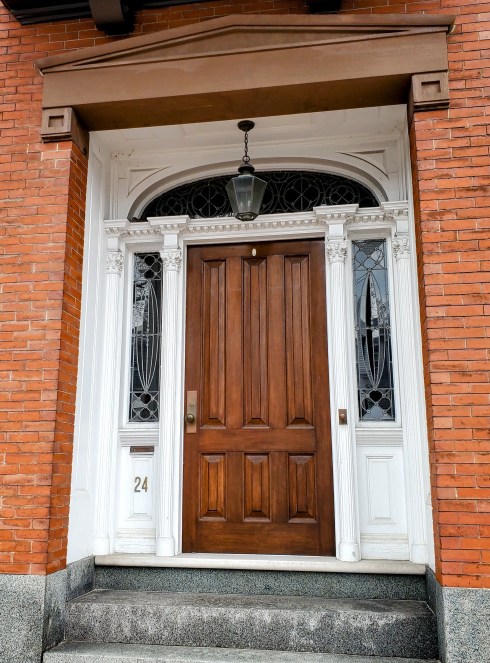
Salem is a great city for doors. There are so many exemplary doors in a succession of architectural styles: First Period, Georgian, Federal, Greek and Gothic Revival, all the Victorian varieties. There are simple plank doors, multi-paned doors, louvred doors, double doors, carved doors, doors with elaborate surrounds and vestibules, and doors of many colors (these have really multiplied over the last decade or so). There are Instagram accounts and hashtags for Salem doors. But one type of door is not very common in Salem: the rounded or arched door. I was looking through the remarkable memory album of G. Albert Lewis at The Library Company of Philadelphia, a volume with incredible illustrations of interiors and exteriors, when I became fixated on the arched entryways of his Philadelphia townhouses. I wondered if Salem had any rounded doors, did a quick Google image search (it was about 11:00 at night, otherwise I would have ran around town), and came up with multiple images of the doors of my own house! I never realized they were so conspicuous; rather I found them incongruous with the attached house next door, with its straightforward Federal entryway. See what I mean?

The second photo above is from the Instagram Account @doorsofsalem where you can see lots more Salem doors.

The double doors, and the entire entrance with bay window above, along with considerable interior alterations and a major addition, are the very tangible results of a considerable investment in the property made by its owner from c. 1860-1890, Willard Peele Phillips. Mr. Phillips was a lawyer, a state representative, and an aficionado of curves: he didn’t just bend the entrance of my house to his will: the parlor pocket doors, the china cabinets in his brand new dining-room, and all the first-floor entryways were rounded as well. He ripped out the elegant slim banister that ascended three stories and replaced it with a mahogany one that is much more bulky but also curvy. The second and third floors were left alone; I guess it was about keeping up appearances. It’s really interesting to compare the pristine house next door to my palimpsest one: 1827 versus 1877. Yesterday I went out in search of more rounded doors and did not find many, but it was fun to snap some beautiful square ones along the way. I’ve been taking photographs of Salem houses for over a decade just for this blog, but there is always a new door to discover.

As you can see, there is a rounded element in several of these Salem doorways in the form of the archways and fanlights, but the actual doors are still standard square (or rather rectangular). Besides my doors, I found arched doors on a famous McIntire summer house on the grounds of the Peabody Essex Museum’s Essex Street campus and its twin across town, constructed by a friend of mine just a few years ago, on Winter and Lafayette Street buildings, and what’s left of the Salem Armory. There are a few Salem churches which also have domed doors, but that’s about it.

But the Federal style which so defines Salem (for now, but maybe not much longer) emphasized light and decoration for its entryways, and so often there is an impression of roundness even if the door is more straightforward. A great example is the doorway of arguably the most beautiful house in Salem, the PEM’s Gardner-Pingree House: its portico and fanlight state (shout) round quite emphatically albeit elegantly. And look at the entrance to my neighbor’s beautiful Italianate house: all you see is curves but the door inside that fabulous vestibule is harmoniously straight.

So then I went back to my inspiration, the Lewis Memory Album at the Library Company, and looked at his doors, and was surprised to find they were not rounded at all—only their surrounds, and dormers! And therein is the magic of architectural texture, evident even on paper.

Illustrations from The old houses and stores with memorabilia relating to them and my father and grandfather / By G. Albert Lewis. The Library Company of Philadelphia.


Runaway Wives of Salem

I don’t think I’ve posted enough about women’s history for this women’s history month so I have put some extra effort into this last March post! Two caveats to the preceding statement: 1) If I do say so myself, my deep dive into local women’s history in the 2020 commemorative year should have earned me “surplus merit” and; 2) extra effort was not a hardship because the subject of this particular post is so interesting but yet elusive: “runaway wives” notices from the later eighteenth and early nineteenth centuries. Every historian, or every social historian I should say, wants to get into the house (or even into the bedroom) of people who lived in the past so these notices of women who left the “bed and board” of their husbands are interesting entryways, but in most cases the door slams shut before you can learn too much!

What’s going on behind closed doors? Illustration from The Life of George Cruikshank in Two Epochs by George Cruikshank and Jerrod Blanchard, 1882. Courtesy of Forum Auctions UK.

The notices are certainly numerous: in the first two decades of the nineteenth century, nearly every issue of the Salem Gazette and the Salem Register contains one or more. They are legal and financial notifications first and foremost, in which husbands announce that they will take no responsibility for the expenses of their runaway wives going forward, but depending on the nature of the separation, they are also an airing of dirty laundry or downright slander. The wives respond occasionally but not consistently, so we are left with only one side of the story for the most part. Sometimes the notice is on the very first page, above the fold (like this first example below) and sometimes it is buried deep inside the paper. Some notices are pro formawhile others contain considerable detail.

Front and Center, 1806, and for some reason 1804 was a banner year for runaway wives.

Let’s look at my sampling in chronological order to see if we can spot any trends. This IS a sampling: there are a lot more of these notices, and reoccurring ones as well. For example, George Felt disavowed his wife Sally in 1807 (below) and then again in 1818. So your eyes don’t blur and headaches occur, I’m breaking up the notices with a few images from chapbooks of the period from the collection at the National Library of Scotland. In general American chapbooks seem more concerned with instruction than relationships, and these British ones are a bit more bawdy, often highlighting the exploits of marital strife in a humorous, lyrical manner.

A Collection of New Songs, etc. Edinburgh 1802. National Library of Scotland Chapbook Collection.

In this first batch we have a combination of the straightforward (Daland and Young) and the slander. Note the phrases and adjectives utilized among the latter: “unbecoming the character of an honest woman,” and “intemperate, quarrelsome and troublesome,” even evil: clearly the men want to justify their abandonment of legal responsibility for their wives. The last notice, just above, is the most detailed and therefore the most interesting: Mrs. Teague has absented herself “frequently” and run up “extravagant” debts, and Mr. Teague provides several aliases for her so people in the “many” towns she visits can be on guard. This cautionary, “I’m doing you a favor” tone is very consistent in runaway wife notices.

The Farmer’s Son; or The Unfortunate Lovers, Glasgow, 1805. National Library of Scotland Chapbook Collection

The batch of notices above contains pretty standard examples, save for the removal of furniture from the family homes by Molly Ives and Mary Vincent. By the 1830s, these notices were clearly old hat, and even a decade before the editors of the Salem Gazette conveyed that sentiment by running an opinion piece which called them “excessively tiresome” as well as one which conveyed the other side of the story in a rather amusing way (notice that the word elope was generally used to refer to getting out of a marriage rather than into one in the early nineteenth century). I wish we had more responses from Salem women, but there are only a few, generally referencing fear of bodily harm (I researched all the women referenced above and found nothing). Going back to the very beginning of our period, Hannah Peele posted publicly in the Gazette that the reason she left her husband Roger’s house for one of their daughter’s as “because I have conceived my life to be imminently in danger while I lived with him: the reasons for which suspicion are too well known to many.”

Just as separations were public, so too were divorces in Colonial and Federal-era Massachusetts. From my perspective as an English historian, it’s pretty clear that divorces were much easier to obtain in New England than Old England. The Puritans of Massachusetts considered marriage a civil contract rather than a religious sacrament and so divorce could be, and was, granted by the authorities  on grounds of bigamy, adultery, abuse and abandonment (although there were also a few successful cases of claims of their husbands’ “insufficiency” on the part of female petitioners): maintaining the social order was the primary consideration. Massachusetts Bay granted the first divorce in British America in 1639 and between 1692 and 1785 the Massachusetts General Court heard 229 petitions for divorce and granted 143. Divorce was not common or easy, but it was an option for Massachusetts men and women. And as is the case with any conflict or schism, we can learn a lot about the parties involved than in cases of peaceful continuity.

Four Excellent New Songs, including Over the Moor to Maggie, Edinburgh, 1780. National Library of Scotland Chapbook Collection.

In contrast to Salem’s most famous divorce, the well-publicized and  scandalous split of elites Elizabeth Derby West and Nathaniel West in 1806, I think that Mrs. Anderson’s 1815 suit (above) is probably more representative. The wife of a mariner during Salem’s most prosperous age, she had not seen or heard from her husband in five years and had no “maintenance” for herself and her child. He was the “runaway” rather than her, and I wonder how many other contemporary Salem women found themselves in such situations. The lives of mariner’s wives: yet more uncharted territory in the history of a city which is overwhelmingly focused on that well-trodden.


Shore Dinners

I have a guilty secret to admit, one which will reveal me to be out of step with most of my fellow Salem residents (no, it’s not about “witches”): I’m not particularly fond of Salem Willows. It’s got a great history and a great spirit, and I’m always happy when I go there, but I don’t really appreciate it. I’m sure I must be a bit of snob about seaside amusement parks, as I never really appreciated York Beach while I was growing up in York either. I don’t understand chop suey sandwiches, and while the popcorn at Hobbs is great, I enjoy my friend Carol’s just as much. While I can take or leave the Willows, I know that many Salem natives wait eagerly for its opening every spring: they have strong memories and associations which I don’t have, and they like chop suey sandwiches. The other day, I came across an article in a 1941 issue of Woman’s Day in a trial database of women’s magazines that we just obtained at Salem State: it was so enthusiastic about the Willows experience back in the day that I began looking at it in a new (old) light.

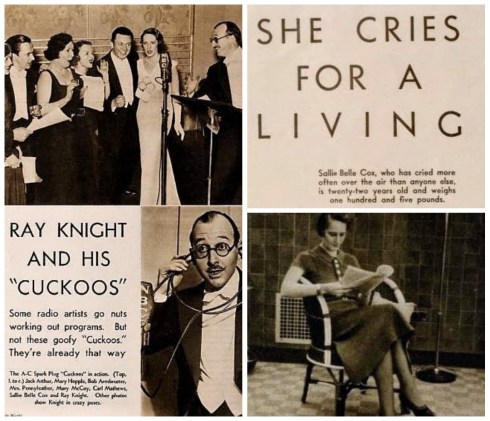
The article is primarily about Ebsen’s, established in 1885 and the last restaurant standing on the Willows’ Restaurant Row. By the end of the decade, it would be gone, but it was clearly alive and well in 1941. Since that was such a fateful year, one can’t help but feel we are “witnessing” the end of the era in the enthusiastic prose of Sallie Belle Cox, who was embarking on her second career after making a name for herself as the “cry baby of the airwaves” playing crying babies on radio broadcasts in the 1930s. On one such program, she met her husband, radio writer and broadcaster Raymond Knight, a Salem native. She became his second (of three) wives, and by her account he was horrified that she did not know the glories of Salem Willows in general and Ebsen’s in particular, so they drove up from New York City in the early summer of 1941. While her husband insisted that his hometown was the “one city in the world where they know how to make a fish dinner,” Cox’s image of Salem was “a weird, fascinating place filled with clipper ships and jaunty old sea captains who brought home exotic wives with rings in their ears to annoy all the other natives whose only fun in life was roasting witches on dull Saturday nights.”

Salem native Raymond Knight and his soon-to-be wife Sallie Belle Cox (behind the microphone at left) in Radio Stars magazine, 1933-34.

And straight to the Willows and Ebsen’s they went. The restaurant was packed, its oilcloth-covered tables and chairs the same which had been installed in 1890. They partake of equally-old Charley Ebsen’s Shore Dinners: fish or clam chowder, fried clams, fried flounders, and fried lobster, with potato chips, pickles, ice cream, and their choice of non-alcoholic beverages. Cox finds the chowder divine and furnishes her readers with the recipe from chef Fred Millet, who has also been around since before 1900. She also notes that “the Rhode Island and Manhattan clam chowders are not even considered worth discussing in Salem” and admits that there can never be enough fried seafood.

“Shore Dinners” by Sallie Belle Cox, Woman’s Day, July 1941.


Samuel Chamberlain’s Salem

The Phillips Library of the Peabody Essex Museum, steward of so much of Salem’s printed, written and visual history amongst its many collections, has recently digitized over 5000 images from the “Samuel V. Chamberlain Collection of Photographic Negatives, 1928-1971″ and they are available and searchable at the Digital Commonwealth. Combined with the Frank Cousins images which the Phillips made available several years ago, there is now a very strong visual record of Salem’s architecture and streetscapes in the first half of the twentieth century, or at least some of Salem’s buildings and streets as neither Cousins or Chamberlain were particularly interested in “working Salem”. Cousins was a bit more of a documentarian than Chamberlain, especially as his era (roughly 1890-1920) encompassed the Great Salem Fire of 1914. Chamberlain was a man of the world, a gourmand, and an artist: his Salem photographs encompass only one part of his work, but an important part as he lived in nearby Marblehead for many years so developed quite an intimate knowledge of the city. I’ve always been struck by his perspectives, but I thought that I’d seen most of his Salem shots as he published so many books of photography of New England scenes in general and of Salem structures in particular, including Historic Salem in Four Seasons (1938), Salem Interiors (1950), and A Stroll through Historic Salem (1969). But I was wrong: there are discoveries to be made among the 1600+ Salem images included in the Phillips Library’s Chamberlain negative collection at Digital Commonwealth. The vast majority of these photographs are of the McIntire Historic District in the 1930s, 1940s, and 1950s, but I can see different details and angles in Chamberlain’s images of these perennially-showcased streets and structures—and lots of wonderful TREES.

New perspectives of old streets: and the interior of the depot!

These are images which struck me as “new” for one reason or another, although the first photograph is just the view of Chestnut Street from my window, over a half-century ago, and everything looks pretty much the same! Look at all the amazing elms: on the other end of Chestnut, on Essex, at the intersection of Federal and Washington Streets. A great photograph of the Lindall-Barnard-Andrews house (c. 1740; 3rd from top) and its amazing fence before some serious mistreatment in the later 20th century. Interesting views of Lynn Street, the Salem Maritime National Historic Site with trees, St. Nicholas Russian Orthodox Church and the Post Office and Washington Street before it became Riley Plaza (What is the white house on Norman?) One of my favorite little buildings on upper Essex Street was a bookstore! The Thomas Sanders house on Summer Street (2nd from bottom) looks much the same, but I want Mr. Chamberlain to turn around: what is behind him? And finally, a rare shot of the interior of the Boston & Maine train depot—rare in general but also for Chamberlain who preferred more timeless and aesthetic perspectives.

Change: Chamberlain was more interested in timelessness and continuity than change, but he couldn’t help but document some changes in Salem over the span of his work, from the 1930s through the 1960s. He was far more interested in urban survival than urban renewal, however: this was a man that sketched French chateaux amidst the destruction of World War I.

Two views of the London Coffeehouse or Red’s Sandwich Shop on Central Street; Nathaniel Hawthorne’s birthplace in its original location and from Hardy Street; The Curwen House rounds the corner from Essex to North Streets; 8 Chestnut Street very hemmed in by the second Second Church; which burned down in 1950, The Richard Derby House also very hemmed in; Charter Street before urban renewal; the cupola from the Pickman-Derby-Rogers House on Washington Street on the grounds of Essex Institute, now gone; the entrance to what Chamberlain called “the Italian Church,” St. Mary’s, built in 1925 and closed by the Archdiocese of Boston in 2003.

A few interiors: Chamberlain’s interior images are lavish and full of architectural and decorative detail; I’ve only included a few shots here but what a resource! All the PEM houses are here, and many Chestnut Street interiors, as well as views of interiors of both public and private homes which are seldom seen. His Salem Interiors has been a favorite book of mine since I was a teenage, and this Phillips/Digital Commonwealth collection includes many shots which are not included in that publication so I’ll going back quite a bit.

Pictorial paper in the Sanders house on Summer Street (see exterior above); much to see in the Northey house parlors, but ships on mouldings—how Salem can you get? Amazing fireplace in the East India House on Essex Street.

Chestnut Street Days! Who knew Chamberlain was such a great photographer of people? Certainly not me. Probably the most charming Salem photos in the Phillips Chamberlain collection are his portraits of Salem residents in colonial dress for the Chestnut Street Days which were held on at least 5 occasions from 1926 to 1976. I think that the photos below are from the 1947 and 1952 Chestnut Street Days, but I’m not entirely sure about the former date. These are wonderful photos of happy people, men, women and lots of children, smiling at the man behind the camera, Samuel Chamberlain. Just delightful. I’m going to post more on these in the future, but I’ve really got to do some oral histories first.

Chestnut Street Day, c. 1947-52. Not a great photograph to close out this wonderful collection, but is this the great man himself? Plus, the dog.


In the Thick of It

This weekend is the annual commemoration/celebration of Leslie’s Retreat, a pre-Revolutionary event which could have marked the beginning of the American Revolution, if not for the patience, restraint, and diplomacy of participants on both sides, and one man in particular. On February 26, 1775, British Lieutenant Colonel Alexander Leslie and 240 soldiers of the 64th Regiment, acting upon the orders of General Thomas Gage, landed in Marblehead and began marching to Salem in pursuit of a rumored store of cannon. This was a Sunday, and thus “the Sabbath was disturbed” in both Marblehead and Salem, as patriots from the former town rode ahead and warned residents of the latter. When the British arrived, a stand-off ensued between the assembled crowd and the soldiers, during which the drawbridge across the North River was raised, enabling the not-so-secret cannon on the other side to be carried on field carriages out of town. A frustrated Colonel Leslie was allowed to march his troops across the bridge after the cannon had left the scene, therefore fulfilling his orders from General Gage. Then he and his troops retreated back to Marblehead and their ship, and sailed back to Boston. Things were a little hotter than I am depicting in this brief summary, but fortunately cooler heads prevailed, among them that of the Reverend Thomas Barnard Jr., the minister of Salem’s North Church, which was very much in the thick of things. I’m going to let Edwin Monroe Bacon, author of Historic Pilgrimages in New England (1898) set the scene.

A profile portrait of the Reverend Thomas Barnard Jr. (1748-1814) which looks quite similar to that of his father, the Reverend Thomas Barnard Sr. (1716-1776), above, Skinner Auctions.

I like this description because it conveys a sense of place. Just three years earlier, the North Church had separated from Salem’s First Church and constructed its first meeting house on the corner of Lynde and North Streets, not far from the river and the bridge (and the cannon). Reverend Barnard Jr., the peacemaker of “Leslie’s Retreat,” was actually the cause of the schism: his appointment following his father’s illness divided the congregation. As we can read above, the British soldiers marched past the “old First Church” in Town House Square towards the North Church, where a large crowd had assembled along with their young pastor, whose “counsel prevailed” that late afternoon. This North Church was ephemeral, only in service until 1835 when the congregation built a new and fashionable Gothic Revival meeting house on Essex Street, which became the present First Church after the schism was ended in 1923. The annual commemorations of Leslie’s Retreat take place in and around this church, with good reason, but I wish the old North Church was still standing: its clearly Colonial stature could lend some contemporary ambiance to the proceedings. But it is long gone, replaced first by a grand Victorian house, and then by the parking lot of the adjacent Methodist Church. But what happened to its clock?

“First Meeting House of North Church” by Thomas Davidson (not sure of source, likely the Phillips Library of the Peabody Essex Museum, but I found it in the November 23, 1942 issue of Life Magazine); George Francis Dow, Old Wood Engravings, Views and Buildings of Essex County (1908): with caption: “The North Meeting House, Salem, Built in 1772 at what is now the Corner of North and Lynde Streets, Abandoned for Religious Purposes in 1835 and taken down about 1860. Engraved in 1873 after a Drawing made by Dr. George A. Perkins.” Frank Cousins photograph of Lynde and North Streets, 1890s, Phillips Library, Peabody Essex Museum via Digital Commonwealth.

BELOW: Before Salem became Witch-central, Leslie’s Retreat was THE big historic story, especially for children, so there’s several YA books which feature it. I was trying to get that sense of place, running-through-the-snow-on-a- cold-winter-afternoon-through-close-Colonial-streets perspective in this post, and these illustrations by Lynn Ward from Jean Fritz’s Early Thunder (1967) come close. My favorite contemporary account of Leslie’s Retreat is actually from a boy, Samuel Gray, which is recounted in this post from J.L. Bell’s wonderful blog, Boston 1775. While you’re there, you should read all of Bell’s posts on Leslie’s Retreat as he is the absolute authority (and he doesn’t quite trust all of Gray’s details).

Illustrations by Lynn Ward from Jean Fritz’s Early Thunder (1967), set in Salem in 1774-1775.


Candy Land

In my sweetest dreams Salem is Candy Land rather than Witch City, and it certainly has the heritage to claim that title (although Candy Land was a Milton Bradley game rather than a Parker Brothers production.) There are of course the famous Gibralters and Black Jacks, still sold at the Ye Olde Pepper Candy Company on Derby Street, America’s oldest candy company. Mrs. Spencer sold her hard candy from a horse-driven carriage, and her primary competition seems to have been the stationary confectioner John Simon, whose shop was stocked with a variety of syrups and sweets, everything from anise drops to peppermint. He was always announcing his “removal” to Boston but somehow never made the move. Before the later nineteenth century, however, most confectionary item were not sold by single confectioners, but rather by grocers and apothecaries, and their lists of available sweets became longer and longer with every decade. Nourse’s Fruit Store on Washington Street sold “calves foot jelly candy, strawberry jelly candy, sherbet candy, gum jelly drops, and “East India Red Rock Candy” and all sorts of candies made with the New England’s favorite ingredient, molasses. Confections got a bit softer in the later nineteenth century, when cream candies became popular, and then comes Chocolate!

The Theodore Metcalf Company, one of Boston’s most successful apothecaries, published a beautiful pamphlet on gibralters and black jacks but these were SALEM candies; Nourse’s advertisement, Salem Observer 4 November 1865; Trade cards illustrate the softer trend in confectionary consumption.

The decline of hard candy and the rise of chocolate seems to be a major trend, but candy customers still loved variety. The most successful, and very long-running, confectionary business in twentieth-century Salem was the “Palace of Sweets” on Essex Street, from which the Moustakis Brothers sold their “mastermade” (a patented term) confections. This business was in operation from 1905 until 1968, and after the Taft Summer White House in Beverly placed a series of larger orders it received—and marketed—the presidential seal of approval.

Moustakis Brothers’ Menu from the digital archives of the Culinary Institute of Technology.

Salem is still candy central, in fact two confectionary shops opened up just this past year: Curly Girl Candy Shop on Washington Street and the Chocolate Pantry on Derby, not far from Ye Olde Pepper Candy Company further down the street. And then there is the venerable and amazing Harbor Sweets, the manufacturers of my very favorite candy, Sweet Sloops. I don’t even really have a sweet tooth, and if I am going to indulge I prefer jelly beans to chocolates, but bring a box of Sweet Sloops into the house and I will not rest until they are gone!

The House of the Seven Gables and Ye Olde Pepper Candy Company sponsored the ice sculpture of Mrs. Spencer’s horse and carriage for the Salem’s So Sweet festival this past weekend: its position made it difficult to photograph but it’s much bigger than it appears in this photo! My beloved Sweet Sloops, available at Harbor Sweets on Leavitt Street in Salem as well as lots of other retailers.


When Nixon went to China and Life Magazine came to Salem

For some reason, I’ve been going through the archives of Life magazine over the last month or so: it started with the photographs, and then I had to read the stories too. Life seems like it was a perfect mix of news and popular culture: we don’t have the like now, do we? And I doubt we ever will again with our very diffused and digital media. I’m no twentieth-century historian, but it also seems to represent the collective mindsets of its changing times: it really excels at representing wartime America, of course, but the later decades too. So far my favorite issue bears a beautiful Elizabeth Taylor on the cover on the occasion of her fortieth birthday: but inside the focus is on President Nixon’s imminent trip to China. It was fifty years ago this very month, and a very big deal. For some historical context, Life went to Salem, which emerges as kind of cultural intermediary between the United States and China, as it was the first American city to become thoroughly acquainted with the East. And so we get to read about Elias Hasket Derby and his ships, and see Derby Wharf, and all sorts of “exotic souvenirs” brought back from China by Salem’s daring merchants and later installed in the old Peabody Museum of Salem. It’s all great, but the best photograph is an aerial view of Chestnut Street where nothing much has changed in fifty years.

“When the US Sailed to China,” Life magazine, 25 February 1972. Photographs by Henry Groskinsky.

I think that the Peabody Essex Museum is still playing that intermediary “West meets East” role, although now the perspective is far more global than western. I know that I fault the PEM often for its displaced library and limited local offerings, but their East Asian and China Trade galleries are beyond impressive. I find myself teaching the first half of World History this semester for the first time in a decade, and I really had to do a lot of preparation before I stepped into the classroom (well, first it was on the screen as we had a “staggered” opening). China is the star of pre-1500 world history, and all my “color” comes from the PEM! Its collections are much stronger in later-dynasty objects, but there’s still some wonderful things on display from earlier eras. Much has happened in the past half-century: the Cold War is over, and Life magazine has also concluded its run, but Salem’s “China Cabinet” not only endures, but has been expanded considerably (and we no longer refer to its contents as souvenirs). In fact, aside from Salem’s built landscape, PEM’s East Asian collections constitute one of the largest and most lasting material legacies of “its” history in situ: this seems like an odd statement, but I think it is true.

Yichengyong Picture Workshop, Tianjin. Family celebrating the New Year and welcoming wealth from all directions, 1908-11, reproduction of detail from a woodblock print; Standing official with tablet, Jin dynasty, early 13th century; Guangzhou artists, Tea packer and porter, about 1803; Guangzhou artists, Wu Bingjian, Known as Houqua, about 1835; George Chinnery, detail from Dr. Thomas Richardson Colledge and His Assistant Afun in Their Opthalmic Hospital, Macau, 1833. There’s an emphasis on people and their relationships in PEM’s present galleries, but there’s also the “Great Wall of China” and a transplanted 18th-century Chinese house, Yin Yu Tang, to see.


Gilded Age Salem

Let me be very clear: Salem is NOT a Gilded Age town. In reference to the new series from Julian Fellowes, Salem is the two Old Money sisters in the stuffy house, not the nouveau riche couple across the street in the bright and shiny Beaux-Arts building. In fact, there are no Beaux-Arts buildings in Salem, which was so Old Money that its dominant Gilded Age style was Colonial Revival, expressed characteristically through renovation rather than new construction. But I wanted to produce a Gilded Age post for Salem for two reasons: 1) despite the mixed reviews, I really like the new HBO series (though I think it should have a more nuanced title than The Gilded Age) and; 2) this time period (I’m going with 1870-1900, though I made one exception) provides me with an opportunity to address a big myth about Salem history, chiefly that it was all over for the city’s economy by 1820 or so. That’s just not true: I see a lot of prosperity and vitality in Salem’s economy in the later nineteenth century, and I think the buildings I have chosen to illustrate its own spin on the Gilded Age prove it. My choices were inspired by shots from the series premiere, although I must say that some of the cgi exterior views (in which everything is so CLEAN) contrasted sharply with those of more textured interiors). But before I get to the new, let me reassert and illustrate my claim that (re-) gilding the lily that was the Federal style was the Salem Gilded style, as we can see so clearly in architect Arthur Little’s 1885 plans for the George Emmerton House on Essex Street.

 Arthur Little and Herbert W.C. Browne architectural collection, Historic New England

Along Essex Street, which is undoubtedly Salem’s most dynamic street, there are also several prominent later-nineteenth-buildings that testify to the vibrancy of that age, but I want to start with a very showy building on parallel Chestnut Street which I think might be Salem’s ultimate Gilded Age construction: the Wheatland-Phillips House, built in 1896 for Mrs. Stephen G. Wheatland following the design of architect John B. Benson. At a glance, this imposing house fits right in with its Federal neighbors, but there is no restraint of scale or detail: it seems very “gilded” to me! Now on to Essex: even though it was built prior to the Civil War and Gilded Age, I’m still including the Bertram Mansion, built in 1855 for philanthropist John Bertram and donated by his family to the City for use as the Salem Public Library in 1887. This building really impressed contemporaries when it was built: I am always looking for signs of a nascent historical preservationist consciousness in the nineteenth century, and I found absolutely no trace of that sentiment in contemporary newspaper accounts of its construction, despite that fact that several “ancient” houses were swept away to make way for this “ornament” to the City of Salem. There are other candidates for such novel ornamentation on Essex Street, but none more than the Putnam-Balch House built in 1872, which once served as the headquarters for the American Legion in Salem.

I have no doubt that Salem had some really grand Gilded Age mansions on Lafayette Street, which was very much the new street of that era. But these structures were swept away by the Great Salem Fire of 1914. I don’t have photographs of all of them, but the Cassino Mansion at 192-194 Lafayette had to be among the most impressive, and it was gone in a day, an afternoon (A Cassino descendant gave me the photograph below, which I cherish!) Probably the grandest survivor on Lafayette is the Gove House built in 1888, the home of patent-medicine millionairess Lydia Pinkham’s very philanthropic daughter, Aroline Gove. The Pinkham story/connection is perfectly gilded.

Back in the center of town and heading north, I think I’m going to add the George C. Shreve House at 95 Federal Street and the James Dugan House on Dearborn Street, both built in 1872, to my list, as Italianate is as close as we’re going to get to Beaux-Arts in Salem. I love the situation of the Dugan House: it’s very grand.

Salem probably has more commercial or institutional architecture that approaches a Gilded Age style than residential: there are blocks on Essex and Washington streets downtown that evoke that era, still and fortunately, even though uninspired contemporary buildings are encroaching. The Superior Court Building on Federal Street (shown from Bridge, below) is an incredible structure inside and out, positively soaring and charming at the same time. It represents an era of unlimited opportunity and decoration quite well, but in typical Salem style, is an extensive 1887-91 renovation of an earlier Renaissance Revival building.