
Category Archives: Nature

Where are all the Quince Trees?

I am encountering so many references to quinces in my early modern recipe books and regimens: to eat, to preserve, in tarts and jellies and marmalade, of course. These English people really loved quinces, or they depended on them, and so they brought them to New England, where every garden apparently had a quince tree or bush; apparently only one was needed because they were so fruitful. There was even a moment in time when quinces were considered as a possible staple crop here in Salem: according to Felt’s Annals of Salem, there was a succession of crop failures which led to scarcity of corn in the 1760s, provoking a public inquiry “whether some foreign vegetables might not be introduced, which would serve as a substitute for bread”. The “quince of Portugal” was proposed, along with the “Spanish potato” (did they not know that the potato was a native North American crop?). This is a good clue, confirmed by some of the English evidence: apparently the English variety of quince was not so pleasing as the Mediterranean variety, thus it needed a lot of cooking, steaming, boiling, roasting and sugaring: just perfect for what the English liked to do to all sorts of foods. According to Thomas Moffatt in Health’s Improvement (1655), quinces were worth the trouble: though their raw flesh be as hard as raw beef unto weak stomachs, yet being roasted, or baked, or made into Marmalade, or cunningly preserved, they give a wholesome and good nourishment.” This was fine for the seventeenth century, but in the nineteenth century I think people wanted to just pick a piece of fruit off the tree and eat it, and consequently Robert Manning, Salem’s superstar horticulturist (and Nathaniel Hawthorne’s uncle) just gives a few paragraphs to quince trees in his New England Book of Fruits and seems more interested in grafting his beloved pears onto them to create dwarf varieties. As quince also served as a type of pre-modern gelatin the development of alternative sources and processes in the nineteenth century were factors that must have aided its gradual disappearance as well. By the later nineteenth century, there were only to be found in “grandmothers’ gardens” and now—nowhere.

Quince San Diego

Quince Fuchs

Quince Cakes

quince newenglandbookof00mannrich_0070 1847

Quince Bush Arthur Wesley Down 1895 MFAQuince, Cabbage, Melon & Cucumbers, by Juan Sanchez Cotan, 1602, San Diego Museum of Art; a Quince tree in Leonhart Fuchs’ De historia stirpium commentarii insignes (Notable Commentaries on the History of Plants), 1542the eighteenth-century recipe book of the Marchioness of Wentworth and a recipe for “Quince Cakes”;  “Quince stock when grafted or budded with a Pear”, Robert Manning’s New England Book of Fruits, 1847; Arthur Wesley Dow, “Our Quince Bush”, 1895, Museum of Fine Arts, Boston.

Well, except for the Bonnefont Herb Garden at the Cloisters (below) and there are a few quince boosters out there so maybe we will see a revival. Since they are small trees, they are perfect for urban courtyard gardens like mine, so I’m looking for a space…..and speaking of small urban gardens, for those of you in Salem (or nearby), the creator of one of the most impressive gardens in Salem (which you can see here) is giving a talk this Thursday night in the atrium of the Peabody Essex Museum. No doubt her garden is illustrative of her knowledge, which means we will all learn a lot!

Quince Cloisters

Tony Cenicola/The New York Times

Gardening event


Remarkable Roots

Fair warning: this blog is going into a very random phase, even more random than usual. Normally around this time of year I would have some sort of Labor Day or “Back to School” post, but as I have just started a sabbatical I am unaccountable to any calendar but that of my own projects–of which I have several. I might post on these occasionally, or I might use the blog to take a break from scholarship. Faithful readers know how I feel about Salem’s ever-intensifying Haunted Happenings, so know not to count on me for any October coverage: last year I got out of town for six straight weekends from September to November and that worked very well for my piece of mind. That’s the standard advice offered to anyone who is critical of Halloween in Salem—embrace it or leave town; you know what you were getting into–but in my case it is actually good advice! Fortunately my study is way up on the third floor of our house–and in back, overlooking the garden rather than the street–so when I’m not traveling I can hide away, far from the maddening crowds. So that’s the setting for the next few months, and I’m not sure what I’ll come up with for this space/place. Today is a good case in point: I was looking into the medical use of several plants in the sixteenth century, including artemisia and byrony, and found myself among the digitized manuscripts of the British Library. One manuscript in particular, Giovanni Cadamosto’s Herbal with accompanying treatises on food, poisons, remedies, and the properties of stones (MS Harley 3736; late 15th or early 16th century) provided me with a little escape/break, mostly because of the amazing roots of several of the plants illustrated within.

Scary Root Antora

Scary Roots Brionia

Scary Roots Colstanga

Scary Roots Corrola P

Scary Roots Dragonhead

Scary Roots F

Scary Roots Jordana

Scary Roots Mandrake

Scary Roots M

Scary Roots Morsb Serpen

Scary Roots Polma chi

I am familiar with this manuscript, but I never realized just how many fantastic roots it contained: suddenly that’s all I could see! We all know about that of the magical Mandrake, of course, but that’s just one of eleven by my count. Anthropomorphism always interests me, but in this case it’s a bit perplexing, as this text represents a more realistic Renaissance attempt to draw from nature rather than just relying on traditional motifs. These roots contradict that naturalism, but then again we’re in that transitional time, when a bit (or more) of whimsy could be retained. I’m still working on the plant identifications: “Antora” might by a yellow variety of aconitum or monkshood, “Dragontea” might be dracunculus vulgaris, or dragon lily, and “Palma Christi” must be the castor bean plant, which went by that common designation.


Beautiful but Deadly

In support of the summer-long celebration of the 350th anniversary of the Turner-Ingersoll Mansion in Salem, better known as the House of the Seven Gables, Salem State has offered up a Hawthorne film series in partnership with the Salem Maritime National Historic Site and this week our last film will be shown: Twice-Told Tales (1963). Since we started with The House of the Seven Gables (1940), it will be interesting to see Vincent Price, who played Clifford in that film in a rather straightforward fashion, in what I assume will be his more characteristic over-the-top style. He plays key characters in all three stories of this anthology film, and Dr. Rappaccini himself in the central story, Rappaccini’s Daughter, which just happens to be my favorite Hawthorne short story (it was actually first published in book form in Mosses from an Old Manse rather than Twice Told Tales, but I’m sure this was of no concern to Hollywood). Rappaccini’s Daughter is the favorite Hawthorne tale of many, and it has inspired many visual and literary impressions and adaptations—particularly in the last decade or so. Its allegory makes it endlessly captivating for successive generations, but I think its most recent popularity is due to its rather macabre storyline: the transformation of a young beautiful woman who tends a garden of poisonous plants and in doing so becomes both immune but also a poisonous vessel herself is Gothic in the extreme.

Poison Garden Jessie Willcox SmithJesse Willcox Smith, 1900

My particular fascination is the paradox of beauty and toxicity in nature. How can plants as beautiful as monkshood and foxglove be deadly? I have neither in my garden at present, but my very first garden at this house was comprised entirely of plants used in the medieval and early modern eras as plague cures. It did not last long, as most of these plants were really unattractive and I didn’t have quite enough sun for them anyway, so I dug it up and dispersed the more attractive plants in a more conventional flower garden. My favorite survivor of the “plague garden” is rue, a beautiful and ethereal blue-ish gray shrub with yellow flowers that I just sheared off yesterday, with not a care in the world for the potential harm that its leaves could have caused to my skin. How could the “Herb of Grace” cause harm? Obviously it’s not the plant itself but ignorance of its “attributes”; it’s not the medicine but the dose. It’s not nature; it’s man (or woman).

Poisonous Rue 3

Poisonous Rue 2 Cadamosto

Poisonous Actea RubraMy newly-shorn rue and its illustration in my favorite Renaissance herbal, that of Giovanni Cadamosto (late 15th Century, British Library MS Harley 3736); A much more OBVIOUS poisonous plant in my garden, baneberry or Actaea Rubra: beware of those berries!

Even more paradoxical than a poisonous plant is a poisonous garden, as gardens are supposed to be places of rest, relaxation, wonder and contemplation: sanctuaries where one can find refuge from the busy (and threatening) world outside. Rappaccini’s Daughter is set in Padua, so I believe that Hawthorne was likely influenced by its famous Botanical Garden, established in 1545 and still thriving with over 7000 plant varieties including a collection of poisonous plants, “which are also in the medicinal plants sector because in suitable quantities they can be used to treat illness and diseases”. Also didactic, but a bit more menacing, is the Duchess of Northumbria’s Poison Garden in Alnwick, England, which features more than 100 lethal plants, several of which are in cages, all just part of a much larger botanical attraction and experience. The Duchess wanted to pique the curiosity of children in horticulture, and it probably doesn’t hurt that her estate “starred” as Hogwarts in the first two Harry Potter films. She also produced a series of books for children titled The Poison Diaries, the first of which has absolutely amazing illustrations by Colin Stimpson of venomous plants “in character”. Scary, but not nearly as scary as the Poison Tree which “stole” into William Blake’s garden, his own creation.

poison04

Poisonous Diaries 2

Poison Tree BlakeAlnwick’s Poison Garden; a Colin Stimpson illustration from the Poison Diaries; William Blake’s Poison Tree from Songs of Experience, 1794, British Museum.


Celebrated Gardens of Salem

A while ago I scored the first volume of a classic text of early American gardens, Gardens of Colony and State, compiled and edited for the Garden Club of America by Alice G.B. Lockwood in 1931. I’ve seldom been without it since; I can’t say that “I can’t put it down” because it is a heavy tome, but I’ve been dipping into it whenever I have a free moment. It’s an absolutely amazing publication: scholarly, detailed, engaging, illustrated, comprehensive. I’ve planned all of my summer road trips around it, even though I suspect I might find myself on sites of former historic gardens more often than not.

Gardens 1

Gardens of Colony and State is nothing less than an illustrated history of American gardens and gardening to 1840: the first volume covers New England and the Midwest, while the second volume presents the South and West (and garden enclosures from across the nation). It is remarkably well-sourced, but also as accessible as you would imagine a garden club publication to be, and its illustrations are nothing short of invaluable. While Salem trades on its darkness now, in 1931 it was still quite well known for its horticultural heritage, and so it rates an entire chapter in the first volume: there is Boston, Salem and Newburyport, and everywhere else in Massachusetts. Lockwood starts off with the Reverend Francis Higginson’s observations on “the bounty of the soil of Salem” in 1629 and shows us the Endicott pear tree and sundial (purchased by the Reverend William Bentley–is this still in the Crowninshield-Bentley House or up in the storage bunker/Collection Center in Rowley?) and then it’s all about Elias Hasket Derby, who employed one of the nation’s first professional gardeners, an Alsatian emigré named George Heussler (whom contemporaries referred to as “Dutch”) for both his town and country gardens. We get to see charming drawings by Samuel McIntire of the former’s grounds—from the Essex Institute/Peabody Essex Museum, of course.

Garden Sundial

Garden Derby 1

Garden Derby 2

We then proceed through the nineteenth century, and visit Salem’s most famous gardens, most of which were laid out or maintained by “Scotch gardeners” (How many gardens are due to the Scotch gardeners! proclaims Lockwood). The botanist John Robinson’s garden at 18 Summer Street was long ago paved over for a parking lot while elsewhere grass and more carefree perennials have replaced the very intensively-cultivated gardens of the Victorian era. An interesting connection: the “Scotch gardener” of Captain Charles Hoffman’s garden at 26 Chestnut, Hugh Wilson, came over from the old country with Peter Henderson, the so-called “father of horticulture and ornamental gardening” in the United States who operated several commercial market gardens and a successful seed company, and they maintained a close connection throughout their lives. Doubtless Henderson made some contributions to the three greenhouses Hoffman and Wilson maintained in the vicinity of 26 Chestnut–one at the rear of his property and two additional ones along Hamilton Street.

Garden Robinson

Garden 26 Chestnut

Across Chestnut Street were the renown gardens of two maiden ladies: Miss Huntington’s garden at #35 and Miss Laight’s garden at #41 Both gardens were featured in several periodicals at the turn of the twentieth century and Lockwood includes older photographs of each—one wonders if they were simplified in the 1930s when the Great Depression reigned and there were probably no more Scotch gardeners on the street. We then read about the botanical experiments of John Fiske Allen at # 31 (more greenhouses!), and enterprises of Robert Manning, Nathaniel Hawthorne’s uncle, in the pastoral paradise of North Salem. By far the most poignant photographs in the Salem chapter of Gardens of Colony and State are those of the Peirce-Nichols House on Federal Street, another PEM property and McIntire creation, if only because of the stark contrast of past and present.

Garden 35

Garden 41

Peirce Nichols

Peirce Nichols Garden 4

Peirce Nichols Garden

Peirce Nichols Garden 2

Gardens page


Coming up Roses

I’m in a bit of a funk about our city right now, but still mid-June is glorious nearly everywhere in New England, and Salem is no exception: it’s time to celebrate the roses, and the lushness all around us. Roses are spilling under and over fences all over town, whether they are wooden picket, wrought iron, or chain-link. We have passed through the period of the peony and the rhododendron (not a fan of either–too lush) into that of roses, lady’s mantle, and mountain laurel. I wish I could keep the roses going in my own garden, but they seldom put on such a flagrant display after June: they just spurt, and it doesn’t matter how much Neem oil I spray on them, their leaves always turn yellow. But they look good now! Here is this year’s crop, followed by some of my favorite roses around town. Rose bushes are difficult to photograph: the one just below my collage, which is on the fence of the Phillips House on Chestnut Street, is actually more lavender than pink.

Roses collage

Roses 24

Roses Fence 2

Roses Cambridge

Roses Ropes

There are several of the old Rosa Gallica, or “apothecary’s rose” shrubs in the colonial garden behind Salem Maritime’s Derby House, and I also saw some in the garden of the Munroe Tavern in Lexington as I was driving by last week. I would love one, but I’d kill it. I was scouting out the site of the new archival center that the Lexington Historical Society is building adjacent to the Tavern: now I’m jealous of both Lexington’s old roses and the imminent accessibility of its archives!

Roses Lex 2

Roses Lexington

Roses Monroe

Back in Salem and in my garden, the lady’s mantle is peaking, as is the rue (which lasts for most of the summer–a truly marvelous herb), and I found some beautiful variegated catmint for a new border: the cats walk right by it so I don’t think it’s a particularly potent variety. I also put in some masterwort (astrantia) plants along the border of the shade garden: their flowers look like little jeweled brooches and I hope they keep appearing all summer long.

Roses Ladys Mantle

Roses Rue

Roses Catmint

Roses Trinity

RosesSalem and Lexington flowering, June 2018.


Aesthetic or Au Naturel?

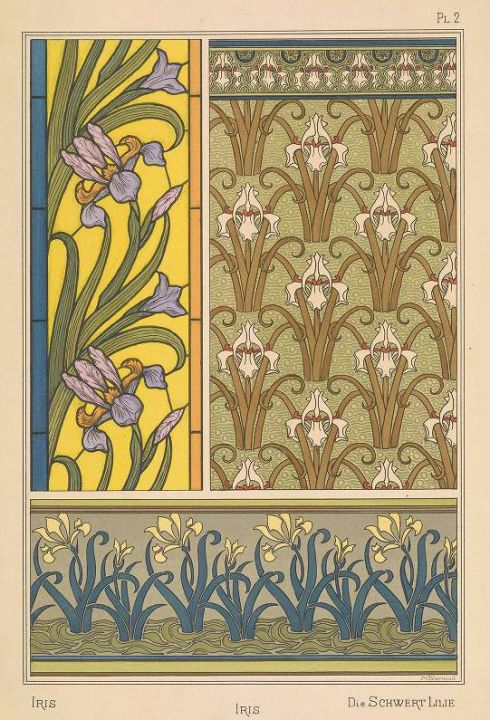
This past weekend I spent an hour or so browsing (digitally) through Eugène Grasset’s La plante et ses applications ornementales (1896) and then stepped outside to see that my lady’s slippers were in full bloom:  no competition, they win hands down. There are nineteen this year: every year I seem to gain one slipper. Other spring plants are enhanced in Grasset’s “applications”, but for the most part I think I prefer nature at this time of year. Yet has things that I don’t have so I think I’ll showcase both, as this was a man that could even make a dandelion look beautiful!

Nature Trillium

Nature Lady Slippers 3

Nature Lady Slippers My trillium are finally in bloom about two weeks behind everyone else’s; the lady slippers!

Nature

Grasset Solomon Seal

Grasset Columbine The PEM’s Peirce-Nichols garden has a veritable sea of bleeding hearts, but I was too late for the Solomon’s Seal and Columbine so I give you Grasset.
Nature Iris

Grasset Iris 2

Nature Roses

Grasset Wild Rose Irises and Roses from the PEM’s Ropes Garden, and Grasset’s versions.

There are no trees in La plante et ses applicationes ornementales but Salem has one of the most beautiful trees/shrubs in bloom right now: the Fringe tree (Chionanthus virginicus), a southern native that can be found in many cemeteries up here, but also notably in front of the grand Wheatland-Phillips house at 30 Chestnut Street. I’ve always thought that this tree suited the exterior embellishment of this house perfectly, but it looks lovely in the Harmony Grove cemetery as well. Even its shadow is beautiful.

Nature Fringe Tree 3

Nature Fringe Tree 2

Nature Fringe Tree

Fringe Tree Shadow

Grasset Dandelion Salem’s Fringe trees and Grasset’s dandelion design.


Trillium Time

Spring has finally arrived in Massachusetts, transforming gardens, grass, and trees in the space of a week. Woodland plants are my favorite ephemeral heralds, so yesterday I drove to the New England Wild Flower Society’s Garden in the Woods to check them out. In a sea of bluebells and creeping phlox there were all sorts of varieties of trillium, which is what I was really after. It was a hunt of sorts, but not really that difficult, as my prey stood out.

First up are the varieties of the trillium cuneatum: whip-poor-will flower, large toadshade, and sweet little Betsy.

Trillium Cuneatum Whip-Poor-Will Flower

Trillium Cuneatum Large Toadshade

Trillium Cuneatum Little Sweet Betsy

Beautiful creamy trillium grandiflorum white wakerobin, “bent trillium” or trillium flexipes, and “nodding” trillium, which was hard to photograph, because it was indeed nodding.

Trillium Grandiflorum White Wakerobin

Trillium Grandiflorum White Wakerobin.jpg 2

Trillium Flexipes Bent

Trillium Nodding

Trillium recurvatum, prairie wakerobin, and yellow trillium, trillium luteum.

Trillium Recurvatum Prairie Wakerobin

Trillium Yellow

And the more striking pink and red varieties: I’m not sure what the formal name of this pink variety is, but the reds are trillium sulcatum, “southern red”, and trillium erectum, red wakerobin.

Trillium pink2

Trillium southern red sulcatum

Trillium Erectum Red Wakerobin

I definitely missed several varieties, but all in all, not a bad afternoon catch. And now I want a garden shed with a mossy roof!

Trillium House


Back Bay Easter

We were a small party for Easter this year so we went to the St. Botolph Club in Boston for a buffet of oysters, salmon, eggs benedict, coq au vin, and lamb (no ham). This is the artsy old Boston club, and I always enjoy going there because the walls are lined with the work of its members past and present. In the crimson library, there is a portrait of an artist who I became acquainted with through his connections to several Salem artists at the end of the nineteenth century: John Leslie Breck. I’ve come to admire his work over the past few years, and I always “check in” with him whenever I go to St. Botolph’s. Though known as one of the young artists who brought Impressionism to the United States (in successive exhibitions at St. Botolph’s), Breck’s portrait is one of earnest realism: he looks handsome and troubled, or maybe I am just imposing that state on him as I know he ended his own life at the age of 39 in 1899.

Back Bay Easter

Back Bay Easter Dining Room

Back Bay Easter Library

Back Bay Easter Breck

PaintingsbyJohnLeslieBrock1890_0000

I don’t mean to be so maudlin, but that portrait always makes an impression on me. But it was a lovely Easter afternoon with great food and company and a walk down Commonwealth Avenue searching for signs of spring. We found some, mostly man- made, but there were a few flowering buds—we are on the brink! Walking back to the car from the Public Garden, I looked for my favorite version of the three Lutheran solas: I was just lecturing on them in my Reformation class last week, and I took a photograph for some extra validation for/from my students.

Back Bay Easter Box

Back Bay Easter last

Back Bay Easter 4

Back Bay collage

Back Bay Easter 3

Back Bay Gloves

Back Bay Bushes

Back Bay Easter Flowers

Back Bay Solas


March On

The first of March: a notable historical day from my own geographical perspective, as it marks the anniversaries of both the incorporation of the first English “city” in North America, my hometown of York, Maine (in 1642), and the commencement of the most dominant event (unfortunately) in the history of my adopted hometown of Salem, Massachusetts: the Witch Trials of 1692. March is also one of my favorite months, so I always wake up happy on its first day. I am sure that this is a minority opinion among my fellow New Englanders, for whom March is generally perceived as the muddiest monthIt certainly can be muddy here, and cold, snowy, rainy, dark, windy, and raw. But it can also be bright (like today) with a brilliant sun that seems to highlight the material world in stark detail. It is the month of all weather, and also a month of transition. That’s what I like about it:  you are heading somewhere in March (towards spring); you are not already there (like winter or summer). I like to be en route, in transition, looking forward, in the process—and March feels like that to me, all month long. If you look at magazine covers from their turn-of-the-last-century Golden Age, advertising artistry rather than celebrity, many seem to convey that movement, if only to depict the wind. At least those that don’t feature rabbits.

M27740-26 001

March Harpers 1895

March 1896 2

March Inland Printer 1896

March Black Cat

March 1897

M33739-10 001

March Scribners 1905

M33739-1 001

March covers from 1895 (2); 1896 (3);1897; 1900; 1905 & 1907; Swann Auction Galleries, Boston Public Library, and Library of Congress.


Change in the Weather

The weather actually did change very perceptibly here, at about 9:30 or 10:00 yesterday morning, from muggy late summer into breezy crisp fall. In about a half hour: I felt it, and everyone I ran into yesterday felt it too. But I still have weather history on the brain, so my title is referring to a volume by the amazing antiquarian of a century ago, Sidney Perley: Historic storms of New England : its gales, hurricanes, tornadoes, showers with thunder and lightning, great snow storms, rains, freshets, floods, droughts, cold winters, hot summers, avalanches, earthquakes, dark days, comets, aurora-borealis, phenomena in the heavens, wrecks along the coast, with incidents and anecdotes, amusing and pathetic (1891). What a title! And it does not disappoint.

Weather Historic Storms of NE

I have written about Sidney Perley many, many times here before as his works are the starting place for anyone interested in Salem history and culture—and often the culmination of inquiries as well: that’s how good he was. Perley (1858-1928) was lawyer by profession but an historian by passion—I’ve met many people like this over my career but Perley managed to somehow excel at both pursuits simultaneously, publishing a steady stream of books (History of Boxford, 1880, Poets of Essex County, 1889, History of Salem, 1924, and all those invaluable articles in his Essex Antiquarian along with many texts on probate law) over the course of his career. Quite logically he was an expert in utilizing the will and the deed as a historical source, but he clearly mined any and every source he could find for essential “anecdotes”. When I begin to delve into the history of a Salem house I always start with Perley, a practice that began long ago when I first moved here and started researching house histories for Historic Salem, Incorporated. He remains an essential guide to the history of Salem for me, and I thought about him a lot last summer, when Proctor’s Ledge was formally recognized and memorialized as the execution site of the victims of the Salem Witch Trials—culminating a process that began in the 1920s with his advocacy for this site. With the inaccessibility and closure of the Phillips Library it is apparent to me that his works are probably our best connection to Salem’s early history. The other day I found an old copy of his Historic Storms on my bookshelf, opened it up, and just like that, several hours went by in what seemed like a minute. It’s one of those books that is quite easily read intermittently but I had lots of other less interesting stuff to avoid so I just settled in and read about the weather.

Perley2

Perley 3

Because the book is focused on weather events, you come away with a perception of very dramatic weather, and maybe it is just because the crisp coming-of-October breeze was coming through the windows of my study while I was reading, but it seemed to me, anecdotally, that October had the most changeable weather of all: severe drought and rain, snow, thunder, lightning, shipwrecks, earthquakes, Indian Summers, and above all, excessive winds. The first of the famous “Dark Days” (of 1716 and 1780, now attributed to forest fires in the north, then very mysterious and perhaps the wrath of God), occurred in October, the second in May, another very changeable month. During the “great” Dark Day of 1780 in Salem, the Reverend Nathaniel Whittaker’s congregation heard that the gloom was divine judgement of their cumulative sin, while out in the streets, [drunken?] sailors paraded about, “crying out to ladies who passed them by, ‘now you may off your rolls and high caps'”. A bit over a century later, Perley serves as his own source in his account of the less famous “Yellow Day” of September 6, 1881: On the morning of “the yellow day” there was no apparent gathering of clouds, such as occurred on the dark day 0f 1780 but early in the morning the sun and sky appeared red, and towards noon every part of the sky assumed a yellow cast, which tinged everything, buildings, ground, foliage and verdure, with its peculiar novel shade. All things were beautiful, strange and weird, and it seemed as if nature was passing into an enchanted state. It was at first intensely interesting, but as the hours dragged on, and but slight change occurred the sight became oppressive. The wonderful spectacle will never be forgotten by those who witnessed it. Love that line, all things were beautiful, strange and weird. Perley was also, it should be acknowledged, a very good writer.

Perley 5

Perley 6

Perley 4

Nocturne: Black and Gold - The Fire Wheel 1875 by James Abbott McNeill Whistler 1834-1903

Scenes from the first crisp Autumn day of 2017 in Salem cast in darker, yellowish hues—as preparations for our annual neighborhood party were ongoing across the street in the Chestnut Street park + James Abbott McNeill Whistler’s Nocturne: Black and Gold – The Fire Wheel (1875, Tate Museum), just because.

