Category Archives: Houses

“English” Houses in Salem

Thankfully, I really do believe that Salem is nearly as well-known for its Federal architecture as its witch trials, but Salem is not just a Federal city. There are a vast variety of architectural styles in evidence around town, and some of the later (post 1870) styles get short shrift, I think. Even for a layman such as myself, Colonial, Federal , Greek Revival, and Gothic Revival structures are fairly easy to identify, but once you get into the myriad Victorian styles, it gets a bit more confusing, and then the amorphous Colonial Revival provides even more confusion. What is “Victorian Eclectic” (all Victorian houses seem rather eclectic to me)?  Are Stick and Shingle houses Victorian or Colonial Revival? Do Craftsman and Arts & Crafts houses fall under the umbrella of Colonial Revival or are they completely different styles?  Or are they the same style?  And where does the Cottage style fit in–there seem to be so many different types of cottages!  I could go on and on with the questions, but until I figure out all the later nineteenth and early twentieth-century styles I just go with my own labels and classifications based on impressions.

That said, there are several houses in Salem which I always think of as English. They have a certain detail, or presence, or situation, that just conjures up England for me, even though they are all (for the most part) wooden, American houses.  I’m really not sure precisely when these houses were built, or for whom:  while downtown pre-1850 houses are quite well-documented in Salem, later houses in more outlying neighborhoods (where most of my English houses are located) do not seem to have (written) histories.  I welcome all estimates of dates and proper styles:  to my untrained eye, they look like a little bit Cottage, a bit Tudor Revival (another easily identifiable style), a bit Shingle, and a bit Arts & Crafts.  Hence my confusion!

South Salem, on the side streets off Lafayette:  a really cute English cottage very near Salem State with lots of neat details, a twin-gabled house, a sprawling two-story Tudor Revival, and two houses, wooden and stucco, that were built on land devastated by the great Salem Fire of 1914 that read “English” to me.

Off the Common:  a very English craftsman cottage, and a house that has a very distinguished, English presence.

All of these houses could probably be labelled Shingle, or perhaps Colonial Revival, and none of them rise to the level of the more strident English country houses built in America after the turn of the last century found in the pages of periodicals like The American Architect and Building News, but I still think of them as old “English” houses in New England.

English-American houses in the American Architect and Building News (1917) and The Pageant of America, Volume 13:  The American Spirit of Architecture (1926).


Road Trip, Part Six: The Other Naumkeag

On the last day of my road trip, before I headed home to Salem, I visited a house named for Salem: Naumkeag, the Stockbridge summer cottage of Joseph Hodges Choate (1832-1917).  The native Americans called the land encompassing Salem Naumkeag, and the Salem-born Choate, a prominent New York attorney who took on Boss Tweed and served as Ambassador to Great Britain before World War I, named his country house for his native city.  I had never been to this western Naumkeag, but I had heard great things about it for many years, and I was not disappointed.

Naumkeag (1885), an early commission of Stanford White of McKim, Mead & White, Stockbridge, Massachusetts:  rear, front & detail views.

Actually, that’s putting it mildly:  I loved this property, which surprised me.  I grew up in a house in southern Maine not dissimilar from Naumkeag:  a shingle-style Victorian with dormers, porches, and a big hallway.  And while I love this house, when I moved away and grew up I always sought more straightforward houses for myself :  Federal and Greek Revival houses with clean lines and open facades in which squares are more important than curves.  Naumkeag is very curvy; it’s the antithesis of my beloved Federal style, but it is so perfectly placed in its setting that it cannot fail to charm.  I quickly realized that it was not just the house, but the house and its surrounding landscape, that was captivating me.  Mr. Choate and his wife Caroline had summered in the Berkshires for many years before they purchased the land on which they built their summer house, and they knew just where they wanted to build it–on a bluff overlooking a pastoral valley very close to the village of Stockbridge, where terraced and sloping gardens could surround the house and link it to that same valley below.

Naumkeag today, house and grounds tied together in a series of interior and exterior “rooms” which provide vistas that look both inward and outward, is not only the result of the collaboration of Mr. and Mrs. Choate and their consultants but also of another extraordinary partnership, between their daughter Mabel and the amazing landscape architect Fletcher Steele (1885-1971).  Mabel met Steele just before she inherited Naumkeag in 1929, and they embarked on a 30-year joint endeavor which made Naumkeag even more magical.  All the details–structural, horticultural, practical, were overwhelming!  I could write a separate post on just how water was moved from place to place.

Fletcher Steele’s work at Naumkeag: the “afternoon garden”, forged steps and “runnel” leading down to the famous, iconic Blue Steps.  My photograph is followed by one by Carol Highsmith (1980; Library of Congress), obviously a much better photographer.

Those blue steps: how amazing.  Art Deco in a “Victorian” garden (or is it?) and also an interesting juxtaposition of beauty and practicality; after all, they exist to channel water down to the lower perennial garden. The use of the azure blue, carefully chosen by Steele after much deliberation apparently, brings the sky down to the ground.  Here’s charming photograph of Steele and Mabel on the blue steps before they were blue:

Back to Salem, the first Naumkeag, where a statue dedicated to Joseph Hodges Choate marks one of the entrance corridors into the city.


Road Trip, Part Five: Two Sculptors in the Summer

Two very famous sculptors of the American Renaissance, a time when sculpture seems to have much more appreciated than now, maintained summer houses and studios in New EnglandAugustus Saint-Gaudens (1848-1907), creator of the Robert Gould Shaw memorial on Boston Common among other masterpieces, and Daniel Chester French (1850-1931), who sculpted Abraham Lincoln and The Minute Man.  I visited both estates on the road trip:  Aspet House, in Cornish, New Hampshire, and Chesterwood, in West Stockbridge, Massachusetts.

After Saint-Gaudens rather reluctantly settled into circa 1800 former tavern that he renamed Aspet House about 1885 and built several studios and gardens, he inspired the foundation of the “Cornish Art Colony” in the border town and its surrounding area.  It’s a golden valley, encompassing towns in both New Hampshire and Vermont on both sides of the Connecticut River and framed by mountains beyond, particularly Mount Ascutney.  The train was the key factor here as well as down in Stockbridge:  artists and others could escape from sweltering New York City relatively easily and spend their summers in bucolic New England.  After Saint-Gaudens’ death in 1907, the estate declined; generations of preservation advocacy resulted in its acquisition by the federal government in the 1960s and the establishment of the Saint-Gaudens National Historic Park in 1977.  It is beautifully maintained and well-interpreted, well worth a visit from near or far, and there are over 100 examples of Saint-Gaudens’ work on view.

Augustus Saint-Gaudens: a photograph of the sculptor at work by Kenyon Cox (Library of Congress), Aspet House, grounds, and the Little Studio, details and sculpture.

About 140 miles to the southwest, Daniel Chester French bought a 122-acre farm in the western part of Stockbridge, Massachusetts (actually it might be in the little village of Glendale) in 1896 and commissioned architect Henry Bacon, with whom he had and would work on a number of memorial projects, to build first a studio (1897) and then a house on a bluff overlooking the Berkshire hills. While Saint-Gaudens remodeled his colonial dwelling (substantially), French opted to replace the existing colonial with a new Colonial Revival house.  Chesterwood is the only historic site that I have ever visited that is owned and operated by the National Trust for Historic Preservation, which received it from French’s daughter in 1969.  The Trust has not merely preserved the estate however; it is very much a living place, with modern sculptures placed artfully in the gardens (which are also beautiful, and designed by French himself, just as Saint-Gaudens designed the gardens at Cornish).

Daniel Chester French:  in his Chesterwood studio, 1907; the house and studio, tracks leading outside of the studio so French could work in natural light, and modern sculptures on the grounds.

French operated in the same milieu as Edith Wharton, whose Berkshire country house, The Mount, I visited in a previous post.  And as Edith, her house, and her circle (played by contemporary models, actors, writers and artists) are featured in this month’s Vogue, so too are French (played by artist Nate Lowman) and his Chesterwood studio.  Saint-Gaudens will have to wait for a later issue, but I can’t imagine a better setting for a photo shoot than Cornish.


Road Trip, Part Four: Huguenot Houses

For the anniversary of the St. Bartholomew’s Day Massacre (24 August, 1572), on which perhaps 3000 Huguenots (French Calvinist Protestants) were slain in the streets of Paris, I am backtracking back to the New York town of New Paltz to feature some houses built by Huguenot exiles from seventeenth-century France.  These are the houses of Protestant survivors of France’s intense religious conflict and repression in the early modern era.

The Saint Bartholomew’s Day Massacre occurred during what became a very temporary truce in the French Wars of Religion (1562-1598) for the occasion of a Capulet-Montague marriage between Henri of Navarre, symbolic leader of the noble Huguenot faction in France, and the French royal princess Marguerite of Valois.  All of the most powerful Protestant and Catholic nobles were gathered in Paris for the royal wedding, and what is generally assumed to have been a targeted assassination (engineered by the bride’s mother, the very Machiavellian Catherine de’ Medici) of Admiral Coligny, the Huguenots’ military leader, spilled out into the streets and was transformed into mob violence.  The wars continued, despite a very depleted Huguenot leadership and with pan-European support on both religious sides, until the bridegroom Henri of Navarre succeeded to the throne in 1589 (becoming Henri IV, the first of the last French dynasty, the Bourbons), made a political conversion to majority Catholicism (“Paris is well worth a mass”) and granted an official toleration decree to his former co-religionists with the Edict of Nantes (1598).

Saint Bartholomews Day Massacre by François Dubois (Musée cantonal des Beaux-Arts, Lausanne) clearly shows Admiral Coligny hanging out of a window (right background) and Catherine de’ Medici (in black, left background) examining a pile of corpses.  Prints of the massacre, like that of Gaspar Bouttats below (Antwerp, 1670; British Museum) circulated around western Europe for a century and more, creating a sense of martydom on the part of French Protestants and a European-wide Protestant unity.

Even though they had been granted a limited toleration (until Henri IV’s grandson Louis XIV revoked the Edict of Nantes in 1685) many French Protestants saw the writing on the wall and left the country for more tolerant (or Protestant) places:  the Netherlands, Germany, England, and the New World. Salem had a small Huguenot community, centered around the successful merchant Philip English, but as my brother and I visited Historic Huguenot Street in New Paltz, New York, this week, I thought these Hudson River Valley houses would better commemorate the Huguenot experience.  These American colonial houses are also a great reminder for an Anglophile and New Anglophile such as myself that not all pre-revolutionary American houses are English in inspiration.

The Hugo Freer House, 32 Huguenot Street, New Paltz, NY; built in northern and southern sections, 1694 & 1735.

The New Paltz Huguenots (often alternatively referred to as Walloons, as many came from the northern French region that is now Belgium) emigrated to American in the 1660s and 1670s and established important contacts in the Dutch settlement of Wiltwyck, now nearby Kingston, New York.  Kingston, along with New York and Albany, was one of the three principal settlements in Dutch New Netherland, and there are some great old stone houses there too, but as it later served as the first capital of New York, the British burned much of it to the ground in the Revolutionary War.  Twelve Huguenot families, the original “Patentees”, established New Paltz in 1678 by purchasing 40,000 acres of land from the resident Eposus Indians; seven of their stone houses survive on Huguenot Street.

The Abraham Hasbrouck House, 94 Huguenot Street, built in 3 phases between 1720 and 1740; a 1940 HABS photograph from the Library of Congress, showing its later dormers; windows and doors of different heights and sizes testify to its structural history.

The Bevier-Elting House, Huguenot Street & Broadhead Avenue, begun in 1698.  These long, sloping roofs do remind me of English seventeenth-century houses in Massachusetts. But not the stone. I love these crooked windows!

The recently-restored Jean/Jacob Hasbrouck House, Huguenot & Front Streets, built c. 1721.

Our last stop in this preserved Huguenot village was the old Burying Ground, which has a reconstructed “Old French” church in its midst.  The gravestones were themselves testimonies to the development of this community, as the original Patentee families married both within and outside their circle over the centuries, transforming themselves from refugees to Americans.

The Old Burying Ground and the reconstructed Church; a 1951 photograph of the cemetery before the Church’s reconstruction by Erma Dewitt, Hudson River Valley Heritage; an eighteenth-century marker.


Road Trip, Part Three: Pilgrimage to the Mount

The contrast between Edith Wharton’s aunt’s house, Wyndcliffe, and her own Berkshire “cottage”, The Mount, could not be more extreme:  decaying Victorian Gothic indulgence as opposed to restored (or in the process of being restored) and restrained American neo-Classicism.  Even before Wharton penned her fictional bestsellers she wrote a popular interior design manual with her friend and collaborator Ogden Codman, Jr., The Decoration of Houses (1898), and The Mount fulfilled her vision. There have been some obstacles and challenges in its ongoing restoration over the past 15 years, but on this beautiful August morning it looked bright and cheerful and orderly. By all accounts, Wharton considered The Mount to be her first real home, and it seems like such a shame that she only spend a decade in seasonal residence, from its construction in 1902 until the break-up of her marriage and departure for France in 1911.

Our vivacious guide kept referring to the house as English in inspiration and style, and I suppose it is:  Wharton always proclaimed her admiration for the Georgian style above all others.  But The Mount felt very American to me, in that assimilated, melting-pot way: Georgian house, Italian gardens, French courtyard.  None of the original furnishings are in the house, so contemporary designers have recreated an updated Edwardian ambiance inside, adhering to the original finishes and arrangements whenever possible.  I did like Bunny Williams’s dining room, but I was more drawn to the original features of the house no matter how mundane:  hardware, the “trunk lift”, the unrestored scullery in the basement.

Less decorative license was taken upstairs in the private rooms of The Mount, including in what is arguably the most important room in the entire house, Mrs. Wharton’s bedroom, where she did all of her writing, in bed.  She would write every morning, numbering her pages and casting them to the floor, where her maid would pick them up and send them off to her secretary to be typewritten.  She loved little yapping dogs, whose presence is felt by the placement of stuffed animals around the house and a pet cemetery out back.

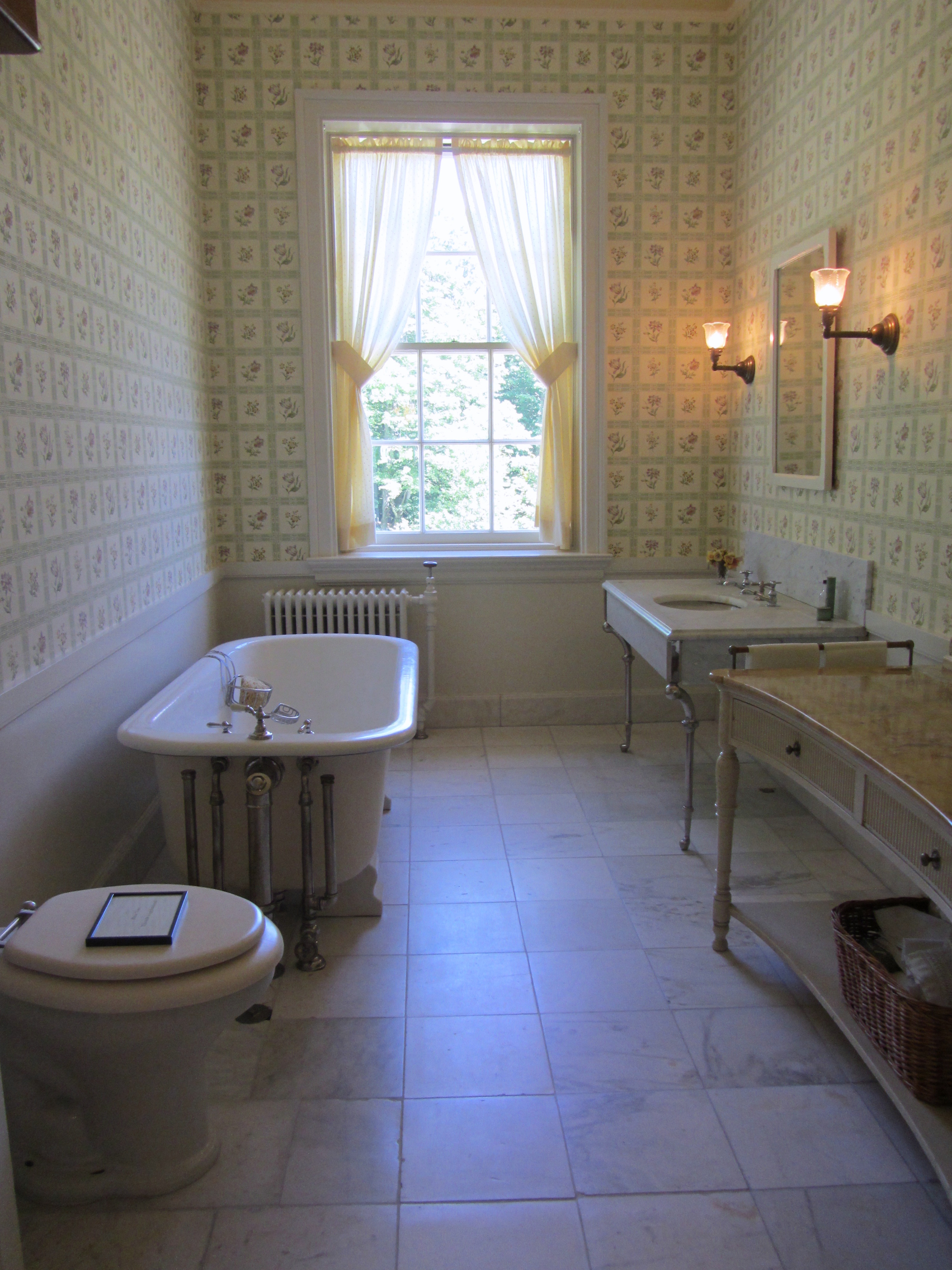
Private spaces made public:  Edith Wharton’s bedroom and adjacent bathroom.

The Mount, Plunkett Street (off Route 7), Lenox, Massachusetts.

Because I was having a completely indulgent day (one in a series), after my morning at The Mount, I stopped on the way back to my inn to pick up that must-have publication of the season, the September issue of Vogue Magazine.  I opened it up, and there she was:  Edith Wharton in Vogue!  Or model Natalia Vodianova playing Edith in residence, in an 18-page article and spread entitled “The Custom of the Country” by Colm Tóibín with photographs by Annie Leibovitz. There was Edith/Natalia ensconced where I just was, along with various actors, authors and models playing members of her inner circle who were regularly invited to the Mount (Henry James, Walter Berry, Theodore Roosevelt, her landscaper niece Beatrix Farrand, and sculptor Daniel Chester French–whose home I also visited yesterday).  A happy coincidence.


Road Trip, Part Two: Road to Ruin

I drove through south central Vermont towards the Hudson River Valley on roads still-ravaged by Hurricane Irene, a year ago, and along riverbeds of displaced rocks.  Not all was perfect and picturesque in the Green Mountain State; there has obviously been a lot of suffering.  There were poignant messages spray-painted on boarded-up houses:  why, Irene?

I checked in at my brother’s house in Rhinebeck, New York and we planned our itinerary for the next day:  first up, one of the most famous of the grand Hudson River Valley ruined mansions:  Wyndcliffe, built in an imposing Romanesque Revival style in 1853 by Edith Wharton’s paternal aunt, Edith Schermerhorn Jones (1810-1876).  Wyndcliffe has been in a state of decline for 50 years or so, and is now nearly ready to come down.  We approached it on a road marked private (in very small letters), and a very nice Kevin Kline-esque man reproached us, more for our own safety than any territorial inclination:  the “structure” does look like it could collapse at any moment and he said people had been going into it at night. We quickly took a few photographs and left, with additional protective neighbors watching us like guardians.

There are several stories swirling around Wyndecliffe.  It was the first of the really ostentatious, over-the-top mansions in the region: 24 rooms, terraced gardens on 80 acres, Norman-esque tower, elaborate brickwork.  It is said (again and again, although I could not find a contemporary source) that the house represented such a flagrant display of wealth that it inspired the phrase keeping up with the Joneses.  Better documented are Edith Jones Wharton’s visits to the house, which she did not particularly care for, but nonetheless used as a setting for at least one of her books, Hudson River Bracketed.  After her aunt’s death, the house became known as “Linden Grove” and “Linden Hall” with the tenure of industrial brewer Andrew Finck, whose descendants owned the property until 1927.  After that, a serious of owners (including a group of Hungarian nudists!) oversaw its slow but steady decline.

The house in its heyday, and in a series of exterior and interior photographs taken in 1975 by Jack E. Boucher, photographer for the Historic American Buildings Survey, Library of Congress:

And some pictures from yesterday, most of which were taken by my brother as I had forgotten to charge my camera battery!  The house is definitely beginning to cave in on itself (although the pictures above illustrate that this has been happening for some time) but maintains that strong sense of dignity and presence often apparent at the very end.


Road Trip, Part One

My husband is preoccupied with a kayak fishing tournament, my house is being painted, and my street (finally–the last time was in the early 1970s by all accounts!) is being paved:  it was time to get out of town.  So off I went yesterday, on a circular tour of New Hampshire, Vermont, (a bit of) New York and Western Massachusetts.  That’s the thing about New England:  it is small, and you can cover a lot of ground–even when you only travel on routes marked “A” and stop at every historical marker, as is my inclination. I drove leisurely towards my childhood home of Strafford, Vermont, perhaps the most picturesque village on the planet, and then poked around central Vermont for a bit.

Strafford Meeting House, built 1799 with additions of belfry and tower in 1832.  As a child, I lived in the shadow of this amazing building, described in a 1959 HABS report as “a well-preserved, severe, wooden structure on an imposing site”.  Severe indeed.  Often mistaken as a church, it has served in a secular function for most of its life, and I remember:  rummages sales, plays, and of course town meetings.

The Meeting House yesterday and in a 1959 HABS photograph, Library of Congress, along with a 1964 cover of Vermont Life (my little brother and I were actually on a cover about 10 years later, but I can’t find it!)

My childhood memory of Thetford, next to Strafford, is of a town of brick houses.  It did not disappoint, although there were some non-brick houses too.  These two neighboring houses were perfect, and perfectly situated on lovely grounds.

The corn is high in central Vermont::

The Cornish-Windsor Covered Bridge, linking the New Hampshire town of Cornish and the Vermont town of Windsor, is one of the longest covered bridges in the United States.  It was built in 1866 and substantially rebuilt in the 1980s. Also in Windsor (actually I guess the bridge is actually in Cornish) is the Old Constitution House, where the constitution of the Vermont Republic was signed in 1777 , in effect until Vermont was admitted to the US as the fourteenth state in 1791.

On to Woodstock, where I spent the night. You could spend several days in Woodstock:  there are shops, restaurants, the Billings Farm & Museum,the Marsh-Billings-Rockefeller National Historic Park, and countless amazing houses.  It is yet another one of those achingly beautiful towns in Vermont, but also a busy and obviously wealthy one.  It’s a “shire town”, or county seat, to use the term we use in the rest of New England. Vermont is always a little bit different, perhaps because of its brief republican experiment.

Woodstock:  houses, another bridge, and a case of vintage tins in FH Gillingham & Sons General Store.


Salem Houses for Sale

I’m a persistent, one might say compulsive, realestalker:  my admiration for my own house doesn’t stop me from checking out others, often. I think that this compulsion is shared by many of my neighbors: nothing stirs up a Salem gathering better than real estate chat. With the down market over the past few years, these discussions have not been as much fun, but I think (hope) that the market is picking up now. I thought I would start featuring a sampling of Salem houses for sale from time to time on the blog, because it’s a nice way to focus on great houses that may or may not have some historical connection or architectural feature that would land them here anyway.  Salem is full of great old houses, many of which are overlooked and very worthy of notice, and lots of newer houses too, though I am not interested in those. Sorry–if you haven’t figured it out before now, I am a complete old-house snob, for aesthetic, architectural, environmental and experiential reasons. The houses below are all in the McIntire Historic District with one exception:  I’ll focus on other neighborhoods in future posts. I’m linking the listings below to Coldwell Bankers site, just because I find it particularly easy to navigate.

Two ivy-covered brick mansions:  26 Chestnut Street and 14 Pickman Street

The Devereux Hoffman Simpson House at 26 Chestnut was the last of the grand Federal mansions to be built on the street, in 1826.  The house has 15 rooms, 7 bathrooms, and a restored carriage house with an apartment on the second floor. It was featured in the New York Times real estate section several weeks ago, and the first photograph below is from there.

I featured the completely-ivy-covered exterior of the Cook-Kimball house on the blog about a year ago and got 4000 clicks in 10 minutes:  it is a striking sight.  The interior looks more stark–and well-preserved, but I’m only going by the listing, which also attributes the house to Samuel McIntire (while all the sources I consulted–Fiske Kimball, Bryant Tolles, Jr.–attribute it to his son, Samuel Field McIntire).  Located on a quiet side street off Salem Common, the property includes six bedroom, an adjacent lot with carriage house, and, as you can see, an amazing staircase.

Beckford Street Colonials: 22 Beckford Street and 20 Beckford Street

Adjacent to each other on Beckford Street, a side street that runs between Federal and Essex in the McIntire Historic District, are these two houses built before the Revolutionary War.  22 Beckford is a really interesting house with lots of period details and a great enclosed yard:  it was actually moved to this location at some point in the nineteenth century.  It has seven fireplaces, parking, and a really cute garden shed out back.  20 Beckford Street, right next door, is actually a multi-family house with two units–there are 12 rooms in all.  The situation of this house, with its front facade at right angle to the street and enclosed yard, affords it quite a bit of privacy.

A Colonial Revival on Federal Street:  87 Federal Street.

Just down the street from the Beckford street colonials, and almost across from McIntire’s Peirce-Nichols house, is the Albert Goodhue House at 87 Federal Street. The house was built in 1893, and has that combination of architectural detail and enhanced scale characteristic of Colonial Revival houses. It is also a multi-family house, with 3 units, parking, and a private yard.

Addendum:  From the Old House BlogFive Reasons to Invest in an Older House.


Samuel McIntire in Texas

I knew that the charming 1793 summer house designed by Salem’s renown architect and woodcarver Samuel McIntire (1757-1811) had been moved (from its original location 4 miles away on Salem merchant king Elias Hasket Derby’s Peabody farm–successively the property of the Crowninshield and Osborn families), and copied (by Derby’s distant descendant Martha Codman for her Newport mansion Berkeley Villa, which you can read about here), but I had no idea until very recently that it was the inspiration for a Houston McMansion.

Here is a panorama of pictures taken yesterday of McIntire’s beautiful summer house, situated since 1901 on the Glen Magna estate in Danvers, Massachusetts.

And here, via my very favorite pinner on Pinterest, via the Cote de Texas blog, via Luxe magazine, are pictures of a house outside downtown Houston designed by John Ike of Ike Ligerman Barkley Architects of New York.

It is probably wrong of me to call this house a McMansion as it is only two rooms deep, but it does have white marble flours (versus the painted wood of the original).  I’m not sure what to think of this creation:  is imitation the sincerest form of flattery in this case?

Another view:  a Rudolf Ruzicka Christmas card for the Merrymount Press, 1940.


Long Hill

Just to the north of Salem, over the Danvers River, is the city of Beverly, of similar size demographically but much larger geographically.  Beverly has a vibrant downtown, which is surrounded by lots of neighborhoods which are quite distinct: Ryal Side on the river, the historic Cove, the affluent coastal communities of Beverly Farms and Pride’s Crossing, inland Montserrat and Centerville, and North Beverly.  This is not an exhaustive list; neighborhood identities are well-established in Beverly. There are amazing Gilded Age mansions in the Farms and Pride’s Crossing, and the entire North Shore coast achieved an even more gilded reputation after President William Howard Taft made Beverly the site of his “Summer White House” in 1909, first renting the Stetson Cottage at Woodbury Point in the Cove and then “Parramatta”, a house in Montserrat.

President Taft’s first Summer White House in Beverly; after 2 summers here, his landlady, Mrs. Maria Evans, informed the President that she was replacing the house with an Italian garden (still there, in the now-public Lynch Park)!  The house was cut into halves, put on barges, and floated across the water to Peaches Point in Marblehead.  You can see all the pictures at the digital exhibition of the Beverly Historical Society.  Paramatta, the second Taft Summer White House, is below.

By way of introducing I am digressing!  Suffice it to say that Beverly had a well-established reputation as the site of a wealthy and politically-connected summer society before and after the coming of President Taft, and the architecture to prove it.  I’m going to take on a few of the greater North Shore’s more famous (and interesting) summer “cottages” myself this summer,but in the meantime you can satisfy any curiosity you may have with the wonderful book by Pamela W. Fox, North Shore Boston: Country Houses of Essex County, 1865-1930, or Joseph Garland’s Bostons Gold Coast: The North Shore, 18901929.

One theme that emerges from both books is the difference between the simple wooden structures built by the Boston Brahmins before Taft’s time and the more elaborate mansions built by non-Bostonians after.  That trend does not quite apply to the house that I am writing about today, Long Hill, built by Atlantic Monthly editor-owner Ellery Sedgwick and his wife Mabel in then-rural Centerville, away from the maddening crowd on the coast.  Sedgwick’s Massachusetts (western Massachusetts) roots go way back, but he did not choose to build a restrained Yankee cottage; instead he and Mrs. Sedgwick copied (and mined) a dilapidated Southern house:  the Isaac Ball House (1802) in Charleston, South Carolina. I tried and tried to find a photograph of the original Charleston house in situ, to no avail (only turning up images of the Ball family’s several plantations, all in sad states, and a few references to the “town house”) but Long Hill, completed around 1921, is supposed to be a close copy.

When I visited Long Hill the other day, I ran into some architect friends of mine, who pointed out details that I would have not seen on my own:  the perfect proportions (sadly missing in modern “Georgian” Mcmansions), the old, weathered, mellowed brick, certainly not circa 1920 brick, the very delicate columns, the classical details.  It is a charming house, well-situated, but it still looks a bit out-of-place to me.  I’m more impressed with the gardens, and all the surrounding woodland.  I never really understood why the Sedgwicks wanted to be so far away from coastal “society” (and breezes), because I never really knew about Mrs. Sedgwick’s horticultural interests—and achievements.  The author of The Garden Month by Month (1907, lots of illustrations and a pull-out flower color chart) wanted land, not ocean views, and she and her husband acquired 114 acres in Centerville on which to build not only their house but their very cultivated garden, even more impressive because of the contrast between it and the woodlands beyond.  Mabel Cabot Sedgwick died in 1937, but her husband remarried another horticulturalist, Marjorie Russell Sedgwick, who continued to improve the gardens at Long Hill.  The property was transferred to the Trustees of Reservations in 1979, and remains a peaceful, pastoral retreat.

The gardens at Long Hill:  woodlands surround the manicured lawns and garden “rooms” adjacent to the house:  blooming Solomon’s Seal, wisteria & peonies.