Category Archives: Houses

Salem Savior

She was not the only hero(ine) in the story, but rather in good company:  still Ada Louise Huxtable played a big role in the prevention of the complete annihilation of historic Salem by the forces of urban renewal in the 1960s. The Pulitzer-Prize-winning architectural critic for The New York Times and The Wall Street Post, often referred to as the “dean” of American architectural criticism, died yesterday at the age of 91. The dominant themes of the obituaries that I am reading this morning are Mrs. Huxtable’s influence over both architectural criticism and the architecture of New York, but she shaped the architecture of Salem as well. So here is my little parochial appreciation.

Ada Louise Huxtable in her New York apartment, 1988.  Arnold Newman/Getty Images.

Ada Louise Huxtable in her New York apartment, 1988. Arnold Newman/Getty Images

Mrs. Huxtable. who summered in nearby Marblehead, heard of the urban renewal plans for Salem and was moved to write a rather passionate piece that the Times put on its front page on October 13, 1965: “Foes Fear Plans Will Mar Old New England Heritage; Urban Renewal Plan Threatens Historic Sites in Salem, Mass.” She reported on what was going on, but definitely put her own viewpoint in the article:  By setting up “design controls” for the new construction, the city guarantees itself, at best, “instant Georgian” (apparently she detested Colonial Williamsburg!) to replace the genuine example. The spurious product is a much better economic deal than the real thing…As things stand now, it will take some potent modern witchcraft to save Salem’s historic past.  A series of follow-up articles were published in the Times from 1967 to 1974, culminating, happily, with the latter year’s “How Salem Saved itself from Urban Renewal (September 29). During this period, local preservationists were galvanized to fight the demolition of 103 buildings in the city center in the name of “urban renewal”, and the plan shifted to the redevelopment and revitalization of Essex Street, Derby Square, and Front Street. Many buildings were lost, but not as many as would have been without the advocacy and inspiration of Mrs. Huxtable, I believe.

Many years later (1993), Mrs. Huxtable was interviewed by Robert Campbell, the architectural critic of the Boston Globe, and he asked her where in New England she thought she had had the most impact.  She replied:  I think I had more impact on Salem, because Salem had a hideous urban renewal plan. I remember going over it with the then-mayor and planner, and they were going to eliminate the beautiful Japanese garden next to the museum and they were planning roads that would take away whole blocks. So I went back to New York and sold it to the Times as a Page 1 piece … and that brought whoever was on the National Advisory Council on Historic Preservation in Washington to Salem. “What are you doing here?” That resulted in the change of planners and the total change in the plan.

Urban Renewal 015

Urban Renewal 018

Essex Street today:  a road does NOT run through the Japanese garden of the Peabody Essex Museum, but unfortunately the Brutalist parking garage with its first-floor shops did replace earlier commercial buildings.

Urban Renewal 020

Urban Renewal 009

Front Street, revitalized not destroyed, a far more successful shopping district than the nearby Essex Street pedestrian mall, and the Ash Street house (built in 1811) of another preservation heroine, Bessie Munroe.  She fought urban renewal in the 1960s while she was in her 80s! Unfortunately the house now looks over a parking lot, and a very ugly modern building built on the site of jail where the accused witches were held in 1692.

Old Wethersfield

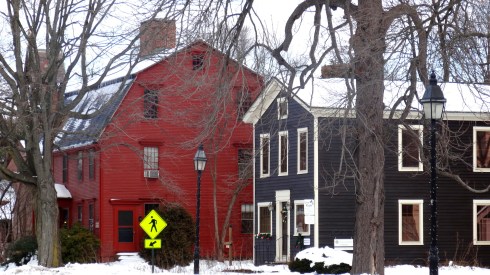
Whenever I’m heading home from New Jersey or New York or points south, I always like to stop in at Old Wethersfield, Connecticut:  it’s a beautiful village just off the highway and just outside Hartford:  a convenient respite for a weary traveler. Old Wethersfield is a National Register Historic District, comprising 100+ houses from the seventeenth, eighteenth and nineteenth centuries situated along a main thoroughfare and a slender rectangular green, which is part of the larger town of Wethersfield. I had two restless guys with me yesterday but they still let me stop for a bit, to take pictures of some of my favorite houses and briefly run into Comstock, Ferre & Company, which has been selling heirloom seeds for two centuries. Wethersfield is known not only for its colonial architecture, but also for its venerable seed companies, including Comstock and the Charles C. Hart Seed Co. in the present and a whole host of provisioners in the past. The most profitable product of these companies, a red “Wethersfield Onion”, even gave the old town the nickname “Oniontown” for a while. I am also compelled to mention Wethersfield’s fascinating/notorious founder, John Oldham, who was exiled from the Plymouth Colony for “plotting against pilgrim rule” and went on to establish settlements in Hull, Gloucester, and Watertown, Massachusetts, and eventually Wethersfield, the first English settlement in Connecticut. (Oldham seems to have rubbed shoulders with Salem’s founder, Roger Conant, on more than one occasion). Travel and Leisure magazine just designated Old Wethersfield one of America’s “prettiest winter towns”, and it certainly appeared so yesterday afternoon with snow lining the brick sidewalks and artfully draped on the colorful colonial houses.

Just a small sampling of Old Wethersfield, New Year’s Day 2013:

Wethersfield 052

Wethersfield 046

Wethersfield 044

Wethersfield 045

The plaques and signs refer to the house above, as in the case of one of Old Wethersfield’s most famous houses, the Webb House, pictured below with its neighbors.

Wethersfield 080

Wethersfield Webb House 083

Wethersfield 084

Wethersfield 074

Wethersfield 077

Wethersfield 076

Wethersfield 086

More!!! And as you can see, there are “newer” houses in Old Wethersfield too.

Wethersfield 091

Wethersfield 092

Wethersfield 056

Wethersfield 053

Wethersfield 060

Wethersfield 090

The Comstock building, obviously a livelier place in the summer but still very much open, and an 1899 seed catalog cover featuring the Wethersfield Onion, the “greatest onion on earth”,  from the Smithsonian Institution Libraries’ Collection.

Wethersfield 049

Wethersfield Onion Smithsonian


New Year’s in New Jersey

This post is going to be a study in contrasts. We’re on the northern New Jersey shore visiting my husband’s family, hearing storm stories and seeing lots of storm damage. Superstorm Sandy is very much in evidence, two months after its arrival. Some areas in this region emerged relatively unscathed, while others were hit hard:  two cases in point are Allenhurst, where my husband’s family home is located, and Sea Bright, where our niece lives. These boroughs are located just a few miles from each other on the shore, but their present environments could not be more different.

shore 003

Crossing over into New  Jersey on the George Washington Bridge on a stormy day.

Allenburst is a wealthy little enclave right next to the storied Asbury Park. The train to New York runs right through its little village center, offering wealthy urban dwellers an escape from the sweltering city a century ago and a relatively easy commute now. In some ways Allenhurst reminds me of my hometown, York Harbor, Maine, which also developed as a summer community, but there are notable differences:  the village is laid out in a grid pattern, the architecture is on steroids, and of course, this being the Jersey shore, there is a boardwalk.  The cabanas of the Allenhurst beach club (they build these private clubs right on the beach here; I don’t really understand how that can happen on a supposedly-public beach, but there it is) were washed away by Sandy, and a little section of its boardwalk, but I couldn’t find much more serious damage in evidence. The houses of Allenhurst, are stately: grand Victorians, Tudors, lots of Spanish-styled, tiled-roofed mansions from the teens and twenties. From my New England perspective, I notice an absence of the simple Shingle style, and the presence of lots and lots of stucco. I am sparing you the huge tacky modern houses that have been built right on the ocean; the more charming houses are on the side streets of Allenhurst.

shore 048

shore 046

shore 033

shore 030

shore 038

shore 036

shore 068

Shots of Allenburst:  an oceanside mansion and  “smaller” houses along the side streets, one closed-off street section, pink iron deer!

Traveling up the coast to Sea Bright through Long Branch I stopped by the Church of the Presidents, which is undergoing a major renovation. Seven Gilded Age presidents, Ulysses Grant, Rutherford B. Hayes, James Garfield, Chester Arthur, Benjamin Harrison, William McKinley and Woodrow Wilson, vacationed in this area and attended this church; James Garfield died just across the way after several months of suffering after he was shot in the early summer of 1881.

shore 129

You can see piles of wood and sand and boarded-up houses along this road, although major development has occurred in this area and the large multi-story buildings (which have wiped out any trace of those associated with the seven presidents) look like they could withstand any storm, but maybe not.

shore 070

shore 075

shore 077

shore 080

shore 081

Among the melee, these column sections certainly give one a “fall of the Roman Empire” feeling–not quite sure where they came from.

And then to Sea Bright, a barrier beach town that was really devastated and remains so. Displaced residents, boarded-up storefronts, condemned buildings, and what many say is an unrecognizable beach constitute the aftermath of Sandy, but also a very vibrant spirit focused on recovery. The municipal government seems very responsive, there’s been all forms of outside help, and an organization called Sea Bright Rising seems poised to will that to happen in the New Year.

shore 115

shore 106

shore 104

shore 090

shore 108

shore 097

shore 101

shore 122

shore 113

shore 111

Sea Bright, New Jersey, two months after Sandy: the pictures speak for themselves except for the last one, which is of an island in the Shrewsbury River behind the borough, where all the boats from a nearby mainland marina ended up.


Red Christmas

Even before I read a nice little article yesterday on how the holidays obtained their color themes, I was already planning to focus on red:  it’s been a dreary week and I needed a little cheering up. The red that we now associate with Christmas comes from an amalgamation of historical and cultural forces:  iconic images of St. Nicholas of Myra wearing red robes, holly berries and the apple props of medieval mystery plays, the Victorian poinsettia craze, the colorful depictions of Santa Claus by nineteenth-century cartoonist Thomas Nast, and the Coco-Cola Santa Claus of the early twentieth century. I’ve already covered Saint Nicholas in a lengthy post a week or so ago, so this perspective is going to be structural. Here are some of my favorite red houses, tastefully decorated for the season in typical understated New England fashion. I’m starting up north, in my hometown of York, Maine, where I happened to be last week before our weather turned dreadfully dreary, and then I’ll work my way home to Salem via Newburyport.

Two of the Historic House Museums of Old York:  the 1719 Old Gaol (Jail) and the 1754 Jefferds Tavern. As you can see, the gaol is situated on a little hill that overlooks York Village below. There is a large new barn-like structure attached to the tavern which I dont really care for (despite the fact that it is named after my wonderful high school guidance counselor) so Im showing a vantage point that excludes it.

treees 001

red Gaol 2

red gaol

treees 011

Heading south, I stopped in Newburyport–a city of white houses for the most part–and found two adorable colonial sideshingled houses on side streets in the south end.

red house Newburyport

treees 019

treees 021

Back in Salem, where there are not a lot of red houses, really. But there is venerable Red’s Sandwich Shop downtown, and the Manning house in North Salem, which was once in the midst of one of the most famous orchard nurseries in Massachusetts. This was the home of Nathaniel Hawthorne’s uncle, Robert Manning, a famous “pomologist” (an expert in the cultivation of fruit trees) and according to the sign, also a stagecoach agent–news to me. The last picture in this group is a rare red Greek Revival on Essex Street: you seldom see a house in this style painted red, as they are meant to mimic stone. From these pictures it appears we like our red houses with white trim in Salem.

Red's Sandwich Shop

red house North Salem

red Manning House

red greek revival

Finally, Nathaniel Hawthorne’s c. 1750 birthplace, moved to its present location adjacent to the House of the Seven Gables on the harbor in 1958 from downtown. A rather gnarly tree seems to be threatening it! And last but not least, a wonderful old (fishing?) shack on the other side of the Gables: a little worse for wear maybe, but still red and picturesque–it does seem to be crying out for a wreath at this time of year.

Red Hawthorne House

Red Hawthorne House rear

red shack


Trees in the House

I was intent and inspired to have a rather spare Christmas tree this year, but once again we have a huge and furry white pine (I think I incorrectly called last year’s tree a Scotch pine) tree, over nine feet tall, that just eats ornaments.  Oh well, the house probably calls for such a display, in contrast to the more minimalist Scandinavian looks, featuring branches and twigs more so than trees, that I collected in a pile of tear sheets. I particularly like this beautiful Toronto house, owned and decorated by designer Ingrid Oomen, that is featured in this month’s issue of Canadian House and Home.

Tree in the House HH

Tree in the house CHH 3

I don’t know why the second scan came out so grainy–sorry. These minimalist tree branches go so well with this decor, and they could really be maintained all year round, minus the ornaments. I also like this simple display from Country Living, counterposed with the more traditional tree in the adjoining room.

Tree in the House Country Living

I have not managed to go the overly-creative or minimalist route this year.  The Christmas season is always a little frustrating for me, as I have high decorating hopes and not much time, with lots of papers and exams to correct and grades to turn in. I have a few little live trees around the house, like this one on the dining room mantle next to my new deer from Wisteria, and then the big tree in the front parlor (which I am showing you in both undecorated and decorated states so you can see what a monster it is). It doesn’t matter how many ornaments or garlands you put on this tree, it still looks essentially green.

trees Mantle

tree in the house

trees2 007

Two of my favorite historical images of Christmas trees: Eastman Johnson’s Christmas-Time, The Blodgett Family (1864) and a print of President Roosevelt’s children showing him their closeted Christmas tree in 1903:  he was an avid environmentalist and would not have one in the house (or so he proclaimed).

Christmas-Time, The Blodgett Family Eastman Johnson 1864

Tree Roosevelt 1903 WH Hist Assoc

Eastman Johnson, Chistmas-Time, The Blodgett Family (1864), Metropolitan Museum of Art; The Roosevelt children show the President their tree, 1903, White House Historical Association.


Christmas at the Willows

This weekend’s Christmas in Salem tour is focused on Salem Willows, for the first time (I think!) in this storied event’s 33-year history. The tour has developed its large following by opening up historic homes in the city’s central historic districts (McIntire, the Common, Derby Street), but every once in a while it branches out to showcase an outlying neighborhood: North Salem a few years ago and now the Willows. Eight homes are on the tour, all decorated for the season. By the time you are reading this, it’s too late to purchase tickets online, but they will be available at the Bentley School (25 Memorial Drive, Salem) on Saturday and Sunday. Christmas in Salem is the major fundraiser for Salem’s preservation organization, Historic Salem, Incorporated, and as such, it enables HSI to continue its preservation advocacy and outreach.

In terms of preservation, the Willows (or more formally the Juniper Point residential neighborhood, which is adjacent to the historic Willows municipal park) has been a bit vulnerable in recent years, given its desirable coastal location, its lack of historic district restrictions, and the transformation of its summer cottages to year-round residences. There have been some rather aggressive additions and an unfortunate teardown a few years back.  But the majority of the neighborhood’s close-knit Victorian and early twentieth-century dwellings appear perfectly preserved, and they provide a nice backdrop for a seaside Christmas stroll.

Willows Salem State

Willows 012

Willows SSU

A Craftsman cottage (not sure if this is on the tour–it’s just one of my favorite houses) in Salem Willows, framed by two early 20th century doctored postcards from the archives of Salem State University.


Queen Anne and Napoleon III

We spent Thanksgiving in Saratoga Springs, New York, a city that on first impressions is as “Victorian” as Salem is “Federal”. I wasn’t able to spend the entire long holiday weekend there (and I was sick most of the time I was there), so I didn’t go on a long architectural/photographic walking tour as is my typical inclination, but I did dash down North Broadway, which is lined with Gilded Era mansions, as well as a few downtown side streets. I’m going back for more soon. Even before the quick trip to Saratoga, I had been thinking about Victorian houses here in Salem, and how I’ve never really done justice to this broad category of architecture. There are so many subcategories and styles!  I’ve always been a bit confused about two in particular:  Queen Anne and Second Empire. Not the styles of these houses, which are easily recognizable with their towers, turrets, and mansard roofs, but the names:  how did these thoroughly American houses get named for the last Stuart monarch, who reigned in Britain a full 150 years before a “Queen Anne” house was built across the Atlantic, and the French Second Empire ruled by Napoleon III (which was at least contemporary with Second Empire houses here in America)?  These names seem to imply a cultural imperialism that is incompatible with the assertive American spirit of the later nineteenth century, but then again, I’m neither an American historian or an architectural one, so my impression could be incorrect.

Queen Anne (r. 1702-1714) in 1705 by Michael Dahl, and an carte-de-visite of Napoleon III (r. 1852-70), National Portrait Gallery, London.

I can understand the use of the term “Victorian” for nineteenth-century houses on both sides of the Atlantic, as Queen Victoria really dominated her long era, but Napoleon III was no Queen Victoria! I suppose the rebuilding of Paris–the cultural center of the world–in Second Empire style during his reign provides the general explanation for the use of that term over here. The use of “Queen Anne” remains a mystery to me, but here are a couple of Queen Anne houses:  the first one in Saratoga, the second in Salem. There are several great Queen Anne houses in Salem, mostly outside the city center, but this more compact example is just a few steps from the Common:  it seems to feature all the characteristic details of the style in a much smaller footprint than the grand Saratoga house. This is a house that even a Federal fan such as myself could love.

The Second Empire style was forged by the Haussman Plan, a comprehensive urban planning initiative in Paris commissioned by Napoleon III and administered by Georges-Eugène Haussmann between 1853 and 1870. Much of central “old” Paris was swept away and replaced by grand boulevards and squares lined with mansard-roofed and embellished multi-story buildings made of “sanitary” stone. The “haussmannization of Paris” was projected to the world via serial publications and French paintings, creating an international style.

Images of the new boulevards of Paris, 1850s-1870s, Victoria & Albert Museum, London.

When I walk down the streets of Salem, I see structures, small and large,  that seem to be inspired by the Second Empire style:  American translations in a “colonial” context. Lafayette Street gives off a “French” impression in more ways than one, and not far from the Queen Anne house, just off the Common, is a multi-family painted-brick house that comes close to the French standard, at least to my untrained eye. The Salem house that really reads Second Empire to me, however, is over on my side of town, on upper Essex Street.  Even though Bryant Tolles (in Architecture in Salem:  an Illustrated Guide,1983) refers to it as reflecting “French Academic and High Victorian Italianate” influences, the Putnam-Balch House, which was built at the height of the Second Empire style, always reads “Paris, 1870s” to me. This majestic mansion, somehow all the more extravagant because it is built of wood, really dominates the streetscape with its sheer presence:  it once served as an American Legion post and has recently been restored.


Seeing Pink

Black and orange are the predominant colors of the season but I was looking for pink this weekend. Pink houses, large and small, can be found all over Salem but primarily in the outlying neighborhoods away from the center historic districts. While colonial houses can look lovely in pink, this custom seems to apply more to Charleston and Savannah than it does to New England:  pink is just not a Puritan color!  So most of Salem’s pink houses are Victorians, with the exception of a very bright Greek Revival on Winter Street just off the Common, and a little Georgian house in dusty salmon pink right off Derby Street.

And on the other side of Derby Street, overlooking Derby Wharf, the Friendship, and the Custom House, a pink triple-decker, another iconic New England architectural style.

I kept walking east:  downtown was full of tourists and motorcycles, the weather was beautiful, and I knew that I’d find some pink house in the Willows. Salem Willows is a late Victorian park with an adjacent residential neighborhood of structures that were built as seasonal cottages in the later nineteenth and early twentieth centuries. All of these houses have been transformed into year-round residences, and it’s a colorful neighborhood with few preservation encumbrances. There was a full spectrum of pink here, from shocking Schiaparelli to the very pale color of the Gothic Revival cottage overlooking Juniper Point Beach.

Back in town, I turned left and walked down Lafayette Street, which was a grand boulevard of painted ladies before the great Salem Fire of 1914.  Some survived, and Colonial Revival residences replaced those that did not:  one has a conspicuous pink and light gray color scheme that you cannot fail to notice.  On a side street Lafayette, there’s a lovely late 19th century pink house, with an adjacent three-car garage, also in pink.  And way down the road, almost on the Marblehead line, is a “Scooby Doo” eclectic Victorian overlooking Salem Harbor dressed in faded pink.  I was losing the light by this time, as you can see.

These are all great houses, but I must admit that my two favorite pink houses are not in Salem. One is the Justin Morrill homestead in Strafford, Vermont, which I’ve already featured in a post, and the other is the Roseland Cottage in Woodstock, Connecticut, which is owned and operated by Historic New England. Both are assertively Gothic Revival structures–“Gothic” and pink are two descriptive terms which are seldom linked together, but in these two cases we have notable exceptions!

Roseland Cottage, Woodstock, Connecticut, 1846.  Historic New England.


Which Witch House?

One reason that I’ve been an ardent preservationist for most of my life is my belief that buildings hold extraordinary power–even more power, I think, than unbuilt spaces, no matter how beautiful. I can’t imagine a better example than Salem’s “Witch House” (more formally and accurately known as the Jonathan Corwin House), a structure that represents both the most tangible connection to the Witch Trials of 1692 as well as a symbol (and vessel) of Salem’s modern transformation into the “Witch City”. The Witch House seems to reflect the evolving aspirations and perceptions of the city that surrounds it:  for much of the nineteenth century, it was referred to as the “Roger Williams House”, a designation that tied it to the seventeenth-century minister who left intolerant Salem for free Rhode Island rather than the witch-trial Judge Corwin from a generation later. Freedom of conscience versus irrational jurisprudence.

The Witch House today and in an 1886 card by Edwin Whitefield, author/illustrator of Homes of our Forefathers.  Whitefield’s images seems to be based on that of Samuel Bartoll’s 1819 painting, in the collection of the Peabody Essex Museum.

The early architectural history of the Witch House is a bit mysterious (a study has been commissioned by the city, but I haven’t seen the results yet), but most experts believe that it dates from much later in the seventeenth century than Roger Williams’ time in Salem. All of the above images, those from the nineteenth century and just yesterday, might be idealized images of this fabled house. We do know that Jonathan Corwin acquired a structure in this location in 1675, and that he served on the Court of Oyer and Terminer which tried the accused “witches” of 1692. That fact alone seems sufficient for the house’s transformation into the “Witch House” much later, after it left the possession of the Corwin family in the mid-nineteenth century. More than anyone, the person responsible for this identification was George Farrington, an entrepreneurial Salem apothecary who definitely emphasized the witchcraft (rather than Williams) associations of his new place of business:  Farrington grafted a box-like shop onto the house and sold medicines in bottles with a flying witch insignia, anticipating the marketing strategies of Daniel Low decades later and many Salem businesses today. He also published images of  the “old witch house”, effectively establishing that identity.

The Witch House in the mid-nineteenth century:  very influential photographs by Frank Cousins of the front and rear of the house just prior to Farrington’s purchase in 1856 (the house had acquired a gambrel roof in the mid-eighteenth century), a Deloss Barnum photograph from the 1860s, after Farrington’s pharmacy had been attached to the house, an “Old Witch House” stereoview published by Farrington, and a Farrington medicine bottle from the 1880s as pictured in a recent ebay auction.  All photographs from the Robert Dennis Collection, New York Public Library.

For nearly a century, the Witch House was configured as a strange (maybe not for Salem) combination of business and tourist attraction and thousands (maybe more) of postcards were issued, fixing and broadcasting its identity. In the decades before and after World War I, when Daniel Low was marketing its witch spoon and other witch wares nationally, there seems to have been a marked increase in the number and variety of Witch House cards. There are also some interesting private photographs of the house from this era, confirming its conspicuous place in Salem’s urban streetscape.

Two photographs of the Witch House in the 1890s from the Schlesinger Library at Harvard, and postcards from 1900, 1901, 1906, 1908, 1911 & 1922.  Just a random sampling of many on the market!

The 1940s was a decade of transformation for the Witch House, when it came to represent preservation–but also profits: change and continuity. With the planned widening of North Street, a main thoroughfare in and out of Salem, the house was threatened, and its survival (along with that of the adjacent Bowditch House) became the rallying cry for the formation of  Historic Salem, Incorporated and its subsequent restoration under the direction of Boston architect Gordon Robb (who had worked on Colonial Williamsburg as well as another famous Salem seventeenth-century structure, the Pickering House). Moved to a more secure northwestern position on its lot, its shop detached and gables rebuilt, the Witch House was opened to the public in 1948 by the City of Salem, and it has been doing steady business ever since.

The Witch House in 1940 (HABS photograph by Frank Branzetti, Library of Congress), 1945 & 1948.

For more on the evolving perception, and structural history of the Witch House, see Salem’s Witch House:  a Touchstone to Antiquity (The History Press, 2012) by Salem architectural historian John Goff.


Parks and Preservation

Just north of Salem are two adjoining state parks, Bradley Palmer State Park and Willowdale State Forest, which spread over parts of the towns of Topsfield, Hamilton and Ipswich. I took advantage of a free afternoon and the return of the sun and headed up there yesterday, in search not only of woods and trails but also houses, of course. Nature is never enough for me!  These properties were named after their donor, Bradley Palmer (1866-1946), a prominent U.S. and corporate attorney who built a beautiful Arts and Crafts country house called Willow Dale in 1901 at which he entertained such splendid company as HRH King Edward VII and President William Howard Taft.  In 1937, Palmer began donating sections of his large estate to the Commonwealth of Massachusetts and it was transformed into the parks.  All of the buildings on the Palmer estate, including Willow Dale and its outbuildings and the older Lamson and Dodge houses, have been leased by the state to long-term tenants who pay their “rent” in sweat equity through the Historic Curatorship Program, preserving these structures at minimal public cost.  The mansion has been transformed into the Willowdale Estate, a very elegant function facility, its coach house has just been completely renovated, and the older houses are in the process of being rehabilitated by their “resident curators”.

The Structures:  The Willowdale Estate  and its newly-restored coach house.

The Georgian Lamson House, considerably expanded by Bradley Palmer, and described as a “unique amalgam of Colonial and Colonial Revival styles” by the Massachusetts Department of Conservation and Recreation.  Images from 2008 –when its resident curators were chosen–and yesterday.

I have to admit that I couldn’t find the Dodge house, which was disappointing because I have been reading the great blog by its resident curators for the last several months.  If you’re interested in the Historic Curatorship Program (and Massachusetts has several other great properties it would like to lease) this record of the ongoing process is a must-read.  Lots of “restoration” blogs seem to be more about design and shopping, but not this one!  The Dodge house appears to date from the late eighteenth century, and Palmer made some “improvements” (including electricity) to this structure as well.

Dodge House exterior and wallpaper from residentcurator.com.

As you can see (read), the houses were the primary reason for my visit to the Palmer and Willowdale parks, but it was beautiful day, so I took a walk through the woods. Trails for people and horses (Palmer was an enthusiastic equestrian) are laid out through the Palmer park, and while it is possible to get off the beaten track, you’re never too far away from a steeplechase jump.  There is also a large meadow in the midst of the park, with the most luxurious moss edging I have ever seen. Willowdale is a bit less landscaped, but it also has laid-out trails:  this is Massachusetts, after all.