Category Archives: History

Be Merry and Drink Perry

One of the most famous colonial Christmas “incidents” occurred here in Salem on Christmas night, 1679: the so-called (by Stephen Nissenbaum, author of The Battle for Christmas) “Salem Wassail”. In the old English wassailing tradition, but quite contrary to the prevalent Puritan culture of Salem, four young men from Salem Village burst into the remote home of 72-year-old John Rowden and began singing before his hearth in an effort to entice him to offer them some of his (apparently renown) pear wine, or perry. Rowden and his family tried to get the intruders to leave, but they responded that “it was Christmas Day at night and they came to be merry and drink perry, which was not to be had anywhere else but here, and perry they would have before they went.”  The Rowdens were steadfast (after all Christmas revelry was actually illegal in the colony from 1659-1681), but wavered a bit when the young men offered them some money for the wine, “coins” which turned out to be pieces of lead. More pleading, a request for directions to Marblehead  (apparently not as dry as Salem), and then the young men stoned the Rowden homestead in demand of perry. Desperate times call for desperate measures, and as we all know, the holidays can promote rather disorderly behavior. The seventeenth-century “war on Christmas”, provoked by Puritans who saw no scriptural basis for the holiday and associated it with paganism (they were right) and popery, was largely over in Old England at the time of the “Salem Wassail” and it would soon end in New England as well.

Here and now, I have stocked up for my Christmas visitors with perry ( a traditional local version from Russell Orchards in Ipswich and a more festive sparkling variety–see below) as well as other spirits: I don’t want to get stoned.

Perry

Anon-The_Vindication_of_Christmas_or-Wing-V474-105_E_684_1_-p1

Anon-The_merry_boys_of_Christmas_or-Wing-M1852-A6_2_24_-p1

Bonny Doon Vineyards Sparkling Perry label (there’s also quite a few artisanal pear CIDERS on the market now–not sure if they are the same as perry; Russell Orchards makes both); two tracts from the war on Christmas in the 17th century: The Vindication of Christmas (1653) and Merry Boys of Christmas, or The Milk-Maids New Years-Gift (1660).


Christmas Roses

I like to decorate with live plants at the holidays–and all year round–but I don’t particularly care for the traditional Christmas plants: cyclamen is too gaudy for me, as are Christmas cacti, and I can’t stand the smell of paperwhites. I suppose amaryllis are alright, but I can never get them to bloom on time and, again, I find them a bit showy. Poinsettias are too predictable (and I have cats). So the only flowering plant that I seek this time of year are hellebores, varieties of which are alternatively called “Christmas Roses” (helleborus niger) and “Lenten Roses”. You’ve got to love a winter-blooming flower, and the association with Christmas is based not only on the season but also on the story of a penniless shepherdess who sought to give a gift to the baby Jesus–an angel turned her tears into pale waxen flowers, which were, of course, the greatest gift. Like tears, hellebore petals are seemingly-fragile, especially in contrast to their sturdier stems, and white, like winter (although there are pale pink varieties too–but the Christmas rose is white). There is another dissonance between the virtues of the plant and its seasonal beauty:  all of the classical and medieval herbals testify to its toxic qualities.

Hellebore BM Egerton

Hellebore after John White BM 1600

Hellebore Mary Delaney BM 1770s

Hellebore Cooper Hewitt early 19th century

Hellebore McIntosh

Hellebores 3

Hellebores 2 013

A succession of hellebores:  British Library MS. Egerton 747, Salernitan Herbal c. 1280-1310; two images from the British Museum: after John White, c. 1600 and Mary Delaney, 1770s; early 19th century British soft paste plate from the Cooper Hewitt National Design Museum, Smithsonian; a Charles Rennie MacKintosh drawing, c. 1901-1914, from the Victoria & Albert Museum, London; one of my potted hellebores, overlooking a snowy Chestnut Street.


Verjuice

From sweet to sour, or tart.  Over the Thanksgiving holiday, I had the most delicious pork scallopini at an Italian restaurant in Rhinebeck, New York. It had an interesting acidic flavor in its sauce–my stepmother identified it as vinegar, but after looking through a bunch of recipes, I’m pretty sure it was verjuice, a close relation with a long history. Verjuice (or verjus) just means “green juice”, and generally it refers to the juice of strained unripe apples or grapes, hence the tartness, but I’ve seen references to it in recipes dating way back–and most prominently in the late fourteenth-century household guide Le Ménagier de Paris and the Tudor cookbooks of Thomas Dawson. I always thought verjuice/verjus was just another name for vinegar (an incredibly important substance in the medieval and early modern eras–essential in both cooking and preservation), but upon closer reading, it’s clear that it is different, as this recipe from Le Ménagier makes clear:  SAUCE FOR RABBIT OR FOR RIVER-BIRD OR FOR WOOD-DOVE. Fry onions in good oil, or mince them and put to cook in the dripping-pan with beef drippings, and do not add verjuice nor vinegar until boiling: and then add half verjuice half wine and a little vinegar, and pass the spices. Then take half wine half verjuice and a little vinegar, and put all in the dripping pan under the rabbit, dove or river-bird; and when they are cooked, boil the sauce, and have some bits of toasted bread and put in with the bird.

Verjuice was (is) neither vinegar nor wine, but perhaps something in between, which is not my original observation. In this foodie world that we live in, it was only a matter of time before verjuice made a comeback, and the Australian chef Maggie Beer started producing it commercially a while ago. Just the other day, I was strolling through a shop in Newburyport, and there it was. So now I can try to make my own perfect scallopini–or maybe a traditional syllabub for our Christmas Day desert.

Verjuice 002

Verjuice Dawson

Verjuice BM

Noble Verjus at Wishbasket in Newburyport; Title page of the 1610 edition of Thomas Dawson’s The Good Huswifes Jewel, which has many recipes calling for verjuice; “As sour as Verjuice”, George Hunt print c. 1825, British Museum.


Blood Sugar

Sugar has long been a connecting commodity, linking various global communities in networks of supply and demand. In both my world and western history courses I have long stressed its importance: as a key factor in the expansion of Europe from the Crusades on, as a major cause of the Transatlantic Slave Trade, as an initiator and indicator of the increasing globalization of trade and consumerism over the early modern era. From the moment I discovered Sidney Mintz’s classic text Sweetness and Power. The Place of Sugar in Modern History (1985), sugar has been one of my portals into the early modern past. Because of the inextricable connection between sugar and slavery, I thought I was familiar with the term “blood sugar”, as used by abolitionists in the eighteenth and nineteenth centuries in much the same way that we would use “blood diamonds” today, but I never really understood the full ramifications of that term until I was viewing a current exhibition at the John Carter Brown Library at Brown University: Sugar and the Visual Imagination in the Atlantic World, circa 1600-1800. “Blood sugar” can refer metaphorically to the blood, sweat, tears, and lives of the slaves who were sacrificed on the altar of the ever-increasing consumption of sugar in the western world, but also literally to use of cattle blood in the sugar-refining process. Several sources in the Sugar and the Visual Imagination exhibition make the explicit connection between sugar and the blood shed by people and animals, including the fascinating 19th century abolitionist “picture book” aimed at children, Cuffy the Negro’s Doggrel Description of the Progress of Sugar  (1823).

Blood Sugar

This might seem like a very graphic association for children, but British abolitionists of the eighteenth and nineteenth centuries (like their counterparts across the Atlantic) were not known for their subtlety. The most popular pamphlet of the 18th century, William Fox’s Address to the people of Great Britain on the propriety of abstaining from West Indian sugar and rum (1791) went much farther and set the tone for much of the debate:  Nay, so necessarily connected are our consumption of the commodity the misery resulting from it, that in every pound of sugar used, (the produce of slaves imported from Africa), we may be considered as consuming two ounces of human flesh.The Sugar and the Visual Imagination exhibition explores this “Cannibalism” angle and its role in making sugar distasteful for everyone–including the royal family, who were pictured in several contemporary caricatures trying to wean themselves off the substance. Below, a rather grotesquely caricatured Queen Charlotte (who was said to have African blood herself) weighs tiny pieces of sugar on a scale for her guests while King George III says he can leave it altogether.

Blood Sugar BM

Isaac Cruikshank, The Gradual Abolition of the Slave Trade, or Leaving of Sugar by Degrees, 1792, British Museum.

Even (long) after the abolition of the slave trade in both Britain and America, sugar continued to foster connections, criticism and conflict. It became a focal point for critics of both economic and political imperialism, as illustrated by the 1906 Puck cover below (from the Library of Congress), criticizing U.S. economic policy in the Philippines. Much more recently, I came across the headline “Coca-Cola Distances itself from Blood Sugar Farms” in Cambodia.

Blood Sugar Puck 1906


My Favorite Georgians

The public presentation of history is often driven by anniversaries, and Britain is just beginning a long Georgian moment driven by the 300th anniversary of the Hanoverian dynasty’s accession in 1714 and commencing (after the birth of little Prince George this summer) with the British Library’s new exhibition Georgians Revealed: Life, Style and the Making of Modern Britain. Viewing it from afar (online), I like the exhibition’s emphasis on Georgians rather than the more boring King Georges, and its inclusion of some of the more interesting aspects of the era: the development of “celebrity culture”, the “commercialization of leisure”, the emergence of the novel, and intensifying consumerism in many realms of life. But from my own distant Anglo-American perspective, I’m noticing a distinct lack of a colonial presence. Before the Revolution, we should certainly consider the people who inhabited British America as Georgians, so I’m featuring a few of my favorite American Georgian gentlemen here. Although I don’t have quite the same connection to them that I do for some of the people of the earlier era in which I specialize, there is something compelling about both their images (personas) and their stories, if only because several of them walked on the same streets that I do.

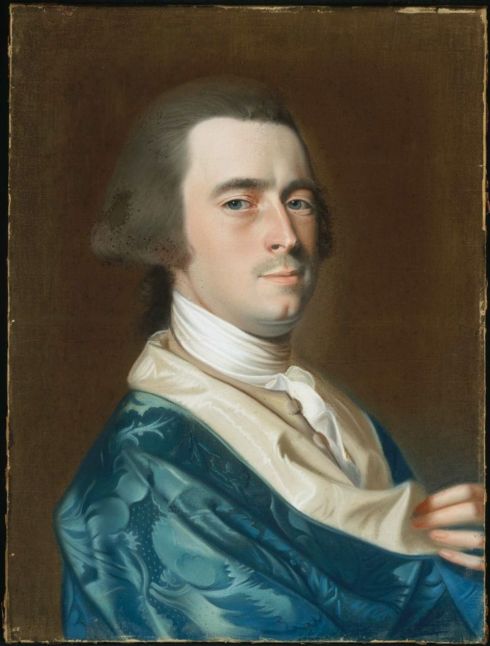
My Georgian Gentlemen: Benjamin Pickman, the dashing Loyalist Salemite and husband of the faithful Mary of my last post. What better Georgian than a Loyalist? Even though he left his family and country, his letters testify to the earnestness of his decision and the pain he endured from the separation. Here John Singleton Copley pictures him as a young man, well before this rift, and I think he looks both dashing and earnest. Jonathan Jackson, a contemporary of Pickman’s from Newburyport, painted in his resplendent blue robe by Copley. Jackson looks a little more “Georgian” here but he was no Loyalist: he converted his merchant ships to privateering vessels during the Revolution and later served as a Massachusetts delegate to the Continental Congress. His first wife, Sarah Barnard Jackson, was the daughter of the Reverend Thomas Barnard of Salem, whose silhouette is below. As a true Georgian, Barnard helped avert what might have become the first clash of the American Revolution in early 1775–an incident called “Leslie’s Retreat”–when he negotiated British Colonel Alexander Leslie’s retreat from Salem.

Georgians Pickman

Georgians Jonathan Jackson

Georgians Thomas Barnard

John Singleton Copley, Benjamin Pickman, c. 1758-61, Yale University Art Gallery; John Singleton Copley, Jonathan Jackson, late 1760s, Museum of Fine Arts, Boston; Painted Silhouette of the Reverend Thomas Barnard of Salem, late 18th/early 19th century, Skinner’s Auctions.

Obviously I have a preference for Copley, who, like his colleague and compatriot Nathaniel West, represents the Anglo-American/Atlantic world in which the acclaimed artist lived and worked. Both were “American” artists who became “English” artists: they were true Georgians above all. Both left their “country” for good before the American Revolution, along with Henry Pelham, Copley’s stepbrother and the subject of one of his most famous compositions, A Boy with a Flying Squirrel (1765). My favorite illustration of this Anglo-American artistic world is a painting of West’s London studio by his protégé Matthew Pratt: entitled The American School, it hints at the future division.

Georgians Pelham Squirrel

Georgians American School MET

John Singleton Copley, A Boy with a Flying Squirrel, 1765, Museum of Fine Arts, Boston; Matthew Pratt, The American School, 1765, Metropolitan Museum of Art.

It looks like Georgians Revealed depicts British Georgians as a fun-loving, pleasure-seeking people: there are lots of illustrations of drinking, dancing and dressing:  by comparison, American Georgians look rather earnest and restrained. It’s hard to compete with the vibrant print culture that emerged in Britain from the 1780s on, however, just when Americans ceased being Georgians.

Georgians

Georgians New England Psalms Revere

Carousing Georgians in Britain and Psalm-singing Georgians in America: Midnight. Tom and Jerry at a Coffee Shop near the Olympic, illustration by Issac and George Cruikshank in Pierce Egan, Life in London, 1823, British Library; Paul Revere, “the Music Party”, engraving for the frontspiece of William Billings, The New England Psalm-Book, Boston, 1770. Library of Congress.


Minding the Farm

There is a lot to admire about eighteenth-century women in general; two that I admire in particular are Abigail Russell Curwen (1725-1793) and Mary Toppan Pickman (1744-1817), the wives of two of Salem’s most prominent Loyalists. In 1775 their husbands Samuel Curwen and Benjamin Pickman decamped for London, leaving both ladies behind to mind their considerable estates. Whether Mrs. Curwen and Mrs. Pickman were passionate Patriots we do not know, but one smoothed the way for her husband’s return after the Revolution, while the other did not. We are fortunate to have portraits of these two Salem ladies, painted by two of the best portrait painters on either side of the Atlantic.

Curwen

Pickman

Abigail Russell Curwen, 1755:  Joseph Blackburn (Northeast Auction’s March 2010 Americana Auction); Mary Toppan Pickman, 1763: John Singleton Copley (Yale University Art Gallery).

These portraits were painted very shortly after their respective marriages; consequently they look a bit more carefree than I expect they would have appeared later in life–especially the parasol-bearing Mrs. Pickman! The Pickmans appear to have had a happy marriage even while he was away, but by all accounts the Curwens disliked each other intensely and were happiest on opposing sides of the Atlantic Ocean. After the Revolution was over, Pickman came right back to Salem and picked up (professionally–perhaps personally???) where he left off, but Curwen reluctantly returned and then fled right back to London, writing about his wife in his later-published Journal that “the Marriage shackle that unhappily linkt her to me is now to all intents and purposes broken”. It was not just his wife of which Curwen spoke ill: he was clearly a “miserable lout” (to use the words of one of my Americanist colleagues) and angry at the world; consequently he could not be reconciled to either his wife or Salem. By all accounts, Pickman was clearly a much more affable sort who was even referred to as “the agreeable Mr. Pickman” by John Adams, the ultimate Patriot.

But this post is not about the men, it’s about the women, who assumed  (or did not assume) ultimate responsibilities for their family’s fortunes and well-being during a time of apprehension and agitation. The Curwens had no children (unsurprisingly) and one of the reasons Samuel fled back to London was because he faced “ruin” at home, while the Pickmans had four children, a town house and a farm in South Salem, which Mary managed with her mother-in-law, Love Rawlins Pickman. Because of her “sacred” character, Mary was “admitted to all circles in Salem” during the war and after, and thus facilitated her husband’s return. After Abigail’s death in 1793, Samuel Curwen returned to Salem for a second time, and remained until his death in 1802. Benjamin Pickman’s letters to Mary (in the Phillips Library of the Peabody Essex Museum) continually testify to his “unfeigned love and esteem” for her and the pain of their separation (as well as that of America and Great Britain): upon his return they lived together for over thirty years, until her death in 1817.

Pickman Farm Northeast Auctions

The Pickman Farm off the present-day Loring Avenue in South Salem: A VIEW OF THE HOUSE AND PART OF THE FARM OF THE HON’BLE BENJAMIN PICKMAN, ESQ., SALEM, MASSACHUSETTS, MID-LATE EIGHTEENTH CENTURY, Northeast Auctions.


Off for Thanksgiving

I’m off to New York State for Thanksgiving and a big wedding party, returning on Sunday. Happy Thanksgiving and/or Hanukkah to everyone: safe travels and wonderful meals.

Thanksgiving BPL


Four Loves

For some time I have been trying, very sporadically, to reconstruct the lives of four Salem women called Love:  Love Rawlins Pickman (1709-1786), Love Pickman (Frye,1732-1809), Love Frye (Oliver, Knight, 1750-1839) and another Love Rawlins Pickman (1786-1863). The first Love, from a prominent Boston family, married Benjamin Pickman of Salem and gave birth to the second Love, who married into another prominent (though unfortunately Loyalist Massachusetts family named Frye), and gave birth to the third Love. The second Love Rawlins Pickman, a friend of Nathaniel Hawthorne’s wife Sophia, was, I believe, a granddaughter of the first, niece of the second, and cousin of the third. They are all part of the wealthy and influential Pickman family of Salem, whom I have mentioned several times before on this blog in reference to their amazing houses:  here and here. The two Love Rawlins Pickmans really are Salem women–one is buried in the old Broad Street cemetery which I can see from my study, the other up in North Salem–while the in-between Loves, Loyalists that they were, are buried in Britain. I could flesh out more by engaging in more genealogical research but (like most professional historians that I know), I have very little patience for that pursuit, preferring the forest to the trees. What I’m really curious about is:  which Love Pickman made these beautiful embroidered pictures?

Pickman Embroidered Picture 2

Pickman Embroidered Picture 1

Pickman the Kiss Given

Pickman the Kiss Returned

Silk embroidered pictures by Love Rawlins Pickman,
including The Kiss Given, and The Kiss Returned, after 1747, The M. and M. Karolik Collection of Eighteenth-Century American Arts, Museum of Fine Arts, Boston.

The curators at the Museum of Fine Art, Boston, attribute these amazing pictorial embroideries to the second Love Pickman, but I can find no reference to her as Love Rawlins Pickman, and she would have been quite young, in her early to mid-teens. As a girl from a wealthy Massachusetts colonial family, no doubt she would have been tutored intensively in needlework (though she predates Sarah Stivours, who operated a famous school in Salem from 1778-1794), but I’m wondering if this a example of schoolgirl art or perhaps Mrs. Pickman indulged in such artistic pursuits? This is just one query about the elusive-but-everywhere Pickman family–I’ve got lots more.


“Burglarious Tools”

The police blotter headline caught by eye–Salem Police Nab Alleged Copper Thief on Flint Street–because, frankly, copper downspouts are far too vulnerable in Salem (and I have one right on the street!), but as I read the details, one particular phrase really captured my attention: At 10:18 a.m., police responded to a report of stolen copper down spouts on Flint Street. [The alleged thief] was arrested on charges of larceny over $250, malicious destruction of property valued above $250 and possessing burglarious tools. Burglarious!!! Is that really a word? Burglarious tools!!! I can only imagine. Is there a precise definition–lots of things could be considered “burglarious tools”, I should think. And is there really a law against possessing them apart from using them?

Well I went right to my legal history colleague who directed me to the statute to answer these questions. The Commonwealth of Massachusetts (along with several other states) does indeed have a statute regarding burglarious tools among its General Laws (Chapter 266, Section 49):

Whoever makes or mends, or begins to make or mend, or knowingly has in his possession, an engine, machine, tool or implement adapted and designed for cutting through, forcing or breaking open a building, room, vault, safe or other depository, in order to steal therefrom money or other property, or to commit any other crime, knowing the same to be adapted and designed for the purpose aforesaid, with intent to use or employ or allow the same to be used or employed for such purpose, or whoever knowingly has in his possession a master key designed to fit more than one motor vehicle, with intent to use or employ the same to steal a motor vehicle or other property therefrom, shall be punished by imprisonment in the state prison for not more than ten years or by a fine of not more than one thousand dollars and imprisonment in jail for not more than two and one half years.

I’m no lawyer, but the key words here must be “knowing”, “knowingly” and “with intent”: you can’t just arrest someone for having a toolbox in their possession. I know that Massachusetts has long taken theft seriously (it was a capital crime from 1715 to 1839) but I presume that the “burglarious tool” law came later, maybe in the late nineteenth century, when there seems to have been a preoccupation with more deliberate, strategic, involved crimes, requiring some serious tools. I found an interesting article in the May 1874 issue of  Manufacturer and Builder on “Burglar’s Tools” which seems to present their manufacture as the dark side of the industrial revolution, and there are several other contemporary publications which seem to be a less preoccupied with the perpetrators than their paraphernalia (and, as several commentators have pointed out, more prescriptive than preventative!)

Burglarious Tools 1874 manufacturer and builder

Burglarious Tools 1875 Montreal NYPL

Burglarious Tools

Manufacturer and Builder, 1874; Aftermath of a Bank Robbery in Montreal, New York Graphic, January 9, 1875 (New York Public Library Digital Gallery);“Bank Burglars’ Outfit”, from George Washington Walling, Recollections of a New York Chief of Police. New York: Caxton Book Concern, 1887.


Edmund the Martyr

Since I tangled with John Foxe the other day I’ve been dipping into some martyrologies–not the best bedtime reading I can assure you! I’m quite taken with the story of Edmund the Martyr (841?-869), and by sheer coincidence, his feast day is tomorrow. I think both English Catholics and Protestants would both recognize Edmund as a martyr at the time of the Reformation (though the latter would never validate his sainthood), and I am surprised that such a vivid writer as Foxe does not go into the gory details of the saint’s death. Edmund was King of one of the smaller early medieval English kingdoms, East Anglia, when the Danish Vikings invaded his territory and and slayed him. The basic events recorded in the Anglo-Saxon Chronicle were supplemented by the more detailed account of Abbo of Fleury in his Life of Saint Edmund (986): so that he might be compelled to renounce Christ, Edmund was imprisoned and tortured by the Danes (led by the oddly-named Ivar the Boneless), first whipped and tied to a tree and shot with arrows ‘until he bristled with them like a hedgehog or thistle’, but his faith remained steadfast. He was then beheaded (not sure whether or not he was alive at this point) and his head thrown into bramble thickets deep in the forest (on November 20). When his men searched for Edmund’s head later, they found it guarded by a wolf who called ‘hic, hic, hic (here, here, here)’, and so it was recovered. If the violence of one’s death is a testament to the conviction of one’s faith, certainly Edmund was a very pious man, and he was apparently recognized as such not long after his death, with a series of remarkable memorial coins. Given the nature of his martyrdom, you can imagine (actually you don’t have to) the other visual images associated with Edmund’s sainthood, from the eleventh century to the present.

Edmund Morgan MS 1

Edmund Morgan 2

Edmund Morgan MS 3

The torture and beheading of Edmund, and the recovery of his head from the guardian wolf, Morgan Library MS M.736, Miscellany on the life of St. Edmund, Bury St. Edmunds (where Edmund’s relics were entombed), England, ca. 1130

The beautiful Morgan manuscript dates from an era in which Edmund was recognized as a patron Saint of a recently-unified England, along with the soon-to-be martyred Thomas à Becket. One can’t help but compare Edmund to another popular Saint, Sebastian, who was tortured and killed in much the same way a millennium earlier: Sebastian has much the same “hedgehog” appearance in his depictions, and was universally venerated during the time of the Black Death because of its metaphorical association with arrows of poison/plague. The late medieval poet John Lydgate, who spent the last years of his life at the monastery at Bury St Edmunds, the martyr’s namesake town, inspired this next group of images, produced for a presentation copy of his life of Edmund which was gifted to King Henry VI in the 1430s.

Harley 2278 f.61

Edmund BL Lydgate MS 2

Edmund BL Lydgate MS 3

Harley 2278 f.66 (min)

Edmunds Restoration BL Lydgate 4

British Library MS Harley 2278, 1430s: Edmund is subjected to torture and beheading, the recovery of his head and reunification of his body.

A few other objects that speak to Edmund’s veneration through the ages: a medieval pilgrim badge, which could represent either Sebastian or Edward, a French Revolutionary print (something about heads?), and a twenty-first century sculpture: designed by Emmanuel O’Brien, constructed by Nigel Kaines of Designs on Metal, and installed in Bury St Edmunds  in 2011.

Edmund Pilgrim Badge BM

Edmund BM

Edmund Bury Statue 2011

Pilgrim badge and print by François Anne David, 1784, both British Museum; Emmanuel O’Brien metal sculpture at Bury, installed in 2011.


