Category Archives: History

A Juneteenth Tour

I learned about Juneteenth ridiculously late, from a student! It was about five or six years ago (only!) and I was talking about Salem’s Black Picnic, an old tradition recently revived, with a brilliant African-American student and she said “that sounds like Juneteenth” and that was that. I don’t remember whether I feigned acknowledgement out of embarrassment or not but inwardly I was mortified by my ignorance. Yes, I was trained in European history, but I’m an American too! Since that time, I’ve used my focus on local history here to learn more about African-American history in Salem: I’m still lacking the big picture but fortunately I have wonderful colleagues at Salem State who help me with context and filling in the blanks. I started putting together my own African-American history tour of Salem about three years ago, and it began (and ended) with Hamilton Hall, where the Remond family lived and worked for decades. This was more familiar territory for me, and the Hall remains my main window/entry/initiation and orientation point for Salem’s African-American history; its centrality is particularly marked this year because of a special exhibition on view all summer long: Unmasking & Evolution of Negro Election Day and the Black Vote. The creation of Salem United, Inc., the organization that revived the Black Picnic at Salem Willows in 2014, the exhibition draws connections between the colonial traditions of Negro Election Day, nineteenth-century African-American parades and picnics, and the Civil Rights struggles of the twentieth century. Salem, United Inc. President Doreen Wade’s enthusiasm for this history is so infectious that her history is transformed into ours.

Scenes from the exhibition: our host and guide Doreen Wade, reproduction dress for Negro Election Day royalty & the jelly bean test for voting from the 1960s, the Brick Hearth Room, very much the center of the Remonds’ activity in the Hall.

For me, this exhibition was about the power of place: I was really moved by the exhibits in the Brick Hearth Room (last photo above), where the Remonds, who struggled for personal, professional, racial, and citizenship recognition for so long, worked, adjacent to where they first lived. The connection between past and present also felt appropriate to me: the distinguished historian of slavery Ira Berlin asserted that Negro Election Day “established a framework for the development of black politics” and who am I to argue with that? It was a special day at the end of May, recognized in twenty or more cities throughout the northeast from the mid-eighteenth century, on which resident African-Americans celebrated, made merry and wore dress clothes (sometimes belonging to their masters), elected notable “kings” or “governors” from among their own, and enjoyed a brief interlude of freedom and agency. To me, it looks like the medieval and early modern festivals of Europe, where everything was turned upside down for a day and peasants elected a “Lord of Misrule,” but it had African roots: I guess the drive for those on the bottom to live like those on the top for just a brief spell is universal. Negro Election Day is well-documented in Salem by most of its famous diarists. In 1741 Judge Benjamin Lynde identified May 27 as a day of “fair weather” and “Election: Negro’s hallowday here at Salem; gave Scip 5s. and Wm 2s. 6d.” indicating both recognition and a form of engagement, and William Pynchon seems to have had a similar attitude in 1788 when he went “to election at Primus’s flag,” indulged in the ale and pies offered at the festivities, and watched the dances. In 1817, the Reverend William Bentley noted “the still bewitching influence of what they call election” in his diary, but by the nineteenth century Election Day seems on the wane, replaced by more formal organizations like the Sons of the African Society in Salem with its dignified meetings and parades, and eventually by the Black Picnic at Salem Willows from 1880. While eighteenth-century white observers seem to be bemused by Negro Election Day, the nineteenth-century perspective seems more mocking, as you can see in the political commentary below: like a negro election King to-day but back again to-morrow. Besides the juxtaposition of objects in the Remond space, the most poignant exhibit in the Unmasking & Evolution exhibit for me was a photograph of a minstrel show at Salem Willows: apparently while the Black Picnic was happening, white Salem residents actually organized a performance with children in blackface to mock them. It’s quite an image on its own, but I think we need a bit more information about it. I can’t unsee it, and it reproduces badly here, so you should see it for yourself.

A minstrel show at Salem Willows—the exhibit caption says 1885 but it looks quite a bit later than that?

Obviously there is some rich history—American and African-American, both, together— encased in Hamilton Hall, in general and in particular this summer, so it’s the perfect place to start a Juneteenth tour. Some other suggestions: 8 High Street, where Clarissa Lawrence, fierce educator and abolitionist, lived among a small community of African-Americans, Aborn Street, where Salem’s first African-American teacher, Charlotte Forten, taught, at the former Epes School at number 21R, Oak Street, where Charlotte lived with Caroline Remond Putnam, daughter of John and Nancy Remond and an extremely active entrepreneur, abolitionist, and later suffragist, Higginson/Derby Squares, where the Remonds and other African-Americans had a succession of profitable businesses, and finally Harmony Grove Cemetery, where you can see the very striking and solitary grave of John Remond. And then to the Willows, of course.

Mrs. Nancy Remond was known for her Election Day cakes, which she offered not only during election week (last week of May) but all year long, Salem Gazette; John Remond’s grave stone in Harmony Grove Cemetery; more information about Salem United and the Black Picnic in Salem Willows is here.


Villages out of Time and Place

So this is going to be one of those posts in which I ask a lot of questions and have no answers (I think; maybe I will get to some). I’m trying to work out my own thoughts about a particular place and what it means: writing is one way to do that, as is solicitating the views of others, so blogging is a means to get to meaning. The place in question is Pioneer Village: Salem in 1630, a cluster of structures situated in Forest River Park which was built under the auspices of “architect-antiquarian” George Francis Dow as a representation of first-settlement Salem for the Massachusetts Tercentenary of 1630. The very engaged agricultural entrepreneur, Harlan P. Kelsey, a strong advocate for more energetic urban planning in Salem, undertook the landscape design. There was a grand historical pageant performed at the village, and then another recreation, of the ship Arbella of the Winthrop fleet, set sail for Boston. Pioneer Village was supposed to be a temporary installation, but it was such a popular regional attraction that it became a more permanent one, at the vanguard of outdoor “living history” museums in the United States: its claim to be the first of such museums is based more on interpretive practice than date, as Henry Ford’s Greenfield Village opened up in 1929 and the Storrowtown Village Museum in Springfield, Massachusetts also dates to 1930. Over the next few decades, a succession of outdoor history museums opened up across the country, including Colonial Williamsburg and Old Salem in North Carolina (1932 & 1950, respectively) and three additional institutions in Massachusetts alone:  Old Sturbridge Village (1947), Historic Deerfield (1952) and Plimoth Plantation (1957; now Plimoth Patuxet Museums).

Pioneer Village today and in its heyday, in the 1930s and 1940s, Historic New England and Digital Commonwealth photographs.

So if you have visited any of these museums as well as Pioneer Village you will immediately notice a dramatic difference in terms of size, scale, and apparent resources and mission. The former are all administered as foundations or corporations with large staffs and budgets; Pioneer Village has for the most part been a municipal initiative run by the City of Salem’s Park and Recreation Commission with the exception of recent brief periods when it was administered by several collaborations of local history and preservation professionals, the House of the Seven Gables, and a local college (not Salem State University, which is located nearby, but rather Gordon College in Wenham). Judging from the succession of newspaper stories dating from the 1930s into the 1960s, Pioneer Village might have been able to sustain itself on proceeds from the gate: it was quite a busy place. But as the popularity and practice of “living history” interpretation began to decline in the later 1970s, it lost its base, perhaps even its rationale. As it has always been a seasonal attraction, the Village has been vulnerable to deterioration and destruction by neglect, weather, fire and vandalism: I believe only about half of the original structures are still standing. The Arbella (which returned to its home “port” after the Boston celebrations) was severely damaged by a hurricane in 1954 and the only period structure, the Ruck House, was destroyed by fire in the 1960s. In 1985, the Park and Recreation Commission voted to dismantle the Village, but the first of a series of restoration and reactivation efforts reopened the site in 1988. From that point on, it has been a case of good intentions but insufficient resources, and now the City has proposed a rather radical plan to “save” Pioneer Village by exchanging its site with that of the turn-of-the-century tuberculosis Camp Naumkeag at Salem Willows. The rationale behind this proposed move is sound on paper—the Salem Willows is on the trolley route and the ballpark and other recreational spaces at Forest River are definitely expansive—but I am wondering if a Salem Willows Pioneer Village will still be Pioneer Village. And I am also wondering what Pioneer Village is. As I said at the outset, I’ve got a lot of questions, but these are the big three:

  1. What is the historical and cultural significance of Pioneer Village?
  2. Is Pioneer Village worth “saving”?
  3. If Pioneer Village, such as it is, is moved to another site, will it still be Pioneer Village, whatever that is?

Significance: To tell you the truth, I’ve never given Pioneer Village much thought. I teach seventeenth-century history, and this site has been in walking distance from my classrooms over my entire career: have or would I ever use it as a teaching resource? No. It was seldom consistently accessible and never in very good shape, and now I have all of the digital teaching tools that I need. I always thought that the Village represented a moment in place and time, and that moment was Salem 1930 rather than Salem 1630. As someone who has dabbled in Salem history here over that last decade or so, Pioneer Village looks to me like the culmination of a long period of overtly sentimental celebration of Salem, commencing with the Centennial of 1876. Generally it is seen as an expression of Colonial Revival culture, and I agree with that, but I also see it as an example of civic pride. Before Salem became Witch City, its leadership and residents were much more focused on productivity than infamy, and I think the Village still represents the former for those who wish the “Salem story” was a bit less focused on the Witch Trials. I like the terms “architectural museum” and “restoration village” used by the architectural historian Edward N. Kaufman, who traces the origins and inspiration for Pioneer Village and its successors to the big nationalist expositions of the nineteenth and early twentieth century, commencing with the Crystal Palace Exhibition of 1851 and the Paris International Exposition of 1867: the latter had several recreated villages, like the “Austrian” and “Russian Peasant”  Villages  below. Like Pioneer Village, these were exhibits built for a specific event. Unlike Pioneer Village, they were dismantled after that event. Americans, including residents of Salem and its region, wanted their “history” stay around for longer.

Austrian and Russian Villages, International Exposition of 1867, Paris.

When you look at Pioneer Village as something that was built (and rebuilt) as an expression of civic pride it takes on the cast of a monument rather than a historical resource, at least for me. Another perspective relates to the history of preservation (or preservation technology in particular), one in which I had never explored before in relation to Pioneer Village. Apparently it was very consequential in demolishing the “Log Cabin Myth” which held that every seventeenth-century European arrival lived in a log cabin à la Lincoln. In his classic book of the same name, Howard Shurtleff observed that the myth was “an American belief that is both deep-seated and tenacious” and credited Dow for refuting it: Mr. Dow included in his reconstructed Salem a number of small framed cottages, each provided with a brick or “catted” chimney, and roofed with thatch. Some were walled with weatherboarding, sheathed with material boards, and the intervening space filled with “nogging”—clay, chopped straw and refuse bricks; others were walled with wattle and daub. This “Salem Pioneer Village” still stands (in 1939, when Shurtleff was writing and 20 years later, when his landmark book was reissued) and has proved far more effective than books in refuting the Log Cabin Myth. All of the contemporary commenters on Pioneer Village really emphasized its traditional, “authentic” construction, and this became another point of civic pride as Salem businesses made comparisons between their own productivity and that of their colonial predecessors in annual programs such as “Early American industries portrayed at the Pioneer’s Village, Salem, Mass.” In 1936, the Hygrade-Sylvania company presented an exhibit on early illumination, while the Naumkeag Steam Cotton Company sponsored a demonstration of flax weaving and culture and local druggist John E. Heffernan highlighted seventeenth-century herbal medicines. The theme was very much see how far we have come in the midst of the Depression. The national Chronicle of Early American Industries, founded in 1933 and still in print, referenced Pioneer Village in nearly every issue.

Ok, now I’ve hit academic cruise control and could go on for quite some time: but this isn’t a journal article, it’s a blog post. So I’m going to start wrapping up in relation to my questions.

Significance conclusions: clearly Pioneer Village was significant in its time (1930) and for at least two decades thereafter. I think it’s still significant as an example of how a city uses its history, but I do not think it is an educational resource (bear in mind, I teach college students; early childhood educators might have a different opinion). I really think it’s a monument, like the Bewitched statue downtown, but much, much better in the sense that it seeks to highlight achievement and industry rather than exploit tragedy. I don’t have enough information to comment on its current state of repair and whether the original 1930 buildings could even make the move: because the City of Salem has “preserved” the Village it is now an historic artifact and will be subject to review by the Massachusetts Historical Commission. If the move is undertaken, I hope an expert in preservation technology and/or an architectural historian is consulted.

Should it be saved: yes, but with a clear understanding of what it is and what is it supposed to do. I only see logistical rationales for the move in the public discourse.

Will it still be Pioneer Village in Salem Willows? No. It will be something else entirely: a new Pioneer Village. It could be a hybrid Salem: 1630 and Salem: 2026 if the construction integrity of the original structures is preserved through the move, and new structures built utilizing the evidence and knowledge we have gained over the intervening century. The new Village could be a testament to both the Tercentenary spirit of 1930 and the Salem Quadricentenary spirit of 2026. If that was the aim, it would be nice to have Salem craftsmen, architects, and landscape architects involved in creating (rather than recreating) the new Pioneer Village: successors to George Francis Dow and Harlan Kelsey.

What Salem really needs: not a new Pioneer Village, but a new Salem Museum, which would integrate, interpret, and document ALL of Salem’s history: first settlement, Witch Trials, American and Industrial Revolutions, the experience of the Civil and World Wars,  native American, African-American, Irish American, Polish American, French Canadian and American, and everything and everyone between. Enough of this “siloed history!” This of course would be the ultimate Quadricentennial achievement and expression.


The Phillips House

I can’t believe that I’ve been blogging here for eleven+ years and have not featured 1) the only house museum; 2) the only house belonging to Historic New England; and 3) the only house which was (partially) moved to its site on the street where I live, Chestnut Street, before! There are two buildings which are open to the public on this famous street, Hamilton Hall and the Phillips House: the former is most definitely an assembly hall, while the latter is a home, and when you visit it, that will be one of your primary takeaways. Not only will you become familiar with multiple generations of the Phillips family, but also members of their staff (who were apparently never referred to as servants); not only will you see beautiful rooms “above,” but also working spaces “below.” The Phillips House has one of the best preserved historic working kitchens on the street (last used in 1962), which you will not see here, because I spent so much time and took so many pictures on my own personal tour with my former student Tom Miller that my camera was dead by the time I got there. So you must see it for yourself. The Phillips House opened for the season this past weekend: it is open every weekend through October but advance reservations are required.

The Phillips House on Chestnut Street is open! Great to see the flag flying. Tom Miller  opened the door for me on this past Friday, and we commenced a three-hour tour. Tom has been a associated with the house for 13 years, and knows everything about the Phillips house, its contents and inhabitants.

Because the house is a creation of many decades, families and styles, it has a lot to teach visitors, even though its interiors are presented as they were in 1919, several years after the Phillips family had taken possession and completed their renovations. Their fortune was based on Salem commerce, shrewd investments, and advantageous marriages, and they were well-traveled and engaged in society and civic affairs, so we can learn a lot from their stories as well. The story of the house begins with a maritime marriage and a messy divorce: between Elizabeth Derby, daughter of Salem’s wealthiest merchant, Elias Hasket Derby, and one of his ship captains, Nathaniel West. Mr. Derby did not approve of the marriage in 1783, but nevertheless he left his daughter an enormous inheritance in his 1799 will, which she used to to build a magnificent country estate just a few miles inland, commissioning the justly-famous Samuel McIntire to undertake much of the design and craftsmanship. After an important reform to Massachusetts divorce law in 1806 allowed women greater property rights in divorce cases involving infidelity on the part of the husband, Elizabeth Derby West sued for divorce and won, in a very public case involving a parade of prostitutes perhaps paid to give evidence against Captain West by her vengeful brothers, with whom he had engaged in fist-to-cuffs down on the docks. Elizabeth moved to Oak Hill permanently and continued to lavish material attention on it until her death in 1814, leaving it to her three daughters with the stipulation that they never let their father have a piece of it. The youngest West daughter, Sarah, died intestate five years later and consequently  her father did indeed inherit a third of the estate, despite his former wife’s wishes. He detached four rooms of the estate and had them moved to Chestnut Street: four miles in two days via teams of oxen and logs. After installing a central hall-connector with Palladian window and doors, he now had a slim but elegant (McIntire!) house. Over the nineteenth century the house doubled in size with a succession of owners, and the Phillips family acquired it in 1911. The cumulative composition is a bit Georgian, a bit Federal, a bit Victorian, and a lot of Colonial Revival, with just a pinch of Gothic.

The house in 1916, with lines marking the original McIntire rooms moved to Chestnut Street. An oxen team moving a structure along State Street in Newburyport for comparison, and the house in the later nineteenth century, all collections of Historic New England.

As you move through the house you are aware that you are entering another architectural era, especially as you move from McIntire front to Colonial Revival rear—somewhat of a pale imitation with an expanded scale. But you’re also busy looking at all the things that tie everything together, the personal belongings of a very grounded though worldly family.

Colonial Revival-ized houses always seem to have or side stairs: the front hall must be wide and open; I seem to recall that this side doorway (the “carriage entrance”) was once in front and is McIntire.

Dinner is set for a small party on the evening of July 30, 1919 in the expansive dining room: part of the extensive additions to the back of the house. No McIntire mantel, but lots of movable decorative detail in the form of serving ware, and one of my very favorite paintings which I somehow forgot was here: Joseph Badger’s Portrait of Thomas Mason (with a squirrel). It was a delight to see it: you can have your Copley boy and squirrel painting, I prefer this Badger.

As I am writing this it is very hot, so I want some ORANGE FAIRY FLUFF. The amazing pantry at the Phillips House, and the Badger!

Upstairs, things are a bit more intimate: bedrooms and bathrooms and Mrs. Phillips’ day room for keeping the household accounts. On the third floor there are guestrooms and staff rooms: a rear staircase descends from the latter to the kitchen. There are really wonderful windows throughout the house, in all shapes and sizes, with great views of Chestnut Street, and more McIntire detail in the front two rooms on the second floor.

Another major painting which “surprised” me in residence at the Phillips House was Marblehead folk artist J.O.J. Frost’s Massey’s Cove ( The Hardships and Sacrifice, Massey’s Cove, Salem 1626) depicting the first European settlement of Salem. It was just wonderful to see it there, hanging in Stevie Phillip’s light-filled, McIntire embellished bedroom with the best views of Chestnut Street in either direction. A less happy surprise, in this most Salem of houses, was a crumpled-up sign for the James Duncan Phillips Library, a library which is, of course, no longer in Salem.

I think I had professorial privilege as Tom showed me EVERYTHING and the standard tour can’t be quite as expansive due to time constraints, but the interpretation of the Phillips House definitely emphasizes the close personal connections between the generations that lived in the house and their staff and this is highlighted by one of the special tours at the house, “The Irish Experience at the Phillips House,” which will be offered on August 5. An annual must-attend event which we all missed last year is the antique car meet, which is on August 8. Vintage cars line the length of Chestnut Street, and the juxtaposition of cars and houses is more than instagram-worthy, believe me!


Salem Soldiers at Andersonville

It is during the weeks around Memorial and Veterans Day that I feel the absence of an active Salem historical society or museum most keenly. Don’t get me wrong: there are dedicated interpreters of the past in our city. Salem has a wonderful veterans’ agent (a SSU history grad) who does an amazing job marking these days and creating initiatives which reference the past while also attending to his present duties. And there is a Salem Historical Society consisting of avid historians who provide important resource and reference roles and highlight moments when they can, but it has no collections and no official commemorative role. Everything is in Rowley, of course, and the “official” purveyor of all things historical seems to be Salem’s tourism office, Destination Salem, though if you go to its website and consult the timeline of “Salem’s History” you would not know that Salem had experienced any war after the War of 1812: no Civil War, no Spanish American War, no World War I or II, no Korean War, no Vietnam War, no wars in Irag and Afghanistan.

Of course, Salem men (and women) participated in all of these wars: these wars are part of “Salem’s History”. I have tended to focus on the Civil War in my Memorial Day posts in the past, perhaps because its aftermath and collective mourning are the origins of the “holiday”. I also use these posts to come to some understanding of this war and its impact personally: I’m not an American historian and I don’t have grounding in the historiography of this conflict, but I can see and feel, as we all can, that it is still with us. This year I want to highlight a source that has given me new insights into the experience of Salem men during the Civil War: Patriots of Salem. Roll of Honor of the Officers and Enlisted Men during the Late Civil War, from Salem, Mass. compiled by Thomas J. Hutchinson and Ralph Childs (1877).

This is such a great source, and if you cross-reference it with other sources (like the Civil War Soldiers and Sailors database maintained by the National Park Service and local and genealogical sources—I have some key references here) you can glean both broad and specific perspectives of Salem’s contribution to the Union effort, which was great: over 3000 men served in the war and there were myriad support efforts at home. The compilers of Patriots of Salem endeavored to produce a register, “in neat and compact form” to be utilized “for future reference” and kept in every home, as a memorial reminder of sacrifices made. They succeeded: the volume is a great expression of both commemoration and local history. As its subtitle indicates, it includes rank, age, date of mustering in, date of discharge and the cause thereof for every Salem soldier, as well as a list of prisoners of war, the wounded and killed in action, and those who died in service. Because the book has been digitized by the Internet Archive, you can also search its contents and make up your own list of who was at Antietam, who was at Wilderness, who was at Gettysburg: noting that William L. Purbeck of Church Street and the 5th Massachusetts Battery died at the latter battle at age 18, I searched through all the sources to find his dying words: “Who shall care for Mother now?”

Monument to the 5th Massachusetts Battery at Gettysburg, c. 1880. Huntington Library.

The majority of Salem soldiers were discharged due to “expiration of service,” thank goodness, but records of desertion, suffering and death are embedded in the text: apparently a detachment to Louisiana was a veritable death sentence, due to disease rather than combat. I was thoroughly unprepared for the number of Salem men who ended up at Camp Sumter at Andersonville, the most notorious of the Confederate prisoner of war camps: 31, of whom 20 died there. I know I have cited a much smaller number in previous posts but my blog is so unwieldly now I can’t find them. Twenty Salem men died at Andersonville, from June 22 to September 15, 1864. This time frame is significant: most of the Salem men were among the nearly 10,000 prisoners of war transferred to Andersonville from other southern POW camps beginning in June, and by the end of that month a reported 30,000 Union soldiers were being held in a camp which had been built for 10,000. Patriots of Salem does not list the precise causes of death of the 20 Salem men who died at Andersonville, but the most common conditions were typhoid, dysentery, scurvy, gangrene, and above all, “chronic diarrhea”. On the very day that the photographs below were taken, July 17, 1864, Privates Charles W. Coney and George W. Cross, both Salem shoemakers from the 14th Massachusetts, died: two losses among nearly 13,000 at Andersonville.

Camp Sumter, Andersonville, Georgia, July 17, 1864, Library of Congress.


Slavery Siege in Salem

The occupants of a house on Bryant Street in North Salem, British emigre Thomas Spencer, his wife and mother, both named Mary, and their houseguests, experienced a very scary night in late October of 1835, and I am not referencing Halloween. For this Preservation Month, the National Trust for Historic Preservation has selected the theme (or charge) of telling the full story, encouraging people across the country to dig deeper as they explore the histories of their built environment. I try to do that all the time here, as there are so many layers to Salem’s history, and this particular house is a perfect case in point: all at the same time it represents triumph over adversity, triumph over inequality, triumph over discrimination, triumph over terror, and candy. 

First the house, 17 Bryant Street, then the backstory, then the terrible night: Halloween Eve, 1835.

17 Bryant Street, the Thomas Spencer Homestead, built c. 1800. Here pictured in 1904 (Essex Institute Historical Collections), 1979, 1986 and yesterday. As the Macris inventory indicates, this Federal house has been “altered beyond recognition”.

The backstory: much as been written about the Spencers, yet there is still quite a bit of confusion about the essential facts of their lives, both in Britain and in Salem. I used some genealogical and British records to come up with my summary, but I still have questions. I think I can do better than the standard Salem tale, however, which is basically “poor shipwrecked soul (Mary Sr.) is washed up on the North Shore penniless and gifted a barrel of sugar which she transforms into a miraculous hard candy called Gibralters and sells on the front steps of the First Church and the streets of Salem from her ever-recognizable buggy (make sure to add one or more exclamation marks to the closing phrase:) which is in the collection of the PEM!!! This candy is still being made and sold in Salem, at the Ye Olde Pepper Candy Company on Derby Street near the House of the Seven Gables.

I really don’t have much to add about the candy: that seems covered. But there’s a lot more to say about the Spencers. Mary Smith (Spencer) was born in Nottinghamshire in 1759: I really don’t know how she became a Spencer. Nearly every record I tracked down seemed to confuse the “Thomas Spencer” who was supposedly her husband with the “Thomas Spencer” who actually was her son, who was born in 1792 or 1793 in Coventry. She booked passage on the New York ship Jupiter which left London in March of 1805: it hit an iceberg off Newfoundland and was shipwrecked. There were many reports in the eastern newspapers, including the Salem Register, identifying the 27 passengers who drowned, along with the captain and most of the crew, but the survivors are not named. These “persons preserved” in the Jupiter’s longboat ended up in Marblehead, and later, Salem, Mary Spencer among them. There are also newspaper reports of the charity extended to these survivors, including, the sugar that was reportedly granted to Mary Spencer by the benevolent ladies of Salem, enabling her to become the enterprising confectioner of  lore and legend.

Salem Register; the iconic image of Mrs. Spencer, from Early Personal Reminiscences in the old George Peabody mansion in Salem, Massachusetts by Clara Endicott Sears. 

I don’t think Thomas was with Mary; I believe he came over in the 1820s and eventually took over his mother’s business. He was married to Mary Robinson in England in 1817: their two sons, Franklin and John Kirby, were both born in Salem. Thomas remained in Salem, very much part of the community, until 1837, when he was bequeathed a considerable amount of property in the villages of Sturton and Bransby in Lincolnshire by the Reverend John Kirby, the namesake of his younger son. There was no “title,” as some of the Salem accounts suggest, but some very nice properties nonetheless. In various letters sent back to some of his friends in Salem, Thomas writes that he is finally doing what he always wanted to do: farming. He left his mark in Salem, however: as an entrepreneur, as part of the Quaker community, as a naturalist (a topic he spoke on regularly at the Salem Lyceum), and above all, as a abolitionist. Both Thomas and Mary R. Spencer were devoted Quakers, and a big part of the expression of their faith was an equally strong commitment to the transatlantic abolitionist cause. Thomas was one of the founders of Salem’s Anti-Slavery Society in 1834, and he and Mary attended a series of abolitionist conventions over the next few years, but the peak of their commitment to the cause was clearly their shelter and protection of their fellow English abolitionist George Thompson and his family in late October of 1835.

Salem Gazette; George Thompson in the 1830s, National Portrait Gallery.

Following the passage of the Slave Emancipation Act in 1833, which granted enslaved persons in many (but not all) of the colonies of the British Empire their freedom after a five-year period of “transition” and compensation to the slave-owners rather than those who were enslaved, British abolitionists focused on the immediate abolition of slavery in the empire—and the world. One of their most effective missionaries, George Thompson, was commissioned to undertake a series of lectures in the United States in 1834-1835 in collaboration with the American Anti-Slavery Society. It’s very clear that Thompson’s tour, or Thompson himself, was a lightening rod: while he was instrumental in inspiring the formation of more than 300 local abolitionist societies, he faced constant criticism (even in Northern newspapers) as well as threats of mob violence in all the major cities he visited, including Boston and Salem. The general criticism was along the lines of “who is this infamous foreign scoundrel who deigns to lecture the citizens of the United States on their domestic duties?” It was nativist, xenophobic, and nationalistic, with slight variations in each locale. When Thompson came to Salem on the last leg of his tour, he quite naturally stayed at the large Federal home of his countryman and fellow abolitionist Thomas Spencer, a bit removed from the city center. On the morning of October 30, this is the handbill that circulated around town: The Citizens of Salem, the friends of order, who are desirous to preserve the quiet of families, and the peace of town by driving from our society the foreign pest, who is endeavoring to agitate the country with his doctrines and to destroy the Union of State by his fanaticism, are earnestly requested to meet at the Town Hall, this afternoon, at 3 o’clock to adopt measures to effect this object. Salem, October 30, 1835. The main “measure” implemented was essentially the formation of a large mob, which surrounded Spencer’s North Salem house that very night, even though Thompson had fled. The Boston papers reported on “symptoms of violence” the next day, but Spencer was more forthcoming in a letter he wrote to one of Thompson’s sponsors, the Glasgow Ladies Auxiliary Emancipation Society.

Boston Morning Post; Thomas Spencer reports to the Glasgow Ladies Auxiliary Emancipation Society, 1835, in Three Years’ Female Anti-Slavery Effort, in Britain and America: Being a Report of the Proceedings of the Glasgow Ladies’ Auxiliary Emancipation Society.

Well obviously there’s a lot here: a mob of 400 men! The xenophobia (“one Englishman is as good as another” ) and the anti-Quaker expressions as well: shades of seventeenth-century Salem. Because of some notable abolitionist individuals and institutions like the Remonds and the Female Anti-Slavery Society, we are accustomed to thinking about Salem as a center of progressive abolitionism, but my Americanist colleagues remind me that only a small percentage (1-3%) of urban dwellers in antebellum cities identified as Abolitionists. Spencer writes about “Southerners from Boston” (which is a funny expression–do you think he means actual Southerners or did Salem people look upon Bostonians as “Southerners”?) as well as pro-Slavery men of Salem. His mother, the famous Mary Spencer, is obviously still alive, but I think she died that very year. His wife, the other Mary Spencer, has a “new-born babe” in her arms, but I can’t find any record of that child. Is it any wonder that Thomas Spencer sold everything in Salem and departed for England two years later after coming into his inheritance from the Reverend Kirby? And shouldn’t we be talking about a bit more than candy when we consider Mary and Thomas Spencer and the Salem in which they lived?

Home in Englanda special photograph of Thomas and Mary Spencer in front of their home in Bransby, Lincolnshire, in 1867 from the Sturton & Stow History Society. They both died in 1876.


A Salem Shipwright

Salem’s Federal-era shipwrights Retire Becket and Enos Briggs are justly famous, but the men who crafted ships both before and after the so-called Golden Age are a bit more obscure. A case in point is Edward F. Miller, who maintained a productive and prosperous shipyard (at the site of Briggs’ yard) in South Salem in the middle of the nineteenth century producing ships for Salem, Boston and New York merchants before he shifted his attention and skills to erecting structures for land: I first learned about Miller when I visited Stonehurst in Waltham, which he built for the architect Henry Hobhouse Richardson and his client Robert Treat Paine, but there is little mention of him in Salem. His shipyard built La Plata (bark, 1850); Dictator (schooner, 1853); Delight (bark, 1855); Mary Wilkins (brig, 1855); Arabia (bark, 1857); Guide (bark, 1857); Jacinta (schooner, 1860), Glide (bark, 1861); Jersey (bark 1869); and Taria Topan (bark, 1870, and the latter served as the model for the cabin headquarters of the Salem Marine Society on the top of the Hawthorne Hotel.

William Pierce Stubbs, Bark Taria Topan of Salem, 1881, Bourgeault-Horan Antiquarians; The Salem Marine Society Room at the top of the Hawthorne Hotel, The Bark Glide of Salem.

Miller had a dynamic nineteenth-century life: learning his trade at shipyards in his native Nova Scotia, East Boston, and Charlestown (where he worked on the Constitution), going to sea and to California at the time of the Gold Rush, returning to Massachusetts and investing his new fortune into shipyards in Marblehead and then Salem, and building ships for two decades until he moved to Newton, Massachusetts in 1878 and starting building houses (apparently he also had a third career in maritime publishing). In Salem Vessels and their Voyages, George Granville Putnam presents Miller’s ships as worthy successors of those of Becket and Briggs: “No vessel so large as the Grand Turk of 1791—which was allways spoken of in its day as ‘the Great Ship’—was built in Salem for nearly 80 years until the bark Jersey of 599 tons was built in South Salem by E.F. Miller for Captain John Bertram in 1868; the barks Guide and Glide each of 495 tons had preceded it and there followed in 1870 the bark Taria Topan, 631 tons, also built by E.F. Miller, the last large square-rigged vessel built in Salem.” At the beginning of every project and the occasion of every launch, the Salem papers heralded Miller’s activity, reminding us all that Salem’s “ebbing” maritime culture, so vividly depicted by Nathaniel Hawthorne, was still quite lively in the decades before and after the Civil War. And of course the Stonehurst connection is Mcintire-esque: when I first stepped inside its massive entry hall, I remember thinking, “this is like a ship’s cabin” and indeed it was.

Miller notices: Salem Gazette, 1.17.1856; Salem Observer, 7.16 1864, Salem Observer, 9.22.1860; Salem Register, 1.12. 1857; The cabin-like Great Hall at Stonehurst, built by Miller.


Way Down South

We’re just back from a quick trip to the Florida Keys and Miami, not really my ideal vacation location but my husband craved sun and sand and fishing and I had never been to Key West so it was good compromise destination. There was just enough architecture to keep me occupied and he indulged me with a visit to Vizcaya. I was a bit worried about Florida’s reputation for negligent masking, but everywhere we went people wore their masks inside. The highlights of the trip for me were: Key West cottages, with their myriad shutters, porches, and brightly painted doors, our Key West hotel, which was both very stylish and very comfortable, the shrimp and grits featured at the hotel’s restaurant, with the non-traditional, amazingly delicious additions of manchego cheese and bacon, Ernest Hemingway’s house and its resident cats, many lime-flavored drinks, learning all about the female keepers of Key West’s lighthouse and the construction of Henry Flagler’s Overseas Railroad, and Vizcaya, of course. It was also very interesting to watch the coexistence of so many different vehicles on the streets of Key West, including cars, scooters, bicycles (which really rule the road) and skateboards. And because I cannot go to another tourist city without comparing its “interpretive infrastructure” to that of Salem, I must say that Key West’s signage (both wayfinding and historical) is more uniform, more aesthetic, and simply BETTER than that of Salem, although that’s not saying much as our signage is so bad.

Key West, including the interior and exterior of our hotel, the story of our marriage, and a Marathon sunset.

Lowlights? Only the heat, I would say. It was exhausting to do my characteristically energetic architectural walkabout in Key West, but as I write this bundled up in bed on a cold and wet New England spring morning, that warmth is a fond memory.

Miami & Miami Beach: Vizcaya exterior and interior, and just a few houses from a few decades later—all is turquoise and coral.


Envisioning Salem, 1962

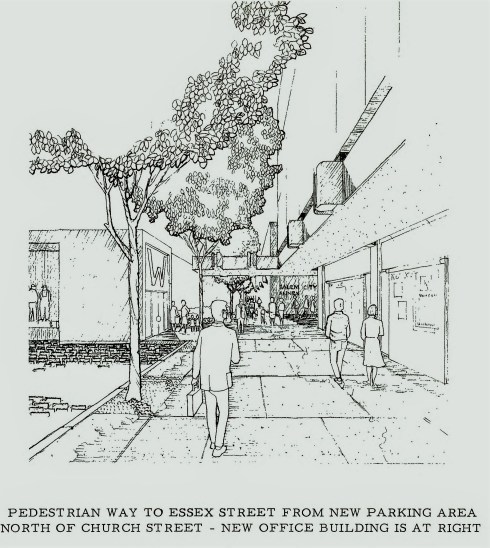
Salem is currently in the midst of implementing another urban renewal plan under the supervision of the Salem Redevelopment Authority (SRA), the board that was created by the city’s first urban renewal plan in the 1960s. The story of the implementation of that plan is a pretty established narrative: over-ambitious SRA orders destruction of much of downtown and advocates for the construction of a highway into central Salem to increase access for shoppers lured away by the North Shore Shopping Center in Peabody until concerned citizens’ protests and the New York Times architectural critic Ada Louise Huxtable’s extremely influential article brought national attention to the imminent destruction of Old Salem, shifting “renewal” towards redevelopment and preservation. Well, obviously I’m simplifying a much more complex process with many players: I’m starting to go through some of the sources which documented this process so I can understand it a bit better. I thought I would start with the early 1960s vision, as expressed by a series of reports issued by Blair and Stein Associates of Providence, RI, a planning firm hired by the City. Blair and Stein supposedly produced seven reports for the Salem Planning Board: I have found only three so far and the “Central Business District” report the most interesting: Salem, Massachusetts : central business district / prepared by Blair and Stein Associates in cooperation with the Salem Planning Board and the Massachusetts Department of Commerce (1962).

This study and its recommendations was not as focused on “tear it all down” as I expected: there are definitely recommendations for clearances, but also for preservation. Blair & Stein believed that the North Shore shopper, who is always referred to as “she,” could be lured back to downtown Salem if “blight” was cleared away and access improved. There are many references to urban blight, which was perceived as both decay and the reign of “inappropriate” facades and signs: after those were removed the state and fate of the stripped building should be considered. Because the emphasis is on renewing Salem’s shopping district above all, parking is very important, as is the overall design of pedestrian avenues around the downtown. Thus they gave us a pedestrian mall on Essex Street, Salem’s main street, but also on secondary routes leading into it. Salem would become an outdoor mall, with a mix of old restored buildings and new complementary structures: complementary not “imitative,” which is what I think most people would like to see now. It’s just annoying when advocates of sub-standard new construction accuse anyone who argues for higher standards of trying to turn Salem into a faux Federal city: I like the language below emphasizing scale, texture, character and “spirit” of new construction and did not expect to find it in a document of this nature and vintage.

Interesting spelling of “aesthetic” but these are goals I wish we were shooting for now!

Apart from the concerns about blight, parking and aesthetics, the major difference between this plan and the current one relates to housing: Blair and Stein envisioned a distinct shopping and cultural district and did not advocate for the expansion of residential buildings downtown, while that is a major planning goal at present. While they referenced tourism, they clearly saw it through a regional focus rather than a national one, and they don’t even mention Halloween. Salem would be a city of day trippers and day shoppers, returned to regional hub status.

Deed restrictions prevented all that planned Front Street parking, and inspired Artists’ Row, here pictured in 1978, Salem State University Archives and Special Collections.

The schematic sketches are just that, clean and orderly, and now I am seeking the specifics of how this rather vague plan turned into the scary plan of action recorded in the Boston Regional Office of HUD several years later: The Heritage Plaza East project advanced from the planning stage to the execution stage in February 1968. About 40 structures in the area will be rehabilitated, 140 will be razed, and 75 families will be relocated in the process of clearing the area. CLEARED OUT. The records of the SRA, which for some reason are deposited in the Phillips Library, will certainly shed light on the “progress” from planning to execution.

Appendix:  Historic Salem, Inc. has prepared a “Citizens Guide to the Downtown Renewal Plan” for those who wish to engage with its implementation, available here.


A Tory-Loving Town?

Salem has a bit of a reputation as a “Tory-loving town” due to the sentiments of some of its more conspicuous residents on the eve of the Revolution: prominent judges, merchants and lawyers could not reconcile their local and imperial loyalties and thus became exiles for the duration of the Revolution, or for the rest of their lives. The Banishment Act of the State of Massachusetts, issued in 1778 “to prevent the return to this state of certain persons therein named and others who have left this state or either of the United States, and joined the enemies thereof” named only four Salem Loyalists, William Browne, Benjamin Pickman, Samuel Porter and John Sargeant, but this is only a fraction of those who were identified as Tories by their own words or those of their contemporaries. The British archives, family genealogies, and contemporary newspapers point to a lot more: I did a very cursory search and came up with: Henry Gardner, merchant and shipowner, Captain Thomas Poynton, apothecary Nathaniel Danby, physician John Prince, Customs official Jonathan Dowse, merchant George Deblois, schoolmistress Mehitabel Higginson, John Fisher and Samuel Cottnam, as well as the well-known gentlemen Andrew Oliver, Samuel Curwin, the Honorable Benjamin Lynde, and William Pynchon, and I’m sure that this is not an exhaustive list. Most of these names are featured on the very warm address offered to General Gage upon his removal of the provincial capital from Boston to Salem in the late Spring of 1774, and I suspect the remaining signatories had similar sympathies.¹ Timothy Pickering’s father was a Tory! Despite the pretty dynamic historiography of New England Loyalists, and some very accessible accessible primary sources, I don’t think we know enough about Salem’s Tories and their stories.

Just a few monographs and primary sources for the further study of Salem’s Loyalists; Congratulations to General Gage.

Some of the more interesting Tory anecdotes focus on houses. In Sarah Orne Jewett’s The Tory Lover (1901) a character expresses her concern for the potential consequences of her friend’s entanglement: “I could not pass the great window on the stairs without looking out in fear that Madam’s house would be all ablaze…..There have been such dreadful things done against the Tories in Salem and Boston!” The “dreadful” acts against Salem Tories included a mob attack on the Ropes Mansion in March of 1774 while Judge Nathaniel Ropes lay inside dying (of smallpox) and the shattering of windows at William Pynchon’s Summer Street house. The cause of the mob attack on the Ropes house might have been the judge’s high judicial salary or contagious disease; nevertheless he died the day after it happened. Salem’s nineteenth-century historians recounted a “family tradition” that Thomas Poynton’s house, with its distinctive gilded pineapple over the doorway, was also attacked: he fled in 1775 and died in England in 1791. William Pynchon boarded up his windows and remained in Salem, documenting its revolutionary social life in his famous diary. Other Tories remained and appear to have suffered few consequences for their views (Andrew Oliver) while several were welcomed back after 1783 (Benjamin Pickman; Henry Gardner). Diaries and letters reveal some of their stories, but I think a more collective and integrative approach would yield more insights. It was all so very personal: there were obviously family and friendship connections among Salem’s Loyalists, but some families were divided by the Revolution as well. Salem has no Tory Row like Cambridge because the site of many Loyalist residences was the ever-evolving Essex Street, but a primitive (sorry! still working on my digital skills here; the book interrupted my progress) mapping can mark the Tory presence and/or absence.

Tory Houses: several survive but most are long gone. The Ropes Mansion in its original location, right on Essex Street (Old-Time New England, 1902); The Salem Chamber of Commerce is located in Dr. John Prince’s much-altered house on Essex Street, and Historic Salem, Inc. is located in the much-altered Curwen House, which used to be situated on Essex Street.

Only William Browne’s mansion, firmly and conspicuously located in the center of Salem, was confiscated: it would be replaced by the grand (but short-lived) Derby Mansion after the Revolution. The transition of power and influence from the Brownes to the Derbys seems rather revolutionary in many ways. When I look at the last Salem advertisements of two Tory shopkeepers, I wonder about all their stuff: for them, leaving was not just a matter of turning a key and leaving some associate (or their wives) to look after their property. (I also wonder if Nathaniel Dabney’s “Head of Hippocrates” sign was quite as big as depicted). Henry Gardner apparently paid taxes to the Town of Salem during his period of exile: perhaps that preserved whatever property he left behind. By contrast, Samuel Porter was clearly missing things upon his return. And what of Salem’s African-American residents, especially those who were enslaved: a 1777 petition by a “Great Number of Blackes” stated their case for freedom with revolutionary rhetoric, but were others enticed by British offers of liberty? Clearly there is lots to learn about Loyalists.

Essex Gazette, June, 1774; Salem Mercury, June 20, 1788.

¹James Stark, in his Loyalists of Massachusetts and the Other Side of the American Revolution (1910) states that “The importance of the following addressers is out of all proportion to their apparent significance. They are an indispensable genesis to the history of the Loyalists. For the next seven years the Addressers were held up to their countrymen as traitors and enemies to their country. In the arraignments, which soon began, the Loyalists were convicted not out of their mouths, but out of their addresses. The ink was hardly dry upon the parchment before the persecution begain against all those who would not recant, and throughout the long year of the war, the crime of an addresser grew in its enormity, and they were exposed to the perils of tarring and feathering, the horrors of Simbury mines, a gaol or a gallows.” but I think this is a bit of an overstatement.


Circa 1775

For Patriots Day, I endeavored to find Salem houses built in 1775, but it turned out to be a bit more involved task than I envisioned. I was just going to walk around and look at the Historic Salem, Inc. plaques, then I decided to consult the Massachusetts Historical Commission’s MACRIS database, which gave me a very workable list. The former overruled the latter for many of the houses I encountered however, so “circa 1775” is the best I can do. Salem houses are sometimes tricky to date just by apparent style: there is a conservatism that dominates the quarter century after the Revolution when it comes to you average dwelling (as contrasted to the Federal mansions which rose at the same time). Several “Georgian” cottages were built in 1806 or even 1826. So these houses are very “circa” for the most part, in the most flexible sense of the word, and I’m not really going to be able to answer the question behind this post: how many people in Salem were confident enough to build a house after five+ years of escalating conflict and tension over representation and sovereignty in British America?”

First up is the Wendt House on Crombie Street: this house has been the object of consternation for decades. First it was threatened my Holyoke Mutual Insurance Company, which threatened to demolish it for parking spaces, then it was saved by Historic Salem, Inc. (HSI), now it is threatened again (not so much its form but its LIGHT) by a large apartment building proposal. Below, Summer, Cambridge and Hight Street Houses: 51 Summer Street is dated 1771 by Historic Salem, followed 6 Cambridge Street and 8, 14 and 21r High Street.

And over on the other side of town: a Briggs Street house which MACRIS dates to c. 1775 but for which HSI has a more precise history, a Daniels Street House which is a great example of the “conservative” trend I spoke of above, and 19-21 Essex Street, which has been through many transformations. Such a cool house, and pretty substantial even without its later additions, indicating that even though the political times were turbulent, the economic future perhaps looked a bit more promising from the perspective of 1775.

19-21 Essex Street in 1985, MACRIS.