Category Archives: History

Scorched Earth/A Lost Salem Garden

Since I went in deep for the centennial anniversary of Great Salem Fire of 1914 a few years ago I have this date imprinted in my mind: I woke up this morning and my first thought was oh no. So much was lost that day—houses, factories, civic buildings, churches–as the fire devoured several wards of Salem. The recovery effort, which seems remarkably swift and efficient to me, focused primarily and rightfully on rebuilding, but there was an implicit concern for the loss of landscape as well, and so parks were planned and trees replanted. There was one notable Lafayette Street landscape that was lost on forever on that day, however: the garden of George B. Chase. There was no effort to reconstitute this creation; instead the large lot became the site of the new Saltonstall School, which rose from the ashes of the fire pretty quickly. The Chase Garden was indeed fleeting, but fortunately we have two great sources to remember it by: the wonderful 1947 guide book Old Salem Gardens, published by the Salem Garden Club, and several photographs in the American Garden Club’s Archives of American Gardens at the Smithsonian.

Chase Old Salem Gardens

Chase Old Salem Gardens 2

Chase Garden collageJust one of my many copies of the invaluable Old Salem Gardens (1947) with the Chase garden entry; the location of the Chase garden on the 1874 and 1891 Salem Atlases.

The Salem Garden Club ladies who produced Old Salem Gardens, chief among them Club President Mable Pollock, took great care to include historical information and personal reminiscences whenever possible, greatly enhancing the research value of their compilation:  this is no little pamphlet! We hear all about the Chase Garden from the “discussive and chatty” Miss Chase, who grew up on the property, as her memories are transcribed onto the page. She tells us about the beds of ostrich ferns and rhododendrons in the immediate proximity of her family house, above which swayed purple beech and weeping birch trees, and a “large bed containing 72 plants of Azalea mollis bought from Lewis Van Houtte of Belgium”. In the spring there was white narcissus poeticus, followed by red salvia. Laburnum and althaea screened the large vegetable garden, which included salsify, rhubarb, asparagus, peas, beans, carrots, summer squash, tomatoes, onions and corn: the seed of the latter [came from] a cousin, Benjamin Fabens, and was called “Darling’s Early”. It was most satisfactory in every way, for the ears were not too long, and they had deep kernels and a small cob; the husk was quite red, as were the blades….it was the sweetest corn ever eaten at that time. Continuing along towards Salem Harbor along a box-bordered path, we “see” fruit trees and more exotic trees and shrubs, including a very notable varieties of magnolia and viburnum which particularly impressed repeat visitors from the Massachusetts Horticultural Society. Near the back of the garden were beds of roses, and a cutting garden of annuals and perennials, encircled by yet another row of shrubs and trees, including the oldest growth on the property, a locust grove, which nature had planted. All swept away on one day: June 25, 1914.

Chase Garden

Chase Garden AAG 1904 Smithsonian

Chase Garden After

Chase Garden After 2Views of the front and back of the Chase Garden (including Mr. Chase himself on the bench), 1904, Archives of American Gardens, Smithsonian Institution; Ten years later on Lafayette Street: postcard views of the Fire’s immediate aftermath from the (commemorative???) Views of Salem after the Great Fire of June 25, 1914 brochure issued by the New England Stationery Company.


In-Vested

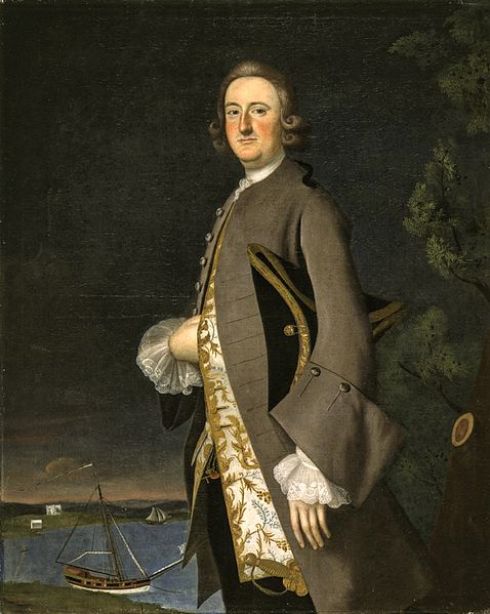
Yesterday I was treated to a very special tour of the China Trade gallery and basement of the Peabody Essex Museum by a distinguished and generous curator, and while I was able to snap lots of photographs (exhibition items, packing and conservation materials, amazing things in storage, including a whole subterranean gallery of ship models, some in their original Peabody Museum cases) I came away thinking about just one item, a portrait of Captain William Story by the Chinese artist known in the west as “Spoilum” (Guan Zuolin). The Story portrait stuck with me for two reasons. I had just been reading Nathaniel Hawthorne’s “Custom-House” prelude to The Scarlet Letter, which disses Story as one of the venerable figures, sitting in old–fashioned chairs, which were tipped on their hind legs back against the wall. Oftentimes they were asleep, but occasionally might be heard talking together, ill voices between a speech and a snore, and with that lack of energy that distinguishes the occupants of alms–houses, and all other human beings who depend for subsistence on charity, on monopolized labour, or anything else but their own independent exertions. These old gentlemen—seated, like Matthew at the receipt of custom, but not very liable to be summoned thence, like him, for apostolic errands—were Custom–House officers. By all accounts this is an unfair characterization of Story, who was ending his storied maritime career with a post at the Custom House as Weigher and Gauger, but you can read about his long career here. The other reason I was so taken by Story’s portrait is far less weighty: once again I wondered, why is his hand in his vest? This is a portrait by a Chinese artist who probably knew nothing of that western convention—or perhaps Spoilum was such a popular artist precisely because he did.

Story PEM

Story Spoilum

Importing Splendor gallery wall at the Peabody Essex Museum with portrait of Spoilum’s Portrait of William Story, c. 1804; close-up from MIT’s “Envisioning Cultures” website.

Everyone seems to associate the hand-in-vest/waistcoat pose with Napoleon but many such portraits predate those of the little emperor. Why put the hand in this position in an expression of apparent disablement? Or is it cloaked power? Then there are the rather spurious theories of Masonic hidden hands or attempts by the artists to lessen the challenge of rendering hands by painting just one. Apparently it was simply a dictate of genteel behavior, handed down from the ages of Greece and Rome (which explains the pose’s eighteenth-century origins, in that most neo-classical of centuries). If it was a question of gentility, you can see how the pose would appeal to merchants and sea captains, self-made men who perhaps wanted to appeal a bit more polished for posterity.

Piggot

Young Mariner

George_Washington,_1776

Spoilum Cranstoun

Portrait of a Western Merchant

American Sea Captain Dutch School

Ships Model PEM

Pre-Napoleon in-vested sea captains (+ General Washington): Joseph Blackburn, Portrait of Captain John Pigott, c. 1752, LACMA; John Durand, Portrait of Young Mariner, ca. 1768–1772, collection of John and Judith Herdeg; Charles Willson Peale, General George Washington, 1776, Brooklyn Museum of Art; Chinese-export Reverse Painted Mirror of Captain John Cranstoun, c. 1785, Bonhams; Spoilum, Portrait of Western Merchant, c. 1785, “Envisioning Cultures at MIT; Portrait of an American Ship Captain (Purported to be Captain John Thompson of Philadelphia who engaged in the China trade), c. 1785, Sotheby’s + in the basement of the Peabody Essex: what a treat!


Stalking Nathaniel

I read an amusing, though very flowery, little pamphlet yesterday entitled A Pilgrimage to Salem in 1838 in which the anonymous author, described merely as a “southern admirer” of Nathaniel Hawthorne, happens upon a copy of the recently-published Twice-Told Tales while visiting Boston and, immediately transfixed, decides to travel up to Salem so that he might see–and perhaps even talk to– the object of his affection before returning to his “plantation”. He immediately boards the steamship that will take him to East Boston, where he jumps on the brand new Eastern Railroad train to Salem, and once there, I discovered the way to the lodgings of my favorite author. He was not within, but would probably be at home some time in the course of the day.  I inquired respecting his haunts. They were the Athenaeum—the bookstores–the streets occasionally, or North Fields, or South Fields, or the heights above the turnpike, or the beach near the fort; and sometimes, I was told, he would extend his excursions by foot as far as Manchester, along the wave-washed, secluded, and rocky shore in Beverly. And so Mr. Southern Gentleman pursues Nathaniel here, there, and everywhere, and somehow always misses him (he just left)  but takes in the sights of Salem along the way.

Stalking Nathaniel Map

Stalking Nathaniel E Boston 2nd

Stalking Nathaniel Train Station

Charles_Osgood_-_Portrait_of_Nathaniel_Hawthorne_(1840) (1)

1840 Map of the North Shore showing the new Eastern Railroad, David Rumsey Collection; the East Boston Depot, from an Edwin Whitefield drawing, and George Elmer Browne’s drawing of the first Salem station, built in 1838, both from Francis Boardman Crowninshield Bradlee’s Eastern Railroad: a Historical Account of Early Railroading in Eastern New England (Salem, MA: Essex Institute, 1917). The object of this pilgrimage: Nathaniel Hawthorne, in his earliest portrait by Charles Osgood, supposedly commissioned by the author’s uncle, Robert Manning, Peabody Essex Museum. (One can understand the stalking!)

There is something about this article: something a little off. I couldn’t find the original, supposedly published in a Charleston, S.C. periodical titled The Southern Rose in March of 1839; instead I read a reprint in a 1916 Essex Institute publication, A pilgrimage to Salem in 1838, by a Southern admirer of Nathaniel Hawthorne. Reprinted from “The Southern rose” (Charleston, S.C.) of March 2 and 16, 1839, with a Foreword by Victor Hugo Paltsits, Another view by John Robinson, and A rejoinder by Mr. Paltsits. Mr. Paltsits, of the New York Public Library, believed that the author was William Gilmore Simms, the southern novelist and historian (and slavery apologist), while Mr. Robinson, the great horticulturist and curator at the Peabody Museum, thought it might have been Nathaniel himself! Just think of that: what a public relations feat early in Hawthorne’s career! He comes off as sought after, mysterious, elusive, brooding in a Heathcliffian way, and very clever: a perfect characterization for a young novelist. Robinson thinks the “southern admirer” knows Salem too well, and he certainly does throw in a lot of place names. I’m quite fixated on the train trip myself, about which the article’s author is a bit too blasé while everyone in Salem was much more obviously excited, including Hawthorne. An article in the Salem Register dated September 3, 1838 notes that the railroad has been the great centre of attraction to the people of Salem and vicinity. The novelty of this mode of travelling has drawn immense crowds to witness its operation, and on every occasion of the arrival and departure of the cars, the grounds in the neighborhood of the depot and on the eastern bank of the Mill Pond are covered with delighted spectators of the bustling scene, while the new faces in our streets, and the hurrying to and fro of carriages for the accommodation of passengers, have given to our city a busy appearance to which it has long been a stranger. The southern visitor does not describe a Salem that is in any way busy, but then he is singularly focused on Hawthorne, and also, really, on himself.

Hawthorne collage

The southern admirer, whoever he is, seems particularly excited to encounter Salem’s Old Town Pump (here in 1856 and 1884 illustrations), memorialized by Hawthorne in “A Rill from the Town Pump” in Twice-Told Tales.


Cultivating American History

The Smithsonian Libraries have produced a summer-long digital and actual exhibition on the history of American gardening titled Cultivating America’s Gardens and it features a Salem garden! I’m not surprised; I’ve consulted the Smithsonian’s Archives of American Gardens on more than one occasion and it has several wonderful slides of Salem gardens, most unidentified. The “old-fashioned” garden of the Misses Laight on Chestnut Street in the 1920s opens up one section of the exhibition, “Gardening as a Link to the Past”, which doesn’t surprise me either: Salem’s Colonial Revival ethic and aesthetic certainly extended to horticulture. Besides “the Past”, Cultivating America’s Gardens has six additional sections/themes: “Gardening for Science” (“botanizing” in the eighteenth and nineteenth centuries), “Rolling out the Lawn” (the emergence of the Great American Lawn from the Victorian era through World War II), “Gardening to Impress” (Gilded Age gardens and World Fairs), “Gardening for the Common Good” (Victory gardens and school gardens), “Gardening as Enterprise” (selling seeds), “Gardening for the Environment” (sustainable gardening), as well as a concluding section on the Smithsonian’s role in preserving America’s garden heritage. My discoveries from the online exhibition? The word “botanizing”, which I never knew was a verb, the “tastemaker” Mariana Griswold Van Rensselaer (1851-1934), author of more than 300 articles for Garden and Forest as well as the influential Art OutofDoors: Hints on Good Taste Gardening, and the Lowthorpe School of Landscape Architecture, Gardening, and Horticulture for Women, founded in Massachusetts in 1901, the first of its kind open to women. I definitely want to learn more about that!

Curated Gardens Laight

Curated Gardens Victorian Lawns

Curated Gardens Gilded

Curated Gardens War

Curated Garden collage

Curated Seeds

PA624001

The Laight Garden in Salem, 1920s; Catalog for Ross Bro’s. Co., Farm & Garden Supplies (Worcester, Massachusetts, 1909); The Blue Garden at Beacon Hill, Newport, Rhode Island, 1920s; Editorial cartoon: “War Garden to Do Its Duty”, drawing after J.N. Darling in the New York Tribune, about 1917 (LOVE THIS); the gardens of Alexander Hamilton and Dolly Madison as envisioned in 1920 by Peter Henderson & Co.’s Everything for the Garden catalogs; Burpee’s Seeds Contest entry, 1925; The Concrete Jungle, Philadelphia, Pennsylvania, 2002, Lawrie Harris, photographer, all Smithsonian Institution Libraries.


Forward and Back, Present and Past

It was an interesting weekend in Salem, full of events, exuberance and achievements, as well as a bit of contradiction, from my perspective. Salem’s Trials, the symposium that my department organized in collaboration with the Essex National Heritage Area and Salem Award Foundation for the 325th anniversary of the Trials, was on Saturday and then the Foundation’s 25th Anniversary was on Sunday: I came away happy and optimistic from the first event, convinced we had remembered and honored the victims of 1692 in the best possible way, and a bit confused by the second. It was certainly festive and forward-looking, focused on an array of six-word memoirs on the theme of inclusion as well as the recognition of two (extraordinary!) “rising leaders” newly-graduated from Salem High School and Salem Academy, but also on the contributions of the owner of the Salem Witch Museum–who happens to be a major beneficiary of the cumulative tragedy that is the Salem Witch Trials. One day I was sitting on a panel titled “The Making of Witch City” (filmed by C-Span) in which we discussed the unfortunate exploitation of the “witches” of Salem, the next I was observing a very public expression of gratitude offered up to the driver of Haunted Happenings! It was a bit surreal for me but I think I was the only one: one savvy Salem insider observed that he pays for shit in response to my bewilderment. Ah well, the memoirs did look lovely, shimmering in the sun on a beautiful, breezy day.

Salem's Trials SAF

Salem's Trials Memoirs

Salem's Trials Memoirs 2

Like everything, it’s about perspective: ultimately the Salem Award Foundation, whose full name is the Salem Award Foundation for Human Rights and Social Justice, is more focused on the present than the past and needs the resources, network, and flexibility to achieve its goals and mission: I have the luxury of being able to remain laser-focused on the past and the victims. That’s just what we did on Saturday morning, but in the afternoon we shifted to a more layered discussion of how these victims have been remembered, driven as much by the symposium attendees (including several descendants of victims of 1682 who recorded their “testimonies”) as presenters. The keynote address by geographer Ken Foote, “Salem Witchcraft in Landscape and Memory”, was particularly resonant for me. Dr. Foote laid out the full spectrum of “marking” sites of tragedy, from sanctification to obliteration, and viewed Salem in this context. He noted that when he first came to Salem in 1984, no one could really tell him where the victims of 1692 were executed, and now there is not only the 1992 tricentennial Witch Trials Memorial but a new memorial on the site of the recently-confirmed execution site at Proctor’s Ledge (now scheduled to be dedicated on July 19). As I was listening to him, the question that kept running through my mind was: what if the sacredness of a site is challenged–or not even recognized? as that seems to be what happens to the downtown Witch Trials Memorial every October when Haunted Happenings is in full swing and it is transformed into a convenient place to eat fried dough. It seems like contradictory commemoration will remain in force in Salem until the sanctification of that site can be realized, and I don’t know if that will (can) ever happen.

Salem's Trials BB

Salem's Trials Tad

Salem's Trials Foote Just one weekend in Salem: The Salem Award Foundation’s 25th Anniversary Celebration and Salem’s Trials Symposium. Below, the Witch Trials Memorial off Charter Street, yesterday: for much less contemplative times, click here.

Salem's Trials Memorial


Black Ships

My title is literal, or descriptive. While the phrase “Black Ships” has a larger historical and cultural meaning, as a term used by the Japanese to refer to western vessels approaching their shores in the sixteenth and nineteenth centuries (with a long stretch of relative isolation in between), in my typical materialistic fashion I’m referring to my latest collection obsession: reverse glass painted silhouette ships. It’s a potential collection, because I haven’t actually collected anything yet, but a particular Salem example has captured my fancy, so who knows what else I might find?

Black SHip Salem 1st dibs

Perseverance Crop19th Century Reverse-Painted Ship Silhouette on Glass Maple Frame, circa 1840, Trinity Antiques & Interiors, 1stdibs.

Love this. I’ve seen lots of reverse glass paintings before, mostly on clocks and mirrors, but this silhouette version is more striking and timeless—I’m going to need to see more. There were two Federal-era Salem ships named Perseverance: one was shipwrecked off Tarpaulin Cove, Naushon Island in Vineyard Sound in 1805; the other had a later (and longer) life sailing to Sumatra. The former ship was memorialized by Italian-born Salem painter Michele Felice Corné in his 1805 painting Perseverance Wrecked near Tarpaulin Cove, and the dashing Salem sea captain Richard Wheatland has a connection to both vessels: he was master of the first Perseverance, and part-owner of the second. I’m not sure which ship is portrayed in “my” painting: obviously the lighthouse is a prominent feature, leading one to assume that this is the first Perseverance, but the lighthouse on Naushon Island was not built until 1817 (but this is an 1840 perspective, perhaps creative license is being taken?)

Black Ships Corne_PerserverenceWrecked

Perseverance Richard Wheatland Salem Michele Felice Corné’s Perseverance Wrecked (1805), and a portrait of Captain Richard Wheatland by the Chinese artist Spoilum (Guan Zuolin), from MIT’s “Visualizing Cultures” site.

I found some super-tacky ship silhouettes from the twentieth century, and some elegant Victorian examples: there seems to be no in-between. I’ll spare you the former, and here are some of my favorites of the latter category, nearly all of them from auction archives, and well-beyond my price range. I think my “collection” might end up being more virtual than tangible!

Black SHip Victory

Black Ship Royal Albert

Black Ships collageH.M.S. Victory, H.M.S. Royal Albert, H.M.S. Foudroyant, another Victory, and View from the Coast of H.M. Ships MarlboroEuryalus.


Soldiers of the Revolution

For the past couple of years, the focus of my Memorial Day remembrance has been the Revolutionary War soldiers of Salem, a rather forgotten lot when compared with their fellow veterans of more recent wars. There are seldom flags marking their graves this weekend, and rarely do their headstones even refer to their service. I wander through the old burial grounds of Salem looking for age-appropriate candidates, and then consult the (digital) volumes of Massachusetts Soldiers and Sailors of the Revolutionary War when I get home. Last year I featured the Revolutionary War veterans of Broad Street Cemetery: this year I am focusing on Salem’s third-oldest cemetery, the Howard Street Burial Ground. Howard Street is primarily known for its associations with a spectral Giles Corey and as the resting place of a host of Salem sea captains (including a few famous privateers), but there are at least ten notable Revolutionary war veterans interred in this sacred space as well, and probably more: there are many damaged and “time-washed” stones in Howard Street, rendering them into potential tombs of unknown soldiers.

Soldiers Unknown

Soldiers Unknown2

Soldiers Unknown3

But then you get lucky, and run right into the well-preserved headstone of Stephen Wood (1747-1841), a “soldier of the Revolution”: I just love that simple, succinct, reverential phrase. Wood fought at the Battles of Bunker Hill, Saratoga, Princeton, and White Plains with the 6th Massachusetts Regiment and lived, as you can see, to be 94 years old.

Soldiers Wood

The original marker of the most famous “soldier of the Revolution” buried at Howard Street, Colonel Samuel Carlton, was presumably too humble for his family, who replaced it with a more stately edifice in 1898, inscribed with his impressive service at Ticonderoga and Valley Forge. The Reverend William Bentley noted his death in 1804: He was born in Salem in the next house to that which he died in Union Street. His parents were from Andover in this Country. He was bred to the seas & was a Master of a Vessel till the war, when he engaged in the Northern army & had a Lieutenant Col’s. commission under Col. Brewer, in the campaign of 1777. He was sick & returned home & for the last 14 years was unable to make any use of his lower extremities. He was a very cheerful man, original in his expressions, & capable of drawing attention in his conversation. He has left numerous descendants. No man ever endured so much with greater patience.

Soldiers Carlton

Then there is Captain John Collins, another master mariner who joined up in 1780 and served until the end of the war, Mr. Charles Richardson, yet another simple “soldier of the Revolution”, the long-lived trio of Ebenezer Burrill (1755-1826), William Prossor (1750-1842), and Captain Henry Tibbetts (1762-1842), all “revolutionary pensioners”, Jonathan Archer, and Scottish-born Captain John Melvill, who signed up in May of 1775 and served in Captain William Blackler’s Company, part of Colonel John Glover’s Regiment. I am confused about the stark marker of Moses Townsend, dated 1828: there were two Salem Moses Townsends, father and son, who served in the Revolutionary War: the elder was a prisoner of war in the infamous Mill Prison near Plymouth, England, where he died in 1777; the younger lived until 1843. Could this be a memorial to the senior, buried over in Old England, or another Moses Townsend entirely?

Soldiers collage

Soldiers Townsend

Just a few steps away from the Howard Street Burial Ground is the grave of General Stephen Abbott (1749-1813), safely guarded within the confines of St. Peter’s graveyard with its adjacent Sons of the American Revolution marker. Abbott is a rarity among Revolutionary War soldiers in that he is always remembered, more for the fact that he was the founder and first commander of the Second Corps of Cadets in 1781 than his earlier service with General Washington. Salem’s claim as the founding place of the National Guard is based on that unit, and so every year at First Muster time guardsmen gather to lay a wreath at Abbot’s grave site, in Abbott Square. I imagine that there were more SAR markers in Salem at one time, in Howard Street, Broad Street, and elsewhere: were they “lost” over the years? Could we obtain replacements?

Soldiers Abbott

Soldiers Abbot 2


Memorial Trees

I’ve been thinking a lot about memorialization lately: the process and purpose, as well as its vehicles. Like most historians, I’ve always found public/collective memory fascinating (mostly in terms of what is remembered and what is not) but I think the combination of the pulling down of Confederate statues and our upcoming symposium on the Salem Witch Trials as well as the imminent dedication of the new Proctor’s Ledge memorial site to its victims has shifted my interest into overdrive at this moment. Given my penchant for the built landscape, it should be no surprise that my favorite (this word seems odd in this context) memorials are artistic and architectural: images of the Korean War Memorial in Washington and the “Blood Swept Lands and Seas of Red” ceramic poppies installation at the The Tower of London in 2014 are forever etched in my mind. But last year, there was an even more moving memorial in Britain which piqued my interest in “living” memorials: the “we’re here because we’re here” commemoration of the centenary of the Battle of the Somme on July 1, 2016, during which thousands of volunteers played the part of “ghost soldiers” in remembrance of the 19,240 men killed on just that first day of the battle.

Memorial‘we are here because we are here’, conceived and created by Turner Prize-winning artist Jeremy Deller in collaboration with Rufus Norris, photo by Topher McGrilli.

The Great War inspired (again, the word seems wrong) all sorts of memorialization on this side of the Atlantic, primarily in its immediate aftermath and into the 1920s. I don’t see Americans yearning for a poignant remembrance of the doughboys now, but maybe next year? In any case, one of the most national initiatives of remembrance following World War I was the planting of trees, another form of “living” memorial. Across the United States, from 1918 over the next decade or so, communities planted trees in memoriam of their lost loved ones. This was not a spontaneous movement, but rather one that was vigorously encouraged by the American Forestry Association, which asserted that the The Memorial Tree, “the tree that looks at God all day and lifts her leafy arms to pray”, has become the tribute of the people of the nation to those who offered their lives to their country in the Great War for Civilization” and placed the article below in a parade of papers in January 1919.

Trees Memorial

Maybe there was some spontaneity in this campaign, or at the very least it catered to ingrained instincts; trees had long been symbols of personal mourning in American culture—think of Andrew Jackson’s White House magnolias, planted for his beloved wife Rachel, and all those weeping willow samplers. But I think World War I marks a moment when tree memorials became something more collective and more public. In Europe, trees had been utilized as memorials of collective achievement, not loss: the French were so inspired by Boston’s Liberty Tree (later stump) that they planted their own, “perpetuating the memory of Liberty” in 1789.

Tree Englands Deliverance

Tree of Liberty 1789England’s Memorial of the Glorious Revolution, or of ” its Wonderfull deliverance, from French tirany and Popish oppression. Performed Through Allmighty Gods infinite goodness and Mercy By His Highness, William Henry of Nassau The High & Mighty Prince of Orange 1688′, British Museum; The French Liberty Tree, Lesueur Brothers, (18th century); French. Medium: gouache on paper. Date: 18th Century. Perpetuating the memory of Liberty; plantation d’un arbre de la liberte; Provenance: Musee de la Ville de Paris, Musee Carnavalet, Paris, France / Giraudon. 

And back across the Atlantic we go, a century and more later. President Warren G. Harding responded to the Memorial Tree campaign with a statement in May of 1919, in which he offered his approval and encouragement (“I can hardly think of a more fitting testimonial of our gratitude and affection than this”) and noted that these plantings were “one of the useful and beautiful ideas which our soldiers brought back from France. The splendid avenues of France have been among the great delights and attractions to travelers there, and a similar development would equally add to the beauty and attraction of our country”. And so it began: judging by the photographs at the Library of Congress, Mrs. Harding (Florence) spent a lot of time planting trees, as did both Coolidges after her.

Tree Planting 1924 Boy Scouts LC

Tree Planting Mrs. Harding 1921

Tree Planting 1923 Mrs Harding LOC

Tree Planting Coolidge 1922

Tree Planting Mrs. Coolidge 1929Memorial Tree planting, 1919-1920: Boy Scouts, Mrs. Harding (2), President Coolidge, Mrs. Coolidge and Girl Scouts, Library of Congress.

As you can see very clearly in the Calvin Coolidge photograph, memorial trees were supposed to be registered with the American Forestry Association and have tags attached, but this didn’t happen everywhere and all the time: consequently there are memorial trees out there–“silent sentinels” in the words of the National Park Service–which are not recognized as memorials. Maybe someone remembers when they look at one of these tag-less trees, but a family memory does not a monument make!

Memorial Tree Badge LC American Forestry Association tree badge, Library of Congress.

I don’t know if any World War I memorial trees were planted here in Salem, but both memorials to the victims of 1692, the tercentenary memorial downtown and the soon-to-be-dedicated (I think July 19?) Proctor’s Ledge Memorial feature trees as integral features of their design and symbolism: black locust trees (on which the accused witches were purportedly hanged) for the tercentenary memorial and a single oak tree at Proctor’s Ledge. These trees are marked and will not be forgotten–nor will those they represent.

Memorial Tree collageThe Salem Witch Trials Memorial off Charter Street in downtown Salem, and the design for the new Proctor’s Ledge Memorial, Martha Lyon Landscape Architecture.


Stepping off in Salem

I browsed through a few promotional publications issued by the Boston & Maine Railroad Company a century and more ago this past weekend and was reminded of just how integral the train was to Salem’s economic and cultural life at the time, and well after. In 1909 New England Magazine emphasized the former in an interesting article called “The New Salem” which charts Salem’s transition from seaport to manufacturing center: “its railroad facilities (it is on the main line, Eastern Division of the Boston & Maine railroad, and has direct lines to Lowell and to Lawrence, which are great coal-carrying roads), are unexcelled, for its manufactured products can be loaded into box cars and sent with expedition to any part of the United States, Canada, or Mexico, where standard gauge rails run, without transfer”.  Boston & Maine emphasized their economic role in slimmer, more ephemeral publications, but their illustrated guide books, highlighting the shore, the mountains, and “picturesque” New England, tended to focus on their ability to effect cultural connections. Down East Latch Strings; or Seashore, Lakes and Mountains by the Boston & Maine Railroad. Descriptive of the tourist region of New England (1887), Here and There in New England and Canada (1889), and All along Shore: a booklet descriptive of the New England coast (1907), all issued by the “General Passenger Department” of the Boston & Maine, were clearly oriented towards “the vacationist’s enjoyment”. These books have instructive descriptions of what the vacationist should look for in each town once he or she steps off the trains, wonderful illustrations, and great maps—I could look at these railroad maps forever. All trails seem to lead to Old Orchard Beach or North Conway, but there’s lots to see along the way—or on the way back.

Train touring collage

Train Touring DE LATCHSalem was one recommended stop along the eastern line up to Maine in the 1880s–but Old Orchard Beach was really the place to be in the summer. Bird’s Eye and route maps are always included and tipped in.

Train Tour 5

Train Tour Map 1902

The chapter on Salem in Moses Foster Sweetser’s Here and There is a fascinating mix of past and (1887) present, with a slight reference to the witchcraft “delusion” and much more emphasis on the China Trade and Hawthorne: before the 1892 Bicentennial Salem hadn’t quite evolved into its Witch City identity. Sweetser refers to Salem as a “mother-city”, and notes its somewhat-faded grandeur as well as its current vitality: “Of late years there has sprung up a new Salem within the old, a metropolis for the adjacent populous towns of Essex South, with active manufactories, richly-endowed scientific institutions of continental fame, and a brilliant local society, made up in part of cultivated immigrés from Boston, who find here the choicest advantages of urban life in a venerable and classic city”.  I love this observation—it contradicts what I think is the mythology of a long decline for Salem and it also sounds like now (although the émigrés are coming more from Cambridge and Somerville than Boston).

Train Tour

Train Tour 4 The North and South Churches in Salem, and the “Old Witch House” in Here and There in New England and Canada (1889): I’m not sure the Witch House ever looked like this!

Sweetser departs Salem for points north “passing out from the castle-like stone station of Salem, the cars rumbling into the the long, dark Salem Tunnel, for half a century happily known as the “Kissing Bridge” of this route, and the locale of more than one bright osculatory poem”. Well there’s one avenue for further research—and once again I wonder, why did we tear our depot down?

Train Tour 6


Harbor Views

Among my collection of Salem stereoviews I have very few of the coastline or harbor, preferring structures to nature, always. But Salem’s coastline–and especially its harbor–has been built almost from its founding as both a settlement and a working port, so I’ve started to look for some shoreline stereoviews. I haven’t had much luck in terms of items for purchase but the other day I dipped into the digital collections of the American Antiquarian Society and came up with several harbor views unknow to me–the only one I was aware of is the first one by Frank Cousins, the others are new (to me) perspectives. These are all undated but I think they are from the late 1880s and early 1890s: it is notable that I’m searching for “Salem Harbor” but finding very few images of the “working” harbor, which would have consisted of rotting wharves by this time. The images below portray a harbor of leisure: the Willows, beaches, docks for day trips. Salem was emerging as a tourist destination at this time because of its carefully-crafted history, but also because it could tap into the draw of the New England seashore. No one wants to see those old wharves at this time, but fortunately artists like Philip Little were capturing them for posterity.

Salem Harbor Stereoview Cousins “Pennsylvania Pier” by Frank Cousins, from his “Salem in 1876” series, which was published in the early 1890s.

Salem Harbor Stereovew 6

Salem Harbor Stereoview 7 Collins Cove “Collins Cove” is written on the back.

Salem Harbor Stereoview 8

Salem Harbor Stereoview 4

Salem Harbor Stereoview Naugus Head “Salem Harbor from Naugus Head”.

Salem Harbor Stereoview 2

Salem Harbor Stereoview 5

Salem Harbor Stereoview 3 This last view is the most rare and mysterious: no date, no photographer, no publisher. I think it is from the end of the Willows looking back towards Salem on the Beverly Harbor side but am not sure—any other ideas?

All Stereoviews courtesy the American Antiquarian Society.