Category Archives: History

The Beautiful Barrett House

I’ve just returned from a brief getaway to the Granite State during which I drove all over much of its lower half (two-thirds?) but became focused on just two towns: New Ipswich and Tamworth. I don’t think I’ve ever developed a proper appreciation for this neighboring state and so I’m trying to work on that: I’ve lived in Vermont, Maine, and Massachusetts, and so New Hampshire was always just a place “in between”, to drive through rather than a destination. Growing up, my father worked at two universities on either side of the state, Dartmouth and UNH, but we lived in Vermont during the earlier period and Maine during the later–and not just over the line of either adjoining state. So I think I always wondered secretly: did my parents DISLIKE New Hampshire? During my teenaged years in southern Maine, Portsmouth, New Hampshire was our go-to town, but somehow I always disassociated it with the rest of the state, as if it was an island. It is not. This particular weekend I was headed up to see a friend in the Lakes Region but decided to take a detour to the southwestern part of the state so I could see a Historic New England house that I’d never visited before: the Barrett House in New Ipswich. Amazing: a high Federal house in a very unlikely place—or is it? New Hampshire is full of perfect white two-story federals, but the Barrett House is something more grand: Portsmouth-like, or even (dare I say it) Salem-like. What’s it doing in sleepy New Ipswich?

Barrett House

Barrett House exterior

Barrett House placque

Well of course New Ipswich was not sleepy when pioneering textile manufacturer Charles Barrett built this grand house as a wedding gift for his son Charles Jr. and daughter-in-law Martha Minot, whose father promised to furnish the house in a manner complementing its (then) cutting-edge style. Across the field in front was the textile mill, down the road was the (Third) New Hampshire Turnpike, connecting Vermont and Massachusetts. After New Ipswich chose not to accept a railroad stop several decades later, its manufacturing era came to an end but an impressive architectural legacy remained, including the 1817 “Appleton Manor” which is now for sale. Successive generations of the Barretts owned and occupied the house into the twentieth century, also their Boston businesses determined that it became more of a country retreat than a primary residence. This evolution echoes that of several houses in central New Ipswich, contributing to the preservation of its architectural landscape. Historic New England’s predecessor, the Society for the Preservation of New England Antiquities (SPNEA), acquired both the Barrett House and its neighboring George Barrett Sr. house in 1948.

Barrett House 1904

BarrettsThe house in 1904, Cambridge Historical Society; Barretts remain on the walls.

Like all of Historic New England’s properties, the house is interpreted in a very personal way, utilizing extensive family furnishings: Barrett Mill-made linens, Barrett-bound books, portraits, furniture, all manner of accessories. All of this creates a feeling of intimacy, as does the smallish scale of the rooms–I found the rather imposing exterior of this house to be somewhat deceptive. It’s perfectly open and light (look at all of those 12 over 12 windows!) and square and Federal: no Victorian additions or “improvements”, and only a bit of stuffy Victorian decor in a back parlor. Even the third-floor ballroom, which extends over the width of the house, retains an aura of intimacy: sparsely furnished with family chairs of different eras, gathered in a circle for conversation and company.

First Floor: front parlor and dining room (with Zuber et Cie wallpaper!). I particularly loved the Chinese Export dishes, which did not belong to the Barretts. The back parlor is a bit more of a mix, befitting a family room.

Barrett Parlor

Barrett downstairs

Barrett DR

Barrett Mantle

Barrett China

Barrett downstairs 2

Barrett books


Second Floor Bedrooms: back and front.

Barrett Bedroom 3

Barrett dining room

Barrett Linens

Barrett Bedroom

Barrett bedroom2

Barrett Chair

LOVE these “peacock” chairs, and below: “furnishing” for an early twentieth-century bathroom, one of the few additions to the house.

Barrett Bathroom


Third-floor ballroom.

Barrett ballroom

Barrett Ballroom 2


Outbuildings: Like Salem’s Ropes Garden, the Barrett House was the setting for the 1979 Merchant-Ivory film The Europeans. Actually it was used far more extensively than the Ropes, for both interior and exterior scenes, and the Barrett’s Gothic Revival gazebo was a particularly effective backdrop. The Carriage House is full of carriages (of course), including a carriage-hearse!

Barrett House collage

Barrett Carriage House 2

Barrett Carriage House 3

Barrett Carriage House


Just a few more New Ipswich houses, for context, beginning with Charles Barrett Sr.’s house next door. There seems to be a fondness for those center projected gable entrances, perhaps inspired by the Barrett House?

Barrett House Senior

Barrett House NI

Barrett House NI2

Barrett House NI4

Barrett House brick


Flame-Stitch

For antiques aficionados, August is all about Americana auctions (couldn’t resist all the alliteration!) and there are always Salem pieces to discover. Among the lots of Skinner’s upcoming Americana auction, a late eighteenth-century pole fire screen captured my attention immediately, not just because it was made in Salem, but also because of its flame-stitch embroidery. Flame-stitch is one of my favorite perennial patterns, characterized by its durability and adaptability: it spans the ages (from at least the Renaissance) and can be easily adapted by time and place. It’s somewhat obscure origins–according to the curators at the Victoria & Albert Museum, it is a technique also sometimes known as Irish stitch, Hungarian stitch, Florentine stitch and bargello stitch, the variety of names indicating the uncertainty of its origins–perhaps explains its mutability. It is one of those patterns that can appear both “antique” and “modern”: flame-stitch cushions, in particular, seem timeless.

Flame-stitch Pole Screen Skinner

flamestitch collage

Flamestitch garden pillow

Mahogany pole screen, late 18th century, Skinner Auctions/ Flame-stitch pincushion, late 17th century, Victoria and Albert Museum/ Flame-stitch “Jasper” pillow, Jayson Home/ 18th century flame-stitched pillow, 1stdibs/ a faux flame-stitch pillow in my backyard.

In its modern incarnations, flame-stitch doesn’t necessarily need to be a stitch: the zig-zag, chevron pattern seems to be sufficient for the more general identification. No needle required, pattern without technique. The vibrant contrasting colors of flame-stitch fabrics past have also given way to more tone-on-tone variations of the present. I’ve always wanted to upholstery one of my couches in a flame-stitch fabric, and I must admit that both the Federal-era embroidered version (on the left) and the more contemporary variation (on the right) both appeal to me (although I really love the 18th-century embroidery fabric from a Newport-made slip seat–which might have originated as a pocketbook–AND the early 19th-century French and Lee Jofa chartreuse fabrics below).

flamestitch collage2

Flame-stitch Winterthur

a-woven-flamestitch-panel

Flamestitch Lee Jofa

American Country Federal Sofa, Northeast Auctions/ Southwood Mahogany Flame-Stitch Sofa, Chairish/ 18th-century slip seat upholstery, Winterthur Museum Collections/ Woven early 19th century French flame-stitch panel, 1stdibs/ Lee Jofa watersedge fabric.

Two historic flame-stitch items that often pop up at auctions are men’s pocketbooks or “wallets” and stools. An extraordinary example of the former is included in the upcoming Skinner auction: a later eighteenth-century Massachusetts wallet featuring African-American servants, or slaves, well-dressed but definitely in service. This was featured on Antiques Roadshow a while ago, and so I was not surprised to see it come up for auction (with an estimate of $10,000-$15,000). There are so many (somewhat less singular) examples in museum collections and auction archives that I imagine every late eighteenth-century man walking around with a flame-stitch wallet! For women, there were flame-stitch embroidered shoes, from earlier in the century. Obviously there are endless variations of both the historic technique and the modern pattern, but I think the form that captures the cherished quality of flame-stitch best are bible and book covers, which were also produced in great quantity in the eighteenth century.

Flamestitch wallet collage

Flame-stitch pocketbook bonhams

Flame-stitch purse CH

28.102.17a-b 0002

FS stool collage

Flamestitch Book Cover PMA

Rare flame-stitch Massachusetts wallet featuring African-American figures, Skinner Auctions/ American silver-mounted pocketbook inscribed “Thomas Stubbs”, 1798, Bonhams Auctions/ Flame-stitch pocketbook, late 18th century, Cooper Hewitt Museum, Gift of Mrs. Rollin Stickle/ Flame-stitch Latchet Shoes, c. 1700-1729, Metropolitan Museum of Art/ Early 18th century French fruitwood stool, Bonhams Auctions/ Folk art painted stool with flame-stitch seat, Northeast Auctions/ Pair of mid-century modern flame-stitch benches, 1stdibs/ Bible cover, 18th century, Philadelphia Museum of Art.


The Last Collector of the Custom House

The life of David Mason Little (1860-1923) began in Swampscott and ended in Boston, but most of it was led in Salem, and in the fullest way possible: he was an MIT-trained naval architect, an inventor, a photographer, a silversmith, a military officer, a historian, a bank director, a mayor, and the last Collector of the Salem Custom House. Born into the wealthy and accomplished Little family of Little’s Point, Swampscott fame, he had many, many advantages, but certainly made the most of them. He was a descendant of Revolutionary soldier and scientist Colonel David Mason, his siblings included the famous maritime artist Philip Little, who lived a few buildings down and across the way from his Chestnut Street mansion, the architect Arthur Little, and the biographer Grace Little Oliver, his wife was the granddaughter of Salem’s great philanthropist John Bertram, and his youngest son Bertram became an influential collector and the director of the Society for the Preservation of New England Antiquities (SPNEA), the forerunner of Historic New England. These bare biographical facts do not do justice to this man, who seems to have been that rare combination of civil servant and polymath.

Little Collage The Honorable David Mason Little, and a Boston Globe article dated July 17, 1904, shortly after his appointment as Salem’s last Collector of the Custom House.

Little’s service–as quartermaster of the Second Corps of Cadets and state ordinance officer during the Spanish-American War, as city councillor, school board member, and Mayor of Salem–is commendable of course, but his inventiveness and artistry are compelling, primarily because of his range of interests. Like his brothers, he traveled around Europe following his graduation and returned armed with a fascination for “instantaneous” photography (capturing movement) and new rapid dry-plate equipment designed to facilitate the technique. He tinkered with this for a bit, and designed a new camera shutter (patent # US 284645 A)) as well as a steam yacht “specially fitted for photographic work” which he took out into Salem and Marblehead harbors during regattas. The result was his pioneering portfolio of yacht photography, Instantaneous Marine Studies, published in 1883–with a cover designed by his brother Philip. Years later, after his term as Mayor of Salem was completed, Little turned to another craft: metalwork. Learning the art of silversmithing from Arts and Crafts smith George Gebelin (to whom he also became a patron), Little crafted housewares for the family home on Chestnut Street, as well as this beautiful teapot for his daughter Marguerite, two years before his death in 1923.

Little Collage2

Little One

Picture 094

Little ResidenceCover and plates from Little’s Instantaneous Marine Studies (1883), a Little silver teapot in the collection of the Museum of Fine Arts, Boston; the Little residence at 27 Chestnut Street Salem.


Give me Mrs. Miniver

My husband, myself, and my stepson can rarely find a movie we all want to see together: the latter is 16 so of course all summer movies are made for him, but I can’t stand the bombastic computer-generated imagery and violence and the predictable scripts. When Christopher Nolan’s Dunkirk came out, we all wanted to see it and so went together last week: a rare occasion. We did not return home together, however, as I had to run out less than halfway through! It wasn’t that it was bad–it was actually riveting–but also just too painful for me to watch all those men on the beach, so exposed and so vulnerable. I knew the Armada was coming but I couldn’t wait for it.

Dunkirk film

Dunkirk real The film and the reality, June 1, 1940 ©Imperial War Museum, London

It’s ridiculous I know, but I think I prefer the Mrs. Miniver version of Dunkirk, in which the gentleman-architect Mr Miniver takes his pleasure craft (conveniently docked in front of his Hollywood-perfect expansive English cottage) out into the Channel and returns only slightly battered (and bearded) a few days later. During his absence, Mrs. Miniver battles a downed Nazi in their kitchen. She wins, of course, but the Director William Wyler gives him a speech intended to bolster the Allied effort (by the time the film was released in 1942, the United States had already entered the war, but during its production Wyler was concerned about American isolationism): We will bomb your cities…Rotterdam we destroy in two hours. Thirty thousand in two hours. And we will do the same here! Combined with all other “inspirational” details in the film, including the bombing of the Miniver house, the heartbreaking death of their new daughter-in-law, and the village vicar’s closing sermon, it’s no wonder that Joseph Goebbels was afraid of it.

Mrs. Miniver 2

Mrs Miniver

It was acceptable to make propaganda films in the 1940s: today things must be as real as (technically) possible and sometimes that is unrelenting, at least for me: I fear my stepson is inured due to a steady diet of video games. I would like to see the Dunkirk miracle play out so I think I’ll have to steel myself to go back and see this film again, but in the meantime I’ll occupy myself with more distant records of this epic event, in paper and a paint. The Imperial War Museum in London has many photographs (including several of the Germans moving in after the evacuation), oral histories, and paintings of Dunkirk among its collections, although after I spent some (digital) time with these memorials I realized they weren’t that distant after all.

Dunkirk collage

Dunkirk 1940 IWM jpeg

Dunkirk painting 1940

Dunkirk Drawing IVW

Dunkirk abstractJune 3 headlines from the Sydney Morning Herald and the Los Angeles Times; a small fraction of the 200,000 British Expeditionary Forces who were evacuated (+140,000 French troops), ©IWM; Charles Ernest Cundall, The Withdrawal from Dunkirk, 1940© IWM (Art.IWM ART LD 305); “little ships” in Muirhead Bone’s The Return from Dunkirk; Arrival at Dover, 1940, © IWM (Art.IWM ART LD 251); Rudolf A. HaywoodThe London Fire-Boat ‘Massey Shaw’ approaching Dunkirk at 11 pm on the 2nd June 1940, © IWM (Art.IWM ART LD 248).


A Grandmother’s Gift

I’m almost done with a long stretch of rather intense work, obligations, and events, and feeling grateful to the friends and family who supported me while I was in the midst of it. I should feel grateful more often I think, and so I was trying to expand my present state this morning as I was considering my various “debts” in my third-floor study: and there, sitting on an old family desk (a gift from my aunt for which I am very grateful), alongside some ribbon embroidered with elephants and a hand-carved elephant head (gifts from a very good friend and a former student, to both of whom I am also grateful) lay the most notable benefit of blogging I have received to date: a hand-written manuscript memoir written by Mary Jane Derby Peabody for her grandchildren in 1880 given to me by a lovely lady from Maine who enjoyed my post on the Salem native and artist. It’s a beautiful book: a precious gift to the grandchildren, and also to me.

Old Times

Old Times for Young Eyes is a charming memoir of a Salem childhood, full of family, houses, furnishings, servants, teachers, teas, flowers, gardens, schoolgirl maps, and the fright we were in when there was alarm at night that the British has landed at Marblehead during the War of 1812! She wants her grandchildren to know all about the Derby family, and includes reproductions of her own painting of her childhood home on Washington Street (formerly on the site of the Masonic Temple) as well as the grand but short-lived Derby Mansion overlooking Salem Harbor. With her teenaged years, the setting moves to Boston, and Mary Jane describes that city in the 1820s in both words and pictures–it looks unrecognizable in the latter. I love everything about this book: the cover, the binding, the writing, the personal perspective and point-of-view, the details and the purpose.

Old Times 3

Old Times 4

Old Times Dedication

Old Times Botany

Old Times 2

Old Times Images

Old Times Images 3

Old Times Text

Old Times Images 2 Cover details and dedication…developing her love of botany…..gathering flowers for pressing on Gallows Hill…..Mary Jane Derby Peabody and the Washington Street House of her childhood….the Derby Mansion, “built by Elias Hasket Derby, your great-great-grandfather, in 1780”, Boston notes and drawings.

I’m not quite sure why I’ve waited so long to post on this book; I’ve certainly been grateful since the moment I received it! I suppose it may be because of a note that Mary Jane included on the memoir’s title page: Privately written for the family only by M.J. Peabody AELXXIV 1881. “Privately” gave me pause, as does only, but the book had already left the family’s possession and was acquired by my benefactress at a yard sale. I intend to pass it on to a Salem archive–not sure which one yet–because both its story and its lessons (this is a grandmother’s memoir after all) should be preserved. I particularly like her assertion that it is important for young people to have beautiful things around them, which her life story illustrates.

Old Times Private Publishing

Old Times precious thingsWise words from Mary Jane Derby Peabody (1807-1892).


A Week to Remember

It’s a rare week in Salem that the Witch Trials are the focus of commemoration rather than commerce, and this week is just such a time: the combination of the 325th anniversary of 1692 and the completion of the new memorial marking the execution site at Proctor’s Ledge is creating a perfect storm of remembrance. Maybe I’m a bit more focused on it than the average person because I’m also teaching a graduate institute on early modern witch-hunting all week and moderating a panel on Proctor’s Ledge on Thursday, but I think many people in Salem and its environs will be thinking about the victims of 1692 this particular week. I find the timing very poignant: we had our 325th anniversary symposium on June 10, the date of the execution of the first victim, Bridget Bishop, but on July 19 the Trials intensified with the execution of five women: Sarah Good, Elizabeth Howe, Susannah Martin, Rebecca Nurse, and Sarah Wildes. Even though more executions were to follow in August and September, July 19 was also a turning point in the village consciousness: if such a venerable and pious woman as Rebecca Nurse could fall prey to accusations of witchcraft, then surely anyone could. Mayor Kimberley Driscoll of Salem will dedicate the Proctor’s Ledge memorial on Wednesday the 19th at noon, the Danvers Alarm List Company, the stewards of the Rebecca Nurse Homestead in Danvers, are hosting a commemorative event that evening, and Governor Charlie Baker has proclaimed the 19th Rebecca Nurse Day.

Week 5 Hill

Week Rebecca Nurse

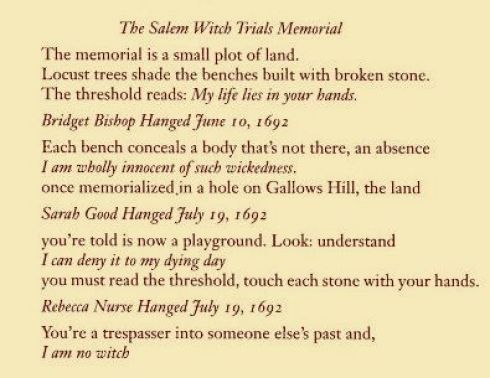
I went by the new memorial this morning, a glorious Sunday, as I wanted to spend some contemplative time there—it’s a small neighborhood site so I’m sure Wednesday will be a bit more busy. I’m so grateful to both the city and the neighborhood for making this memorial happen, as well as to the Proctor’s Ledge team of historians and geologists and interpreters who were not going to be satisfied with a generic “Gallows Hill” (earlier “Witch Hill”) execution site. Gallows Hill remains a neighborhood, however, and I sure there are those who live there who fear that their community will be overwhelmed by the witch-trial tourism that overruns the city in the fall and has transformed the downtown tricentennial Witch Trial Memorial into some less than sacred space. I hope that doesn’t happen too. I find the two memorials to be very complementary; if fact, when I was looking at the new one this morning I kept thinking about downtown, especially with reference to a poem about the latter by Nicole Cooley, from her 2004 volume of poetry inspired by the victims–and resonance–of 1692, The Afflicted Girls.

Week Text

Week Text 2

The absence she speaks of seems somehow less present at Proctor’s Ledge (if absence can be less present).

Week Memorial

Week Memorial 2

Week Worst Day

The Proctor’s Ledge Memorial in Salem, to be dedicated on July 19, 2017.


Battle of the Bonfires

Salem’s traditional Independence Day eve bonfires were epic, receiving considerable regional and national attention up until the 1950s, peaking with a portfolio of images taken by Life magazine photographer Yale Joel in 1949. I’ve written about these spectacles before, but there is more to say. I have a much better understanding of their chronology now, but I still can’t find evidence of the very first one, which early 20th-century references point to happening in 1814. I do not doubt this date, or even an earlier one, as bonfires go way back in Anglo-American history, through the Armada and Gunpowder Plot commemorations on one side of the Atlantic and Pope’s Day and Revolutionary War festivities on the other, but I wish I could find some confirmation. Actually, I don’t have much information about Salem’s bonfires prior to 1890, but after that year they clearly took off, escalating in size and notoriety over the next decades. There was a decade-long dry spell from 1910, which I assumed (very logically) was due to the Great Salem Fire of 1914, but actually predated that catastrophic event by several years. Things start heating up again in 1921, and in the 1920s there were bigger bonfires and crowds with every passing year. There are sporadic bonfires in the 1930s and 1940s, and then after the war the tradition continued into the 1960s (I think!) but it’s a bit hazy.

Bonfires Cabinet Card 1907

A.C. MacKintire cabinet card, c. 1906: these bonfires were BIG.

So here’s a bit more national, regional, and local context for Salem’s Independence Day bonfires, gleaned from a variety of sources, including a local facebook group focused on Salem’s history. Unfortunately no member is old enough to remember the pre-1930 glory days, but the earlier history is surprisingly (or perhaps unsurprisingly) well-documented.

1. It’s all about the 1890sI’ve noticed this about other aspects of Salem’s history, particularly anything related to tourism: everything intensifies in the 1890s. There are random brief references to Salem’s bonfires before 1890, but in that year the Boston Daily Globe ran a long story under the headline “Old Salem Ablaze. Bonfires on Gallows Hill Lighted the Home of the Witches” which described a frenzied celebration in the streets of Salem on July 3:  from sunset until midnight the principle streets were crowded with men, women, boys and girls, who passed the time in firing crackers, throwing torpedoes and blowing horns. In many ways it was the most noisy demonstration ever made in Salem. At midnight the immense crowd assembled in the vicinity of the highlands to watch the bonfires. On Gallows Hill a pile consisting of over 1000 barrels and boxes, to say nothing of old straw beds and witch hazel crammed into the intersections of the stack was set on fire, making a very handsome sight. The pile was 50 feet high and the flames towered as many feet higher. From 11-1 there was a concert on the hill by the Salem Brass Band. The Broad Street Social Club also had its annual jubilee on the Lookout and its adjacent pasture in the at the head of Broad Street (now the site of Salem Hospital). The 8th Regiment Band gave a concert from 8 to 12:00, interspersed with a exhibition of dissolving views, thrown upon an immense screen (what in the world was this????). At midnight upwards of 1000 barrels were set on fire, making a mountain of flame, which could be seen for miles.

Bonfire 1898 collage

2. Battle of the Bonfires: as the Philadelphia Record article above illustrates, there was a fierce competition in Salem over bonfire blazes, between the Gallows Hill Association which built their pyre on Gallows Hill and the Broad Street Club, which claimed Lookout Hill: this competition led to bigger and bigger bonfires with each passing year. In addition to this internal Salem competition, there was also competition between Salem and other Boston-area cities and towns, particularly in the first decade of the twentieth century. Salem clearly won the Boston battle, and the Gallows Hill guys (succeeded by the Ward Four Social Club and the Ancient Order of Hibernians) took the Salem prize.

Bonfires 1903

Bonfire 1905collage

3. Independence Day was the “most dangerous day of the year”. I’m quoting from an 1865 editorial and a 1935 Department of Agriculture pamphlet, both referencing the death, maiming and disablement associated with the festivities of July 4. During that long period there were repeated attempts by federal and state officials to cut down on the fiery July 4th celebrations, to no avail. On several occasions violence broke out in Salem, most notably in 1909, when a shooting occurred at the Lookout bonfire. Note the description of the scene in the Boston Daily Globe article from the next day: upwards of 75,000 persons witnessed the burning of the stack of railroad sleepers and barrels. Hundreds of boys and men were firing guns and revolvers. There’s a sense that things were getting a bit out of control, which may explain why the bonfires ceased for about a decade at this point.

Bonfire BDG 1909

4. Logistics. I’m amazed that things didn’t get even more out of control, given the composition of the bonfires: barrels of course, which were provided by local businesses, including tanneries, so supposedly they had remnants of combustible materials. Casks, old straw beds, hogsheads, railroad ties and sleepers, wired together and lit afire by torches before 1905, and then: ELECTRICITY. Salem made big news in 1905:  never before in the history of this country was a bonfire started by wireless electricity claimed the Boston Daily Globe, thanks to 18-year-old John J. Brophy, pictured below. Even though the days of the Lookout bonfires were numbered at this point, this was a great victory for the Broad Street Club. One of the few acknowledgements of any potential danger in producing these spectacles concerns ignition: twenty years later there will be a brief attempt to ignite by “radio”.

Bonfire electricity collage

5. 1920s revival. After a break during the nineteen-teens, during which the Great Salem Fire devastated the city and the new Salem Hospital was built on Lookout Hill, the Gallows Hill bonfires resumed under the auspices of the Ward Four Social Club and Ancient Order of Hibernians. The 1922 bonfire was ignited just after midnight ‘the night before’ by the old-fashioned torch method, and not by electricity as one or two of the former fires were started. There is a very conspicuous emphasis on “tradition” and “revival” in all of the coverage of these 1920s bonfires, and this is when you see references to the first bonfire: the organizers of the 1928 bonfire referred to it as the “114th Bonfire”. There was a tremendous response: with crowds reported at 80,000 for Salem’s tercentenary year and nearly as many in 1927. There are a few regional competitors in this decade, but Salem’s bonfire was repeatedly claimed to be “New England’s Biggest”.

Bonfires 1922

Bonfire 1927 collage

Bonfire 1928 Lowell Sun

6. Decline and dispersal. From 1931 to 1951, the Gallows Hill bonfires ebbed and flowed and ebbed again. The Boston Globe coverage of July Fourth festivities in the region shows what happened at the beginning of the era very clearly. In 1931, there was another “huge Salem bonfire stack”, so momentous that it required round-the-clock guards before the big night, while in 1932, both Boston and Salem abandoned their “bonfires of yore” at the onset of the Depression: for the first time in many years, there will be no mammoth stack in Salem. Several places have taken the money to buy railroad ties and cut them into stove lengths to give to the needy when the cold weather arrives. This strikes me as a pretty straightforward illustration of just one little consequence of the decade’s economic crisis! The bonfires resumed from 1937 to 1940, but they were much smaller and Salem was just briefly mentioned along with other communities in a Fourth of July roundup by the local papers. After World War II, everyone wanted to build a big celebratory bonfire, and Salem’s attracted a crowd of 60,000 in 1946, but in the next year (gasp) neighboring Danvers had a bigger stack and a bigger crowd. The Life photographs look a bit memorialistic in this context, but Salem natives tell me that the bonfires continued into the 1950s and early 1960s. What is clear from personal reminiscences is that Gallows Hill was no longer alone from this point on: there were smaller bonfires built in other parts of town: Collins Cove, Dead Horse Beach in the Willows, along the river in North Salem. So the bonfires (and the competition?) continued as an expression of neighborhood and community spirit, tapped down but still very traditional.

Bonfire Depression collage

7. Appendix: is there an (unfortunate) connection between Salem’s famous bonfires and that OTHER big Salem event, resulting in the common misconception—still very much alive today—that the accused witches of 1692 were burned on Gallows Hill?  I can’t tell you how many national headlines I read like the one below!

Bonfire 1928 Text Box


Red, White & Blue in the Newburys

I visited a friend up in Groveland yesterday and drove home in a very indirect way, east along Route 113 and south along Route 1A: I could have been home in a half hour or so but instead my return trip took several hours, because I had to stop and look at houses, of course. Much of my drive was through the Newburys: West Newbury, Newburyport, and just Newbury. These are all beautiful towns: Newburyport is the most bustling, and justly celebrated for its colonial and Federal architecture, but I’ve always been equally impressed by West Newbury, which is characterized by a line of beautiful classic colonials–interspersed with the occasional First Period house—all perfectly preserved. They’re all on Route 113, the main route between Newburyport and Haverhill and beyond–once obviously a country road running parallel to the Merrimack River but now pretty busy. There’s no sidewalk, so you have to look for spots to pull over and then walk alongside traffic until you reach the object of your adoration. Normally I don’t have time to do this, but yesterday I took the time.

Newbury Colors 9

Newbury Colors 10

Newbury Colors 12

Newbury Colors 8

Houses on the West Newbury Training Field (+ World War I Memorial): two down, an amazing First Period house (which is actually light green).

Newbury Colors 7

Newbury Colors 11

Newbury Colors 5

Newbury Colors 4

Newbury COlors 3

Newbury Colors

Newbury Colors 2

Newburyport, all ready for the Fourth.


Preservation by Pencil

I often get asked if I’m ever going to write a book about Salem—and I always feel like the subtext of the question is or are you just going to keep dabbling on your blog? I always say no, as I’m not really interested in producing any sort of popular history about Salem and I’m not a trained American historian. I have a few academic projects I’m working on now and at the same time I like to indulge my curiosity about the environment in which I live, because, frankly, most of the books that do get published on Salem’s history tend to tell the same story time and time again. First Period architecture is the one topic that tempts me to go deeper: not architectural history per se (again, another field in which I am not trained), but more the social and cultural history of Salem’s seventeenth-century structures—especially those that survived into the nineteenth and twentieth centuries. How do they change over time? Why do some get preserved and others demolished? What was their perceived value, at any given time? Why do some houses get turned into memorials/museums/”monuments” and others disappear, forever forgotten? And (here’s the blogging angle): why are some of these structures preserved for posterity in photographic and artistic form and others not? This is a rather long-winded contextual introduction to my focus today: the wonderful house renderings of the Anglo-American artist Edwin Whitefield (1816-1892). Whitefield was an extremely prolific painter of landscapes and streetscapes, flora and fauna, and I’m mentioned him here several times before, but I recently acquired my own copy of one of his Homes of our Forefathers volumes, and now I need to wax poetic. I just love his pencil-and-paint First Period houses: they are detailed yet impressionistic, simple yet structural, and completely charming. I can’t get enough of them.

HFTitle Page

HF4

HF3

HF 8 Coffin House

HF Gloucester

There are five Homes of our Forefathers volumes, published between 1879 and 1889, covering all of New England and a bit of Old England as well: Boston and Massachusetts are intensively covered in several volumes. Whitefield clearly saw himself as a visual recorder of these buildings and was recognized as such at the time (a time when many of these structures were doubtless threatened): An 1889 Boston Journal review of his houses remarked that “We cannot easily exaggerate the service which Mr. Whitefield has rendered in preserving them”. Even though the title pages advertised “original drawings made on the spot”, implying immediate impressions, Whitefield put considerable research and detail in his drawings, intentionally removing modern alterations and additions so that they were indeed the homes of our forefathers. His process and intent are key to understanding why Whitefield includes some structures in his volumes and omits others. He includes only two little-known Salem structures in Homes: the Palmer House, which stood on High Street Court, and the Prince House, which was situated on the Common, near the intersection of Washington Square South, East and Forrester Street. There were so many other First Period houses in Salem that he could have included–Pickering, Shattuck, Ruck, Gedney, Narbonne, Corwin, Turner-Ingersoll–but instead he chose two houses which were much more obscure, thus rescuing them from perpetual obscurity.

Preservation by Pencil Collage

Homes of our FF LC

Already-famous First Period houses in Salem, either because of their Hawthorne, witchcraft, or Revolutionary associations: the Turner-Ingersoll house before it was transformed into the House of the Seven Gables, Hawthorne’s birthplace in its original situation, the Shattuck House on Essex Street, a sketch of the Corwin “Witch House” and the Pickering House. Whitefield’s single postcard of the Witch House in its original incarnation (it was then thought to be the residence of Roger Williams, an association that was later disproven by Sidney Perley).

The Palmer and Prince houses are mentioned in the Pickering Genealogy (Palmer) and Perley’s Essex Antiquarian articles, and apparently there’s a photograph of the former deep in the archives of the Phillips Library, but without Whitefield’s sketches they wouldn’t exist. He was drawn to them, I think, by both their age and their vulnerability: both would be torn down, with little notice, in the same decade that his sketches were published.

HF SALEM 2

HF Salem


The Lost Bungalows of Great Misery Island

Out on Salem Sound the other day, sailing in a beautiful boat, I looked over at one of the several islands that mark the entrance to Salem Harbor and tried to imagine what once was. Off Great Misery Island there is a calm maritime meeting place referred to as “Cocktail Cove”: while one imbibes off-island now a century ago drinks were served on the island, first at the Misery Island Club, which became the Casino Hotel in 1904, and also in private cottages: 26 in all. Most of the structures on Great Misery were swept away by a fire in May of 1926 (just before the season), and both it and its adjacent island, Little Misery, reverted to nature under the stewardship of the Trustees of Reservations. But for a quarter of a century or so, Great Misery was quite a happening place, and its cottages attracted the attention of contemporary shelter magazines. House & Garden and The House Beautiful featured several Misery Island summer houses on their pages in their “aughts” heyday,  all bungalows, and all the work of Salem architect Ernest M.A. Machado, an extremely enterprising young architect who died far too soon.

Sailing to the Misery Islands, passing the Fame along the way–off Great Misery.

Misery Sailing

Misery Fame

Misery Today 2

Ernest Machado’s buildings on Great Misery: the Clubhouse/Casino (MIT Archives); the bungalow of Mrs. Charles Steadman Hanks (Mary Harrod Northend, “Some Seacoast Bungalows”, House and Garden, June 1905), “Ye Court of Hearts” (The House Beautiful, June 1905), the bungalow of Mr. George Lee, “The Anchorage” of Mr. George Towle (The House Beautiful, June 1909) , and “The Bunker” of Mr. Jacob C. Rogers (The House Beautiful, June 1906).

Misery Island Club

Misery Hanks collage

Misery Island Lee Bungalow

Misery Bungalow 2

Misery Bungalow 3

Misery Bungalow Bunker

Misery Bungalow Bunker 2

All of these Misery Island bungalow-owners lived on the mainland, either down in Boston or somewhere on the North Shore (Rogers was the last private owner of Samuel McIntire’s majestic Oak Hill, where the Northshore Mall now stands, or should I say sprawls), but they also owned summer houses along the Gold Coast: these cottages were for the weekend! The magazine articles accompanying these images emphasize the simplicity of the island bungalows, but it was a very deliberate, and very occasional, ethic. For about a quarter century, Misery was a Gilded Age playground, complete with shooting range and golf course, perfect for Harvard senior “Robinson Crusoe” picnics and reunions. Its moment might have been even shorter: social register references seem to appear with much less frequency in the teens and twenties, and then this very social chapter in the island’s history closes much more abruptly with the 1926 fire.

Misery club Bonston Post June 25 1902

Misery Reunion 2

Misery Fire collage May 8-10 1926 Boston Daily Globe

Misery Today

Misery Salem Harbor 2Newspaper reports of the 1902 Harvard reunions (Boston Post, June 22-25, 1902 ) and 1926 fire (Boston Daily Globe, May 8-10, 1926); Great Misery today, and home in Salem Harbor on a glorious early evening!