Category Archives: History

Salem Women of Note, 1939

The very last time I was up at the Peabody Essex Museum’s Phillips Library in Rowley, last February I believe, I requested a folder within which was the transcript of a short paper given at a meeting of the Zonta Club of Salem in 1939 by Annie Balcomb Wheeler entitled “Salem Women of Note”. I thought this would be the beginning of regular trips to the Phillips, but then came the pandemic closures. It is open now, but I just don’t have time to go up there with my book contract and four courses this semester: I won’t for some time, maybe never, unless I decide to take take up another book project, tentatively titled “Dead History: How America’s Most Historic City lost its Past” in my mind (the phrase Dead History is taken from a 1915 newspaper article about Salem’s deteriorating historic sites, but obviously it is a double entendre now). There’s some interest in this, but I’ve got to get through The Practical Renaissance first, and after that it might be better to leave Salem history in my rear-view mirror except for fluffy forays here. I remain rather forlorn about the state of Salem’s historic archives and interpretation, but am happy to see that the Peabody Essex Museum is diving into Salem history headfirst this fall, with two collections-based exhibitions on the Witch Trials and “Salem Stories“. This is quite a change, and I hope not just a reaction to the pandemic, which has reoriented many museums towards local and regional visitors. A renewed and sustained interest in historical interpretation and programming by the PEM could be a game-changer for Salem.

Ropes by Purely SalemA wonderful view of the PEM’s Ropes Mansion on Essex Street by my friend Matt of PurelySalem on Instagram! (He takes the most beautiful photographs). I‘m hoping that PEM’s foray in history involves looking at old things in new light: the Ropes is a great example because there are many stories that remain untold about it. It’s not a GOOD story, but we need to know more about slavery in Salem, and the Ropes Mansion was built by one of Salem’s more prominent slaveowners, Samuel Gardner. 

Well, high hopes for “Salem Stories” but back to Annie Balcomb Wheeler and her notable Salem women of 1939. I certainly didn’t expect this little paper to be my last dive into the Phillips collection for months and I didn’t spend much time with it: I just noted the women whom Annie Balcomb Wheeler found notable, because I wanted to compare her 1939 list with my evolving list of women spotlighted in my #SalemSuffrageSaturday posts. It’s so interesting to me to chart the highs and lows of written history: who or what we deem important now as opposed to who or what was important in 1939 or 1839 or 1739. Right now in Salem I think people are primarily interested in women of color, Charlotte Forten and Sarah Parker Remond in particular, as well as the traditional philanthropists, like Caroline Emmerton, the founder of the House of the Seven Gables. None of these women made it onto Wheeler’s list, which includes the Quaker Cassandra Southwick, poet Anne Bradstreet, accused “witches” Mary English and Elizabeth Proctor, educators Abigail Fowler, Lydia Very, and Ellen Dodge, physicians Sarah Sherman and Kate Mudge, diarist Mary Vial Holyoke and author Maria Susannah Cummins. I’ve posted on all of these women, with the exception of Fowler, Dodge and Holyoke: the educators are new to me but the latter is a definite oversight! It’s very notable to me that there are no artists on Wheeler’s list–nor entrepreneurs—as Salem women’s history is so rich in these categories, but I’m happy to see the emphasis on education and medicine. I wonder why she chose Mary English and Elizabeth Proctor, and not other victims or accusers of 1692? As it happens, I had just been looking at a document of testimony against the former at Yale’s Beinecke Library as I was trying to find some seventeenth-century writing that my students could actually read: here it is, along with the deposition of Mary Walcott against Proctor from the University of Virginia’s Documentary Archive and Transcription Archive, which has been the essential repository of Salem Witch Trials records and resources for more than a decade.

Salem Women Indictment Mary English Yale

Salem Women of Note Elizabeth Proctor1692 Depositions against Mary Hollingsworth English and Elizabeth Proctor, Beinecke Library at Yale and University of Virginia’s Salem Witch Trial Documentary Archive and Transcription Project.

I cannot account for all of Salem’s female schoolteachers: there are so many! Abigail Fowler seems to have had a career which spanned 50 years: upon her death in 1771, her obituary noted that this “noted school dame” had “finished her earthly labors. She was in her 68th year, and began to teach children before she was 18, and continued so to do till her decease”. I wrote about Lydia Very here: she was both an author (or poetry and children’s books) and public schoolteacher for many years, but her legacy has always been overshadowed by that of her brother, Jones Very. Ellen Maria Dodge was a longtime instructor at the Salem Normal School, and she also wrote the School’s history upon the occasion of its move from downtown Salem to its new campus on Lafayette and Loring Streets.

Lydia Very (2)

Salem Women of Note Ellen DodgeA privately printed book of poems by Lydia Very, 1882, Boston Book Company; Ellen Maria Dodge, Salem State University Archives and Special Collections.

I’ve written about Salem women physicians and Maria Susannah Cummins, the author of the incredibly popular Lamplighter, but recently I discovered a connection between Dr. Kate Mudge, who lived in the Bowditch House (currently the offices of Historic Salem, Inc.,) where Cummins was born. Like Bradstreet, I don’t really consider Cummins a Salem girl: her parents moved to Dorchester shortly thereafter. But still, cool connection: Dr. Mudge was certainly aware that she lived in the storied house of Nathaniel Bowditch and Maria Cummins, because her contemporary, photographer Frank Cousins labeled his photograph of the house (then around the corner on Essex Street) as such.

Salem Women Bowditch House (3)The Curwen/Bowditch House, Salem, 1890s. Frank Cousins/Urban Landscape Collection at Duke University Library.

So that brings me to Mary Vial Holyoke (1737-1802), the second wife of Dr. Edward Augustus Holyoke, and her diary. I have never appreciated this text properly, I think: Annie Balcomb Wheeler has convinced me to look at it again. It’s just that Mrs. Holyoke is so matter-of-fact about everything, especially death, including the deaths of her infant children and people all around her. This is certainly not a reflective diary, or a modern diary, but I should try harder to read between its lines, because I think Mary Vial Holyoke deserves her own post.

Salem Women of Note Mary Vial by GreenwoodPhotograph of a Greenwood portrait of Mary Vial Holyoke.


Lafayette Fangirls

I just love the idea and the historic reality of the “Farewell Tour” taken by the Marquis de Lafayette in 1824: the exuberant reception, and the deep appreciation expressed by both Americans and Lafayette again and again and again, everywhere he went. I also like all the things that were produced for this occasion: prints, plates, paintings, ribbons, all manner of print and material commemorative culture. In honor of its namesake, Lafayette College has amassed a large collection of Lafayette memorabilia but it is by no means the only repository of such items. Like every American town and city where Lafayette alighted, Salem greeted him with great enthusiasm, on this very day nearly 200 years ago, and Lafayette left his mark: the main southern thoroughfare to Marblehead was named after him, as well as one of my favorite rooms (the room with the bar!) in Hamilton Hall. The Hall was the site of the elaborate dinner (including 65 separate dishes) for the General/Marquis prepared by its increasingly-renown African-American caterer John Remond and his wife Nancy, with the ladies of Salem providing the decorations: the Salem Gazette reported that the “whole effect was beyond our powers of description” on the next day.

Lafayette in Salem Collage

Even more so than the Hall, it’s these ladies that I am interested in, as I bet they were all decked out. I love the Lafayette ladies’ accessories from this era: the ribbons, hats, gloves, and fans which were worn at the parades in his honor and then tucked away in some keepsake box, perhaps brought out at the time of his death in 1834, and then packed away again. They’re not difficult to find, as Lafayette’s tour was so extensive, and women who could afford to displayed their patriotism in a very exuberant and festive fashion: we have to remember that Lafayette was not only a valiant foreigner who answered America’s call at a crucial time, he was also the last living Revolutionary General in 1824. He was more than “the Nation’s Guest”, but he was also French, so deserving of a display.

Lafayette Gloves

Lafayette Bag Cooper Hewitt

Lafayette-Ribbon-Lafayette-CollegeGloves with Lafayette’s image from the collections of the Metropolitan Museum of Art and the Museum of Fine Arts, Boston; a silk bag from the Smithsonian’s Cooper Hewitt Museum, and a ribbon from the collection at Lafayette College.

Fans are the most elaborate of Lafayette mementos, in my humble opinion, and several Salem ladies had fans for the farewell tour–whether they were domestically produced or French imports I do not know. There’s a lovely Lafayette fan featured in the Museum Collections of the Essex Institute which I assume is still in the collection of the Peabody Essex Museum, but I can’t find it, of course, because PEM. The Museum of Fine Arts has two fans which likely belonged to Elizabeth and Sarah Derby, if the initials are any indication. If they did in fact belong to the Derby girls, I don’t know if they had them in hand on that day, this day, in 1824: all of the newspaper accounts reported heavy rain in Salem. And after that he was gone, but the adoration continued: in a piece that was reprinted up and down the east coast the Salem Gazette observed that “Everything is Lafayette, whether it be on our heads or under our feet…..” in October.

pixlr

Lafayette Fan Elizabeth Derby MFA

Lafayette Fan Sarah Derby MFA

Lafayette-Salem-Oct-12-Gazette

Fans in the collections of the Essex Institute (Peabody Essex Museum?) and Museum of Fine Arts, Boston; Salem Gazette, October 12, 1824.


A Victorian View of Salem Witchcraft

I had not thought about the prolific and pioneering author Harriet Martineau (1802-1876) for years: until I encountered a portrait of her by the Salem artist Charles Osgood in the Catalog of Portraits at the Essex Institute (1936). I was looking for some lost portraits of Salem women—portraits which are still presumably in the collection of the Peabody Essex Museum but which we have no access to either digitally or in person, and for which no accessible catalog entry exists except in the Smithsonian’s Catalog of American Portraits. I found many such portraits in this catalog, but I did not expect to find Harriet, a popular British author whose many works contributed to the emerging fields of sociology, economics, and political science. Martineau was cast into the breadwinner role for her impoverished family while in her 20s, and so she picked up a pen and produced an astonishing array of texts illustrating the contemporary social and economic structures of the British Empire: taxation, the poor laws, industry and trade. While these might seem like dry topics then and now, Martineau had an extraordinary ability to interpret, translate, and distill abstract and complex theory into clear and engaging prose: both Charles Darwin and Queen Victoria were fans!  Travels to the United States and the Middle East expanded Martineau’s range of topics as well as her abilities to report and observe, and she moved beyond illustration and theory into methodology, thus contributing to social-science practice. Martineau accepted no limitations: of genre (she wrote both fiction and non-fiction) or gender, and neither her encroaching deafness or her many illnesses stopped her from writing. When diagnosed with fatal heart disease in 1855, she wrote her own obituary, noting that: Her original power was nothing more than was due to earnestness and intellectual clearness within a certain range. With small imaginative and suggestive powers, and therefore nothing approaching to genius, she could see clearly what she did see, and give a clear expression to what she had to say. In short, she could popularize while she could neither discover nor invent. She lived, and wrote, for another twenty years.

Harriet Martineau by Charles Osgood Catalogue of Portraits in Essex Institute (2)

Harriet Martineau Richard Evans 1834 NPG (2)Harriet Martineau by Salem artist Charles Osgood, c. 1835, Catalog of Portraits in the Essex Institute (1936); and by Richard Evans, c. 1833-34, National Portrait Gallery.

In 1834, the same year that her Evans portrait was exhibited in London, Harriet traveled to the United States on a research trip: she wanted to observe and analyze the dynamic economy of the new nation, as well as its “peculiar institution” of slavery. Her time in America refined her observation skills but also made her more of an activist: encountering both slavery in the south and the fervent abolitionist community in New England intensified her own anti-slavery sentiments. She published her American observations in Society in America (1837) which contains a forceful critique of the Southern economy’s exclusive reliance on slave labor and a much more favorable view of New England based on principles of the “moral economy”. In the Slave South, “one of the absolutely inevitable results of slaver is a disregard of human rights; an inability even to comprehend them”, while in the egalitarian North “every man is answerable for his own fortunes; and there is therefore stimulus to the exercise of every power.” Martineau goes on to extol the economic (and social) virtues of Salem, where she was in residence for several weeks at the Chestnut Street home of  Congressman (and future mayor) Stephen C. Phillips. She loves everything about Salem: its beautiful historic homes, its bustling tanneries, its “famous” museum, but especially its social mobility: “what a state of society it is when a dozen artisans of one town—Salem—are seen rearing each a comfortable one-story (or, as the Americans would say, two-story) house, in the place with which they have grown up! when a man who began with laying bricks criticizes, and sometimes corrects, his lawyer’s composition; when a poor errand-boy becomes the proprietor of a flourishing store, before he is thirty; pays off the capital advanced by his friends at the rate of 2,000 dollars per month; and bids fair to be one of the most substantial citizens of the place!”

brm0399-bachelder-salem-1856-1024x794 (2)Salem in the mid-nineteenth century from John Bachelder’s Album of New England Scenery.

Harriet Martineau was far more interested in the present than the past, and she predicts that the “remarkable” Salem, “this city of peace”, “will be better known hereafter for its commerce than for its witch-tragedy.” [if only!!!] Nevertheless, it happens that both one of her earliest and one of her last American publications was focused on Salem witchcraft: reviews of Charles Wentworth Upham’s Lectures on Witchcraft comprising a history of the delusion in Salem, in 1692 (1831) and Salem Witchcraft with an account of Salem Village and a history of opinions on Witchcraft and Kindred Subjects (1867). Her review of the latter in the Edinburgh Review displays her interpretive abilities perfectly, managing to both summarize Upham’s work and supplement it with a Victorian sensibility as well as the perspective of a social scientist. Like many of her contemporaries, Martineau was interested in psychological experimentation: the practice of mesmerism, in particular, was interesting to her for its curative powers as she experienced challenging medical conditions from the 1840s. Her interest in the powers of suggestion influenced her reaction to Upham’s study of the Salem trials, but so too did her sociological studies of organized religion and community interactions. She manages to display both historical empathy and the presentism which characterizes so many interpretations of the Salem Witch Trials at the same time as she emphasized “the seriousness and the instructiveness of this story to the present generation [this could have been written today]. Ours is the generation which has seen the spread of Spiritualism in Europe and America, a phenomenon which deprives us of all right to treat the Salem Tragedy as a jest, or to adopt a tone of superiority in compassion for the agents in that dismal drama.” [this could not].

Harriet Upham 1831 (2)

mdp.39015026502115-seq_593-2The first Upham work to be reviewed by Harriet, and a sketch of Miss Martineau at work in Fraser’s Magazine, November, 1833.


Delights for Ladies

This was one of those weeks that the book took precedence, so it was difficult for me to find the time to research a proper #SalemSuffrageSaturday post: it really has been time-consuming to find all those lost reformers, gentle ladies, and entrepreneurs—though the authors and artists are much easier. I have a few more I want to highlight before this commemorative year is over, but this week all I have is book for ladies, written by an Elizabethan author whom I am sure could not have conceived of universal suffrage in his wildest imagination even though he was a relatively progressive fellow for his time. Hugh Plat (1552?-1608) is featured in several of my chapters: his work was very wide-ranging. He wrote about agriculture and gardening, alchemy, engineering, medicine, and all sorts of little inventions meant to improve daily life: an everlasting “tube-like” victual called macaroni for seamen on long voyages, a prototype raincoat, cheaper candles and lanterns for the homes of “the poorer sort”, and even dentures! He was an absolute believer in the art of alchemy, not as some secret enterprise, but as a way to extract the inherent spirits and virtues out of natural substances, and make them more efficacious. He wanted to make English land more fertile, English homes lighter, and English bodies healthier. Plat can certainly be criticized for selling ineffective plague pills during the pandemic of 1593, and I’m still wrestling with that. There are two great books on Plat: Deborah Harkness’s The Jewel House. Elizabethan London and the Scientific Revolution and Malcolm Thick’s Sir Hugh Plat: the Search for Useful Information in Early Modern London. I’m grateful for both, as they are based on manuscript evidence which I can’t access as well as Plat’s many publications, but I need to find my own Hugh Plat.

Plat-Jewel-House

Plat’s major work, still being published nearly 50 years after his death.

The Jewel House of Art and Nature was popular, but a book aimed at the relatively new feminine audience was even more so: first published in 1602, Delights for Ladies, to adorn their Persons, Tables, Closets and Distillatories was published in 13 editions up until the middle of the seventeenth century, sometimes bound with a companion text, A Closet for Ladies and Gentlewomen, or the Art of preserving, conserving, and candying. The original is available here, and two editions were published in the twentieth century: one by the Trovillion Press in 1939 and another edited by historian G.E. Russell after World War II. I have a badly-beat-up Trovillion edition, which still manages to be a beautiful little book, and some day I am going to have a pristine one!

Plat Cover (2)

20200819_095505

20200819_095520

20200822_090633

Screenshot_20200822-094416_Chrome

Delights is a book of “still-room secrets” with which women could whip up precious potions and waters to take care of their daily needs and concerns. It is also a rather specialized cookbook, and general housekeeping book: you really understand that word—housekeeping—when you read it, as Plat’s concern here, also evident in his other books, is to preserve foodstuffs and keep them fresh for as long as possible. He detested spoilage and waste. So there are preserves that we would recognize today, including “marmelades” and “gellys” made from fruit, but also instructions on how to keep fish and meat for “many days”. The house also has to be kept clean and well-provisioned with both food, drink, and medicines for maladies minor and major. There is a lot of expensive sugar in this book, which obviously catered to early modern English tastes, but also indicates that this was certainly not a book for the “poorer sort”: Plat’s huswife, a term that came into use during his lifetime, was a “courteous gentlewoman” who could read. And what might be her personal concerns, besides provisioning her house? Something to keep her face fresh, clean, and spot-free, a lovely hand lotion, tooth paste, and a dye to return the chestnut or golden luster to her hair (or her husband’s beard). Something to help the “ytch” and take out stains from her garments and bedclothes. A pomander for the plague-time, and headache powders, and sweet-smelling perfumes for any time. The more things change………….

Plat Table (2)

Plat Rose Water (2)

Plat Dye

Plats Pimples

Plat Teech (3)


Bells were Ringing

We’ve come to THE week of this year-long suffrage celebration, which has unfortunately been overshadowed by other events! But I think we should all stop and recognize the anniversary, coming up on the 18th, of the constitutional ratification of the 19th amendment 100 years ago. Since the 1970s, Womens Equality Day has been commemorated on August 26, the day that the ratification was certified, but a century ago, everyone realized that the Tennessee vote on the 18th was the big moment: the suffragists themselves, the newspapers, and even the anti-suffragists! The photograph of Alice Paul extending the flag of 36 stars from a balcony, symbolizing the realization of the two-thirds majority, while her colleagues jump with joy (well I like to think they were jumping) below, captures this moment perfectly.

Suffrage-Celebration-ALice-Paul-2Library of Congress

I wanted to ascertain, and feel the local reaction to the ratification, so I checked out as many local papers as I could. We’re handicapped with 20th century history when it comes to newspaper coverage as the Salem Evening News is available only on microfilm and our public library has been closed since the pandemic, so I have relied primarily on Boston papers which covered the region. I’m sure I’m missing a lot of little anecdotal reactions, but here’s the slightly-bigger picture: rapid registrations, bells chiming out, a big celebratory evening at Faneuil Hall, and a Boston parade, of course. After celebration came deliberation: as the pundits tried to assess the impact of all these new voters on the upcoming election.

SUffrage Celebration 1 (2)

Suffrage-celebration-Boston-POst-Aug-9

Suffrage BDG Collage

Suffrage-Celebration-Boston-Evening-Globe-Aug-19-2

Untitled-2020-08-15T103559.549

Suffrage Cel

Suffrage Bells Aug 28

Suffrage Victory Parade

Suffrage Straw Poll

Griswold VotesThe aftermath of August 18, 1920: headlines and editorials in the Boston Post and Boston Daily Globe, August 19 (I didn’t realize the Ponzi Scheme was in the news at this time!), primaries were coming up, so there was an immediate focus on registration, big victory celebration at Faneuil Hall on the 23rd; supposedly there was a national bell-ringing event on the 28th (?), the last Woman Suffrage Association parade in September; a straw poll in October and Mrs. Almira C. Griswold’s registration made NATIONAL headlines on September 11-13, 1920.


The Gardener’s Labyrinth

I’m having this really neat synchronicity of research, writing and life right now, as I’m working on Chapter Three of my book, which is focused on Elizabethan horticulture. So I get up, water my garden, and then go upstairs into my study and read and write about English gardening texts from the sixteenth century. Or there is the alternative day: I get up, drink coffee, read and write about English gardening texts, and then go downstairs for “cocktail watering” at the end of the day.  Regardless of when I sit down to immerse myself in this topic, it is obvious that there was a lot to write about then, and so I have a lot to write about now: new plants, coming from the Continent or the New World, how to feed the rapidly growing city of London, how to harness the power of plants for a variety of medicinal purposes. There were kitchen gardens, physic gardens, market gardens, and “summer gardens” for pleasure and relaxation. No matter what the purpose of the garden, the general belief was that it should be adjacent to the house and laid out in beds segregated by paths and walkways: the influences of the French parterre and medieval precedents encouraged the creation of a “knotted” or knot garden, which seems to have become a Tudor symbol. The pioneer of English gardening texts, Thomas Hyll (or Hill) published his first book, The Profitable arte of gardening in 1558: it was reprinted frequently thereafter and published in an amplified edition called The Gardeners Labyrinth posthumously in 1577. The Labyrinth was also very popular, due to the combination of Hyll’s “plain” instructions on how to lay out, enclose, plant, fertilize, irrigate, protect, and harvest a garden as well as its wonderful illustrations, the most reprinted of which are his images of watering the garden, something we all need to think about right now in the August doldrums (at least in New England). And true to its title, the Labyrinth also includes illustrations—templates really, for knot gardens, mazes, and labyrinths. Somehow I am more appreciative of his watering advice right now, in these 90-degree days!

Gardeners Collage First

Gardeners Labyrinth 1594 (2)

Gardeners Labyrinth Ch. 20 (3)

Gardeners Labyrinth 1594 watering through troughs (2)

Gardeners Labyrinth Watering (3)Tending to and ordering your garden in the Elizabethan era: Thomas Hyll’s Gardeners Labyrinth.

I am a bit confused by these two alternative watering techniques: “the maner of watering with a pumpe by troughes in the garden” and “the maner of watering with a pumpe in a tubbe” as Hyll is quite clear in the text that “water rotteth and killeth above ground.” So do we water from above or below?  I generally do both: aiming for the roots when I start watering and then just lazily arching it from above when I get tired and lazy—especially if I am watering with wine-in-hand. So many tools we use now were used then—rakes, hoes, shovels, watering “pottes”: and he calls his tin watering devices “great Squirtes”! August was hot in those Elizabethan summers as well: and Hyll instructs his readers to get out there and water in whatever way they can.

20200810_185343

20200810_070845Bad cocktail watering (?) and the garden in the morning.

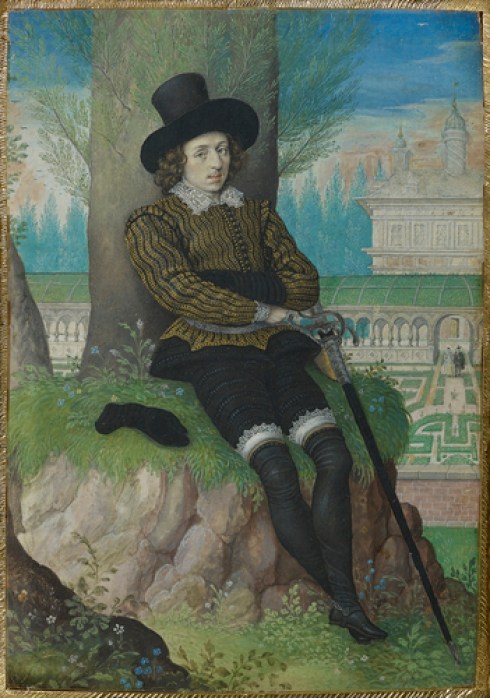
There are several knot garden examples in The Gardener’s Labyrinth as well as mazes: Hyll had to appeal to the literary public, which was essentially a monied and aspirational one, and so his gardens had to have ornamental qualities as well as utilitarian ones. The knot or maze is a perfect and very literal example of man bending nature to his will, a key Renaissance preoccupation: man is at the center of everything. The perfectly-ordered gardens that appear in the backgrounds of English portraits from this era reflect very well on their individual subjects, as well as the society at large.

Gardeners Knot (2)

Gardeners Maze (3)

Lord Edward Russell

Gardening Young Man

Garden Lettice Newdigate 1606Knot & Maze designs from the Gardeners Labyrinth, 1577; Lord Edward Russell by George Perfect Harding, watercolor copy of a 1573 portrait after unknown artist, National Portrait Gallery; Isaac Oliver, a Young Man seated under a Tree, 1590-95, Royal Collection Trust; Lettice Newdigate, c. 1606, Private Collection: Arbury Hall, Warwickshire.


We Girls and One Boy

I have forgotten what I was searching for on the Internet Archive last week, but somehow I ended up looking at yearbooks of the turn-of-the-century graduating classes of the Salem Normal School, the founding institution of the university where I now teach, Salem State University.  The cover of the 1904 yearbook, entitled The New Mosaic, first caught my attention, then the fanciful illustrations inside, and lastly, the writing. I moved on to the 1905 and 1906 yearbooks, titled The New Mosaic and The Mosaic respectively, which were equally charming, and all the way up to 1914, when the yearbook was published with the rather odd title of Normalities (I get it–Normal School/Normalities, but still). It seems that for a brief time, generally the first decade of the twentieth century, the Salem Normal School seniors published really interesting accounts of their educational experiences—focused on what they learned and what was going on in their world rather than simply who they were. After 1915 or so, the yearbooks became Year Books, with the standard “facebook” format still used today: registries of students rather than their own reflections.

Mosaic 1904 Final Collage

Mosaic 1905

Mosaic 1906 collage

pixlr

These yearbooks are fascinating and rather poignant—they made me miss my own students! The seniors pay tribute to their teachers, to each other, and to the class behind them. We read all about their activities and clubs and how long it took them to walk down Lafayette Street from the train station. There are lots of whimsical drawings—which will be replaced by more straightforward photographs later. I’m including this post under my #salemsuffragesaturday banner as nearly all the students at the Salem Normal School were women in these days, and the editorial staff of these successive yearbooks were exclusively women. Men were admitted to the school from 1898, but their numbers were extremely low during this first decade of the twentieth century: this makes for some rather amusing class pictures, as we can see from the photograph of the 1906 graduating class below. The same ratio for the 1904 class, as the New Mosaic of that year registers excitement for the upcoming graduation of “We girls and one boy”.

Mosaic 1906 one boy (3)The 1906 graduating class of the Salem Normal School

I kept reading because I wanted to see what the students were saying about all the events of the later teens: war, pandemic, suffrage. The yearbooks became less creative, but they started to include editorials: a popular Geography professor who served in World War I died of pneumonia (brought on by influenza?) right after the Armistice and now there were more male students, so the war was very much on the minds of successive editors. Nothing is said about suffrage, which really surprised me: instead there is an overwhelming focus on reforms, developments, and opportunities in the teaching profession. But everything is much more serious than a decade or more before: when the girls, and one or two boys, lived and learned in a much smaller, less-threatening Salem world.

Mosaic 1904 Collage 2

mosaic1906sale_0019 (3)

Mosaid-1918-editorial

Mosaic-Liberty-Club-1919-2

Salem Normal School yearbooks before and after World War I: so many Salem witches in the yearbooks from 1904-8; things get much more serious a decade later: the Liberty Club was dedicated to selling liberty bonds in 1918. The Boston Public Library has a vast collection of yearbooks from nearly every Massachusetts town, most of which have been digitized.


The Fabric of Friendship

Back to my Salem singlewomen shopkeepers and businesswomen: they continue to be my favorite subjects among these #SalemSuffrageSaturday posts. Socialites, authors and artists: too easy! I came across one of the most stunning nineteenth-century photographs I have ever seen: of Miss Eliza P. Punchard, dressed formally in black bombazine, in front of Ann. R. Bray’s dry goods store at 76 Federal Street circa 1875. The picture was taken by the very accomplished Salem photographer Edwin Peabody, and it is in the collection of the Peabody Essex Museum, although you will never find it on the PEM’s impenetrable and unhelpful website: I make most of my PEM discoveries through old publications of either of its founding institutions, the Peabody Museum and the Essex Institute. In this case, the photograph was published in Museum Collections of the Essex Institute, published in 1978. It may seem like an old-fashioned way to access a museum’s collections in 2020, but believe me, such publications are your best bet for now.

20200726_150219

This photograph is so compelling, so sharp, so curious! Miss Punchard is not posing formally, yet she looks very formal! Her cheekbones! A literal window into a shop full of fabrics! I want to see more of the sign! So what’s the story?

Miss Eliza P. Punchard and Miss Ann R. Bray worked together in the dry goods business but they were not business partners: the former was always listed as clerk in the census and directory records while the latter was clearly the shopowner. They were, however, friends and perhaps life partners: after leaving bequests to a score of nieces and nephews in her native Gloucester, Miss Bray left the bulk of her estate, and her shop, to Miss Punchard in her 1875 will: I can only assume that this photograph marks Miss Punchard’s succession to the well-established Bray business: and is she wearing mourning? Miss Bray’s will implies that they were very close but I can’t presume anything more than that—although again, they lived together and alone (except for a succession of servant girls, several from Maine and several from Ireland) for more than three decades: every time they needed a new servant Miss Bray advertised for help in “a household of two”. Following Miss Bray’s death in 1875, Miss Punchard ran the shop until her retirement in 1886; she died three years later. And that was the end of a seemingly-successful woman-owned business in Salem, one of many: I am sure I am just scratching the surface with these posts. The Bray business had a long run, from around 1821 at least, when Miss Bray began advertising her services as a tailoress in Salem: not a seamstress mind you, but a tailoress. The “trimmings”took over and she moved into dry goods dealing from a variety of Federal Street locales: ending up at #76.

Bray Salem Gazette 1821 (2) Best

Bray 1833

Bray Goods SR June 24 1848 (2)

Bray black and whiteAdvertisements in the Salem Gazette and Register, 1821-1853: Cambric and Bombazine dresses from MoMu: Fashion Museum Antwerp and the Metropolitan Museum of Art.

Miss Bray was an enthusiastic advertiser in the Salem Gazette, Register and Observer and even the Wizard of South Danvers (now Peabody) and her stock got larger and more exotic as her business expanded: she offered gingham from the beginning to the end (and you can see it in the photograph of Miss Punchard) but added many other fabrics and frills from the 1840s on. I’m familiar with lots of things (merino, tartan, worsted, muslin and linen), but clueless about others: what in the world are “Russian Diapers” and “Circassian Bombazettes”? From some fashion historian crowdsourcing, I did learn that “Quaker Skirts” were a lightweight hoop, and Miss Bray offered other hoops as well, including the “Watch Spring” and “Bon Ton” varieties, and all manner of petticoats, including the popular Balmoral Skirt inspired by Queen Victoria. BUT there is definitely a patriotic shift during the Civil War: towards simpler fabrics, manufactured domestically. Mourning wear, unfortunately, was always in demand.After the war Miss Bray returned to her vast array of fabrics and accessories, and even included pianofortes in her stock! Just brief glimpses into two women’s lives in Salem: their public roles are somewhat revealed while their private world remains just so.

Bray Collage

Bray Goods July 24 1862 (3)

20200729_115759

Bray EndSalem Register, January & July 1862; South Peabody Wizard, January 1869; Newburyport Daily Herald, November 1886.


Break for Ice Cream

I was reading and writing about the 1563 plague in London—very deadly and very overshadowed by later Tudor and Stuart plagues—when I had to take a break for ice cream in the midst of a stifling afternoon. The break went on a bit longer than expected because I became diverted into the history of ice cream: I just opened up an old cookbook I had for a moment (really!) but the recipe looked similar to some that I had seen in the seventeenth-century cookbooks that I am going to be writing about later in this chapter that I’m working on so I indulged myself for a bit longer in the name of “research”……and before you I knew it I had abandoned early modern England and was looking into the history of ice cream in Salem. From the plague to ice cream in a half hour: the balance of book and blog will not work well if I continue to be so indulgent (but it was hot).

earliest-ice-cream-recipe

Take three pints of the best cream, boyle it with a blade of Mace or else perfume it with orang flower water or Ambergreece, sweeten the Cream, with sugar[,] let it stand till it is quite cold, then put it into Boxes, e[i]ther of Silver or tinn, then take, Ice chopped into small peeces and put it into a tub and set the Boxes in the Ice covering them all over, and let them stand in the Ice two hours, and the Cream Will come to be Ice in the Boxes, then turn them out into a salvar [salver = dish] with some of the same seasoned Cream, so sarve [serve] it up to the Table.

This is Lady Ann Fanshawe’s handwritten recipe for “icy cream” from the mid-seventeenth century and the Wellcome Library’s digitized recipe-book collection (MS.71113) . It is unusual when compared to the first published recipes for ice cream in the next century, which are more custard-style creams, made with egg yolks, and then frozen. But Lady Fanshawe’s ingredients–mace, orange-flower water, and even ambergris (well maybe I should exclude ambergris)–were not that unusual: early ices were made with a wide range of ingredients: all sorts of fruits and herbs, honey, tea and coffee, crumbled cakes and biscuits. Ice cream history in the nineteenth century is marked by two big developments, both in the US: the development of the portable ice cream “freezer” and “Philadelphia-style” ice creams, made without eggs. But nineteenth-century ice creams, sorbets and sherberts were still more exotic than we think they were, or at least thought they were: Mrs. Lincoln’s Frosty Fancies and Frozen Dainties, published in the late nineteenth century for best-selling freezer manufacturer White Mountain, feature lots of interesting ices, and ice creams made with arrowroot, cornstarch, and gelatin for their foundation, rather than eggs.

Ice Cream Frosty Fancies (3)

ice_cream_Fozen-removebg-preview (2)

And yes: I think this is yet another aspect of Salem’s history which seems notable, although I did not extend my break to make a city-by-city, town-by-town comparative analysis of ice-cream production and consumption. Salem had a very early ice cream “manufactory”, from at least 1856, as well as several antebellum retail shops or saloons. And these multiplied over the later nineteenth century and then of course opened up in the tourist destination that was (and remains) Salem Willows. Salem also had ice cream “peddlers” from the late nineteenth century on, and even a “millionaire milkman”: Gilbert H. Hood of the famous H.P. Hood Company, still very much with us, who spent the summer and fall of 1921 “learning the business from the ground up” while based at Hood’s Salem ice cream factory, now the site of luxury condominiums.

Salem Ice Cream

Cool-1881

Ice Cream Holly Tree

Ice Cream Shute (5)

Ice Cream NDN Aug 19 1989

Hood Collage

Notice of Salem’s first ice cream manufactory in the Salem Register, June 30, 1856; Salem Willows postcards from 1905; The manufactory at 271 Essex became a “saloon” in the 1870s and another popular ice cream parlor was the Holly Tree on Central Street (Collections of Historic New England); “Ira Moody Chute standing in front of his ice cream wagon, Salem, Mass., ca. 1898,” (Historic New England); The Newburyport Daily News, August 19, 1889; Gilbert H. Hood in the Boston Herald, October 9, 1921.

More! The SERVING of ice cream was serious business a century ago, and Historic New England has some great examples from the Phillips House: ice cream forks, scoops, molds, trays, etc….: check them out here.


The Grande Dame

We know her instantly when we see her: from her famous John Singer Sargent portrait painted 20 years later: she is Ellen Peabody Endicott, the Grande Dame of Salem, Boston, and Washington society, standing right behind the bride at the first presidential White House wedding of Grover Cleveland and Frances Folsom on June 2, 1886. As the wife of Cleveland’s Secretary of War, William Crowninshield Endicott, she was invited to the intimate “stand-up” wedding, along with all the other cabinet ministers and their wives and so appeared in national newspaper stories over the next few weeks: her face is strong and clear-cut. One would say it was the typical Boston face. Mrs. Endicott looks like the high-bred New England woman of long descent. She wore a red pompom in her handsome gray hair at the president’s wedding. Mrs. Endicott is her husband’s first cousin. Both are descendants of the Putnam family.

Endicott-Collage

Endicott grovergettingmarried

Screenshot_20200721-193543_ChromeThe President’s wedding from Harper’s Weekly, June 12, 1886 via the Library of Congress. Mrs. Endicott is on the extreme left above.

Yes, that’s correct: Ellen Peabody Endicott was an Endicott both my birth and by marriage, and a perfect example of how early Salem families, and slightly “newer” merchant families, liked to stick together. She was the granddaughter of Joseph Peabody, one of Salem’s richest golden-age merchants if not the richest, and was born (in 1833) and raised in two beautiful houses: 29 Washington Square on the Common (now the Bertram Home) and the summer house in Danvers, which the Endicotts later referred to simply as “the farm” (now Glen Magna, owned by the Danvers Historical Society). About a decade after her marriage to William Crowninshield Endicott in 1859 they established their primary Salem residence at the venerable Georgian mansion on Essex Street now known as the Cabot-Low-Endicott House: this house became quite notable due to Mr. Endicott’s rather spectacular career (Chief Justice of the Massachusetts Supreme Court, Secretary of War in the Cleveland administration) and their daughter’s spectacular marriage to the British politician Joseph Chamberlain. The Endicotts moved into a Boston brownstone mansion on Marlborough Street following his retirement, but still spent all of their summers in Danvers.

pixlrMrs. Endicott’s houses: clockwise, Washington Square and Essex Street, Salem; 163 Marlborough Street, the Farm (Glen Magna).

Mrs. Endicott is a perfect example of yet another theme that has been emerging from these #salemsuffragesaturday posts: the difficulty of piecing together women’s lives when you only get references through an association—usually a husband. In Mrs. Endicott’s case, we hear about her because of her husband’s cabinet position and also because her daughter married the notable British politician Joseph Chamberlain in 1888: the transatlantic marriage was big news on both sides of the ocean and the bride’s parents are always characterized as old Yankees, Boston Brahmins, Puritan and/or Codfish aristocracy in all the stories (you can read all about the “Puritan Princess” here). There was also interest in the new Mrs. Cleveland, and on the several occasions when she traveled to Massachusetts, Mrs. Endicott was sent to meet and accompany her: consequently we get to hear about what both women wore in considerable detail.

Endicott Collage 2

But later in life, after her husband’s death in 1900, we begin to see Ellen Peabody Endicott for herself: in terms of her accomplishments and quite literally.  She oversaw (with the help of her son, William Crowninshield, Jr., and her son-in-law Joseph Chamberlain) considerable improvements to the house and garden at the Danvers estate, including the installation of the beautiful McIntire summer house which was originally built for Elias Haskett Derby’s farm on Andover Street a few miles away in what is now Peabody. And then there are the two amazing portraits by John Singer Sargent: in oil and charcoal. The latter is very appropriately in the collection of the Peabody Essex Museum, and was included in the Sargent exhibition at the Morgan Library and Museum just last year.

Screenshot_20200721-150316_Chrome

ellen_peabody_endicott_mrs._william_crowninshield_endicott_1951.20.1

Screenshot_20200721-150804_ChromeWilliam Crowninshield’s death in May of 1901 was a national headline; Ellen Peabody Endicott (Mrs. William Crowninshield Endicott), 1901 by John Singer Sargent, National Gallery of Art: Gift of Louise Thoron Endicott in memory of Mr. and Mrs. William Crowninshield Endicott; Portrait of Ellen Peabody Endicott, 1905, John Singer Sargent, Peabody Essex Museum: Gift of Mrs. William Hartley Carnegie, 1957.

Appendix: Painting Ellen’s Portrait!  The Sargent oil portrait in situ in Karin Jurick’s painting “Sitting Idly By”: you can see more of her work here.

Screenshot_20200725-075532_Instagram