Category Archives: Design

Mapping the Book

For some reason, I belong to all of these membership shopping sites. They send me daily notices of their “special” sales, which usually just annoy me; seldom do I click through and look at their wares. But I did click on the Fab link the other day, and found some really neat pictorial maps of the scenes, plots, characters and places of some classic books, including Moby Dick, Huckleberry Finn, and Robin Hood, produced by the Harris-Seybold  Company of Cleveland, Ohio in the 1950s, presumably to showcase their cutting-edge printing equipment. These are different from the make-believe maps you find in children’s books (NeverlandMiddle Earth) because they are representations of real places, superimposed with fictional characters (well, all of them except for Treasure Island). The Library of Congress also featured these maps, in its exhibition and accompanying book Language of the Land:  Journeys into a Literary America.

Literary Maps Moby Dick

Literary Maps Huck Finn

Literary Maps Virginian

Literary Maps Robin Hood

Literary Maps Treasure Island

Harris-Seybold Literary Maps of Moby Dick, Huckleberry Finn, and The Virginian, 1953, Library of Congress, and of Robin Hood and Treasure Island, 1953, Fab.com.

So much better than those old-fashioned literary maps where authors’ heads are placed on their state or town–but many of these can be found in the Library of Congress’s exhibition as well. I spent considerable time (now lost) trying to make a literary map for Salem based on Hawthorne’s House of the Seven Gables following this Google Earth procedure, with less than impressive results. Instead, I’m featuring a cropped image from another vivid mid-century map, Alva Scott Garfield’s Scott-Map of SALEM MassachusettsThe Wealth of the Indies to the Uttermost Gulf!” Scott’s maps are always extremely well-annotated–and often very cleverly so: the caption underneath the requisite witch on her broomstick reads “aviation started in Salem” while a nearby musket-bearing Puritan is captioned “the anti-aircraft is surprised” (see below). In the proximity of the actual House of the Seven Gables she has assembled many of the characters from the House of the Seven Gables (Clifford and Hepzibah, Phoebe, Judge Pyncheon), creating a perfect literary map of this little corner of Salem. And in another corner, Scott has placed characters from The Scarlet Letter, and the author himself, near the Mall Street house where Hawthorne penned his first novel, charting more literary territory.

Literary Maps Scott

Scott Salem

Scott Map

Alva Scott Garfield, A Scott-Map of Salem, c. 1950s, Barry Lawrence Ruderman Antique Maps, Inc.


Anonymous Authors

The revelation that J.K. Rowling is actually “Robert Galbraith”, the author of the now-bestselling crime novel The Cuckoo’s Calling, got me thinking about anonymous authorship in general and in history. I’ve never really understood the motivation:  all that work and no credit? But of course there were lots of individual motivations depending on the context:  political, religious, and social factors which favored, or mandated, discreet publication. Pseudonyms or pen names became a way for female authors to publish when that just wasn’t done, and for intellectuals to public works that seemed a little beneath their areas of expertise:  children’s works, satires, common novels.  For a variety of reasons, it seems to be common practice for contemporary mystery and romance authors to publish under pseudonyms, so perhaps that was Rowling’s motivation.

Pseudonym Cuckoo

alice_in_wonderland_H  middlemarch_H

J.K. Rowling’s / Robert Galbraith’s The Cuckoo’s Calling and two other books issued under pen names: Lewis Carroll/ Charles Lutwidge Dodgson’s Alice’s Adventures in Wonderland and through the Looking Glass and George Eliot/ Mary Ann Evans’s Middlemarch. These editions are from Penguin‘s series of clothbound classics, with covers designed by Coralie Bickford-Smith. I want every single title in the series, whether I like the book or not.

Pseud Penguin

In the period that I study and teach, anonymous authorship by pseudonym or initials was very common: this was the first age of print, a conspicuous craft, and also an era of intense religious division in much of Europe. Authors who penned strident religious (or political, because the two go hand in hand in the sixteenth and seventeenth centuries) had to be careful, but I think that anonymity was used by authors of less controversial, more entertaining works to conjur up an air of mystery or provoke a guessing game, almost as a marketing tool. The best examples of satirical, oppositional anonymous authorship in early modern England are the tracts penned by “Martin Marprelate” in 1588-89, protesting Archbishop of Canterbury Richard Whitgift’s increasing control over the press and espousing early Puritan sentiments. Martin’s identify was never revealed, and he was resuscitated on the eve of the English Revolution several generations later.

Marprelate_Martin_pseud-The_protestatyon_of_Martin_Marprelat-STC-17459-433_10-p1

The Protestation of Martin Marprelate, 1589: who “makes it known unto the world that he fears neither proud priest, anti-Christian pope, tyrannous prelate, nor godless cater-cap”. STC 17459, 1589.

Jumping forward to the end of the eighteenth century, when two of that era’s most influential works were both published anonymously:  Common Sense (1776), “written by an Englishman” soon revealed to be Thomas Paine, and An Essay on the Principle of Population (1798) by Joseph Johnson, later identified as Thomas Malthus. I can understand why both men would wish to retain their anonymity, at least at first: Paine was inciting a revolution (once “outed” he would donate the proceeds from his immensely popular pamphlet to the Continental Army), and Malthus’s analysis of the relationship between population growth and natural resources was both frightfully modern and thoroughly dismal.

Pseudonyms

Pseud Malthus

Annotated copies:  the first edition of Common Sense, and Charles Darwin’s edition of Thomas Malthus’s Essay on the Principle of Population, from the Cambridge University Library’s digital exhibition,”Books & Babies:  Communicating Reproduction”.

Another big jump, to the near present. Even though it seems like ages ago, I remember the sensational revelation that the author of the bestselling roman à clef  of the first Clinton campaign, Primary Colors, was in fact Newsweek columnist Joe Klein, who published the book as “Anonymous” in an effort to protect his sources and preserve his journalistic integrity. That seems like a rather quaint motivation now, twenty years later.

Pseudonyms Primary Colors


Rails to Resorts

Even before our university archivist posted a 1914 Boston & Maine Railroad map of the “Summer Resorts of the Coast, Lake and Mountain Regions” along its routes (and despite this past week’s terrible train derailments in Quebec and Paris) I had been planning a vaguely conceived “summer railroads” post. I know all the wealthy people who lived on my street a century ago who summered (or “rusticated”) in Maine took the train, and since we’re going camping (!!!!!!!) in Acadia National Park on Mount Desert Island in a few weeks, I had the romantic notion of throwing all our stuff in the cargo car and making our connection to the Bar Harbor Express.  The train does indeed run through Salem, but no place in the U.S. is as connected by rail as it was a century ago, and the Bar Harbor Express no longer runs (we’ll need the car anyway, so I can sleep in it).

Mapping Vacation 1914

Mapping Vacation 1882p

Two Railroad Advertising Maps:  Boston & Maine “Summer Resorts”  1914 map, Salem State University Archives; an earlier (1882) version for New York’s train tourists, New York Public Library Digital Gallery.

These maps were just part of the railroads’ multi-faceted print advertising campaigns, which must have been extremely effective during hot summers like this one, when people were eager to leave the sweltering cities for cooler spots at the coast and mountains. In conjunction with its maps, the Boston & Maine railroad, which dominated the New England market until the 1960s, issued a series of stunning posters by Charles W. Holmes in the 1920s which focused on the appeal of summer resorts near (there’s even one for Revere Beach) and far. They really capture that air of interwar elegance, and represent the increasing accessibility of New England’s “vacationlands”.

Mapping Vacation 1925 Charles Holmes BPL

Mapping Vacation Old Orchard BPL

Mapping Vacation Holmes Win BPL

And for later in the year, the Snow Train………………..

Mapping Vacation Snow Train

Travel posters by Charles W. Holmes for Boston and Maine Railraod, 1920s, Boston Public Library travel poster collection.


Ideal Cities

Salem is a boom town/construction zone right now with big projects ongoing, or about to begin, all over town: a large housing project on the site of the demolished St. Joseph’s Church on Lafayette Street and two more on the outskirts of town, a new “Gateway” center on one of the major entrance corridors, a new parking garage for the train station, more expansion for the Peabody Essex Museum and my own university, a huge (and great) power plant demolition/reconstruction project, and, of course, infrastructure work, a constant activity in a city as old as Salem. There is so much going on that the city has put up a separate website just to handle information about these projects.

Boom Town

I am glad that Salem is doing so well in terms of development, and I believe that most of these projects will benefit the city tremendously. But not all. Certainly the Mayor’s office and city government facilitated these proposals, and are doing a good job overseeing the process of their implementation. However, I can’t help thinking that much of this development is compartmentalized and not part of a plan, that our city is reacting to proposals rather than seeking them out, vision in hand and mind.  Too often a proposal skates by the various boards, simply because it’s better than what is there now. As is my general inclination, I can’t help but compare past and present, and as I’m teaching a summer-long graduate class on the Renaissance, a time when urban planning became an art (like everything else) that is my past. Ideals were very important to Renaissance society, for both human development and urban development. The rediscovery of Vitruvius’s Ten Books of Architecture in 1414, the desire to build structures on a human scale. and the influence of mathematics combined to create an ideal vision for Renaissance cities, exemplified by three panels produced in the 1480s, all called The Ideal City.

Boom Town Ideal City Walters

IdealCityUrbino

cittc3a0_ideale_di_berlino_2

Ideal Cities in Baltimore, Urbino & Berlin museums: Fra Carnevale, Walters Art Museum; Piero della Francesca or Leon Battista Alberti ?, Galleria Nazionale delle Marche, Urbino; Gemaldegalerie, Berlin.

It’s really not fair to hold up these panels as standards because they were, in fact, idealized rather built cities:  “windows into a better world”. Yet the ideal, the plan, the desire to live in a better world, still has merit. I know we lost the sense of human scale and aesthetic detail in the twentieth century, but we can still seek better and more beautiful buildings, that assimilate easily into their material landscape. Perhaps it’s not the lack of planning but the actual architecture that is troubling me. This is certainly the case with one project: a proposed $45 million complex that would include a possible hotel, residences and retail stores to be built on a downtown block that definitely needs some help–this would be an easy case of it’s better than what’s there now so the expectations, and the standards, will be low. The renderings for the project reveal a (cheap) brick and glass multistory building which is a mirror image of the “Tavern on the Square” structure affixed to the old Salem News building across the way:  both are more suited for the suburban corporate office parks found along Route 128, Boston’s inner beltway, than a historic port city like Salem.  Both buildings, like several structures built in Salem in the past few years, are not only grace-less but also place-less: they have no relation to our city’s built environment and are also, quite frankly, boring. Can’t we do better?

Boom Town Dodge St

Boom Town Waltham Corporate Center

“Mill Hill” proposal conceptual rendering for Salem & the Waltham Corporate Center along Route 128.


A Fashionable Fourth

Even though it’s not an era in which I have any academic expertise, I admire the Gilded/Edwardian era from afar: nearly every contemporary commercial  image seems to convey a society that is simultaneously dynamic and elegant. Of course we never see who did all that ironing! The other day I was looking through some examples of a new ephemeral category for me, menus, when I spotted a rather dashing young lady outfitted for the Fourth of July. This particular Gibson Girl graces the cover of a menu for a holiday dinner held in 1900 at the Hotel Magnolia up in Gloucester, a New England coastal “clapboard castle” now sadly gone. I wanted to see some more examples of July Fourth fashions from the era, so I rounded up the usual sources and found a fashionable couple and a girl from a century ago who would look perfectly fine today–especially in her gladiator sandals, very on trend this summer.

Fashions for the Fourth

Fashionable Fourth Penfield LC

Fashionable Fourth 1914 Puck

1900 Menu, New York Public Library Digital Gallery; Edward Penfield cover for Collier’s Magazine, July 1913, and “Follow the Flag” cover for Puck Magazine, July 1914, both Library of Congress.

I think I’ll extend my era, backwards and forwards, to encompass more nationalistic looks.  The two dresses below, separated by more than a century and featured together in the Museum at the Fashion Institute of Technology’s 2009 “Fashion & Politics” exhibition, are certainly patriotic, and perhaps a bit over the top. If you don’t want to wrap yourself in the flag, an accessory in red, white, and blue will do– a trend that was all the rage during World War Two.

Fashionable Fourth FIT

Fashionable Fourth Shoes

Fashionable Fourth Clutch

1889 costume and 2009 dress by Catherine Malandrino, Collection of the Museum at FIT, New York; LaValle Shoes, 1940, Collection of the Museum at FIT; 48-star Clutch, c. 1940-58, Metropolitan Museum of Art, New York.


Merchant Princesses

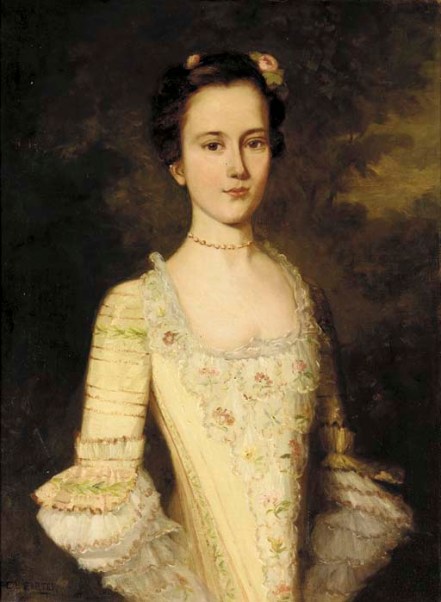
I recently found another Salem painting in the Christie’s Auctions archive that captured my attention and fancy: “Portrait possibly of a Girl of the Derby Family” by C.L. Carter, early nineteenth century (she actually looks more eighteenth-century to me). She’s a lovely girl, but I think she entranced me not only because of her Salem connection, but because she reminds me of another “merchant princess” from long ago and far away: Bia Medici, the illegitimate daughter of Cosimo I de’ Medici, as envisioned by Bronzino.  I say “envisioned” because while the portrait of the Salem girl captured the fullness of life (I think), the Bronzino portrait is a memorial image of the recently deceased girl. In life and death and in these paintings, both girls represent the privileged positions their respective families held in two mercantile oligarchies, centuries and an ocean apart.

Merchant Princess CL Carter Christies

Merchant Princesses  Bronzino

C.L. Carter, Portrait Possibly of a Girl of the Derby Family, Christie‘s; Angelo Bronzino, Untitled, known as Portrait of Bia Medici, Daughter of Cosimo I or Portrait of Bia, illegitimate daughter of Cosimo I de’ Medici, Uffizi Gallery, Florence.

Bronzino’s Medici princess has become iconic I think; I use her in my Renaissance classes to illustrate contemporary themes of family, death and remembrance, and Medici power and the students are always very taken with her, perhaps because of the angelic quality Bronzino (working from a death mask) gave her. Joseph Cornell was apparently taken with her as well, as she is the featured image of his 1948 collage sculpture that was part of the Navigating the Imagination exhibition originating at the Smithsonian American Art Museum and shown here in Salem at the Peabody Essex Museum. Another artist who seems to have been inspired by the portraits of these and other merchant princesses is the Australian photographer Bill Gekas, who has posed his very alive 5-year-old daughter in a series of  “reimagined” scenes, with adorable, and engaging, results.

Merchant Princess Cornell

Merchant's Daughter

Joseph Cornell, Untitled (Medici Princess), c. 1948, Private Collection; Bill Gekas, The Merchant’s Daughter, © Bill Gekas.


Storybook Structures 3.0

My preference for classical American architecture does not stop me from seeking out more whimsical structures: the “storybook” style of the interwar years is a particular obsession, though there are not many examples in our region. One of my very favorite Salem houses, which I wrote about here and check in on often, is classic storybook, as is Santarella in western Massachusetts. Most of the houses below would probably be classified more as Arts and Crafts or “eclectic” houses by architectural historians, but it’s all in the details for me: a few fanciful touches makes the grade. The first house, which is situated on a street that runs parallel to ours here in Salem, has long fascinated me. It was built on a swath of land that was devastated by the great Salem fire of 1914, I think shortly afterwards, both because it was the city’s policy to rebuild as soon as possible, and the appearance of similar (but not identical) structures in building periodicals from the World War One era.

Storybook 022

Storybook Low Cost Homes

Storybook 019

A Salem cottage, and its inspiration? Rendering from Richardson Little Wright’s Low Cost Suburban Homes; a Book of Suggestions for the Man with the Moderate Purse (1916).

This next house is right around the corner in the same Salem neighborhood, but it fortunately survived the fire. The main structure dates from the 1840s, but a very fanciful wing was added at some point after the turn of the century. The entire composition is really charming, as you can see:  even the fence.

Storybook 008

Storybook 011

Storybook 014

The towns that line the coast just south of Salem, heading towards Boston, have rich inventories of older houses, many with whimsical details. These next two houses definitely date from before the storybook era (if indeed there is one): they are essentially and eclectically Victorian. But how can I resist including Moorish and Norman “castles” in this company?

Storybook Structures 060

Storybook Structures 046

Storybook Victorians in Swampscott (top) and Lynn (bottom), Massachusetts.

Storybook intersects with all of the other architectural styles of the first decades of the twentieth century: Arts and Crafts, Cottage, Tudor Revival, among others. These last two houses, in Swampscott and Nahant respectively, illustrate this assimilation. The first house, with its spectacular slate-tiled roof, looks like an embellished bungalow, while the second is (unmistakably) an all-American Tudor. But  both have that fairy-tale feel, accentuated by their settings.

Storybook Structures 066

Storybook Structures 053

lowcostsuburbanh00wrig_0030

Swampscott and Nahant cottages, and a photograph from Wright’s Low Cost Suburban Homes (1916).


Fashion and Art, centuries apart

One big fashion and art exhibition closes this month while another opens: at the Metropolitan Museum of Art in New York, Impressionism, Fashion and Modernity closes on May 27 while across the Atlantic, In Fine Style: the Art of Tudor and Stuart Fashion just opened at the Queen’s Gallery at Buckingham Palace in London. I had hoped to see both exhibitions, but will probably end up of seeing neither; for some reason I thought the Met show was up all summer. Oh well, I have been perusing the catalog of the former and I’m already familiar with most of the paintings in the latter, and I have some general comparative observations, which would almost certainly either be reinforced or refuted if I saw the actual shows.

First observation: the early modern era was a much better time for MEN’s fashion. Tudor and Stuart men got to dress up in fabulous, colorful clothing for all sorts of occasions, and they had ARMOUR.  There is no comparison for the Belle Epoque. One of the galleries in the Met show is entitled “Frock Coats and Fashion: the Urban Male”, but these stockbrokers are clearly no match for the enigmatic sixteenth-century man in red or King Charles I.

Art and Fashion Degas

Art and Fashion Red  Art and Fashion Charles I

Edgar Degas, Portraits at the Stock Exchange, 1879, Musée d’OrsayParis; Portrait of a Man in Red, German/Netherlandish School, c. 1530-50, Royal Collection © Her Majesty Queen Elizabeth II; Daniel Mytens, Portrait of H.M. King Charles I, 1628, Royal Collection© Her Majesty Queen Elizabeth II.

Second observation: black-and-white is classic. No matter what the occasion, black-and-white attire is timeless and striking. The Met exhibition has a gallery of black dresses and white dresses, also completely classic, but what I notice looking at both eras is the eternal elegance of the two non-colors together. Below we have two very different scenes:  seventeenth-century mourners and a lady of leisure on a sunny late nineteenth-century afternoon, united by their attire.

664px-Anthony_van_Dyck_-_Thomas_Killigrew_and_( )_William,_Lord_Croft_-_WGA07416

Art and Fashion Black and White

Sir Anthony van Dyck,Thomas Killigrew and (?) William, Lord Croft, 1638; Royal Collection © Her Majesty Queen Elizabeth II; Albert Bartholomé, In the Conservatory (Madame Bartholomé),1881; “Summer Day Dress Worn by Mademe Bartholomé in the PaintingIn the Conservatory”,1880, which is described as cotton printed with PURPLE dots and stripes but it reads black to me–a good illustration of why I should have seen this exhibition in person!

Third observation: texture = luxury+artistry. This is where the art and the fashion really meet. In both exhibitions, the fabrics are absolutely luxurious, and the artists’ ability to depict their textures is absolutely amazing. Obviously the Met exhibition, which places garments adjacent to paintings (as in the example above) illustrates this artistry in a really compelling way, but the artists of the Tudor-Stuart era, who are depicting royalty and nobility, are also compelled to inject that luxurious texture into their subjects’ portraits, as illustration of their exalted status.

Art and Fashion Tissot

Art and Fashion Leyly

Glistening fabrics from both eras: James Tissot,Evening (The Ball),detail, 1878; Sir Peter Lely, Frances Teresa Stuart, Duchess of Richmond, c.1662, Royal Collection© Her Majesty Queen Elizabeth II.

Fourth observation: it’s all in the details. Both exhibitions feature “little” things that are incredibly important: trims, jewelry, undergarments, patterns. Whether the sixteenth-century ruff or the nineteenth-century corset, details are important to these societies–and these artists. You would think that the details would be more important in the early modern portraits than the nineteenth-century en plein air paintings, but that is not the case. The details are always important.

404437 crop

Art and Fashion

Details of Marcus Gheeradts the Younger’s (attributed) Anne of Denmark, 1614, Royal Collection © Her Majesty Queen Elizabeth II, and Ckaude Monet’s Camille, 1866, as banners for their respective exhibitions.


Paper Dresses

When I visit my brother in the Hudson River Valley I head for downtown Rhinebeck and one of my favorite shops, Paper Trail, as soon as it is politely possible: this is a destination shop. It’s not only the merchandise, it‘s the merchandising, and the paper creations that are in the windows and scattered about the store. Every time I go there there’s always a dress or two, shoes, and other works of art that make this shop a gallery. This time, there was a beautiful paper wedding dress (with butterfly back) in the window, fashioned by local paper couturier Linda Filley of upcycled materials. And much more inside:  Filley’s “windblown girl” dress made of recycled craft paper and shoes, paper chandeliers, flowers, birdhouses, map art, and even not-so-mundane cards.

Paper Dresses 002

Paper Dresses 003

Paper Dresses 016

Paper Dresses 008

Paper Dresses 006

Paper Dresses 009

Paper Dresses 013


Period Rooms

The “period rooms” installed in many museums are always the first place I go, but as I often find myself wandering about alone, I’m not surprised that there are efforts afoot to instill a bit more life into them. Our major museum here in Salem, the Peabody Essex Museum, doesn’t even have period rooms even though I believe that its predecessor, the Essex Institute, pioneered such installations with its George Francis Dow-designed rooms from a century ago. The PEM owns entire historic houses, however, so one can certainly understand the reluctance to consign precious exhibition space to static rooms. The Museum of Fine Arts in Boston retains its period rooms, and has just added a seventeenth-century English drawing room to their assemblage of suites.

I know of a several projects aimed at revitalizing period rooms from the past few years, but there must be many more. Just recently, the “All America House” exhibit at Woodlawn Plantation in Alexandria, Virginia opened, the result of a collaboration between the National Trust for Historic Preservation, Woodlawn’s owner, and MADE: In America, a nonprofit organization, in which teams of students from the University of North Carolina at Greensboro, George Washington University and the Corcoran College of Art + Design were charged with creating a home for a modern family in the historic rooms at Woodlawn, working with the Woodlawn staff and mingling antiques from the collection with new furniture designed and manufactured in the United States. The goal was the creation of rooms which “referenced the many layers of history embodied at Woodlawn over the last 210 years”. Below are before and after pictures from the National Trust’s blog, with the pristine period parlor above and the “All-American” parlor below.

Woodlawn

Period Rooms Woodlawn I NTHP

Period Rooms Woodlawn 2 David Wilson

Woodlawn Plantation and its front parlor, before (National Trust for Historic Preservation photograph) and after (David Wilson).

I love the All America parlor designed by the students (and how great that students were recruited for this project rather than Big Famous Designers): it’s a similar aesthetic to my own house (or at least a style I’m striving for) but clearly it represents a historic era–say the heyday of Woodlawn as a working plantation–less than it does our own time. Nevertheless, people love the contrast of past and present, and such approaches can encourage engagement–the goal of every history educator or interpreter.

Another interesting attempt to revitalize period rooms was the Brooklyn Museum’s Playing Houseactivation” from a year ago, in which modern artists working in various genres (Ann Agee, Anne Chu, Mary Lucier and Betty Woodman) were invited to place site-specific artworks in eight of the Museum’s 23 period rooms. Again, the goal was the merging and juxtaposition of past and present, creating new perspectives on both.

DIG_E_2012_Playing_House_Canes_Acres_Plantation_PS6

DIG_E_2012_Playing_House_Schenck_House_view1_edited_PS4

The Brooklyn Museum’s Cane Acres Plantation period room (late 18th century) with abstract pottery “placemats” and sculptures by Betty Woodman and textile “flowers” and cloths by Anne Chu; video installation by Mary Lucier in the dining room of the seventeenth-century Jan Martense Schenk house.

I wish I had gone to the exhibition in person because the pictures seem to present the period rooms as mere backdrop for the modern art and I’m sure the real experience was much more interactive. One last attempt to inject life into a dusty period room was the recent Supper with Shakespeare collaboration between the Minneapolis Institute of  Arts and British food historian Ivan Day. Mr. Day created a desert display for the Institute’s c. 1600 Tudor Room which featured a sugar castle centerpiece and tarts made from period recipes, placed on a table set with period cutlery and serving ware from the Institute’s collection, so people could see how these still things–table, chairs, plates, knives–were used in their own time.

MIA Tudor Event

Supper with Shakespeare display at the Minneapolis Institute of Arts; photograph by Ariana Lindquist for the New York Times.