Category Archives: Design

Fenced In

While taking a twilight stroll around Salem the other day/night, it seemed to me as if the street-fronting fences were straining to contain the abundant shrubs, flowers and vines within. September is such an abundant time–even in the city. Salem has some great fences, although it once had many more: when I look through pictures from a century ago I am always struck first by the elaborate fences that lined its streets. Most of the wrought iron ones have survived, many of the wooden ones have not. I think commercialization is the main enemy of the elaborate wooden fence–and a great case in point is the “Dr. Phippen House” on the Common (misidentified by the Historic American Building Survey at the Library of Congress as located on Chestnut Street):  pictured below in 1938 and the other day. It is now a funeral home with no fence in front, and a chain-link fence along its side yard.

Fence Phippen House Salem

Fence Phippen House Salem MA

Fences 021

Most definitely a loss, as this house occupies a prominent position on the Common. But there are similar fences throughout Salem that survive, primarily, but not exclusively, in the McIntire Historic District.  Iron fences are sturdier survivals, and can be found all over downtown Salem, in varying states of repair. For those who read my post last year about the sad state of the Salem Common fence, I have great news:  it is being repaired and restored. We all benefit when a city, or any property owner, puts their best fence forward.

Fences 015

Fences 018

More examples of front fences from my (increasingly-dark) walk around town, ending up at the Ropes Mansion garden, which is really stunning at this time of year–definitely worth a trip from near or far.

Fences 008

Fences 030

Fences 033

Fences 035

Fences 037

Fences 010

Fences 048

Fences 047


In Praise of Massachusetts Chairs

Aficionados of antiques, decorative arts, and furniture, or simply admirers of artistry and design, can find plenty to see and learn at all of the events and exhibitions associated with Four Centuries of Massachusetts Furniture , a collaboration of eleven institutions designed to put the spotlight on Bay State craftsmanship. You may not have been aware that this past Tuesday, September 17th, was declared Massachusetts Furniture Day by our own Governor Deval Patrick!  The announcement was made at the State House with the chair of John Endecott, the first governor of the Massachusetts Bay Colony, sitting prominently in the background–I assume this is a Salem chair as that is where Endecott landed and lived (it certainly couldn’t be the English chair which accompanied his successor John Winthrop on the Arbella  which is the subject and device of Hawthorne’s story “Grandfather’s Chair”).

Chair of Endecott at MSH

©Andrea Shea/WBUR

It’s really all about chairs for me, as even a casual reader of this blog would know. Just in my head, without going to Four Centuries’ great website or any of its events, I can immediately think of a chronological succession of great Massachusetts-made chairs–up to about 1830 or so:  after that, I’m lost. The nice thing about this initiative is its incredible time span, which must accommodate colonial craftsmen and Federal superstars like Samuel McIntire of Salem as well as industrial manufacturers in central and western Massachusetts, After all, Worcester held the title of “chair capital of the country” a century ago and Gardner is still proudly “the chair city”.

Biggest_Chair,_Gardner,_MA

Gardner’s Big Chair, c. 1910

So here we go:  my own Four Centuries of Massachusetts Furniture, taken from a variety of sources and certainly informed by the collections showcased on the Four Centuries’ sitea particular discovery for me is Boston furniture-maker Samuel Gragg–amazing!  Obviously there’s a bias here in favor of the early nineteenth century, but it was hard to choose favorites in general:  Massachusetts really produced a lot of great chairs (more than all of the other original 12 colonies put together apparently) and continues to do so.

Chair 17th c MFA

Chair Chippendale Boston MFA

Chair Lolling Skinner

PicMonkey Collage

Salem Fancy Chair

Chairs 1825

Chair regency winterthur

Richardson Chair

Apartment Therapy

Chair Plycraft

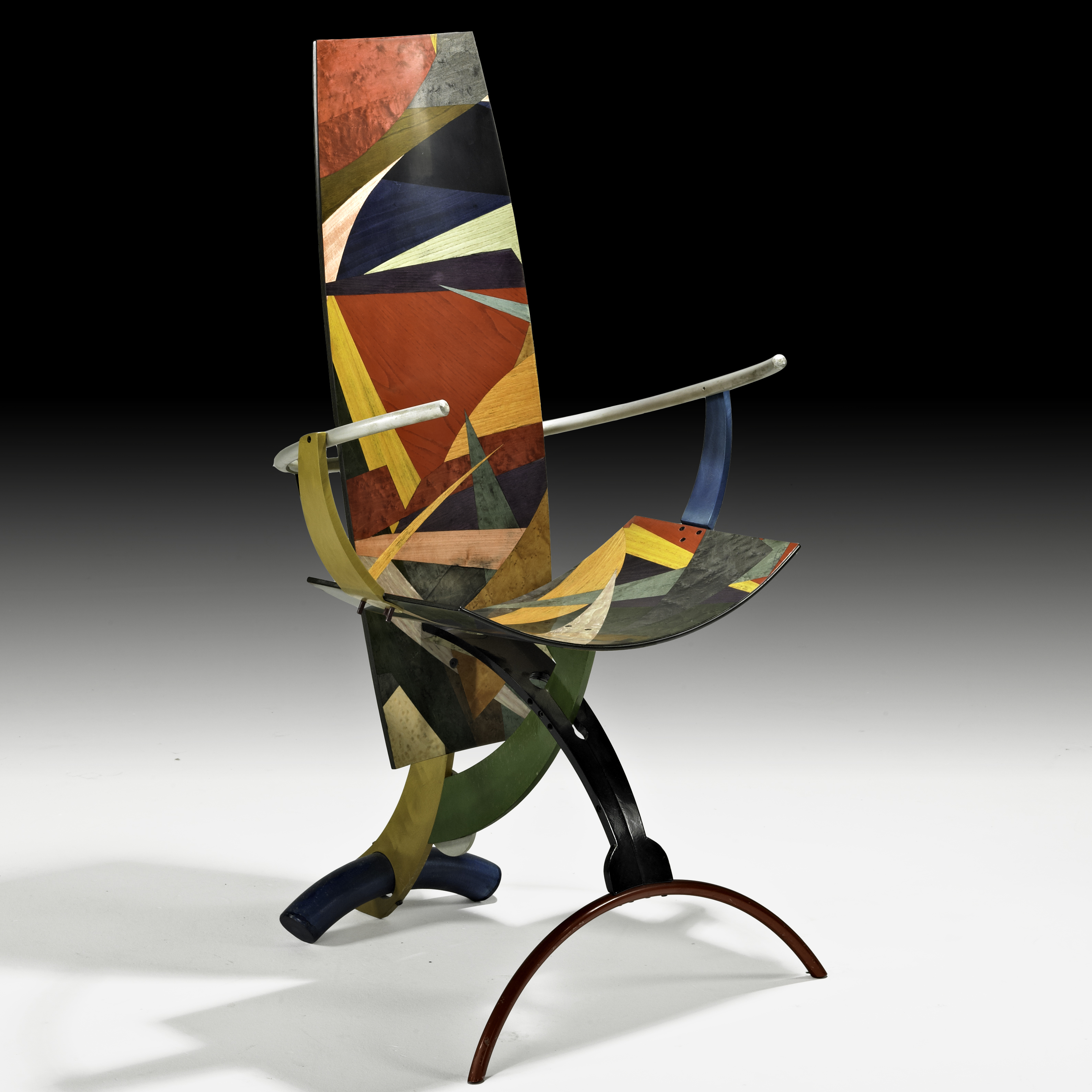
Char by Jay Stanger 1994 Fuller Craft

Made in Massachusetts:  Leather “Great Chair“, 1665-80, Boston (a near-contemporary of the Endecott chair), and Chippendale side chair, about 1770, Boston, both Museum of Fine Arts, Boston; Federal “Lolling” Chair made by Joseph Short of Newburyport, c. 1795; Federal armchairs made by Samuel McIntire for the Peirce-Nichols House in Salem, 1801, Metropolitan Museum of Art, New York, and in situ; “Fancy” side chair, probably Salem, c. 1800-1820, American Folk Art Museum, New York; Pair of decorated fancy chairs, attributed to Samuel Gragg, Boston, c. 1825, Skinner Auctions; Boston “Grecian” side chair, c. 1815-25, Winterthur Museum, Gallery & Library; Armchair designed by H.H. Richardson for the Woburn Public Library, Boston, 1878, Museum of Fine Arts, Boston; Shaker chairs at the Hancock Shaker Village near Pittsfield, Massachusetts, courtesy of Apartment Therapy; Armchair by Norman Lerner for Plycraft, Lawrence, Massachusetts, c. 1955, Skinner Auctions; “Arched and Animated” chair by Jay Stanger, Fuller Craft Museum, Brockton, Massachusetts.

Mass Furniture Haverhill Chairs

Another great line-up:  chairs in the snow, c. 1910, Haverhill, Massachusetts. Smithsonian Institution.


Fox and Geese

The pictures from my last post on the Coolidge Reservation do not convey one of its major features:  what remains of  the many geese that obviously enjoy the Ocean Lawn as much as other visitors. I remarked upon this to the ranger who was stationed there, and he laughed and told us that they brought in a fox to keep the geese away, but after a while he gave up and left……the geese won. The parable of the fox and the geese and their adversarial relationship is an old one, even older than the fox in the hen-house I think, and it has inspired centuries of illustrations, decorative objects, and games, all featuring the hunter and the hunted or the geese somehow outfoxing the fox; in either case, the two parties are inevitably intertwined, in one way or another.

Fox and Geese Harley BL

Fox and geese

British Library MS Harley 4751, English Bestiary, 1230-40; Fox and Geese in the Tudor Pattern Book, Bodleian Library MS Ashmole 1504, 1520-30.

It looks like the fox is winning in these two pre-modern images, and he definitely has the upper hand in most representations of the relationship, at least until the creation of a succession of satirical views from the later eighteenth century onwards.

Fox Goose and Gander

Fox and Geese BM

Johann Heinrich Tischbein, A Goose and a Gander Honking in Alarm as Foxes Approach, mid-18th century, Metropolitan Museum of Art; The Goose Lost (a caricature of British politician Charles James Fox), published by J. Barrow, 1784, British Museum.

Porcelain and pottery with fox-and-goose motifs were also produced around this time, including rather elaborate pieces for extensive table services and the popular ABC and proverbial plates for children. Talk about intertwined: look at the gravy (sauce) boat below!

AMICO_CLARK_1039413730

Fox and Goose Gravy Boat

Fox Plate V and A

Fox and Goose plate Cooper Hewitt

Fox and Goose plate detail

Meissen Porcelain Cup and Saucer, c. 1760, Sterling and Francine Clark Institute; AMAZING Staffordshire Fox and Goose Sauce Boat, c. 1780-1790, and Transferware Plate, 1790, Victoria & Albert Museum, London; Creamware Fox and Goose ABC Plate by Elsmore & Son, England, late nineteenth century.

Children’s books published in the nineteenth and twentieth centuries, whether fables, nursery rhymes, or bedtime stories, feature a variety of illustrations of foxes and geese, generally on friendlier, or at least less predatory, terms. And then there were the fox-and-goose games of strategic pursuit, played on a board, in the parlor or even outside, which date back to the seventeenth century at the very least. Textile designs in the past and present  feature fox and geese continuously, in abstracted patterns for quilting and knitting, and more literal prints for fabrics and wallpapers.

Fox and Geese Game 1883

FoxGeesePieces

Fox Fabric

Fox and Geese board game, Gloucester, Massachusetts, 1993, Smithsonian Institution, and pieces from a modern version of the game; Westfalenstoffe fox and geese fabric.

My favorite images of these two natural enemies are a bit more basic and elemental, in line with the medieval and Tudor images above. The realistic, rather than romantic relationship was captured completely by John James Audubon in the nineteenth century and The National Geographic more recently: these are elemental and eternal images.

audubon

04-feisty-fox-drives-snow-goose-670

John James Audubon, Fox and Goose, c. 1835, Butler Art; An arctic fox and a snow goose face off in Sergy Gorshkov’s photograph for National Geographic,


Edith & Jane, and Penguins

I have never been a good sleeper, but over this past summer I developed a very regular sleeping pattern:  I wake up exactly at 4:00 every morning. If only I was a farmer–or worked for the Today show! After a few weeks of tossing and turning, I now get up and do something–generally read or write–so not to wake my soundly-sleeping husband. I’ve been reading Edith Wharton all summer, so her characters are often the last thing I’m thinking about when I fall asleep. When I wake up at 4:00 (and believe me, it is always precisely at 4), I generally go upstairs to my study, which is lined with academic books that seem far too intimidating for that early in the morning–and Jane Austen. So I pick up Jane, and read for a couple of hours. And then I fall asleep for a half-hour or so, and wake up with “memories” of odd Wharton-Austen mash-ups:  Lily Bart from The House of Mirth is navigating Regency society rather than that of New York; Anne Elliot from Persuasion is sitting quietly in a Gilded Era drawing room rather than back in Bath. I’m all confused when I wake up.

PicMonkey Collage

Jane Austen (1775-1817) and Edith Jones Wharton (1862-1937).

Now I’m sure that I’m not the first person to draw comparisons between these two iconic authors, who captured their relatively rarefied worlds a century apart. They both write about women, women who face social, economic, and cultural constraints. Jane’s women face different constraints than Edith’s, but the latter’s more modern characters seem to be living in a darker world, without much help, from either their creator or their fellow characters. I think that’s why I’m engaging in these subconscious mash-ups:  I want to rescue Edith’s young women by transporting them back to Austenland, where Jane will take care of them. Lily Bart and Summer‘s Charity Royall are certainly not as nice, and consequently deserving, as Elizabeth Bennet and Elinor Dashwood, but they have no family, no hope, and no future in Wharton’s script. Jane would do better by them, I think. I have no idea why I would transpose Austen characters to turn-of-the-century New York:  they would not do well there.

Apart from this brief foray into lit crit and armchair psychology, this post provides yet another opportunity to showcase my absolutely favorite books, as nearly all of my Austen volumes are Penguin Clothbound Classics with covers designed by Coralie BickfordSmith. And now I find that there are companion Wharton volumes in Penguin’s relaunched English Library line of more affordable paperbacks, also with Bickford-Smith covers. I just love the whole idea of book design in this digital age.

PicMonkey Collage

PicMonkey Collage

PicMonkey Collage

Some Penguin Wharton Covers, and the Penguin 150th anniversary volume, Three Novels of New York, with cover design by Richard Gray.

Edith House of Mirth Penguin English Library

Edith Wharton Ethan Frome Penguin

Edith and Jane


Orphans and Multiples

A photographic essay in the Huffington Post from a few days ago entitled “10 Orphan Row Houses So Lonely You’ll Want To Take Them Home With You” did indeed make me sad. A sampling of photographer Ben Marcin’s work, the photographs feature single surviving rowhouses (I prefer the one-word spelling) in Baltimore, Philadelphia, and Camden, New Jersey, the heartland of mid-Atlantic urban architecture. I love rowhouses: I actually live in one, although it’s just a double, and I went to college in Baltimore and briefly lived in Washington, D.C., another great rowhouse city. You just know that these still-strident orphans were once part of a strong streetscape, and want to know the story behind their abandonment–and survival.

rowhouse  Ben Marcin Baltimore

Rowhouse Ben Marcin Baltimoreblue

Rowhouses Ben Marcin Philadelphia

Rowhouses in Baltimore and Philadelphia by photographer Ben Marcin, C. Grimaldis Gallery, Baltimore.

I got happier when I started reading about some rowhouse renovations, and took a leisurely late-afternoon walk to see some of Salem’s rowhouses. We don’t really have rowhouse blocks like larger cities, but we do have several rows of triple and quadruple semi-detached houses just in my neighborhood,  and a few more around  town. Before the great fire of 1914, there was a “Tontine Block” of four houses in Salem built in 1805, no doubt inspired by Charles Bulfinch’s Tontine Crescent in Boston, one of the first American residential urban planning projects. The Boston Tontine was built in 1794-95 and unfortunately demolished in 1858, the victim of encroaching commercial construction.

Rowhouses Tontine Crescent

Rowhouses 1850s franklin tontine crescent bpl

Bulfinch’s Tontine Plan, 1794, and the Tontine Crescent shortly before its demolition in 1858, Library of Congress and Boston Public Library.

Here in Salem, the triple house on Chestnut Street, fortunately very much still standing, and the lost 1805 Tontine block on nearby Warren Street testified to Bulfinch’s influence; the latter was rebuilt after the fire with some charming Craftsman details, inside and out. The other Salem rowhouses are clearly not Federal in inspiration: dating from the second half of the nineteenth century, they are wooden structures built in a more vernacular Victorian style. Each and every one is enhanced by the presence of its neighbors.

Rowhouse Salem Chestnut

Rowhouses Salem 2

Rowhouses Salem 3

Rowhouses Salem 4

Salem rowhouses on Chestnut, Warren, North Pine, and Broad Streets.


Doors of Winter Street

One of the things that I like best about Salem is that I notice, or see, something new (really old) every day. It doesn’t matter how many times I have walked along a certain route, I’ll always spot something that I haven’t taken notice of before. I don’t have the same eye for the natural landscape, only the man-made one. Details emerge and stop me in my tracks. Yesterday’s late-afternoon run around Salem Common somehow turned into a more leisurely walk up Winter Street, a wide boulevard that has served as one of Salem’s major northerly access routes almost from its foundation: consequently it is lined with really lovely eighteenth- and nineteenth-century houses. I was looking for late-summer gardens, but as this is a main entrance corridor, most of the gardens are tucked away out back–and suddenly all I could see was doors, really beautiful doors, each one unique. Now I actually lived on Winter Street for a brief stretch of time between houses, but I never really noticed these doors before, and suddenly they had all my attention. So here’s a sampling, beginning (after a little orientation) with the stunning entrance of one my favorite houses on the street, a brick Greek Revival.

Winter Street Map Perley 1905

Winter Street 024

Winter Street 025

Winter Street 032

Winter Street 026

Winter Street 028

Winter Street 031

Winter Street 034

Winter Street Postcard

Detail of Sidney Perley’s 1905 map of Salem, Boston Public Library, and doors of Winter Street houses; the louvred door and front of one of my favorite Winter Street houses, built in 1827 and pictured on the right of the circa 1910 postcard of Winter Street.


The Eyes have It

Thumbing through the New York Times Style Magazine yesterday, two features caught my eye: one on the beautiful botanical compositions of the French artist Carmen Almon, and another on eye motifs in current clothing and accessories collections. Everything comes around again in fashion, and there is certainly nothing new about the decorative use of the anatomical eye. I was immediately reminded of one of the most spectacular portraits of Elizabeth I, the “rainbow” portrait by Isaac Oliver, in which all-seeing and all-hearing eyes and ears adorn the seemingly-eternal Queen’s gilded gown.

Elizabeth_I_Rainbow_Portrait

Eyeful Elizabeth

Isaac Oliver, The “Rainbow Portrait” of Queen Elizabeth I, c. 1600, Hatfield House.

I was also reminded of the Georgian and Regency custom of wearing somewhat secretive “lover’s eyes”, miniature paintings of one of your beloved’s eyes, on a chain or as a brooch or ring, supposedly initiated in England by the Prince of Wales (later King George IV) as an expression of his devotion to his unmarriageable mistress, Maria Fitzherbert. Eye miniatures seem to have had an earlier, French, political purpose, and then of course the “all-seeing” eye of providence became an important Masonic symbol that somehow found its way onto our own dollar bill, but the hundreds of decorative objects that have survived seem to be predominately love tokens. Two early nineteenth-century brooches from the Victoria & Albert museum are below, and you can see many more examples here and here.

Eye brooch 1800 V and A

eye miniature V and A

Two early nineteenth-century unsigned watercolor eye miniatures, Victorian & Albert Museum, London (Note the diamond tear in the lower one!)

The Times “This and That” item, Eyes Everywhere, features eye-embellished flats and a gorgeous organza dress from Christian Dior, as well as the amazing “blue-eyed” ring by Colette and a Kenzo sweatshirt, both below. To complete the ensemble, I scouted out an optical skirt and another blue-eyed accessory–this time a clutch. It would take a daring woman indeed to wear all these items together, transforming herself into a veritable eyeful.

Eye Ring Colette at Fragments

Eye top Kenzo

Eye Skirt by Illustrated People

luluguinnesssapphire-eye-clutch-620-luluguinness

Skirt by Illustrated People; Lulu Guiness clutch.


Asylums Abandoned and Adapted

What is it about abandoned mental hospitals? There is a lure there; not quite sure why. For many years, the abandoned state mental hospital in nearby Danvers, formally and progressively known as the Danvers Lunatic Hospital, the Danvers State Insane Asylum and the Danvers State Mental Hospital (you can trace the evolution of the vocabulary of mental illness by charting the changing names of such institutions, so many of which were built in the later nineteenth century), drew many night-time visitors to its darkened doors after its closure in 1992. Constructed between 1874 and 1878 in the “Domestic” Gothic style and according to the Kirkbride Plan which dominated asylum architecture at the time, you can see why it cut a rather menacing silhouette when lifeless. Even before it was abandoned, Danvers was inspirational (it is said to be the model for H.P. Lovecraft’s Arkham Sanitarium in “The Thing on the Doorstep” and several other stories) but somehow became even more so in its abandonment: inspiring preservationists, photographers, and movie producers.

Abandoned Asylum Danvers Trask

Abandoned Asylum Danvers 1930s

Abandoned Asylum Danvers 1895

Danvers in its heyday:  photographs from Danvers Town Archivist Richard Trask History of Danvers State Hospital at the Danvers Archival Center and from the Eighteenth Annual Report of the Trustees of the Danvers Lunatic Hospital, 1895.

Below are pictures of the hospital dating from 2000-2001, when preservationists were engaged in an intense battle to save the building, or at least its central administrative section, for adaptive re-use. They were successful in placing Danvers on Preservation Massachusetts’ Most Endangered List that year, but not in saving the structure: both its wings and its central section were demolished by the Avalon Bay Communities, Inc., an apartment development and management company, following its acquisition in 2005. What “remains” was really reconstructed rather than renovated, so my alliterative title is a misnomer, at least as it applies to Danvers State.

Abandoned Danvers2 SSU

Abandoned Danvers SSU

Abandoned Danvers 3 SSU

The Shuttered Hospital:  Preservation Massachusetts Flikr. (The steeple was removed in 1970, apparently for safety’s sake).

The shuttered era of Danvers State has inspired some hauntingly beautiful images, most notably by photographers Roger Farrington and John Gray. Farrington is the historian-photographer, capturing the institution’s interior at the moment of its closing in 1992, while Gray comes along a bit later and expands the geographical context of Danvers and its decline in an extremely compelling way in his beautiful book Abandoned Asylums of New England: A Photographic Journey. I particularly like his image (below) of Worcester State Hospital, another Kirkbride building built and closed at the same time as Danvers, which met much the same fate. Looking through Gray’s book, my question is no longer what is it about abandoned mental hospitals but why do we build monumental buildings that we can’t, or won’t, maintain? Maybe we no longer do.

Roger-Farrington-15

Abandoned Asylums Danvers Rooftops Gray

Worcester State John Gray

Photographs by Roger Carrington (interior) and John Gray (Danvers turrets at sunset and Worcester State in the dark).

The consensus among preservationists is that Danvers didn’t have to be demolished/reconstructed: there were other options and there are other models of adaptive reuse among the remaining (sadly small number) of Kirkbride buildings. There is a great blog/website which provides a one-stop resource of information and images for these institutions and their fates. The list of demolitions is much longer than the list of saves, and most of these complexes seem to be crumbling, but there are a few rays of hope:  the Traverse City Mental Hospital in northern Michigan (alternatively known as the Northern Michigan Asylum), now redeveloped and reconsecrated as the residential Village at  Grand Traverse Commons, seems to be  the best example of preservation and conversion. Things look good for the Fergus Falls State Mental Hospital in Minnesota as well but, like Danvers, it’s been abandoned for years.

Traverse

Traverse1-popup

Fergus Falls Hospital 1928

Traverse City in 1990 and The Village at Grand Traverse Commons today, photograph by Gary Howe for the New York Times; Fergus Falls Hospital in 1928, Minnesota Historical Society.

I could go on and on about each and every one of these abandoned buildings, both those that remain (Athens, Ohio, Buffalo!!!) and those that have been lost, but I’m going to go back to Danvers, which has provided a dramatic backdrop and inspiration in both its open and shuttered eras. Two films have been filmed there, the Jean Simmons  film Home before Dark (which I saw long, long ago and have no memory of the Hospital; I’m going to look at it again) and the 2001 horror film Session 9, which I have not seen and have no desire to see.

Session 9 2

session 9 danvers

Poster and Screen shot from Session 9 (2001).

Perhaps the most creative expression inspired by Danvers State Hospital has simultaneously preserved a piece of it. A year ago, I came across an article about Danvers resident John Archer’s “Scrap Mansion” in the New York Times. As a board member of the Danvers Preservation Commission, Archer was a key part of the fight to save Danvers State, but when it came down, he salvaged a turret and installed it in his ever-expanding house.  So pieces of Danvers State Hospital remain intact, both in the reconstructed facade on its original site and a house nearby.

Archer1 Archer3

Danvers State/Avalon

???????????????????????????????

John Archer before his Danvers Wing, and salvaged doors from Danvers State, Trent Bell for the New York Times; Danvers State administrative building/Avalon Danvers, last weekend.


Rockefeller’s Teeth

I’ve returned from our camping trip to Mount Desert Island off Maine, home to America’s oldest, and most eastern, federal park:  Acadia National Park. Mount Desert is more than the park: its dramatic landscape, characterized by the close encounter of sloping coastal mountains and sea, also includes several pretty towns and villages (Bar Harbor, Northeast Harbor, Southwest Harbor, Somesville, Tremont) but this was a camping trip dictated by nature. Nevertheless, Acadia, like all national parks, is a product of both private and public initiatives, and few people in the former sector contributed more than John D. Rockefeller, Jr., son of the founder of Standard Oil, who donated more than 11,000 acres to the park and financed and oversaw the construction of one of its most notable features, the network of crushed-stone carriage roads topped by quaint cobblestone and granite bridges and lined with broken boulders, occasionally referred to as “Mr. Rockefeller’s teeth”. To me, these roads are the perfect blend of human achievement in harmony with nature–and they also afforded a welcome escape from camping.

Acadia 012

Acadia 027

Acadia 046

Mount Desert Island:  harbor, coastline, and the view from Mt. Cadillac.

Mr. Rockefeller designed, financed, and oversaw the construction of 57 miles of carriage roads between 1913 and 1940, using local labor, local materials, and the island’s landscape as his guideposts. The roads run through fir forests, around glacier lakes and mountains, and over streams and chasms, offering perfect vistas at every opportunity. To stand on one of his 16 bridges, several of which have built-in viewing spaces, is literally to be served up nature: they represent multidimensional access. No cars (which Mr. Rockefeller apparently detested): only feet, horses and bicycles. I remember walking down one of these roads a few decades ago when they were not in such superlative condition; now they are pristine.

Acadia 033

Acadia 037

Acadia 067

Acadia 074

Acadia 073

Acadia 078

Acadia 079

Acadia 080

Acadia 083

Acadia 090

Acadia 091

Acadia 093

Acadia 099

Mr. Rockefeller's Teeth

The Jordan Pond Gate Lodge, commissioned by Mr.Rockefeller and designed by Grosvenor Atterbury, and several bridges of Acadia; Mr. Rockefeller’s teeth along the road.

More tomorrow:  fog and sun.


Imperial Ermine

In the midst of a royal-birth-dominated media week I found myself in my graduate class, interpreting two iconic Renaissance portraits with ermines in them. And thus a post was provoked. How did this little weasel get associated with royalty, pretentious nobility, and the academic and clerical hierarchy? The answer lies in the (rare) white fur of this beast (more scientifically know as the stoat, or short-tailed weasel) as well as the emblems incorporated into what became a distinct ermine design: for no animal has the “ermine” black and white coat, it is a heraldic invention.

Ermine Leonardo

1585_elizabeth_ermine_portr

Leonardo da Vinci, Lady with an Ermine (Cecilia Gallerani, the mistress of Ludovico Sforza, the Duke of Milan), 1489-90, The Czartoryski Museum and Library, Krakow; Nicholas Hilliard, The Ermine Portrait of Queen Elizabeth, 1585, Hatfield House.

Leonardo has a real ermine in his portrait of a woman who is presumed to be Cecilia Gallerani, the mistress of his powerful patron Ludovico Sforza, the Duke of Milan–whose heraldic emblem was an ermine. But the little creature on Elizabeth’s arm, wearing a crown collar, is an artistic creation based on the ermine pattern, in which the distinctive black tips of the animal’s (several animals actually) tail is stitched onto the fur, sometimes cut into distinct heraldic shapes. I think you can see this most clearly in the portrait below, in which a sixteen-century German merchant’s wife is wearing very distinct ermine sleeves (and a lot of jewelry) with her family crest in the corner.

ermine Cologne portrait

Bathel Bruyn the Younger, Portrait of Woman of the Slosgin Family of Cologne, 1557, The Metropolitan Museum of Art, New York.

As eminent (and wealthy) as she might have been, this woman is not a Queen–or even the mistress of a Duke: it seems like anyone can wear ermine in the sixteenth century, at least outside of England. The black-and-white (or white-and-black) patterned “fur” had become a device of conspicuous consumption and social mobility, because of its long-held associations with majesty, wealth, and a Christ-like “purity bought with his own death”, in which it was said that the ermine would give himself up to the approaching hunter, so not to sully his pure white winter coat (not quite sure why this was royal). The sheer expense of  ermine is most likely the ultimate source of its desire and association with the wealthy and privileged: the stoat’s coat is pure white only in winter, and then there are all those little black tails. I do think ermine maintains its exclusive association with royalty longer in England than on the Continent, but I could be wrong.

Ermine Bedford Hours

Ermine George I

Ermine sign for Crown Inn 1750 V and A

Ermines

Ermine in various incarnations, through the ages: The Duke of Bedford prays before St. George in his ermine-lined robe, c 1423, the Bedford Hours, 1423  (Additional Ms. 18850 ), British Library, Mezzotint of King George I by John Smith, 1715, British Museum; Drawing for a sign for the Crown Inn, c. 1750, Victoria & Albert Museum, London; The Stout wearing his summer and winter coats, Prang & Co., 1878, New York Public Library Digital Gallery.  

Appendix:  as a stark contrast to Leonardo’s portrait, I could not resist adding this Ermine with a Lady portrait” by Ellen Paquette!

Ermine with a Lady