
Category Archives: Current Events

History is not a Spectator Sport

I was in several New Hampshire towns in the Monadnock region over the past weekend, and in each and every one of them there was a centrally-located History Center or Historical Society, open for business with timely exhibitions on view. These institutions were clearly both engaging and reflecting the collective curiosity of their respective communities, rather than just offering up a commodity or tablets (in whatever media form) of established facts that anyone can look up at any time. And once again I returned to Salem, a city that calls itself “Historic” but yet has no public history museum that is collecting, preserving, interpreting, and exhibiting its history and has experienced the removal of most of its archives by the Peabody Essex Museum, in an exasperated state. It’s not that there aren’t some great historical attractions and experiences in Salem: there are. But for the most part, Salem’s “history” is either siloed or for sale: there is no center, no apparent concern for the public record or the public memory, and an overwhelming emphasis on performance or presentation rather than participation.

WOrld War Jaffrey

World War Jaffrey 2

WOrld War HancockHistorical markers are everywhere in New Hampshire—and Salem’s Massachusetts Tercentenary markers are still among the missing; a Sunday afternoon exhibit/gathering at Hancock’s Historical Society.

I have two very specific cases in point to illustrate my assertions. We are in the midst of a national commemoration of World War I, inspired by the United States World War One Centennial Commission, of which all five living presidents serve as honorary co-chairs. All around me there are great local exhibitions on the Great War, from Hancock, New Hampshire in the north (see above) to Framingham and Lexington in the west, to Orleans on the Cape (where the only German attack on American soil occurred 100 years ago last week!) What’s happening here in Salem? Two very discreet digital exhibits, so discreet that I doubt very few people know about them. The Salem Public Library has several collections relating to individual Salem residents’ experiences during World War among their “Digital Heritage” items, including lovely silk postcards received by Anna Desjardins from soldiers stationed “somewhere in France”, and the Salem Veterans’ Services Department of the City of Salem actually has a “World War One Centennial Project” on the city website which I found while I was looking for something else entirely! Great resources here, including photographs of the two units in which Salem soldiers fought, individual biographies and obituaries, and newspaper clips, but where’s the engagement, and where’s the press? The introductory text references a collaboration with the Salem Public Library but I don’t see any links there, nor at the Salem Museum, Destination Salem, or anywhere else that keeps track of Salem events and initiatives, but I’m going to put it out there. This welcome but unheralded effort of 2018 contrasts dramatically with the reception the returning soldiers received a century ago when it seems like every parish and ward turned out for ceremonies and financed the monuments that still stand,  so “time will not dim the glory of their deeds”. I hate to disagree with a monument, but I do think the glory of past deeds is dimmed if awareness of such deeds is limited to a name on a plaque.

EPSON scanner image

World War 101stThe 101st Field Artillery in France, and just three of Salem’s World War I Memorials.

You can also find Salem’s City Seal on the city website, which is described as: a ship under full sail, approaching a coast designated by the costume of the person standing upon it and by the trees near him, as a portion of the East Indies; beneath the shield, this motto: “Divitis Indiae usque ad ultimum sinum,” signifying “To the farthest port of the rich east”; and above the shield, a dove, bearing an olive branch in her mouth. In the circumference encircling the shield, the words “Salem Condita A.D. 1626” “Civitatis Regimine Donata, A.D. 1836. Actually the costume very specifically identifies a native of Banda Aceh, the capital city of the Aceh province of Indonesia, on the northern tip of the island of Sumatra. Salem’s monopoly of the pepper trade with this region initiated and defined its golden age in the first decades of the nineteenth century, and when the seal was designed in 1836 this connection was not just acknowledged, but sealed. And in the spirit of historical and cultural engagement, the Acehnese dance company Suang Budaya Dance will be performing the traditional “Dance of  the Thousand Hands” at the (30th!) annual Salem Maritime Festival this coming weekend—on the very wharf where Salem ships once departed for their native land and returned to discharge “Salem Pepper”. The folks at the Salem Maritime National Historic Site know how to pay tribute to the past by engaging the present and the City of Salem should take a lesson: though perhaps war and trade are simply not hip, funky or witchy enough to attract the attention of City Hall.

Active Sport Salem City Seal


Wordy Fourths

In recent years, Salem has put on an amazing fireworks display for the Fourth, before that it was BIG blazing bonfires, and before that it was LONG orations–sometime competing long orations. These speeches were always given by “notable” men, sometimes from Salem, and always from Massachusetts. I went through a succession of these speeches–which used to run to an hour and more by all accounts–to try to pick out some themes beyond a general patriotism. In the first decade of the nineteenth century, it’s all about competing visions for the country by the Jeffersonian Republicans and the Federalists, a more unified message emerges with the onset of war with Britain in the next decade, and then gradually we move towards abolitionism and nativism: sometimes together. We get occasional glimpses of other aspects of celebration/commemoration in the first half of the nineteenth century (see 1808 below), but mostly what is recorded are WORDS.

Fourth of July 1804 collage

Fourth of July 1805

Fourth of July 1808

July 4 1810

_Fourth 1812 collagePrinted Independence Day Orations from Salem, and the arrangements for the Federalists’ holiday in 1808, with dinner at the “new” Assembly House: Hamilton Hall. I am wondering if the Benjamin Peirce of 1812 is the Benjamin Peirce of 1775–he would have been 74 years old.

Fourth of July 1826 I found it surprising that there was STILL animosity towards Britain more than a decade after the War of 1812 was over–this must be a reflection of the damage the war caused to Salem’s trade and position. The Reverend Henry Colman tried to smooth feathers in his 1826 oration: I am aware of the extreme and bitter diversity of opinion which prevailed among her best citizens in regard to the recent war. But at this distance of time we can view the subject calmly and weigh its merits with justice, candid minds, whatever may be their views of its expedience or management, will find it difficult to doubt that the motives in which it originated with were patriotic…..And unsuccessful as it may be deemed by any in the attainment of its avowed objects, the country came out of it, bringing new trophies of an illustrious heroism, and of a devotion to what many might reasonably deem the cause of liberty and right, worthy of those who hold alliance to the heroes of the revolution”.

Nearly twenty years later—-looking backward from my privileged perspective— it looks like we are gearing up for yet another war with Anson Burlingame’s 1854 Salem oration. Burlingame was a Massachusetts politician who was fiercely patriotic, abolitionist, and anti-Catholic all at the same time. A few years after he gave this Salem speech, he called South Carolina Congressman Preston Brooks “the vilest sort of coward” for his brutal assault on Senator Charles Sumner, after which Brooks challenged him to duel to which he himself failed to appear, thus proving Burlingame correct! His Fourth of July speech seems to be more passionately Nativist than Abolitionist, and it inspired an amazing satire, also published in 1854: Corporal Pitman’s Great Oration, Pronounced on Salem Common July 4, 1854, a speech that was never given.

Fourth 1854 collage

July 4 1854Anson Burlingame’s Salem speech, 1854, and his defense of Sumner and Massachusetts on the floor of the House of Representatives, 1856; a satire of the former by “Corporal Pitman”, which reads like it would be quite a performance.

I think the truly celebratory Fourth that we enjoy today is rooted in that of the Centennial–in which the whole city was festooned: speeches were certainly made, but the emphasis was more on actions: particularly a city-wide procession.

Fourth 1876 collage

Effusive Fourth1876 and this morning: when it was so hot we could barely stand to stay outside for the 7 (???) minutes or so it took to listen to the reading of the Declaration of Independence. I like how everyone is lining up in the shade, like soldiers.


Hawthorne Summer

Every single year I think about Nathaniel Hawthorne in the first week of July, as his birthday was on July 4, but this particular summer he—or his inspiration–is everywhere in Salem as this year marks the 350th anniversary of the house most closely associated with him: the House of the Seven Gables. In some ways, the Gables is as much of a creation as the story after which it was named, but it’s still a 350-year-old house overlooking the harbor, and therefore a standing symbol of Salem’s multifaceted past: in this year when so much of the city’s historic fabric has been removed by the Peabody Essex Museum I believe that its existence–and the role it plays in our city today–is more important than ever.

Gables PC Harvard

Gables Harvard 1910The newly-restored House of the Seven Gables, 1910, Harvard Fine Arts Library Postcard Collection
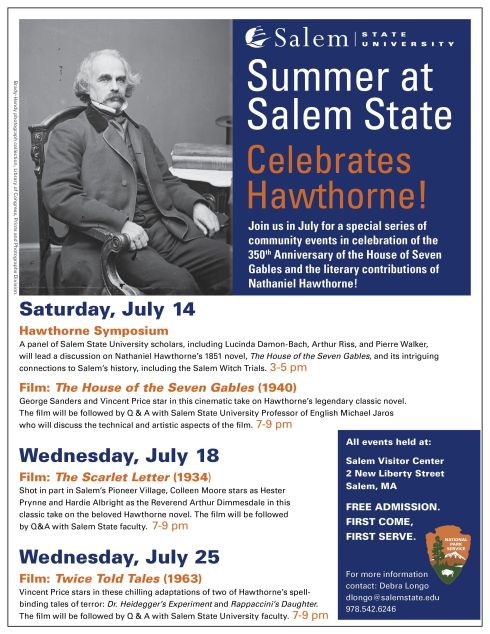
Not only does the House of the Seven Gables Settlement Association serve as a solicitous steward of this iconic house, it maintains a packed schedule of programming, continues to fulfill the social welfare mission of its founder, Caroline Emmerton, and partners with other regional institutions to interpret and present Salem’s history and culture. Even though its focus is limited necessarily, in many ways it is as close to a historical society as we have in this “historic” city. Both the organization and the House stand as authentic and educational antidotes to Salem’s more sensationalistic offerings. And again–given what has happened to Salem over this past year, it’s more important than ever that the city’s existing historical organizations work together to shore up—and celebrate–our heritage. So I’m particularly happy to see the first big Hawthorne event of the summer: an ambitious and aptly-titled public reading called “Enduring Hawthorne: A Marathon Reading of Nathaniel Hawthorne’s The Scarlet Letter”, a collaboration between the Gables, Salem Maritime National Historic Site, the Salem Athenaeum, and the Essex Heritage National Area on June 7 in front of the Custom House. The following weekend, Salem State University will screen the first film of a three-film series based on Hawthorne novels at Salem Maritime’s Regional Visitor Center, with a preceding symposium in which English faculty will discuss the historical context of The House of the Seven Gables. Then we will see the 1940 film, with The Scarlet Letter and Twice-Told Tales coming up on successive Wednesdays in July–with Q & A sessions after both. Scenes from The Scarlet Letter (1934) were apparently shot in then recently-constructed Pioneer Village, so I’m pretty excited to see that film in particular.

Summer at Salem State July 2018_Web Version

Scarlet Letter 3 Still from The Scarlet Letter, 1934. Pioneer Village?

With August comes Gables Fest: Celebrating 350 Years of Stories and Songs, a day-long event on the 4th which will take attendees on a musical “journey” through the history of the Gables (with food and drink) and a collaboration with another historic site celebrating a big anniversary this year: the Marblehead Museum’s Jeremiah Lee Mansion, built in 1768. Through “Architectural August” there will be architectural tours, visiting member events, and a comparative focus on these two structures built a century apart.

Interesting Houses collageFrom Burroughs & Company’s Interesting Houses of New England, 1915: with a photograph of the Gables before its restoration/recreation.

Remove not the ancient landmark, which thy fathers have set. (Proverbs 22:28)


Art+Science

The Salem Arts Festival was this past weekend in Salem: its tenth anniversary. Last year plastic-bag jellyfish were suspended above Derby Square and Front Street; this year it was all about bees. Salem’s art scene is very vibrant now, but this little city has always had a bustling community of artists (well, after the Puritans morphed into the Congregationalists) and craftsmen. I’ve written about quite a few individual artists, but I thought I would look for more collective precedents, and that quest took me directly to the fairs of the Salem Charitable Mechanic Association (1817-1932). The records for this association, like those of nearly every Salem institution and organization, are relatively inaccessible, as they are in the Peabody Essex Museum’s Phillips Library, which has been closed in Salem, removed to Rowley, and for which digitization plans are nonexistent at present. But fortunately the Association wanted to showcase the creations of all its exhibitors, and so compiled a wonderful program for its first fair in 1849 that has been digitized in several places. This was held in its very own Mechanic Hall, built a decade before.

Art + Science collage

Art + Science The_Salem_Charitable_Mechanic_Association

Art + Science Mechanic Hall SSUTwo copies of  Reports of the First Exhibition of the Salem Charitable Mechanic Association, 1849, a certificate from the exhibition (Boston Athenaeum), and Mechanic Hall at the corner of Essex and Crombie Streets in Salem, built in 1839 and destroyed by fire in 1905 (Dionne Collection, Salem State University Archives).

This program makes for very interesting reading for several reasons. First of all, the judges of each category are very detailed and opinionated about their criteria for awarding diplomas and silver medals–although it appears that everyone who showed up got the former. The sheer eclecticism of the entries is notable, as is the relatively small number of industrial entries–surprising as the exhibition was occuring in the midst of the Industrial Revolution in Massachusetts. The organizers address this deficiency in their introduction: it is to be regretted that there was not a greater display of the Manufactures of Old Essex, especially of Cotton and Woolen Goods. Andover and Newburyport, with their numerous and extensive Cotton and Woolen Manufacturing Establishments, did not exhibit a single article. Saugus with her Flannel and Yarn Factories—-none, and Danvers, with her Carpet and Tweed Factories, was also deficient. When we consider that Essex County produces more than the whole State of South Carolina—-that her products are more than twenty millions of dollars—and a fair share of it in the articles alluded to—the display was not what it should have been. But notwithstanding these adverse circumstances, the energy and the perseverance of the mechanics of Salem, essentially aided by the Ladies, produced one of the most beautiful exhibitions ever witness in this vicinity. I guess they just didn’t get the word out! And yes, “the Ladies” are very well-represented in this 1849 exhibition, which showcased every possible type of art: mechanical and utilitarian, “fine” and decorative.

PicMonkey Image

1849salemmechassoc_obvDiplomas and medals for “drab” clothing, an artificial leg, mineral teeth, a miniature steam engine and a Patent Cloth Folder used at the Naumkeag Steam Mills in Salem, among other exhibits; a rare medal from the 1849 exhibition, from John Kraljevich Americana.

Above all, the integration of art and science seems very apparent in this exhibition: perhaps it is highlighted by the paucity of industrial exhibits but there are still many categories that we would consign to an arts festival today rather than one celebrating “mechanics”. Besides “Fine Arts”, everything created with a needle was on display, along with everything for the house and the body. This exhibition was all about creation, pure and simple. I love this universality and lack of separation between the artistic and the scientific: it illustrates the continued influence of the culture of the Renaissance, the period in which I was trained, during which everything was an art. But the Charitable Mechanic Association had its categories too, some of which seem rather arbitrary: the sole Daguerreotype exhibitor, one of Salem’s three practitioners at the time, was D.S. Bowdoin, who won a silver medal in the Fine Arts category for “a very admirable collection of Specimens, showing great skill in the mechanical execution, good taste in the arrangement of subjects, and in the management of light and shade”.  To me, the daguerreotype seems a near-perfect combination of art and science.

Bowdoin collageI couldn’t find any D.S. Bowdoin daguerreotypes from 1849, but here are two cartes de visite from later: studio portraits portrait of Robert Daley (or Daily), a Salem “expressman”, c. 1855 (Historic New England) and John Lewis Russell, a well-known botanist and Unitarian minister (Wisconsin Historical Society). According to the later photograph, Bowdoin’s studio was in the Downing Block, Salem.

Back in the present and now that I think about it, this arts festival does indeed bridge the gap between art and science in its own way: what could be more technological than transforming commissioned plastic bees into building materials? I have never really understood the stem vs. steAm debate, and let’s throw an H for history in there somewhere!

bee collage 2

Arts Festival 1

Arts Festival 3

Arts Festival 2

Arts Festival 4

Arts Festival 8

Arts Festival 6

Arts Festival 7

Arts Festival 9Scenes from the Salem Arts Festival on Saturday: my neighbor Racket Shreve’s “Best in Show” painting in the gallery in Old Town Hall along with “Remembering Georgie” by Heather M. Morris; the Mural Slam—just loved this work-in-progress of “Salem from Above” by Casey Stanberry, especially in its partially finished state.


Ceremonial May

I woke up happy but exhausted this morning, having completed a marathon May week of graduate festivities: three dinners, our department retreat, and two commencement ceremonies (graduate and undergraduate) plus the usual end-of-the-semester chair business. I missed the Royal Wedding, but seem to be able to glean both the highlights and every little detail from the massive all-media coverage! It strikes me from both my academic and personal perspectives that May is a month for ceremonies: I was a May bride myself, despite that old superstitious saying (which Harry and Meghan also ignored): marry in the month of May, and you’ll surely rue the day. May makes sense for ceremonies, most of which require ceremonial garb: it’s warm enough to go coatless to show said garb off, but not too warm. That fresh spring green is everywhere, along with fragrant flowering, providing the perfect decorative setting for whatever you are celebrating or commemorating. Commencements and weddings are natural occasions for this time of year, but looking back through the seasonal year it seems that other celebrations were also planned for May: the big exposition openings of the nineteenth and early twentieth centuries, royal coronations when possible, and several other unique events. The traditional May Day festivities of the first day of this merry month set the stage for more to come.

lookandlearn.com-U316696

Ceremonial May Prince+Harry+Marries+Ms+Meghan+Markle+Windsor+rhsxJVnjT0El

Ceremonial May SSU 1966

Cermonial May SSU

Ceremonial May SSU 2The Royal Wedding, the Marriage Ceremony in St George’s Chapel, Windsor. Illustration for The Illustrated London News, 6 May 1882 (Queen Victoria’s youngest son, Prince Leopold, actually married Princess Helen of Waldeck-Pyrmont on 27 April 1882, but it was May news a week later); yesterday’s wedding in St. George’s Chapel, WP pool photo; Graduation at Salem State College in 1966 (Salem State University Archives and Special Collections) and Salem State University yesterday.

Ceremonial May Great Exhibition

Ceremonial May Philadephia Centennial

Ceremonial May Golden Spike

Ceremonial May Coronation 1937

Ceremonial May Charles II

Photograph collection ca. 1860s-1960s

 Opening of the Great Exhibition by Queen Victoria, 1 May 1851 by Henry Courtney Selous, Victoria & Albert Museum; opening of the Philadelphia Centennial Exhibition, 1876, Library of Congress; “Golden Spike” Ceremony marking the completion of the transcontinental railroad in the U.S., May 10, 1896, Library of Congress; “Coronation Number” of the Illustrated London News commemorating George VI’s coronation in May of 1937; King Charles II’s coronation was in April of the 1660, but the traditional holiday marking both his succession and the restoration of the monarchy, “Oak Apple Day”, was celebrated on his birthday, May 29; Decoration Day in late May, Cuba, 1899—commemorating the lost soldiers of the Spanish American War, Smithsonian Institution.


Rolling in Their Graves

I promise: this is the last Phillips Library post for quite some time. It’s been six months since the Peabody Essex Museum admitted, under duress and only because they needed approvals from the Salem Historical Commission, that the Library was moving to a former toy factory off Route One in Rowley, Massachusetts. Since then there has been a public forum, lots of meetings, a succession of newspaper articles in the Salem News and the Boston Globe, a stern letter to the PEM from the President of the American Historical Association, and countless posts by me appealing, edifying, and scolding the Museum’s leadership. All to no avail: the Library–constituting a great part of Salem’s documentary history–is now in Rowley, and from what I hear (from a friend who is desperately trying to finish her Ph.D. dissertation–they didn’t tell her the Phillips was going to close last September either), is set to open sometime in June. Even the Google address (sort of) has changed, so that must be that, right?

Phillips Location

The address of the Phillips has changed but everything else remains the same: photographs of the interior and exterior, and its description: in the Essex Institute Historic District of Salem. If past practices are any indication, this half-correct entry will be up for quite some time: when the Phillips was moved to a temporary location in 2011 for the restoration of the building you see above, the address was never changed. And so I must say that the two men who are referenced in this entry—one visually and the other by name—are likely rolling in their graves after all that has happened. The photograph on the left is of Dr. Henry Wheatland (1812-1893) in one of the Phillips’ smaller reading rooms, around 1885. Dr. Wheatland dedicated his life to the Essex Institute, helping to found it through a merger of the Essex County Natural History Society and the Essex Historical Society in 1848, and serving later as the Institute’s Secretary, Treasurer, and President. As the finding aid to his papers in the Phillips Library asserts, Dr. Wheatland “devoted much of his life to ensuring that the Institute became a ‘permanent centre of influence for the enlightenment and instruction of the community'” and even continued to serve as its President after he was struck with paralysis at age 80, until his death. Wheatland was born in Salem and he died in Salem, and his will, like the wills of many donors to the Essex Institute and its library, left bequests to a Salem institution. I know he was referencing his desire that the Essex Institute’s library should be reference only in his 1893 will, but still: no books [should/to] be taken from the building except in extraordinary circumstances.

Wheatland collage                                                                                  New York Times, 1893.

The prominent and prolific Boston architect, Gridley J.F. Bryant (1816-1899), is another grave-roller, as he was the architect of the Italianate Daland house which has served as part of the Phillips Library in Salem for over a century and would certainly not want to be associated with the suburban industrial building that now constitutes the Phillips Library in Rowley. His name should be removed at once.

Phillips Library Rowley

800px-Bigelow_Chapel_-_080167pv One of Bryant’s more notable commissions: the Bigelow Chapel at Mt. Auburn Cemetery. Library of Congress.

I can’t speak for all the people that put their trust in the predecessors of PEM, but fortunately it is a registered non-profit in Massachusetts and so its actions are subject to review by our Attorney General, Maura Healey. Several weeks ago a meticulous brief was delivered to her office formally requesting that the Public Charities Division review the actions of the PEM relative to the Phillips Library under Massachusetts General Laws, Chapter 12, Section 8H, regarding breaches of trust. The many “Friends of Salem’s Phillips Library” who have emerged over these past six months are sending letters in support of this brief and its request for review, and you can too if you like: Office of the Attorney General/Non-Profit Organizations/Public Charities Division/One Ashburton Place/ Boston, MA 02108.

Some other updates:

Contrary to what I reported here last week, the Working Group organized by Salem Mayor Kimberley Driscoll and PEM CEO Dan Monroe is still working: they will have more meetings. Their agenda still seems to be exclusively PEM-driven and they have a very odd understanding of what “collections” constitute, but they are still at work.

It looks like the votes are there for the Salem Historical Commission to approve the demolition of the 1966 “Stacks” building at the rear of Gridley Bryant’s Daland House. Everyone agrees that this space was insufficient to store the vast collections of the Phillips, and it is rather inelegant, as you can see below. When the library was moved in 2011 to a temporary location to accommodate the renovation and expansion of all of the Phillips buildings, it became apparent that this addition was essentially unworkable, given the integrated structure of its construction. The PEM leadership implied that they just learned this in 2017, and so were “forced” to abandon all of the Phillips buildings (and Salem) altogether, but we have learned of several mitigating plans from the intervening years, including those which specified the construction of a brand new “stacks” building. In any case, the present Phillips buildings are not ready to accept all the collections at this time, primarily due to the poor planning of PEM. Rowley can be yet another temporary facility for these materials, but we are continuing to work to bring them back to Salem.

Phillips Stacks The windowless “stacks” addition may soon be coming down. Salem News photograph.

And what about digitization? The fact that the PEM is at least a decade behind comparable institutions in the digitization of its holdings has become common knowledge: the institution itself has acknowledged its deficiency by including “digitization priorities” on the limited Working Group agenda. There is some progress: I noticed just the other day that several records of the Salem Witch Trials have been added to the limited digital collections of the Library. The bulk of Witch Trial records were digitized a decade ago by a team of scholars and have been available at a (much more contextual) site sponsored by the University of Virginia since that time, but there are hopes that the well-endowed PEM will someday provide a global scholarly community with more materials which will elucidate this often-told story, and so many more lesser-known ones.

I’m certainly moving on to other stories. After all, spring has finally arrived, the trillium are out, and there are places to go and more diverse and distant pasts to explore. If there are any new developments, I’ll post them here, but only if they are course-changing.

P.S. And thanks for your patience—especially those of you who are perhaps not quite so interested (obsessed) with this issue!


Rescinding the Rump

The official response to the Peabody Essex Museum’s reluctant admission to the removal of Salem’s historical archives to a storage facility in Rowley was the formation of a “Working Group” by Mayor Kimberley Driscoll and PEM CEO Dan Monroe. In partnership, Ms. Driscoll and Mr. Monroe chose the members of this group, identified as “stakeholders”, from among Salem’s local officials and heritage and tourism organizations. I was wary from the very announcement of this group, because I believe that all of Salem’s residents are “stakeholders”, impacted equally by a short-sighted and disrespectful policy which removed the material heritage of a great city. (I also really, really, really dislike that divisive and disingenuous term). Nevertheless, I knew that there were well-intentioned and thoughtful people in this Working Group, so I hoped for the best. Now it appears that the work of the Group is complete: as the agenda for its third (and presumably last) meeting this week includes the item “Final Statement”, I assume it’s a wrap.

So what has been accomplished?  You don’t have to rely on my assessment: it’s all in the public statement issued on behalf of the Working Group on April 10. As a result of these “discussions” (one meeting was a meet-and-greet, the other a tour of the Rowley facility), the PEM has agreed to open Plummer Hall and the Saltstonall Reading Room of the former Phillips Library to the public as a “research facility” stocked with bound editions of the long-running Essex Institute journals the Essex Institute Historical Collections and American Neptune plus terminals that can be used to access “digital information from the Phillips Library”, very few items of which have been digitized!  In fact, one of the few things that the PEM has seen fit to digitize is the American Neptune, and the Essex Institute Historical Collections is available right down Essex Street at the Salem Public Library, so this concession (which was actually announced before the formation of the Working Group) is a joke, an insult, and an outrage.

WG Statement

After I heard that the Working Group was concluding its work, just yesterday, the first image that flew in my head was that of Oliver Cromwell marching into Parliament on April 20, 1653 and dissolving the powerless remnant (Rump) that was all that remained of the Long Parliament for which he had waged a revolution, and afterwards overtaken, with the famously paraphrased speech: You have sat too long here for any good you have been doing … Depart, I say; and let us have done with you. In the name of God, go! (It was likely a far more colorful dismissal ). An ineffectual body, but yet the only semblance of “representative” government, disbanded just like that. I’m sure I’m the only person in the world who could make such a connection: it must be the April dates—and my preparations for my summer graduate course on early modern English history. Or it might be my desire to find refuge in the past when the present is so bleak.

Rump 1790 BM

Rump West

Rump 1885 Cassells

Rump Cromwell Great MenFour very different Cromwells dissolving the Rump Parliament on April 20, 1653: British Museum, 1790; Benjamin West, 1782, Montclair Museum of Art; and Cassell’s Illustrated History of England.

So the leadership of the Peabody Essex Museum remains resolute in their decades-long campaign to bury Salem’s history, successfully (so far) employing strategies of restricted access, the redeployment of resources, and a confusing (and likely very, very costly) renovation, aided very ably by the accommodations of our elected officials. There may be some external pressures from this point on, but I am so very sorry that those in positions of power and influence in historic Salem have chosen not to safeguard, much less fight for, its history.


PEM: Praise and Public History

Ever since that fateful night in early December 2017 when a representative of the Peabody Essex Museum disclosed that the vast majority of the collections in its Phillips Library, the major repository for Salem’s history, would be moved to a storage facility in Rowley, I’ve been both very critical of this decision and very focused on the institutional leadership which made it. This admission is no surprise to regular (likely suffering in silence) readers: much more so will be the praise that I’m actually going to heap on the PEM in this post! Just this past week the museum announced two new positions: a manager of historic structures and landscapes for its historic houses in Salem and a head librarian for the Phillips Library. From my perspective, both positions signal a renewed commitment to the Salem resources which the PEM inherited from its founding institutions, particularly the Essex Institute. I’ve never questioned the PEM’s stewardship of its assets: my major concern has been mothballing, so investment in these important areas is very welcome. The architectural position seems focused on preservation issues, but the new librarian will be charged with some big organizational and outreach responsibilities, including increasing the Library’s responsiveness to the needs of local, regional, national and international researchers, integrating it more fully into the Museum, and transforming the Phillips into an innovative and active intellectual hub supporting the overall mission and global scope of the PEM. All this and the long-awaited digitization plan! This is a very responsible position and the PEM should be commended for seeking to fill it.

Librarian collage

Librarian Library of Congress 1966Challenges & Opportunities:  The Head Librarian in Sam Walter Foss’s Song of the Library Staff (1906); “To the rescue. Many librarians believe computers are the only means to effectively cope with their bulging bookshelves” (1966). New York World-Telegram and Sun Newspaper Photograph Collection, Library of Congress. 

That said, I’m just not sure how the PEM is going to create the “innovative and active intellectual hub” it is referencing in this job description in a storage facility off Route One in Rowley, much less foster the community engagement that is referenced continually in all of its messaging. My continuing preoccupation with the relocation of the Phillips Library stems from outrage at the removal of Salem’s historical archives, but also confusion about how such a move aligns with the PEM’s own goals. I understand the PEM’s arguments about the logistics of conservation and digitization, but what about integration? How can the Library be integrated more fully with the Museum when the Library is in Rowley and the curators of the Museum—as well as the physical Museum itself—are in Salem? Perhaps the goal is a virtual/digital integration, but we all know that that’s a long way off for the PEM. Discussion of LAM (Libraries, Archives & Museums) integration has been evolving for over a decade, and the Head Librarian job description indicates awareness of this dialogue, but the PEM seems oddly out of touch with other cultural trends, namely the evolution (and rejuvenation in many cases) of libraries as places not only of collections but also myriad connections and the growth of a dynamic field and practice of public history which emphasizes a wider and more multi-faceted engagement with the past. The PEM is investing a lot of money in the restoration of the physical buildings which constitute the (former?) Phillips Library in Salem but what purposes—and who— will this space serve once it is finished?

AAR collagePast & Present: the Library of the American Academy in Rome in 1933 and today, “a perfect blend of the past with the contemporary demands of modern scholarship.”

I understand that the h-word is anathema in the upper realms of the PEM but why ignore the demands of its host community, the interests of hundreds of thousands of visitors to Salem each year, as well as the strengths of its collections and its stated goals of “community engagement” by abandoning history? The answer can only lie in a very simplistic (and musty) understanding of what historical interpretation in the public realm constitutes these days: Colonial Williamsburg blinders if you will. Many of the PEM/PM Third Thursday events (now defunct), had historical aspects, as exemplified in its (also now defunct?) Phillips Library blog, Conversant. “History” is not all about the War of 1812 or even the Salem Witch Trials (I swear): it’s also about fashion, food, play, cross-cultural encounters, and golden ages, all of which the Peabody Essex Museum clearly embraces. History is about home, and housing: just imagine a PEM-initiated public history project about housing in Salem past, present and future similar to the 2016 symposium organized by the Cambridge Historical Society entitled “Housing for All?”. I can’t imagine anything more relevant, more engaging, and more reflective of the Museum + Library’s integrated resources.

Before_the_Fire__Salem_Neighborhood_North_Side_of_Broad_Street

Redevelopment__Completed_Reconstruction_The_PointBefore & After the Great Salem Fire of 1914: Housing on the northern side of Broad Street before the Fire and Mill Hill after, Phillips Library Digital Collections.


Salem Film Fest 2018

It is that time of year again: time for the annual Salem Film Fest, now in its eleventh year and very firmly established on the cultural calendar. Over the years, it has been very inspiring to see the festival’s growth: in terms of participation, attendance, offerings and impact. The care taken with curation is always very apparent to me: resulting in a nice balance of films with themes that are global and local, environmental and material, very serious and a bit more whimsical. One of the first films I saw at the festival was Grown in Detroit, way back in 2011: this was an interesting window into the urban crisis playing itself out in Detroit at the time and this year’s Beauty and Ruin offers another by focusing on the collections of the Detroit Institute of Art, which some thought might provide a solution to the city’s bankruptcy in 2013. I’m really looking forward to this film: as most of you know, the sanctity (and proximity) of a community’s treasures are important to me, and this film will be playing in PEM’s lovely Morse Auditorium!

FilmFest

FilmFest2 Stills and scenes of Detroit past and present in Beauty and Ruin.

I have a friend who oversaw the recent Skinner auction of items from Avis and Eugene Robinson’s collection of African American history (and also this beautiful–but troubling—catalog), so I’m also interested in seeing Black Memorabilia, which examines “the subculture around the collectibles and antiques that serve as reminders of America’s troubled racial past and present”. And speaking of subcultures, I might go for Mermaids, in which a select group of individuals idolize, identify and occasionally “become” sirens of the sea. In keeping (somewhat) with the marine theme, the South Korean film Old Marine Boy about a daring North Korean deep-sea diver in the South, looks amazing. On a very different note, I’m kind of interested in seeing Rodents of Unusual Sizeabout the enormous orange-toothed swamp rats (nutria) which have infested the waters of Louisiana post-Katrina and oil spills, but I’m not quite sure I want to spend so much time with these odious creatures on the big screen.

Mermaids Film

Old Marine Boy

Rodents2Scenes from Mermaids, the Old Marine Boy, and the poster for Rodents of Unusual Size.


Remember the Armory

The opposition to the Peabody Essex Museum’s removal of Salem’s historical archives to an industrial park in Rowley incorporates a range of perspectives: some people have never been in the Phillips Library but nevertheless have been waiting for its return; others have very concrete memories of childhood forays or later visits to research some specific aspect of their Salem past: their house, their neighborhood, their family. Everyone had great expectations: as the Museum leadership closed the Library in 2011 with promises to return in two years, only to disclose the Rowley move six years later, under duress. Expectations are a powerful motivating force, but so too is distrust: and for those of longer Salem residence the latter is clearly apparent. For them, the PEM’s latest move (literally and figuratively) falls into an established pattern of behavior that has broken trust with the Salem community. And the event that looms largest in this pattern is the demolition of the storied Salem Armory in 2000, under the auspices of the Peabody Essex Museum, which had previously signed a memorandum of agreement to preserve and incorporate the Armory’s headhouse into its expansion plans. Only the Armory entry arch remains on Essex Street, right next door to what used to be the Phillips Library, a constant reminder of what was and what was not preserved.

Armory 2

Salem Armory LOC

Armory Arch

The Salem Armory in 1992, ten years after a ravaging fire, and the year of the Memorandum of Agreement by which the “Museum Collaborative” promised to preserve its headhouse. This was also the same year that the Essex Institute and the Peabody Museum of Salem were merged to form the Peabody Essex Museum, which was still bound by that agreement. Library of Congress.

The Armory story–of its rise, role, and fall–has been written about many times, and well: the preservation report and narrative for the MOA is here, some colorful context is here, and the story in parts, right up to arrival of the wrecking ball, is here. But one of the most poignant accounts of the Armory (or of any building’s destruction, frankly) that I have ever read is a Letter to the Editor (of the Salem Evening News) written by Salem architect Staley McDermet in 2002, two years after its demolition. Mr. McDermet asks for an apology that I don’t think he–or we–every received, and goes on to document everything that happened. Indeed, the letter is historical in terms of both intent and subject, but it is also a very timely document, in light of the PEM’s recent actions and their explanations for actions in the past, so timely that I thought it should be “published” again.

Armory text 1

Armory text2

Armory text 3

Armory text 4

