Category Archives: Culture

Camellia Days

Nineteenth-century monied New Englanders loved camellias and living embodiments of their desire exist at the Lyman Estate greenhouses of Historic New England, which hosts “Camellia Days” in February and March when these old trees are in bloom. Somehow I miss this event every year, but not this year. I drove to Waltham on Wednesday and had a quick view of the Lyman Estate mansion followed by some alone time with the camellias. The Lyman greenhouses are old (1804), and as close as I can get to Salem’s greenhouse era, when there were at least eight (maybe more—my count is ever-evolving) right in the middle of the city. Camellia Days extends to the mansion, which was designed originally by Samuel McIntire, so there’s a more direct Salem connection there too. I was never really a fan of this rambling structure, but now I realize that is because of its robust Victorian additions rather than its original design. McIntire’s plans reveal a charming two-story house unblemished by those bays. I can certainly understand why Arthur Lyman wanted to expand the house in the 1880s, however: he had a large family who enjoyed this bucolic estate as an escape from busy Boston. And I do love the relocated staircase and vaulted ceiling of the added third storey.

The mansion was built in 1793 and expanded and altered in 1882-83, but the Lyman family retained McIntire’s Federal ballroom (which they used as a library) and oval “bow parlor”. The relocated stairway with its Palladian window oversees the grounds and greenhouses.

I really liked the very Victorian library as well, but my heart stopped when I entered the adjacent china room with cabinets full to brimming with purple transferware! “My” Waterhouse wallpaper adorned one of the bedrooms upstairs so that was nice too. It’s a lovely summer estate with a preserved landscape in the midst of now-busy Waltham.

But I was there for the camellias and they did not disappoint! These are lush, heirloom varieties. I’m partial to less showy plants in the bright light of summer, but in the very dim light of late winter these bright blooms are just what you need. The Lyman greenhouses are accessible all year long actually (and there are great plant sales), but Camellia Days provide extra enticement.


Trolley Goals

I came across this book entitled The Trolley and the Lady (1908) and thought, wow, great, this is going to be a great exploration of turn-of-the-century “transportation liberation” from the perspective of a liberated woman! But I should have known, as it was written by a man (William J. Lampton), that this would not be the story. Indeed, it’s a tale of a man chasing a woman on a trolley from New York City to southern Maine. He seems to catch up with her in my home town, York Harbor. In a way I guess it is about liberation, as the woman in question, Clara, is exploring New England via trolley, but it’s definitely not written from her perspective. Still looking for that perspective, I encountered a lot of projection and instruction related to the topic of women and trolleys. After I read the Lampton book, I found a charming and practical little piece, still from a male perspective, in The Puritan magazine, a women’s monthly published in 1899-1900: illustrating the right and wrong way that a woman (equipped with the cumbersome skirts of the era) should flag, board, and disembark from a trolley.

Despite the paternalistic instruction and aside from the conductor, the woman is alone, and that’s the key point. Like bicycles and later cars, trolleys were a way for women to get out and get away, on their own. But trolleys are even better than those other vehicles: no physical exertion was required and very little money, and there were routes everywhere in the early twentieth century: 940 miles in New England alone according to one trolley company’s advertising.

As street railways expanded beyond urban cores in the later nineteenth century, images of trolleys emphasized exploration rather than commuting, and featuring women was a good way to reinforce that message. Charles Herbert Woodbury’s two wonderful lithographs for Boston’s suburban trolley network (1897 & 1895) really illustrate this messaging well.

Boston Public Library via Digital Commonwealth; the second poster is inspired by Oliver Wendell Holmes’ 1891 poem The Broomstick Train or the Return of the Witches.

This post is just a teaser; there’s something about trolleys and gender that is interesting and needs a bit more exploration. The sexes/masses are pushed together in close contact: there are new opportunities, new connections, new horizons, and the need for new rules. The Puritan story is a bit condescending for sure, but there are more misogynist commentaries on trolley-riding women from the same era, generally regarding the “immodesty” of their dress as they climbed on or off. There is the occasional critique of male passengers (see below, upper right) but many more postcards targeting women: this is the age of “vinegar valentines” after all. A spinster chasing down the last trolley on the “Matrimonial Line” is not nice! And then there’s that old chestnut about street cars and women. Too much protesting, I think.


The Last Week in February

Well, it’s been quite a winter here in eastern Massachusetts, and last week was quite a week, so I think I’m going to take a break from topical posting and just present the week that was. It started with a blizzard, and even though it is now March 1, as I am typing I see big fluffy snowflakes out there again. But not all was white: there was bright blue towards the end of the week as my husband and I proceeded north for a little break. In this topsy turvy winter, Rhode Island experienced 30+ inches of snow while midcoast Maine seems to have had just a dusting. By the time we got up there on Thursday, it seemed springlike to me! We saw my stepson, who works at an oyster farm near Damariscotta, engaged in a bit of house-hunting, and (lucky us) stayed at the storied Norumbega Inn in Camden. The latter was a long-time wish of mine, having driving by the fantasy castle on Route One many a time, and it did not disappoint. After two nights in Camden, we returned to Salem on Saturday for a really cool event at Hamilton Hall: Fashioning Freedom: Layers of Liberty. This was a theatrical performance fashioned as a “a celebratory, historical runway of Black creativity and activism” featuring prominent nineteenth-century African Americans, including the Remond family of the Hall, Frederick Douglass’s wife Anna, educator Charlotte Forten, and sculptor Edmonia Lewis. A collaboration between Salem’s revered historical theater company, History Alive, and the Hall, it was a can’t miss event for me: all Renaissance scholars adhere to the concept of “self-fashioning,” which is just what we saw, and of course after having written about John Remond in Salem’s Centuries it was a thrill to see “him” right in front of me. So it was a very interesting week and I am ready for March!

Monday’s blizzard from my second-floor windows.

And then: bright blue sky and sea in Maine! Obviously there was snow up there too, but less of it and more room to spread it around. City snow can be exhausting: you just can’t find get it out of the way and it is increasingly gray (among other colors). Below are a few houses in Newcastle, Cushing and Friendship, and then we were off to Camden and the Norumbega.

The Norumbega, otherwise known as Norumbega Castle, was built as a private home for Maine native Joseph Barker Stearns in 1886-87 in a style that is generally described as “Queen Anne”. To me, it has always seemed more Romanesque, but its interior was a bit lighter than I imagined—smaller too. Not that it is small, it’s just that the scale is not baronial or overwhelming. We stayed in one of the turret rooms, named Sandringham. Stearns made his millions in the telegraph industry by patenting and licensing duplex telegraphy, by which two messages could be sent over the same wire simulteneously. Camden is a hilly coastal Maine town (with its own municipal ski slope, called the Snow Bowl) and the Norumbega is situated on an elevated site which once, and really still, has unobstructed views over Penobscot Bay. The house remained residential for a century, and then was converted into an inn. We really enjoyed our stay: our room was lovely, as were all the public rooms, and breakfast and bar bites in the small blue cocktail lounge were special touches. We actually saw a bit less of Camden than we expected to because we just wanted to hang out in the castle—you can do that in the winter and not feel guilty. But Saturday morning we knew we had a date with the Remonds so back to Salem we went.

The real Remonds at Hamilton Hall and a few shots from “Fashioning Freedom” before and after the performance. It was a very visual evening so check out Hamilton Hall for more professional photos in the next few days. Congratulations to all involved! The month ended with the news that Salem’s new consolidated elementary school will be named after Sarah Parker Remond–yet another triumph for an important Salem family! I do tend to view them in the collective as they were all so invested and engaged. As we enter women’s history month, here’s a clip of an 1855 petition calling for the resignation of Judge Edward Greeley Loring, the Massachusetts Justice most associated with the enforcement of the Fugitive Slave Act, signed by ALL the Remond women, including matriarch Nancy, her daughters and daughters-in-law, and their friend Charlotte Forten. You can see more at the Massachusetts Archives Anti-Slavery Petititions Dataserve at Harvard University:

https://dataverse.harvard.edu/dataverse/antislaverypetitionsma.


A Major Revolutionary Engraver

So many untold revolutionary stories in Salem’s history. SO MANY. I started thinking about Joseph Hiller, a soldier (Major, in fact), watchmaker, engraver, and Collector of the Port of Salem and Beverly, last week and put together a little visual sketch of his life, just to have everything in one place and illustrate how he both impacted and reflected his time. Hiller (1748-1814) was a Boston man, who came to Salem for reasons that are unclear to me, probably business. He is generally referred to as a watchmaker and sometimes a silversmith, though several sources refer to his more general “mechanical” abilities. In 1775, he became a Revolutionary player, in several ways. He is referenced as an officer in one of the Salem companies, and some sources indicate that he was at Lexington and Concord. I’m not sure about that, but his other early Revolutionary role is well-documented: he became an engraver and thus a disseminator of Patriot portraits. Just two weeks after the Battle of Bunker Hill, Hiller produced one of the earliest portrait prints of the Revolution: a mezzotint ot Major General Israel Putnam as portrayed in pastel by his fellow Salemite Benjamin Blythe. European publishers had been producing portrait prints for decades, and now Hiller was tapping into an emerging American market.

American Revolution Institute of the Society of the Cincinnati. More about this print, Blythe, and Putnam here.

Hiller was in the right place at the right time to engage in patriotic publishing. He followed up the popular Putnam print with one of John Hancock, based on the John Singleton Copley portrait, and possibly (several of Hiller’s prints are “possibly by” or “attributed to” as we don’t always see the definitive signatures visible on the Putnam and Hancock prints above) with prints of the martyr of Bunker Hill, Major General Joseph Warren, and General George and “Lady” Martha Washington, based on portraits made by Charles Willson Peale for John Hancock in 1776. The smoking battlefield of Bunker Hill is in the background of George Washington’s portrait, placing him at Dorchester Heights in the foreground, ready to drive the British out of Boston in March 1776. There is no dramatic/poetic narrative to attach to him, but Hiller seems Revere-sque in his commercial pursuits.

“The Hon. John Hancock Esquire” mezzotint after Copley, 1775, Christies; Major Joseph Warren mezzotint after Copley, possibly Joseph Hiller, Yale University Art Gallery; His Excellency George Washington and Lady Washington, McAlpin Collection, New York Public Library.

The uncertainty of several of Hiller’s attributions might be one reason we don’t hear more about him. Even though I wrote my Ph.D. dissertation on printing, I think art historians are far more equipped to analyze the transformation of portraits into prints, and there has been quite a lot of discussion among them over the attribution of the portraits I am featuring in this post. Context and connections must be considered. For the Blyth(e) portraits, I’m looking forward to reading a recently-published book by Bettina Norton entitled Benjamin Blyth, Salem’s 18th-Century Limner at a Time of Radical Upheaval, (Tidepool Press, available here and here) as it was she who identified the Bunker Hill-Dorchester Heights George Washington connection noted above. But for Hiller, publishing is only part of the story. After the Revolution, he was appointed Naval Officer for the port of Salem by Governor John Hancock and Collector by President George Washington thereafter: from 1783 until 1802, a busy time for the port, Hiller was Salem’s chief Customs official. Don’t let Nathaniel Hawthorne’s disdain for this post a half century later color its importance: during Hiller’s time import duties represented the vast majority of Federal revenues. A portrait in the Custom House is a testimony to his tenure, and his name is on a lot of paper, generally with more famous names! By all accounts Hiller was a professional officeholder, but he was also a conspicuous Federalist, so subject to the Jeffersonian purge. After he left his post, he left Salem for various locales, eventually ending up in Lancaster, where he died in 1814.

Hiller’s portrait in the Custom House (1819) built after his tenure and death, Salem Maritime National Historic Park; Cover of 1789 letter from Treasury Secretary Alexander Hamilton to Hiller, Smithsonian/National Postal Musuem; Crop of 1794 Sea Letter for Two Friends signed by George Washington, Thomas Jefferson and countersigned by Hiller, Library of Congress. Hiller’s various obituaries reference Lexington and Concord, but I can’t place him there—I am always eager to find ANY Salem soldier present on that day so if you have more information, let me know! More interesting details of Hiller’s life: he was a prominent Mason and Swedenborgian convert.


Frosty Salem

So I was going to bring you some photographs of Salem during yesterday’s snowstorm today, but that would have necessitated actually going out and walking around, and just a few steps from my backyard out onto Chestnut Street at midday were enough to convince me that I didn’t want to do that. So I have images of snowstorms past, mostly new discoveries, and most from the Peabody Essex Museum’s Phillips Library, which possesses the largest collection of famed photographers Frank Cousins and Samuel Chamberlain, as well as images by amateur photographers in family papers. True to their promises of several years ago, the Phillips librarians have been steadily digitizing their local collections and everytime I go their digital collections page I see new-to-me things. If you’re new to Salem photo-sleuthing, you can just start with their very accessible “Salem Streets” collection, culled from a variety of sources. And of course all the glass plate negatives of Frank Cousins were digitized quite a while ago, and can also be found at Digital Commonwealth. My title is from Cousins, who assembled several of his favorite images for an 1891 collage, which I imagine was hung in the window of his Bee-Hive shop that very winter. Then I’m going to double back and proceed in chronological order.

So let’s go back a decade into the 1880s, when we really start to see a lot of photographs of Salem streets and buildings, both commercially published and popping up in family papers. I’ll never forget opening up the volumes of the Francis Lee papers a few summers ago at the Phillips Library in Rowley and seeing all of these gorgeous photographs from the mid-1880s. The photos below are from the same time period—1884-86—and this first amazing one is taken from the vantage point of Lee’s house, 14 Chestnut Street. No filter! Isn’t this a striking image? This photo and those that follow are attributed to John Robinson, a Salem author and horticulturalist and trustee of pretty much every single civic institution in the city at the time. I wasn’t aware that he was a photographer as well; I don’t know if had commissioned these images for some future publication? The last one of this group is from the vantage point of his house on Summer Street, and so we have two striking views of Samuel McIntire’s South Church, which burned to the ground in 1903.

Chestnut Street winters, Salem Streets collection, Phillips Library, Peabody Essex Museum.

The 1890s: was Frank Cousins’ most productive decade as a photographer. He loved to photograph Chestnut Street too, but he branched out, all over the city, as his “Frosty Salem” poster illustrates. I love his winter shots because many of them include people, while his more formal architectural photographs decidedly do not.

Essex Street, the Common, Dearborn and Lafayette Streets,1890s, Frank Cousins Glass Plate Negative Collection, Phillips Library via Digital Commonwealth.

Also from the 1890s are several photographs by amateur photographers of an uprooted (Elm?) tree on Chestnut Street, with every possible angle captured!  I have looked in vain for more views of dealing with the snow, but this is as close as I could get. Closing out this decade are several beautiful photographs of the Pickering and Bartlett houses on Broad Street which are somehow connected to (taken by?) a certain Katherine A. Pond. I need to know more about her.

Chestnut and Broad Streets, 1890s, Phillips Library Digital Collections.

The 1920s: when I was looking for photos of Salem’s 1926 Tercentenary in various family albums at the Phillips, I came across the photos of the winter of 1924-25 in Francis Tuckerman Parker’s album. Again, these are not professional, and they are not digitized—I just took photos of the snapshots myself—so they not that great quality, but they are so interesting for what they show. The first image shows the intersection of Chestnut, Summer, and Norman Streets and on the extreme right is what I think is the last photograph of Samuel McIntire’s house before its demolition. The second, looking up Chestunt in the other direction, shows the church that replaced McIntire’s South Church, which was later demolished. Then we have a snow trolley on Essex, and a very messy intersection at the Essex and Summer.

Salem in the winter of 1924-25, Parker Family Photograph Album, Phillips Library.

1930s: the Phillips Library also possesses the huge negative collection of Samuel Chamberlain, a very important mid-century photographer of New England architecture and scenery, which is accessible at Digital Commonwealth. Chamberlain published Historic Salem in Four Seasons in 1938, so I assume these photos are from that time, but the collection encompasses his entire career. Pioneer Village, Salem’s outdoor living-history museum, was in its first decade, and Chamberlain photographed its buildings and landscape lavishly.

Pioneer Village by Samuel Chamberlain, Digital Commonwealth.

And finally, a street view of Broad Street in 1956 and an aerial view of Chestnut in 1972, both after the storms. The latter is included in a feature in Life magazine in that year, prompted by President Nixon’s visit to China. Eastern-oriented Salem seemed like a good place to examine American perspectives on Asia at that time; I don’t think that would be the first Salem association now.

Salem in 1956 and 1972: William F. Abbott collection at the Phillips Library and Life magazine, 1972.


Salem Ladies 1876

I think I’ve previewed the “anniversary year” for quite a few years on this blog in Januarys past, but this particular year is going to be so dominated by the 250th anniversary of the American Revolution (nationally) and Salem’s 400th anniversary (locally) that I decided not to. However, I don’t want to lose sight of the trees through the forest! I’ve always thought that the 1870s was an interesting decade for Salem women, and in 1876 in particular there were two women’s organizations which emerged that I think really represent the collective impact of women both within and outside their community at this time, and after. One organization, the Ladies Centennial Committee of Salem, had a very specific focus and is no longer with us, while the other, the Woman’s Friend Society, most certainly is: it is celebrating its 150th anniversary this very year. I thought I’d shine a spotlight on both. I had an opportunity to research the Ladies Centennial Committee’s efforts for my chapter on Salem and the Colonial Revival in Salem’s Centuries, and my general awareness turned to appreciation for both its organization and creative curation: its December 1875 Salem exhibition of “relics” from the past was broadcast across the nation. These objects were sent to the Centennial Exposition in Philadelphia along with many other Salem exhibits from the present, and because so few other Massachusetts towns and cities followed suit Salem really dominated the entire effort from the Bay State. The Ladies of Salem followed up with a Centennial Ball at Mechanics Hall, which added to Salem’s Centennial Fund coffers and enhanced its reputation as as steward of the Colonial past.

Centennial Commemoration in Salem: Exhibition and Ball, Mechanic Hall on Essex Street Salem and the Massachusetts Building in Philadelphia. Salem is the “Old City of Peace” and not yet Witch City.

The exhibition of antique articles was quite diverse, encompassing furniture, clothing, silver, portraits and paper from the past, but I think these women were more than casual antiquarians relying on their family and social connections for “relics” of Salem’s and America’s past. Mrs. Hagar, the committee chair, wasn’t even old-money North Shore: she was Mary Bradford McKim Hagar from New York State, the wife of Daniel Hagar, the principal of Salem Normal School. They received so much publicity, and often their Centennial efforts were paired with other pieces of “news” related to Salem women (see the first image above) which I think is really interesting. The membership of the committee included women—most prominently educator Kate Tannant Woods—who were as much or more interested in social reform as cultural curation. While she was serving on the Centennial Committee, Woods was instrumental in establishing the Moral Education Society of Salem, which eventually changed its named to the Woman’s Friend Society, after similarly-named societies in the area.

Right from its foundation, the Salem Woman’s Friend Society developed a mission that expanded far beyond the first “Needle Woman’s Friend Society” founded in Boston in 1847 “for the purpose of giving employment in needlework to poor women.” The Salem mission included a girl’s reading room, an employment bureau, and housing, after Salem’s most generous philanthropist, Captain John Bertram, offered them half of a stately Federal house on Elm Street for shelter purposes. In 1884, his daughter Jennie Emmerton, always referred to as “Salem’s richest woman” and long Salem’s largest individual taxpayer, deeded the house to the Society, which acquired the other half of the Joseph Fenno house in 1887 through private donations. There was also a focus on vocational education, but I’ll let the Society explain its expanding mission in its own words, with this great fundraising brochure from its deposited records at the Salem State Archives and Special Collections. (*note: these records are amazing! I had one student write a great paper about the employment bureau several years ago, but more studies could be sourced)

So many initiatives! Including the District (later Visiting) Nurse program, which would later be adminstered out of the House of the Seven Gables, founded by Jennie Emmerton’s daughter, Caroline Emmerton. All of this outreach was extraordinarily important in the historical context, when Salem’s immigrant population was increasing steadily and social and medical services were not yet in place. And now, more than a century later, such systems are well-established but the Woman’s Friend Society continues its important work in the housing sphere, where insufficiency prevails. This is also a Salem organization that knows and shares its history, and will be commemorating its 150th anniversary with several special events in the coming months, so watch this space.

Emmerton House/ Women’s Friend Society, 12 Elm Street, Salem, Massachusetts.


Minority Report

Provocative title, yes? It’s not mine. A very different presentation for me today: a very short post, with no pictures and very little analysis on my part. Basically I just want to offer you a link, to the Minority Report of the two historians appointed to the City Seal Task Force, whose contributions to the Official Report were so butchered and detached from documentation that they felt compelled to compose their own report and submit it to the Salem City Council for its review and consideration of an alteration to Salem’s official city seal since 1839. I’m not sure what’s going to happen here, but we all (including myself—five posts here!) got very swept up in this process. In general, the City Council seems to have a preference for very bland history, which offends no one and affirms some contemporary value, or very commodified history (all witches all the time everywhere), which many people find offensive but is rationalized according to its perceived monetary value, and nothing in between. Very little nuance is permitted, and of course history is all nuance and the City Seal discussion really had a lot of nuance, all of which is presented so well in this Minority Report. And that’s one reason I want to amplify it.

Download Report

The other reason why I wanted to share this report is that it is excellent in general as well as in nuance! It’s a detailed summary of a major sector of Salem’s maritime history during its so-called “golden age,” drawn from both traditional and new studies, with some great insights into cultural history and public history. It features an array of perspectives, from both the past and the present. Even if you’re not into the seal debate (which is understandable–I don’t know how it creeped up on me either) it’s well worth your time.

Now usually I would analyze and annotate this myself, but I said to myself (for once): I have said (written) enough! I certainly would be interested in your comments here, however (particularly because I haven’t had anyone to discuss this with), and I’ll be back with something new next week. I’m not sure when the City Council is going to take this issue up, but I’ll report back when they do.


Old Salem Settings

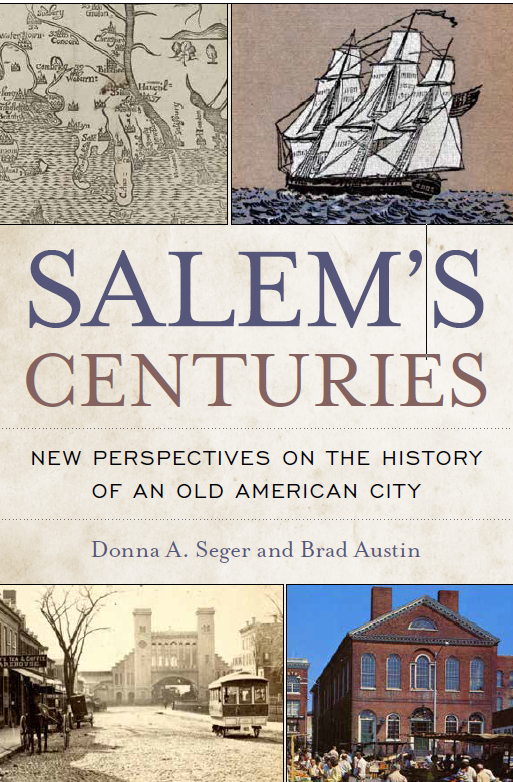
One of the chapters I wrote for the forthcoming (on January 6!) Salem’s Centuries was on the Colonial Revival, and in it I  explored Salem’s experience of that cultural movement as well as Salem’s influence in that cultural movement. I am no art historian, so my purview is very broad, and more focused on popular distillations of “Salem style” than original creations.  There were so many references to “Old Salem” in the first three decades of the twentieth century; now when you hear that phrase it is generally referring to Old Salem Museum & Gardens in North Carolina. But in the 1920s and 1930s, you could buy silverware, furniture, rugs, wallpaper, draperies, and ceramics influenced by “Old Salem.” One product that was particularly effective at conjuring up an image of a very romanticized Salem during its commercial heyday was the “Old Salem” line of china manufactured by Copeland starting in Salem’s tricentennial year of 1926 into the 1950s. This was a “Blue Room” issue marketed under Copeland’s original name Spode, for extra transferware sentimental appeal. I think it was first issued in a polychrome pattern, but the blue-and-white version really took off in the U.S., if advertisements and auction lots are any indication.

I’ve included a snip of text from a House Beautiful feature on “colonial” dinnerware from the 1930s in this last image because there’s a lot there/here. First of all, I love this line about how Old Salem the pattern evokes Old Salem the place, a place lost in time, when “the shoe factories had not yet banished the salty flavor of its existence.” Very Colonial Revival. The author wants to emphasize the pattern’s revival and continuity: it was originally produced back in that “salty” past and New Englanders have always bought Spode. I do find the “original production” assertion a bit confusing as the pattern does indeed feature ships, though not exclusively Salem ships, and the settings are clearly European. In fact, Old Salem, which was produced with old copper plate transfers of Italian views, is kind of a composite view in several ways: old world, new world, maritime, floral, all fused together by the magic of transferware for Salem’s 400th and America’s 150th.


Facts, Feelings, and Erasure

I really didn’t want to publish any more about the Salem City Seal saga here, but the closing meeting of the Task Force which has recommended its replacement was concerning in so many ways that I simply had to write about it (it was keeping me up at night). For those that haven’t followed this issue and are (really) interested, previous posts are here and here and here. I am going to write about the discourse and deliberations in this last meeting, but I’m not going to use names. I don’t see any need to get personal beyond public statements, but you can watch all of the recorded zoom meetings (which get very personal), including the November 1oth one, here. A very brief summary before I get into it. In the spring of 2024, several Salem residents, most of whom seem to be members of the North Shore Asian American and Pacific Islanders Coalition, expressed their opposition to the Salem City Seal, which features a depiction of a native of the Aceh province of Sumatra, a pepper plant, and an arriving ship, all of which represent the lucrative and impactful pepper trade which dominated Salem’s economy and society (and culture) in the first half of the nineteenth century and left a lasting imprint. The seal was adopted in 1839, and its central image was redesigned by Salem artist Ross Turner in the 1880s to represent a more general Asian figure, with the ship and pepper plant remaining. Those opposed to the seal perceived its central depiction as an offensive cartoonish character, and called for its replacement. The City’s Race Equity Commission voted to do just that, without consulting the residents of Salem in any way, but the Mayor and City Council recommended the appointment of a deliberative body to conduct historial research, gauge public opinion, and make a recommentation. And so the City Seal Task Force first met in March of this year, ostensibly for a period of 18 months, with members appointed from the Race Equity Commission and the Salem Cultural Council, two “credentialed” historians, and other mayoral appointees. By October they had concluded their business with a recommendation to replace the seal and since then they’ve been dealing with the cumbersome business of assembling their final report. The meeting on November 10th was the last meeting of the Task Force, and on the agenda was the approval of this report, which was created by the submission of individual sections by task force members and a editorial process to create a “unified” voice.

Paintings of the original seal and Ross Turner replacement, and the current seal. The former are in the public drive of the Task Force, where you can find presentations and other materials. I had never seen the original seal before.

The dynamic in this meeting was led largely by four people, the two designated historians and the editors of the draft final report.For reasons that were unclear to me, the charge to those writing sections of this report was to keep it short, very short: a page or two. This mandate was explained in the meeting by the two editors, who are the Chair and Vice Chair of the Task Force: attention spans. Anyone reading this report would have a short attention span. Since this report will be sent to the City Council for final approval I thought this was a little insulting to its members, and pretty condescending to the Salem public at large. Anyway, that was the charge and everyone obeyed, but the two historians had asked that citations be included in the report and excluded from the draconian word limitations since documentation is a requisite part of any historical analysis. Apparently that request was agreed upon, but the draft report has no citations: as the editors explained, they had included a bibliography which, in their view, was a sufficient replacement for footnotes. Now I am sure everyone reading this can understand the difference between footnotes and a bibliography. As I am typing this, I am taking a break (although I don’t really need one, as they are very good!) from a stack of rough drafts my students have submitted in our capstone seminar course, and I can assure you that these history students are documenting their assertions. What you have in the report are assertions without documentation, which to me looks like a device to render them mere opinion. Since there is a very stark contrast between the non-historical sections, in which the seal is presented in the company of strident images of nineteenth-century Orientalism and twentieth-century popular culture, and the historical sections which lay out the vastness of of the pepper trade and its impact in a more documentary manner, it’s almost impossible to discern between feelings and fact when you read this report unless you are independently knowledgeable about any of the information presented “in evidence.”

I’m going to let James Lindgren move my “story” along while demonstrating the use of a footnote, but I should say that the historians on the Task Force were trying to source and document primary sources as well as interpretive texts.

There was a lot of back and forth on this issue, and the citations are somehow going to be made public, but I don’t think they are going back in the text, because that would make it far too long for all those readers with short attention spans. But a larger issue loomed over all of this discussion, introduced at the beginning and never resolved. One of the historians asserted that his entire section had been rewritten by the editors, with the exception of one dangling (citation-less) quote!  Neither of the editors appeared to assume responsibility for this, and so the charge kept coming back, politely but assertively, with the final observation that the rewrite was so awkward that it must have been the work of ChatGPT. Immediately after this serious concern was raised, another task force member commented that the historians in the group were trying to dominate not only the discussion, but the report, with their voices—-immediately after her colleague declared that he had lost his! This exchange made everything so crystal clear to me: I had never seen erasure so up close and personal before. Generally historical erasure is about omission, or so I thought, but this seems much more pro-active. As soon as voices from Aceh, the people actually represented on the seal, spoke in its favor, they were diminished and dismissed. Salem’s long-running pepper trade was reduced to the Battle of Quallah-Battoo (Kuala Batu), a retaliatory attack by the US Navy on the Malays who had seized the ship Friendship and killed three of of her crew in 1831, an obvious overreaction which was questioned and even condemned up and down the eastern seaboard. A half-century of maritime history, with major reverbations on both sides of the world, reduced to one action, and attempts to introduce historical context rewritten, literally. Indeed, it seemed to me that the majority of the City Seal Task Force was intent on erasing not only Salem’s history, but the discipline of history itself.

200th Anniversary of PEM’s East India Hall this very year! At the dedication dinner in October of 1825, President John Quincy Adams gave a toast to Salem’s trade with the East Indies: No commercial nation has been great without it, may the experience of ages induce us to cherish this rich source of national wealth.


The Revolution in Color

I decided to celebrate the debut of Ken Burns’ new series on the American Revolution by getting out two old books which I always enjoy browsing through, and which I now realize were quite foundational in how I look (and I do mean look) at American history in particular and history in general. The two books are The Pictorial History of the American Revolution by Rupert Furneaux and The Colonial Spirit of ’76 by David C. Whitney, and they were both published for the Bicentennial by Ferguson Publishing of Chicago with ample illustrations, including watercolors of noted Revolutionary spaces and places by “visual artist” Kay Smith. That’s how she is always described, and she died just this year at age 102! Every time I look at her watercolor buildings, I remember when I saw them for the first time; it happened just yesterday when I took the books out. And so it has finally dawned on me that my lifelong pursuit of history through houses began with her. The two books have lots of other cool illustrations too, including prints of every single tavern along the eastern seaboard which has any sort of Revolutionary connection, but Kay provides most of the color. I don’t know about reading these books—they’re definitely rather dated and devoted to storytelling rather than multi-causal analysis, but they are fun to look at. No Salem at all, sadly: colonial capital or Leslie’s Retreat or privateers. The Pictorial History has a chronological/geographical format and the Colonial Spirit is supposed to be more of a social history, I think, but its basic structure is biographical. Here are some of my favorite illustrations—all by Kay Smith, and most of buildings, of course—from Boston to Yorktown.

Kay Smith could depict people too—-her take on Major Andre’s famous sketch of Peggy Shippen Arnold is very charming. Interesting illustrations are scattered throughout both books liberally: uniforms, of course, firearms, vignettes of “daily life,” a great presentation of a Declaration of Independence cover sheet juxtaposed with a facsmimile of Thomas Jefferson’s hand-written and -corrected copy (used by Burns at the opening of episode one of The American Revolution). These books made for just as pleasurable browsing as all those years ago. And what do we think of the latest take on the Revolution?