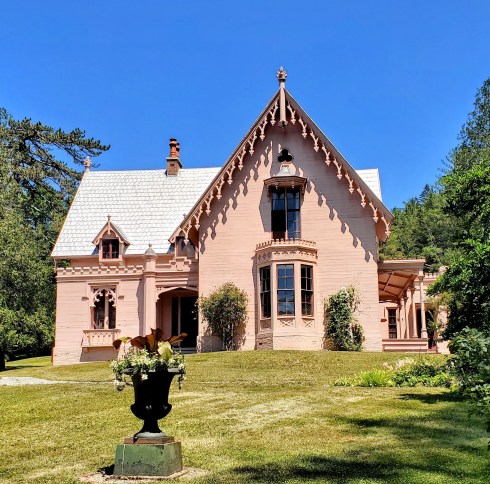
I drove “out west” to the recently-reopened Emily Dickinson Museum last week thinking it would just be a pleasant last road trip of the summer during which I would learn a bit more about the poet, take some photographs of her house and the surrounding Pioneer Valley, and then return home to dash off a quick post and then turn to my syllabus prep as the new semester starts TOMORROW. But that’s not how it worked out: I couldn’t dismiss Emily or the rest of the Dickinsons that quickly or easily. The “Homestead” was striking and the tour substantive, but I left with fewer pictures and more questions than I intended to have. Emily remains enigmatic, but I found myself more interested in her living conditions than her work: the physical space of the house and its surrounding land, which was much larger and more pastoral in her time, her dashing brother Austin and very close sister-in-law Susan next door, the constant companionship of her younger sister Lavinia, and what can only be called the LOOMING presence of her brother’s pushy mistress and the first editor of her work, Mabel Loomis Todd. Emily managed never to meet Mabel (which I find particularly impressive) but nevertheless she was there. It was just all too much for me, so I wondered how Emily persevered/flourished in such a space! So when I got home, I couldn’t possibly post before I read three books about Emily and her family, all when I should have been working on my syllabi! This beast was the best: I could not put it down for two days, an amazing work of scholarship.


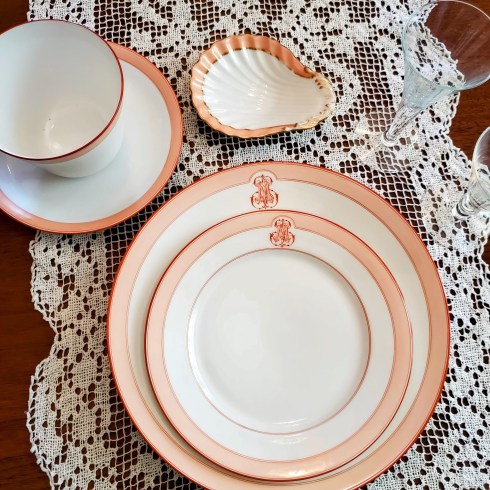
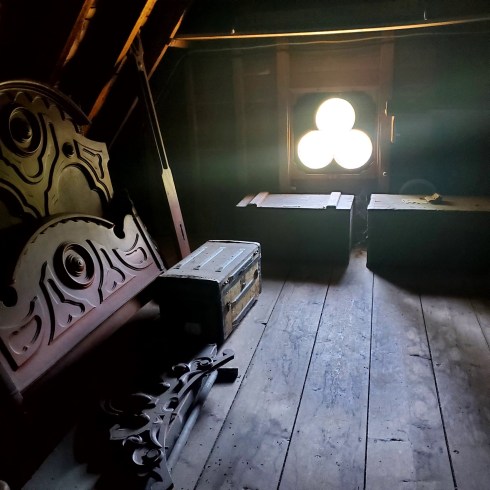
The Dickinson “Homestead,” members of the family, the library and conservatory. The Museum places pinecones on period seating which it does not want you to sit on, but also provides period seating in green!
So much LOVE and DEATH! Emily’s parents die–her mother after a long incapacitation in the bedroom next to Emily’s, and then her beloved young nephew. His father, her brother Austin, begins his passionate and long affair with Mabel, wife of a young Amherst College astronomer, and Emily has to pussyfoot around her own house, the Homestead, to get to her conservatory off the library while they are having liasons! Next door at the Evergreens, the social center of Amherst it seems, her very best friend and “sister over the hedge,” Sue Dickinson, is in distress over her husband’s open adultery. Emily herself commences a passionate-yet-platonic (I think?) relationship with an old friend of her father’s, Judge Otis Phillips Lord from SALEM. She refers to him as “My Lovely Salem” in her letters and he visited her often before his death in 1884. Emily died two years later and then Mabel the Mistress takes over, with the approval, at first, of Lavinia. The Poet is established, but conflict between all of the surviving insiders ensues, resulting in many Dickinson possessions and Emily’s papers going to Harvard. The recently-restored Homestead contains period copies of everything and so you really feel the Dickinson presence (or at least I did) but Harvard’s Houghton Library is the major Dickinson repository.


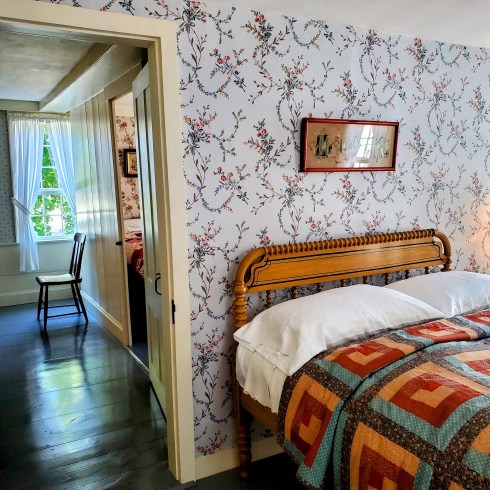
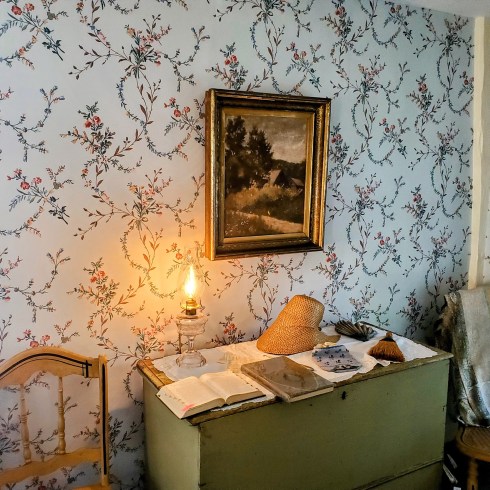
The amazingly colorful double parlor: somewhat subdued walls and brightly-patterned floors seems to be the theme. The lovely runner and second-floor landing floorcover by Thistle Hill Weavers; Emily’s bedroom and stand-in “desk”—a Federal work table. The real desk in the Dickinson Room at the Houghton Library.
But displaced possessions don’t matter, believe me, the house is THE HOUSE, and it is so colorful and full of texture, it feels alive! I loved it: the curation of the interiors seemed to echo the “meticulous care” Emily took with her own life. There are period pieces, both authentic and reproduction papers and textiles, and also some donations from the recently-concluded Dickinson series. The Homestead is a palimpest house: built in 1813 in a more austere Federal style, it was expanded and embellished by Emily’s father, and interpreted as her family house. I think I responded to it so much because it reminded me of my own house, built in 1827 and “italianaticized” in the 1850s, but my double parlor is nowhere near as colorful as Emily’s! You’ve got to go; you’ll have your own response, believe me.


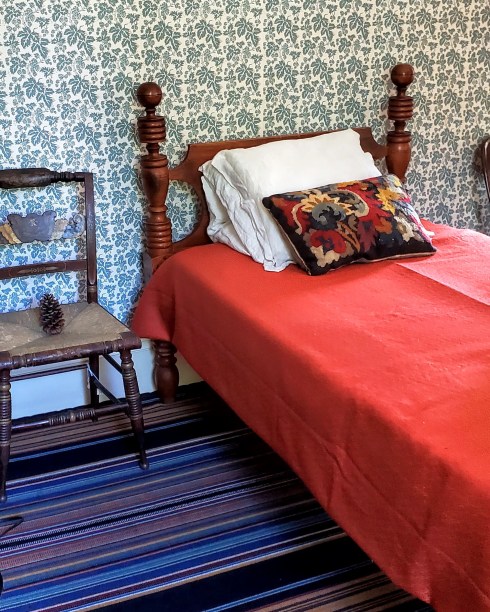


A fragment of period wallpaper in Emily’s room, and an utilitarian white dress representative of what she preferred; her mother’s room next door, furnished with a bed from Dickinson the television series; the only surviving tree from the Dickinson era: an oak which survived the Hurricane of 1938. The Evergreens, Austin’s and Sue’s house, which is closed now but apparently still perfectly Italianate inside.


 Hollyhocks in Cornish, NH and on the cover of early 20th centuy gardening books: Shelton (1906); Ely (1903); Bennett (1919); McCauley (1911); “Colonial” woman and hollyhocks in font of the John Ward House, Salem in a c. 1911 photo by Mary Harrod Northend; layout for a Colonial Garden from
 Sixteenth- and nineteenth-century hollyhocks: Wellcome Images; George Baxter’s print of Valentine Bartholomew’s Hollyhocks (1857), Victoria & Albert Museum.


 Ross Sterling Turner, Hollyhocks (1876), LA County Museum of Art; Eastman Johnson, Hollyhocks (1876), New Britain Museum of American Art; Childe Hassam, In the Garden (Celia Thaxter in her Garden) (1892); Smithsonian Museum of American Art; Abbot Fuller Graves, Portsmouth Doorway (1910), Peabody Essex Museum; Frederick Carl Frieseke, Hollyhocks (1911), National Academy of Design.


 So, much of this seems fine, certainly the themes are great (more on them below), and the criteria professional. I’m having some difficulty envisioning the logistics of the vetting process, but will leave that to the experts. What does concern me, however, is the disassociation of “site” and “building” as referenced in #3 on. As you see in my graphic above, the Salem Witch Museum, the most profitable of the for-profits, is referred to as the former East Church, which is presumably how it made the cut. Why the East Church is deemed “historic” is beyond me, aside from its imposing Gothic Revival style: certainly it is no more historic than the nearby houses of ultra-philanthropist George Peabody and Supreme Court Justice Joseph Story, or the birthplace of the illustrious Benson brothers across the Common. When I asked why and how the Salem Witch Dungeon Museum, also located in a former church (built by the Christian Scientists and not the East Church parishioners), was included on the trail, I got this response from the Executive Director of Destination Salem: The Witch Dungeon Museum and Lynde Street are the site of early fortifications. English settlers knew that their presence in Salem immersed them in a web of global conflicts. Fearing reprisals from the indigenous people they were displacing and attacks from other colonial powers, the colony of Massachusetts erected a fort near this spot in 1629. Samuel Sharpe came from London with cannons to assume command of the militia. The first fort was probably made of tall wooden palisades, with extensions jutting out to prevent flanking. In the following decades, further fortifications were built along the Salem coast and a palisade was built along the western end of town. The early, feared attacks never happened. The East Church built a chapel on Lynde Street in 1897 and The Witch Dungeon Museum opened in the building in 1979. Visitors can watch a live-action reenactment of a witch trial and tour a recreation of the grim prison where the accused were kept. So basically: because a long-gone fort was once on the site of the Salem Witch Dungeon Museum, it qualifies for the trail? I don’t think I need to spend too long discussing the implications of this “standard.” In a city as old as Salem, every structure downtown was built on the site of something else: there are layers and layers and layers. The Witch Dungeon Museum’s storefront sister “museum” on venerable Essex Street, the Salem Witch History Museum, could claim that it sits on the site of Salem’s first printing house or any number of historic structures and thus qualify for the new Heritage Trail. Perhaps the cumulative criteria above could mitigate against this, but it does not appear to have done so with the Salem Witch Dungeon Museum: I think we need to be honest about where we are leading people—and why.
 Mannequin City: mid-20th century interpretive “technology” reigns in Salem’s for-profit witch “museums” which have no incentive to innovate, as the City delivers visitors right to their doors; Witch Dungeon Museum hanging mannequins.


 Salem tourism brochures from the 1950s through the 1980s: not until the last decade was the Heritage Trail restricted to downtown and the “story” increasingly restricted to witches. Love the sentiment of “traveling through history in Salem.”
 Higginson Square, 1893, Nelson Dionne History Collection, Salem State Archives and Special Collections. A big flatiron to highlight Asheville’s Flatiron building. It begs the question: no Parker Brothers site for Salem’s new Heritage Trail?