Category Archives: Architecture

A Jewel Box on Mall Street

Just off Salem Common was a rather nondescript house, long consigned to institutional use, which was rescued by a couple who transformed it into what can only be described as a show house, with every single surface polished and embellished to perfection. Everyone in Salem watched the exterior metamorphosis with great interest, and then the doors of One Mall Street were opened up for the 2016 Christmas in Salem house tour and we were able to see inside, where everything was color and light, with more texture and detail than one could capture at first impression. That’s why I was so fortunate to be invited back into One Mall Street a month ago, and shown around by its owner-restorers, whose plan was to strip the c. 1800 house down to its studs and then rebuild it, with the best materials and more classical detail than its original builder could afford. A sun-splashed courtyard on the eastern side of the house (once an asphalt driveway) provided the orientation, and the house’s own “bones” the inspiration. The end result is a house that is nondescript no more.

jewelbox31

Jewel box 3

Jewel Box Macris

jewelbox 21

As you might guess from the renderings just above, one half of this restoring couple is an architect: this is not a shoemaker’s-family-has-no-shoes scenario! Clearly this project was a labor of love. And now that it is complete, the family is moving on to a new one—in Vermont— and One Mall Street is now for sale. I can’t imagine a house in more move-in condition: essentially it’s been rebuilt from (below) the ground up: from the basement bar and workshop to the attic apartment. This house’s past is a bit murky (it was moved to its lot in 1906; no is really sure from where) but its future is clearly very bright.

Jewel Box Collagejewel box 30

jewel box 31

jewelbox 23

jewel box 15

jewel box 13

jewel box 14

Above: One Mall Street in Salem today and in 1997 (MACRIS); various plans, the beautiful entrance hall and stairway, living room, kitchen, dining room, study, and back stairway. Below: more staircases, the amazing more-than-finished basement, complete with bar, pool table, and workshop—and that ceiling! This house has the most beautiful ceilings I have ever seen: I came right home and called the plasterer.

staircase collage

basement collage

Jewel box 33

jewel box 11

jewelbox30Listing for One Mall Street, Salem:  https://www.raveis.com/raveis/72311320/1mallstreet_salem_ma?ROWNUM=1&page=1&sortdir=DESC&sort=price&TOTAL=27


Back Bay Easter

We were a small party for Easter this year so we went to the St. Botolph Club in Boston for a buffet of oysters, salmon, eggs benedict, coq au vin, and lamb (no ham). This is the artsy old Boston club, and I always enjoy going there because the walls are lined with the work of its members past and present. In the crimson library, there is a portrait of an artist who I became acquainted with through his connections to several Salem artists at the end of the nineteenth century: John Leslie Breck. I’ve come to admire his work over the past few years, and I always “check in” with him whenever I go to St. Botolph’s. Though known as one of the young artists who brought Impressionism to the United States (in successive exhibitions at St. Botolph’s), Breck’s portrait is one of earnest realism: he looks handsome and troubled, or maybe I am just imposing that state on him as I know he ended his own life at the age of 39 in 1899.

Back Bay Easter

Back Bay Easter Dining Room

Back Bay Easter Library

Back Bay Easter Breck

PaintingsbyJohnLeslieBrock1890_0000

I don’t mean to be so maudlin, but that portrait always makes an impression on me. But it was a lovely Easter afternoon with great food and company and a walk down Commonwealth Avenue searching for signs of spring. We found some, mostly man- made, but there were a few flowering buds—we are on the brink! Walking back to the car from the Public Garden, I looked for my favorite version of the three Lutheran solas: I was just lecturing on them in my Reformation class last week, and I took a photograph for some extra validation for/from my students.

Back Bay Easter Box

Back Bay Easter last

Back Bay Easter 4

Back Bay collage

Back Bay Easter 3

Back Bay Gloves

Back Bay Bushes

Back Bay Easter Flowers

Back Bay Solas


Remember the Armory

The opposition to the Peabody Essex Museum’s removal of Salem’s historical archives to an industrial park in Rowley incorporates a range of perspectives: some people have never been in the Phillips Library but nevertheless have been waiting for its return; others have very concrete memories of childhood forays or later visits to research some specific aspect of their Salem past: their house, their neighborhood, their family. Everyone had great expectations: as the Museum leadership closed the Library in 2011 with promises to return in two years, only to disclose the Rowley move six years later, under duress. Expectations are a powerful motivating force, but so too is distrust: and for those of longer Salem residence the latter is clearly apparent. For them, the PEM’s latest move (literally and figuratively) falls into an established pattern of behavior that has broken trust with the Salem community. And the event that looms largest in this pattern is the demolition of the storied Salem Armory in 2000, under the auspices of the Peabody Essex Museum, which had previously signed a memorandum of agreement to preserve and incorporate the Armory’s headhouse into its expansion plans. Only the Armory entry arch remains on Essex Street, right next door to what used to be the Phillips Library, a constant reminder of what was and what was not preserved.

Armory 2

Salem Armory LOC

Armory Arch

The Salem Armory in 1992, ten years after a ravaging fire, and the year of the Memorandum of Agreement by which the “Museum Collaborative” promised to preserve its headhouse. This was also the same year that the Essex Institute and the Peabody Museum of Salem were merged to form the Peabody Essex Museum, which was still bound by that agreement. Library of Congress.

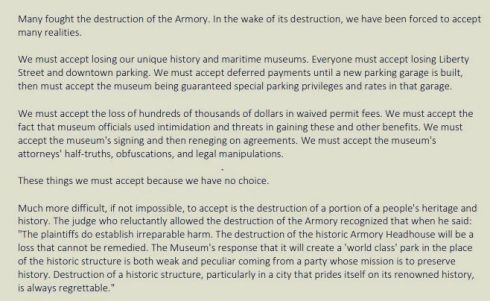
The Armory story–of its rise, role, and fall–has been written about many times, and well: the preservation report and narrative for the MOA is here, some colorful context is here, and the story in parts, right up to arrival of the wrecking ball, is here. But one of the most poignant accounts of the Armory (or of any building’s destruction, frankly) that I have ever read is a Letter to the Editor (of the Salem Evening News) written by Salem architect Staley McDermet in 2002, two years after its demolition. Mr. McDermet asks for an apology that I don’t think he–or we–every received, and goes on to document everything that happened. Indeed, the letter is historical in terms of both intent and subject, but it is also a very timely document, in light of the PEM’s recent actions and their explanations for actions in the past, so timely that I thought it should be “published” again.

Armory text 1

Armory text2

Armory text 3

Armory text 4


First-Period Fantasy

I’ve been obsessed with the Downing-Bradstreet house (which once occupied the site of another current obsession, the Phillips Library) for quite some time: consequently I took advantage of some extra time during this past spring break to dig a little deeper into its history. Actually, the history is easy: it’s the projection that is difficult. We know that this “mansion house” was built by 1640 and demolished more than a century later, but our only image of it was created by a man who was born after its demolition and whose source is unknown:  did it really look like this?

Oldest House Bradstreet-Downing

Wow: that’s a big house with a lot of windows, gables, glass, and finials. What in the world are those “flanking towers reminiscent of feudal days”, in the words of Frank Cousins? Are they made of glass? Indeed they were according to Robert Rantoul’s 1888 essay on the “New Domain” of the Essex Institute, which describes what preceded its buildings on “Downing Block”: it had two massive sets of chimneys and also two transparent, hollow columns of lead sash and diamond glass, great lanthorns (?????), one of either side of the front door, for lighting up the ample grounds in front, and these rose from the foundation to the roof and contained a cupboard-door at each floor of the house for inserting candles or other illuminating appliances on occasion of festivity or other need of light. Wow again. All of this illumination, combined with the scale and detail of the house, makes it appear more like a romantic fantasy of a seventeenth-century house than an actual seventeenth-century structure, especially as it was situated in frontier Salem. This “grate” house, either real or embellished, was built by London barrister Emmanuel Downing, the brother-in-law of Governor John Winthrop, who eventually returned to England leaving the mansion to his daughter Ann as part of the dowry for her marriage to Captain Joseph Gardner, who was killed in the Great Swamp Fight of King Philip’s War in December of 1675. In the following year, the Widow Gardner married Simon Bradstreet, the last Governor of the Massachusetts Bay Colony, whose first wife Anne, America’s first published poet, had died in 1672. Bradstreet returned to Salem (his port of entry to the New World) and took up residence in the Mansion until his death in 1697. Both he and Ann are buried in the Old Burying Ground on Charter Street. The now-Bradstreet House was passed down in the Ropes family for a few generations, but ultimately it was transformed into a tavern (the Globe), divided, and demolished in 1753. The artist of its iconic image, Marblehead painter and muralist Samuel Bartoll (1765-1835) created both the painting above and a similar one of the Corwin (Roger William House in the 19th century; “Witch House” in the 20th) in 1819-1820: what was the basis of his conception?

Bradstreet collage

Bradstreet Witch House BartollFrank Cousins photograph of the Bartoll painting; 1930 Port of Salem map, Boston Public Library & illustration from Lossing’s History of the United States of America (1913); Samuel Bartoll’s Corwin House, Peabody Essex Museum.

I have no answers to the questions I am asking, but it’s still important to ask them, as these idealized (?) images guided so many restoration projects later on. Nathaniel Hawthorne likely saw the Bartoll paintings in Salem: they influenced his vision in the House of the Seven Gables, which later inspired the material transformation of the Turner-Ingersoll mansion into the more “picturesque” House of the Seven Gables by Caroline Emmerton and Joseph Everett Chandler in 1908-1910. Later in the twentieth century, the Corwin House underwent a similar transformation—back (or forward) to the Bartoll vision, with a few less finials.

Bradstreet Bartoll Chairs Julia Auctions

Bartoll Landing of the Pilgrims 1825More idealized American imagery from Samuel Bartoll: Painted Hitchcock Chairs, James D. Julia Auctions; and a Fireboard Depicting the Landing of the Pilgrims, 1825, Peabody Essex Museum.


Is it better than a Junkyard?

Read this paragraph: ___________ is changing rapidly. Some of the changes have been good: the burgeoning art scene, the museum-building boom, the explosion in restaurants and the whole Napa-of-craft-beer thing, not to mention legalized marijuana. But there have also been some bad changes: the terrible traffic, the litter and pet waste everywhere, the sky-high rents and the swelling ranks of the homeless, not to mention legalized marijuana. It could be describing Salem at the moment! But it’s not: fill Denver in that blank space, a city that is dealing with far more growing pains than Salem, given its much bigger size. Denver’s building boom has given rise to a very boisterous public discussion about the merits and demerits of all the new structures appearing on its horizon, and this particular quote is from an article by art historian and writer Michael Paglia titled “Denver is Drowning in a Sea of Awful Architecture”. This just one of a sea of articles and posts expressing disdain for Denver’s “fugly” architecture: also see here, here, and here; there are also a good measure of constructive articles seeking a more aesthetic way forward for the Mile High City. Why am I writing about Denver? Well, when I did a Google image search of a planned housing development on Salem’s North River hoping for some sort of architectural context, the closest match I could find was one of Denver’s identified ugliest buildings. Here we are: one of five buildings consisting of 48 condominiums with underground parking proposed by the Salem development firm Juniper Point Investment Co. LLC for 16-18 Franklin Street right on the North River, a very visible “gateway” property.

Ghastly development

Ghastly 2

To be honest, I am unsure of the status of this proposed design: it was submitted to the Salem Planning Board at its last meeting on February 15 (after many continuances apparently) and those minutes are not yet available. And to be fair, the site of this proposed development is a junkyard: the long-lived Ferris Junkyard. So anything could be better, right? Well, NO. Too often in Salem I hear: it’s better than what was there before as a rationale for begrudging approval. This large waterfront property, which is adjacent to a park and another prominent property slated for redevelopment, deserves serious consideration of design and context. This is an amazing historic opportunity, as this site has been industrial-zoned for well over a century, but sits on the edge of a beautiful residential neighborhood and right across from Salem’s downtown.

Junkyard Salem News

Ken Yuszkus/ Salem News Staff Photo

Junkyard collage

Junkyard DC

North River 1912The site, and the North River coastline near the bridge, 1851, 1890s and 1912, when the first City Plans Commission report asserted that the river “needed to be redeemed”.

Given the long industrial usage of the property, it might be hard to find context, but can’t there be some feature—architectural or material—to indicate that these buildings will be located in Salem, Massachusetts and not Florida or California or anywhere else where flat roofs rule? Tanneries, coal sheds and the famous Locke Regulator Company (above): any inspiration there? Slightly to the north, North Salem was a botanical paradise—can’t this land be reclaimed as such? We need pear trees in honor of Nathaniel Hawthorne’s uncle Robert Manning, a famous pomologist whose orchard was in the midst of Northfields, and whose residence remains on Dearborn Street. Perhaps some inspiration can be found in the work of Salem-born and -raised architect Philip Horton Smith (1890-1960), who really distinguished himself as a preservation architect in his Salem commissions but also designed a lot of new buildings, including the Hawthorne Hotel, the Salem Post Office, and the neighborhood of brick duplexes further along Franklin Street for the Salem Rebuilding Trust after the Great Fire of 1914. Smith was a true Colonial Revival architect, and I’m certainly not advocating for brick veneers on every new building in Salem, but just a bit more attention to place, as shaped by both the past and the present. I am certain that the neighbors have been waiting for something special to be situated in this particular place for quite some time; indeed we all have.

Salem Rebuilding Trust North Salem Philip Horton Smith’s  Franklin Street “low rent brick cottages”, 1915.


Unobstructed Views

My self-education in historical architectural photography is now quite stalled in the realm of the photogravure, and I just can’t see enough tonal prints of old buildings, preferably but not necessarily of the New England variety. There is a slim volume titled Under Colonial Roofs by Alvin Lincoln Jones with forty stunning photogravures from negatives by Charles Webster that I keep by my bedside but I like the Internet Archive copy even better because it is annotated by a snarky little anonymous note facing the title page: the first good photographic study of New England’s historic houses was Alvin Lincoln Jones’ Under Colonial Roofs which appeared in 1894. The pictures, which are of a high quality, show us many buildings that have since disappeared. The picture of the Paul Revere House, when compared to a modern view, gives us some idea of how drastic the 1907 restoration must have been. Jones’ picture leads me to conclude that it is very easy to over-restore a building. I wonder what he/she thought of the coincidental restoration of the House of the Seven Gables! The 1894 version of the Paul Revere house is in fact very revealing, as is that of the Wells-Adams House, also in the North End, which would come down in the very same year that Under Colonial Roofs was published.

undercolonial roofs

undercolonialroo00jone_0081

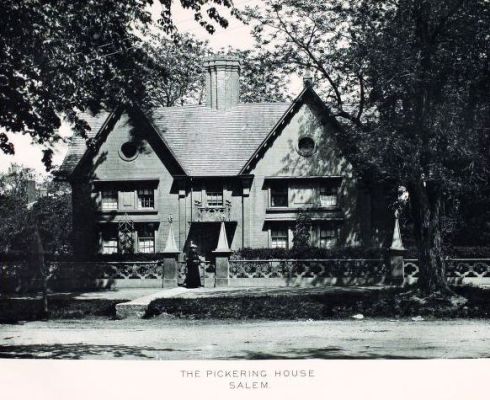
Jones showcases only two Salem houses, a very un-restored Corwin/Witch House, which he calls the Roger William House as it is several years before Sidney Perley disproved that connection, and the Pickering House, which looks then pretty much like it looks now. There are so many more I wish he had included! But images of Salem’s “ancient” houses were being dispersed far and wide by Frank Cousins in the 1890s, so I can understand his sparing coverage. There are lots of Essex County houses in the volume: I was particularly drawn to the Cobbett House on East Street in Ipswich, which appears to be no longer with us, the striking image of the Whipple House (again–in its un-Colonial-revivalized state) and the Peaslee Garrison House up in Haverhill, which looks like it could have been built in East Anglia.

undercolonialroo00jone_0106 (1)

undercolonialroo00jone_0111

undercolonialroo00jone_0146

undercolonialroo00jone_0201

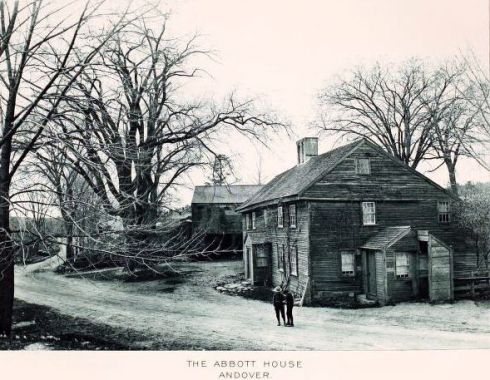
Jones takes us to all of the usual houses in Lexington, Concord and Duxbury, but does not venture onto the Cape or “out west”. Perhaps the anonymous note-inserter is correct: there is something about the untouched, organic images of two houses that I am familiar with—the Abbot house in Andover and the Peter Tufts House in Medford (which Jones calls the “Cradock House”) that are so very revealing, even more than the photographic technique. These houses would survive the twentieth century: not so the Barker House in Pembroke, then boarded-up, overgrown and abandoned.

undercolonialroo00jone_0216

undercolonialroo00jone_0223 Cradock House

undercolonialroo00jone_0343 Barker House Pembroke


Anchor Away?

As if it is not enough to bury the archives of a historical seaport in an inland warehouse 45 minutes away, rumor has it that one of the prominent symbols of Salem’s maritime heritage will also be removed: the large anchor that stood sentinel in front of the East India Marine Hall for over a century. I don’t like to trade in rumor, but given the leadership of the Peabody Essex Museum’s propensity to avoid announcements until their intended actions have become faits accomplis, I think I should. We’re all scrambling to save as much of Salem’s historic fabric as we can. But I have a question mark in my title and am ready, indeed eager, to issue a retraction. Looking at the latest renderings for the addition that is rising on the western side of hall, however, I fear that that won’t be necessary.

Anchor 1912

Anchors First

Anchors 2

Anchors NS MAG EssexStreetLookingEastatNight-ba45be61East India Marine Hall and its milieu, 1912-the near future? As you can see, the anchor—clearly maritime kitsch that would spoil the sleek streetscape envisioned—is not there. Below we have a livelier, anchor-centric rendering from Rich Mather Architects: unfortunately Mather died and the PEM looked elsewhere, although his colleagues and successors at MICA Architects carried on with the rest of his commissions.

Anchors Aweigh Rich Mather Landscape Architect

To be fair, the anchor has not been in front of the East India Marine Hall from the date of its erection, but only since 1906. It was a gift from Theodore Roosevelt’s short-lived Secretary of the Navy Charles Bonaparte, of the “American Bonapartes” descended from the little Emperor’s younger brother Jerome. Secretary Bonaparte seems to have been a remarkably tone-deaf official, as almost immediately upon his appointment, in response to solicitations for funds to restore the venerable USS Constitution, he asserted that Old Ironsides should be towed out to sea and used as target practice! This caused an uproar in Boston, as you can imagine: the Boston Transcript opined that “to New England sailors, firing on the Constitution would be almost as offensive as bombarding Bunker Hill Monument or Plymouth Rock” and the national press ran stories under the headline “Secretary Bonaparte’s Collision with New England Patriotism”. There were Save the Constitution fairs and petitions, as the combined forces of the Daughters of the War of 1812 and the Massachusetts Historical Society shepherded a movement which forced Bonaparte to back down. He wisely did so, and in his second (and last) annual report he called for patriotic celebrations in Massachusetts’ seaport towns, in recognition of the Bay State’s maritime heritage. This was the compensatory initiative that brought a hand-forged c. 1820 anchor to rest before the East India Marine Hall in 1906. As long-time Peabody Museum treasurer and trustee John Robinson noted in his 1921 pamphlet The Marine Room at the Peabody Museum of Salem,“as an anchor is the emblem of the Salem East India Marine Society, for whom the building was erected in 1824, the placing of this large, old-time anchor at its front is very appropriate”. Apparently not now.


A Thin Veneer of Heritage

Six weeks into the struggle to convince the leadership of the Peabody Essex Museum to return its Phillips Library to Salem, I find myself with lost faith and many learned lessons. The phrase “broken trust” has been applied to the PEM’s actions many times over these past weeks, but that is too legal a concept for me: I prefer to think in terms of faith, encouraged by Victor Hugo’s lovely observation that A library implies an act of faith which generations, still in darkness hid, sign in their night in witness of the dawn. Under the guise of preservation and with a consistent disdain for accessibility and accountability, the PEM leadership broke faith with the community of Salem, and now I have lost faith in them. I’m trying to separate the leadership from everyone else who works at this large Museum, in effect the Museum itself from the policy regarding the Library and its collections, but that’s tough to do when such an all-encompassing feeling as faith is in play. Working on it.

PEM East India Room collageThe interior of the East India Marine Hall past and present, and before the installation of the PEM’s newest exhibition, Play Time.

I’ve learned many lessons over these past weeks but I think the most important one is about prejudging in general and my own prejudices in particular. I’ve been concerned about the commodification of history in Salem for quite some time (as regular readers are all too aware!) and assumed that this trend was driven exclusively by the many tour guides in town, who were presumably more concerned with #tourismmatters than heritage. Now I know that that predisposition is largely incorrect, as I have seen and heard tour guides take earnest and public stances in support of the return of the Phillips while established heritage institutions have stood silently on the sidelines, taking no position and choosing not to exercise their more considerable influence. I remain impressed, and heartened, by the power of history to unite a broad spectrum of people, although at the same time I realize that history, or the perception of one’s history, is also intensely personal.

Essex Institute 1980

Phillips RizviThe Collections of the Essex Institute in the Phillips Library Reading Room, 1980, and the library collections reinstalled, 2008, Rizvi Architects.

I’ve been having difficulty separating the personal from the professional in my reaction to the PEM’s policy towards the Phillips ever since the “announcement” was made—actually I don’t even think I can get past the “announcement”, or lack thereof! But I better try, because obviously no apologies will be forthcoming; instead PEM CEO Dan Monroe offered only the assertion that there was an expectation by a number of people that we had a responsibility to consult with them about what would be done with the Phillips collection…an expectation we didn’t particularly share or understand in last week’s Boston Globe article. I certainly wasn’t expecting a consultation, but an announcement might have been nice, especially as the PEM’s last official word on the Phillips was that it would be returning to Salem in……..2013.

Thank goodness, when confronted with such adversity, healthy instincts of self-preservation begin to take over, and so I’ve started to privilege the professional over the personal in my considerations. When I look at the situation from the former perspective it is clear to me that I don’t need the Phillips Library in Salem or even in Rowley. I have a car, a Ph.D., and a flexible schedule so I can probably gain access to the new warehouse library during one of the 12 hours a week or so that it will be open (well maybe not, after my running commentary over these past weeks) if I want to. In any case, I’m an English historian, fortunate to be equipped with academic databases and dependant on repositories that have made the accessibility of their collections a priority. Local history is just a lark for me, right?  Unfortunately, private priorities only work for a while: when I start thinking about all those records relating to Salem people, places and institutions, and all those Salem donors, I find myself right back in the realm of public history.

Actually, I do have three presentations coming up this year on the intersection of the Colonial Revival and historic preservation movements here in Salem—all of which were scheduled just before the temporary Phillips facility closed down on September 1, ostensibly so that materials could be readied for the big move to Rowley (which was not, of course, announced at that time). I was looking forward to using the library’s collections intensively for the first time in my career, an opportunity that will sadly not come to pass. I’ll have to make do, and I will make do, with the help of other institutions that have made their materials more accessible and lots of secondary sources, but I fear I will only be scratching the surface of this Salem story without the Phillips sources.

Colonial Stairway Wallis 1887

Colonial Frank Wallis Stairs 1887

Colonial Frank Wallis 1887

Colonial Seating collage

Colonial Tables Wallis 1887

Colonial Doorway Salem Wallis 1887

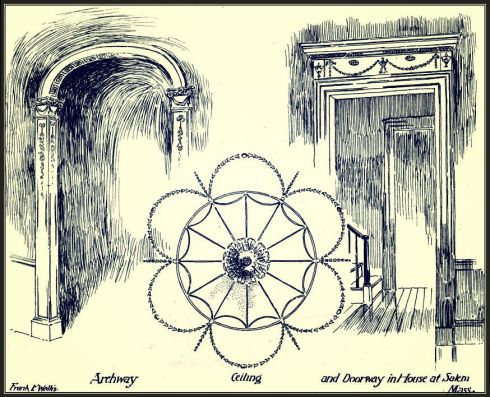
Colonial Gates Wallis 1887And I really fear I’ll be too reliant on the detailed-yet-romantic work of Maine-born architect Frank E. Wallis, whose reverence for Salem is all too apparent! Plates from Frank E. Wallis, Old Colonial Architecture and Furniture. Boston: George H. Polley & Co. Publishers, 1887. 


Severed from Salem

Reading through the Phillips Library catalog is an activity that is simultaneously enticing and frustrating: one can glean the scope of the collections but not access them, provenances are presented but not deeds of gift or deposit (which is standard). Given the missions of its two founding institutions, the Essex Institute and the Peabody Museum, the Phillips’ collections are both regional and global in nature, but one cannot fail to notice the prominence of Salem materials, consequences of content and/or bequest. To supplement that perception, just browse through the century-old Essex Institute Bulletins digitized by the Internet Archive, where you can easily access long lists of donations and deposits from descendants of scores of old Salem families and every type of organization: public, civic, commercial, religious, fraternal and sororal (a word I had to look up!). As is always the case in the Witch City, there’s too much focus on witch trial records: the tragedy of the removal of the Phillips Library by the Peabody Essex Museum is the vast amount of personal and institutional history–a cumulative cultural memory– that will be severed from Salem. Let me offer up just one collection of papers as an illustration: the Almy, Butler, and Robson Family Papers, which encompass the activities and associations of three intertwined Salem families from 1804 to 1982. Through these records, we can (or could) examine the rise and fall of one of Salem’s most prominent department stores, Almy’s, Bigelow and Washburn (1858-1985), a particular phase in the history of the Wesley Methodist Episcopal Church (now the Wesley United Methodist Church on North Street, which donated its archives to the Phillips as well), an edited manuscript of Katherine Butler Hathaway’s famous memoir The Little Locksmith (!!!!!), and considerable correspondence and materials relative to her niece Elizabeth “Libby” Reardon Frothingham’s energetic advocacy for historic preservation both during and after Salem’s battle with urban renewal in the 1960s and 1970s. Personal perspectives on Salem’s history.

Almys PC

Salem-Wesley-ME-Churchx

Phillips PC Just two Salem institutions whose records are preserved in the Phillips Library, and the Essex Institute in its heyday.

The personal nature of historical materials works both ways: the people of Salem should be enabled to engage with their history in a personal way. When I read the detailed catalog entry and finding aid for the Almy, Butler, and Robson family papers, I think of the Almy’s clock that still stands on Essex Street, the first time I read The Little Locksmith, just a few years ago, and Elizabeth Reardon’s house histories for Historic Salem, Inc., which I used as a model for my own reports way back when I first moved to Salem and wanted to learn about my new city house by house. I’ve read about her exciting “discovery” of two Salem first-period houses hiding in (somewhat) plain sight, and just last year, I visited the ongoing restoration of her former house, and saw the cupboards where her records–memorials of decades of service to Salem– were stored. And now they’re off to Rowley?

Reardon 4

Gedney House

Severed 3

Severed 4The Gedney House on High Street, soon after its discovery by Elizabeth Reardon and restoration by Historic New England, and an excerpt from Julie Arrison-Bishop’s article “A Witness to Four Centuries in Salem”, Historic New England Summer 2015; 1965 Boston Globe article on Elizabeth’s discovery of the Samuel Pickman House (hiding under a mansard roof), and the Pickman House today, with the Peabody Essex Museum in the background.


In Praise of Townhouses (and Small City Living)

This weekend will bring the (38th) annual Christmas in Salem house tour, centered on the “City Sidewalks” of downtown Salem, with decorated homes on Central, Crombie and Chestnut Streets open, along with a house on Hamilton Street. I love this tour: for me it highlights Salem at its best, showcasing the creative continuity of the city rather than exploiting one dark time, in stark contrast to that other big Salem event (yes, I’m referencing Haunted Happening, which I still can’t get out of my system). I’m not exactly sure what the “City Sidewalks” theme means, but for me it conjures up a streetscape of diverse buildings—large and small, residential, commercial and institutional–closely aligned together so to form a community characterized by the integration of all the activities of daily life: a city, and to be more precise, a small historic city like Salem. Maintaining the balance between all of these diverse structures is challenging: the materials, scale, and infrastructure of modern construction can be a constant threat. Consequently preservation and planning advocacy is absolutely paramount, and the proceeds from the annual Christmas in Salem tour go towards these efforts on the part of Historic Salem, Incorporated.

Townhouses Central

Townhouses Crombie

Townhouses Chestnut2Central, Crombie & Chestnut Streets, Salem

I am certain that the tour committee also wanted to emphasize the diversity of residential structures in downtown Salem, as everything from an above-the-shop flat (in a Bulfinch building no less) to a sea captain’s mansion (designed by McIntire of course) will be on view. They are all townhouses in the general sense of the word, but the more specific designation—a multi-level, semi-detached structure–will be represented on the tour as well. The two 1906 covers of The House Beautiful below illustrate my vision of winter/Christmas in an urban village of townhouses–and the one on the right features the Chestnut Street mansion of Pickering Dodge, who commenced the construction of one of the tour’s featured townhouses–just next door– for his daughter and son-in-law in 1828. Since I acquired my own townhouse, which was built just the year before on the same street, I’ve bookmarked images of townhouses—semi-detached and freestanding, exteriors and interiors—that have enhanced my appreciation of their functionality and design: first and foremost the two “party” paintings of Boston artist Henry Sargent in the collection of the Museum of Fine Arts. The Dinner Party (1821) and The Tea Party (1824). It might not be Christmastime, but it feels like it in these festive parlors. Another great townhouse interior painting is Robert Scott Tait’s A Chelsea Interior (1857-58) featuring the author Thomas Carlyle, along with his wife and dog in the parlor of their London townhouse:  again, likely not Christmastime, but the “shotgun” perspective is classic townhouse. The taller townhouses of the 1850s are featured in the wintry Street in Winter: Evening by an anonymous artist, who casts light on the city sidewalks from a shop window: in the next century all of those windows will be lit up, especially at Christmas time.

Townhouse collage2

Townhouse Dinner Party Sargent

Townhouse Tea Party Sargent

Townhouse Chelsea

Townhouses New England Street

Townhouse paperHenry Sargent, The Dinner Party & The Tea Party, 1820s, collection of the Museum of Fine Arts, Boston; Robert Scott Tait, A Chelsea Interior, collections of the National Trust; A Street in Winter: Evening, collection of the Museum of Fine Arts, Boston; I am very enamored of this townhouse wallpaper from the new Hearth & Hand/Magnolia collection at Target.

Christmas in Salem “City Sidewalks” Tour, December 1,2 & 3, 2017—more information and additional events here: http://salem.org/event/37th-annual-christmas-salem-house-tour-2/2017-12-02/.