Tag Archives: Women’s History

A Daring Woman

I’ve been working on a longer project on Lady Deborah Moody (1586-1659?), another one of the transatlantic travelers of the seventeenth century who fascinate me perpetually. She was in Salem for only a few years but made her mark, characterized as a “dangerous woman” by John Endecott but looking decidedly more daring to me. Lady Deborah was born Deborah Dunch in 1586, to Walter Dunch of Avebury, Wiltshire (1552-1594) and Deborah Pilkington (1564-1594+), the daughter of James Pilkington, the Bishop of Durham and perhaps the most Puritan-leaning member of the Elizabethan episcopal hierarchy (who was himself exiled during the Marian regime). In 1606 Deborah married Henry Moody of Garsdon Manor, Wilthire, with whom she had two children and acquired her “Lady” status after her husband was granted a knighthood and a Baronet title by King James I. She remained in London for a decade after his death in 1629, and then left for the New World: acquiring a small house near that of Reverend Hugh Peters in Salem and then working farms in nearby Lynn and Swampscott. But her time in the Massachusetts Bay Colony was to be short-lived because of her avowed religious beliefs, particularly her public disavowal of infant baptism. Anabaptists were definitely not welcome in Puritan New England, and Lady Moody was fined, excommunicated from the First Church of Salem and eventually evicted from the colony altogether. Dutch New Netherland, famously tolerant in matters of religion, beckoned, and in 1645 she became the first female founder of a settlement in the Americas, receiving over 7000 acres encompassing present-day Gravesend in Brooklyn and Coney Island.

I haven’t been able to find an image of Lady Deborah, but here are several associated with her life:  I’m all about visual context! The first is one of the marble memorials to her parents, Walter and Deborah, in Little Wittenham Church near Dorchester (courtesy The Early Modern Whale); the second has nothing at all to do with her, but is a stunning (probably memorial as well) double portrait of near contemporaries, one of whom was possibly named Dunch (e): Anonymous English Artist, A Child and his Nurse (possible John Dunch), c. 1589, Private Collection (part of last year’s exhibition at the National Portrait Gallery, Elizabeth I and her People); Anti-Anabaptist (and-Presbyterian) Broadside back in old England, 1647; J & J Graphics notecard of the Lilac Garden in Swampscott, the present-day location of Lady Deborah’s “Swampscott” Farm, 1640-42; The Moody Coat of Arms, utilized by Lady Deborah’s son Henry, an American Baronet; Still-standing Gravesend house at 27 Gravesend Neck Road long-associated with Lady Moody, although it doesn’t appear that she ever lived there (courtesy Ephemeral New York and Brooklyn Historical Society; you can read more about the house here).

Dunche Memorial Little Wittenham

achildandhisnurse

Anti Anabaptist Propaganda 1647

Lilac Garden Swampscott J and J Graphics

Moody Coat of Arms Collage

ladymoodyhouse Gravesend

lady-moodys-house-BHS


The Woman Who Lived in My House

I knew that a woman named “Mrs. Rose” lived in my house in the middle of the nineteenth century, but nothing more about her: when I saw the name on the 1851 map that I featured on my last post my curiosity was piqued. So I took advantage of a free snow day yesterday and searched for some biographical details, which were not too difficult to find. I have a general disdain for genealogical work, but Mrs. Rose was so well-connected that at least an outline of her life came together pretty easily.

She was Harriet Paine Rose, born in 1779 to parents from two prominent Massachusetts families: the Paines of Worcester and the Ornes of Salem. Imagine being of her generation: she was born in the midst of the Revolutionary War and died on the eve of the Civil War, in 1860, right here in Salem (though not right here in my house, but that of her daughter’s, down Chestnut Street at #14).  Her father, William Paine, had come to Salem from Worcester to study medicine with the renown physician Dr. Edward Holyoke and presumably met Lois Orne, the youngest daughter of wealthy Salem merchant Timothy Orne, at some social occasion. There are two charming portraits of Harriet’s mother and aunt by Joseph Badger in the Worcester Museum of Art, and I can’t resist showing them here.

House Harriet's Mother

House Rebecca Orne Worcester Art

Lois Orne (Harriet’s mother), at 21 months and Rebecca Orne (Harriet’s aunt) at age nine by Joseph Badger, 1757, Collection of the Worcester Museum of Art.

Lois and William were married in Salem in 1773, with Miss Orne’s dowry receiving considerable attention: an extravagant silver tea service made by Paul Revere, his largest private commission. This was a service that “attested alike to the solidarity of her fortune and lustre of her descent”. Quite ironic, as a year after their wedding the Paines decamped to Britain, as William was a Loyalist!  There he completed his medical education and was successively appointed an apothecary and surgeon to the British army. The family was stationed first at Newport, Rhode Island (where Harriet was born in 1779) and later at Halifax, Nova Scotia, where they remained, as exiles, after the Revolutionary War.

Paine Silver

Paul Revere’s “Paine Service”, Collection of the Worcester Museum of Art.

Family drew them back, apparently, first to Salem in 1787 and then to Worcester, where they took up residence at “The Oaks”, the Paine family estate, now (again, rather ironically) owned by the Daughters of the American Revolution. I don’t know how the Paines were received at that time, but Dr. Paine eventually became a naturalized citizen in 1812. So Harriet spent her adolescence and teenage years in Worcester, but that’s about all I know: I’m not sure if or where she went to school, or when or how she met her eventual husband, Joseph Warner Rose, whom she married in 1802.

cousins-timothy-orne-house-266-essex

Timothy_Paine_house-Worcester

The Ancestral Homes of Harriet’s Grandparents:  The Timothy Orne House in Salem, Frank Cousins photograph, c. 1890 (the house is still standing on Essex Street, though much changed), and the Timothy Paine House in Worcester (“The Oaks”).

I really do wonder how Harriet met her husband because he was quite exotic:  Joseph Warner Rose was an Englishman who, at that point, had never been to England:  he was the son and heir of the owner of a large sugar plantation owner in Antigua, where he had been born. The Rose plantation, called “The Valley”, was located six miles outside of St. Johns, in an area which is still called “The Roses Estates”. By 1803 the newlyweds were on the island, and Harriet was in an altogether different world than her native New England:  a world of sun and heat and bright colors and slavery. I have no idea how she felt about this; I don’t think I could find out, unless there is some diary somewhere. What I do know about her life on Antigua over the next 15 years or so is revealed by parish records of births and deaths: Harriet bore nine children, seven of which died in infancy. Perhaps because of these successive tragedies and their impact on his wife, Mr. Rose brought Harriet back to Massachusetts with their two surviving daughters and remained there himself for a while. There are references to health problems (blindness?) on his part, which drove him to London for treatment, and then back to the island, to settle his affairs. While there, he died unexpectedly, and Harriet was left a widow in her early forties. She never returned to Antigua, and I have no idea what happened to the Rose Plantation or its inhabitants other than the fact that slavery was abolished throughout the British Caribbean in 1834.

Antigua 1623

William Clark, “Digging or Rather Hoeing the Cane Holes in Antigua”, from Ten Views in the Island of Antigua, aquatint (London, 1823).

The very same year that her husband died, Harriet’s eldest daughter, also named Harriet, married John Clarke Lee of Salem, an aspiring businessman from the same interconnected social circle in which all of her cousins seemed to dwell. This union would produce ten surviving children and the Lees would build the grand Greek Revival at 14 Chestnut Street which would later become the home of the renown Salem artist Frank Benson. The senior Harriet, my Mrs. Rose, remained in Worcester until the death of her father in the 1830s (Lois had died a decade before) and then moved to the city of her maternal ancestors, and my house. The 1850 census lists her in residence, aged 70, with one Jane McCracken, 29, from Ireland, whom I assume was a servant: 10 years later she died at the Lee house just down the street.

In the last few years of the nineteenth century, several of Harriet’s direct and more distant descendants wrote genealogical histories which reference her, and even attempt brief characterizations. Her niece’s account, A Sketch of the Children of Dr. William Paine, 1774-1869, emphasizes her virtue (in her pew at St. Peter’s she prayed every Sunday for the President and all others in authority) as well as her great beauty, an attribute that is also noted in the slightly-more detached Pickering Genealogy by Harrison Ellery. Ellery also notes that Mrs. Rose was “the last person in Salem to wear a turban” and includes a heliotype image of a portrait miniature (below) in the possession of her grandson which is, he assures us, a very unsatisfactory likeness, and is said to give one no idea of her beauty.


Harriet Paine Rose


Minding the Farm

There is a lot to admire about eighteenth-century women in general; two that I admire in particular are Abigail Russell Curwen (1725-1793) and Mary Toppan Pickman (1744-1817), the wives of two of Salem’s most prominent Loyalists. In 1775 their husbands Samuel Curwen and Benjamin Pickman decamped for London, leaving both ladies behind to mind their considerable estates. Whether Mrs. Curwen and Mrs. Pickman were passionate Patriots we do not know, but one smoothed the way for her husband’s return after the Revolution, while the other did not. We are fortunate to have portraits of these two Salem ladies, painted by two of the best portrait painters on either side of the Atlantic.

Curwen

Pickman

Abigail Russell Curwen, 1755:  Joseph Blackburn (Northeast Auction’s March 2010 Americana Auction); Mary Toppan Pickman, 1763: John Singleton Copley (Yale University Art Gallery).

These portraits were painted very shortly after their respective marriages; consequently they look a bit more carefree than I expect they would have appeared later in life–especially the parasol-bearing Mrs. Pickman! The Pickmans appear to have had a happy marriage even while he was away, but by all accounts the Curwens disliked each other intensely and were happiest on opposing sides of the Atlantic Ocean. After the Revolution was over, Pickman came right back to Salem and picked up (professionally–perhaps personally???) where he left off, but Curwen reluctantly returned and then fled right back to London, writing about his wife in his later-published Journal that “the Marriage shackle that unhappily linkt her to me is now to all intents and purposes broken”. It was not just his wife of which Curwen spoke ill: he was clearly a “miserable lout” (to use the words of one of my Americanist colleagues) and angry at the world; consequently he could not be reconciled to either his wife or Salem. By all accounts, Pickman was clearly a much more affable sort who was even referred to as “the agreeable Mr. Pickman” by John Adams, the ultimate Patriot.

But this post is not about the men, it’s about the women, who assumed  (or did not assume) ultimate responsibilities for their family’s fortunes and well-being during a time of apprehension and agitation. The Curwens had no children (unsurprisingly) and one of the reasons Samuel fled back to London was because he faced “ruin” at home, while the Pickmans had four children, a town house and a farm in South Salem, which Mary managed with her mother-in-law, Love Rawlins Pickman. Because of her “sacred” character, Mary was “admitted to all circles in Salem” during the war and after, and thus facilitated her husband’s return. After Abigail’s death in 1793, Samuel Curwen returned to Salem for a second time, and remained until his death in 1802. Benjamin Pickman’s letters to Mary (in the Phillips Library of the Peabody Essex Museum) continually testify to his “unfeigned love and esteem” for her and the pain of their separation (as well as that of America and Great Britain): upon his return they lived together for over thirty years, until her death in 1817.

Pickman Farm Northeast Auctions

The Pickman Farm off the present-day Loring Avenue in South Salem: A VIEW OF THE HOUSE AND PART OF THE FARM OF THE HON’BLE BENJAMIN PICKMAN, ESQ., SALEM, MASSACHUSETTS, MID-LATE EIGHTEENTH CENTURY, Northeast Auctions.


Four Loves

For some time I have been trying, very sporadically, to reconstruct the lives of four Salem women called Love:  Love Rawlins Pickman (1709-1786), Love Pickman (Frye,1732-1809), Love Frye (Oliver, Knight, 1750-1839) and another Love Rawlins Pickman (1786-1863). The first Love, from a prominent Boston family, married Benjamin Pickman of Salem and gave birth to the second Love, who married into another prominent (though unfortunately Loyalist Massachusetts family named Frye), and gave birth to the third Love. The second Love Rawlins Pickman, a friend of Nathaniel Hawthorne’s wife Sophia, was, I believe, a granddaughter of the first, niece of the second, and cousin of the third. They are all part of the wealthy and influential Pickman family of Salem, whom I have mentioned several times before on this blog in reference to their amazing houses:  here and here. The two Love Rawlins Pickmans really are Salem women–one is buried in the old Broad Street cemetery which I can see from my study, the other up in North Salem–while the in-between Loves, Loyalists that they were, are buried in Britain. I could flesh out more by engaging in more genealogical research but (like most professional historians that I know), I have very little patience for that pursuit, preferring the forest to the trees. What I’m really curious about is:  which Love Pickman made these beautiful embroidered pictures?

Pickman Embroidered Picture 2

Pickman Embroidered Picture 1

Pickman the Kiss Given

Pickman the Kiss Returned

Silk embroidered pictures by Love Rawlins Pickman,
including The Kiss Given, and The Kiss Returned, after 1747, The M. and M. Karolik Collection of Eighteenth-Century American Arts, Museum of Fine Arts, Boston.

The curators at the Museum of Fine Art, Boston, attribute these amazing pictorial embroideries to the second Love Pickman, but I can find no reference to her as Love Rawlins Pickman, and she would have been quite young, in her early to mid-teens. As a girl from a wealthy Massachusetts colonial family, no doubt she would have been tutored intensively in needlework (though she predates Sarah Stivours, who operated a famous school in Salem from 1778-1794), but I’m wondering if this a example of schoolgirl art or perhaps Mrs. Pickman indulged in such artistic pursuits? This is just one query about the elusive-but-everywhere Pickman family–I’ve got lots more.


Mrs. Parker and the Colonial Revival in Salem

A recent article about a beautiful garden in Litchfield, Connecticut in Traditional Home referred to that northwestern Connecticut town as the “birthplace” of the Colonial Revival movement in America, which struck me as a pretty bold claim.  It is a pretty little town that seemed to deliberately tie itself to a fixed point in time about a century ago, but certainly lots of places could claim to be the birthplace of such a widespread cultural movement.  We certainly had our share of Colonial Revivalists here in Salem in the guise of architects, photographers, artists and authors, many of whom I’ve already written about here, but one who I have not yet mentioned:  Mary Saltonstall Parker (1856-1920), author and artist, but above all, someone who captured the myriad details of the past and the present.

For the last part of her life, Mrs. Parker lived across the street from our house on Chestnut Street in the beautiful brick Federal house you see below, the only house on the street whose facade does not face the sidewalk. Her Salem and Chestnut Street roots go way back:  she was, in the words of her near-contemporary Mary Harrod Northend, “a descendant of Colonial dames”.  She grew up at the other end (and other side) of the street, in a house built by her great-grandfather, Captain Thomas Saunders, for her grandmother and grandfather, Mary Elizabeth Saunders and Leverett Saltonstall, later the first Mayor of Salem and a member of Congress. This same house, 41 Chestnut, later became the home of her parents, Lucy (Saltonstall) Tuckerman and Dr. John Francis Tuckerman , and consequently her childhood home.  She left upon her marriage to William Phineas Parker, a cousin of the Parker Brothers of game-fame, but she didn’t go far.

So Mary Saltonstall Parker grew up surrounded by the comfort of friends and family on a street lined with mansions which were filled with all the beautiful things that mercantile money could buy.  She seems to have taken none of this for granted, and starting in the 1890s she started documenting her world–first the past, then the past and the present.  Her first means of artistic documentation and expression was verse; her second, embroidery, a traditional colonial craft.  There is a flurry of little books in that last decade of the nineteenth century:  At the Squire’s in Old Salem, Salem Scrap Book, Rules for Salad, in Rhyme, A Baker’s Dozen of Charades, A Metrical Melody for the Months, and, my favorite, Small Things Antique.  This last book is a charming discourse (in verse, of course) on all the little things she finds around the house, most of which no longer have any purpose but decoration: badges (the precursors of buttons, I suppose) from the 1840 and 1850 elections, warming pans (In old New England homes their use is ended, They hang with ribbon from the wall suspended. They stood for so much comfort in the days, When all our heating came from a log fire’s blaze), toasting forks, patch boxes, knee buckles, the pink lustre china on her shelves, the old jewelry in her top drawer.

The last item she observes in Small Things Antique is a sampler, and that schoolgirl craft would be her major form of expression for the last part of her life.  With her needlecraft, however, I think you can see the difference between Colonial and Colonial Revival:  Mary Saltonstall Tuckerman Parker’s samplers might have been produced with traditional techniques, but their themes were contemporary:  war and uncertainty in the first decades of the twentieth century.  The two samplers below, from the collection of the Peabody Essex Museum, show a mother’s anxiety before and during World War One.  There are biblical passages combined with very contemporary references and images above, and below, an amazing mixture of past and present:  her own family warriors (her father, John Francis Tuckerman, a naval surgeon, and her two sons, Francis and William, presently in the service) along with an image from the Bayeaux Tapestry!  A long–very long–tradition of wartime embroidery.  The sampler has even more currency because of her “notation” that it was completed just after the November Armistice, the “Dawn of Peace”.

Mary Saltonstall Parker Samplers, from the Collection of the Peabody Essex Museum.  These images were scanned from Painted with Thread:  the Art of American Embroidery by Paula Bradstreet Richter, the Curator of Textiles and Costumes at the PEM.  Painted with Thread is the companion catalog to the 2001 exhibition of the same name.

Mrs. Parker’s samplers gained national recognition during World War One, and one was commissioned for the cover of House Beautiful in 1916:  a more traditional example, in both technique and imagery.

The last sampler completed by Mrs. Parker before her death in 1920 has an outwardly traditional appearance as well, with its house and garden and quotes (the Prior one at the top is particularly poignant) but it also reveals personal sentiments, for better or worse:  the words Armistice and Victory put us in the time, and the nearly snuffed-out candles bracketing her name tell us that her time is nearing an end.

Mary Saltonstall Parker (1856-1920), Sampler, 1920, from Paula Bradstreet Richter, Painted with Thread, The Art of American Embroidery (Peabody Essex Museum, 2001).


The World of Work Boxes

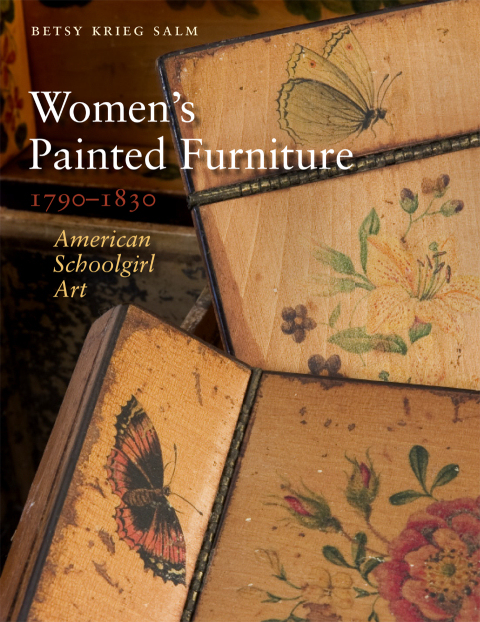
I was researching a post on painted “fancy chairs” from the Federal era and after when I got distracted by a great book and its subject matter: Betsy Krieg Salm’s Women’s Painted Furniture, 1790-1830 (University Press of New England, 2010) caught my eye in the library for numerous reasons (it’s a beautiful book, I love painted furniture, the era coincides with Salem’s golden age, so I knew I’d find some good stuff in it), but once I opened it I could not put it down. The result of three decades of research by the author (who is an ornamental artist herself), the book is art history, social history, education history, cultural history, world history all at the same time.

The subtitle, American Schoolgirl Art, is particularly appropriate as this book is about training, expectations, and influences as well as the motifs which decorate the furniture. I had never really considered the distinct genre of “schoolgirl art” and now I’m curious about its place in other eras and cultures. Lots of painted pieces are examined in Salm’s book, but my favorite by far are the work boxes produced by young women from relatively wealthy families, like Salem’s own Mary Derby Prince, the daughter of a Salem ship captain, with connections by blood and marriage to two of Salem’s most commercially aristocratic families, the Derbys and the Ropes. Another Salem box from the same era (and milieu) is that of Hannah Crowninshield, from the collection of the Peabody Essex Museum. Have I ever seen this before?  I don’t think so, but I could have walked right by it. I am familiar with samplers, of course, and the various types of wooden, decorated boxes produced for documents and other materials, but somehow I have never put the two together in the form of a work box, produced by young women as both an example of their work and for their work. Here are some of my favorites from the book:

Work Box by Ann Trask, Rowson Academy, Boston, circa 1810-20. Collection of Old Sturbridge Village.

Lid of Work Box by Hannah Bland, Massachusetts, circa 1810-30. Private Collection.

Detail of Lobstermen from Work Box of Fanny Barber, Gloucester, Massachusetts, 1821. Private Collection.

These boxes are so charming and so reflective of the environments in which these girls lived and worked, as well as the more general cultural influences to which they were exposed.  A little bit more context, for both American schoolgirl art and (transatlantic) work boxes in the first half of the nineteenth century:  a concise yet substantive article about the curriculum and culture at the Misses’ Martin’s School in Portland, Maine, and a few images of professionally-made work boxes from the British Empire. The first box is a particularly expensive example, with leather covering, silk lining, brass fittings, and custom-made sewing and needlework accessories, from the collection of the Victoria & Albert Museum in London.

Work Box, England, circa 1815. Collection of the Victoria & Albert Museum, London.

These last two “cottage” work boxes are both examples of Tunbridge ware, even though they were made in places thousands of miles apart:  southeast England and India. Tunbridge ware is the very intricate type of inlaid woodwork that emerged in the vicinity of Tunbridge Wells, Kent in the eighteenth century, characterized by the creation of mosaic patterns with different colored woods, and sometimes other materials. Tunbridge ware designs influenced American decoration and obviously Asian as well, as the second work box, made of wood veneered with ivory, was made in India around 1790-1800.

Tunbridge ware painted sewing box, early 19th century, Bleasdales Ltd.

Ivory-veneered Work Box, Vishakhapatnam, India, circa 1790-1800. Collection of the Victoria & Albert Museum, London.


Corset Culture

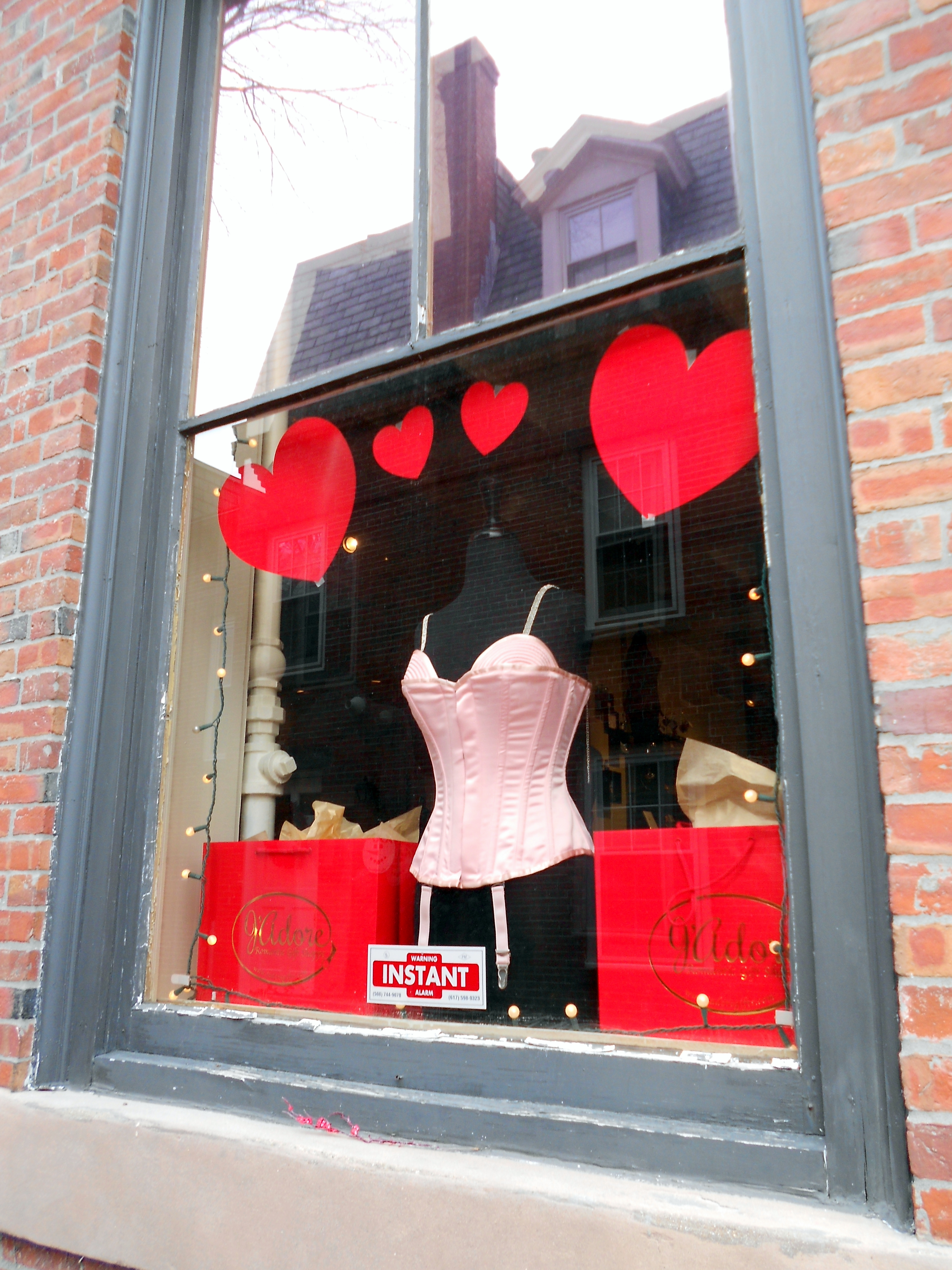
From my vantage point here in Salem, it appears that we’re in the midst of a corset comeback:  not only do we have our own corsetmaker who sells her creations online, but also a new bricks-and-mortar corset shop in Derby Square, right across from Old Town Hall.  A Beautiful Corset (10 Derby Street, Salem) offers made-to-order corsets by the British corset manufacturer Vollers, for which it is one of the few distributors in the United States. The owner explained to me that she has operated an online business for several years, but opening a real shop was a necessity, because with corsets, it’s all about the fit (and the fitting!)  Her expansive store is filled with “models” named after years, as Vollers still cuts their corsets from patterns made in 1899, and 1903, and so on, as well as a gift shop-within-a-shop called J’adore. 

The shop window at A Beautiful Corset/J’Adore, fabric choices for the corsets, a finished product in Chinese silk–with Salem’s Old Town Hall as backdrop.

My interest in corsets doesn’t come from a love of constraint, but rather of craftsmanship, and I always like to see a new shop open up in Salem, particularly one that doesn’t offer the same old (kitschy, witchy) things.  Corsets are both very old and very new, given that they morphed into girdles several generations ago, coincidentally with the invention of all sorts of synthetic and stretchable textiles, and essentially disappeared.  The reappearance of the hand-made corset is something to celebrate, just like letterpress printing.

The commercial revival of corsetry seems to be coincidental with a cultural one.  Several exhibitions featuring the corset have been mounted in the last few years, including the Victoria & Albert Museum’s touring exhibition Undressed:  350 Years of Underwear in Fashion and the Worcester Art Museum’s Bound by Fashionthe Corset in European Art.  It seems absolutely fitting that Worcester should have a big corset exhibition, as that city was the absolute center of corset manufacturing here in Massachusetts (with claims of being the largest corset manufacturer in the world) in the later nineteenth and twentieth centuries, when the Royal Worcester Corset Company (1861-1950) employed over 2000 workers (mostly women) at its state-of-the-art factory.

Pink silk corset, circa 1885-95, from the Collection of the Victoria & Albert Museum, London; Portrait of a Woman, 1556, by an anonymous painter of the Flemish school, Worcester Art Museum, Worcester, Massachusetts, and interior view of the Royal Worcester Corset Factory main stitching room, from Digital Treasures:  a Central and Western Massachusetts Library Project.

Worcester might have had claims to worldwide corset domination, but in terms of advertising claims, the company that seems to have led the industry in innovations was Warner Brothers, the founding corporation of the present-day Warnaco.  The company was founded by a pair of physician brothers, Lucien and Ira Van Der Warner, who founded their “reformed” corset company in Bridgeport , Connecticut in 1874 after several years of lecturing on the considerable dangers of whalebone- and steel-boned corsets.  Their new “healthy” corset was boned with more flexible coraline, an organic product made from the agave americana plant, and they must have spent a fortune on colorful chromolithographic advertising to showcase its natural benefits.  Two decades later, they had both retired as millionaires.

Warner Brothers Coraline Corset advertisement and trade cards, from Duke University Digital Collections and the Library of Congress.

The history of the corset is really essentially the history of women–women’s fashions, women’s health, women’s work–so obviously a short blog post can only scratch the surface.  Another major reason why corsets have been having a “moment” in the past few years is an amazing book:  Valerie Steel’s The Corset:  A Cultural History (2001), a work of intensive scholarship and immediate accessibility.  If you want the whole story of the corset, pick it up.
A 15-year-old corset worker in 1917:  Library of Congress.


Bicycles Built for Everyone

While many European countries have had a consistent bicycle culture for a century or so, America’ s relationship with two-wheelers seems to run in cycles (pardon the pun).  I think we want to be a bicycling nation now, but this was certainly not the case twenty years ago and our national obsession with the automobile will never go away.  This weekend, instead of getting out on my bike (one of the few forms of exercise that I really enjoy) I read (or perused) two books on bicycles, both of which made a pretty strong visual case for the existence of a vibrant American bicycling culture at the turn of the last century.  Cyclopedia by William Fotheringham is an illustrated reference book about the history and trivia of bicycles, a pick-up-and-learn-all-sorts-of-little-things type of book, while Wheels of Change:  How Women Rode the Bicycle to Freedom (with a Few Flat Tires along the Way)  by Sue Macy explores the interesting relationship between women’s’  liberation and bicycling, a connection that is easily supported by the print and popular culture of the period.

An editorial cartoon from the June 19, 1895 edition of Puck magazine links the many varieties of the “new woman” (wearing pantaloons!) with bicycles, and a poster advertisement for the New York Ledger from a couple of years later features a woman wearing even shorter bloomers.  It appears that the bicycle aided the progress of dress reform, at the very least.

Actually the famous bicycless (?) Elsa von Blumen was one of the first ladies to blaze this trail, winning races against horses and other women racers on her high-wheel bicycle in the 1880s and marketing photographs of herself in full bicycle dress.  Bicycle racing of all forms seems to have been extremely popular in the two decades on either side of the turn of the twentieth century:  women against women, women against horses, men against men.

Elsa von Blumen in 1889

A very alliterative advertisement for the “Racycle”

The replacement of the high-wheel (penny-farthing) bicycle by the modern “safety” bicycle intensified interest in two-wheelers in general and racing in particular.  Bicycle clubs were very common and there was a brief window of opportunity just after the turn of the century  for bicycles to become the primary means of transportation, particularly in urban areas.  Advertisements and other forms of ephemera were very prevalent; Americans just seemed to like the image  of the bicycle, as the last poster below indicates.

Bicycle Races in 1895, Library of Congress

Library of Congress

After about 1910 or 1920, with the increase in the production of automobiles and the consequential decrease in price, bicycles seem to have lost their appeal as an adult form of transportation.  The advertising of that era onwards clearly indicates that bicycles were now marketed primarily to children.  Here in Salem, Parker Brothers took advantage of the emerging juvenile market by turning out bicyle-themed books and games.

No matter what product or service they were selling, late nineteenth -and early twentieth-century trade cards often featured children, as well as cute and fuzzy little animals.  Add a bicycle motif and you have an even more adorable image, if that’s possible.  The J & P Coats Thread Company’s bunny and kitten cards below, have always been among the most popular cards with ephemera collectors.

Back to the Future:  Britain’s “Tweed Run” movement (a crusade against bike shorts founded in 2009) spawns American’s “Tweed Ride” movement: