Tag Archives: Women’s History

It was Her Shop

Looking through classified advertisements in eighteenth-century Salem newspapers is one of my favorite pastimes: I can’t think of a better way to gain insights into the public lives of people at that time, though their private lives are, of course, another story. The other day I was wandering around in 1769 and a particularly enticing notice caught my attention: with its large letters and array of goods it could not fail to do so. Priscilla Manning, in big bold letters, listed her worldly goods, encompassing all manner and colors of cloth, caps, hose, shoes and tea, of course, all available at “her shop in Salem, a little above Capt. West’s Corner, at the lowest prices for Cash.” First I had to figure out what all of these eighteenth-century fabrics were: taffeta, satin, lawn, cambric, and linen were familiar to me, but somehow I have made it to this advanced age without knowing what “calamanco” was. I assumed it was an alternative spelling for calico, but no—a very different, thicker, embossed woolen cloth, which has its own (tortoiseshell) cat association in some parts of this world. Not only was I ignorant about calamanco: I had no idea that our neighboring city to the South, Lynn, was a major producer of calamanco shoes in the eighteenth century, well before it became known as an industrial Shoe City. But there’s the reference right in Priscilla’s inventory: best Lynn-made calamanco and silk shoes. My friend and former colleague Kimberly Alexander, author of Treasures Afoot: Shoe Stories of the Georgian Era, set me straight: calamanco shoes were the “everyday footwear of American life” and Lynn-made shoes had such a good reputation in the Boston area that merchants such as Priscilla “proudly trumpeted their origin”. Yes, that’s right: Priscilla Manning was a merchant; why is that occupational term reserved only for men?

Priscilla-Mannings-Shop-Essex_Gazette_1769-12-19

IMG_20200416_145733_213

Calamanco Shoes Deerfield

My calico cat Trinity and some anonymous tortoiseshell I stole from the web, as apparently some parts of the word call torties “calamanco cats”; calamanco wedding shoes from c. 1765, collection of Historic Deerfield (object #HD 2004.26, photo by Penny Leveritt).

Priscilla continued to carry on her business until 1772 when she married a widower from Andover named George Abbot: he brought his two young girls to Salem, and if advertisements are any indication, took over her shop. Suddenly it is George Abbot who is offering all of theses splendid goods, from the same shop, with only a few slight changes, including cash given for empty snuff bottles. Priscilla disappears!  Certainly the commercial contacts necessary to conduct such a cosmopolitan provisioning business were hers, and I bet she continued to work them, but she is no longer the public face of her business. Actually the newspapers give us few insights into the Abbots during the Revolution: George appears in a 1774 letter addressed to General Gage protesting the closing of the port of Boston, and then we don’t see another advertisement until 1783, when the shop has moved to “Main Street”. In the following year, he died at age 37, leaving Priscilla as the guardian of her two stepdaughters and their daughter, also named Priscilla.

Priscilla-Manning-Essex-Gazette-March-17-1772

Priscilla-Manning-Essex_Gazette_1773-04-27_155

So what does Priscilla do? She re-opened her shop, “just above the town pump”, and built a big new house—both in her name. I do wonder if she had more freedom of operation as a widow than a miss, but that conspicuous advertisement from 1769 indicates she was under no commercial constraints before her marriage. The papers carry notices of the marriages of her stepdaughters and, sadly, the death of her own daughter at the tender age of 16, but they can offer no other insights into the life of Priscilla Manning Abbot, until her own death in 1804. What she left behind, to be disposed of by her executrix Elizabeth Cogswell: her mansion house and barn, one-half of wall pew #6 in the “Rev. Dr. Barnard’s meeting-house” and of course, her stock in trade.

Priscilla-Manning-Salem_Mercury_1788-02-19_2

Priscilla-Manning-Salem_Mercury_1789-02-24_3

Priscilla-Manning-Salem_Gazette_1804-04-03_3

Priscilla-Manning-Salem_Gazette_1805-01-18_3

20200416_133113

20200416_133028

I think this plaque should read Priscilla Manning Abbot, Merchant.

Appendix: Priscilla Manning’s ad caught the attention of an expert in the field as well as wandering me: check out Carl Robert Keyes’ analysis at the Adverts 250 Project.


Salem Doctresses and Doctors

I was watching a rerun of Antiques Roadshow last week when a woman from Ohio presented a wonderful trade sign from the 1830s to folk art dealer Allan Katz: on one side it read “Mrs. Dupler, Female Physician” and on the other “Mrs. Dupler, Doctress.” I have been researching the first female physicians in Salem over the past few weeks so this appraisal really caught my attention: that odd word doctress had popped up several times, and I didn’t really know what it meant. Mr. Katz explained that it had “magical’ connotations, but I think it also referred to traditional herbal healing: the first doctresses to advertise as such in Salem newspapers all had the word “Indian” before their “titles”.

pixlr

Doctress-Salem_Register_1852-11-08_1

Doctress-Salem_Register_1862-12-04_3

Doctress-Coly-Salem_Register_1862-12-04_3-1Advertisements in the Salem Register, 1852 & 1862.

The founder of New England’s first medical school for women, the New England Female Medical College (1848-1873), asserted that the ladies of the profession should have a title exclusively their own, and not be compelled to share one with dentists, apothecaries, cattle curers, professors of divinity, professors of law, and male physicians of all descriptions and specialties, but most of his graduates did not agree with Dr. Samuel Gregory. And no wonder: these were women of science who wanted to distinguish themselves from itinerant folk healers, mediums, and other “eclectic” practitioners!

pixlrThe Female Medical College campus on East Concord Street in Boston.

The New England Female Medical College was absorbed into the new Boston University Medical School after 1873, and most of Salem’s first female physicians were graduates of the latter. From the graduation of Sarah E. Sherman in 1876 through the retirement of her former associate Mary Roper Lakeman in the later 1920s, Salem had several successful medical practices run by female physicians. Drs. Sherman, Kate G. Mudge, and Lakeman all included M.D. after their names and Dr. before: they never referred to themselves as “Doctress”. These women attended medical conferences, published papers, attained leadership positions in professional associations, and mentored other female physicians—bringing a succession of young female doctors to Salem. Indeed it’s clear from both the Salem Directories and Polk’s Medical Register and Directory of North America that doctress remained a designation for women who had not attended medical school. I am certain that the esteemed Dr. Sherman (who also was among the first women elected Salem’s School Committee in 1879) was not happy to be grouped together with doctresses like Mrs. Lydia M. Buxton, “Clairvoyant Physician”, and after the 1880s, she was not.

Doctress-Salem-Directory-1902

Screenshot_20200408-072249_InstagramSalem Directories, 1882-1892.

Appendix: for much, much more information and context about the history of women physicians and health workers, check out Drexel University Medical School’s great “Doctor or Doctress?” site: http://doctordoctress.org/.


The Death of Nathaniel Hawthorne’s Little Sister

I’m seeking to cast some light on relatively or completely unknown Salem women for my #SalemSuffrageSaturday posts, in addition to the usual suspects, who live on in perpetual sunshine. Sometimes this is difficult to do, as the sources simply aren’t there, and sometimes you can only illuminate these women through their association with something or someone who leaves a source-strewn trail. Today my focus is on Maria Louisa Hawthorne (1802-52), the younger sister of Nathaniel Hawthorne: we can get to Louisa (which she was called) through Nathaniel, but also, unfortunately, through her tragic, even sensational death. In a very telling and consequential mid-nineteenth-century moment, Louisa found herself, after a lifetime of service to the various family members in Salem whom she was also quite dependent on in her single state, and after a rare vacation to that celebrated hotspot Saratoga Springs, on board the paddle-wheel steamboat Henry Clay on its journey from Albany to New York City on July 28, 1852 when a ravenous fire on board forced her to choose: conflagration or the deep, dark Hudson. She choose the latter, and drowned, in one of the River’s worst maritime disasters, in the conspicuous company of former NYC Mayor Stephen Allen, landscape architect Andrew Jackson Downing, the granddaughter of a President and the sister of a Senator, among many other victims.

Hawthorne NYT Aug 2 1852 Inquest (3)

63.550.101

ArmeniaNew York Daily Times, Aug. 2, 1852; Nathaniel Currier, “Burning of the Henry Clay Near Yonkers,” Metropolitan Museum of Art; The survivor: the Armenia, Antonio Nicolo Gasparo Jacobsen, Christie’s.

It wasn’t just the distinction or associations of some of the victims, it was the way they died. In a display of what can only look like wanton recklessness to us, the Henry Clay was engaged in a fiercely competitive race with another steamboat, the Armenia, on their way to New York City, passengers be damned. Apparently this was common: the fastest steamship (not the safest!) drew the most passengers. The Henry Clay was apparently well in the lead, its engines bursting to capacity, when the fire broke out in their compartments. The ship’s pilot aimed for the banks of the Hudson, but those passengers in the stern (like Louisa) were trapped, and faced with that very difficult choice. To make matters worse, the ship’s paddle wheels kept spinning, further imperiling those who did jump into the river. Louisa was on this journey with her uncle John Dike, the husband of her maternal aunt Priscilla Manning, who survived the wreck and traveled directly to Concord to tell Nathaniel. The siblings were close, as Nathaniel’s letters testify: Louisa was the first person he had written to after his marriage to Sophia Peabody, asking her to come and visit them at the Old Manse, and just before her death, he had written and asked her to come and live with his family permanently. Sophia Hawthorne recounted Mr. Dike’s appearance in a letter to her mother a few days later:

This morning we received the shocking intelligence that Louisa Hawthorne was lost in the destruction of the steamer “Henry Clay” on the Hudson, on Wednesday afternoon, July 27. She has been at Saratoga Springs and with Mr. Dike for a fortnight, and was returning by way of New York, and we expected her here for a long visit. It is difficult to realize such a sudden disaster. The news came in an appalling way. I was at the toilet-table in my chamber, before seven o’clock, when the railroad coach drove up. I was astonished to see Mr. Pike get out. He left us on Monday morning,–two days ago. It struck to my heart that he had come to inform us of some accident. I knew how impossible it was for him to leave his affairs. I called from the window, “Welcome, Mr. Dike!” He glanced up, but did not see me nor smile. I said, “Go to the western piazza, for the front door is locked.” I continued to dress my hair, and it was a considerable time before I went down. When I did, there was no Mr. Dike. “Where is Mr. Dike?–I must then have seen his spirit,” said I. But upon going to the piazza, there he stood unaccountably, without endeavoring to enter. Mr. Hawthorne opened the door with the strange feeling that he should grasp a hand of air. I was by his side. Mr. Pike, without a smile, deeply flushed, seemed even then not in his former body. “Your sister Louisa is dead!” I thought he meant that his own sister was dead, for she also is called Louisa. “What! Louisa?” I asked. “Yes.” “What was the matter?” “She was drowned.” “Where?” “On the Hudson, in the ‘Henry Clay’!” He then came in, and my husband shut himself in his study. Their son Julian recalls in his memoirs that after receiving the news, Mr. Hawthorne went out, and was seen no more that day. 

At this point (July 30), Louisa’s body had not been recovered, but it was three days later, and Sophia then wrote to her sister Mary: I find that Louisa was not burned, but drowned.

Hawthorne NYT Aug 2 1852

Sophia_Letter_NYPL_DG-removebg-previewNew York Daily Times, August 2, 1852: Sophia Peabody Hawthorne Letters at the New York Public Library Digital Gallery.

The deaths of Louisa Hawthorne and her fellow victims were consequential: given the proximity of the tragedy to New York City (Riverdale) and the prestige of some of the victims, this was a story that did not fade away, all summer long and into the fall. Inquests were held, and trials, as the Henry Clay‘s owners and officers were tried for manslaughter. They were all acquitted, but in August the Steamship Act of 1852 was passed in Congress, imposing inspections, regulations and licensing on the industry, and expressly outlawing racing, “to provide for the better security of the lives of passengers on board of vessels propelled in whole or in part by steam.” A tragic and consequential death, but what of Louisa’s life? I’m sad that I can’t flesh it out a bit more: beyond the childhood companion to her brother and sister, the seamstress, the young woman always taking care of one Manning or another, the maiden aunt who was a favorite of Nathaniel’s and Sophia’s children. I’m sure she was all these things and a lot more, and I’m not sure whether she preferred to spell her family name Hathorne or Hawthorne.


Sisters in Service: Salem 1918

When your focus is on historical women, as mine has been for these 2020 #salemsuffragesaturday posts, sometimes you find their stories are somewhat segregated from what is going on at a particular time, and sometimes it is clear that their stories are absolutely integral and central to what is going on at the time. Salem’s experience of the Influenza Epidemic of 1918 is illustrative of the latter case: nurses were not only on the front lines of this strike; they constituted primary care. And there were simply not enough professional nurses to go around in the context of both war and contagion, particularly in the panic months of September and October. Salem was actually well-positioned to meet the challenges of a contagious epidemic: it had a brand new, state-of-the-art hospital with its own nursing program and several charities which focused on “public health nursing”: the Woman’s Friend Society (still thriving today) operated a “District Nurse” (later Visiting Nurse) program under the direction of Superintendant Miss Pauline Smith, and the Committee on Prevention of Tuberculosis had an “Instructive Nurse”, Miss Teresa Trapeney, on staff. The City had been battling the “Great White Plague” for quite some time, but it had to supplement its forces to deal with the “Spanish Flu”.

Influenza-Collage

Salem-Hospital-1910-3

Sisters Oct 2 1918

20200326_114532The 1910 Associated Charities of Salem Annual Report in 1910 features a rendering of the new Salem Hospital on Highland Avenue, which was opened in 1917; Boston Daily Globe advertisement, October 2, 1918; the Woman’s Friend Society on Hawthorne Boulevard.

Before I delve into that response, a few words about the nature and mortality of the 1918 Influenza Epidemic, in general and in Salem. There have been quite a few references to it over the past few weeks, as people naturally want a historical precedent for any crisis, but many of these references have been incorrect, even wildly incorrect. For example, President Trump’s March 24 assertion thatYou can’t compare this [COVID-19] to 1918 where close to 100 million people died. That was a flu, which — a little different. But that was a flu where if you got it you had a 50/50 chance, or very close, of dying. Maybe the 100 million estimate can be overlooked as global mortality estimations are all over the place—everywhere from 20 million to 100 million—but that mortality rate assertion is ridiculous: the real number is in the neighborhood of 2.5%. The president’s sloppy statement misrepresents both the nature of the threat and the heroic efforts that were made to combat it: it is dehumanizing. I’ve NEVER understood the vagueness of the general mortality numbers until I delved into the research for this post: it is very clear from the Massachusetts records that there was both epidemic influenza as well as influenza-triggered respiratory diseases, predominately pneumonia, in 1918. Some accounts and estimates only include the primary category; others include both: these figures from 1917-1918 illustrate the connection between the two diseases and their notable increase over the year.

Influenza-1918-Table-3

This same source, the Commonwealth of Massachusetts’ annual reporting of the state’s vital statistics for 1918, lists 151 deaths from influenza and 102 for pneumonia in Salem for 1918, but this is an under-representation of the threat: the daily papers report as many as 1500 cases during some days in late September. Another factor which likely bears on all of the Massachusetts statistics is the fact that the Board of Health did not rule influenza a “reportable disease” until October 2, well into the epidemic. The Annual Report of the Salem Hospital for 1918 notes the 40% increase in patients over the year, and offers the assertions that a larger increase might have been made if during the Influenza epidemic in September and October, it had been possible to secure additional nurses to replace those who were ill. This increase affords conclusive proof of the claim of the hospital authorities that it was not meeting the needs of the community. Salem Hospital could not meet the needs of its community in the fall of 1918 not only because it had insufficient nurses: many of the nurses who were on staff, in addition to physicians, came down with influenza themselves, and so the decision was made to establish a separate, emergency hospital to limit the spread of the contagion. Tent cities sprung up all over eastern Massachusetts in the fall of 1918, but in Salem one gets the impression that that was never a consideration: this was only four years after the Great Salem Fire—which prompted the establishment of several tent cities—after all. I can’t determine whether they were asked or they volunteered, but the Sisters of St. Chretienne, recently established in the former Loring Villa in South Salem, offered up their newly-expanded building as the emergency influenza hospital, and themselves as nurses. Consider their situation: they themselves had been displaced from their Convent-Noviate on Harbor Street by the Fire in 1914, had purchased and overseen the expansion and transformation of the residential Loring Villa into a school, and had just opened that school when the epidemic hit! Only their fellow St. Chretienne sisters across the Atlantic found themselves in a more challenging situation, in the midst of the major war zone of World War I.

Influenza Lawrence

Lawrence mask room (3)

Brookline Tent City (3)

Tent Hospital Brookline (3)

Ste Chretienne SSU (3)

20200327_145600Influenza tent hospitals in Lawrence (top two–including the “mask room”: they had MASKS then!) and Brookline (more masks on display), September 1918, Lawrence History Center Digital Collections and Brookline Historical Society; The St. Chretienne Academy in South Salem, now part of the South Campus of Salem State University, served as Salem’s emergency influenza hospital in the fall of 1918, Salem State University Archives and Special Collections.

Both education and health care were encompassed within the mission of the Sisters of St. Chretienne, and their fellow sisters from Salem’s other Catholic orders, the Sisters of Charity of the Immaculate Conception and the Sisters of Notre Dame, also served as nursing aides during that fevered fall of 1918. The situation called for a sacred-secular collaboration, as the Sisters were joined by the Woman’s Friend Society and its District Nurses as well as individual Salem women answering Governor Samuel McCall’s call that able-bodied people with any medical training volunteer their services. After several intense weeks in late September and early October, the influenza “crest” (rather than curve) appeared to be subsiding—or at least that was the story in the press—but by years’ end, it appeared to be on the rise yet again: in Salem, Miss Julia E. Pratt, the matron of The Seamen’s Widow and Orphan Association on Carpenter Street, found that the majority of her charges were infected with the persistent influenza, and across Massachusetts, the call went out once again: to women. 

Influenza Immaculate

Sisters BG Oct 9 1918

Influenza Years End

Orphans CollageBoston Daily Globe: September 30, October 9, December 20 & 23, 1918.


The Fair’s the Thing

Like everyone else, I’m thinking about healthcare workers these days, so I wanted to focus on Salem women who were physicians or nurses for this week’s #SalemSuffrageSaturday post: I’ve found THREE practicing women physicians in Salem before 1900 and lots of wartime nurses. But I don’t have their stories straight yet: I need more context, more details, more narrative. They are not ready, or more accurately, I am not ready for THEM. So I thought I would focus on philanthropic ladies’ fairs in general, and one fair in particular, as these events were a major expression of the civic engagement of Salem women in the mid-nineteenth century. Starting in the 1830s and extending through and beyond the Civil War, Salem ladies held fairs for a host of benevolent societies and causes: seamen’s aid, widows and orphans of seamen, anti-slavery, the Sanitary Commission and other efforts to support the Union army, temperance, suffrage. These fairs were months in the planning, raised significant funds, and got a lot of press. They were not only a major form of civic engagement for women, but also of civic action and association. It seems impossible to underestimate them, although I’m sure I’m only dealing with the veneer of Salem society that had the time and the resources to dedicate to such endeavors. But still, you’ve got to follow your sources, and many of mine lead me to fairs.

Ladies Fair Boston 1858 (2)Ladies Fair for the Poor in Boston, 1858. Boston Public Library

I believe that the first fair in Salem was in 1831, but the first fair that made a big splash and set the standard for all of the fairs to follow was held two years later at Hamilton Hall as a benefit for the newly-established New England Asylum for the Education of the Blind (later the Perkins School for the Blind), the first institution of its kind in the country. Its founding director, Samuel Gridley Howe, has developed a reputation as the authoritarian husband of abolitionist and suffragist Julia Ward Howe of Battle Hynm of the Republic fame, but in the 1830s he was a handsome and dashing doctor (and also a passionate abolitionist) who had served six years in that most romantic of conflicts, the Greek Revolution, and wrote about it. It’s easy to understand how and why he inspired devotion among the ladies of both Salem and Boston: there were competing fairs for his school in 1833, which drew a lot of attention to both. There were quite a few articles on the rival fairs in a variety of newspapers, and we also have the Fair program, as well as the substantive research of Megan Marshall, who identifies Elizabeth Palmer Peabody as one of the prime movers behind the Salem event in her Pulitzer-prize-winning book The Peabody Sisters. Three Women who Ignited American Romanticism. 

samuel-gridley-howe

Peabody Sisters (3)Samuel Gridley Howe in the 1850s; Megan Marshall’s great book, although I also like the earlier text on the Peabody sisters: Louise Hall Tharp’s Peabody Sisters of Salem, which I read over and over again as a teenager—I think it’s one of the reasons I ended up in Salem! A really good example of collective biography.

Elizabeth was the eldest of the famous three Peabody sisters of Salem (who deserve their own post; I can’t believe I haven’t written about them yet!), all of whom became intertwined in a Boston world of romanticism and reform. Middle sister Mary would marry educator Horace Mann, and youngest sister Sophia would eventually marry Nathaniel Hawthorne, but in the 1830s they were all struggling in somewhat-genteel poverty. Elizabeth had made the acquaintance of Howe (through Mann) in Boston, and believed in him and his cause, but she also saw the fair as a way to promote the artistic talents of Sophia and possibly raise the family’s dwindling fortunes. This explains why Sophia’s name—(along with that of Hawthorne cousin Ann Savage)—are the only names in the entire program for the Ladies Fair.

Screenshot_20200320-064352_Drive

Screenshot_20200320-064410_Drive

Screenshot_20200320-064438_Drive

Screenshot_20200320-064450_Drive

Screenshot_20200320-064501_DriveCatalogue of Articles to be Offered for Sale at the Ladies’ Fair at Hamilton Hall in Chestnut Street, Salem, on Wednesday, April 10, 1833 for the Benefit of the New England Asylum for the Blind, National Library of Medicine @National Institute of Health.

It is so great to have the entire catalog for this fair, evidence of the creative craftsmanship—and scavenging I suspect—of Salem ladies! Lots of dolls and figures (I would love to see the “large” Queen Elizabeth): so much needlework, so many pincushions, and the two “splendid” paintings by Miss Sophia Peabody, of a place she had never seen—but would much later, after she married Mr. Nathaniel Hawthorne. It was a huge success in terms of proceeds, a fact acknowledged even by the Boston papers, and inspired many repeat performances.

Ladies Fair Boston Post April 12 1833

20200321_091856

20200321_091844$3000! in proceeds reported in the Boston Post; Hamilton Hall this morning: still the site of much civic engagement, but unfortunately not today, or for a while……..


The Battle of the Roses

For this #salemsuffragesaturday, a look at the contest between Massachusetts suffragists and anti-suffragists at the turn of the last century, with particular reference to the Massachusetts suffrage referendum of 1915. Though Massachusetts had (and still has) a well-deserved reputation for progressiveness, it was (and still is) a very traditional state, and has the distinction of producing one of the earliest and strongest anti-suffrage organizations in the later nineteenth century: the Massachusetts Association Opposed to the Further Extension of Suffrage to Women, founded in 1895 (on the foundation of an earlier association, established right after the notable school suffrage victories in 1880). Like their opposition, the Massachusetts Woman Suffrage Association, the Anti-Suffragists had a central office in Boston, and branch committees throughout the state, including Salem. By 1915, their periodical, The Remonstrance against Woman Suffrage, claimed to represent the views of anti-suffragists around the country as well as the over 33, 000 Massachusetts members in 423 municipalities and 130 branch committees. They rallied all of their resources and members to defeat suffrage in the 1915 referendum, thus winning a significant battle but not, ultimately (and fortunately!) the war.

Remonstrance 1915 (3)

Screenshot_20200310-154555_Chrome

One has to do some real historical reorientation to understand the anti-suffragist position, as it is contrary to everything we believe now. As professed by both men and even more stridently by women, it centers on the family within the home, the natural domain of women, and where they were empowered to make their most important contributions to society. In order for society to function in an effective way, separate spheres for men and women must be maintained: public affairs for men; domestic life for women—and domestic life was perceived as the “higher” sphere. Suffrage would impose civic responsibilities on women which they did not seek or need: as you can see from The Remonstrance above, the message was that the vote was being imposed on women by a radical minority of their gender. It gets a bit more complicated (and confusing!) when you consider that many Anti-Suffragists were active club and society members, striving for moral, educational, and social reforms outside the home: one would think that their various missions would be aided by suffrage, but somehow this was not the belief. When I look at the list of Salem women who were members of the city’s anti-suffrage committee, I recognize familiar names of active women: Mrs. Edward C. Battis, Miss Sarah E. Hunt, Mrs. S.E. Peabody, Mrs. John Pickering, Miss P.M. Waldo, Mrs. William Rantoul, Miss Anna L. Warren and Miss Ellen Laight. I also realize that these women who lived right next to women who were notable Suffragists, so there must have been some interesting neighborhood discussions! More specifically and alarmingly, the Anti-Suffragists expressed their fears that votes for women would lead to discord in the existing marriage relation, which would tend to the infinite detriment of children, and increase the alarming prevalence of divorce throughout the land, and made associations between suffrage and socialism, Mormonism, and pro-German sentiments during World War I.

AS Pro German (2)

AS Madonna (2)

The Anti-Suffragists wrote and distributed flyers and pledge cards, published their newspaper, and held rallies and other public events, just like the Suffragists, although their meetings were clearly less numerous and less open: the committee’s records, among the digital collections of the Massachusetts Historical Society, reveal an apparent desire to control the interplay and messaging of public events. They adopted the red rose as their symbol from the beginning—a contrast with the suffragists’ yellow sunflowers and roses—but utilized it with increasing intensity from 1914 on, in their initiatives aimed at the defeat of the 1915 referendum. As Election Day of 1915 approached—and particularly the big Suffrage Parade planned for October 16— the efforts of the Anti-Suffragists became more focused and more public, with a big showdown on Parade Day, when over 100,000 red roses draped individuals and structures lining the street as the Suffragist marchers, wearing yellow banners and/or roses, walked by.

Screenshot_20200313-075639_Chrome

Screenshot_20200310-151752_Chrome

Red Roses

AS Schlesinger

Screenshot_20200313-215403_Chrome

Screenshot_20200313-080054_Chrome

And a few weeks later, a terrible defeat at the polls for Massachusetts Suffragists: with nearly 65% of Massachusetts men voting against universal suffrage. Salem’s return mirrored that of the Commonwealth. Both the Suffragists and the Anti-Suffragists continued their efforts, with the former focusing on the national campaign and a constitutional amendment. Massachusetts became the eighth state to ratify the 19th amendment in June of 1919, and it became law in August of 1920 when Tennessee’s legislature ratified it by one surprising vote: that of first-term representative Harry T. Burn, wearing a red rose on his lapel, who voted “aye” upon the very personal plea of his mother.

Suffrage Returns

Image sources: Ann Lewis Women’s Suffrage Collection; Library of Congress (The Anti-Suffrage Rose); Schlesinger Library, Harvard (Margaret Foley with “the RoseStands for Chivalry sign); Bryn Mawr College Suffrage Ephemera Collection(yellow banner and flower). Newspaper clippings:  Boston Globe, 1914-1915.


Copley Cousins

Two portraits of young Salem women of the mid-eighteenth century, both named Mary and newly-wed, painted by John Singleton Copley wearing the same dress! Whether you’re delving into the reform-minded Salem women of the nineteenth century or the merchant princesses of a century earlier, you quickly form the impression that both groups lived in small worlds. Mary Turner Sargent (1743-1813) and Mary Toppan Pickman (1744-1817) were born and married into money, and their portraits reflect their wealth and status: their shared dress shimmers and glows in Copley fashion, and handcrafted Georgian detail creates a solid background for their portrayals.

Copley mrs._daniel_sargent_(mary_turner_sargent)-large

Copley Pickman ag-obj-8802-001-pub-large

Copley Detail (3)Mrs. Daniel Sargent (Mary Turner), Fine Arts Museums of San Francisco; and Mrs. Benjamin Pickman (Mary Toppan), Yale University Art Gallery + plus a crop of the serpentine trim on their dress.

I love John Singleton Copley’s American portraits: they seem far more authentic, engaging, and artful than the English paintings from his later career. These women lived in a world he knew well, and into which he would eventually marry. Unlike our two Salem Marys, he was not born into wealth and privilege, but his marriage to Susanna Farnham Clarke, the daughter of the prominent Boston merchant Richard Clarke (who lost a valuable cargo to the Boston Tea Party) as well as his talent and productivity enabled him to rise quite high in pre-revolutionary society. He painted famous patriots and loyalists alike, but he was firmly in the latter camp, and thus he decamped to England in 1774. Mary Turner Sargent married into a family of Gloucester patriots; Mary Toppan Pickman’s husband Benjamin was a Loyalist exile—I’m wondering if he ran into Copley in London, as that was another small world.

Copley John_Singleton_Copley_-_The_Copley_Family_-_Google_Art_Project

Copley family cropJohn Singleton Copley, The Copley Family, 1776-77, National Gallery + a crop of Susanna’s blue dress.

There are two other Copley portraits of Salem women that I know of: that of Lydia Lynde Walter (1741-98), a contemporary of the two Marys, and Abigail Pickman Eppes Gardiner (1733-1980), Mary Pickman’s sister-in-law! One imagines lots of chatter among these women about their portraits—and comparisons. Were the two Marys jealous of Abigail, who is clad in indulgent drapery in more individualistic fashion? Abigail had to go with a more classical look, perhaps, so not to look too provincial when she departed for England and Loyalist Land. Lydia Lynde Walter lived with her husband William, the rector of Trinity Church, until 1776 and then they fled to Nova Scotia, a Loyalist destination for those who wanted to remain in North America, where they sat out the Revolution and remained until 1791.

Copley lydia_lynde-large

Brooklyn_Museum_-_Mrs._Sylvester_GardCopley iner,_née_Abigail_Pickman,_formerly_Mrs._William_Eppes_-_John_Singleton_Copley_-_overallLydia Lynde Walter,Virginia Museum of History and Culture; Abigail Pickman Eppes Gardiner, Brooklyn Museum.
Of all these women, only Mary Toppan Pickman remained in Salem throughout her life. Mary Turner Sargent was the great-granddaughter of the John Turner who built the house which would eventually become known as the House of the Seven Gables, the granddaughter of the John Turner who would replenish the family fortune, and the daughter of the John Turner who lost it all—so I guess it’s a good thing that she resided in her husband’s native city of Gloucester, somewhat removed from the scene of her family’s failing fortunes. Mary Pickman remained in Salem even as her husband left for London, managing those properties that were not confiscated and raising their four young children (+ taking care of elderly parents). She seems to have done a a more than capable job, as tributes to her capabilities and pleasant nature are numerous. She and her husband exchanged letters during the course of the Revolution, but of course only ONE of hers survives compared with many of his. Fortunately it is revealing. In June of 1783, she wrote:

I am happy my dear Mr. Pickman that I have once more heard the glad tidings of peace, but my happiness will not be complete until till you return. The satisfaction you received from my letter could not be greater than I felt as seeing yours of the 20th February. I am glad you are disposed to return to America and have no doubt that in a short time every obstacle will in a short time be removed—our fortune is not so much depreciated perhaps as you imagine. We have a very good one left enough to answer any purpose. It has not been in my power to purchase any bills lately but will if possible send you sufficient to pay all demands before you leave England….. (George Francis Dow, ed., The diary and letters of Benjamin Pickman (17401819) of Salem, Massachusetts).

He had been gone for TEN years, leaving her with all of their family responsibilities and instead of writing the war is over, come back immediately, I’m exhausted she writes of her incomplete happiness in his absence and promises to send money to settle his debts before his departure. By all accounts the Pickmans had a very happy marriage, strong enough to withstand this separation: they had two more children in the years following his return.

Looking at the portraits of the blue-dressed Marys and Lydia Lynde, painted in 1763-64, it seems impossible to imagine how much their lives will change with the Revolution; Abigail, posing in the 1770s, looks a bit more wary. Copley captured a waning colonial world, and then left it.


What they Wore

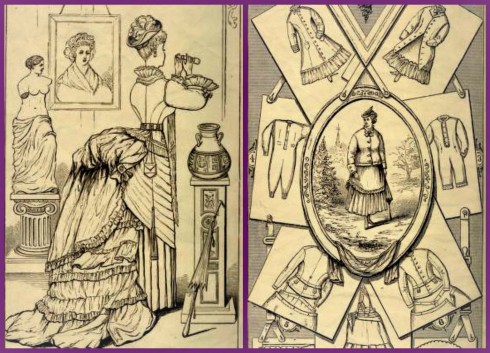
My previous #SalemSuffrageSaturday posts have been pretty wordy—and pretty serious; I think we all just need to see some Salem women of that gilded, reforming era at the end of the nineteenth century. Ever since that Phillips Library digitized part of their large collection of glass plate negatives created by photographer Frank Cousins I have been pouring over these images at the Digital Commonwealth looking mostly at streets and structures. But Cousins captured people as well—lots of people—even if they were not always his primary (or secondary) consideration. Sometimes he lets them pose; often he captures them unobserved, mostly on busy Essex Street. Now that I know how active Salem women were, for abolition, suffrage, temperance, and other causes, I’m wondering if they also embraced dress reforms, but I’m not enough of a sartorial scholar to tell! The other issue is dating: Cousins’ photos date roughly from 1880 to 1915, but very few are dated precisely, and fashion changed within these decades.

Dress Reform CollageUnreformed dress and reformed suit, from Abba Goold Woolson’s  DressreformA Series of Lectures Delivered in Boston, on Dress as it Affects the Health of Women, 1874.

Of course the women on the streets of Salem, going about their business, or striding or sitting on a Willows avenue or beach, are not going to represent either the “ideal” corseted and bustled or sturdy-suited model figures above, but something in between, clad for their real lives. I don’t see a lot of “tight lacing” in the photos below, but I definitely discern corsets, and the skirts are only shorter for the girls. I’m a bit wary of extreme photo manipulation (photographs are sources) but I have no problem with extreme zooming!

At Salem Willows: the first images is dated 1880; not sure about the rest—but I believe that draped skirts of the second photograph are from the later 1880s.

WTW Willows Pavillion 1880 (2)

WTW Willows 2 (2)

WTW Willows Hospital Point (2)

WTW Willows (2)

Streetwear, 1890s? Again, the first image is dated—it is Columbus Day, 1892—but the rest are not. Young women were always allowed to wear shorter skirts, apparently (like the girls in front of the old Salem Hospital on Charter Street and the Pickering School on North Street). Shop windows (like Cousins’ own Bee-Hive) and signs are also clues for evolving fashion. Lots of parasols on the streets of Salem, in rain or shine. The “leg of mutton” sleeves worn by ladies in the last two photographs clearly date to the later 1890s: sorry she is so blurry, but my very favorite anonymous “bicycle girl” on Essex Street seems like a perfect match for the famous Gibson Girl.

WTW Columbus Day 1892 (2)

WTW CHarter Street Hospital (3)

WTW Pickering School (2)

WTW Bee-Hive (3)

WTW Beehive2 (2)

WTW 207 Essex (3)

WTW Essex 153 (2)

WTW Brooks (2)

WTW St Peter Essex (4)

WTW Gardner Street (2)

WTW Margin Street (2)

pixlrFrank Cousins Collection of Glass Plate Negatives at the Phillips Library via Digital Commonwealth +ephemera at the Library of Congress.


Suffrage in Salem: a Big Election!

I always tell my students that history is not necessarily linear: movements and ideas move forward and then fall back and “progress”, however you choose to define it, is always a result of struggle. The struggle for women’s suffrage is a case in point, played out on a national stage as well as a local one. I’ve had to piece together the history of the Salem Suffrage movement from a variety of sources, as the records for its main organization have disappeared, but I think I have it down now, and it was definitely characterized by fits and starts. The connection between the abolition and suffrage movements before the Civil War is very clear: while a petition calling for universal suffrage was submitted to the Massachusetts legislature in 1850 by a group of active Salem reformers, both women and men, abolition was the higher priority during the following decade and the suffrage initiative remained on hold during the Civil War and its aftermath. The debate over the 15th Amendment caused a schism in the national suffrage movement, with some leaders (Susan Anthony and Elizabeth Cady Stanton) opposing the enfranchisement of black men before women had achieved the vote and others (Julia Ward Howe, Lucy Stone) favoring a more incremental approach to suffrage with the enfranchisement of black men as a first step. This split resulted in the formation of two associations, the National Woman Suffrage Association (NWSA) of Anthony and Stanton, and the American Woman Suffrage Association (AWSA), led by Lucy Stone, as well as a cascade of regional, state, and local associations. Supporters of suffrage in Salem, both women and men, were firmly in the Stone camp, and we can follow their efforts through Stone’s weekly newspaper, the Woman’s Journal. Even though the 1870s started with division, there was also an air of optimism in the air: women in Wyoming and Utah won the vote in 1869 and 1870, so why couldn’t reformist Massachusetts be next?

20200114_110638Courtesy Peabody Essex Museum’s Phillips Library.

The Woman’s Journal reports that yearly conventions were held in Salem, generally at the Lyceum, along with regular meetings of the Salem Woman Suffrage Club, which included woman and men and were clearly as much social occasions as strategy sessions. The editors of the Journal  seem to have favored an approach that was not only incremental but “pleasant”, as the account of the 1874 convention (below) illustrates: much praise for the food and flowers, and an observation that “other clubs may take a lesson from this of Salem, which draws members by pleasant means—clergymen, lawyers, judges, editors and not least in influence, women. What remains to do now is the steady and continuous circulation of tracts as a means of enlightenment, and with the light will come the end”. Yet there were several women in Salem who made it clear that tea parties and the dissemination of pamphlets was not enough, writing letters to the editor that expressed the general opinion that while the Salem club was popular, it wasn’t actually doing anything: such expressions seem to be coming from those women who were also involved in other causes like temperance, settlement, and the “moral education” of “fallen women”. As was the case before the Civil War, suffrage was interwoven with other calls for reform.

Suffrage Collage 1874

But maybe the “pleasant” approach was working. In 1879 the Massachusetts legislature passed a “school suffrage” bill, enabling Massachusetts women the right to vote in school committee elections. This definitely seems like a big step forward, but apparently it was an action that represented the traditional belief that education matters were within the realm of female expertise more than any desire to move towards universal suffrage on the part of Massachusetts legislators. Nevertheless, Salem women offered up four female candidates and really turned out at the polls in December of 1879, with the result that all four women were elected to the Salem School Board, the highest number in Massachusetts. The Boston Globe reported that there was “great activity at the polls” with “undertain” results on Election night (December 9), but on the next day the election of the four women was confirmed.

Suffrage Boston Globe December 9, 1879 (2)

Suffrage 1879 Election Library of Congress (2) Boston Globe headline, December 9, 1879; Library of Congress.

And suddenly there was a brand new School Committee in Salem! The four women elected were Mrs. Mary G. Ward of Federal Street, a noted activist for suffrage and temperance in the city, Dr. Sarah E. Sherman, who I believe was Salem’s first female physician, Emma B. Lowd, very active in veterans’ affairs as an officer in the National Woman’s Relief Corps Committee, and Mrs. Lurana N. Almy, the wife (and partner, really) of James. F. Almy, the founder of Salem’s famed Almy’s, Bigelow and Washburn store. Unfortunately Mrs. Almy died before she could take up her seat on the committee, but the other three women served for several years, paving the way for more women members. The ground-breaking year of 1879 was capped off by the submission of a suffrage amendment petition to the U.S. Congress by the Salem Woman Suffrage Committee, signed by the men who could vote in one column and the women who could not in another.

SUffrage School Committee Colored

SUffrage Sarah Sherman 1877 Salem Directory (2)

Suffrage Emma Lowd historyofdepartm01woma_0129 (2)

SUffrage petition CUNYSalem School Committee Annual Report, 1880; Official Souvenir Program of the 24th National Encampment, Boston, MA, 1890……also the Eighth Annual Convention of the Woman’s Relief Corps;“Petition from the Citizens of Massachusetts in Support of Women’s Suffrage,” HERB: Resources for Teachers, accessed February 21, 2020, https://herb.ashp.cuny.edu/items/show/1683.

But two (or three or four or five) steps forward were followed by several steps back. In typical contrary Massachusetts fashion, the multi-layered suffrage movement provoked a counter-movement in the form of the Massachusetts Association Opposed to the Further Extension of Suffrage to Women, established in 1895 and with a Salem branch headed by Miss Anna L. Warner and Miss Ellen B. Laight. Two Massachusetts suffrage referendums were soundly defeated—in 1895 and 1915—before the Commonwealth ratified the 19th Amendment on June 25, 1919.


Sarah Symonds of Salem

When I was a perpetual antiques hunter and picker some time ago, I would run into cast iron doorstops and plaster wall plaques with chipped paint depicting houses and gates and various interior details everywhere: they did not appeal to me and I passed them right by, but I remember seeing them often, in Maine, New Hampshire and western Massachusetts. When I moved to Salem I realized they were Sarah Symonds pieces, crafted right here by a very entrepreneurial artist. To be honest, I remained rather immune to their charms, even in my intense Salem collecting phase, and I still don’t really appreciate them, but I see that many other people do as their prices have certainly increased dramatically. I do have deep appreciation for Sarah the businesswomen, though, and the artistic ambassador of “old Salem,” along with her contemporaries Mary Harrod Northend and Caroline Emmerton.

20200121_133721

pixlr_20200203112531517

Screenshot_20200203-095432_ChromeSarah Symonds pieces from the archive of sold lots at Worthpoint; if I was going to purchase one it would definitely be the Gardner Pingree House.

Sarah (1870-1965) was a ninth-generation Salem resident, descended from the John Symonds (c. 1595-1671) who emigrated from East Anglia in the 1640s. He was an experienced joiner who trained his sons James and Samuel in the cabinet-making trade. The Symonds shop excelled and flourished, and its products are among the most valued pieces of early American furniture today: a small valuables cabinet made by James was purchased by the Peabody Essex Museum for nearly two and half million dollars in 2000. Successive generations of the Symonds family turned to other occupations, but they remained in Salem, and a street named after them testifies to their long residence. Sarah seems to have spent her whole life in Salem: she graduated from Emerson College in Boston (to which I assume she took the train) and later vacationed in a summer cottage in Marblehead but other than these forays she seems very bound to Salem, and to her work. I’m not sure exactly when she first started making bas-relief sculptures and plaques—most likely in the 1890s, and perhaps influenced by the careers of the Salem sculptors Louise Lander and John Rogers—but she received several mentions for her Hawthorne pieces in the press coverage of the centennial commemoration of his birth in 1904. And then she was launched, making and selling pieces in the recently-moved John Ward House on the campus of the Essex Institute, at the Snug Harbor Shop adjacent to the House of the Seven Gables, for a gift “shoppe” at the Hawthorne Hotel, and ultimately at the “Colonial Studio” in the Bray House on Brown Street. As you can see below, she also fulfilled orders by mail.

20200121_134146

20200114_110458

20200121_133906

There are several folders of Sarah’s business records in the Phillips Library and when I started going through their contents I became very fixated on the copyright registration certificates she filled out for each of her sculptures: in my real job I’m a sixteenth-century historian, so I’ve never used sources like these! They are so detailed, written in her own hand, and it occurred to me that seldom do we see artists describe their work so matter-of-factly. No doubt her applications were prompted by the passage of the 1909 copyright law, which extended protections to “works of art; models or designs for works of art”: her first certificates date from just after the passage of this landmark law (which replaced a law made in 1790!)

20200121_133245

20200121_132156

I like to blame Daniel Low for the increasing prominence of the Salem witch, emblazoned on anything and everything, but to be fair, Sarah expanded her witch offerings over the first half of the twentieth century consistently: that category grows and only rivals “Salem’s Colonial Doorways” on her price lists. You can kind of feel some of her Colonial Revival contemporaries (especially Mary Harrod Northend) shirking away from the witch, but Sarah ran with it, producing round witches, tall witches, witches on brooms, witches with cauldrons, witch plaques and freestanding “statuettes,” witch medallions, and ink-well witches. Oh well, a lady has to make a living—and give her customers what they want.

pixlr_20200206150433883

20200114_110408

20200121_133814

20200121_133608Sarah Symonds papers at the Phillips Library, Rowley:  MSS 0.202; The library also has some price lists. There’s an article about Sarah’s bas-reliefs by Barbara Morse White in the Antiques Journal (1976), and you can also read a short biography by Salem preservation architect John Goff here