Tag Archives: Tudors

A Tudor House in Salem

How did I miss it? Here I am, a sixteenth-century English historian living in Salem, and I never knew about a reproduction sixteenth-century house built right here in 1927 by a mason named James H. Boulger. I’ve posted on “English” houses in Salem before, and often lamented the lack of Tudors in town, all the while blind to the existence of this interesting little house in South Salem. While I was researching the “Electrical Home” in this same neighborhood (with streets named for U.S. Presidents), I came across a story entitled “Salem Home and Garage Built in 16th Century English Style” in the November 21, 1927 edition of the Boston Globe. Yesterday I walked down from my office at Salem State to see this very house, hoping that it was still standing and bore some semblance of its sixteenth-century self and had not been turned into a ranch, or even worse, a “Colonial”. But as I walked down Cleveland Road and saw its pitched roof approaching, I got more excited, and there it was: an adorable, obviously well-maintained and well-loved, Tudor cottage.

Tudor second.jpg

Tudor third

Tudor fourth

Tudor Sixth

My only basis of comparison is the grainy newspaper photograph, but it looks like the major alteration to Boulger’s original house is the integration of the originally-freestanding garage. I’m not sure my photographs capture the scale of the house and the interesting pitch of its roof: to me, (and again, for the thousandth time, I’m just an architecture buff) the house looks more Tudor than Tudor Revival. According to the article, all plans were by Mr. Boulger, who is a native of Manchester Eng, and a mason by trade. In designing the building, he was aided by a picture printed in a magazine showing a farmhouse in England during the 16th century. Like many English architects of centuries back, the designer has secured the typical English charm that marked the early, simple, unpretentious homes in England. 

Tudor in Salem

I made a limited search for the precise photograph that might have been Mr. Boulger’s inspiration, but contemporary periodicals in America are full of Tudor Revivals and those in Britain tend to feature either “great” Tudor structures or townhouses, like the famous Seven Stars pub in Mr. Boulger’s native Manchester, now sadly long gone. He seems to have invested as much effort into the interior as the exterior, as the Globe article goes into considerable detail about the “outstanding features” of the new/old house: an ‘English box seat’ window, a combination dining room and parlor, natural finished woods, low, wide arches leading to the various rooms, low situated windows and the ‘cold box’, so-called, where vegetables and wines were kept by the English farmer….. Mr. Boulger plans to install old-fashioned furniture in keeping with the exterior of the building. And no doubt he did.

Seven Stars Manchester

Tudor 1

I’m sure that the Seven Stars, widely heralded as one of England’s oldest pubs in its day, was not Mr. Boulger’s inspiration, but wanted to inject a bit of old Manchester here!


The Golden Age of Gift-Giving

Before the Victorians and the twentieth century transformed Christmas into the extravaganza that it is today, New Year’s Day–in the midst of an extended Christmastide– was the occasion for offering and receiving gifts. We know a lot about the meaning and materiality of gifts in Tudor England because of some extraordinary records, and several recent works which have transcribed and interpreted them for all of us, most notably Jane Lawson’s momentous transcription of 24 surviving Gift Rolls from Elizabeth’s reign, The Elizabethan New Year’s Gift Exchanges (2013) and Felicity Heal’s The Power of Gifts: Gift-Exchange in Early Modern England (2015). These two complementary volumes are really interesting and useful (though expensive–fortunately I received one as a gift!). I’m sure you can imagine how valuable and variable these sources are–as Elizabeth received a lot of stuff from her courtiers: pounds of gold coins in little bags made of luxurious fabrics and embroidered, beaded and embellished, books, jewels, articles of clothing, as well as more unique items. Let’s just look at one year’s haul, recorded in the roll from 1578-79 entitled New Yer’s Guiftes giuen to the QUENE’S MAIESTIE at her Highnes Manor of Richmond, by these Persons whose Names hereafter do ensue, the First of January, the Yere abouesaid, which has been digitized by the Folger Shakespeare Library.

gift-collage

elizabethan-gift-roll-folger

gift-roll-in-situ

Our sources: the gift rolls are quite literally ROLLS.

It’s a long roll, organized by the titles of the gift-bearers, from Earls to Gentlemen, and the value of their gifts, a perfect illustration of currying favor. Elizabeth’s long-time favorite, the Earl of Leicester, offered up a very fair jewel of gold, being a clock fully furnished with small diamonds pointed, and a pendant of gold, diamonds, and rubies, very small; and upon each a lozenge diamond, and an apple of green and russet enamel. From the Earl of Ormond, a very fair jewel of gold, wherein are three large emeralds set in which and red roses, one bigger than the other two, all the rest of the same jewel garnished with enameled roses and flowers, furnished with very small diamonds and rubies; about the edge very small pearls; and in the bottom is part of a flower-de-luce garnished with small diamonds, rubies, and one sapphire, with three mean pendant pearls, two of them small; the backside a green-enameled flower-de-luce. More jewels, lots of gold coin, and embellished apparel, including girdles and kirtles, mantles, “forepartes”,”scarfs”, petticoats, caps, mufflers, gloves and handkerchiefs  in cloth of gold, satin and velvet. Very detailed descriptions: you can easily see why these rolls are so valuable to historians of clothing and accessories, as well as to those attempting to piece together the intricate and dynamic relationships that formed the Elizabethan Court.

elizabeth-in-gloves

elizabethan-blackwork

swete-bag

A crop of Elizabeth and the Three Goddesses by Hans Eworth (1569), ©Royal Collection Trust: a rare image of the Elizabeth wearing gloves, a common New Year’s Day gift. A fragment of Elizabethan blackwork, often referred to in the Gift Rolls, ©National Trust; Elizabeth received at least one “swete bag” to fill with sweet-smelling herbs to guard her from the plague in 1579–this embroidered example is from the collection of the Metropolitan Museum of Art. 

Rather than additions to Elizabeth’s vast and well-studied wardrobe, I tend to look for more unusual items in these records, especially household furnishings.The Earl of Hertford gifted the queen with a small pair of writing tables enameled with a grasshopper, all of gold, enameled green on the backside, and a pin of gold having a small pearl at the end thereof.  From Lady Thockmorton, a large bag to put a pillow in or moire satin, allover embroidered with gold, silver, and silk of sundry colors, with 4 tassels of green silk and gold; and a cushion cloth of network, flourished over with flowers of gold, silver and silk of sundry colors, lined with white satin. Elizabeth also received  contemporary examples of things we might receive today (on Christmas Day): books, stationery, sweets, flora and fauna, including eighteen larks in a cage from one Morris Watkins, on New Year’s Day of 1579.

elizabethan-cushion-cover

Elizabethan Cushion Cover, Metropolitan Museum of Art.


Pomanders and the Plague

Early December is busy for any academic, so just about the only handcrafted Christmas decoration/gift I can manage is the humble pomander. I wrap rubber bands and ribbons around oranges and lemons as Martha Stewart advises, and then stick in the cloves. But it doesn’t matter how many beautiful photographs of Martha’s Christmas vignettes I peruse for pomander-inspiration, I’m always going to think about the plague when I make these things. Given the contemporary belief in the spread of the pestilence through a fog-like miasma of foul air, a corollary faith in the preventative pomander was equally long-held over the late medieval and early modern eras. If you could not smell the plague, you could not contract it. Sweet-smelling herbs, encased in little silver balls which were also called pomanders if you were rather rich, never left your side, indoors or out. Paintings of patrons with pomander in hand became almost conventional–these little balls were the symbol of an infectious age.

perfect-pomanders

Hanneman, Adriaen, c.1601-1671; John Evelyn (1620-1706)

Perfect Pomanders present and past: the portrait of seventeenth-century diarist John Evelyn (©Shakespeare Birthplace Trust) by a follower of Adriaen Hanneman features one of the most modern pomanders I have ever seen!

The Evelyn portrait above is very unusual: I suspect this was a hollowed-out orange filled with the usual plague herbs but it looks like one of my little pomanders! Much more common in the sixteenth and seventeenth centuries were images of sitters with silver and gold pomanders in hand, chained, ever-present: a display of wealth and fortitude. The Flemish sitters below were far more typical in their presentation: the plague was endemic, it could strike at any time, so you must be ever ready with your “preservatives”. They might as well be encased in a spectacular piece of jewelry.

de Vos, Cornelis, c.1584-1651; Portrait of a Lady

pomander-painting-3-met

Cornelis de Vos, Portrait of a Lady, ©The Wallace Collection; Heinrich vom Rhein zum Mohren, a Copy after Conrad Faber von Creuznach, Metropolitan Museum of Art.

So what was inside those little chalices (or “swete” bags if you were less wealthy)? There are lots of “recipes”, with many constants and some variation. Here are a couple of concoctions from the Certain Necessary Directions ; As well for the Cure of the Plague As for Preventing the Infection approved and offered up by the College of Physicians in 1665, a terrible plague year. For the common sort: angelica, rue, zedoary (a type of tumeric), myrrh, camphor, labdanum (most of these don’t actually sound very common–I think most people just grabbed some rue when they went outside). For the “richer sort”: “citron pilles”, angelica, zedoary, red rose petals, sandlewood, lignum aloes, gallic moschat, stozar benzoin, camphor, labdanum, gum tragacanth, and rosewater.

pomander-anon-certain_necessary_directions_as-wing-c1709-1629_22-p1

pomander-recipes

Pomander recipes with a seventeenth-century skull pomander, Metropolitan Museum of Art.

Well, of course, none of these things actually worked to preserve the body from plague. Yet despite their ineffectiveness, the major plague “preservatives” survived through evolution into much less serious substances: vinegar–a major plague fighter–evolves into vinaigrette, theriac, the most powerful supposed plague antidote, into sweet treacle, and pomanders into perfume and sachets and various forms of aromatherapy, as well as Christmas decorations.

pomander-diptyque-candle

Diptyque Paris Pomander Candle.


Pastry Castles

There is much focus on food and drink during December, of course, and today I’m thinking about “pastry castles”, an early form, perhaps, of our own American gingerbread houses? The British Library recently digitized one of the oldest English cookbooks (which is actually a cook-scroll), the Forme of Cury (Add MS 5016), and the recipe for “chastletes” is a conspicuous entry. The Forme of Cury ( a Middle English title for “method of cookery” having nothing to do with England’s current national dish) was written by the chefs of Richard II’s kitchen in the later fourteenth century, and includes recipes for both “common” and “curious” foods, and “for all manner of states, both high and low”. One assumes that the pastry castles, which are a curious mix of sweet and savory in typical late medieval fashion, were produced for the former.

forme-of-cury-scroll-bl

recipe-pastry-forme-of-cury-add5016

feast

Forme of Cury scroll and recipe for pastry castles, BL Add MS 5016; a feast featuring a “chastlete” in a late-medieval Bruges manuscript, BL Royal MS. 15 D I.    

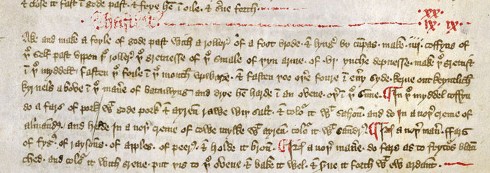
Here is the recipe for chastletes in its original Middle English:  Take and make a foyle of gode past with a roller of a foot brode. & lyngur by cumpas. make iiii Coffyns of þe self past uppon þe rolleres þe gretnesse of þe smale of þyn Arme. of vi ynche depnesse. make þe gretust in þe myddell. fasten þe foile in þe mouth upwarde. & fasten þee oþere foure in euery syde. kerue out keyntlich kyrnels above in þe manere of bataiwyng and drye hem harde in an Ovene. oþer in þe Sunne. In þe myddel Coffyn do a fars of Pork with gode Pork & ayrenn rawe wiþ salt. & colour it wiþ safroun and do in anoþer Creme of Almandes. and helde it in anoþer creme of Cowe mylke with ayrenn. colour it with saundres. anoþur manur. Fars of Fygur. of raysouns. of Apples. of Peeres. & holde it in broun. anoþer manere. do fars as to frytours blanched. and colour it with grene. put þis to þe ovene & bake it wel. & serue it forth with ew ardaunt.

The “Coffyns” refer to the pastry shell, encasing the savory mixture of pork, saffron (amazingly dear at the time!), almonds, raisins, apples and pears—mincemeat essentially. The entire form was not made of “bread”, consequently it’s difficult to make the link between these constructions and our own modern gingerbread houses, which seem to have more modern, continental origins, although Elizabeth I purportedly instructed her cooks to make gingerbread men and women in the recognizable forms of her courtiers and guests. I think we’re talking about multiple lines of food cultural evolution here—pies, cakes, ginger, ginger cakes, breads, and houses–and perhaps I shouldn’t mix them up except under the label of “architectural pastry constructions”.  If I could make my own pastry castle, which I would fill with cake and not mincemeat, I would certainly recreate one of Elizabeth’s very favorite castles, Nonsuch Palace, built by her father in the last years of his reign. This is well beyond my baking abilities, but wow, just imagine such a structure!

nonsuch_palace_by_joris_hoefnagel

nonsuch-2

Two views of Nonsuch Palace by Joris Hoefnagel–the second was just acquired by the Victoria & Albert Museum.


Scent of a Queen

While I was looking for spring wine concoctions in A Queen’s Delight the other day I came across a recipe for “Queen Elizabeths Perfume”: Take eight spoonfuls of Compound water, the weight of two pence in fine powder of Sugar, and boil it on hot Embers and Coals, softly, and half an ounce of sweet Marjoram dried in the Sun, the weight of two pence of the powder of Benjamin to make a sweet, long-lasting perfume. As you can see, other delights are in there, including a rose and cypress perfume supposedly utilized by her brother Edward, and a toothpaste made of Mother of Pearl.

Queens Delight 4

This herbal scent seems a bit more complex (and long-lasting) than Elizabeth’s other perfume, recorded in C.J.S. Thompson’s Mystery and Lure of Perfume (1927) and the inspiration for the “perfume garden” designed by Laurie Chetwood and Patrick Collins which won a Gold Medal and the title of “Most Creative” at the 2009 Chelsea Flower Show. I wish I had seen this garden–which presented the evolution of Elizabeth’s perfume from plant to bottle in a “polysensorial” way–but we can all buy a bottle of the finished product at the Historic Royal Palaces gift shop (oh no, they only ship to the U.K). I think I might prefer the marjoram-based scent anyway; rose damask is a bit cloying.

Scent of a Queenp

PerfumeGarden2009

Perfume Garden Sketch ChettwoodArchitects

Elizabeth Perfume HRP

Sketch and photograph of the award-winning Perfume Garden, 2009, from a portfolio here; Elizabeth’s inspirational rose damask eau de toilette, available (in the U.K.) here.

Speaking of cloying: neither of these perfumes contains the exotic ingredient found in so many recipes for scented sachets, pomanders, and waters in the sixteenth and seventeenth century: musky secretions from the anal glands of the civet cat (not a cat at all), which could mask all unpleasant odors and serve as an aphrodisiac. Shakespeare gave King Lear a civet reference–Give me an ounce of civet, good apothecary, to sweeten my imagination–but a century later it was fortunately out of fashion if Samuel Cowper’s rhyme is any indication: I cannot talk with civet in the room, a fine puss-gentleman that’s all perfume.

Elizabethan Perfume Collage

Barbier Elizabethans 1928

Another perfume recipe from A Queen’s Delight and an Elizabethan perfume bottle from the “Cheapside Hoard” and the Museum of London; the Elizabethan pouchoir print by Georges Barbier from Richard Le Gallienne’s Romance of Perfume (1928).


Tudor Texture in London

Besides far superior public transportation systems and many more public smokers, I think the thing that Americans notice the most when they travel to Europe is texture: a built environment that looks comparatively embellished, nuanced with symbolism, and venerable. Despite London’s dynamic growth over the past twenty years or so, there is still a lot of historic fabric in the city–but much of it is deceptively and relatively “modern”, i.e., Victorian. The Houses of Parliament are probably the best example, but scattered around the city are myriad buildings that “look” older than they really are: especially pubs! I was charged with finding Tudor sites in London on this trip: a task that was not as easy as you might think. The successive catastrophes of the Great Fire of London and the Blitz obliterated much of the city’s pre-modern fabric and in between there were those “improving” Victorians! So what remains of Tudor London? Lots of things, primarily to be found in the National Portrait Gallery, Tate Britain, The Victoria & Albert Museum, and the Museum of London. Several places, namely the Henry VII Chapel at Westminster Abbey, St. Margaret’s Church nearby, Lambeth Palace just across the river, and the Tower of London and the sister churches of St. Helen’s Bishopsgate and St. Andrew Undershaft in the City. There is also the Staple Inn of my last post, whose very Tudor appearance probably owes much to an early twentieth-century “restoration”, and St. Bartholomew’s Gatehouse and the oldest residence in London, located on the picturesque City street of Cloth Fair. To the west, Hampton Court Palace, and to the east, Sutton House in Hackney, which was one of the highlights of my recent tour. You can’t quite immerse yourself in the Tudor era in modern London–but you can come close, for an hour or two, if you find the right spot.

Tudor Texture windows

Tudor Texture Queen's

Tudor Texture Sutton Windows

Tudor Texture Sutton Window

Hampton Court 4

Windows into the Tudor era: exterior of the Chapel Royal at Hampton Court (where we attended a service!), featuring the Tudor emblems of the portcullis and rose; looking out from the Tower towards the Queen’s apartments, built c. 1530 for Anne Boleyn; windows at the Sutton House, c. 1535; one of many impressive oriel windows at Hampton Court Palace.

Henry VIII at Hampton Court

NPG 4618; Catherine Parr by Unknown artist

Tudor Texture tomb_margaretcountessof lennox

Tudor Texture Holme Family

Tudor People: Henry VIII at Hampton Court; my favorite of his wives, Katherine Parr at the National Portrait Gallery; the tomb of  his niece (and the grandmother of King James VI and I) Margaret, Countess of Lennox, in the Henry VII Chapel at Westminster Abbey; not quite Tudor-era people but I love this triptych portrait of the Holme family in the Victoria & Albert Museum, c. 1628.

Hampton Court

Hampton Court 2

Hampton Court 5

Sutton House

Sutton House 2

Sutton House 4

Gherkin and St. Andrews

Hampton Court courtyards and Sutton House and its central courtyards in Hackney; St. Andrew Undershaft in the City of London dwarfed by the Gherkin (my photograph didn’t turn out so well as the Gherkin wasn’t so textured; this is one credited to Duncan which I found here. It’s a pretty classic composition now, as you can imagine!)

So now finally for some real interior texture: the Tudors could not bear an unembellished surface and were particular fond of tapestries and wood paneling for their interiors. At Hampton Court, the private Tudor apartments were demolished to make way for the Baroque “restoration” of William and Mary’s reign, but the Great Hall of Henry VIII’s time remains, with its decorated hammer-beam roof and walls lined with The Story of Abraham tapestries. On the day that I was there last week, this room was full of English schoolgirls (in the best uniforms ever) drawing details from the tapestries in close consultation with their teachers, so it was hard for me to get a clear shot of the interior details (plus I was very taken with these uniforms–fortunately there are lots of pictures of the Great Hall online). Later in the week, at Sutton House, I walked around the house in complete isolation and marveled at each and every surface: it was like stepping back in time in some rooms, while in others the National Trust’s conservation/interpretation approach enabled one to look beyond the decorative facade into the bones of the house, which is a must-see for any Tudor fan.

Hampton Court Great Hall

Great Ware Bed.jpg

Sutton House Door

Sutton House doorway

Sutton House Linenfold Paneling

Sutton House plain paneling

Sutton House paneling

Sutton House Details

Sutton House upstairs

Schoolgirls in the Great Hall at Hampton Court; The very famous “Great Ware Bed”, c. 1590, at the Victoria & Albert Museum (this item could have a post of its own); The National Trust’s Sutton House in Hackney: front door, doorway, paneling, details from fireplace surround & hops woodcarving; upstairs drawing room.        


Ranking the Royals

Another week of anniversaries, as each and every week is. For followers of the British monarchy, it was the week of Elizabeths, with Queen Elizabeth I’s birthday (September 7) and Queen Elizabeth II assuming her well-deserved title of longest-reigning British monarch on September 9. In my day-job capacity as an English history professor, I thought I would make up a list of BEST British Monarchs and contrast it with the longest-reigning ones to see just what the overlap might be. Of course this is a ridiculous exercise, as the first list is completely subjective and the second one completely objective. But I was waiting for my car to be serviced at the dealer and bored with all the other administrative tasks before me. Let’s start with the longest-reigning kings and queens, and the amazing picture of Her Majesty that Buckingham Palace released to mark the occasion. I just love it! The (royal) red briefcase!!

Elizabeth II

So here is the list of longest-reigning monarchs of either Great Britain or England: 1) Elizabeth II (1952-; 63 years, 218 days and counting); 2) Victoria (1837-1901; 63 years, 216 days); 3) George III (1760-1820; 59 years); 4) James VI of Scotland and I of England (1567-1625; 57 years); 5) Henry III (1216-1272; 56 years); 6) Edward III (1327-1377; 50 years); 7) Elizabeth I (1558-1603; 44 years); 8) Henry VI (1422-1471, with a break, 38 years); 9) Aethelred II (978-1016, with a break, 37 years); 10) Henry VIII (1509-1547; 37 years).

British Monarchs

In very random order, the longest-reigning British and English monarchs.

And now is my list of “best” monarchs according to my completely subjective opinion–I invite you to offer up your own candidates. I must state a very big qualification, a result of my training and expertise: all my monarchs reigned before 1688: the “revolution” and constitutional documents of that year and the next dramatically limited the powers of the monarchy and so I don’t think post-1688 monarchs rate. Just my opinion: obviously the British monarchy has a role to play that is extra-political.

My top ten: 1) Henry VII (1485-1509–the first Tudor and the first modern king, in my opinion. Courageous and clever. I’ve definitely bought into the “Tudor Myth”); 2) Elizabeth I (1558-1603–need I say anything? Just accept countless words of praise); 3) Alfred the Great (871-899–warrior, scholar, the first English king); 4) William I “the Conqueror” (1066-1087–another militant unifier, through conquest, but he gave us the greatest primary source in medieval history); 5) Henry II (1154-1189–I know, Becket, but his legal reforms were important; 6) Henry V (1413-1422–it’s hard for me to see him apart from Shakespeare (and Kenneth Branagh) but still, he won it all, and then died, which makes him tragic and interesting); 7) Edward I (1272-1307–I’m giving him credit for all those castles); 8) James VI and I (1567-1625–a rather wasteful king but an interesting man, and anyone who could condemn smoking in the early seventeenth century is worthy of note); 9) Edgar “the Peaceable” (959-975–another builder); 10) Charles II (1660-1685–a lovely personality that reunited England after the long Civil War; a page-turner.

Best British Monarchs

The best? Only according to me.

So there is not much overlap between longest-reigning monarchs and my best monarchs: only Elizabeth and James. No doubt this is partly due to my exclusion of monarchs who ruled after Charles II. No Henry VIII for me: too much waste, too much squandering of the considerable legacy left to him by my favorite king, Henry VII, as well as his own talents. Despite the English Reformation, which he bought into for selfish reasons, I would rank him near the bottom. But that is a list for another day.

Henry VIIIs Nightmare

Buckingham Palace by Assaf Frank

Henry VIII’s worst nightmare and Buckingham Palace © Assaf Frank.


A Kingdom for a Horse

This is the time of year that every teacher, at every level, is in a back-to-school mentality. I don’t feel like I’ve been out of school this particular summer, but nevertheless I am preparing for my fall classes with that usual sense of expectation–thank goodness. I haven’t taught a graduate course for a while, and this semester I’ll be teaching one of my favorites, a readings course on early modern England. I see some great students on my roster, I’ve chosen some of my favorite books old and new, and I expect that the entire experience will be a welcome weekly escape from my daily chair duties. For those of you who are not familiar with European historiography and chronology (which generally, with some variations and accommodations, incorporates English historiography and chronology), the early modern era begins around the turn of the sixteenth century, which means that early modern England begins with the Tudor Dynasty. And the Tudor Dynasty began today, 530 years ago, when Henry Tudor, the Earl of Richmond and last Lancastrian standing, defeated King Richard III and his force at the Battle of Bosworth. Richard was killed in the battle (the last English king killed in action) and Henry was crowned shortly thereafter, right on the field.

Richmond crowned after the battle of Bosworth Field. Illustration from History of England by Henry Tyrrell (c 1860).

A rather romanticized Victorian view of the crowning of Henry over Richard’s dead body, from Henry Tyrell, A History of England for the Young (1860)

I don’t like to consign history to big battles but this was a big battle, a definite turning point. And even though Richard’s reputation has been somewhat restored by the recovery of his body from under a Leicester parking lot in 2012 (revealing 10 wounds to his head sustained during the battle) and its ceremonial re-internment this past spring, I doubt that he can ever rise above the characterization bequeathed to him by Shakespeare in his Tragedy of King Richard the Third, written in the last decade of the reign of Elizabeth I and the Tudor dynasty. While watching the dignified re-internment ceremony (featuring Benedict Cumberbatch–apparently a distant relation), I couldn’t help but think: all this for a ruthless child murder? On the other hand, the physical deformity which represented the rot within for Shakespeare only made him seem more human–and therefore vulnerable–when his skeleton was revealed. In any case, one Bosworth anecdotal episode that’s never going to go away, even though it is Shakespeare History rather than History, are his last moments and words, when, unhorsed, his character cries out in frustration: A Horse! A Horse! My kingdom for a Horse! These words are enduring because they are so Shakespearean universal: I’ve got ALL this but I really need THIS. Even the very biased Bard was willing to give the last medieval English king a bit of humanity/vulnerability at his/the very end.

Bosworth Garrick BM

Bosworth Garrick BM2

Bosworth Garrick VA

Bosworth Forrest LC

Bosworth Jefferson Davis 1864

Bosworth Yost LC

my_kingdom_for_a_horse_by_georgegoodnight-d4dwzj3

The fame garnered by David Garrick (1717-1779–buried right next to Shakespeare in Westminster Abbey) in the role inspired many representations of Richard giving his “horse” speech: here are late 18th and early 19th century prints from the collections of the British Museum and Victoria & Albert Museum; the prominent American Shakespearean actor Edwin Forrest in the role as depicted in an 1855 print, Library of Congress; obviously such drama inspired satire, as seen in the Lincoln Campaign Dial for November 1864 (available here) portraying Jefferson Davis as Richard III and in George Yost Coffin’s political cartoon from the 1890s, Library of Congress; a neat photomanipulation by George Goodnight, aptly titled “My Kingdom for a Horse”.


The Consummate Fool

As the title of Beatrice K. Otto’s engaging book, Fools are Everywhere. The Court Jester Around the World, asserts, fools are a universal phenomenon in the pre-modern world. Still, maybe it’s just my Anglophilia, but it’s always seemed to me that fools were a particularly prominent feature of the court in early modern England, and one fool in particular:  Will Somers, who appears in both “official” portraits and more casual ones, both from his own time, and well after: I wonder why?

Family_of_Henry_VIII_c_1545

Tudor Family Portrait

henrypsalter_lg

The Family of Henry VIII, with Will Somers under the right arch and his counterpart, “Jane the Foole” (sometimes alternatively referred to as “Mother Jak”, Prince Edward’s nurse), on the left, c. 1545, Hampton Court Palace; Tudor family portrait from the Duke of Buccleauch’s Collection at Boughton House, c. 1650-1680–supposedly based on an earlier painting–featuring King Henry VIII, Will Somers, Edward, Mary and Elizabeth; King Henry and Will in an illustration from Henry’s Psalter, c. 1530-45; British Library Royal MS 2 A XVI, f. 63v.

The first reference to Will Somers is in 1525, as a man in his twenties, and he died about 1560. His presence at court is one of the few continuous aspects of the Tudor dynasty: he served, or entertained, King Henry VIII and all three of his children: Edward, Mary and Elizabeth for the opening years of her long reign. Clearly he and King Harry were close, literally in the pictures. This psalter image clearly has religious symbolism–Henry is a harp-playing King David, and Will the fool of Psalm 14 (the fool saith in his heart, there is no God)–but the Tudor family portraits point to a closer personal connection. Following the distinction first made by Robert Armin (an actor in Shakespeare’s company), in his Foole upon Foole (1605) and A Nest of Ninnies (1608), historians and literature scholars still seem most interested in assessing just what kind of fool Will was: “natural” or “licensed”/”artificial”: a natural fool was one with mental challenges or disabilities, an artificial fool was playing the part. There seems to be evidence for both types: in John Heywood’s Wit and Witless, Somers is among the latter while other sources refer to his wittiness. The discussion about the nature of Somers’ foolishness has lasted for centuries, and I think it makes him a rather more interesting character than his Elizabethan successors, Richard Tarlton and Will Kempe, who were obviously artificial, acting fools. Somers experiences a posthumous resurrection in the seventeenth century, which produced some charming portraits of his image and a lively biography entitled The Pleasant History of the Life and Death of Will Summers (1676): And how hee came first to be knowne at the court, and how he came up to London, and by what meanes hee got to be King Henry the eights jester. And over time, Will Somers seems to evolve into the both the wise fool and the full-fledged jester, keeping us guessing all the while.

STC 23434.5, D2v

Will Somers 1620

Will Somers 1798

Will Somers 1814

Title page of  William Sommers, engraved by R. Clamp, 1794; W.H. Ireland, Chalcographimania; or, the portrait-collector and printseller’s chronicle, with infatuations of every description. A humorous poem. In four books. With copious notes explanatory. By Satiricus Sculptor, Esq., 1814.


A Coronation Copy

On this day in 1559 (or perhaps the day before?) Queen Elizabeth I left her court for the Tower of London, commencing the three days of festivities which would culminate in her coronation. It strikes me as a good day, therefore, to (re-)examine the most famous symbol of that event, and one of her most iconic images, the so-called Coronation Portrait. I suspect that this painting has even more resonance in our own time because of the film and poster for the 1998 Elizabeth film, in which Cate Blanchett evokes a more approachable, yet also more vulnerable, version of the Virgin Queen, but it’s also important to note that the painting is not quite of her time. When I’m teaching Elizabethan or Tudor history, I always include one class in which we look at all of Elizabeth’s portraits in chronological order, so that we might grasp both the evolution of her image–and the craftsmanship behind it. My students are always surprised when we come to the Coronation Portrait–near the end of the class rather than the beginning. My observation of strict chronological order mandates this, as the Coronation Portrait is actually a copy, produced in the last years of Elizabeth’s reign–and perhaps even upon the occasion of her funeral, after the original painting was lost.

NPG 5175; Queen Elizabeth I by Unknown artist

Elizabeth I Poster 1998

The Coronation Portrait of Queen Elizabeth I, Unknown English Artist, c. 1600, © National Portrait Gallery, London; 1998 Elizabeth poster.

Most experts seem to agree that whoever painted the Coronation Portrait had seen a contemporary depiction, as there is another c. 1600 image–a miniature by Nicholas Hilliard–that also features the distinguishing characteristics: the long hair, denoting Elizabeth’s unmarried state and virginity, the cloth-of-gold dress tying her to her Tudor predecessors, the royal ermine, crown, scepter and orb. There are literary descriptions of the coronation festivities as well–reprinted at about the same time that these images were reproduced. There’s obviously an effort at commemoration and memorialization at this time of transition, and perhaps even to project a more youthful (human?) image of Elizabeth—she had become essentially ageless by the end of her reign.

Elizabeth_I_Coronation_Miniature

British Library- c.33.e.7.(11) c2104_08_0231+001

 Nicholas Hilliard Coronation Miniature, c. 1600, Private Collection; The Royall Passage of her Maiesty from the Tower of London, to her Palace of White-hall, with al the Speaches and Deuices, both of the Pageants and otherwise, together with her Maiesties seuerall Answers, and most pleasing Speaches to them all, London, 1604, British Library.

If so, the Coronation portrait publicists failed, as another image produced (and reproduced and reproduced….) around the time of her death proved to be far more influential: the engraving by Crispin van de Passe the Elder (after an earlier drawing by Isaac Oliver) projecting a more mature and much more worldly queen, an Imperial Elizabeth. This is the Elizabeth of the eighteenth and nineteenth centuries, the heyday of the British Empire. Even when an intensifying focus on the personal life of the Virgin Queen commenced in the later nineteenth century (culminating in the 1998 Elizabeth film) commenced, she still looks rather Passe-ive!

Elizabeth de Passe V and A

Elizabeth 19th century Oliver de Passe

Elizabeth 20th century coronation portrait

Memorial print of Crispin van de Passe etching of Elizabeth after Isaac Oliver drawing, 1603, Victoria & Albert Museum; Charles Turner print after van de Passe after Oliver, 1816, British Museum, and the early 20th century historical illustrator Fortunino Matania’s coronation portrait of Elizabeth, c. 1920.