For the most part, I’ve managed to avoid dwelling on the pandemic and I must admit that I haven’t been that affected by it either, apart from the radical reconfiguration of my work environment! My struggle is to improve my online communication skills so that I can convey my passion for history through the screen—and that really isn’t much of a struggle, relatively speaking. I feel grateful as I’ve been fortunate: fortunate in my profession, which enables me to work in isolation reading and writing about a distant time and place, and fortunate in my residence—Massachusetts was hard hit in March and April but the steady leadership of our Governor and the responsible compliance of (most of) our citizens has enabled us to contain the spread of the Covid. Most days I am in a sixteenth-century fog writing my book, but headlines from the radio and the television intrude, and of course, the numbers of the infected and the dead keep climbing. I can’t believe that the President would hold rallies in this environment, and I am fearful of the maskless merrymakers I see whenever I do get outside and happen to find myself near a body of water, which is often, because I live on the coast. These “mask slackers” (a great term that comes from the last epic pandemic, when an Anti-Mask League formed in San Francisco) do not in any way remind me of a proverbial and patriotic “live free or die” movement but rather another, older, proverbial expression of selfishness: “eat, drink and be merry for tomorrow we shall die”. This is a biblical reference, of course, and as such it does not imply selfishness on the part of those partaking in the joys of daily life; rather it began to acquire its modern meaning at the time of the Black Death, or shortly thereafter. One of our best sources for the plague’s impact is the Italian author Giovanni Boccaccio, who set the scene for his tales of the Decameron by giving us a first-hand account of plague-time Florence, where
Some thought that moderate living and the avoidance of all superfluity would preserve them from the epidemic. They formed small communities, living entirely separate from everybody else. They shut themselves up in houses where there were no sick, eating the finest food and drinking the best wine very temperately, avoiding all excess, allowing no news or discussion of death and sickness, and passing the time in music and suchlike pleasures. Others thought just the opposite. They thought the sure cure for the plague was to drink and be merry, to go about singing and amusing themselves, satisfying every appetite they could, laughing and jesting at what happened. They put their words into practice, spent day and night going from tavern to tavern, drinking immoderately, or went into other people’s houses, doing only those things which pleased them.
Boccaccio’s description echoed the late medieval Danse Macabre (“Dance of Death”) allegory, an expression of the egalitarian and universal nature of all-conquering Death found in poetry, music, and images both before, and especially after, the Black Death. Late medieval people heard (or saw) the message as a reminder to be ready for Death, which could strike at any time, in a spiritual sense, not just as a call to indulge. Over the next centuries the hoarding isolationists and the dancing fools converged and the focus on sinfulness and salvation was diminished and forgotten, leaving us only with self-centered indulgence in the face of things we can’t, or won’t control: eat, drink, and be merry for tomorrow we die. It’s the end of the world as we know it (and I feel fine).

 Are we in a crisis? Death is just outside the door in The Feast of Dives, Master of James IV of Scotland, c. 1510-20, from the Collection of the J. Paul Getty Museum; I took this screenshot of Governor Kevin Stitt’s tweet back in March because I could not quite believe it: it was later taken down. I’m sad to say that Governor Stitt has recently announced that he is the first Governor to test positive for Covid and I hope he makes a speedy recovery. He attended the President’s rally in Tulsa on June 20 (without wearing a mask) but does not believe that it was where he was infected.


Detail of a photograph of the Danse Macabre frieze at St. Mary’s Church in Lübeck painted by Bernt Notke in 1463; it was destroyed during World War II. Ink & watercolor Dance of Death by anonymous German artist, 16th century, Metropolitan Museum of Art; inset of 17th century oil painting of the Dance of Death, Wellcome Library.






 Theodor de Bry’s famous 1594 engraving showing Amerindians pouring molten gold into the mouths of Spaniards driven by insatiable lust for the stuff.
 Jan Steen, The Dissolute Household, 1663-64.
 It’s all about connections at the British Museum (above) and the Rijksmuseum (below).


 The incomparable Isabella D’Este and a site worthy of her.


 An abandoned farmhouse on Old Dana Road, and the Quabbin Reservoir.
 Courtesy Peabody Essex Museum’s Phillips Library.

 Boston Globe headline, December 9, 1879; Library of Congress.


 Alpheus Crosby and several (not all!) of his equally successful siblings, the sons of Dr. Asa Crosby of Sandwich, New Hampshire. The Normal School at Salem on Broad and Summer Streets during Crosby’s tenure, c. 1857-1865, Salem State University Archives; just a few of the Salem institutions to which Alpheus Crosby volunteered considerable time: the Salem Lyceum, the Salem Athenaeum (then at Plummer Hall) and the Essex Institute, Cousins collection of the Phillips Library of the Peabody Essex Museum via Digital Commonwealth; Professor Crosby’s bestselling series of Greek textbooks, 1860.


 Post-“retirement”: advocacy for radical reconstruction and “impartial” suffrage, 1865-66, Library of Congress; just one donation to the Normal School at Salem. 111 Federal Street in Salem, the residence of Professor and Mrs. Crosby, along with Amy Lydia and Lucy B. Dennis, during the 1860s.


 Doyle Auctions; Gibbes Museum of Art; Jeffrey Tillou Antiques; Sotheby’s Auctions.


 AP Photo by Thibault Camus
 The Cathedrals of Reims and Nantes in their present glorious condition. Photographs by Nicolas Janberg for


 Edwards’ book and paintings; two 1914 postcards; Charles W. Wyllie, The Burning of Reims Cathedral after the Severe Bombardment of the Germans, 17-24 September 1914. From The Sphere, 7 December 1914.
![[The Angel of the Resurrection on the Roof of Notre-Dame, Paris]](https://i0.wp.com/streetsofsalem.com/wp-content/uploads/2019/04/notre-dame-angel-of-resurrection-1853-getty-charles-negre.jpg?resize=490%2C690&ssl=1) Nantes Cathedral in flames on the night of January 28, 1972, Museum of firefighters Loire-Atlantique. Hervio Fund; Charles
Nantes Cathedral in flames on the night of January 28, 1972, Museum of firefighters Loire-Atlantique. Hervio Fund; Charles 


 Tried to get more juxtapositions of historical and modern dress but what can I say? I was enjoying the party! Above is my beautiful friend and a very talented seamstress, Louise Brown, in her own creation of course. Below is our committee (with a few conspicuous absences) with chair Michael Selbst in the middle, to the right of me! And then we have some swag…..thanks to all our sponsors too!


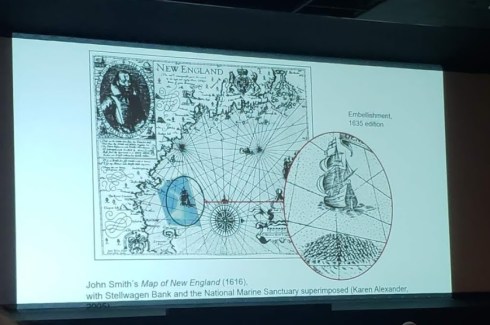

 Scenes from the Salt Cod for Silver Symposium, and the demolition of the Stacks next door.