Tag Archives: Suffrage

November 5th: What’s in a Date?

I’m anxious about our election, and when I am anxious, I always go back into history to find reassurance in relativity. Everything is relative, we’re just dust in the wind. I didn’t really know where I was going, but I started looking into the history of suffrage in our country, as those women really struggled and ulimately succeeded so I thought they would be inspiring and reassuring. And then I came across the date November 5th, 1872, when Susan B. Anthony voted for Ulysses S. Grant, and was arrested ten days afterwards for playing man at the polls. Well, I thought, we could have a nice bookend moment ahead of us on November 5, 2024! But as stalwart as Susan was, she did not ease my anxiety, I needed more historical immersion: so after a brief survey of twentieth-century US electoral November Fifths, I went back into the eighteenth, seventeenth, and sixteenth centuries just to stretch things out a bit and put my 21st century problems in perspective. I found struggles against tyranny in the 18th and 17th centuries, represented by the November 5 birthday of General John Glover, a Revolutionary hero who is ignored here in his native city of Salem but has quite a following in neighboring Swampscott, where avid preservationists are struggling to preserve his retirement farmhouse. Further back, William of Orange landed at Torbay on November 5, 1688, to unseat his father-in-law James II and establish a “glorious” contractual/constitutional monarchy. Earlier in that same century, there was of course the most memorable event, the Gunpowder Plot of November 5, 1605, an attempted coup foiled, and the inspiration for the observation of “Pope’s Night” in colonial Massachusetts. And right in the midst of the Renaissance, Copernicus gazed at the lunar eclipse while in Rome for the Golden Jubilee, germinating new ideas about the heliocentric universe. November 5th has indeed been both an innovative and momentous date throughout history, and I’m hoping that November 5th, 2024 will also break new ground.

Wonderful eclipse painting in background by Mexican artist Rufino Tamayo.


The Suffrage Seekers

I’m not going to write much on this #SalemSuffrageSaturday: I prefer to let one document speak for itself—or its signatories. Election Day is three days away, and if it is a struggle to get all the votes counted we can and should be reminded of the long struggle for universal suffrage. We can certainly wait a week, or a month, as these women (and men) waited for seventy years! The first Salem suffrage petition was in 1850; this one is dated 1880—there were more, representing more marching, writing, meeting, speaking, striving in so many ways….all the way up to 1920.

The citizens of Salem, Massachusetts petition the US Senate, May, 1880: Petition from the Citizens of Massachusetts in Support of Woman’s Suffrage; 5/26/1880; Petitions and Memorials, Resolutions of State Legislatures, and Related Documents which were Referred to the Committee on the Judiciary during the 46th Congress; (SEN46A-H11.2); Committee Papers, 1816 – 2011; Records of the U.S. Senate, Record Group 46; National Archives Building, Washington, DC. [Online Version, https://www.docsteach.org/documents/document/petition-massachusetts-suffrage, October 31, 2020].

We should not segregate the long struggle for the passage of the 19th Amendment: it represent the single largest expansion of voting rights in American history. But we should also note that many women were excluded from its provisions by the barriers of poll taxes, literacy tests, exclusionary acts, and other forms of voter suppression. The struggle continued after 1920, as it does today.

Officials in Rochester, New York have had to encase Susan B. Anthony’s grave in a protective barrier due to the evolving public ritual of placing voting stickers on her grave on Election Day. This year, of course, they’ve also had to come up with a Covid plan! For my part, I’ll be trekking up to Dr. Sarah E. Sherman’s grave in the Harmony Grove Cemetery on November 3 here in Salem.


Voting Matters

I am very, very anxious about the election and can think of little else. I have enough of a historian’s sensibility, of a human’s sensibility, to know that this is the most momentous election of my life. Of course there is little that I can do–other than donate and vote–so I have been appeasing my anxieties in my usual way: by reading about elections past. It has also helped me to read and listen to Boston College history professor Heather Cox Richardson, who has been putting the current situation in a comprehensive historical context for months now: talk about commitment! I have learned a lot about American history during this whole blogging experience, but I think I’ve learned more in the last 6 months than the past ten years: the problem is, I’ve been looking for the comfort of we’ve been here before but I seem to be surmising that many aspects of our current situation are truly aberrant! Apart from the search for context, there is just something very interesting about the logistics and detritus of elections past: in this digital age, we don’t have enough electoral texture. So here are just a few items that caught by eye.

Early Election Ballots: I love browsing through the early election ballots at the American Antiquarian Society: if you don’t understand the Electoral College—they are rather clear illustrations: also of the evolving concept of the ticket. Plus it’s interesting to see the emergence and disappearance of various political parties.

Mass Appeal: I love this flyer for Nathaniel Prentice Banks (also from the American Antiquarian Society), who was running for a Massachusetts congressional seat in the election of 1852. I don’t know if you can read it all, but he is appealing to all different sorts of men—mechanics, young men, middle-aged men and veterans! Plus he courts the ladies, and exhorts them to “stir up” their men!


Voting by Mail: since 1864. Very American. Poll Book from the Smithsonian Institution.


Poll Taxes! Who knew? I associated poll taxes with the segregated South, but in fact, people had to pay them right here in Massachusetts, and in other states as well, right up to the ratification of the 24th amendment in 1964! Imagine paying to vote. Imagine being an active suffragist, working your whole life for the voting rights of women, all women, and even after enfranchisement this barrier is still there! There were a few snarky articles published in the Boston papers right after the ratification of the 19th amendment in which the theory was put out there that perhaps women wouldn’t want to vote as they would have to tell the poll tax assessor their true ages! Unbelievable!


A Salem Parade Flag. Just because it must have been fun to see election parades, which I assume must have brought people together, but perhaps not. 13-star flag used in 1896 Salem parade, Cowan’s Auctions.

Pinback Buttons! Never can get enough of these: most are Roosevelt and McKinley, 1900 & 1904, from the Smithsonian; the Citizen pin is from 1915-20 and the Ann Lewis Suffrage Collection. I love the sentiment of Vote as you please but please vote.


A flyer from Margaret Chase Smith’s presidential campaign, 1964 (Smithsonian Collection). Because Margaret Chase Smith. And that’s as close as I am getting to our present time.


Bells were Ringing

We’ve come to THE week of this year-long suffrage celebration, which has unfortunately been overshadowed by other events! But I think we should all stop and recognize the anniversary, coming up on the 18th, of the constitutional ratification of the 19th amendment 100 years ago. Since the 1970s, Womens Equality Day has been commemorated on August 26, the day that the ratification was certified, but a century ago, everyone realized that the Tennessee vote on the 18th was the big moment: the suffragists themselves, the newspapers, and even the anti-suffragists! The photograph of Alice Paul extending the flag of 36 stars from a balcony, symbolizing the realization of the two-thirds majority, while her colleagues jump with joy (well I like to think they were jumping) below, captures this moment perfectly.

Suffrage-Celebration-ALice-Paul-2Library of Congress

I wanted to ascertain, and feel the local reaction to the ratification, so I checked out as many local papers as I could. We’re handicapped with 20th century history when it comes to newspaper coverage as the Salem Evening News is available only on microfilm and our public library has been closed since the pandemic, so I have relied primarily on Boston papers which covered the region. I’m sure I’m missing a lot of little anecdotal reactions, but here’s the slightly-bigger picture: rapid registrations, bells chiming out, a big celebratory evening at Faneuil Hall, and a Boston parade, of course. After celebration came deliberation: as the pundits tried to assess the impact of all these new voters on the upcoming election.

SUffrage Celebration 1 (2)

Suffrage-celebration-Boston-POst-Aug-9

Suffrage BDG Collage

Suffrage-Celebration-Boston-Evening-Globe-Aug-19-2

Untitled-2020-08-15T103559.549

Suffrage Cel

Suffrage Bells Aug 28

Suffrage Victory Parade

Suffrage Straw Poll

Griswold VotesThe aftermath of August 18, 1920: headlines and editorials in the Boston Post and Boston Daily Globe, August 19 (I didn’t realize the Ponzi Scheme was in the news at this time!), primaries were coming up, so there was an immediate focus on registration, big victory celebration at Faneuil Hall on the 23rd; supposedly there was a national bell-ringing event on the 28th (?), the last Woman Suffrage Association parade in September; a straw poll in October and Mrs. Almira C. Griswold’s registration made NATIONAL headlines on September 11-13, 1920.


An Inventory of Salem Women Artists

Today’s #SalemSuffrageSaturday post is really more of a list than a composition, and a working list at that: I want to take a stab at identifying as many female Salem artists as I can, although I know it’s an impossible task. It’s impossible because there were so many, and I’m pretty certain I haven’t tracked them all down, but it’s also a difficult task because of the historical impact of gender. In the seventeenth, eighteenth, and nineteenth centuries, women were taught artistic and creative skills as part of their informal and formal education: some excelled and were clearly artists, even though they—or anyone else—did not identify themselves as such. I think this especially applies to women who worked in the textile arts but to other women as well. In the nineteenth century we see the emergence of (a few) women who can make their living through their artistic talent and skill; this is rarely possible before.

Artists Fidelia Bridges by Oliver Ingraham Lay 1872 SmithsonianFidelia Bridges (1834-1923) by Oliver Ingraham Lay, 1872, Smithsonian: Bridges is probably the first and most successful Salem woman artist, though she traveled widely and lived in Connecticut for most of her professional life.

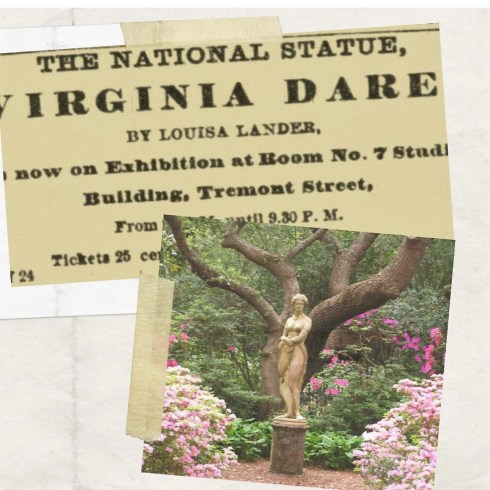
Daughters of old Salem families, Fidelia Bridges, who worked in several mediums and as both an artist and an illustrator, the Williams sisters, Abigail and Mary, who were both artists as well as art dealers, and sculptress Louise Lander, all found themselves in Rome in the mid-19th century for varying periods of time, drawing inspiration and establishing connections. The Misses Williams returned to the family home on Lafayette Street where they created a studio and loaned their works out to several prominent institutions, including the Essex Institute, which featured its very first art exhibition in 1875 featuring many Williams works. Louise Lander (1826-1923) also returned, reluctantly and eventually, to Salem and the family home at 5 Summer Street when she was shunned by the Anglo-American (and quite Salem-dominant) circle in Rome upon charges of some sort of scandalous behavior which she never deigned to answer. She exhibited her “national statue” of Virginia Dare, the first English child to be born in the New World, to raise money for war relief and moved to Washington, D.C. upon the death of her last Salem sister in 1893.

artist williams 4 (2)

Artists Williams Sisters Bulletin of Essex Institue 1875 (2)

Artist Virginia DareMary E. Williams, illustrations from The Hours of Raphael in Outline – Together with the Ceiling of the Hall Where They Were Originally Painted (Little, Brown, 1891); Just some of Mary and Abigail Williams’ works shown in the 1875 Essex Institute Exhibition; Virginia Dare in the Elizabethan Gardens & notice in the Boston Post, January 24, 1865.

To these nineteenth-century artists who seem to be awarded “professional” status I would add Mary Jane Derby (Peabody, 1807-1892) and Mary Mason Brooks (1860-1915) from the generation before and after the “Roman” circle. I’ve written about Derby many times before (see here and here) because I am the fortunate recipient of a journal she composed for her grandchildren, and Brooks more briefly here. Before her marriage, Mary Jane (a cousin of Louisa Lander) was definitely pursuing an artistic career, and she created several lithographs for the Boston firm Pendleton’s Lithography in the 1820s, including a view of her childhood home on Washington Street. Brooks, who worked exclusively in watercolors I believe, was one of the Salem artists who worked out of the famous “studio” at 2 Chestnut Street briefly, and her works were exhibited in Boston and New York. Among Mary Jane’s generation (almost) were two lesser-known artists, Sarah Lockhart Allen (1793-1877), who produced portraits in miniature and pastel, and Hannah Crowninshield( 1789-1834), both of whom were recognized as working artists by their contemporaries. Sophia Peabody Hawthorne (1809-71) is representative of the score of score of female artists who exhibited and sold their works at charitable fairs and bazaars in mid nineteenth-century Salem: always as “misses”.

brm2033-derby-nahant-ca-1827-749x1024 (2)

Artists Mary Mason Brooks

Artists reportsoffirstex01sale_0027 (2)

View of the Nahant House by “MJD” (Mary Jane Derby), Boston Rare Maps; Mary Mason Brooks, The Lumber Schooner, Grogan & Company Auctions. Just a few of the “Fine Arts” exhibitors from Reports of the First Exhibition of the Salem Charitable Mechanic Association : at the Mechanic Hall, in the city of Salem, September, 1849

And then there were all those Salem needlewomen! In her definitive work Girlhood Embroidery: American Samplers and Pictorial Needlework, 1650-1850 (1993), collector and scholar Betty Ring devotes an entire chapter to Salem, focusing on the influential school of Sarah Fiske Stivours (1742-1819) and showcasing the work of Antiss Crowninshield (1726-1768), Love Rawlins Pickman (Frye, 1732-1809), Susannah Saunders (Hopkins, 1754-1838), Betsey Gill (Brooks, 1770-1814), and Mary Richardson (Townsend, 1772-1824) among others. This was a very important Salem art form that was revived in the late nineteenth and early twentieth century by Jenny Brooks, Mary Saltonstall Parker (1856-1920) and other entrepreneurial artists.

Artists_Girlhood_Embroidery__2_-removebg-preview

artists Saunders Sotheby's (2)

Screenshot_20200618-064954_Chrome

Brooks Collage

mary-saltonstall-parker-house-beautiful-1916 (1)Betty Ring’s two-volume Girlhood Embroidery; Salem samplers by Susannah Saunders (Sothebys) and Elizabeth Crowinshield (Doyles); Jenny Brooks Co. advertisements from 1913, and Mary Saltonstall Parker’s cover embroidery for House Beautiful, October 1916.

So that brings me to the most entrepreneurial of Salem women artists, or maybe all Salem artists: Sarah Symonds, an artist-craftswoman descended from a long line of Salem craftsmen. I’ve written about Symonds (1870-1965) very recently, so I’m not going to go and on here, but she operated a very successful business selling her cast plaques of historic Salem symbols and structures in the first half of the twentieth century. Following her death in 1965 the Essex Institute, which operated as Salem’s historical society until its amalgamation into the Peabody Essex Museum in 1992, started collecting her works, as they “have enriched our local picture of the past”.

20200121_133721Sarah Symonds in her studio, Phillips MSS 0.202, Papers of Sarah Symonds, 1912-21.

How the past informs the present, and how the present acknowledges, interprets, and builds upon the past are central preoccupations of mine, and artistic perspectives on these processes can be just as illuminating as texts. I’d like to conclude this (again, working) list of women artists from Salem with a contemporary artist whose work is a great example of this illumination: book artist Julie Shaw Lutts. Julie’s a great friend of mine and I’ve featured her work before here, but she has just completed a very timely project which I love, so I wanted to showcase her talents again. The Vote is a mixed media artist’s book which commemorates the achievement of women’s suffrage in ways that are both personal and memorial, material and textual, and touching: all the best ways.

the-vote-9-julieshawlutts (2)

the-vote-8-julieshawlutts

JS Lutts 2©Julie Shaw Lutts, The Vote.


Women on a Pedestal

Obviously statues have been in the news of late, so I thought I would tap into the national (and international) focus by looking at some of our country’s more notable monuments to women, either striving for the franchise or striving in general, for this week’s #salemsuffragesaturday post. It doesn’t matter what your political inclination is, everyone seems to agree that there are not enough statues of women anywhere and everywhere, and corrective measures are being taken, along with initiatives associated with this Suffrage Centennial year. The husband and wife team who constitute Statues for Equality have established that statues of women represent less than 10% of public monuments in several American cities, and far less in most. In Salem we have only one statue to a woman: Samantha Stevens from Bewitched, situated in our city’s most historic square. She never accomplished anything (because she never actually existed) and her prominent situation and whimsical depiction mocks the real victims of the 1692 trials who were falsely branded “witches”, but nonetheless she is deemed worthy of monumental representation in Witch City. There are so many more women (real women) that deserve to be put a pedestal in Salem—that’s what this year has been all about for me.

pixlrSamantha is currently wearing an ensemble by local artist Jacob Belair, which I think is lovely on its own but also because it covers part of her up! I wish it extended to her unfortunate pedestal. I’m not in Salem now, so I asked my stepson ©Allen Seger to take the photos of Samantha in crochet.

Let’s turn to some more serious representations. Ever since it’s installation 15 years or so ago, the Boston Women’s Memorial has been one of my favorite monuments: not only is it aesthetically pleasing and immediately engaging, but it represents a spectrum of women who shaped Boston’s history (as well as that of Massachusetts and the nation): Abigail Adams, Phillis Wheatley, and Lucy Stone. These women are not just on pedestals (actually they have come off their pedestals) but depicted by sculptor Meredith Bergmann in the process of thought and activity, with their words accompanying them. Monumental women are in large part, active women, the feminine counterpart of all those masculine equestrian statues.

Screenshot_20200612-082211_Chrome

Screenshot_20200612-082224_Chrome

Screenshot_20200612-082234_ChromeThe Boston Women’s Memorial by Meredith Bergmann; photographs from her website.

Meredith Bergmann was also commissioned to create the most anticipated installation of this Suffrage Centennial Year: the Women’s Rights Pioneers Statue in Central Park in New York City, which will be unveiled on August 26, the date on which the ratification of the 19th Amendment was certified in 1920. This will be the park’s first statue honoring real women, and it also focuses on their activity: Sojourner Truth, Susan B. Anthony, and Elizabeth Cady Stanton are gathered around a table, intently focused on drafting a document. The statue had a controversial conception in that Truth was originally excluded, but public discussion and debate resulted in a more inclusive—and representative—monument.

Screenshot_20200612-082723_Chrome

Screenshot_20200612-082623_ChromeModel and Mock-up of the first and final monument to the Women’s Rights Pioneers by Sculptor Meredith Bergmann, to be unveiled in Central Park on August 26, 2020.

As the state which ultimately ratified the 19th Amendment in August of 1920, Tennessee takes its suffragist history very seriously and has produced two notable monuments to the women who worked so hard to make it happen (because it’s really not all about a wavering state senator is it?) There is the Tennessee Woman’s Suffrage Memorial (2006) in Knoxville, depicting Lizzie Crozier French, Anne Dallas Dudley, and Elizabeth Avery Meriwether, and the Tennessee Woman Suffrage Monument (2016) in Nashville’s Centennial Park, featuring Dudley along with Abby Crawford Milton, J. Frankie Pierce, Sue Shelton White and Carrie Chapman Catt. Even more recently, the Commonwealth of Virginia—always the site of so much statue furor—dramatically increased its commemorative depictions of accomplished women with its Virginia Women’s Monument: Voices from the Garden initiative, honoring the “full scope” of women’s achievements with twelve representative statues.

Screenshot_20200612-075354_Chrome

Screenshot_20200613-080549_Chrome

Screenshot_20200612-072439_Chrome

Screenshot_20200612-072336_ChromeThe Knoxville and Nashville Suffrage statues—both by Tennessee sculptor Alan LeQuire—and the unveiling of seven statues of prominent Virginia women last fall: former Virginia First Lady Susan Allen points to a statue of Elizabeth Keckley, dressmaker for Mary Todd Lincoln, and suffragist Adele Clark among the crowds (Bob Brown/ Richmond Times-Dispatch).

I like the fact that so many of these monuments are collective, featuring women engaged with each other. Sometimes they are working, sometimes they are simply “conversing”—or meeting for the first time like one of the most famous Suffragist monuments, the “When (Susan B.) Anthony met (Elizabeth Cady) Stanton” statue in Seneca Falls, New York, portraying the moment when these two icons were introduced by Amelia Jenks Bloomer in 1851. My very favorite “conversation piece” is the lovely statue of two prominent Rochester, New York suffragists, Anthony and Frederick Douglass, having a cup of tea: I would love to have been a fly on the wall (or the bench) for that conversation!

Screenshot_20200613-075828_Google

Screenshot_20200613-080112_ChromeThe Anthony-Stanton-Bloomer statue (1998) by Ted Aub in Seneca Falls; Ira Srole’s “Let’s Have Tea” (2009) in Rochester.

The most official Suffrage statue of all, Adelaide Johnson’s “Portrait” monument to Anthony, Stanton, and Lucretia Mott completed (and dedicated) in 1921, is also a collective representation but the women don’t seem particularly engaged with each other: it’s not my favorite statue but that doesn’t mean I think it should have been hidden away for most of the twentieth century! The “unfinished” appearance of the work also engulfs the women in their “pedestal” rather than placing them on it, but rumor has it that Johnson was making room for at least one more prominent woman—perhaps the first female president—to be carved out of that raw marble in the back at some point in time. Clearly not 2020.

Capitol StatueOffice of the Architect of the Capitol.


Feeding Suffrage

Sorry I’m a bit late today with my #SalemSuffrageSaturday post: I’ve migrated up to Maine for several weeks and the wifi situation is a bit challenging! But I think I have it together now. I’m going to move into some national suffrage history for a few weeks and then go back to the parochial, because the long-term suffrage movement was successful ultimately because it operated at several levels: the national and the local, the exterior and the interior. I have been continually impressed, as I studied this movement this year, at how adept the marketing was, with every concern taken into consideration: messaging, branding. graphics, audience. Lately I’ve been reading some wonderful suffrage cookbooks, which in many ways were the perfect venue for the Suffrage message: not too radical, traditional really, but also containing themes of practicality, self-sufficiency, and above all, femininity. The first Suffragist cookbook, the Woman Suffrage Cookery Books, was edited and published by Mrs. Hattie Burr of Boston in 1886 with exactly that message in its forward:  Alarmists of both sexes will shrink back abashed before this cook-book, for at least two recipes, which she has tested with success, will be given over the signature of each fair suffragist who contributes to its pages. It will be a confession book, a proof that, even if they wish to vote, the suffragists cherish a feminine interest in culinary matters.

Suffrage 1886 2 (2)

Suffrage-Cookbook-1890-2nd-ed-2

First and Second Editions of Mrs. Hattie Burr’s Woman Suffrage Cookbook, 1886 & 1890: you can read the text here.

Indeed there was nothing at all alarming about this cookbook: no radical recipes! In addition to recipes for everything from soup to nuts, there are sections on the care and feeding of invalids and helpful household hints, followed by “Eminent Opinions on Woman Suffrage” (starting with Plato!) only at the very end: an appendix. I think the relative banality of this book must have helped the cause considerably, and it certainly inspired regional editions as well as the first British Suffrage cookbook in 1912. I also think it inspired valuable support, in the form of advertising, from commercial food producers, such as Fleishmann’s Yeast (referenced in several of the recipes) and Kellogg’s Cereals. All in all, it seems like the cookbook was a very nourishing genre for the Suffrage movement.

Screenshot_20200605-093743_Chrome

Suffrage Pittsburg 1915

Suffrage British Cookbook 1912 (2)

Suffrage Ad Collage

suffrage all-stirred-up-9781643134529_lg

Suffrage cookbooks from Washington State (1908), western Pennsylvania (1915) and the UK (1912), from the Ann Lewis Women’s Suffrage Collection. Fleischmann’s Yeast and Kellogg’s advertisements from the 1890s and 1914. I bet that Laura Kumin’s All Stirred Up, which will be published in August, will have lots more details about the publication and impact of these cookbooks. 


Salem Doctresses and Doctors

I was watching a rerun of Antiques Roadshow last week when a woman from Ohio presented a wonderful trade sign from the 1830s to folk art dealer Allan Katz: on one side it read “Mrs. Dupler, Female Physician” and on the other “Mrs. Dupler, Doctress.” I have been researching the first female physicians in Salem over the past few weeks so this appraisal really caught my attention: that odd word doctress had popped up several times, and I didn’t really know what it meant. Mr. Katz explained that it had “magical’ connotations, but I think it also referred to traditional herbal healing: the first doctresses to advertise as such in Salem newspapers all had the word “Indian” before their “titles”.

pixlr

Doctress-Salem_Register_1852-11-08_1

Doctress-Salem_Register_1862-12-04_3

Doctress-Coly-Salem_Register_1862-12-04_3-1Advertisements in the Salem Register, 1852 & 1862.

The founder of New England’s first medical school for women, the New England Female Medical College (1848-1873), asserted that the ladies of the profession should have a title exclusively their own, and not be compelled to share one with dentists, apothecaries, cattle curers, professors of divinity, professors of law, and male physicians of all descriptions and specialties, but most of his graduates did not agree with Dr. Samuel Gregory. And no wonder: these were women of science who wanted to distinguish themselves from itinerant folk healers, mediums, and other “eclectic” practitioners!

pixlrThe Female Medical College campus on East Concord Street in Boston.

The New England Female Medical College was absorbed into the new Boston University Medical School after 1873, and most of Salem’s first female physicians were graduates of the latter. From the graduation of Sarah E. Sherman in 1876 through the retirement of her former associate Mary Roper Lakeman in the later 1920s, Salem had several successful medical practices run by female physicians. Drs. Sherman, Kate G. Mudge, and Lakeman all included M.D. after their names and Dr. before: they never referred to themselves as “Doctress”. These women attended medical conferences, published papers, attained leadership positions in professional associations, and mentored other female physicians—bringing a succession of young female doctors to Salem. Indeed it’s clear from both the Salem Directories and Polk’s Medical Register and Directory of North America that doctress remained a designation for women who had not attended medical school. I am certain that the esteemed Dr. Sherman (who also was among the first women elected Salem’s School Committee in 1879) was not happy to be grouped together with doctresses like Mrs. Lydia M. Buxton, “Clairvoyant Physician”, and after the 1880s, she was not.

Doctress-Salem-Directory-1902

Screenshot_20200408-072249_InstagramSalem Directories, 1882-1892.

Appendix: for much, much more information and context about the history of women physicians and health workers, check out Drexel University Medical School’s great “Doctor or Doctress?” site: http://doctordoctress.org/.


The Fair’s the Thing

Like everyone else, I’m thinking about healthcare workers these days, so I wanted to focus on Salem women who were physicians or nurses for this week’s #SalemSuffrageSaturday post: I’ve found THREE practicing women physicians in Salem before 1900 and lots of wartime nurses. But I don’t have their stories straight yet: I need more context, more details, more narrative. They are not ready, or more accurately, I am not ready for THEM. So I thought I would focus on philanthropic ladies’ fairs in general, and one fair in particular, as these events were a major expression of the civic engagement of Salem women in the mid-nineteenth century. Starting in the 1830s and extending through and beyond the Civil War, Salem ladies held fairs for a host of benevolent societies and causes: seamen’s aid, widows and orphans of seamen, anti-slavery, the Sanitary Commission and other efforts to support the Union army, temperance, suffrage. These fairs were months in the planning, raised significant funds, and got a lot of press. They were not only a major form of civic engagement for women, but also of civic action and association. It seems impossible to underestimate them, although I’m sure I’m only dealing with the veneer of Salem society that had the time and the resources to dedicate to such endeavors. But still, you’ve got to follow your sources, and many of mine lead me to fairs.

Ladies Fair Boston 1858 (2)Ladies Fair for the Poor in Boston, 1858. Boston Public Library

I believe that the first fair in Salem was in 1831, but the first fair that made a big splash and set the standard for all of the fairs to follow was held two years later at Hamilton Hall as a benefit for the newly-established New England Asylum for the Education of the Blind (later the Perkins School for the Blind), the first institution of its kind in the country. Its founding director, Samuel Gridley Howe, has developed a reputation as the authoritarian husband of abolitionist and suffragist Julia Ward Howe of Battle Hynm of the Republic fame, but in the 1830s he was a handsome and dashing doctor (and also a passionate abolitionist) who had served six years in that most romantic of conflicts, the Greek Revolution, and wrote about it. It’s easy to understand how and why he inspired devotion among the ladies of both Salem and Boston: there were competing fairs for his school in 1833, which drew a lot of attention to both. There were quite a few articles on the rival fairs in a variety of newspapers, and we also have the Fair program, as well as the substantive research of Megan Marshall, who identifies Elizabeth Palmer Peabody as one of the prime movers behind the Salem event in her Pulitzer-prize-winning book The Peabody Sisters. Three Women who Ignited American Romanticism. 

samuel-gridley-howe

Peabody Sisters (3)Samuel Gridley Howe in the 1850s; Megan Marshall’s great book, although I also like the earlier text on the Peabody sisters: Louise Hall Tharp’s Peabody Sisters of Salem, which I read over and over again as a teenager—I think it’s one of the reasons I ended up in Salem! A really good example of collective biography.

Elizabeth was the eldest of the famous three Peabody sisters of Salem (who deserve their own post; I can’t believe I haven’t written about them yet!), all of whom became intertwined in a Boston world of romanticism and reform. Middle sister Mary would marry educator Horace Mann, and youngest sister Sophia would eventually marry Nathaniel Hawthorne, but in the 1830s they were all struggling in somewhat-genteel poverty. Elizabeth had made the acquaintance of Howe (through Mann) in Boston, and believed in him and his cause, but she also saw the fair as a way to promote the artistic talents of Sophia and possibly raise the family’s dwindling fortunes. This explains why Sophia’s name—(along with that of Hawthorne cousin Ann Savage)—are the only names in the entire program for the Ladies Fair.

Screenshot_20200320-064352_Drive

Screenshot_20200320-064410_Drive

Screenshot_20200320-064438_Drive

Screenshot_20200320-064450_Drive

Screenshot_20200320-064501_DriveCatalogue of Articles to be Offered for Sale at the Ladies’ Fair at Hamilton Hall in Chestnut Street, Salem, on Wednesday, April 10, 1833 for the Benefit of the New England Asylum for the Blind, National Library of Medicine @National Institute of Health.

It is so great to have the entire catalog for this fair, evidence of the creative craftsmanship—and scavenging I suspect—of Salem ladies! Lots of dolls and figures (I would love to see the “large” Queen Elizabeth): so much needlework, so many pincushions, and the two “splendid” paintings by Miss Sophia Peabody, of a place she had never seen—but would much later, after she married Mr. Nathaniel Hawthorne. It was a huge success in terms of proceeds, a fact acknowledged even by the Boston papers, and inspired many repeat performances.

Ladies Fair Boston Post April 12 1833

20200321_091856

20200321_091844$3000! in proceeds reported in the Boston Post; Hamilton Hall this morning: still the site of much civic engagement, but unfortunately not today, or for a while……..


Suffrage in Salem: a Big Election!

I always tell my students that history is not necessarily linear: movements and ideas move forward and then fall back and “progress”, however you choose to define it, is always a result of struggle. The struggle for women’s suffrage is a case in point, played out on a national stage as well as a local one. I’ve had to piece together the history of the Salem Suffrage movement from a variety of sources, as the records for its main organization have disappeared, but I think I have it down now, and it was definitely characterized by fits and starts. The connection between the abolition and suffrage movements before the Civil War is very clear: while a petition calling for universal suffrage was submitted to the Massachusetts legislature in 1850 by a group of active Salem reformers, both women and men, abolition was the higher priority during the following decade and the suffrage initiative remained on hold during the Civil War and its aftermath. The debate over the 15th Amendment caused a schism in the national suffrage movement, with some leaders (Susan Anthony and Elizabeth Cady Stanton) opposing the enfranchisement of black men before women had achieved the vote and others (Julia Ward Howe, Lucy Stone) favoring a more incremental approach to suffrage with the enfranchisement of black men as a first step. This split resulted in the formation of two associations, the National Woman Suffrage Association (NWSA) of Anthony and Stanton, and the American Woman Suffrage Association (AWSA), led by Lucy Stone, as well as a cascade of regional, state, and local associations. Supporters of suffrage in Salem, both women and men, were firmly in the Stone camp, and we can follow their efforts through Stone’s weekly newspaper, the Woman’s Journal. Even though the 1870s started with division, there was also an air of optimism in the air: women in Wyoming and Utah won the vote in 1869 and 1870, so why couldn’t reformist Massachusetts be next?

20200114_110638Courtesy Peabody Essex Museum’s Phillips Library.

The Woman’s Journal reports that yearly conventions were held in Salem, generally at the Lyceum, along with regular meetings of the Salem Woman Suffrage Club, which included woman and men and were clearly as much social occasions as strategy sessions. The editors of the Journal  seem to have favored an approach that was not only incremental but “pleasant”, as the account of the 1874 convention (below) illustrates: much praise for the food and flowers, and an observation that “other clubs may take a lesson from this of Salem, which draws members by pleasant means—clergymen, lawyers, judges, editors and not least in influence, women. What remains to do now is the steady and continuous circulation of tracts as a means of enlightenment, and with the light will come the end”. Yet there were several women in Salem who made it clear that tea parties and the dissemination of pamphlets was not enough, writing letters to the editor that expressed the general opinion that while the Salem club was popular, it wasn’t actually doing anything: such expressions seem to be coming from those women who were also involved in other causes like temperance, settlement, and the “moral education” of “fallen women”. As was the case before the Civil War, suffrage was interwoven with other calls for reform.

Suffrage Collage 1874

But maybe the “pleasant” approach was working. In 1879 the Massachusetts legislature passed a “school suffrage” bill, enabling Massachusetts women the right to vote in school committee elections. This definitely seems like a big step forward, but apparently it was an action that represented the traditional belief that education matters were within the realm of female expertise more than any desire to move towards universal suffrage on the part of Massachusetts legislators. Nevertheless, Salem women offered up four female candidates and really turned out at the polls in December of 1879, with the result that all four women were elected to the Salem School Board, the highest number in Massachusetts. The Boston Globe reported that there was “great activity at the polls” with “undertain” results on Election night (December 9), but on the next day the election of the four women was confirmed.

Suffrage Boston Globe December 9, 1879 (2)

Suffrage 1879 Election Library of Congress (2) Boston Globe headline, December 9, 1879; Library of Congress.

And suddenly there was a brand new School Committee in Salem! The four women elected were Mrs. Mary G. Ward of Federal Street, a noted activist for suffrage and temperance in the city, Dr. Sarah E. Sherman, who I believe was Salem’s first female physician, Emma B. Lowd, very active in veterans’ affairs as an officer in the National Woman’s Relief Corps Committee, and Mrs. Lurana N. Almy, the wife (and partner, really) of James. F. Almy, the founder of Salem’s famed Almy’s, Bigelow and Washburn store. Unfortunately Mrs. Almy died before she could take up her seat on the committee, but the other three women served for several years, paving the way for more women members. The ground-breaking year of 1879 was capped off by the submission of a suffrage amendment petition to the U.S. Congress by the Salem Woman Suffrage Committee, signed by the men who could vote in one column and the women who could not in another.

SUffrage School Committee Colored

SUffrage Sarah Sherman 1877 Salem Directory (2)

Suffrage Emma Lowd historyofdepartm01woma_0129 (2)

SUffrage petition CUNYSalem School Committee Annual Report, 1880; Official Souvenir Program of the 24th National Encampment, Boston, MA, 1890……also the Eighth Annual Convention of the Woman’s Relief Corps;“Petition from the Citizens of Massachusetts in Support of Women’s Suffrage,” HERB: Resources for Teachers, accessed February 21, 2020, https://herb.ashp.cuny.edu/items/show/1683.

But two (or three or four or five) steps forward were followed by several steps back. In typical contrary Massachusetts fashion, the multi-layered suffrage movement provoked a counter-movement in the form of the Massachusetts Association Opposed to the Further Extension of Suffrage to Women, established in 1895 and with a Salem branch headed by Miss Anna L. Warner and Miss Ellen B. Laight. Two Massachusetts suffrage referendums were soundly defeated—in 1895 and 1915—before the Commonwealth ratified the 19th Amendment on June 25, 1919.